
“Take it to the limit one more time.” (The Eagles)
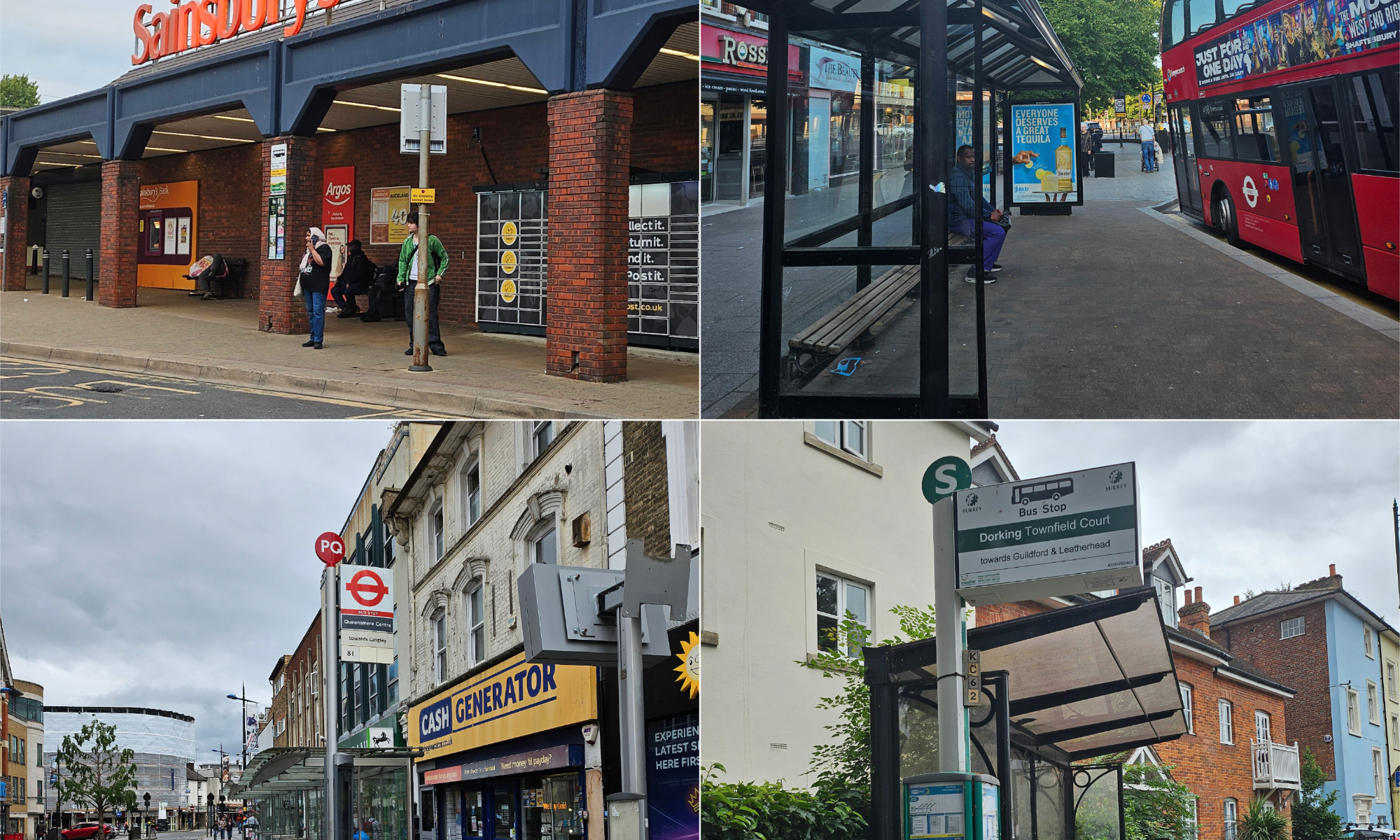
Having circumnavigated London using the Superloop network of buses the previous month, which took just 7¼ hours, I felt like taking on a far more challenging bus odyssey. I was inspired by a Diamond Geezer blogpost, which identified the most northerly, southerly, easterly and westerly bus stops to be served by a Transport for London (TfL) bus. These stops are in Potters Bar, Dorking, Brentwood and Slough respectively, all of which are outside Greater London. My aim was to do a tour of the capital, travelling only on London buses, catching a bus to or from all four of these extreme bus stops, and then returning to my starting point.
When I set about researching a route to achieve my objective, I assumed that I would need to travel to one of the extremities to begin, but then I realised that to travel from Potters Bar to Brentwood by bus would involve passing through Woodford Green, close to my home. So I decided that I would start and finish in Woodford Green – the only downside being that I would be travelling on the same bus route from and to my starting point, requiring me to catch one more bus than if I were to start at the end of a route.
My initial planning indicated that if I were to catch the first bus of the day and that if everything went perfectly according to timetable I would finish just after 9pm, but delays and missed connections could easily push this time back, so there would be some doubt if I would be able to complete it within the day. My original plan was to travel clockwise, mainly because I would benefit from a more frequent service to and from Brentwood in the morning than the evening. I had planned to go the week before I actually did, but a weather warning of torrential thunderstorms caused me to postpone. However by leaving it to Saturday 26th July, I belatedly realised that Oasis would be playing on their comeback tour at Wembley Stadium that evening, and I would be due to pass to the north of Wembley about the time that traffic from fans driving to the gig would be at its worst. So the day before I set off, I hastily replanned to make the circuit anti-clockwise, which would pass north of Wembley in the morning. As usual, I prepared detailed spreadsheets, allowing for many contingencies, and I was pleased to see that the anti-clockwise route should be able to be done in about the same time as the clockwise route, although with a greater risk of a long wait to get to and from Brentwood.
179 – Woodford Green (0534) to Chingford (0541)
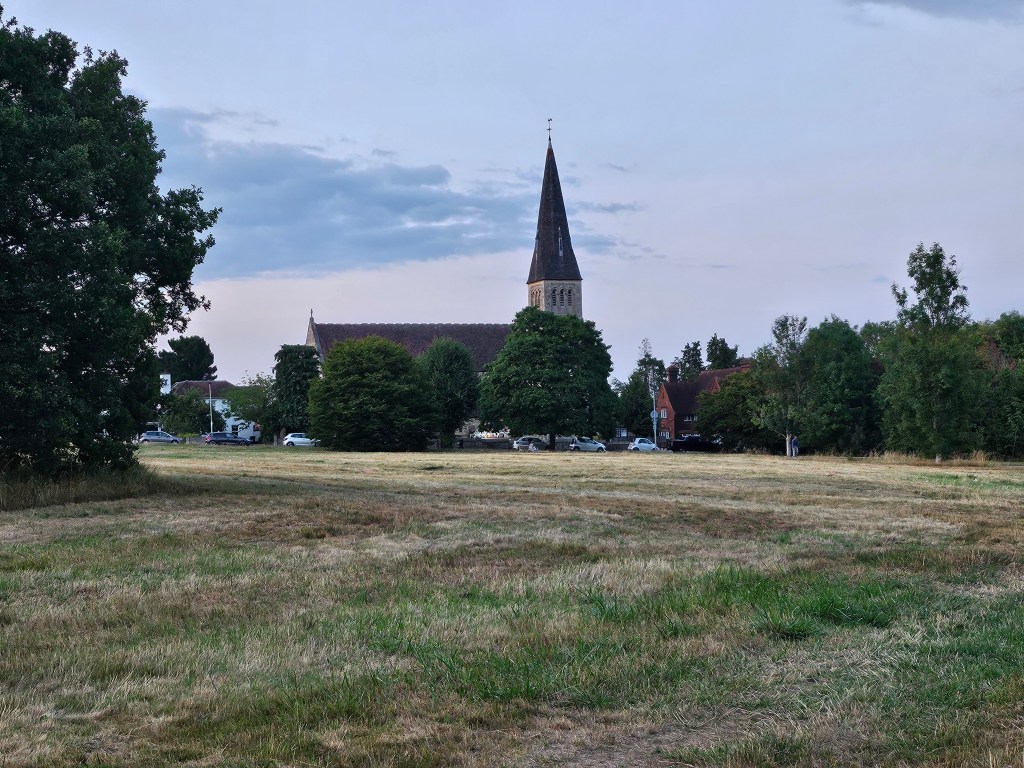
I got up early and left my house just as dawn was breaking to walk to the nearest bus stop on the 179 bus route. This is located on the edge of The Green at Woodford Green and I walked across the grass of The Green near All Saints church to reach it. I got there well before I needed to and was in time to see the earlier 179 bus travelling in the opposite direction, which I would have caught had not the Oasis concert caused me to rethink my plans.
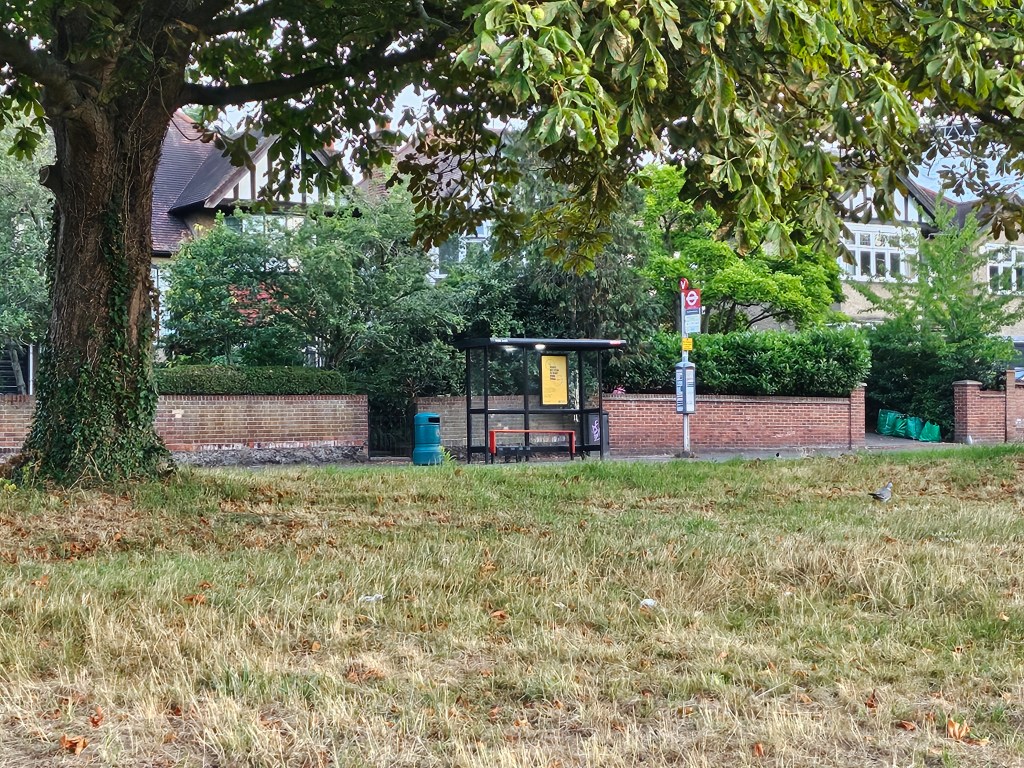
My 179 to Chingford station arrived slightly early at 0534. I did not travel all the way to the 179’s final destination, as its route overlaps slightly with my next bus, so getting off early would maximise my chance of making the connection. I did this at Chingford Green in front of St Peter & Paul church.
313 – Chingford (0546) to Potters Bar (0627)
The 313 arrived on time and soon crossed over the River Lea, which forms the historic boundary between Essex and Middlesex, although at this point it is now wholly within Greater London.
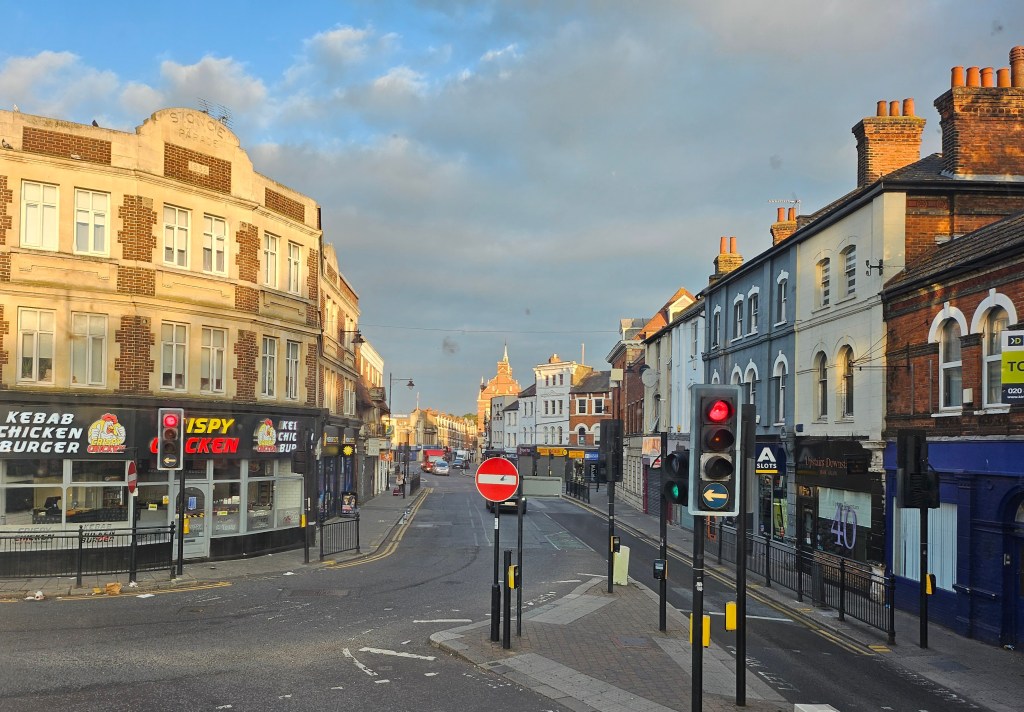
In Enfield, despite the early hour, a surprising number of people boarded, although the rest of the town centre looked deserted. One of the new boarders came and sat in the other front seat on the top deck. North of Enfield we passed through the incongruously named hamlet of Botany Bay, which is neither in Australia nor by the sea. The driver of the bus seemed rather cautious and, although there was little traffic, we started to slip slightly behind timetable, which caused me some concern, as I only had five minutes for my next connection.
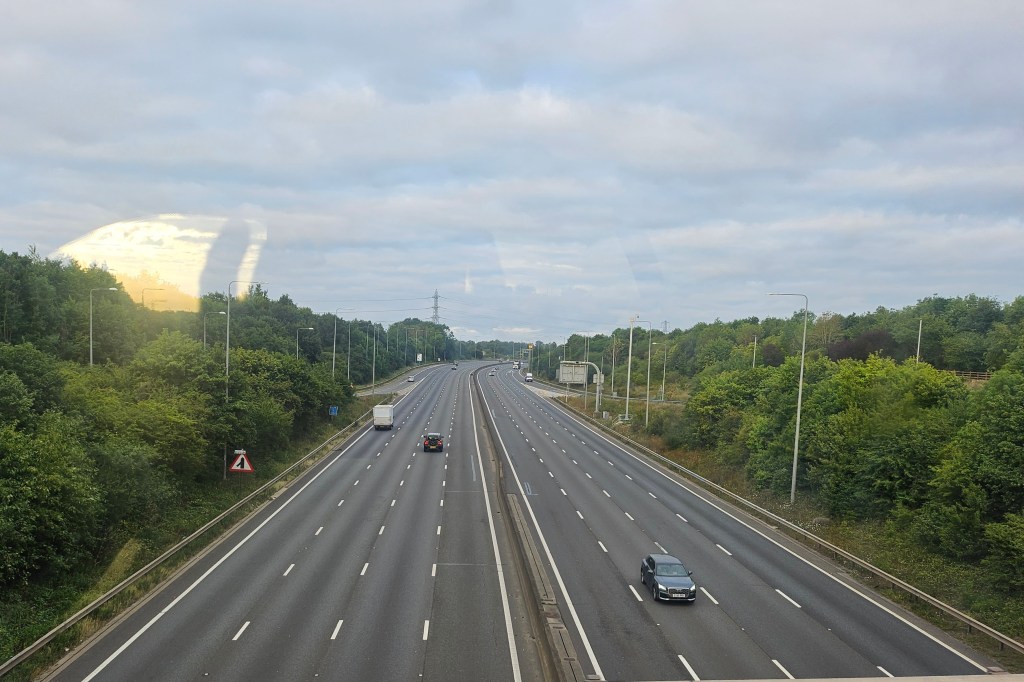
We left Greater London, to be greeted by a welcome to Hertfordshire sign, just before we crossed the M25 orbital motorway. That said, Potters Bar was actually in the historic county of Middlesex, being one of just three Middlesex districts that did not transfer to Greater London in 1965. The bus pulled into Bus Stop D opposite Potters Bar railway station, just a couple of minutes late.
298 – Potters Bar (0700) to Cockfosters (0711)
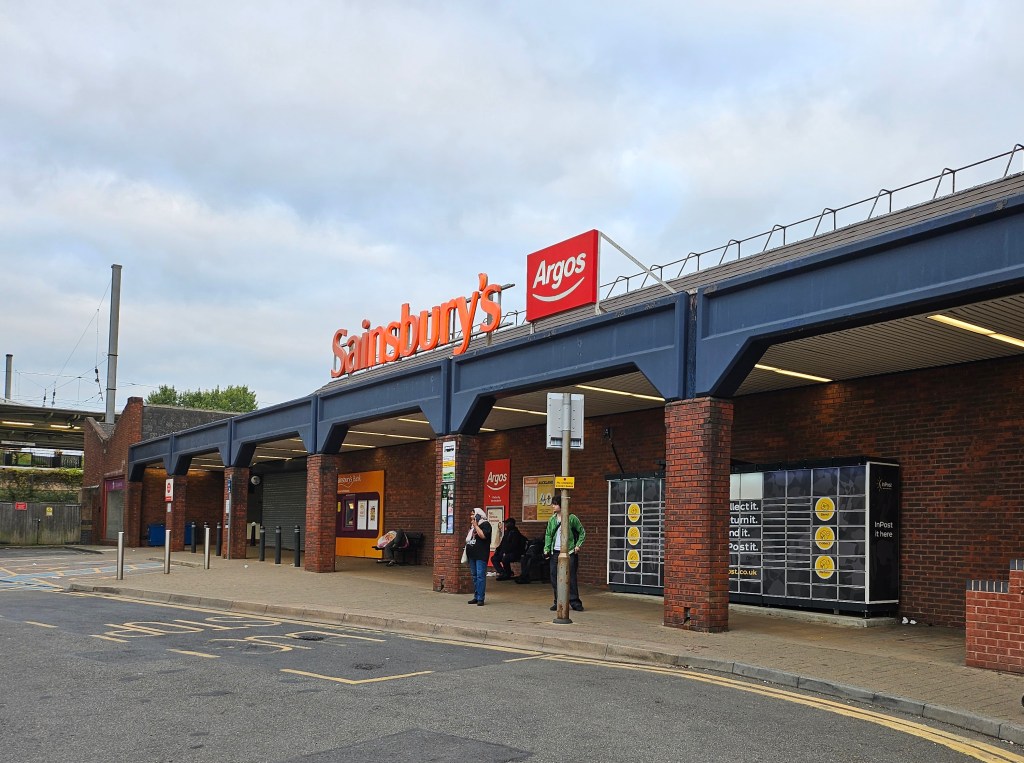
Next to Bus Stop, D where I alighted, is Bus Stop C outside Sainsbury’s, the most northerly bus stop served by a London Bus. I was expecting my next bus, the 298 to Arnos Grove, to be already waiting there, but there was no sign of it. Among the people waiting for this non-existent bus was the person who had got on at Enfield and sat opposite me on the previous bus. Early on a Saturday morning the service only runs every 30 minutes, so I had to wait for the 0700 service to arrive – I could see from the bus tracking map that it was on its way. In the meantime there was another service going to High Barnet at 0645, which would have got me back on track with little loss of time, but I could not use for two reasons. Firstly, it was not a London bus, so didn’t meet the rules that I had set myself, and secondly it departed from Bus Stop B, so I would not have caught a service from the most northerly bus stop.
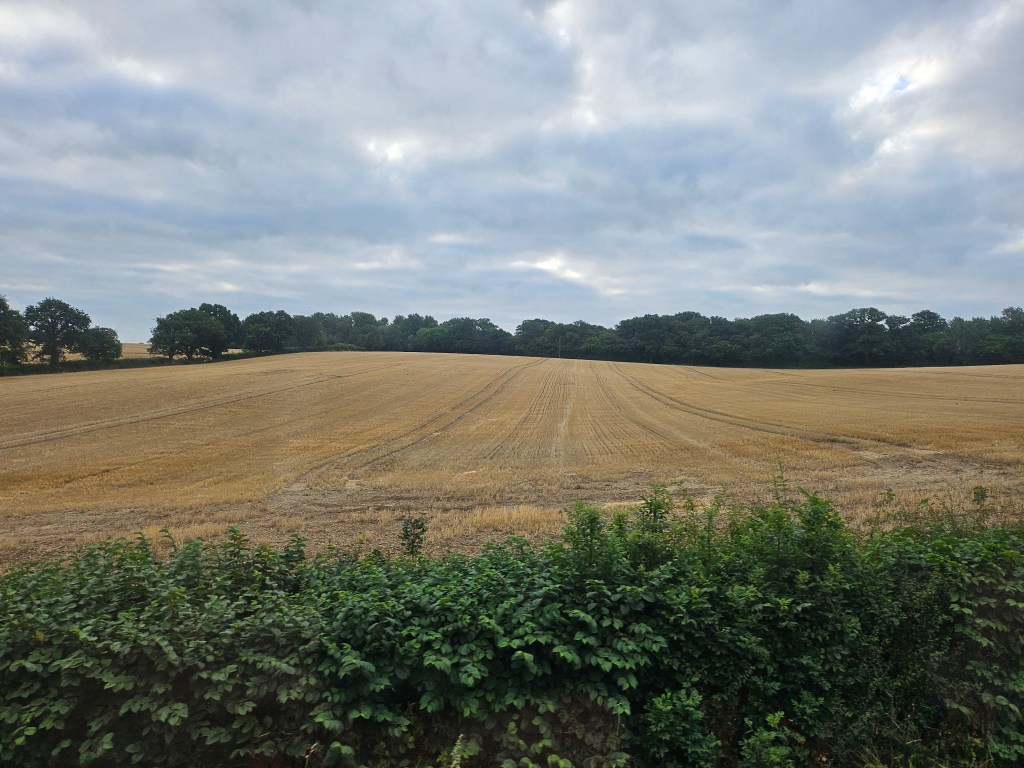
The next 298 arrived just before its 0700 departure time and left promptly. The person who had sat opposite me from Enfield did so once again, I began to wonder if he was engaged in the same challenge as me. The 298 retraced the route of the 313 through Potters Bar to the roundabout over the M25 motorway, where it deviated and entered Greater London travelling through a very rural landscape. Soon the rolling cultivated fields gave way to the large expanse of Trent Park, which continued all the way until I got off at Cockfosters station. My recent travelling companion stayed on the bus.
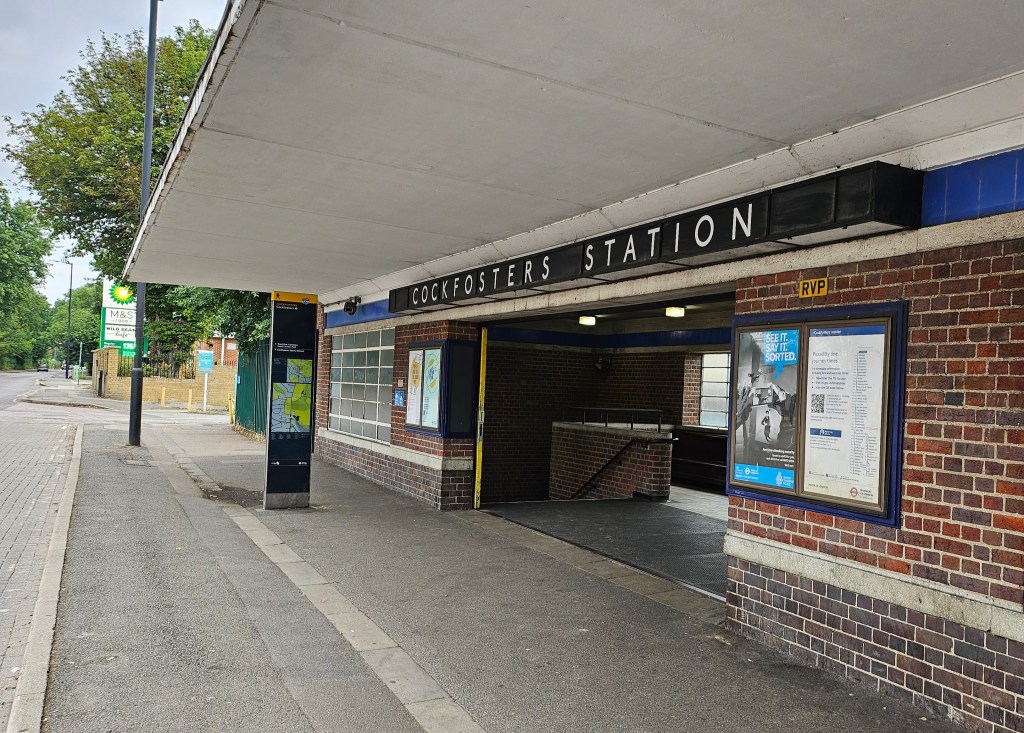
384 – Cockfosters (0721) to Edgware (0758)
I had ten minutes wait until my next bus, which I could see sitting, driverless, in the lay-by opposite. Shortly before it was due to depart, a driver appeared and brought the single-decker bus round to the stop where I was standing. The initial part of the journey was a rather circuitous tour through the residential area near Cockfosters. This was a hail and ride section, with a number of people just stopping the bus at random points as it drove slowly round the area. It started to slip slightly behind schedule, until it stopped while an announcement was made that because of roadworks the bus was now going to be on diversion and the normal stops would not be served. Fortunately, the diversionary route was a short-cut and this allowed the bus to get back on schedule.
If I could make my next very tight connection at Edgware station, I could recoup some of time lost as a result of the bus from Potters Bar not running. I was tracking my position against the 186 bus which was also heading to Edgware from Brent Cross. I could see that it would be very close as to which would get there first. When the two routes merged the bus I was on turned into the main road immediately behind the 186 bus that I needed next. I thought I was safe, but then at the final set of traffic lights before the station, my bus was stopped while the 186 got away. When I was finally deposited at the bus station, I dashed across to the other side to where the 186 was due to depart.
186 – Edgware (0800) to Harrow (0823)
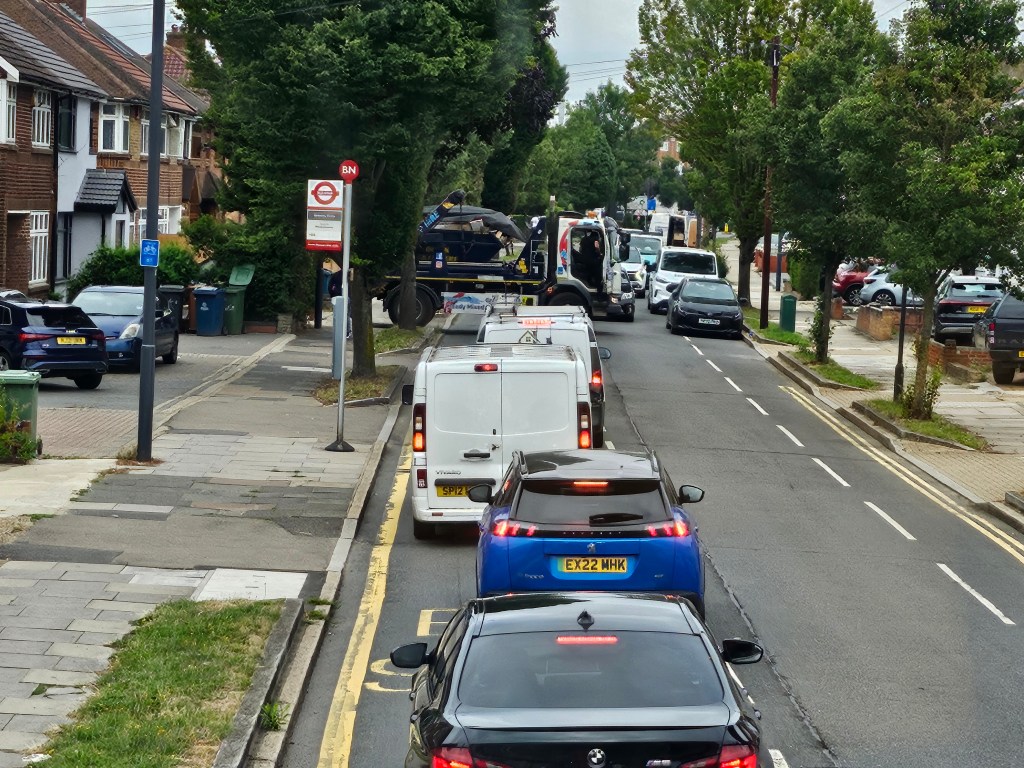
Luckily there was a queue of people waiting to board the 186, so I had no difficulty making the connection. It left promptly just after I had got on for the relatively short journey to Harrow. If this bus kept to timetable, I should just make another tight connection at Harrow bus station. However, shortly after leaving Edgware, progress was halted by a lorry completely blocking the road while trying to pick up a skip from a house. This caused a delay which put us behind schedule, but fortunately once clear of the obstruction my bus driver seemed determined to make up for lost time and we actually pulled into Harrow bus station a couple of minutes early.
SL9 – Harrow (0826) to Harlington Corner (0908)
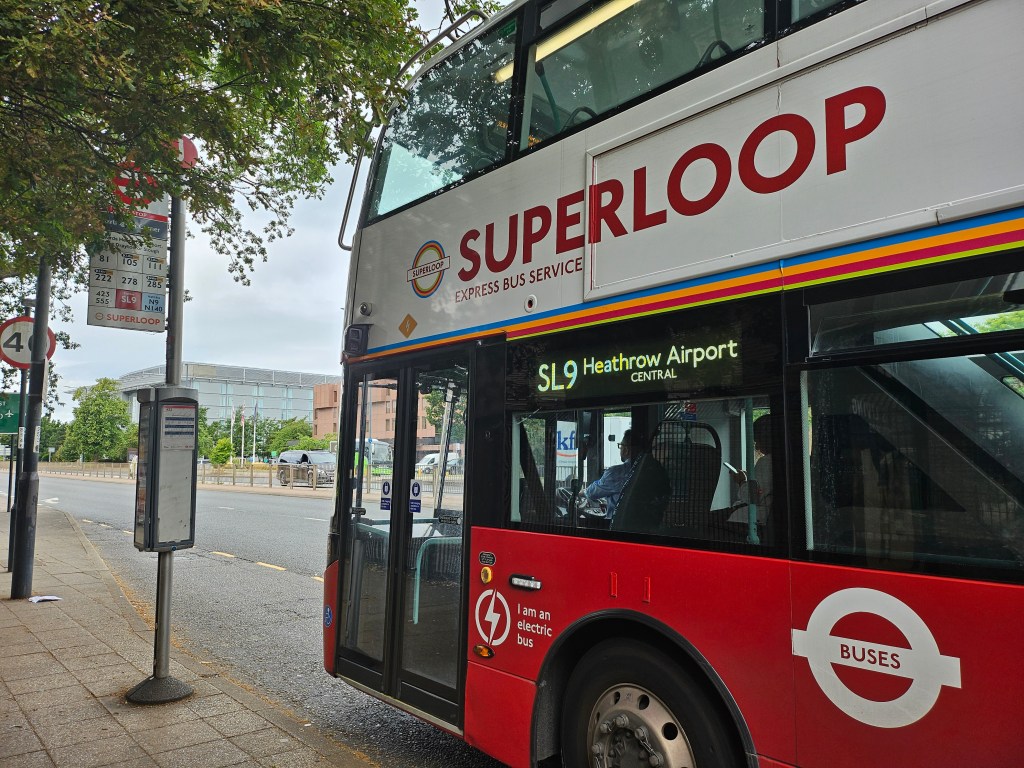
At Harrow I was catching for the first time on this journey a Superloop bus, the semi-express network which I had used to circumnavigate London a month earlier. My previous experience suggested that, unless the traffic was bad, the Superloop tended to gain time against its schedule. Being relatively early on a Saturday, the traffic was still light, but at each stop, including the first in Harrow, there were a lot of people waiting to get on, which slowed progress. Within a couple of stops the bus filled up with all seats taken. Someone came to sit next to me on the front seat, who throughout the journey played annoyingly inane videos on his phone with the volume turned up.
Despite the popularity of the bus, the SL9 made steady advances against its timetable. Its ultimate destination was Heathrow Airport but I was getting off at the penultimate stop at Harlington Corner on the Bath Road. The bus had gained nearly 10 minutes as it was approaching where I was to alight, and I had hopes that I could catch my next bus from Harlington Corner which would have been the one on my original schedule, thus making up the half hour lost by the cancelled bus from Potters Bar. The bus reached the end of Harlington High Street and was stopped by traffic lights while waiting to turn right. At that point I saw the 81 bus I hoped to catch next, also waiting at lights at the same junction, but needing to carry on ahead along the Bath Road. I wasn’t sure of the sequence of the traffic lights, but whichever turned green first would enable its waiting bus to reach the Harlington Corner stop before the other. Unfortunately for me, the Bath Road lights turned green, so by the time the bus I was on could turn right and pull into the Harlington Corner stop, the 81 I needed next was just pulling away.
81 – Harlington Corner (0918) to Slough (0954)
Having just missed a bus, I had a ten minute wait until the next. During my time waiting at the bus stop I had a bizarre encounter with someone who I couldn’t work whether they were trying to perpetrate an elaborate scam or were just stupid – my inclination is for the latter. The said individual approached me and asked whether you have to pay on buses to the airport. I assured him that you do, whereupon he produced a handful of euros and said that his company had only given him euros for his trip and could I change some to pounds for him. I told him that London buses don’t take cash, but that he could use a contactless debit or credit card to pay. He seemed to ignore this last piece of information and instead asked if I could pay for him on the bus in exchange for his euros. I told him that since I wasn’t going to Heathrow Airport, that would not be possible. When a bus to Heathrow appeared shortly afterwards I saw him get on and have a lengthy conversation with the driver, before getting off again.
My bus to Slough initially followed the Bath Road alongside Heathrow Airport before deviating to pass through the villages of Poyle and Colnbrook, which are now united in one joint parish. These two villages bounced around between counties between 1965 and 1995, having been in Middlesex, Surrey, Buckinghamshire and Berkshire.
The bus arrived in Slough on time and deposited me outside the now closed and boarded up Queensmere Shopping Centre. Unlike in Potters Bar, there is only one London bus serving Slough, so I would have to return on the 81. However, the starting point of the route is some way from the end point, on the other side of the derelict shopping centre. According to the timetable, I had just a few minutes before a bus was due to leave, so I set off at some pace down an alley through the remains of the shopping centre to get there in time.
81 – Slough (1006) to Harlington (1042)
My dash through the alley brought me to Bus Stop PQ, the most westerly bus stop to be served by a London bus, and a couple of hundred metres further west than the terminus stop for the 81. Bus stop PQ has an electronic departure board, which confirmed that the next bus back towards Hounslow should have been departing within in a couple of minutes – except that I could see from the tracker on my phone that it had already left!
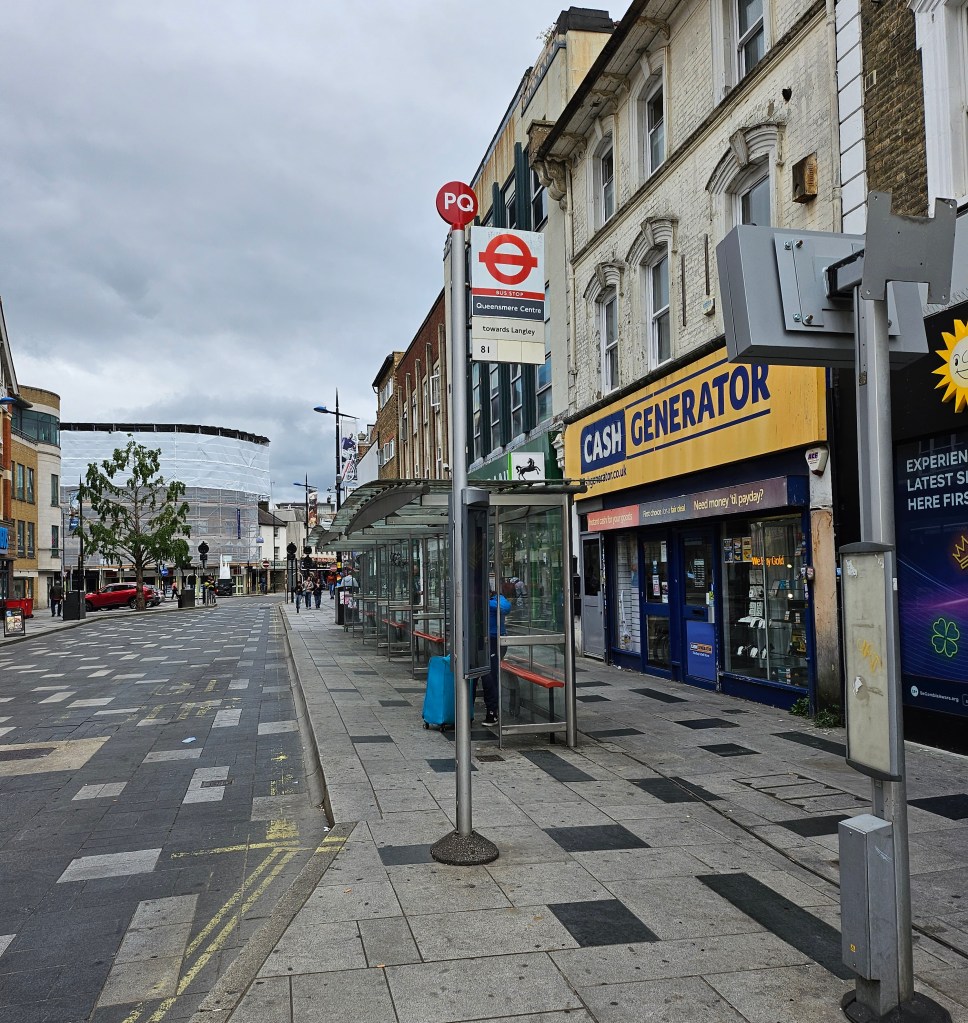
This part of town feels rather down at heel , with betting shops and pawnbrokers adjacent to the bus stop. I had no choice but to wait for the next bus (which was the same vehicle that had brought me to Slough), which also left three minutes before the time shown on the departure board. This retraced the route on which I had just come. I got off on the Bath Road, one stop earlier than where I had got on.
285 – Harlington (1050) to Hatton Cross (1058)
From the stop on the Bath Road I had a choice of two buses to take me onwards, either a 285 or a 423. I had a bit of a wait for either to appear, but inevitably both did so simultaneously. I got on the 285 which pulled in just ahead of the 423. Of course, while the 285 was still at the stop loading up with passengers, the 423 overtook it and turned right at the lights speeding into the distance, never to be seen again.
The 285 bus goes all the way to Kingston, where I wanted to be, but I calculated that I should only ride on it a short distance round the perimeter of Heathrow Airport to Hatton Cross station, where I could again pick up a quicker Superloop bus.
SL7 – Hatton Cross (1100) to Kingston (1135)
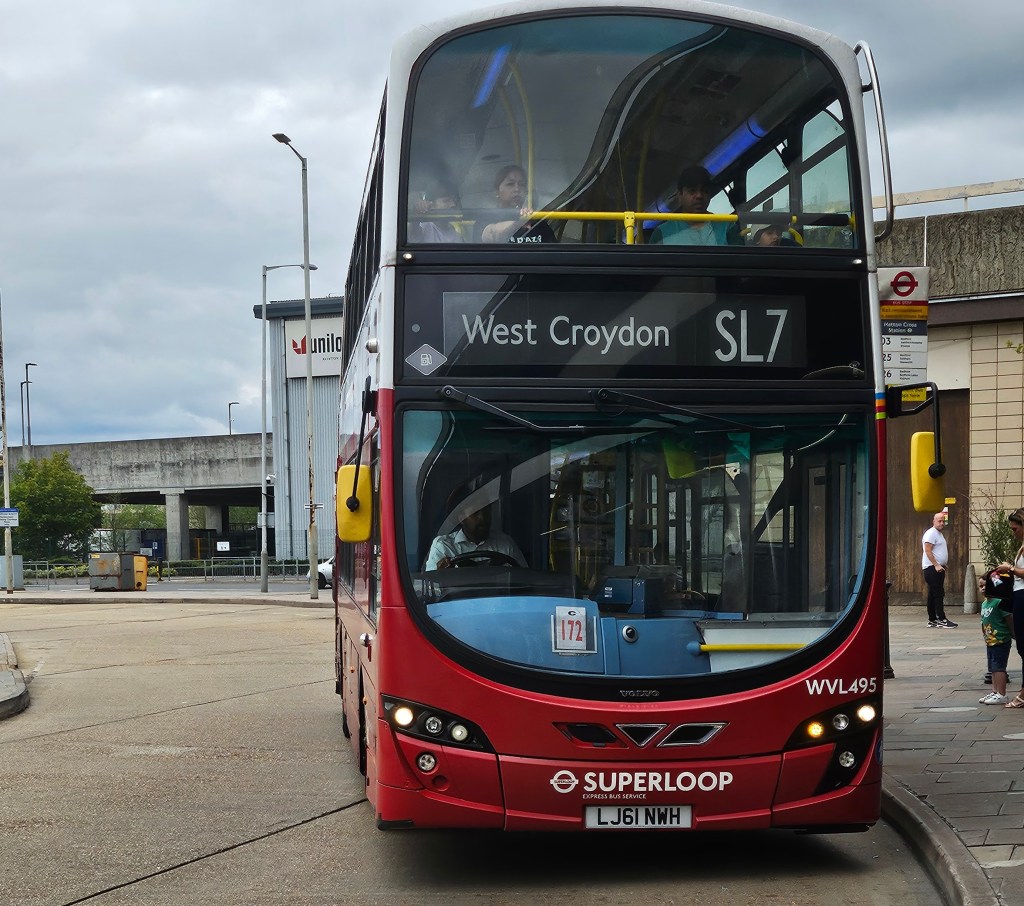
I thought that I would have a ten minute wait for the next Superloop SL7, but to my surprise one turned up within a couple of minutes. The traffic was busy, but there was no major congestion, so the bus steadily gained time against its schedule. Passing alongside Bushey Park, I noticed that recent rain made it look greener than it had when I came this way a month earlier. Crossing over Kingston Bridge brought me south of the River Thames for the first time. As we got closer to Kingston, I began to realise that there was a possibility of catching the 1130 service to Dorking from Kingston bus station, which would put me back on my originally planned schedule. However, at the preceding stop, in Kingston town centre, there was a crowd of people waiting to get on, so that as the bus pulled up alongside Kingston bus station, I could see the 465 to Dorking just pulling out.
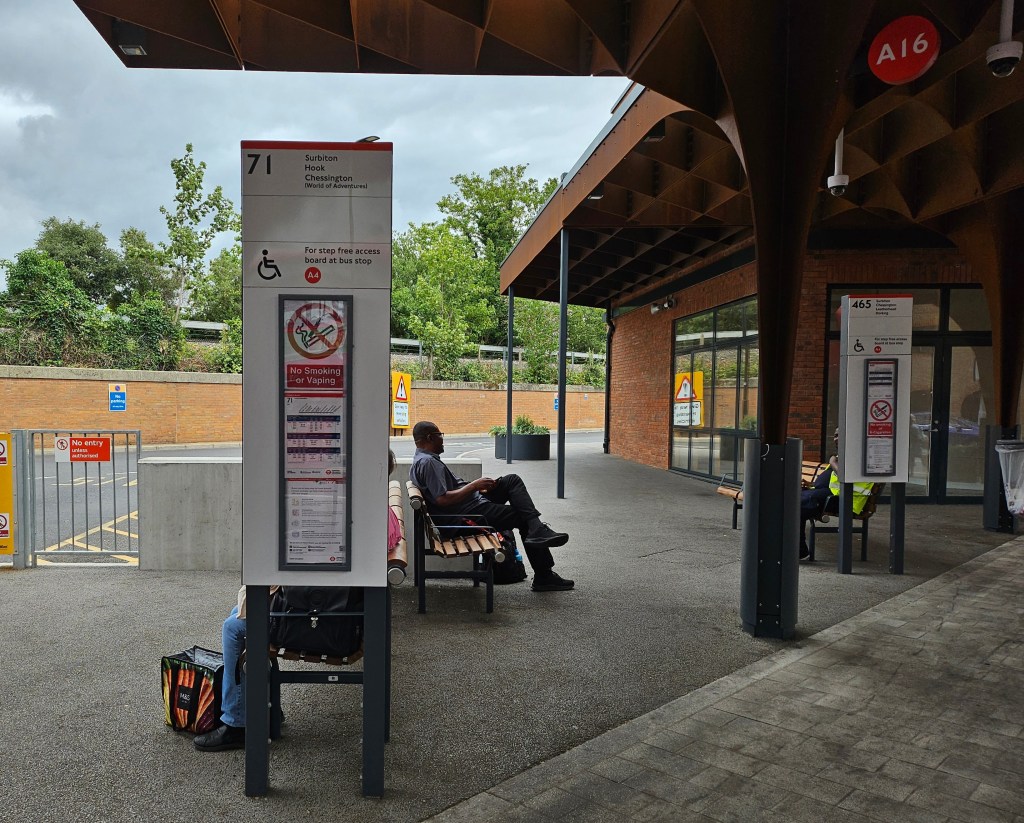
As the 465 runs only every 30 minutes, and I could see on my tracking map that the next one was still wending its way towards Kingston, I used the spare time to buy myself some lunch from a supermarket.
465 – Kingston (1205) to Dorking (1323)
From 1893 to 2020 Kingston was the meeting place of Surrey County Council, even though Kingston itself ceased to be administratively in Surrey in 1965 when it became part of Greater London. The 465 bus departed promptly, but initially made quite slow progress through the busy roads of Kingston and Surbiton. The Greater London boundary sticks out in a long promontory here, and the village of Malden Rushett is quite rural though still part of London.
Shortly after leaving Greater London the bus crossed the M25, to enter the Surrey town of Leatherhead. However, unlike the other cross-boundary London buses, the 465 does not finish at the first town outside London it encounters but carries on to Dorking.
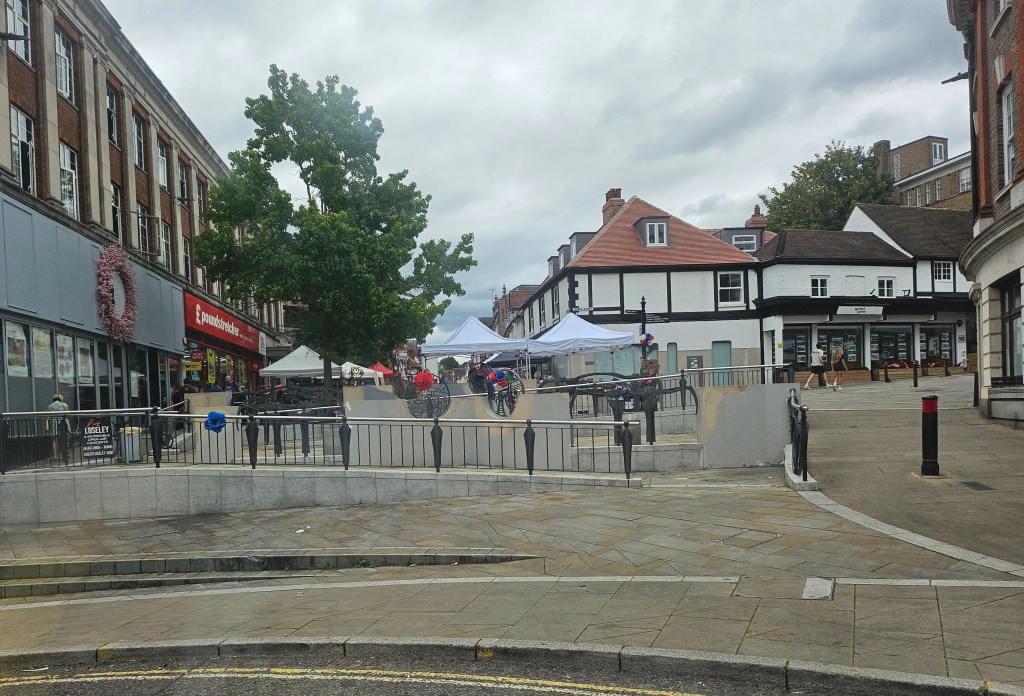
On leaving Leatherhead, the bus crossed over the North Downs, deviating from the main road to visit the village of Mickleham, squeezing past cars parked outside the pub, which appeared to be very busy. Around here a youngster with a bike tried to board the bus, but much to his annoyance he was told that bikes are not allowed on board. A short while later two youths got on, only one of which had a card to pay for his fare – after some negotiation with the driver, the other was eventually allowed to get on.
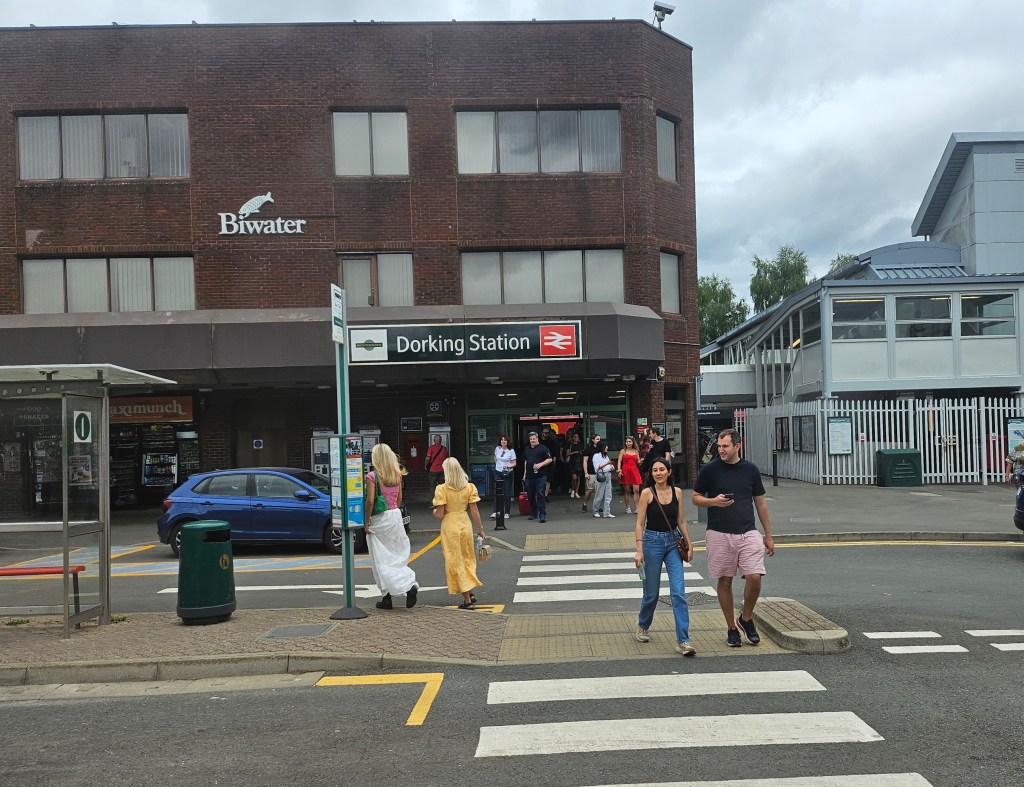
The bus called at Dorking station, before heading to the southern edge of the town, where it was due to rest for a short while. At the terminus, there was only one other passenger on board, who did not seem to realise that the bus was going no further.
465 – Dorking (1330) to Kingston (1445)
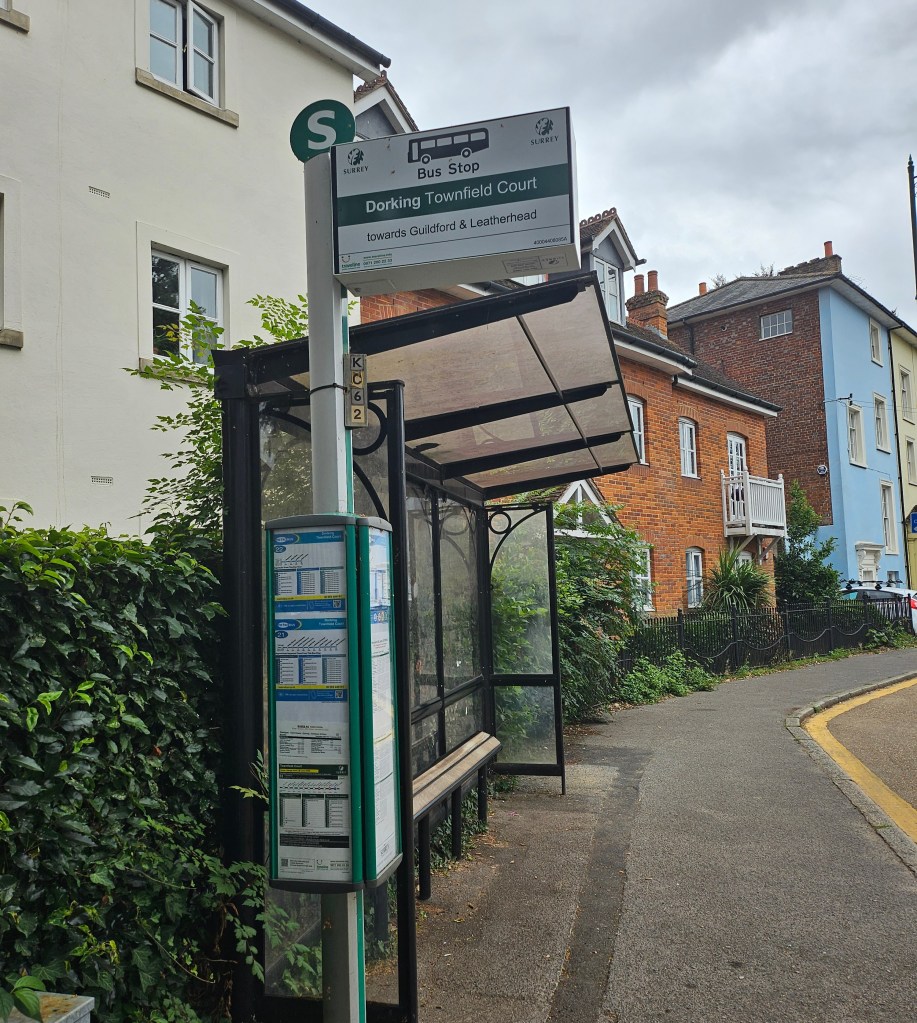
After leaving the bus I walked a couple of hundred metres or so further south to Bus Stop S, where the 465 picks up passengers for its return journey north. This is not only the most southerly bus stop served by a London bus, but also the stop furthest from the boundary of Greater London. According to Diamond Geezer, this stop is 32 miles south of Potters Bar Bus Stop C. One other person got on with me, but they were only going as far as Dorking’s main shopping street half a mile along its route.
On the edge of Dorking, the two youths (including the one who failed to pay his fare) got on again. It was amusing to see their faces as the bus pulled in when they realised that it was the same driver, and presumably the sob story about how they just needed to get home would not work again. Nevertheless, he managed to wangle his way on without paying again.
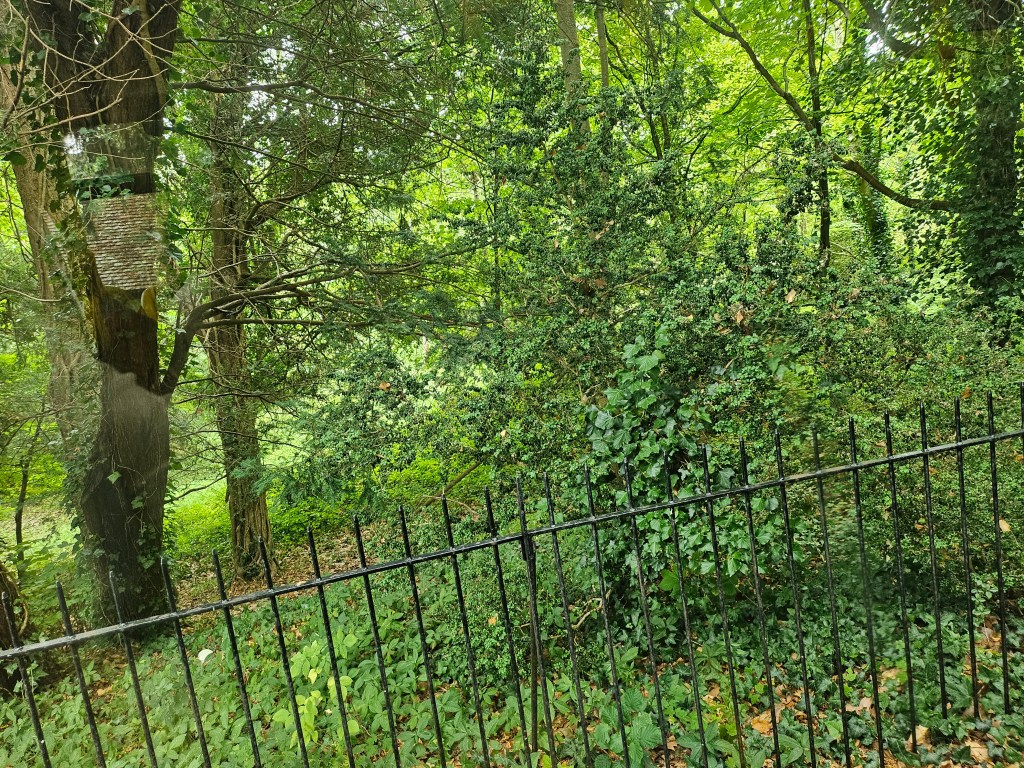
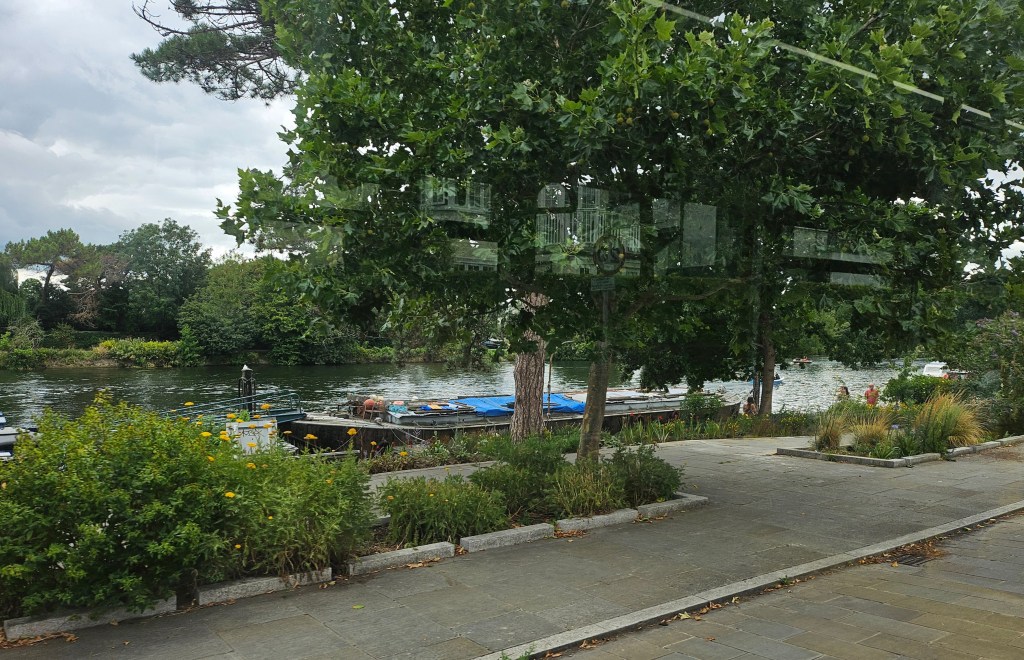
As the bus sped north over the North Downs and through Leatherhead again, the traffic seemed lighter. This became noticeably more so, once we entered Greater London, with the jams in Surbiton and Kingston that had delayed us on the way out having vanished. As we came into Kingston along the edge of the Thames, I noticed that the bus ahead of ours was an 85 which I wanted to catch next. However, when it managed to get through some traffic lights which stopped us, I thought the chance of catching it had gone.
85 – Kingston (1445) to Roehampton (1515)
Rather than go all the way back to the bus station, I got off the bus from Dorking in Kingston town centre, where my next bus, the 85, also stopped. Although the 85 had got away from us on the final run in to Kingston, there was such a crowd of people waiting for it in the centre who were still boarding when I arrived, that I made the connection with ease.
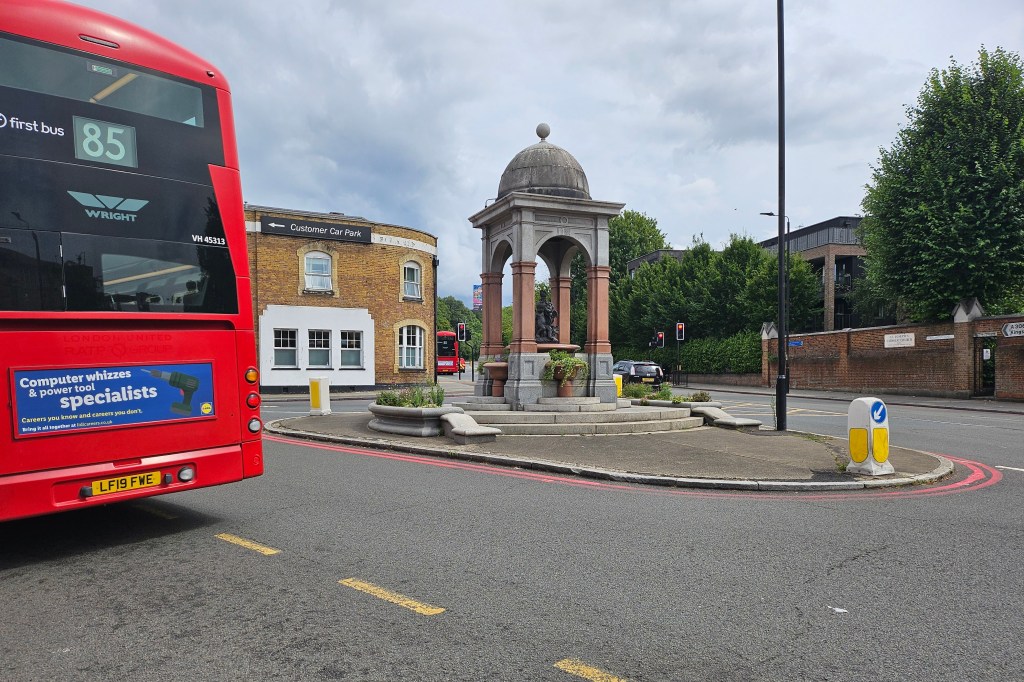
The bus threaded its way between Richmond Park and Wimbledon Common, with a brief diversion to the ASDA in Putney Vale, to reach Roehampton, where I got off, 30 minutes after leaving Kingston.
170 – Roehampton (1520) to Clapham Junction (1546)
There was a five minute wait in Roehampton for the 170 to arrive. This went via Wandsworth town centre to reach Clapham Junction station. In my younger days, when Youngs Brewery was based in Wandsworth (now long gone), I used occasionally to visit Wandsworth with friends to go on a pub crawl round the many Youngs pubs located there. As the bus passed through, it was interesting to see which pubs remained and how they had changed – some were now derelict, others gone upmarket beyond recognition.
344 – Clapham Junction (1550) to City of London (1655)
There were roadworks by the bus stop outside Clapham Junction station from where I was catching my next bus. As this stop was served by multiple buses, there was not room for them to all pull in when several arrived at once. In the confusion I nearly missed seeing the 344 arrive, but I got it to stop to let me on in the middle of the road parallel to another bus that was already at the stop.
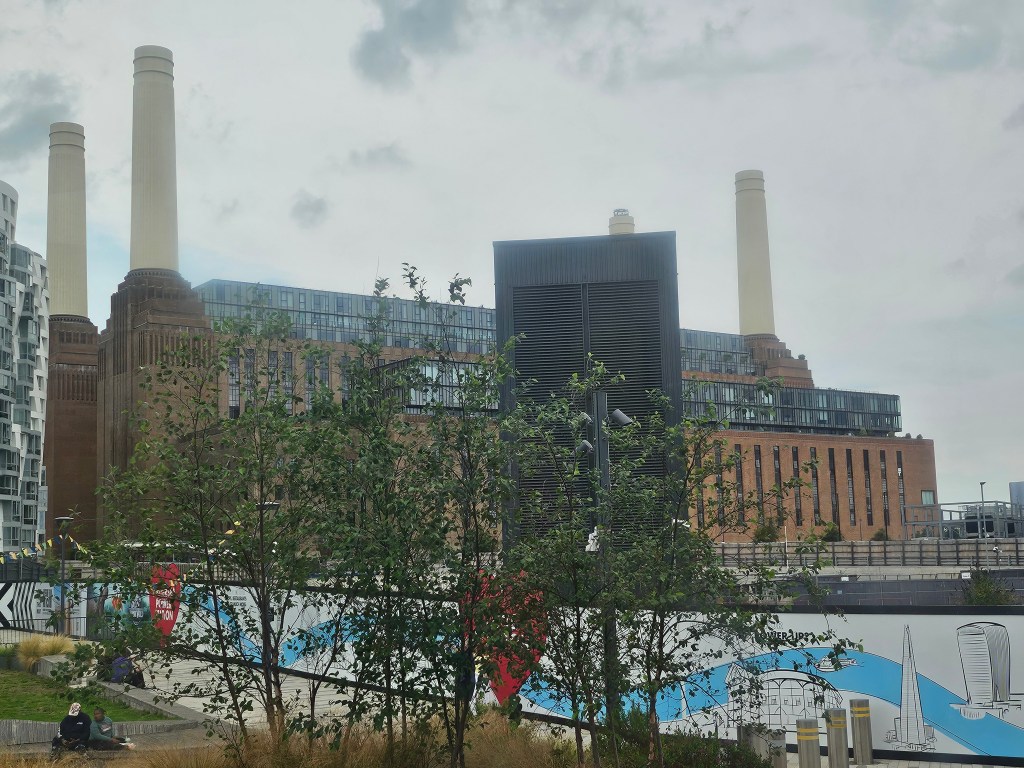
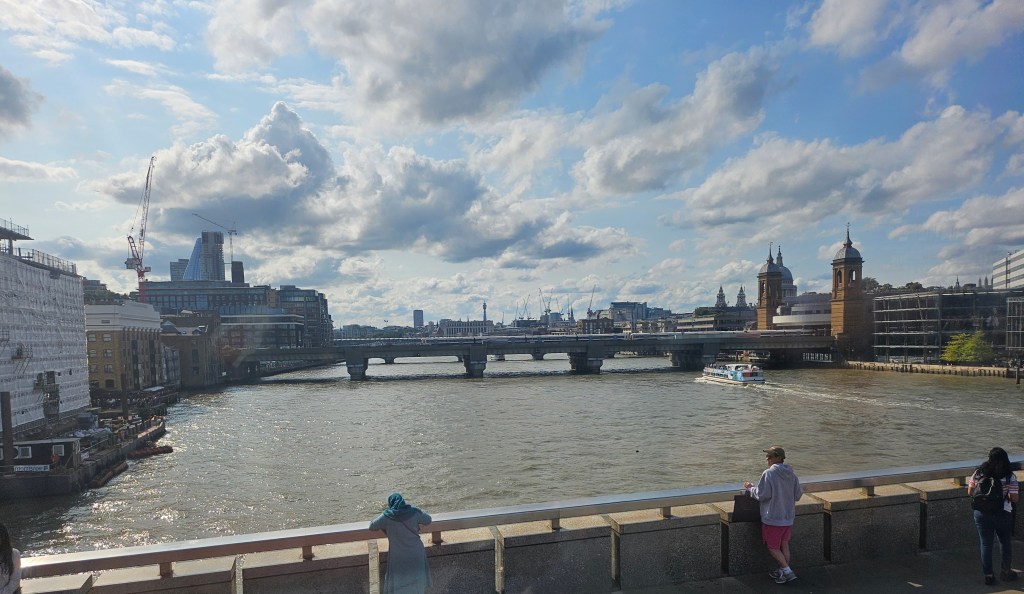
The driver of this bus was not hanging around and within a short space of time we were nearly 10 minutes ahead of schedule. From then on, after every few stops there was a pre-recorded message played to say that the bus was being held at the stop to regulate the service. In total, this happened four times and the enforced delays added another 15 minutes to the journey. The bus went past Battersea Power Station (now a shopping and residential complex), then along the south bank of the Thames to Lambeth Bridge, where it turned inland to go via Elephant & Castle. It finally crossed the Thames on London Bridge to enter the much quieter City of London, where I got off.
25 – City of London (1700) to Stratford (1738)
I knew that because of roadworks, the 25 bus was on diversion through the City of London on this day. I had also realised, by using my tracking map to see the actual route being taken by the buses, that TfL’s website was giving incorrect information about where the diversion route went. I was not sure if the 25 would stop at the bus stop where I had got off, and the point where they would definitely be back on route was about a ten minute walk away. As there was no 25 due imminently I set off to walk down the route they were taking. This went down Fenchurch Street, a street that is not normally served by any London buses, so I doubted there would be any bus stops here. About half way down Fenchurch Street, I spotted a 25 bus coming and also noticed a bus stop ahead which described itself as a pick-up point for coaches only. I stuck out my hand and fortunately the driver stopped to let me get on – I think he was as confused as I was about where he was supposed to stop while on diversion.
As we passed through Whitechapel and Mile End, I noticed that the bus was getting more and more ahead of the schedule on my planning spreadsheet. It was only after I got off that I realised that I had inadvertently copied the weekday timetable for the journey to Stratford, whereas on a Saturday evening the timetable is 10 minutes quicker. (As I had replanned the route only the day before to avoid Oasis at Wembley, I had not had time to double-check everything.) Even using the correct timetable, the bus was still getting ahead of schedule, but fortunately there was no holding to regulate the service this time.
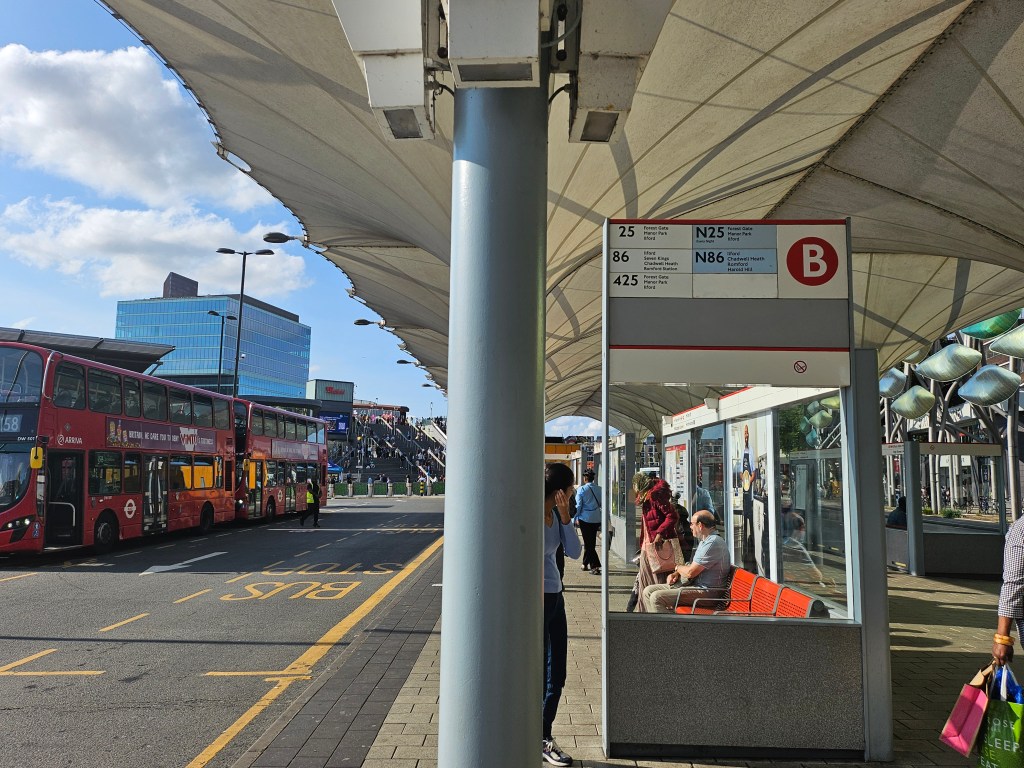
The 25 overlaps with the next bus, the 86, all the way from Stratford to Ilford, so I could have changed at any point along the overlap. I decided to do so at the first opportunity at Stratford bus station, as buses often halt longer at bus stations because of the greater number of people getting on and off, which gives a bit longer to make a connection. However, as my 25 bus pulled into Stratford bus station, I saw an 86 leaving, so I wondered if, had I not got off there, I might have been able to catch it later along the route.
86 – Stratford (1742) to Romford (1839)
I did not have to wait long for another 86 bus to arrive at Stratford bus station. It headed out along Romford Road towards Ilford. The traffic remained remarkably light and the bus started to gain time against its schedule. It weaved around the pedestrianised areas of Ilford town centre, where once again the dreaded announcement was heard that the bus was being held to regulate the service. Fortunately this was a one-off, and after giving up some of its gains while being held in Ilford, it continued to gain time once it set off again to Romford.
I had hopes of making a tight connection, before the frequency of my next bus decreased from every 20 minutes to every 30 minutes. I arrived at my stop on Western Road in Romford seven minutes early, but a little way down the road from where my next bus was due to depart one minute later.
498 – Romford (1850) to Brentwood (1921)
The area where I was changing buses in Romford seemed very familiar. This was not because I had been there at all recently. However, earlier in the year I had been selected for jury service and trial I sat on concerned a very unpleasant stabbing incident in this area. The jury spent many hours watching CCTV coverage of here and the surrounding streets.
There were supposed to be departures from Romford to Brentwood at 1940 and 2000 (and then every 30 minutes), but no bus appeared at 1940, and there was no evidence from the tracking map that it had left early. The 498 I required eventually turned up at 1950 – it was not clear if it was running 10 minutes early or 10 minutes late.
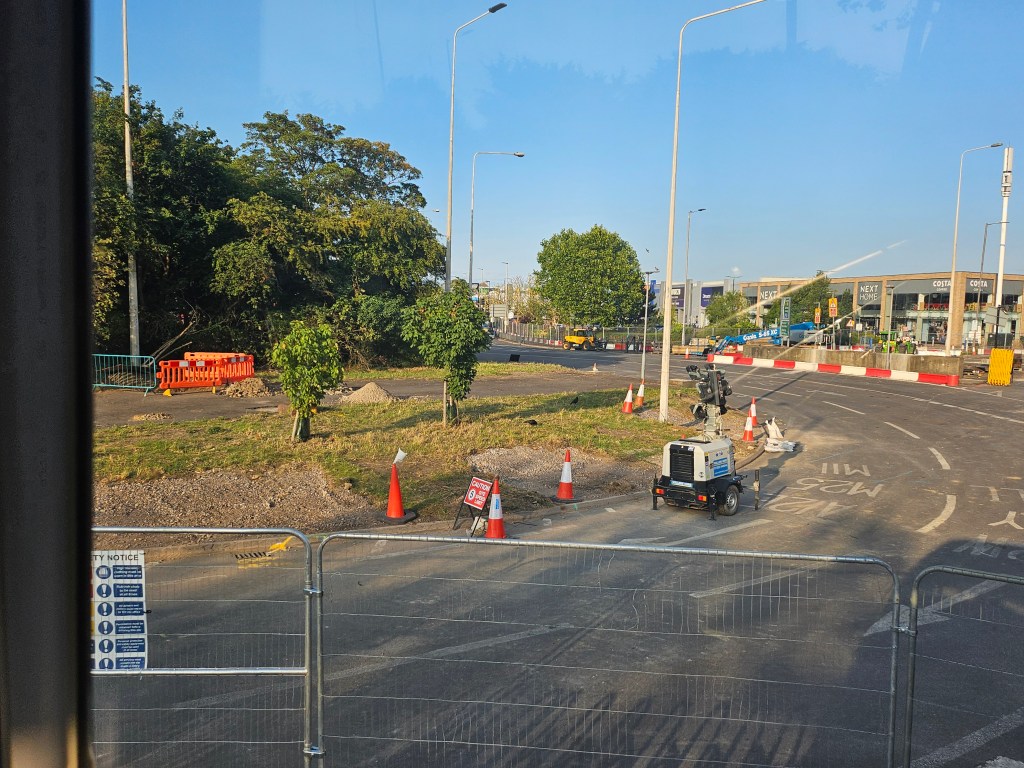
The road leaving Romford was virtually deserted. This was because from the edge of the town centre there are repeated warnings that the road is closed ahead. A major intersection, the Gallows Corner roundabout, is having its ancient flyover replaced over the summer, with access restricted to just buses and emergency vehicles. For other road users lengthy diversions are in place, with the media reporting traffic chaos for miles around. There is only one lane open for the allowed vehicles, with the one way flow controlled by traffic lights. When we arrived at Gallows Corner, we had to wait for four minutes at the lights. When they turned green we paused to allow an ambulance to get ahead of us. Both on the outward and return leg, I noticed some cars passing through the restricted area – unless they had a valid reason, they will be getting fined.
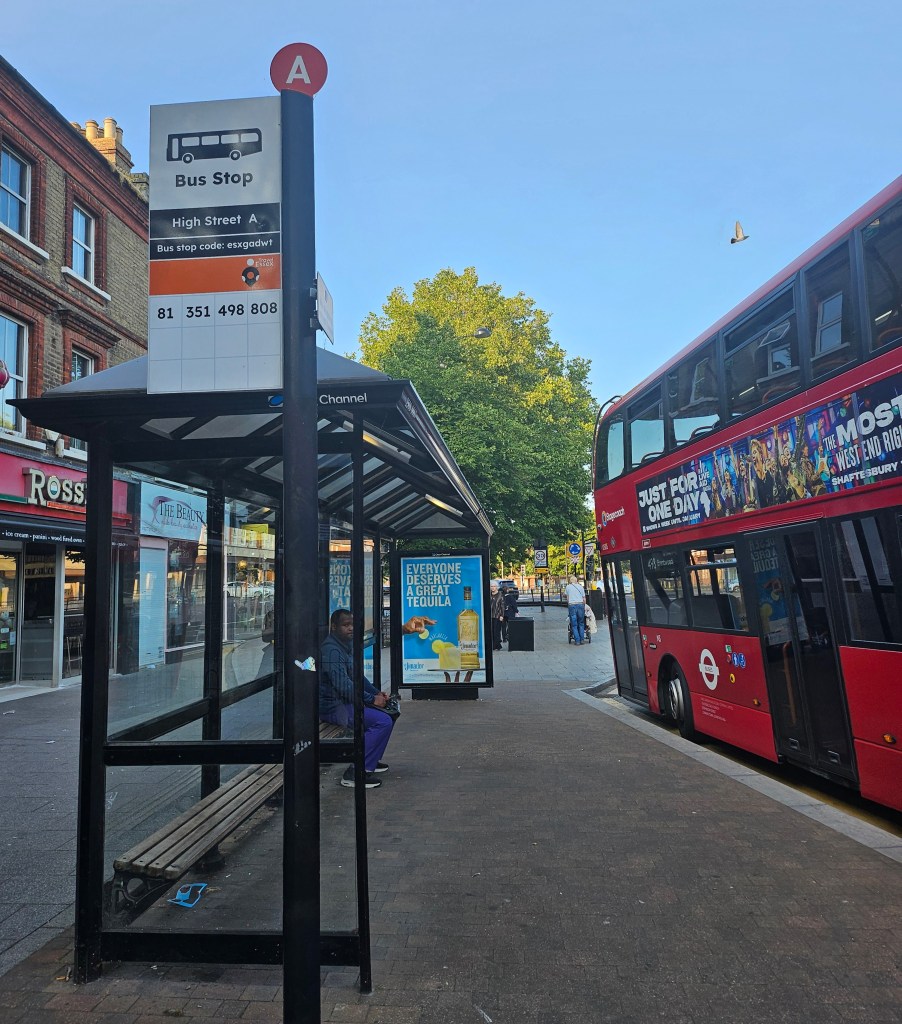
Leaving Greater London for the final time, we passed under the M25 motorway and entered Brentwood. I was getting off at Bus Stop A on Brentwood High Street, the most easterly bus stop served by a London bus. It is 39 miles east of Bus Stop PQ in Slough. This is the only extremity where I did not go to the end of the route, as the 498 loops round to the west to finish at Sainsbury’s.
498 – Brentwood (1927) to Romford (1955)
I crossed the road to Bus Stop F, which is slightly to the west of Bus Stop A, to await a bus to return. It was actually the same bus which brought me which came back round the corner to make the return journey, thus confirming that it had been running late, rather than early, on the outward leg. However for the return journey it actually departed three minutes earlier than shown on the timetable, which it really should not have done given that the frequency is only half-hourly on a Saturday evening.
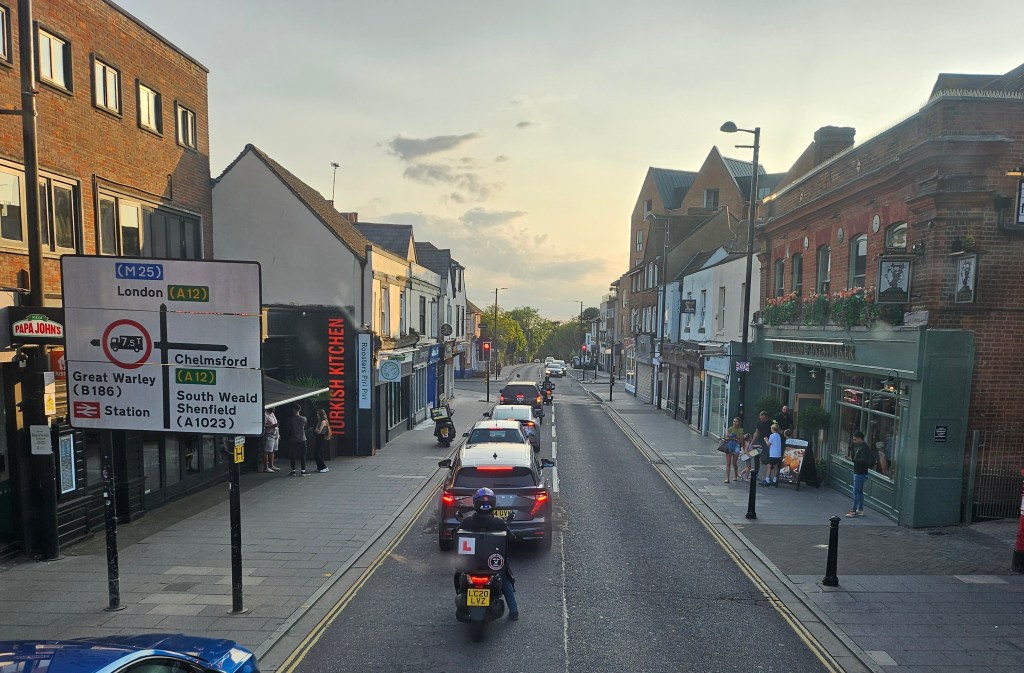
Once again passing back under the M25 and the Gallows Corner roadworks, I returned to the same bus stop in Romford to await my next bus.
66 – Romford (2000) to Gants Hill (2024)
My penultimate bus was the 66 to Leytonstone. After initially going round Romford’s inner ring road, it headed north to pick up the dual-carriageway Eastern Avenue, which enabled it to travel more quickly than any other bus I had been on that day. It was dual-carriageway for the rest of my journey until I got off at the Gants Hill roundabout. I contemplated whether to get off at the stop before or the stop after the roundabout, but decided to wait until after the roundabout, so that I could connect with my next bus without having to cross any roads.
179 – Gants Hill (2045) to Woodford Green (2103)
My final bus, the 179, was due to leave Gants Hill one minute before my incoming 66 arrived, so I knew that I would have to be lucky to make the connection. Maybe if I had got off my previous bus before the roundabout I might have succeeded, but in the event, while my incoming bus was waiting at the traffic lights to get onto the roundabout, I saw the 179 get there ahead of us, and by the time our traffic lights went green it was speeding on its way.
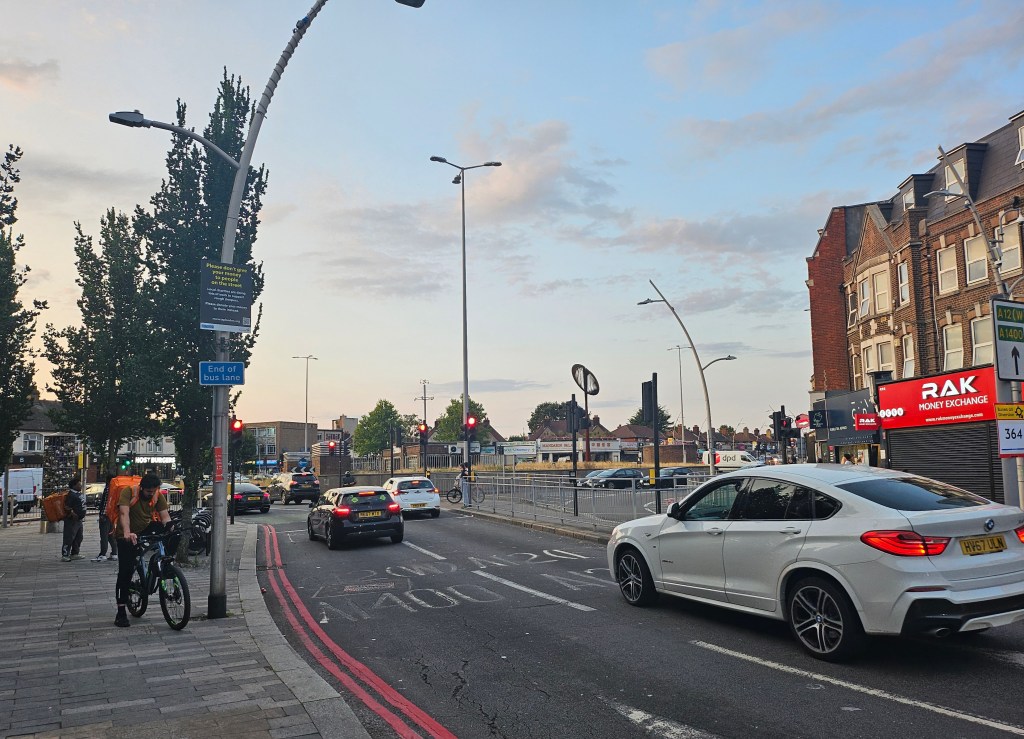
So I had a 20 minute wait at the stop, observing the many restaurants that line the roads to Gants Hill roundabout doing a busy evening trade. My final bus arrived and went via South Woodford to drop me off back at the stop I had started from 15½ hours earlier. I walked home across The Green, tired but satisfied that the objective for the day had been achieved.
Conclusion
This expedition highlighted how good the bus network is in London – much better than you are likely to find in the rest of the country. Twenty one buses were caught – one failed to show up causing me to catch the next, and only one other bus was late.
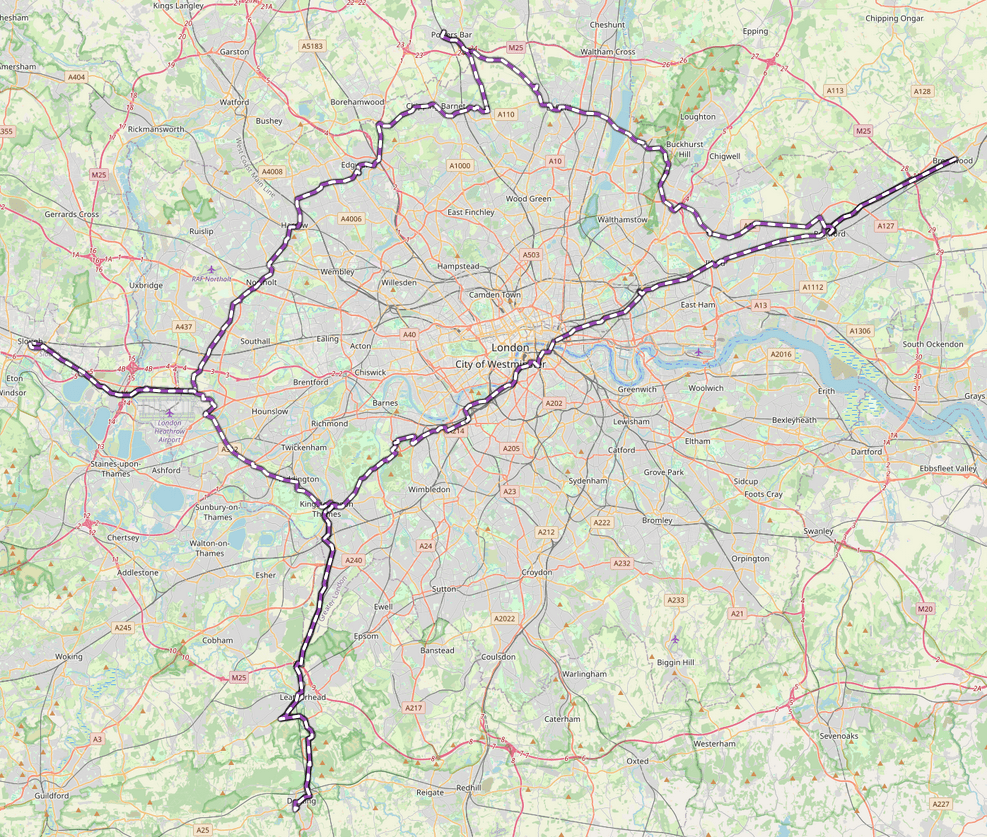
This was a very satisfying challenge to undertake. It was comfortably doable within a day, with lots of alternatives to consider when undertaking the planning, some tight connections made and others narrowly missed.
 Europe Explored