
“Here we go round the mulberry bush.” (Nursery rhyme)
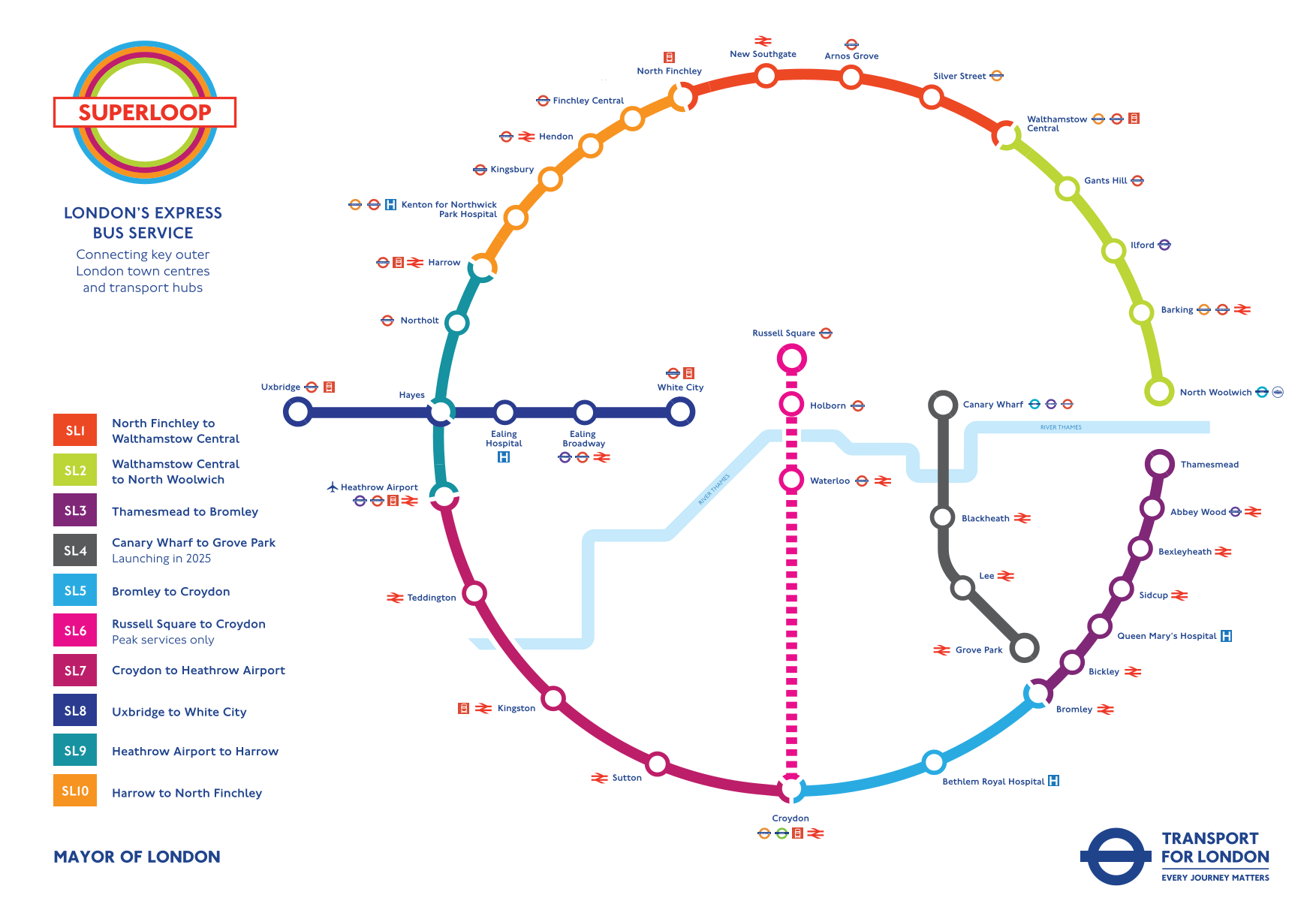
In 2024 I celebrated gaining my Freedom Pass, allowing free bus travel within England, by making a cost free journey from Manchester to my home in Woodford (on the borders of Greater London and Essex). Also in 2024, the final leg of a new orbital network of limited stop buses round London, the Superloop, came into being. I decided that I would try to circumnavigate London using the Superloop buses. (Rather confusingly the Superloop network also includes a number of radial routes, but I am ignoring those.) My Superlooping journey took place on Saturday 28th June 2025, after postponing an attempt a few weeks earlier when torrential thunderstorms were forecast.
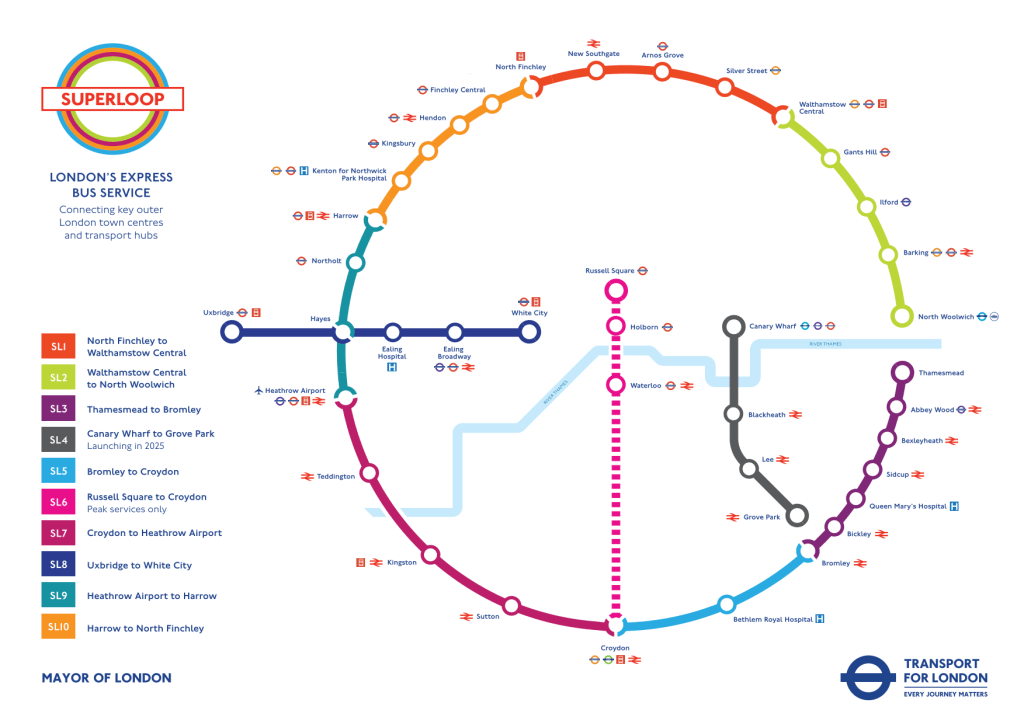
I had done my usual meticulous planning, drawing up a spreadsheet giving the possible outcomes dependent on whether key connections were made or not. This implied it would be best to start early in the morning to avoid the worst of the Saturday traffic jams and if everything worked perfectly I should be able to complete the circumnavigation in about 8½ hours, but it could be up to an hour longer if luck did not run my way. In the event, I had incredibly good luck and managed to complete the circumnavigation much more quickly than I thought was possible.
SL2 – South Woodford to North Woolwich
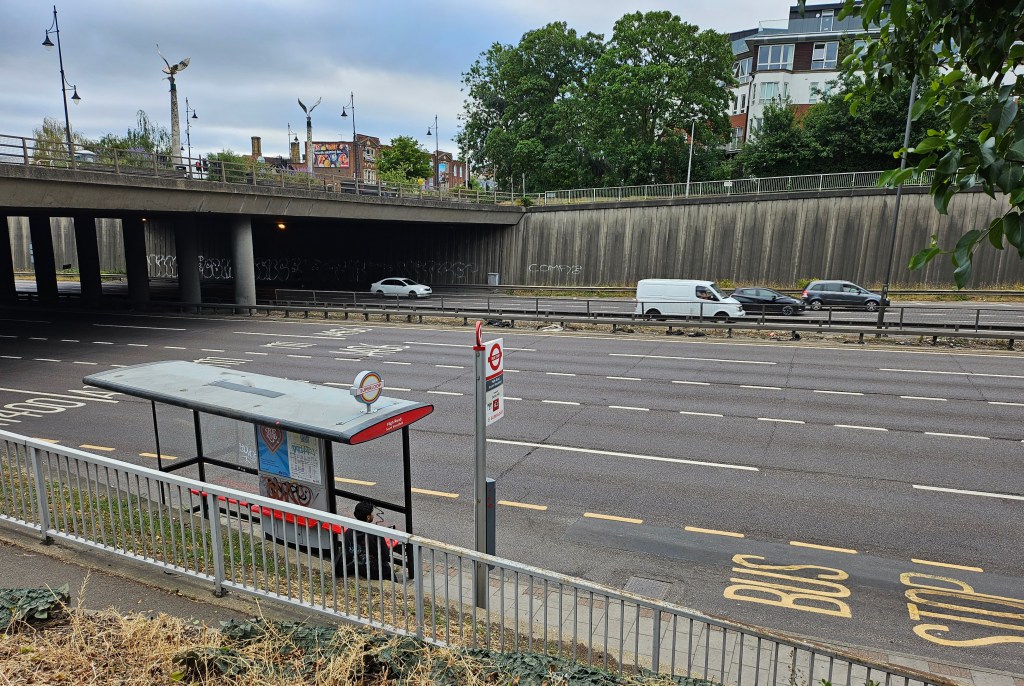
I was going to start my circumnavigation of London at the nearest Superloop bus stop to my home. This is in a lay-by on the North Circular Road at a point where it is several lanes wide in each direction and passes under the original High Road in a deep cutting. I planned to catch the 06:42 departure. Google Maps suggested that it is a forty minute walk from my house. I set off from home a couple of minutes before 6am, not worrying about building in any contingency, as I can usually walk more quickly than estimated by Google Maps. It actually took me just under 30 minutes to walk to the bus stop and I was at the top of the steps from the High Road just before the bus 15 minutes earlier than I had planned was due. Within a minute of me arriving at the stop, the SL2 bus arrived at 06:27.
One other person got on with me, but the bus was fairly empty as it sped along dual carriageways to reach Gants Hill where it turned off to come into Ilford via the side of the attractive Valentines Park. When it reached Ilford town centre the bus filled up. It was here that I noticed that, as I found all day, when London buses get ahead of schedule they don’t wait at a timed stop (as they do elsewhere in the country). I assume that it is because the published timetables on the bus stops, apart from a few first and last buses, only show an indicative frequency rather than the precise times that can be found in the working timetables. This ability to get ahead of time enabled me to make a number of connections during the day, which had not seemed possible when I planned the journey.

When the bus reached Barking most of the passengers who had got on in Ilford got off again. As we weaved past the pedestrianised area of Barking town centre, where some market stallholders were beginning to set up for the day, I could see an area taped off by the police with a forensic tent in the middle of it and a police car guarding it.

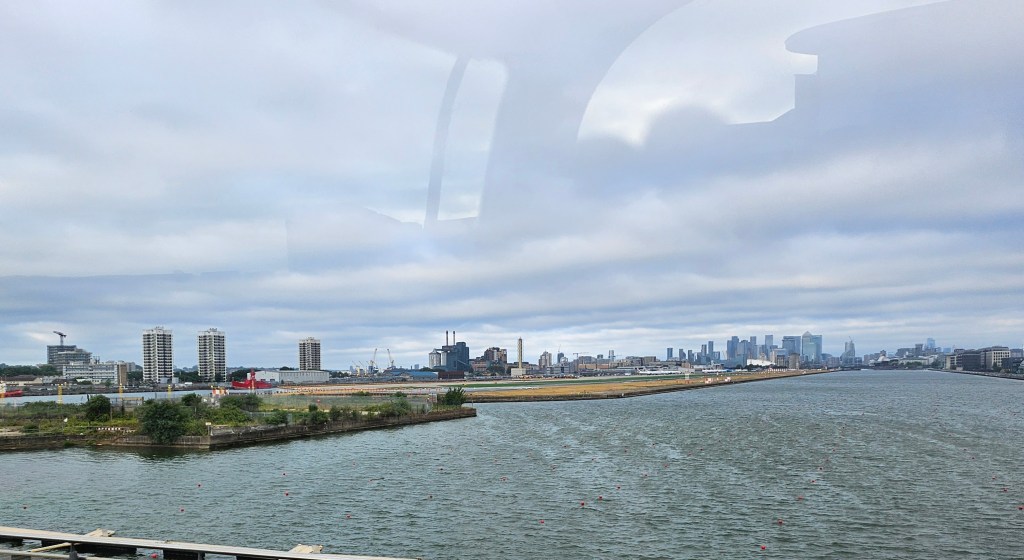
On leaving Barking the bus rejoined the dual-carriageway of the North Circular Road on which the traffic was flowing freely. It then took largely empty local roads to go past the former Royal Docks, where London City Airport is now located, to reach its North Woolwich terminus adjacent to the entrance to the Woolwich Foot Tunnel under the Thames.
Intermezzo – North Woolwich to Abbey Wood
No orbital Superloop bus crosses the River Thames to the east of London and the points either side of the river do not quite align. I had a choice of how to cross the Thames from North Woolwich:
(i) Retrace my steps slightly and catch a DLR train from George V to Woolwich Arsenal. I discounted that option, as this journey was about travelling by bus, not train.
(ii) Catch the Woolwich Free Ferry, which crosses the Thames every 15 minutes from North Woolwich.
(iii) Walk underneath the Thames, using the Woolwich Foot Tunnel.
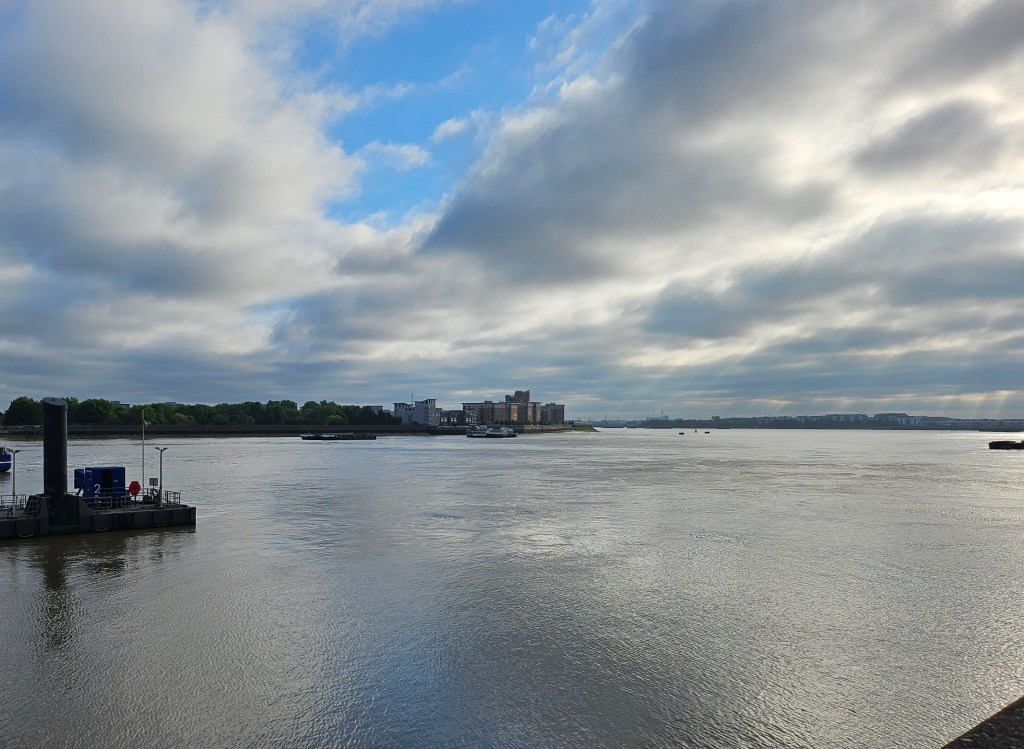
I chose to use the Foot Tunnel, as did most of the few remaining passengers who were left on the bus when it terminated. The lift on the north side has been out of action for a long time, so I had no choice but to walk down. It took a few minutes to walk under the river. I eschewed the lift on the south side, even though it was working, and climbed the stairs to the surface.
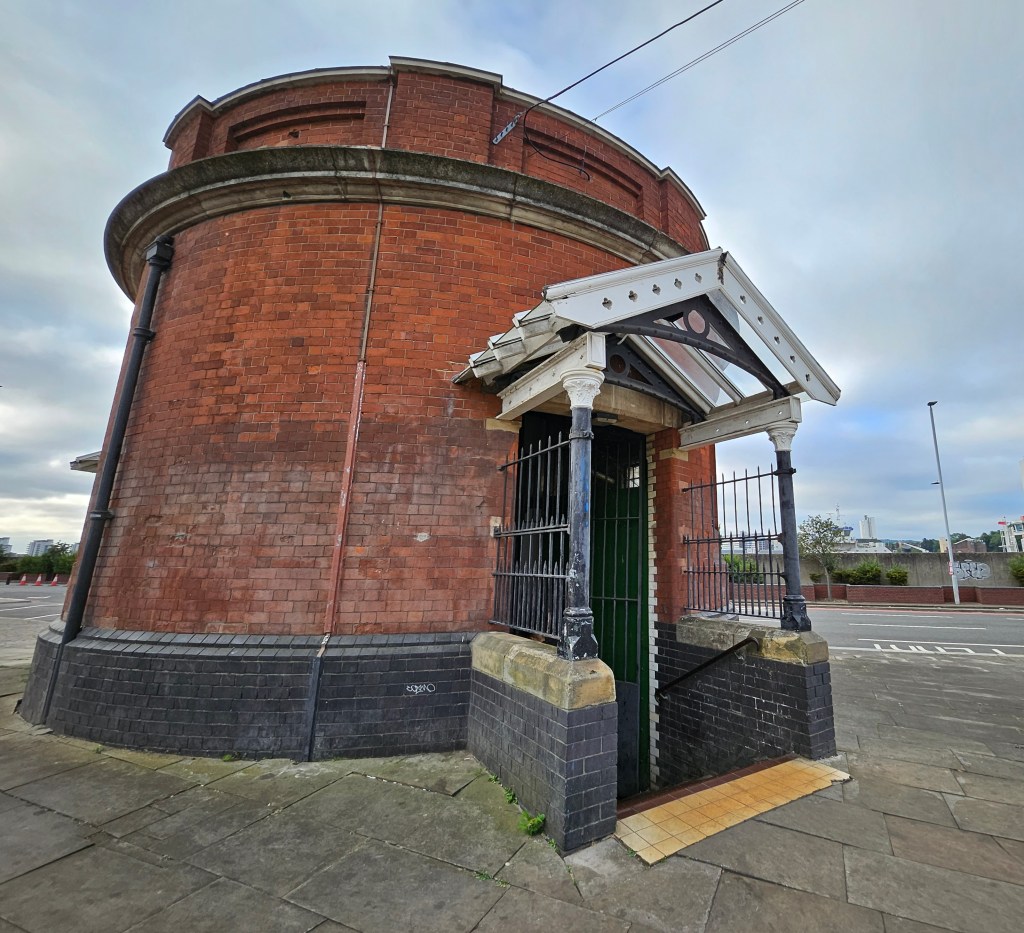
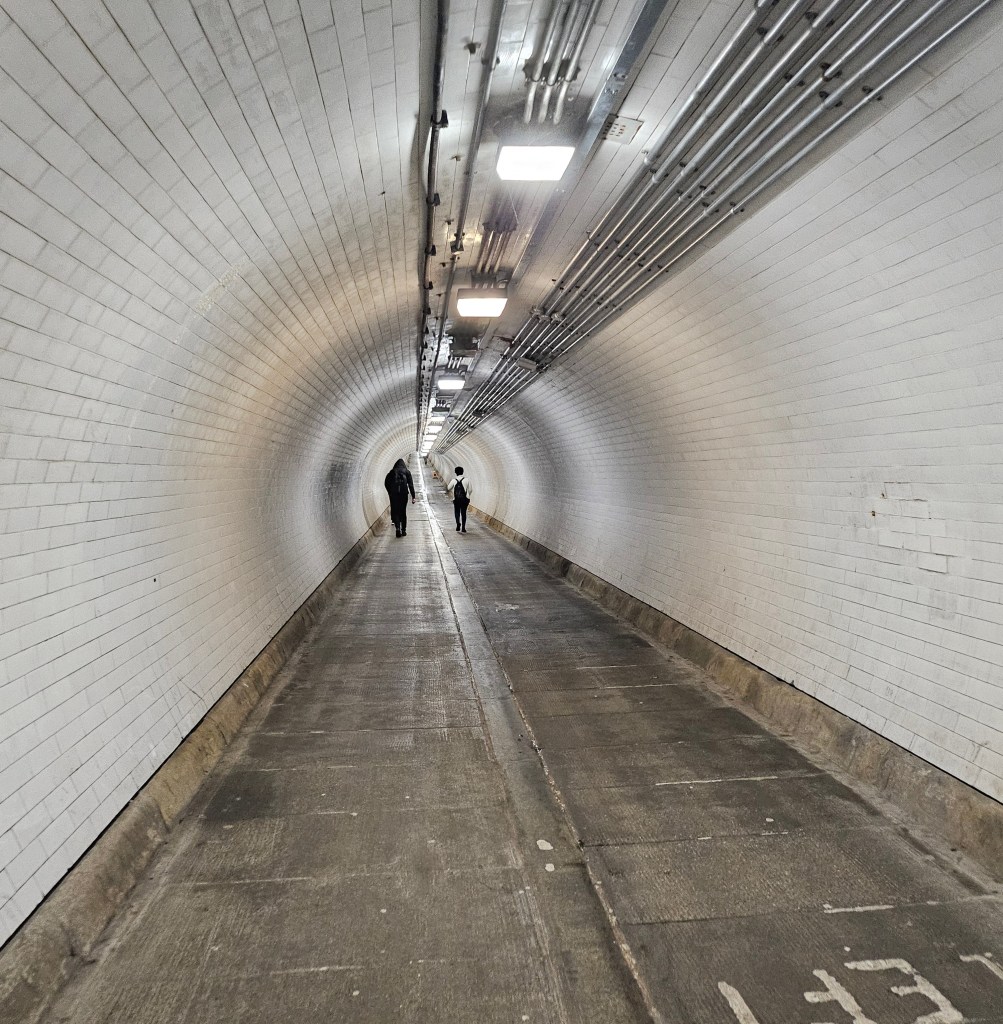
The Superloop south of the river recommences from Thamesmead, three miles further east. From Woolwich, there are three buses to Thamesmead (the 177, 180, or 472) all departing from John Wilson Street around the corner from the tunnel exit. I decided that I would catch whichever came first. In the event, a slightly late 180 won the race. The 180 had the advantage that it intersected with the Superloop at Abbey Wood station before going on to Thamesmead. However, the 180 that I caught was scheduled to arrive at Abbey Wood station a minute after a SL3 bus that I wanted to catch was due to leave.
SL3 – Abbey Wood to Bromley
Given that the 180 was also a couple of minutes late, I assumed that I would not make this connection and would have a 15 minute wait at Abbey Wood. Luckily, the SL3 was itself running three minutes late, so I just had time to cross the road at Abbey Wood and walk to the next bus stop in time to see the SL3 approaching.
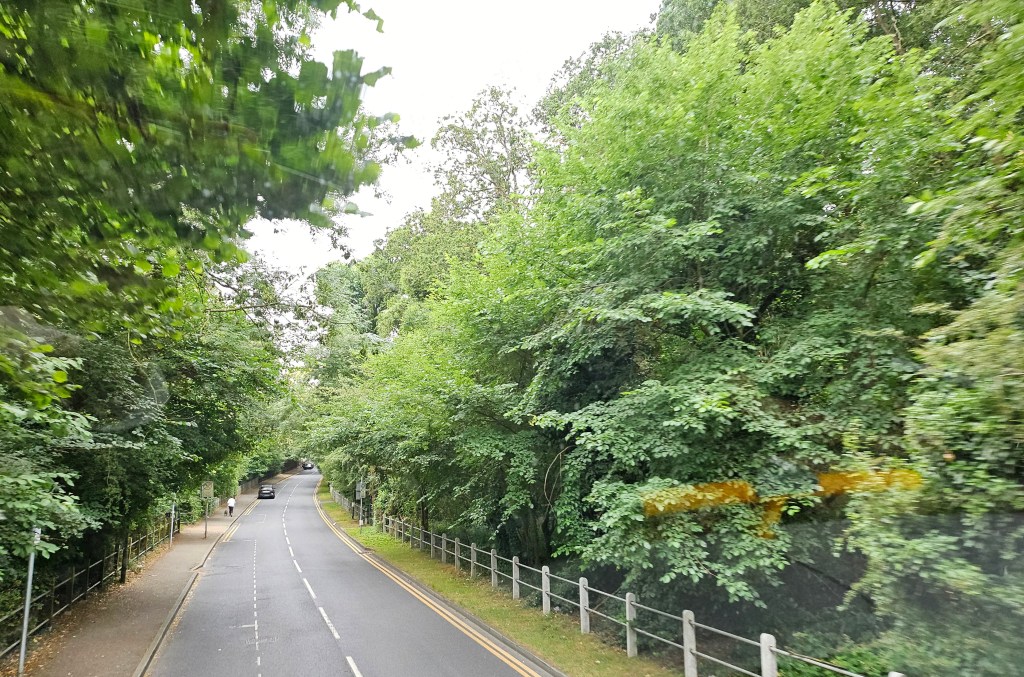
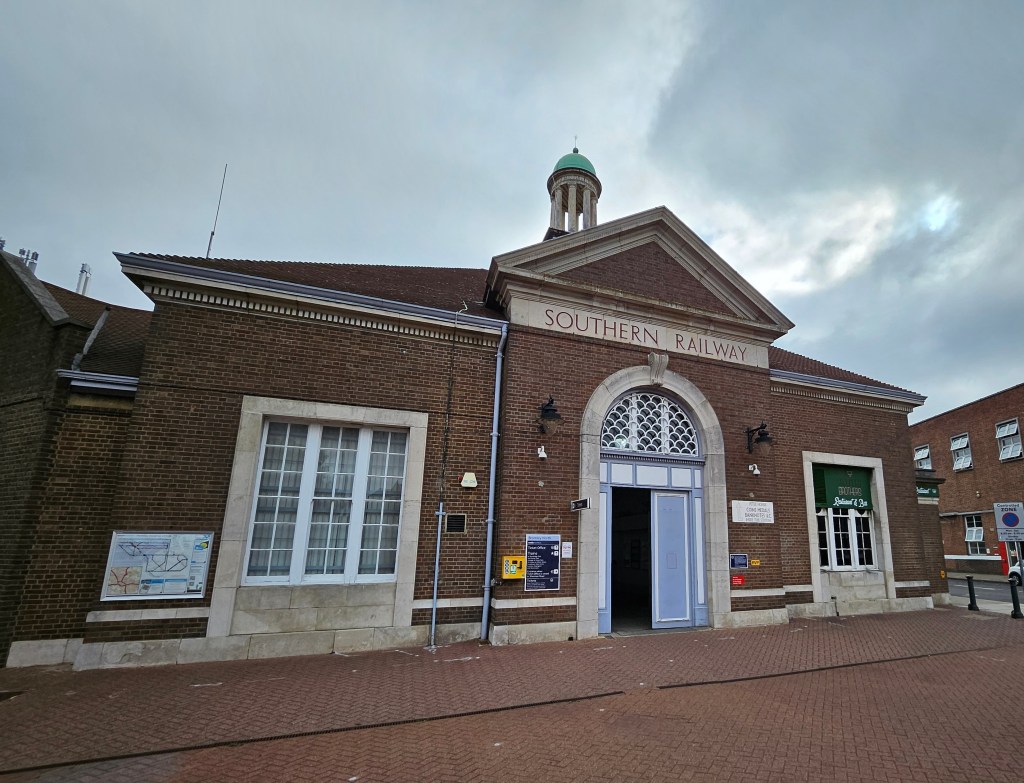
After passing through the greenery of Abbey Wood itself, the SL3 calls at the leafy suburbs of Bexleyheath, Sidcup and Chislehurst before arriving in Bromley. The terminus of the route is at Bromley North station. As my next bus was not due to depart for about five minutes, I had time to investigate whether the station building had any toilets, which it didn’t.
SL5 – Bromley to East Croydon
The SL5 is the shortest of the Superloop routes, scheduled to take just over half an hour to reach Croydon. There was a large crowd of people waiting for the SL5 at its starting point outside Bromley North station. The bus departed on time at 08:28 and was the only single-decker that I travelled on, meaning that it was already nearly full when it left. It was also the most decrepit of the buses that I experienced on this journey.
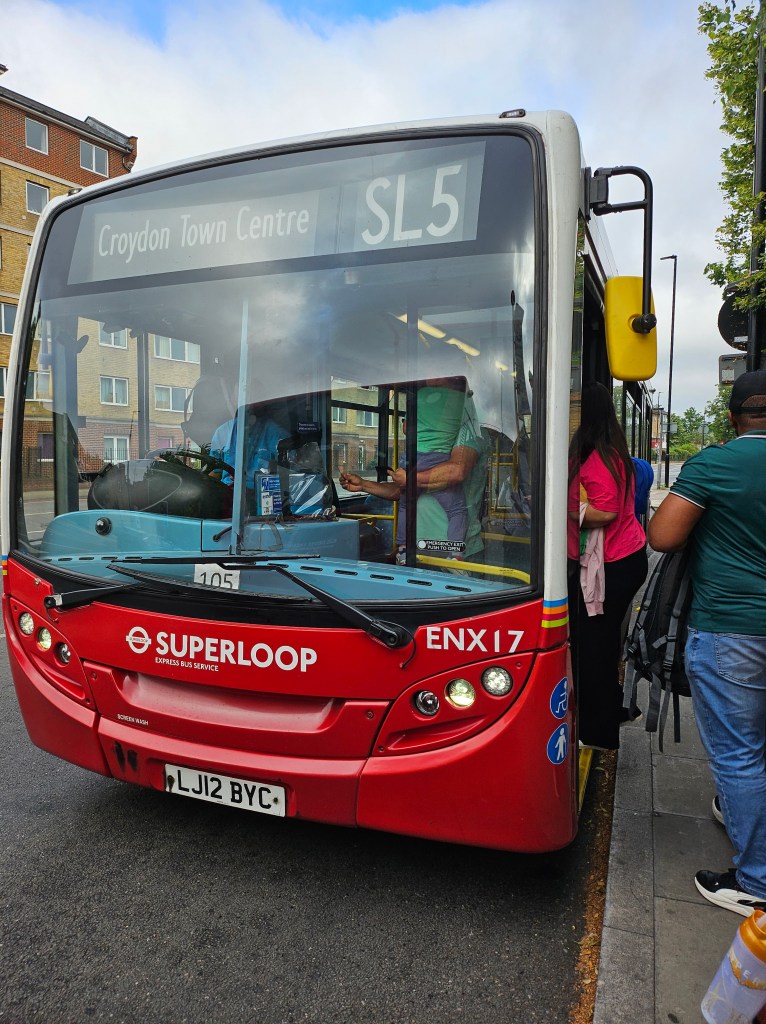
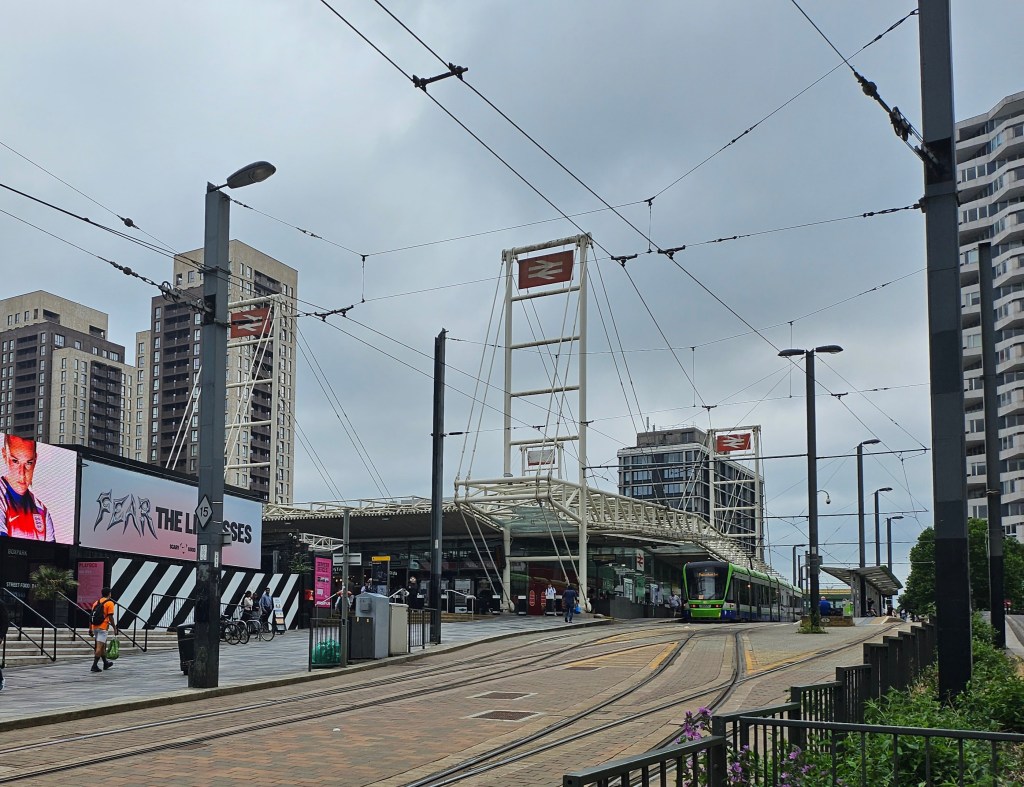
Because of long term resurfacing works, the bus took a roundabout diversion, which meant it was late once it got back on route. At Shirley, the last stop before Croydon, more people got on who had to stand for the remainder of the journey. The bus managed to claw back the delay from its diversion and by the time it deposited me in front of East Croydon railway station it was more or less on time, before it travelled on to its terminus at West Croydon.
SL7 – East Croydon to Heathrow Airport
I walked around a corner to a road which runs along the side of East Croydon station to pick up my next bus, the SL7. From having just travelled on the shortest of the Superloop routes, I was now transferring to the longest. There was already a long queue of people waiting at the bus stop, and when the bus arrived (having started in West Croydon) I was not able to secure one of my favourite front row seats on the top deck.
In Carshalton, where I noticed that the leaves on many trees were prematurely turning brown, one of the front row seats became vacant and I bagged it. This may have been a mistake, as on this bus the driver’s side front row seats have extremely restricted legroom, with something also blocking underneath the seat. It also did not help that someone came and sat next to me giving me nowhere to stretch my legs. This uncomfortable state of affairs persisted for nearly an hour, all the way to Kingston, where a lot of the passengers got off.
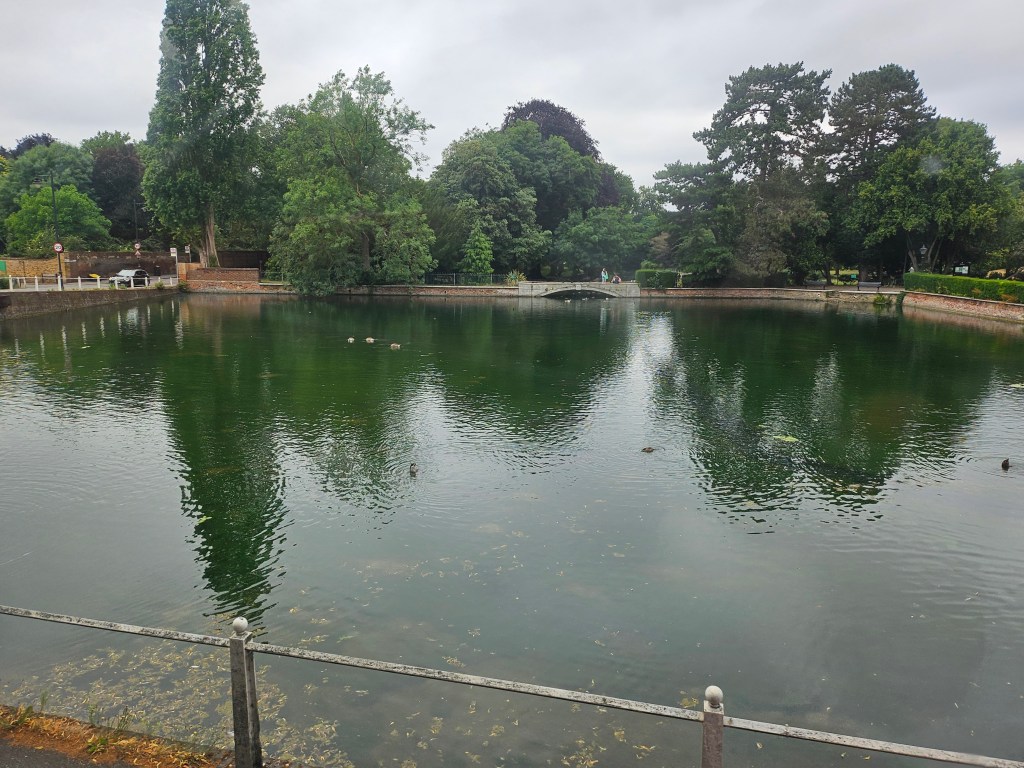
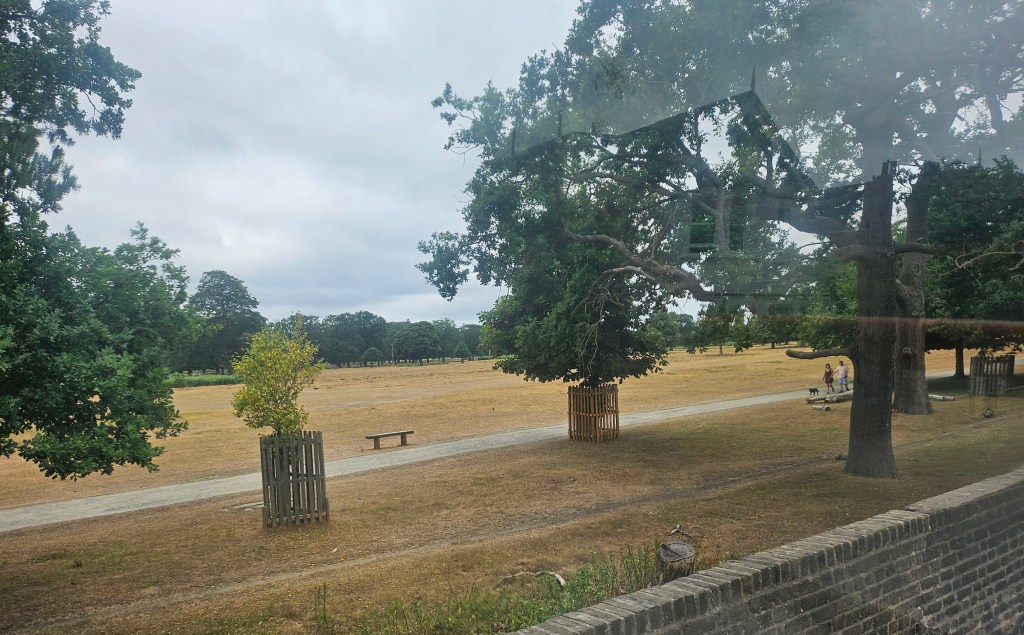
Having now moved to a more comfortable seat, we then crossed over Kingston Bridge to go back north of the Thames again. The bus was now nearly 10 minutes ahead of its timetable, which persisted all the way to Heathrow. We went alongside a very parched looking Bushey Park, before reaching Hatton Cross tube station, where most of the remaining passengers got off.
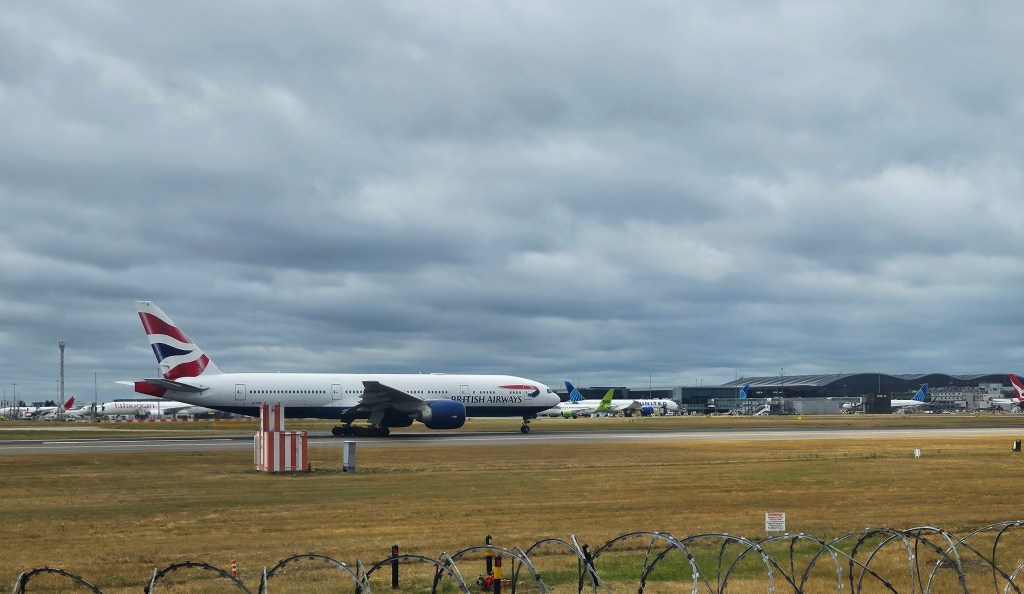
The bus went round Heathrow Airport on the perimeter road, the latter part of which is adjacent to a runway, where I had a close up view of a British Airways plane taking off. The bus then joined the main spur road to the centre of Heathrow, going in a tunnel under the runway, before pulling into Heathrow Central Bus Station ten minutes early.
SL9 – Heathrow Airport to Harrow
With my incoming bus arriving 10 minutes early at Heathrow, I was able to catch my next one almost immediately, which according to the timetable I should have missed by seven minutes. Very few people got on at Heathrow, but at the first stop after leaving, in Harlington, the bus started to fill up.
Now it was late morning and the traffic was noticeably busier than earlier, as were the bus stops with a lot of people getting on and off at each intermediate stop. The Superloop buses are semi-expresses and do not serve every stop. On quite a number of occasions you would see someone waiting at a stop not served by the Superloop expectantly stick out their hand, only to be disappointed when the bus sailed past.
Despite the busier traffic, the bus still was ahead of schedule as it went through Hayes, Yeading and Northolt on its way to Harrow. This was the second Hayes I had been through on this journey. The SL5 on its diversion route had taken me through Hayes (Kent) and now the SL9 went through Hayes (Middlesex), although both are now in Greater London. The bus finally pulled into Harrow Bus Station, adjacent to Harrow-on-the-Hill tube station, a few minutes early.
SL10 – Harrow to North Finchley
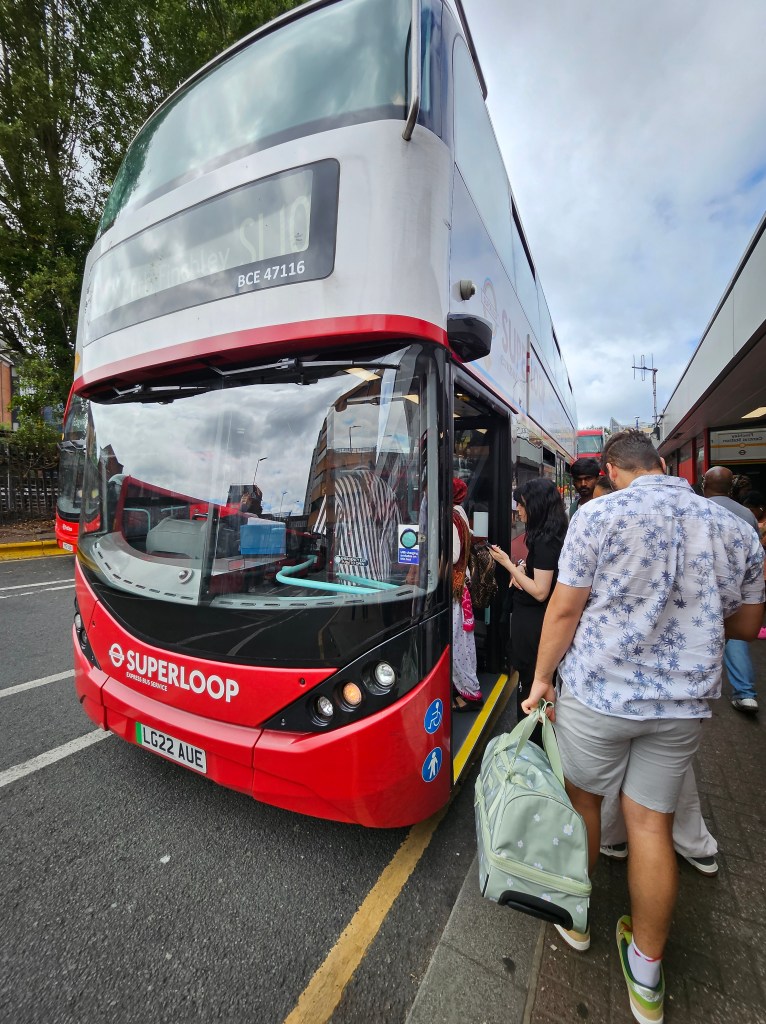
Yet again the early arrival of my bus into Harrow meant that I managed to catch a bus out that on paper I should not have. However, heavier traffic meant that unlike my previous buses the SL10 was unable to get ahead of its schedule. While travelling through Hendon my bus was right behind a different service which was calling at all the stops, but because of parked cars and oncoming traffic, the SL10 could never get ahead of it and slipped slightly behind timetable. In Finchley, the traffic thinned out a bit, which judging by the number of people I saw walking from synagogues, maybe due to the Jewish population of this area not using their cars on the Sabbath. This enabled us to arrive on time at the North Finchley terminus.
SL1 – North Finchley to Walthamstow
Again, as soon as I had stepped off the SL10 in North Finchley, a SL1 to take me to Walthamstow pulled in behind it.
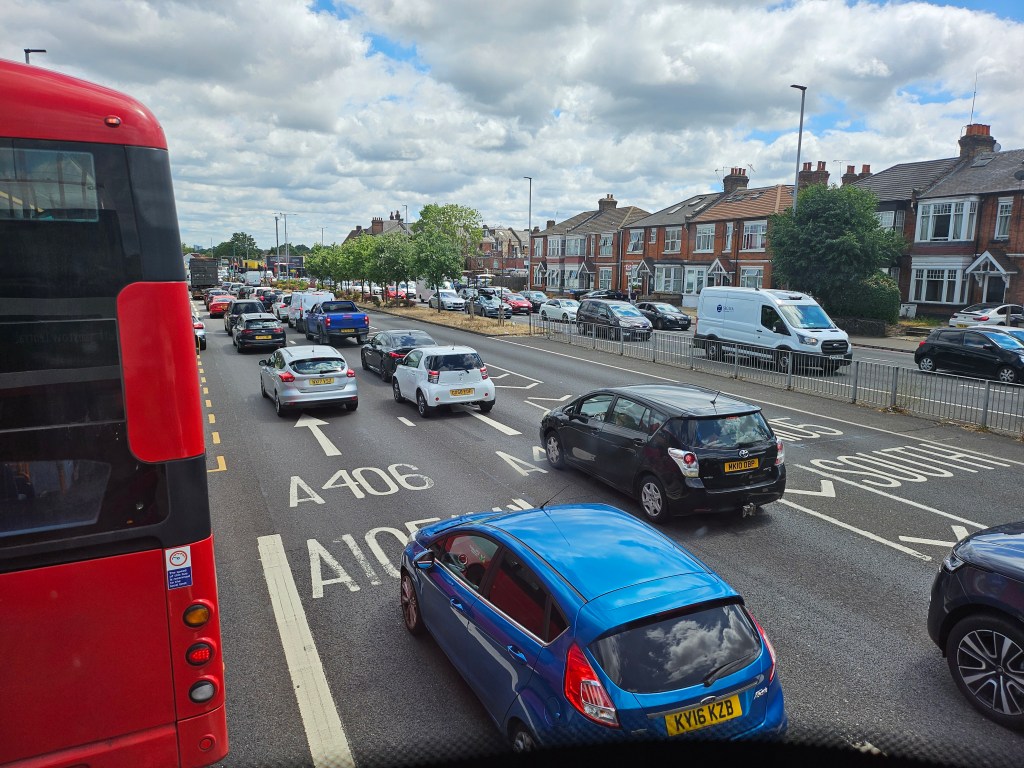
The SL1 follows the dual-carriageway North Circular Road for a large part of its route. However, by now the North Circular was at a standstill and, despite the best efforts of the driver to squeeze into impossible gaps and continuously hooting at cars to get out of his way, for the first time we steadily became later. While stuck in the slow moving traffic, the bus became hotter and hotter, as by now the sun was beating down. Only when the route went on brief diversions from the North Circular was any time clawed back.
Since the routes of the SL1 and SL2 overlap on the approach to Walthamstow Bus Station, I did not need to stay on the bus all the way to the terminus. Instead I got off at Bell Corner, where miraculously it had almost managed to get back on time, and walked a short distance round the corner to the bus stop outside the enormous Walthamstow Town Hall.
SL2 (again) – Walthamstow to South Woodford
It will come as no surprise to learn that as I approached the stop outside the Town Hall, I saw the final SL2 that I needed coming along the road, causing me to run the final few yards to catch it.
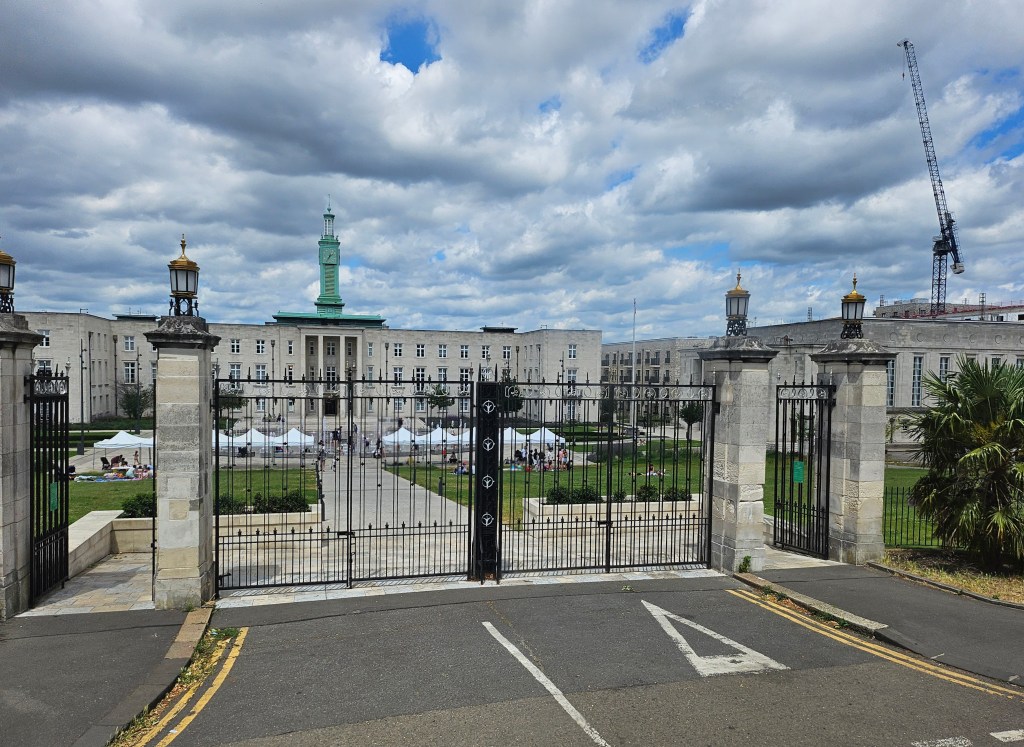
From the Town Hall it is just a short way up Forest Road to rejoin the North Circular again, where the bus deposited me back at the stop I had started from at 13:42, just 7¼ hours after I had set off. From here I was able to get home for lunch rather than tea, as I had been expecting. The whole circumnavigation had been completed 1¼ hours faster than I thought would be possible and 2¼ hours faster than I thought most likely.

Conclusion
I was amazed to have completed the circumnavigation so quickly and pleased that my early start had paid off. Given the way the traffic was building from late morning onwards, I think had I set off even an hour later the overall time for completion would have been much longer.
While pleased to have done it in the time I did, I was slightly disappointed that I did not have time for even a cursory look around the surrounding neighbourhood at any of the places where I changed. Generally the scenery was much better south of the river, almost feeling quite rural in places.
I am glad I did it, but I don’t think it will stick in my memory in the same way as my journey from Manchester the previous year.
 Europe Explored
One Reply to “”