
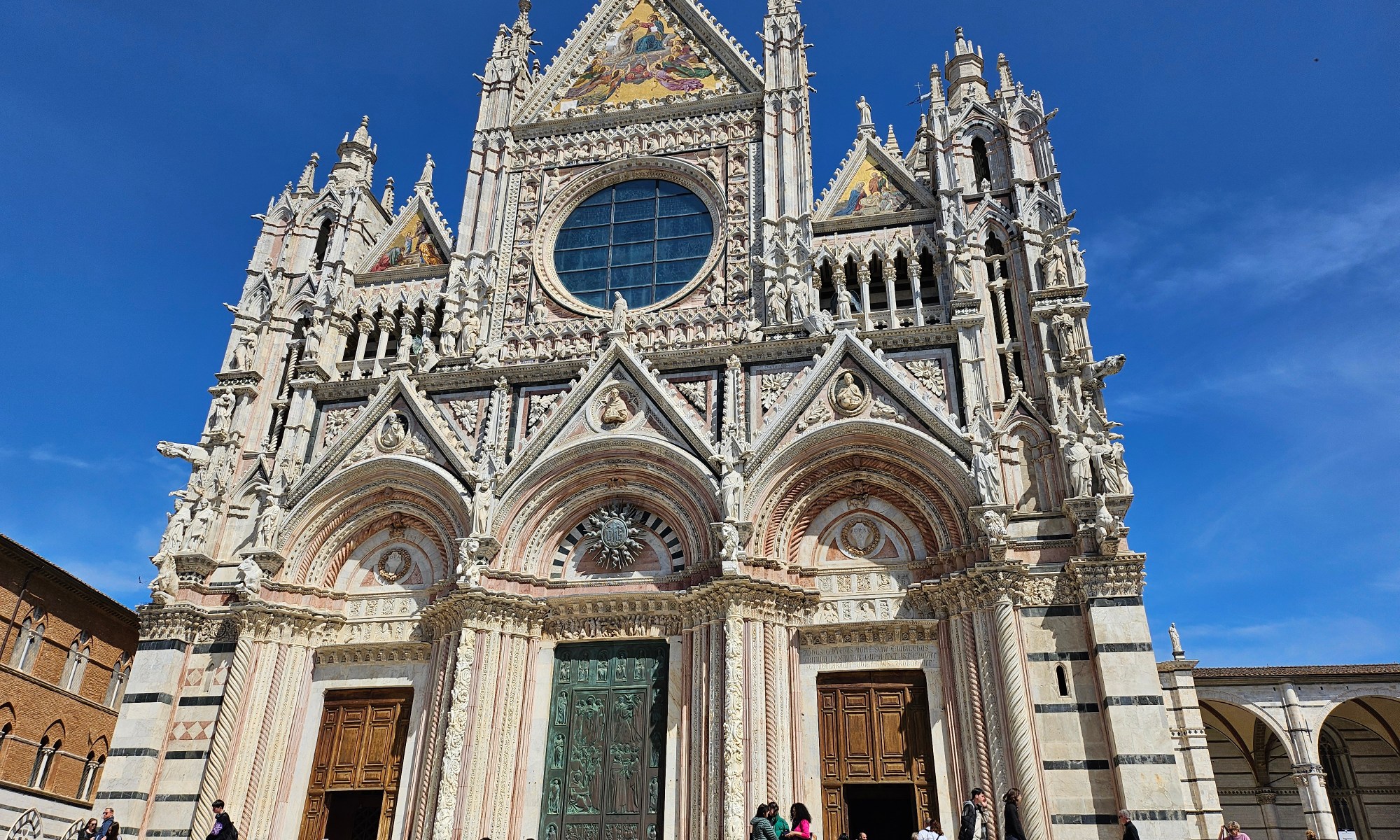
“La semplicità è l’ultima sofisticazione” (Attributed to Leonardo da Vinci.)
This trip was designed to visit some of the ancient cities of Italy which I had not been to before that were key players in the development of pre-Renaissance art. These were suggested by my wife who visited them while Interrailing in her youth. The starting point of Ancona was chosen solely on the basis of the availability of a cheap flight at a reasonable time of day.
Day 1 – Monday 31st March 2025 – London to Ancona
As my flight to Ancona was not due to leave Stansted Airport until 12:20, I had a leisurely start. My normal route to Stansted, when a very early start is not required, is to catch a tube train to Stratford and from there pick up a train to Tottenham Hale to connect with the Stansted Express. By leaving later I was able to use my Freedom Pass for free travel to Tottenham Hale, from where I had booked an advance ticket. The Freedom Pass on weekdays allows free travel on the tube after 9am and on most National Rail trains after 9:30am. I aimed to catch the 09:30 departure to Stratford to enable a free journey. When I got to Stratford at about 09:20 there was a train to Tottenham Hale sitting in the platform, which I got on. This turned out to be the delayed 09:17 departure which left a couple of minutes after I got on it, so my Freedom Pass was not actually valid on it. However, it was a good job that I caught that train, as a track fault near Tottenham Hale meant that all the remaining trains that morning from Stratford to Tottenham Hale were cancelled. Also, southbound Stansted Express trains were being diverted via Seven Sisters and not calling at Tottenham Hale, while those to the Airport were delayed.
Counting my luck, I arrived at the airport about a couple of hours before my flight was due to depart. It was busier than I seen it before and it took about 20 minutes to go through security. Once through security it is normally a brisk walk through the duty free area, selling stuff that I would never want to buy, to the departure area. However, on this occasion there was a jam of people – the cause of which was a large school group waiting outside the toilets completely blocking the way.
I found my usual quiet spot to wait away from the crowds. While there, the departure board changed to show an estimated 15 minute delay for my plane. However, if you track flights you can see the wonder that is Ryanair’s scheduling in progress. Originally, the plane for my flight to Ancona was coming from Milan and was still approximately on time. However, a late arrival from Hamburg was changed to become our flight to Ancona, rather than delay the passengers of where it was originally intended to go next. This meant that our departure time was changed back to being on time and by the time I got to the gate the plane was sitting there and boarding commenced early. While waiting to board the plane, I realised that the school party that had blocked my way into the airport were Italian and were going to be on my plane. As I got on I heard one of the stewardesses tell another that there was going to be a school group of 50 on board, to which her colleague replied “Oh God!”.
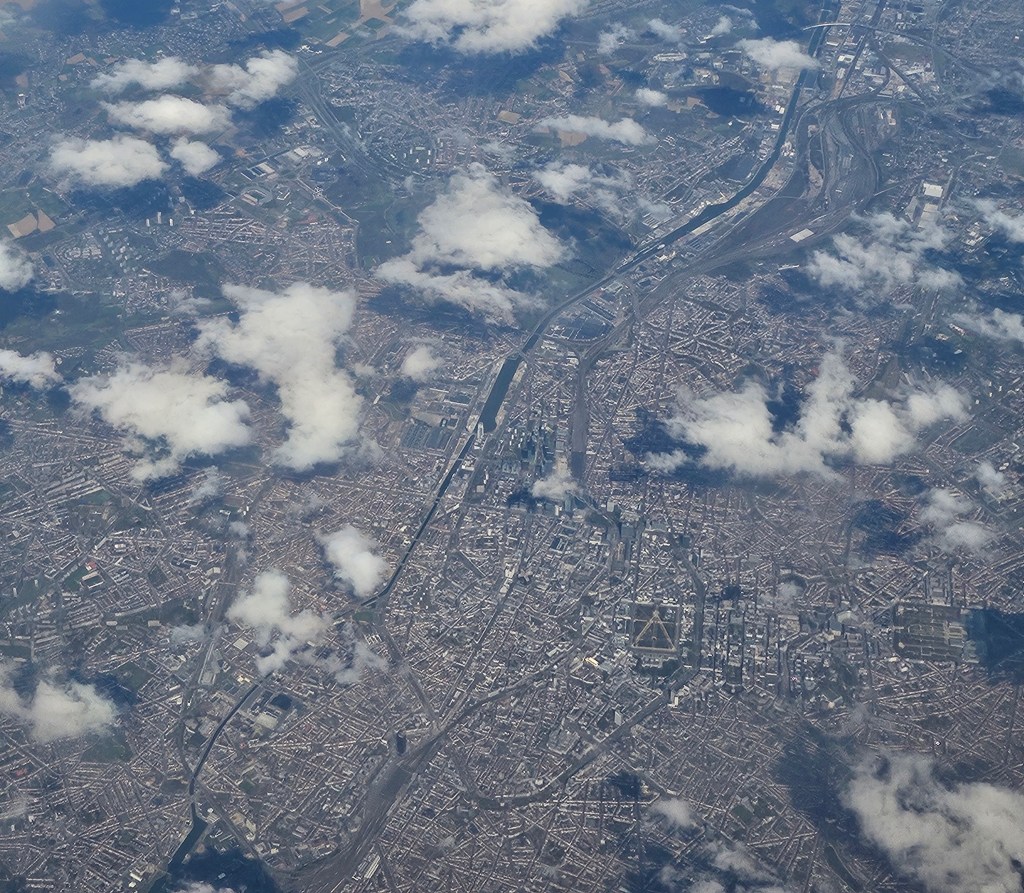
The flight was uneventful and the schoolchildren were actually quite well behaved. There were clear skies as we passed over Belgium, but once we entered German airspace thick cloud obscured the view of the ground until we reached the Italian Alps, where there was a small amount of turbulence. We then started to descend to Ancona airport, following the Adriatic coast. The flight landed about 10 minutes early at 15:25. Once we had landed a woman in the row in front of me opened the overhead luggage locker to retrieve her bag, which fell out hitting one of the schoolchildren on the head and sending his glasses flying. She offered him, in Italian, her profuse apologies and was concerned to check that he was all right and that his glasses were not damaged.
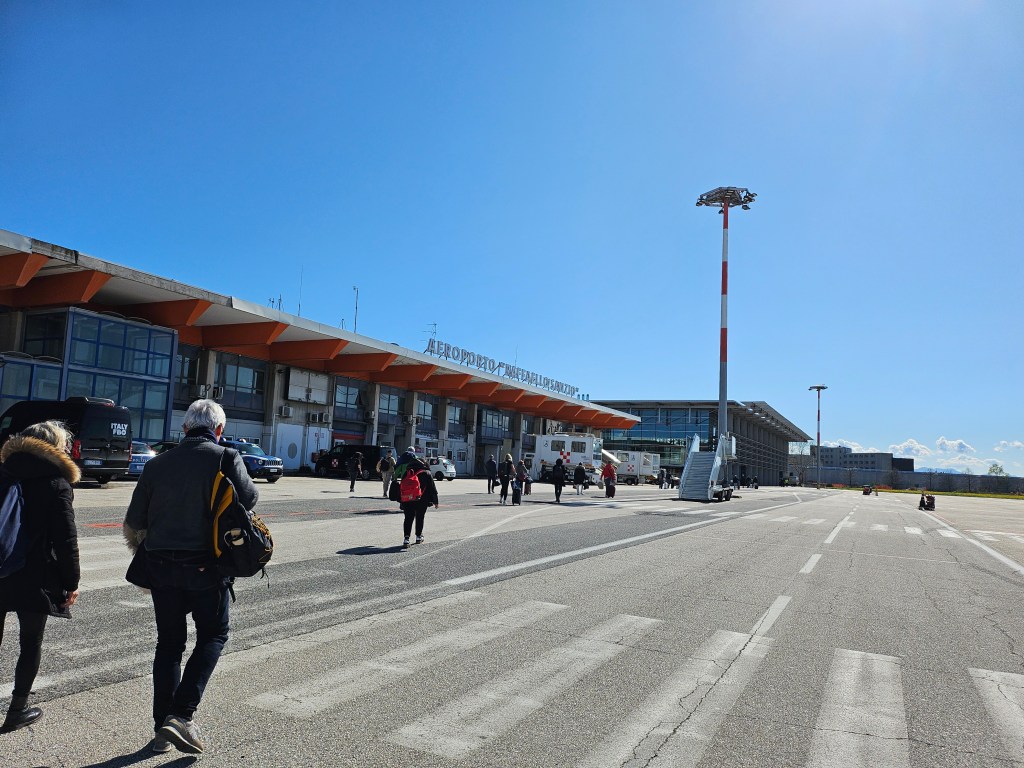
Ancona Airport, which seems to operate under a variety of names (including Raffaello Sanzio (a renaissance painter and architect), Marche (the region), and Castellferritti (the nearest town)), only gets a few flights per day. So, although the plane parked some distance from the terminal, which at any other airport would then involve a bus to transport you, we were just left to walk across the tarmac to enter the terminal building. I got to passport control, which unlike most other EU airports was not segregated between EU and non-EU citizens, with only a few people ahead of me, but they seemed to take forever to process these. I suspect their computers must have been running slowly, as the officials did not seem to be questioning those they were processing. When I reached the counter, I think the computer must have woken-up, as I was let through in a few seconds.
From my research in advance, I had established that on the day I arrived there were just three buses scheduled from the airport to Ancona, while from the nearby railway station there was a train to Ancona approximately every two hours. There were both a train and a bus scheduled to leave at 16:20. In most airports on leaving the terminal you would expect to see signs to the public transport, but here there appeared to be none – there was just a line of expectant taxis. I walked down the outside of the terminal building, hoping to see a bus stop, but I couldn’t find one, so I thought I would investigate the station instead. The advantage of the bus is that it takes you to the centre of Ancona, whereas Ancona railway station is half an hour’s walk from where my hotel was, but the cost of a train ticket is half the price of a bus ticket. Google Maps claimed it was a twenty minute walk from the airport to the airport station, but I did not believe this, as it assumed you walked just on the road to the station’s main entrance on the other side of the tracks. My assumption was correct and there was a way in to the station from the airport side.
When I got there, there was just one other person waiting on the platform – the young woman who had nearly knocked out the child with her bag on the plane. She started chatting to me and I established that she was a half-Italian Guardian journalist who was travelling to Italy to renew her driving licence. She needed to catch the train, as she was travelling beyond Ancona and needed to connect with with another train there. She was unaware of from where the Airport bus departed, so as the train was more or less on time, I bought a ticket to travel to Ancona from the Trenitalia app. Shortly after I had bought my ticket, I saw the bus arrive and pull up outside the terminal building, but it was now too late to change my plans. The train to Ancona arrived on time and was fairly full, but I managed to find a seat for the twenty minute ride to Ancona.
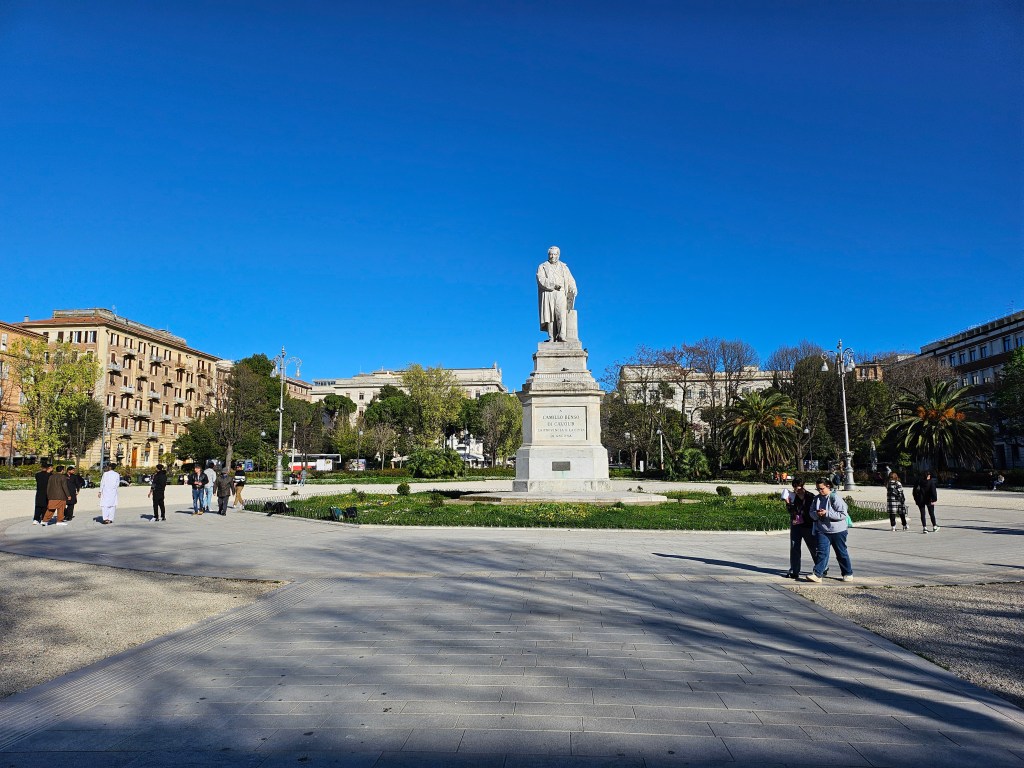
It was a 30 minute walk from the station to my hotel. I made the mistake of trying to follow a straight-line route, not realising that Ancona is very hilly, being located in a steep-sided valley which reaches the coast. It would probably have been quicker to have initially followed the coast road and then walked along the valley floor to the city centre. My hotel was located just a couple of blocks away from the main square, Piazza Cavour.
After checking in to my hotel, I went out for an explore of my immediate surroundings and to find a suitable location for dinner that evening. I chose to dine in a restaurant in a backstreet, where I had a delicious first night meal. I started with spaghetti al ragu, followed by stewed brasicole (rolls of meat filled with bacon, cheese and herbs), and pannacotta for dessert. After drinking a refreshing Menebrea beer on arrival, I had a carafe of the house red wine to accompany my food.
Day 2 – Tuesday 1st April 2025 – Ancona to Perugia
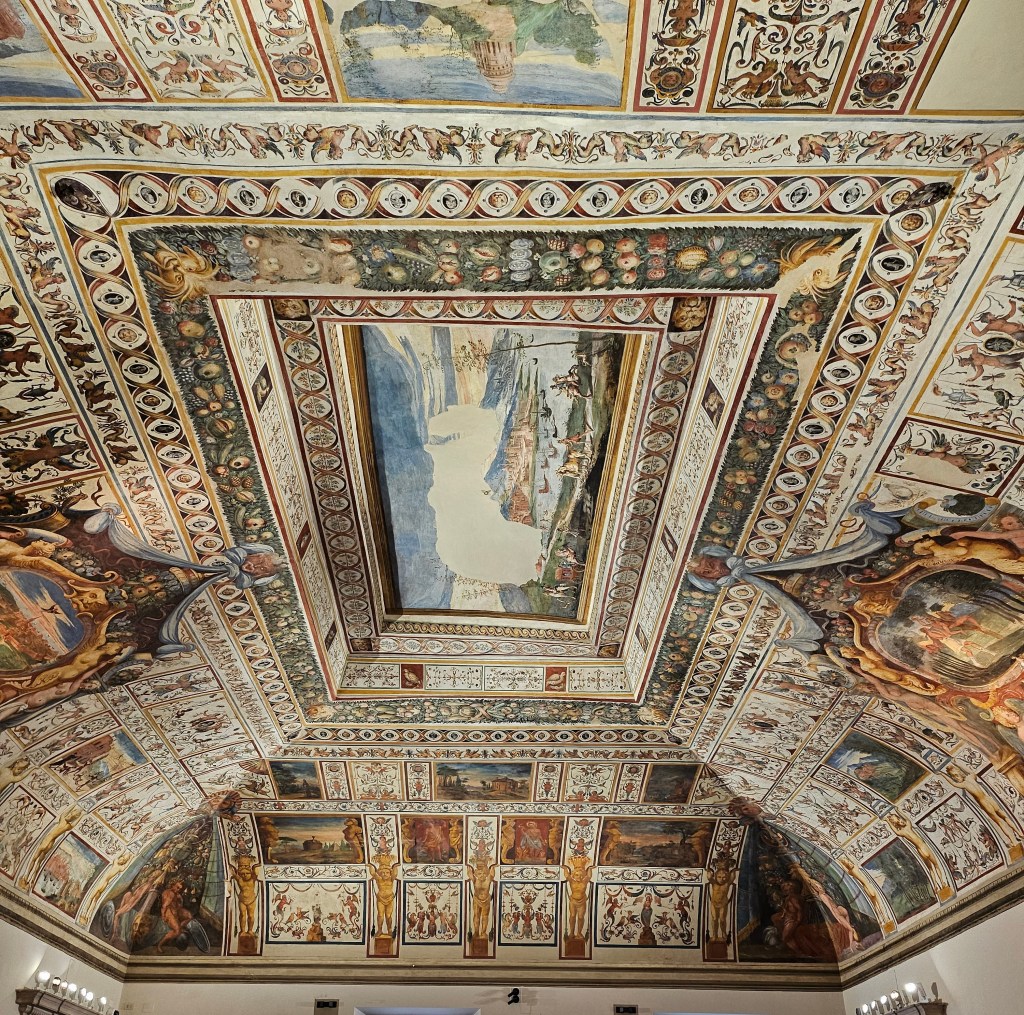
After eating one of the only two hotel breakfasts that I had booked for this trip, I set off to explore Ancona. As the National Archaeological Museum of the Marche Region, located in the former Palazzo Ferretti, opened at 8:30am, I went there first and arrived shortly after it opened. When buying my ticket to enter I was warned that they were expecting a primary school group in the Roman section of the museum that morning, so I tried to visit that area of the museum first. However, the museum attendant at the entrance to the collections was having none of it and insisted that I visit the museum in chronological order, starting with pre-history and then the bronze age. He only turned on the lights to each new section as I reached it. Being located in a former palace, some of the rooms still had their sumptuous original decoration. It was only as I was finishing my tour of the museum at about 10am that the primary school party arrived.
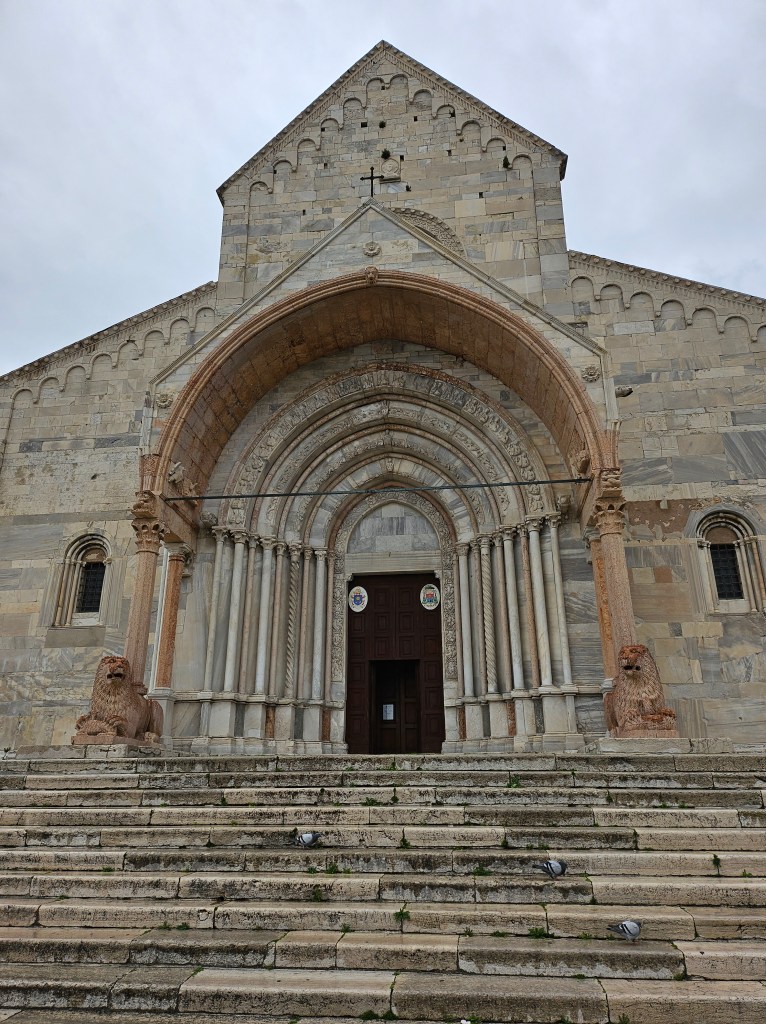
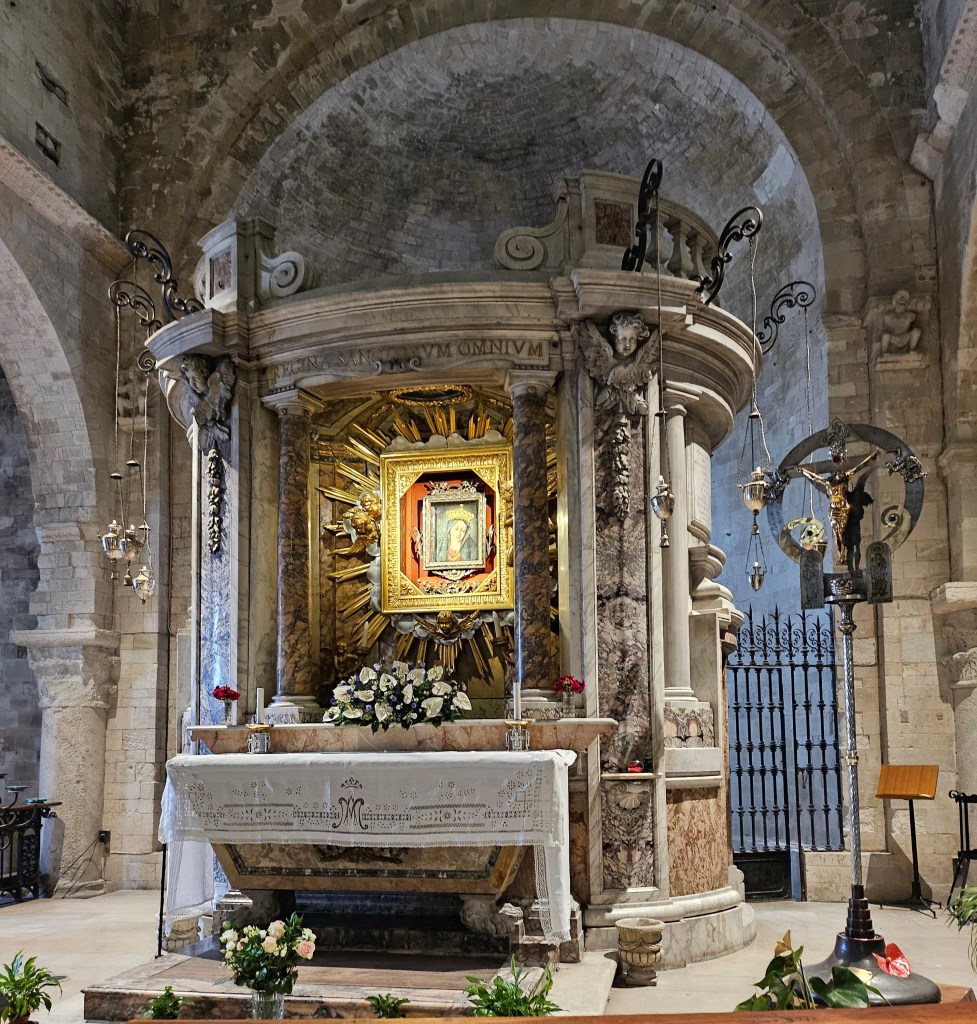
I then set off to explore more of Ancona. Unfortunately, after a little while it started raining, so I went back up the hill past the Archaeological Museum to visit Ancona Cathedral. The original cathedral was built upon an Italic temple, which has been dated to the third century BC, but the current structure was first constructed in the tenth century, in a Romanesque-Byzantine design, although it has been extended and repaired many times. By the time I had finished in the cathedral, including going into the crypt, the rain had eased and I could continue my exploration of the city.
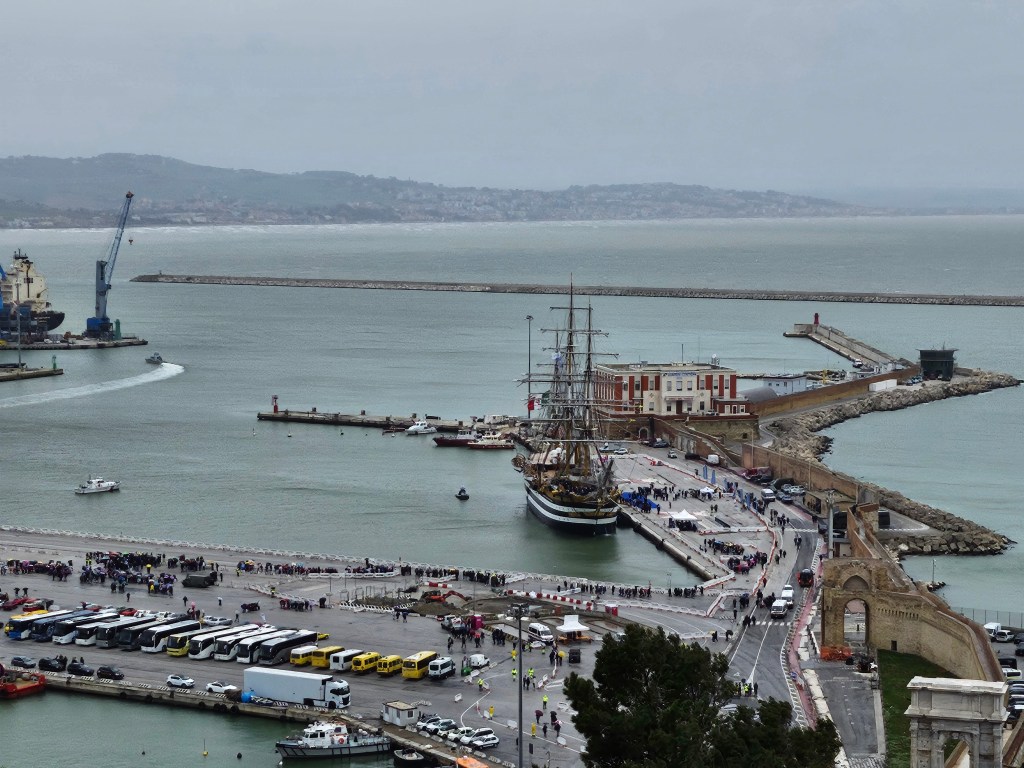
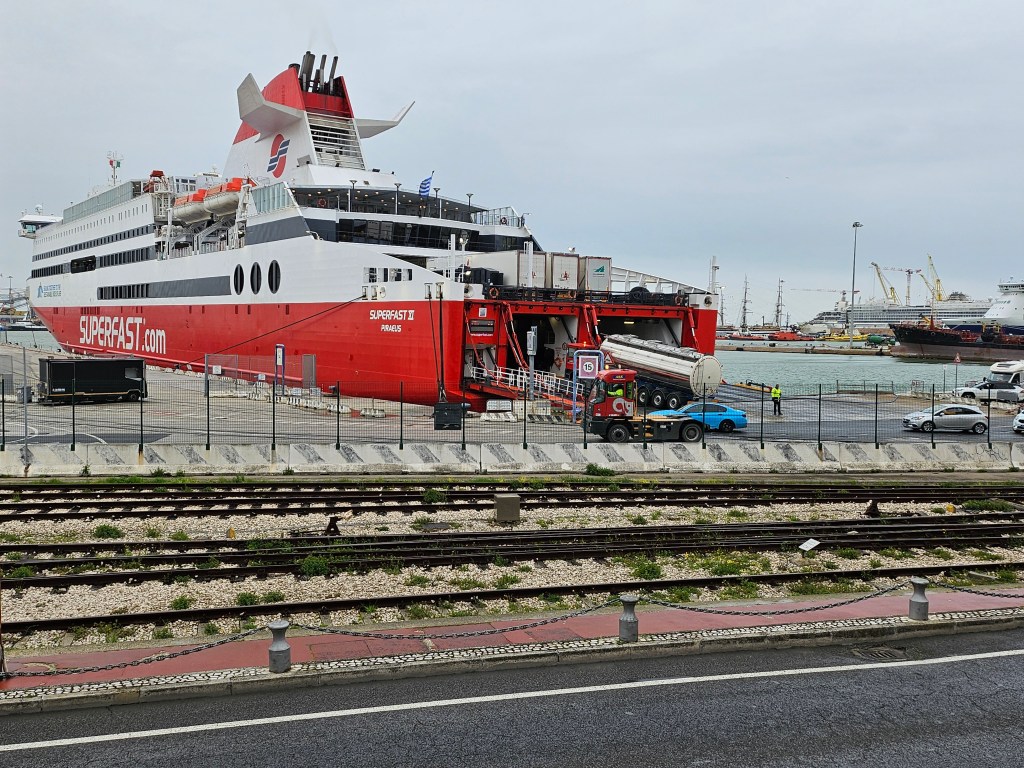
From the hill on which the cathedral is located, there was a good view down to the harbour area. From here ferries depart to Croatia, Albania and Greece. As well as a couple of ferries being loaded with vehicles, there was also an old tall ship moored in the harbour which was visiting Ancona for a couple of days.
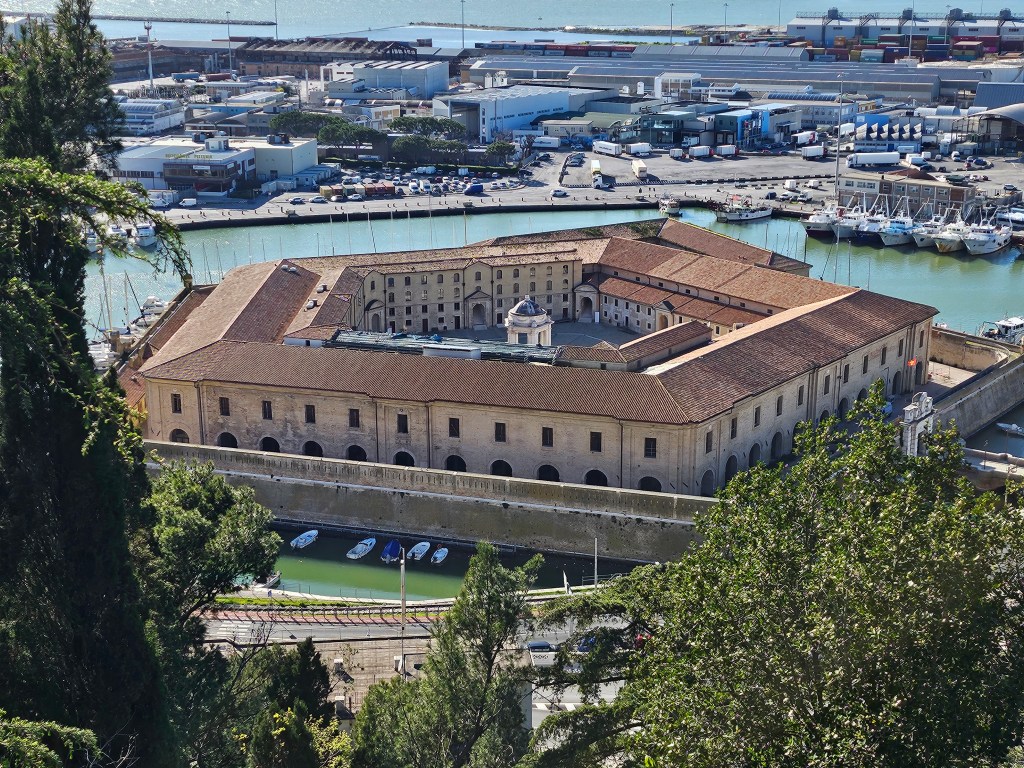
After walking around Ancona a bit more – unfortunately, the main city museum appears to have shut down – I started to make my way to Ancona station. I had learnt my lesson from when I arrived and this time approached the station by walking along the level coastal road. This went past a large pentagonally-shaped defensive fortification that I had seen from above on my walk from the station the previous day, the Mole or Lazzaretto, which has served a variety of purposes over the years – citadel, sugar refinery and quarantine station among others. The museum located within in it was only going to be open that evening, so I had to give it a miss.
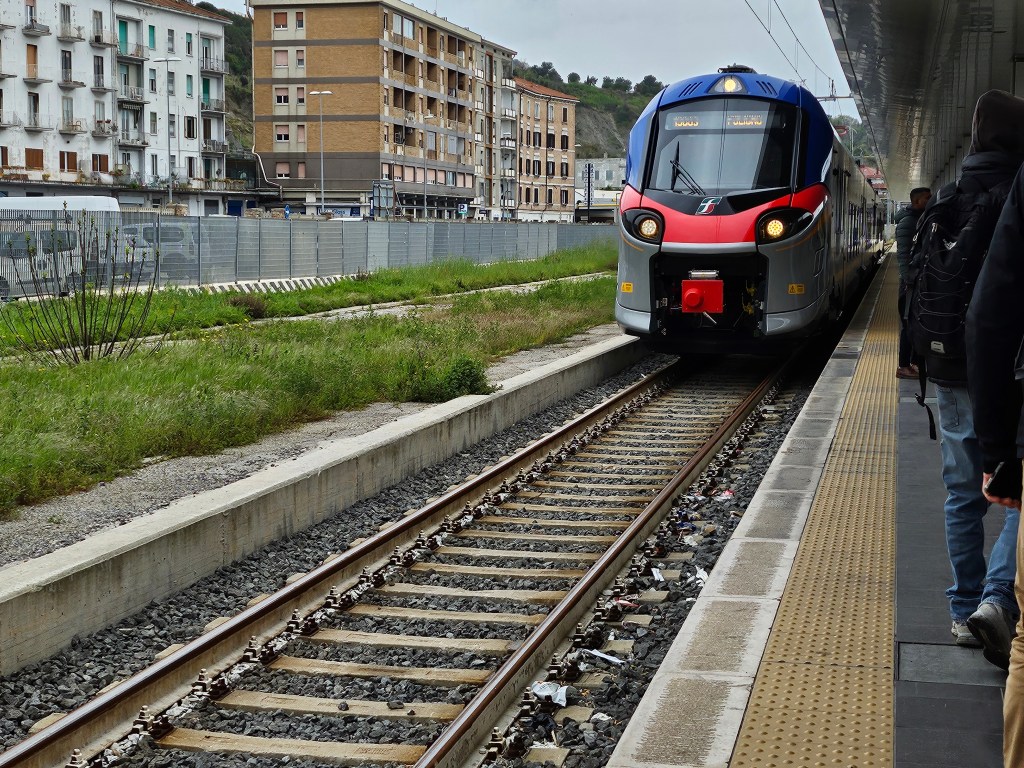
I then went to the station, arriving in good time for the 12:50 train to Foligno I was aiming to catch. The departure board indicated that it would be departing from one of the terminating bay platforms to the side of the station. Unlike the other trains that were due to depart around that time, it was not already in the platform. It eventually pulled into the platform just before it was due to depart and I got on and took a seat just behind the drivers cab. The train smelled and looked as if it was completely brand new – it was so pristine that I think this may have been its first journey in passenger service. The driver walked through the train to take up position to drive it out of the station. However, the departure time came and went with nothing happening. He called the guard into his cab and together they tried doing various things, including rebooting the train’s electronic systems several times. By this stage, I was starting to get concerned as I only had 20 minutes to make my connection. After the driver had spent some time on his phone, another individual arrived and started to fiddle with various control panels. By this stage another train had pulled into the adjacent platform, due to leave an hour after the train that I was on. It was going to Rome, but would call at Foligno on the way, allowing me to connect there to a train 45 minutes after the one I had been aiming for. I thought I would go onto the platform to give me a chance of getting on whichever train was going to depart first. Except that the doors of the train I was on had now closed and the guard was unable to open them. Eventually, when the trains doors did open I got off along with most of the other passengers – most of these got on the opposite train. I decided to wait on the platform to see what happened. The guard opened and closed the doors a couple of times and then the train started to move with me still on the platform. It went just a few yards, before it stopped briefly and the guard beckoned me to get on board. We eventually departed nearly an hour late.
The train initially proceeded in the reverse direction to the way I had come the previous day, stopping at the airport station again. The rain returned and the during the initial part of the journey was lashing against the train windows. I don’t know if it was because it was a new train and could go faster, but it started to claw back some of its lost time. I even had a faint hope that it might pull back enough time for me to make my connection, but this hope was soon scuppered, as much of the route was single track and, because it was not on time, my train had to wait at a number of stations for a train going in the other direction to pass.
I eventually arrived in Foligno 35 minutes late, with my connection having already gone. Luckily, there was only a half hour wait for the next train to Perugia. This gave me a chance to explore Foligno station, which I discovered had its own chapel situated on one of its platforms.
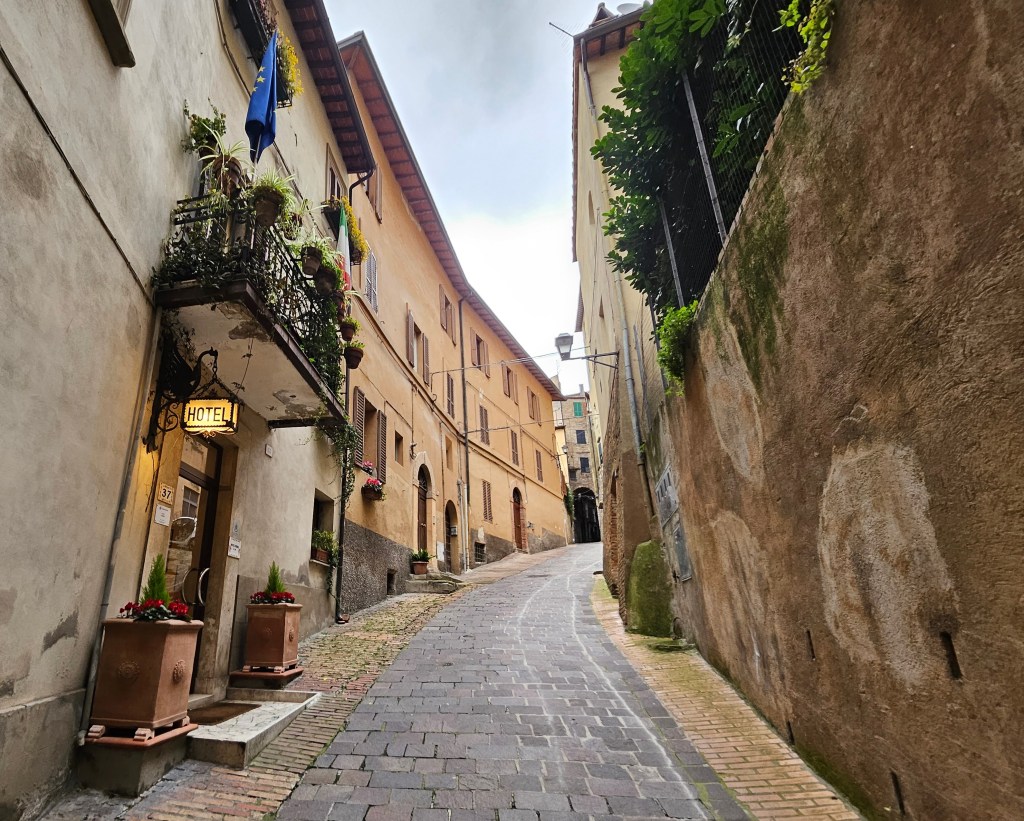
My next train brought me to to Perugia, arriving just before 5pm. Perugia is a hilltop city, whose station is in the valley below, so it was a long steep walk into town. My hotel was an old-fashioned establishment, located in a narrow side-street. After I had checked in I went for a short walk to see the main sights in the centre of Perugia.
For dinner that evening, I had identified a well-reviewed restaurant not far from my hotel, but when I went there shortly after it opened, it was already full. So I went to another establishment further down the same street. There I had pasta with beans and bacon to start with, followed by a pinsa (similar to to a rectangular pizza, but with a different base). When travelling by oneself, one can’t help but overhear conversations from adjacent tables. Perugia has an international university, so attracts people from many countries to study. A young woman with an older man arrived in the restaurant, and the woman negotiated with the restaurant staff in what seemed to be fluent Italian about having a table for five. They were shown to the table next to mine and talked to each other in Swedish. A third person arrived and the conversation immediately switched to German. When the final two of their group turned up, the language switched again and they all conversed in English.
Day 3 – Wednesday 2nd April 2025 – Perugia
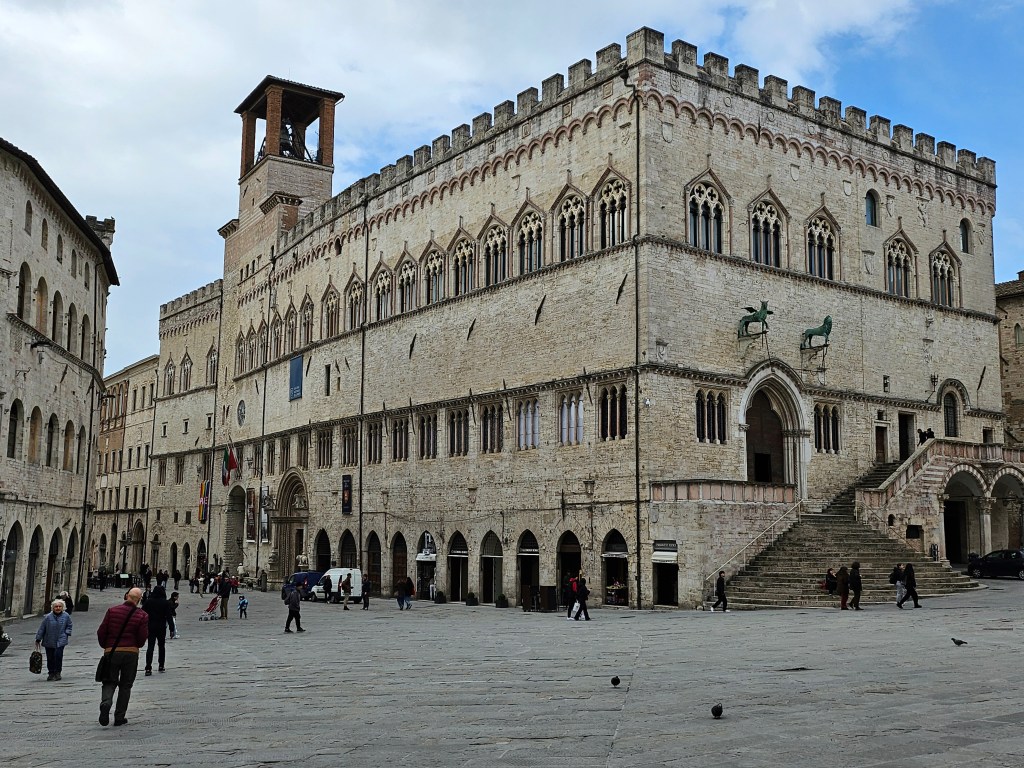
The National Gallery of Umbria, located on the upper floors of Perugia’s town hall, opens at 8:30am, so I went there to arrive shortly after it opened and had the place almost to myself. The permanent collection largely consists of an impressive collection of Renaissance religious art, most of which has been executed in exquisite detail. At the time of my visit there were also a couple of temporary exhibitions – one was on nature in art, containing works, mainly on loan from around the world, from Fra Angelico through to Camille Corot; the other was a collection of Robert Doisneau photographs.
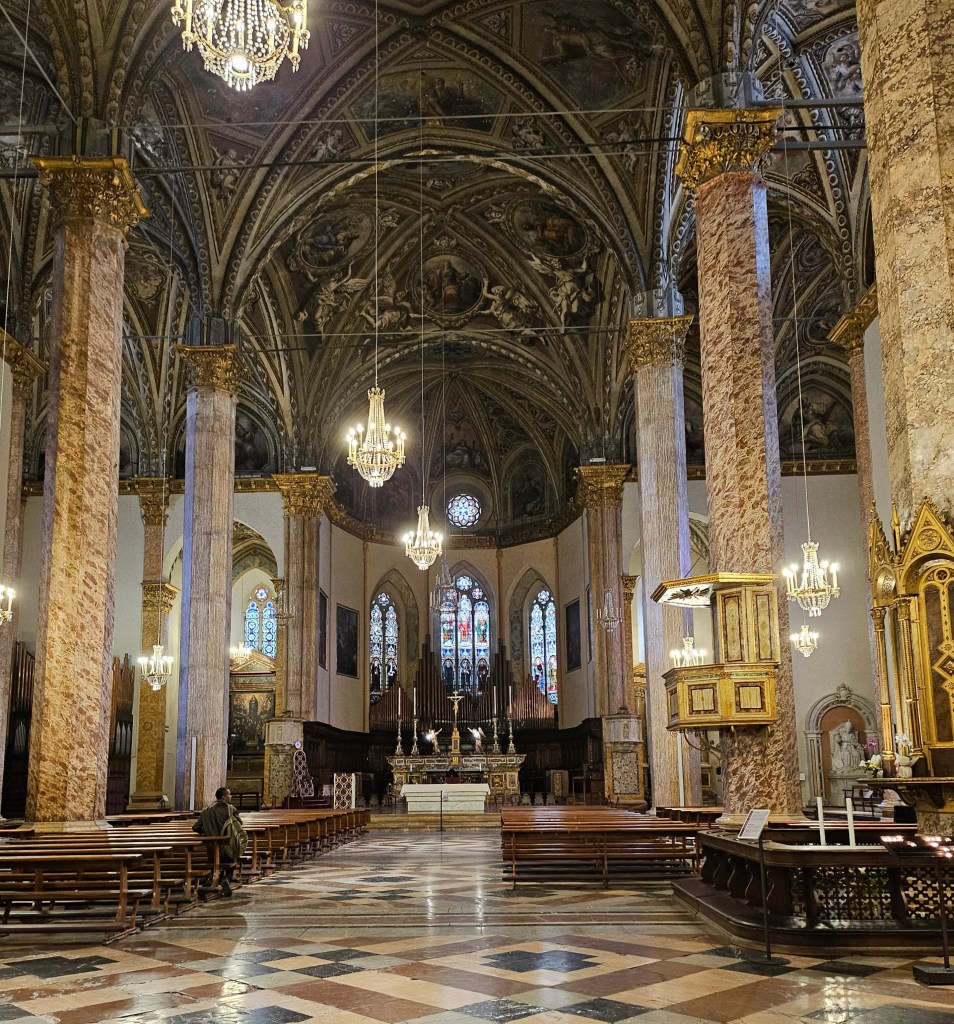
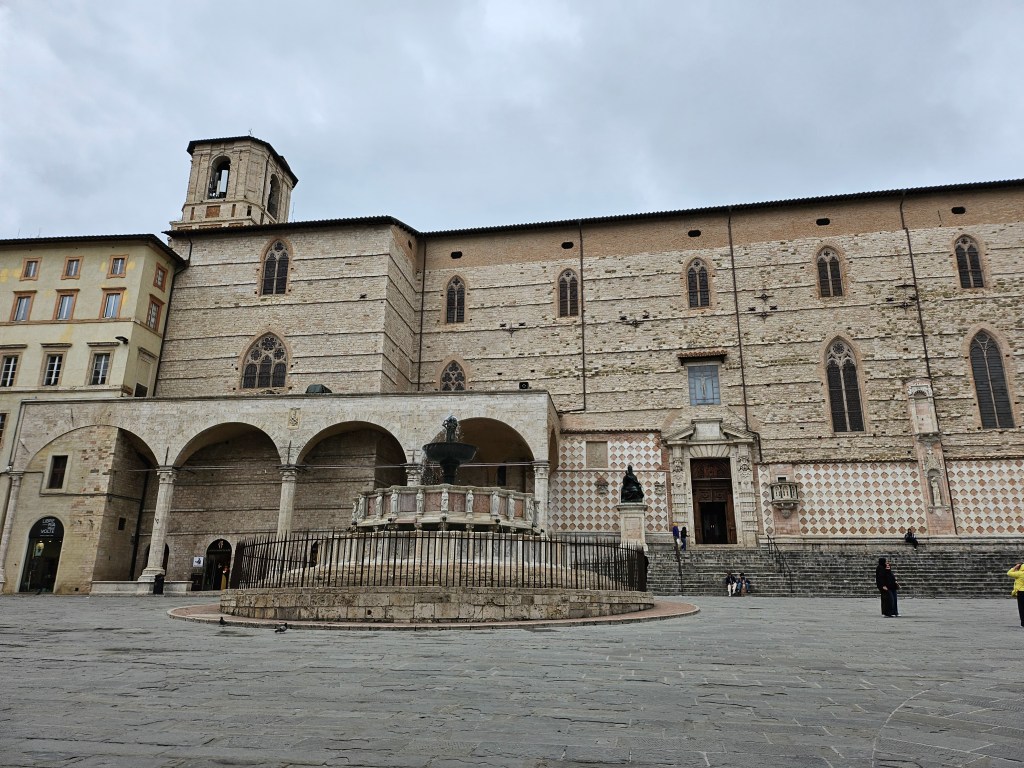
I next paid a visit to Perugia’s cathedral, just across the Piazza IV Novembre from the town hall. The cathedral is unusual in that it has half of one side facing the main square but, apart from the the rear façade, the rest of the exterior of the cathedral is enclosed by adjoining buildings. The cathedral, dedicated to St Lawrence, dates from the 10th century. There is liberal use of pink marble in the interior and it also had an impressive ceiling.
I then booked myself on a tour of of subterranean Roman Perugia. The tour was conducted in Italian, but I was given an electronic tablet to provide translation. The excavations were opened up after repair work following an earthquake in the 1970s. Perugia was burned to the ground in clashes between Octavian and Mark Antony in 40 BC – the scorch marks on some of the stonework could still be seen.

When I finished my tour, I looked round the nearby cathedral chapter museum, which has a number of artworks and other treasures from the cathedral. The cathedral contains the supposed wedding ring of the Virgin, which is brought out to be viewed once a year, and the museum contains a number of copies of the ring and other artefacts associated with it.
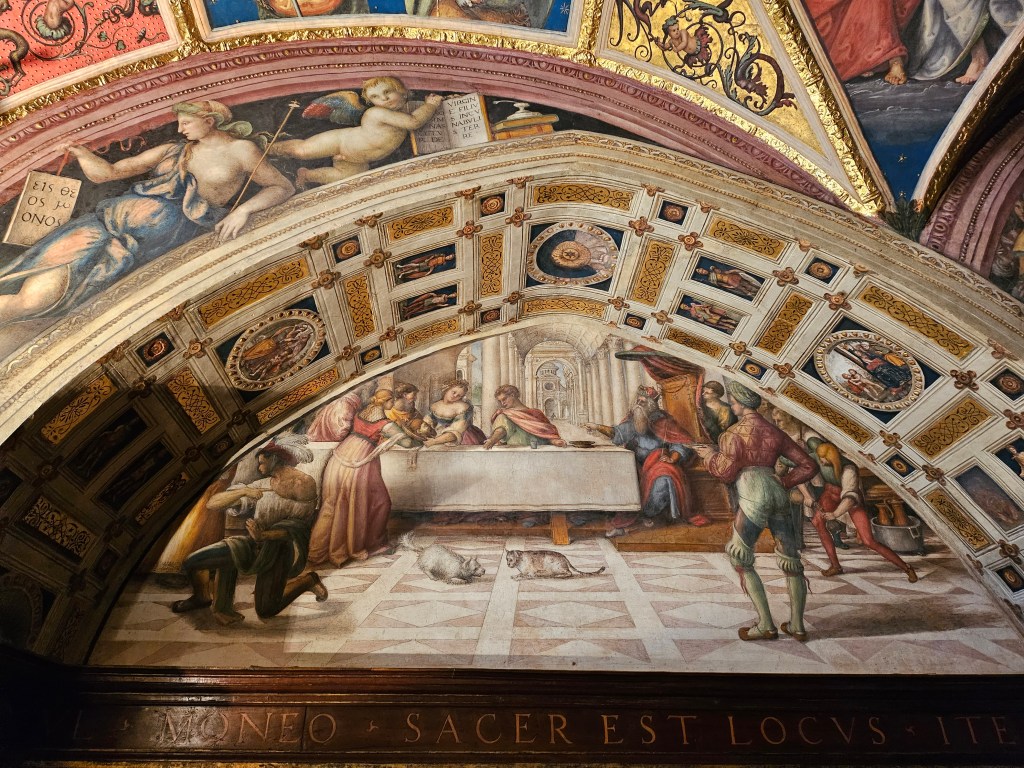
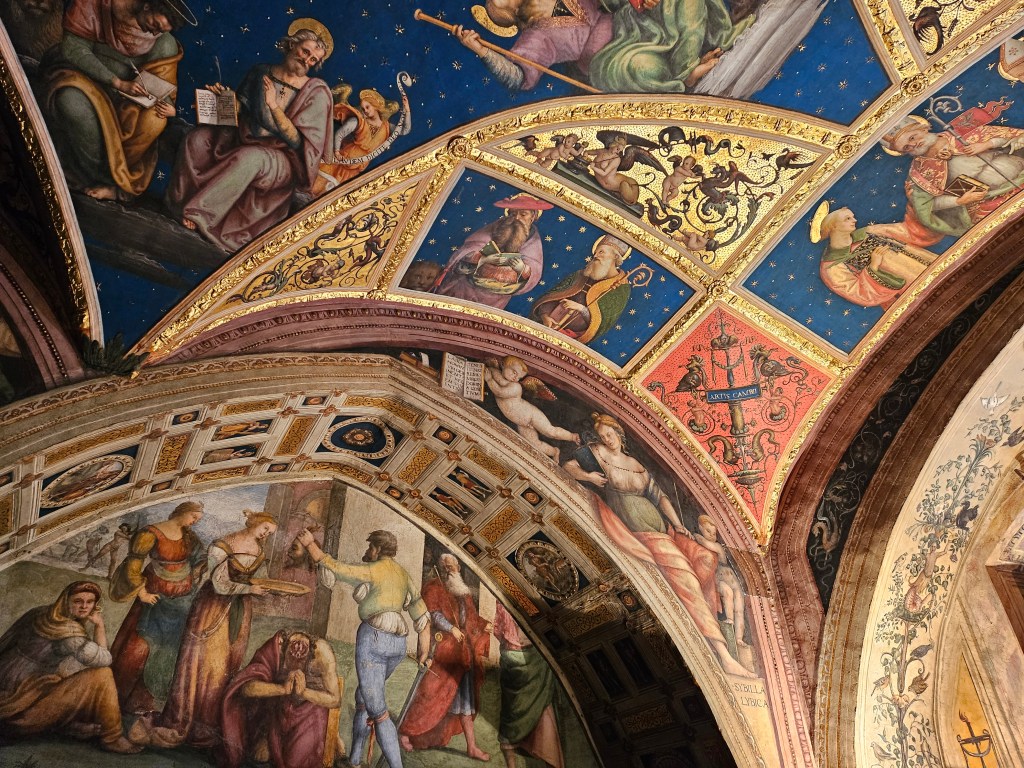
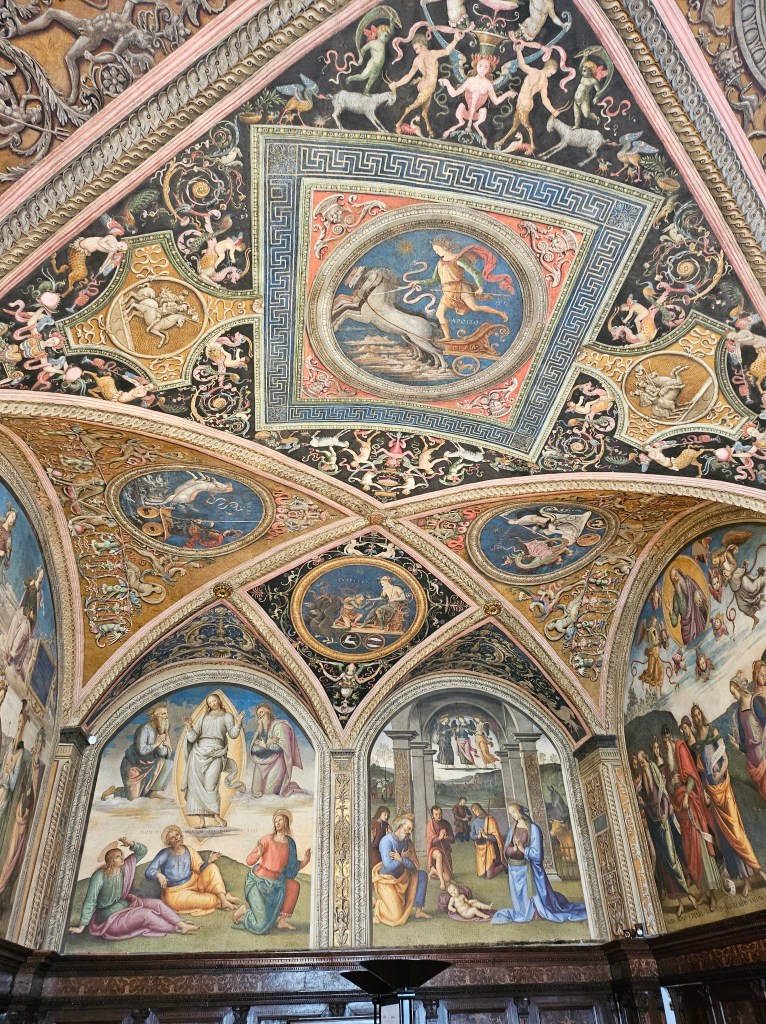
Also in the centre of Perugia, adjacent to the town hall, is the Collegio del Cambio. Its two main rooms are decorated with frescos by Pietro Perugino.
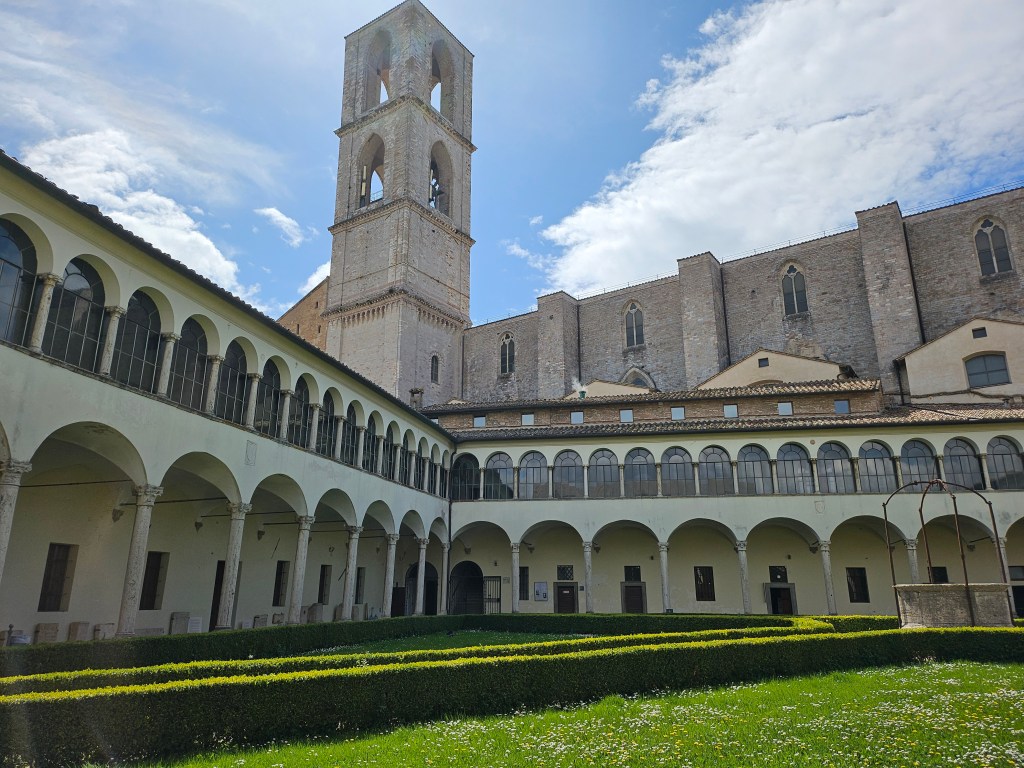
I then walked to the south of the city centre to visit the National Archaeological Museum of Umbria, located near the Basilica of San Domenico. Unfortunately the Basilica was only open that morning and by the time I arrived it had shut for the day. The museum is vast and sprawling occupying the buildings which surround the cloisters of the Basilica. Once again, I appeared to be the only visitor to the museum.
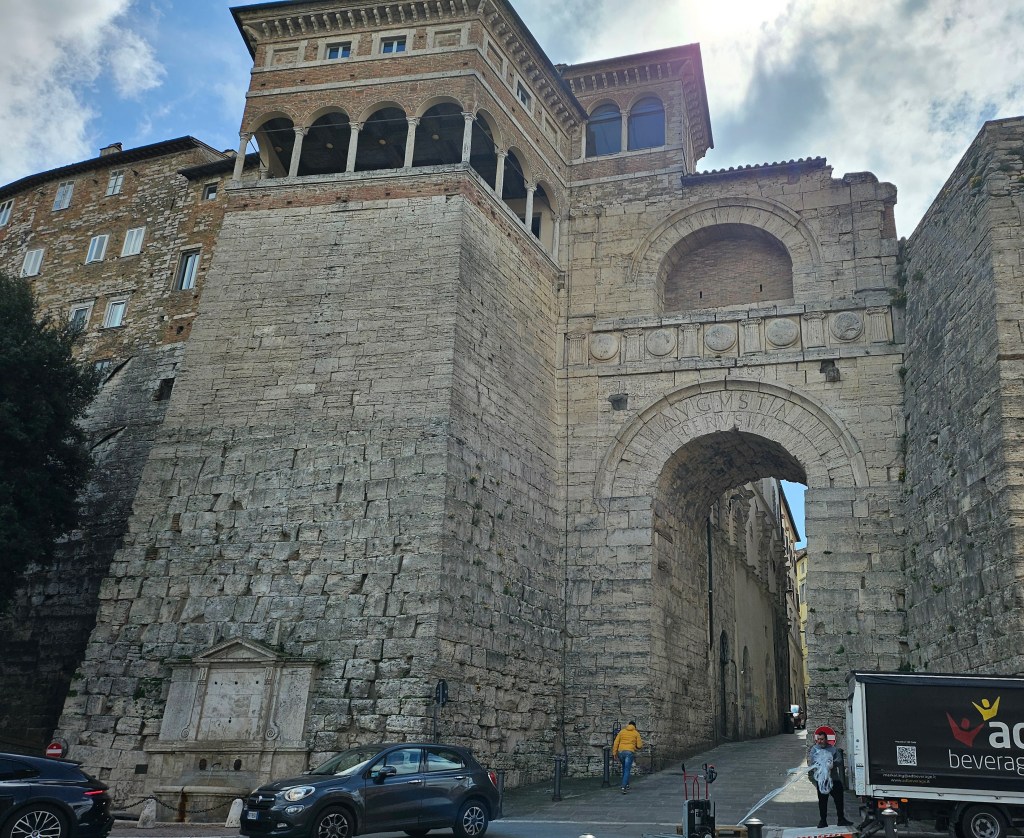
As the next places I wished to visit were not open until later in the afternoon, once I had finished in the Archaeological Museum, I took the opportunity to take a walk round the other parts of Perugia that I had not yet visited. This included walking along the Roman aqueduct that once used to supply water to the city and going past the Etruscan Arch, one of the surviving massive gates through the city walls.
When I had finished my walk, the Museo Baldeschi had opened. Housed in a former palace, in addition to a collection of Renaissance art, it also displays the private collection amassed by the art historian Alessandro Marabottini, ranging from the 16th to 20th centuries.
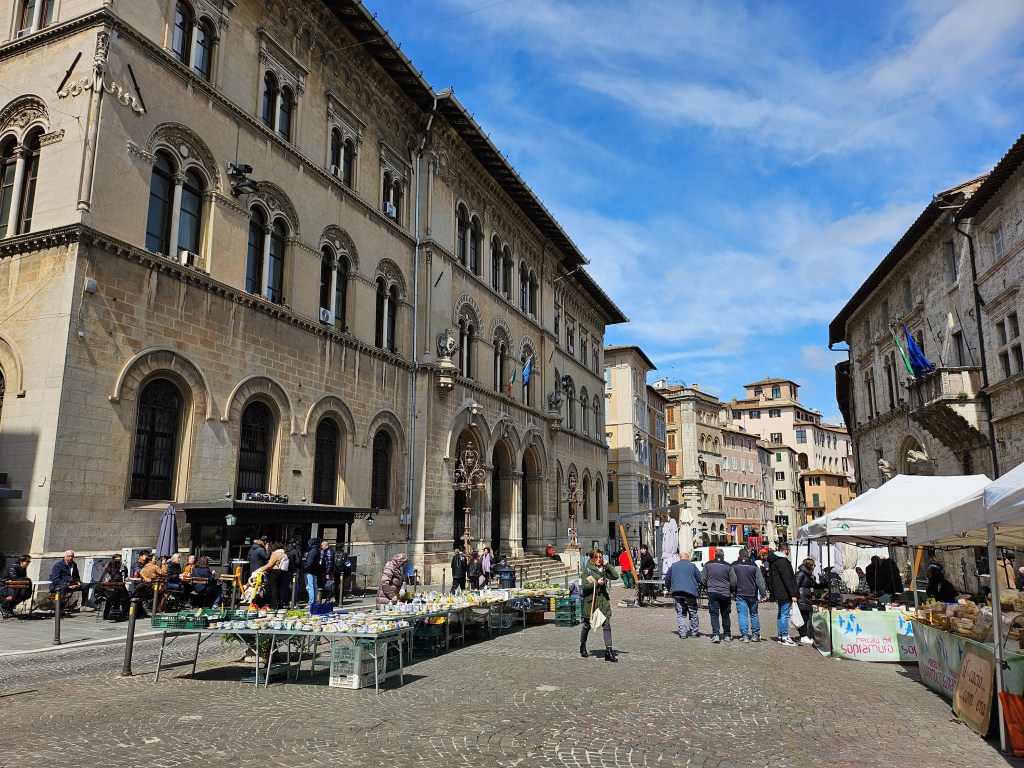

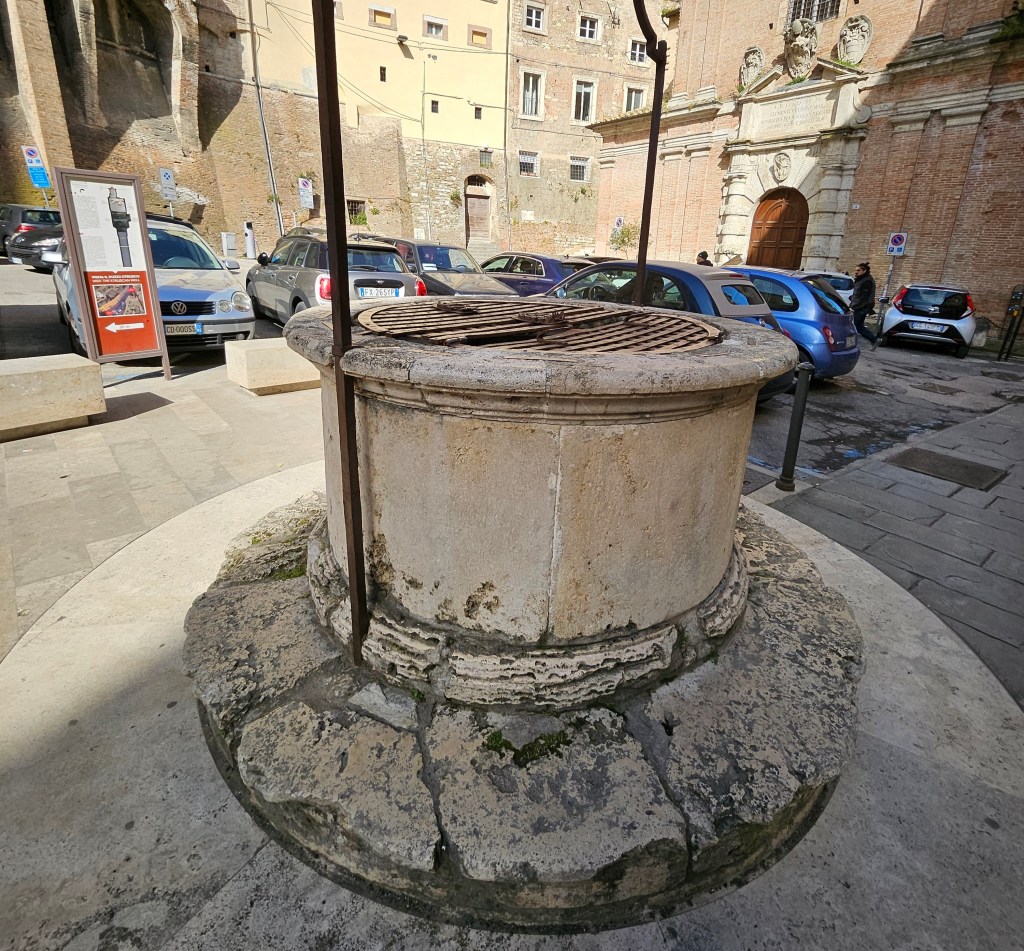
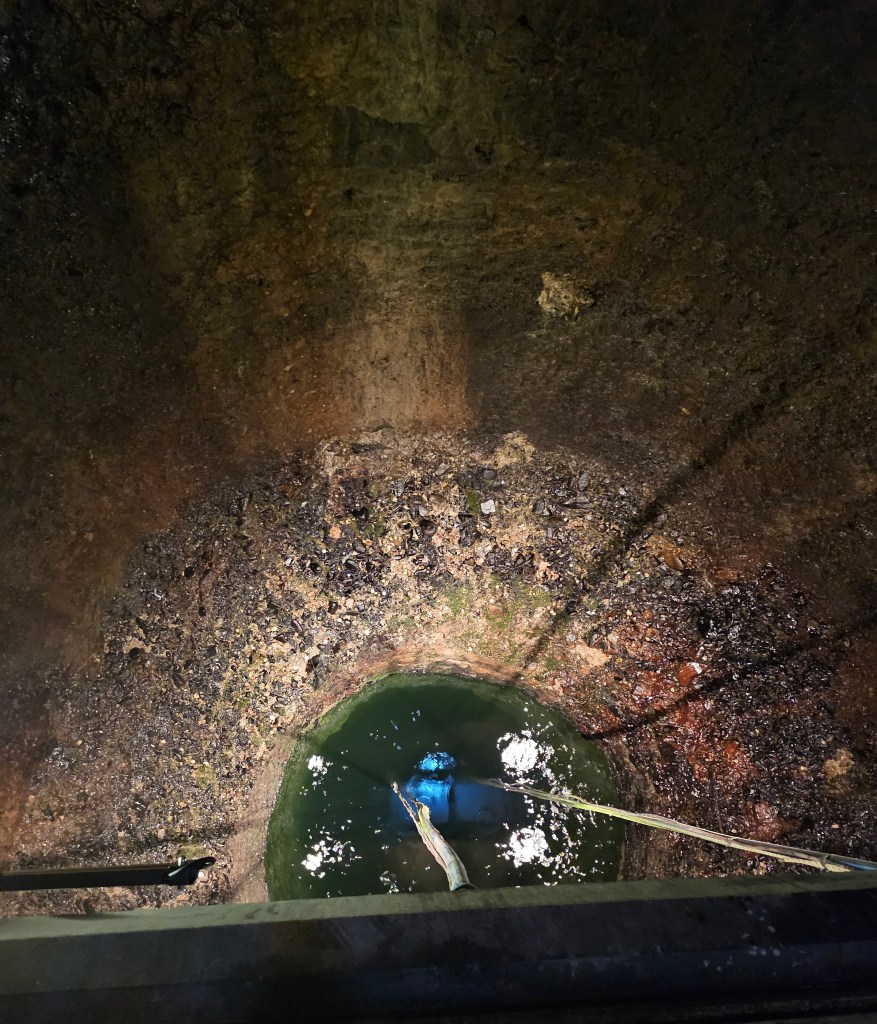
My final visit of the day involved descending below ground again, this time to view the Etruscan Well, which was first dug in the 3rd century BC, although the structure has been strengthened and repaired many times over the intervening years.
Before going out to dinner, I visited Perugia’s main post office to send a postcard home, which took three days longer to arrive than the one that I had sent from Barcelona a few weeks earlier.
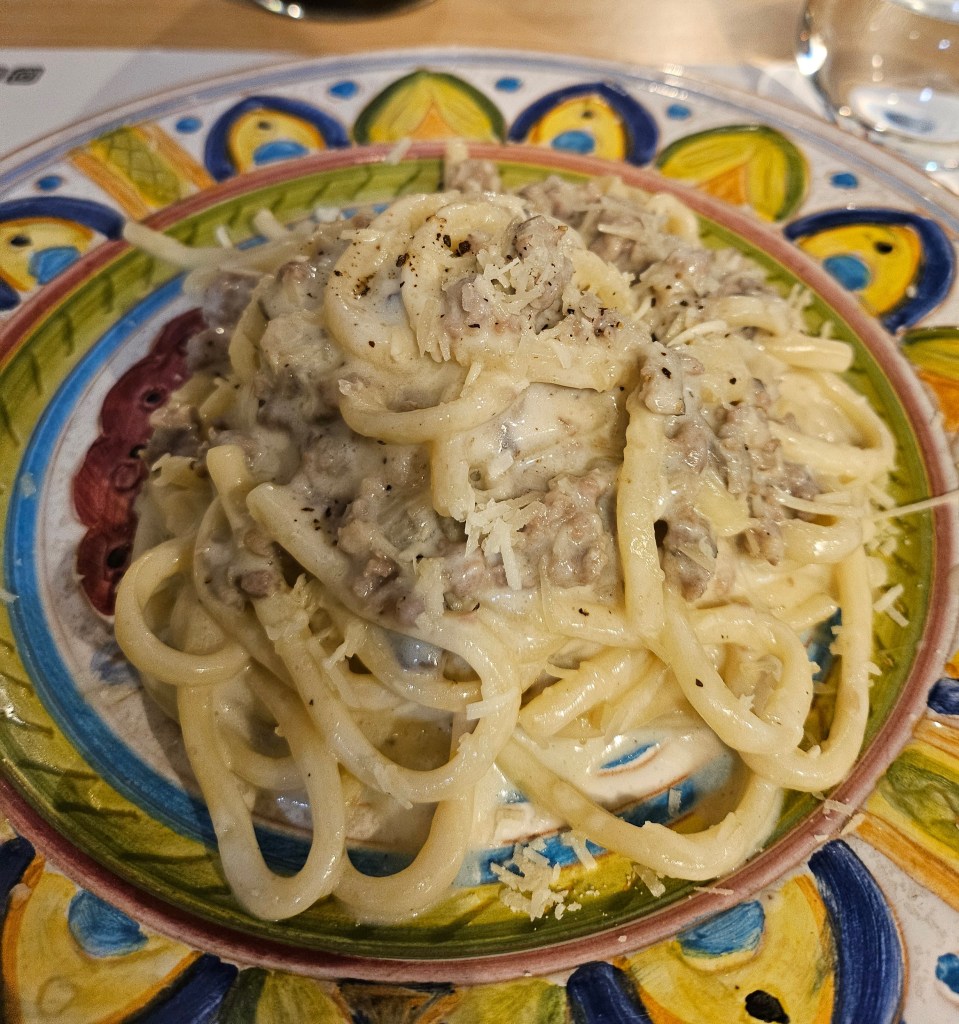
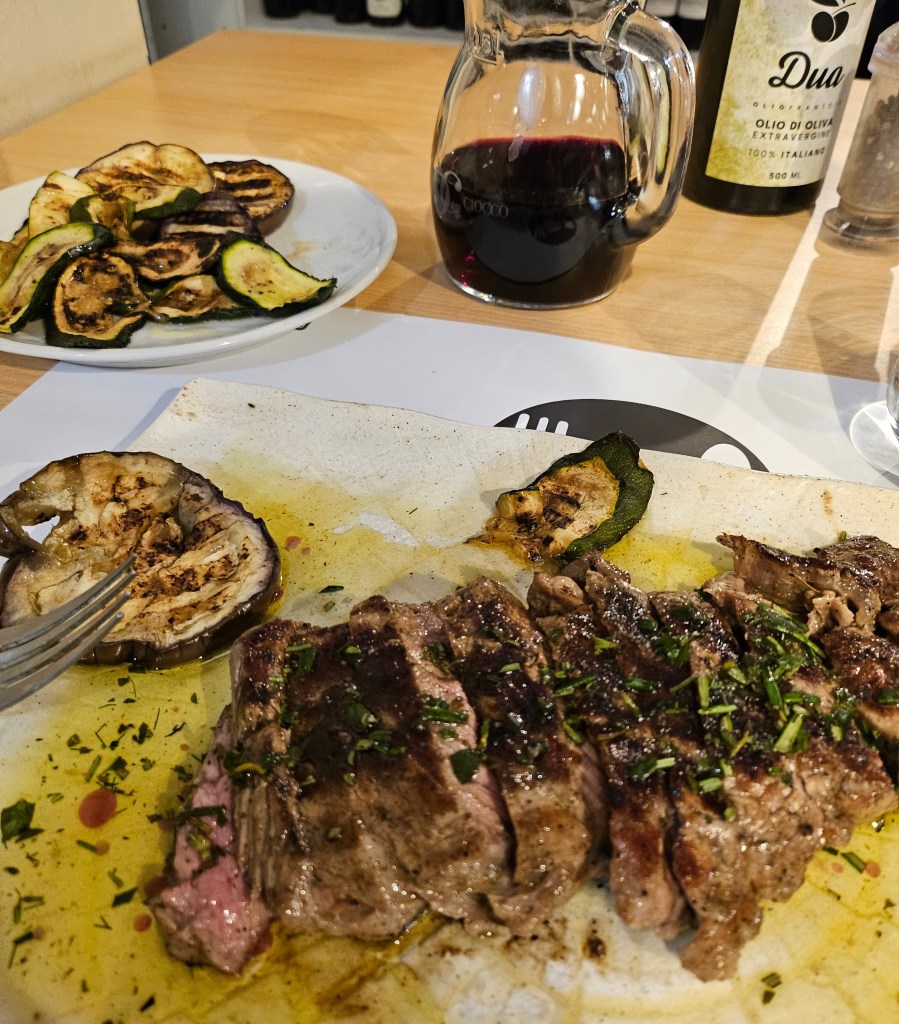
I came across the restaurant I chose for dinner while on my walk round Perugia. Not having booked, I arrived at about the time it opened to ensure getting a table. I started with an Umbrian speciality, strangozzi alla norcina, which was pasta with finely chopped sausage. I followed this with beef tagliata with grilled vegetables. I had a carafe of red wine to accompany my food.
Day 4 – Thursday 3rd April 2025 – Perugia to Siena
An early start was required to catch my train from Perugia station. The walk to the station was less taxing than the walk from the station, as it was downhill all the way. However, retracing the route I came involved going through a park and I was not sure if the park would be open early in the morning. The park was open, and no detour was required, so I arrived at the station in plenty of time for my 08:04 departure.
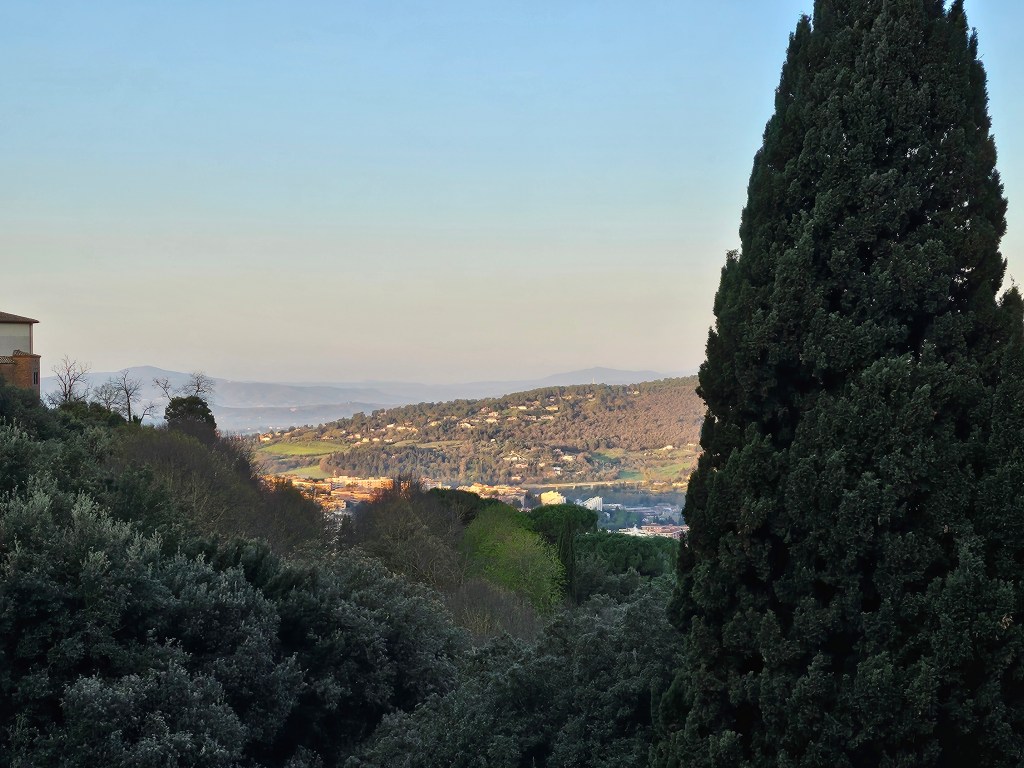
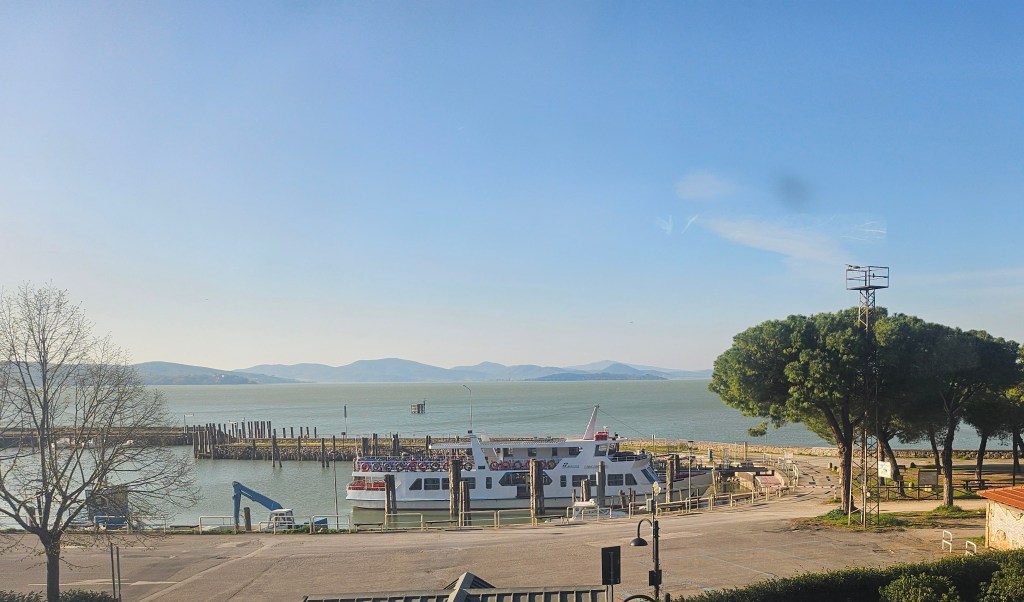
When I arrived at Perugia station the departure boards were confusingly showing two departures going in opposite directions at 08:04 from the same platform. I thought this could not be correct, as neither train was starting in Perugia. The logistics of having the trains cross each other’s paths and then depart from the same platform simultaneously seemed impossible. My thoughts were correct and shortly before 8am the platform shown for the train going in the opposite direction was changed to the one across the tracks from mine. This caught out some unobservant passengers, who only realised that their platform had changed just before my train arrived. My train was seven minutes late coming into Perugia, but as the line into the city is single track, the other train could not leave until mine arrived, which was fortunate for the unobservant passengers intending to go in the other direction. The seven minute delay caused me some concern, as I had only 20 minutes for my first connection and, unlike on Tuesday, there was no convenient alternative if the connection was missed. After calling at various suburban Perugia stations, including one for the university, the train’s delay grew to over ten minutes which added to my anxiety. After leaving Perugia much of the train’s route was along the shore of Lake Trasimeno, the fourth largest lake in Italy (and only a little smaller than Lake Como). I needn’t have worried about the delay, as I discovered that Italian timetables have a lot a padding in the scheduled arrival time at the train’s final destination. Despite being over 10 minutes late for most of its journey, we arrived Terontola-Cortona station just one minute behind the advertised arrival time.
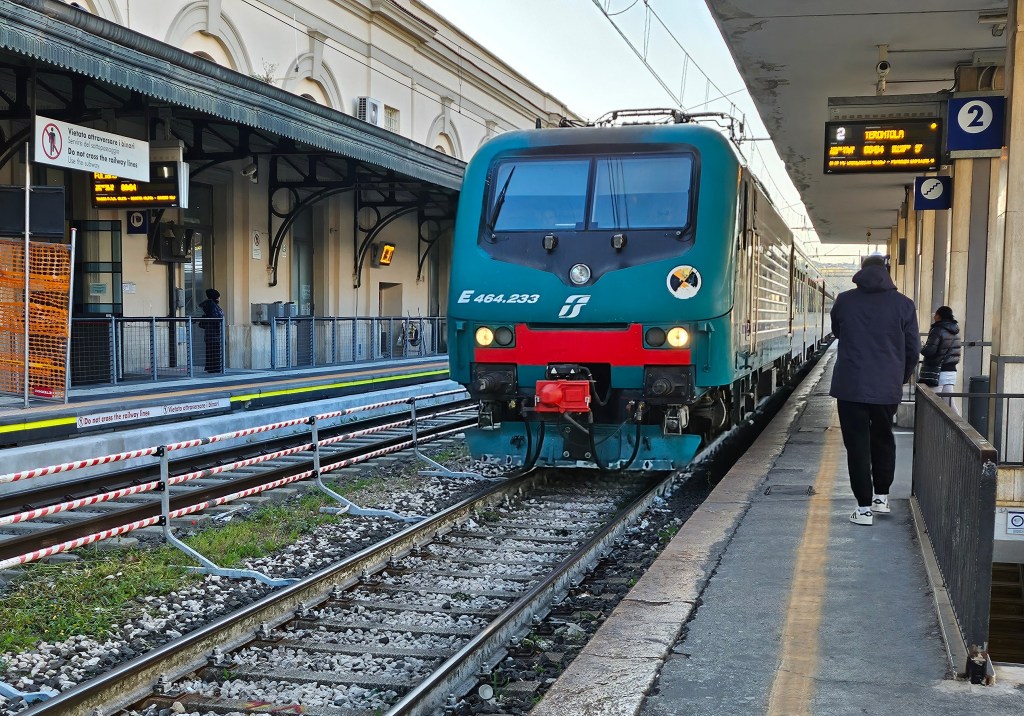
The station is located in the small town of Terontola which is over six miles from the hilltop town of Cortona after which the station is jointly named. My next train for the short ride to Chiusi-Chianciano Terme station was on time. It was the only double-decker train I was to ride on on this trip and the carriage I occupied was completely empty apart from me.
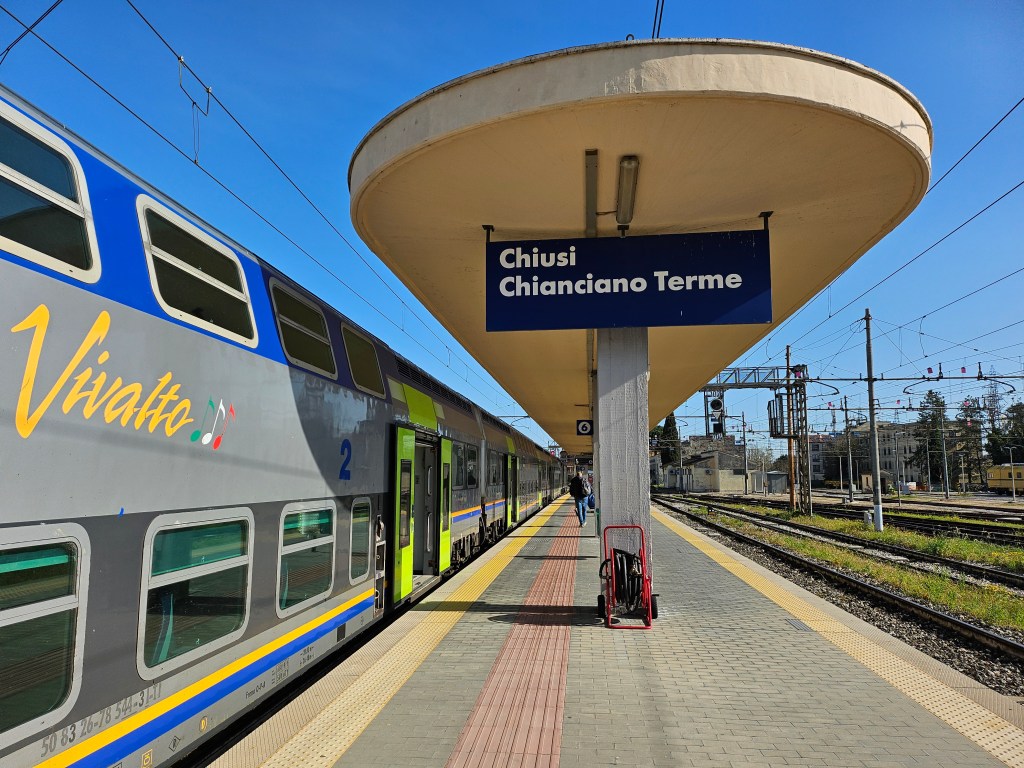
I had an hour for my connection at Chuisi-Chianciano Terme station. Unfortunately this station is in neither Chuisi nor Chianciano Terme, which are, respectively, two and twelve miles away. It is basically a junction, with just a small settlement outside the station, which did not take me long to explore.
The final train of the day would take me to Siena. It was already sitting in its platform when I arrived in Chuisi-Chianciano Terme, but its doors were only opened to let passengers on board about 15 minutes before departure. The line to Siena is not electrified and although the train being used was a hybrid, with the potential to be powered from overhead electric wires, the pantographs were not used on this route. The train departed on time and arrived in Siena a few minutes early, at around noon.
Like Perugia, Siena is a hilltop city. However, the walk from the station is made a lot easier by a series of linked escalators, initially through a shopping centre, which take you nearly to the old city by the Camollia Gate. The weather in Siena was noticeably warmer than it had been during my time in Perugia, where a chilly wind had been blowing. I called in at my hotel to drop off my bag, but as the room was ready they let me go to it. For my first three nights in Italy, I had stayed in rather cramped single rooms, but I received a free upgrade of my hotel room in Siena, which seemed palatial in comparison.
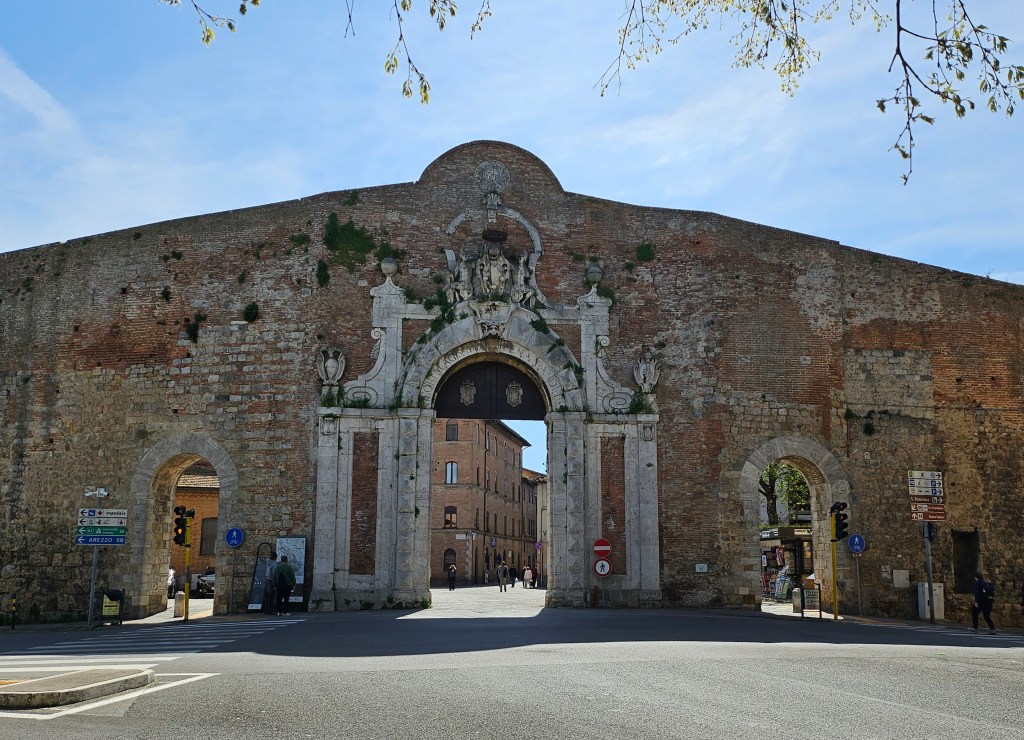
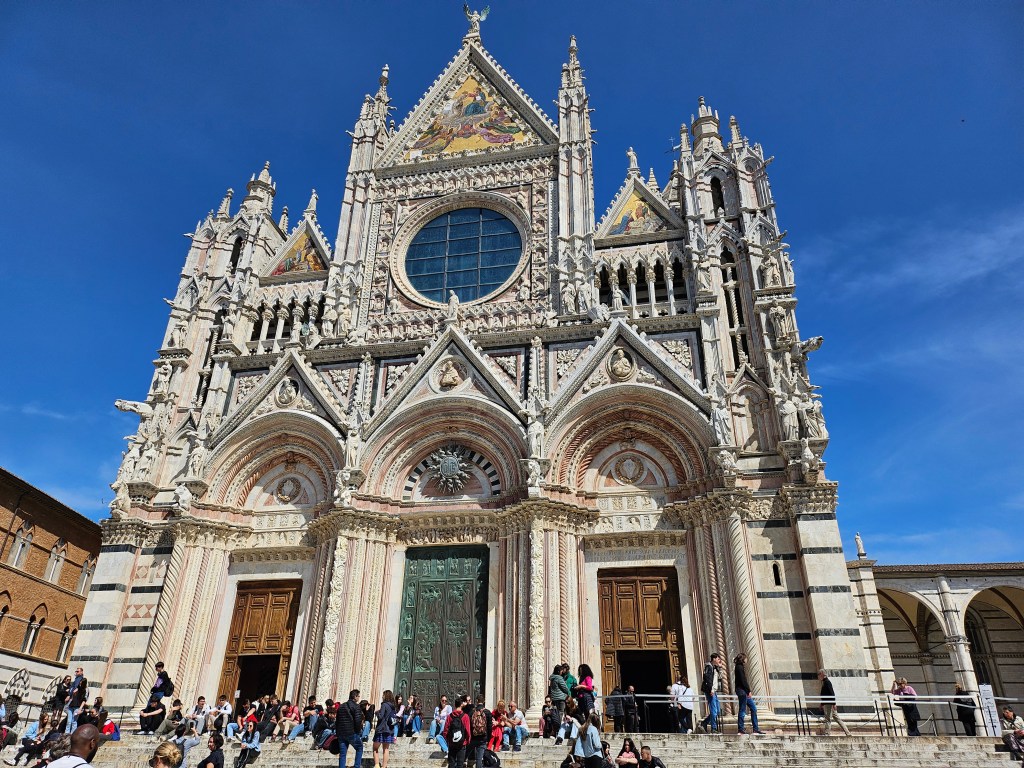
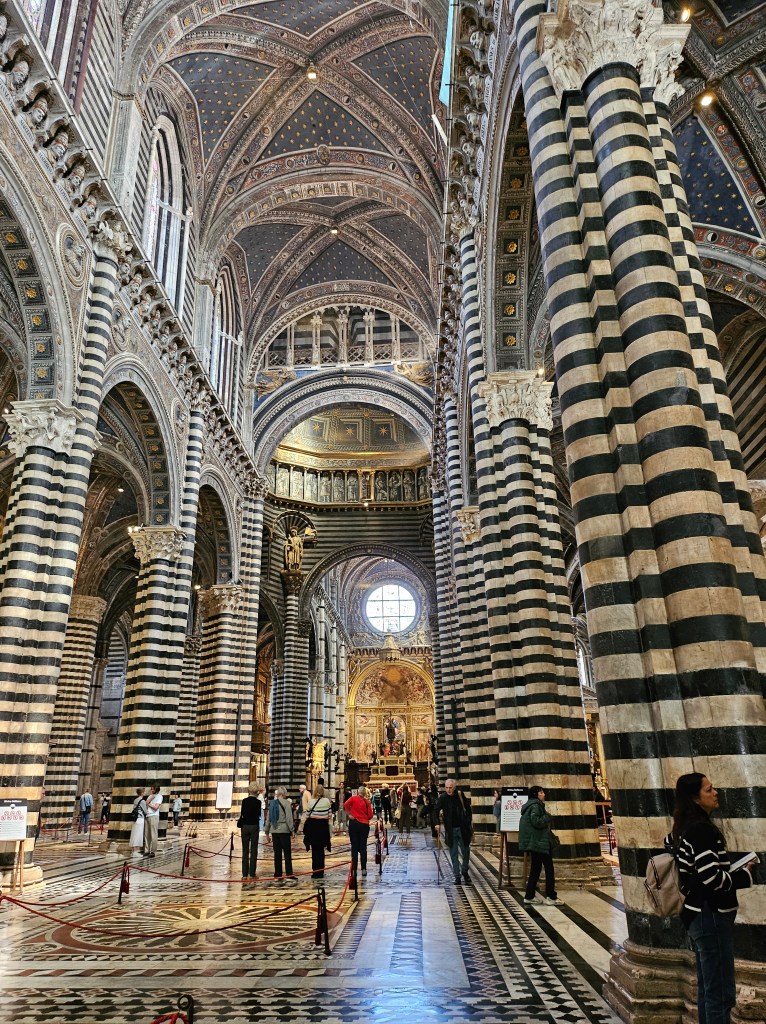
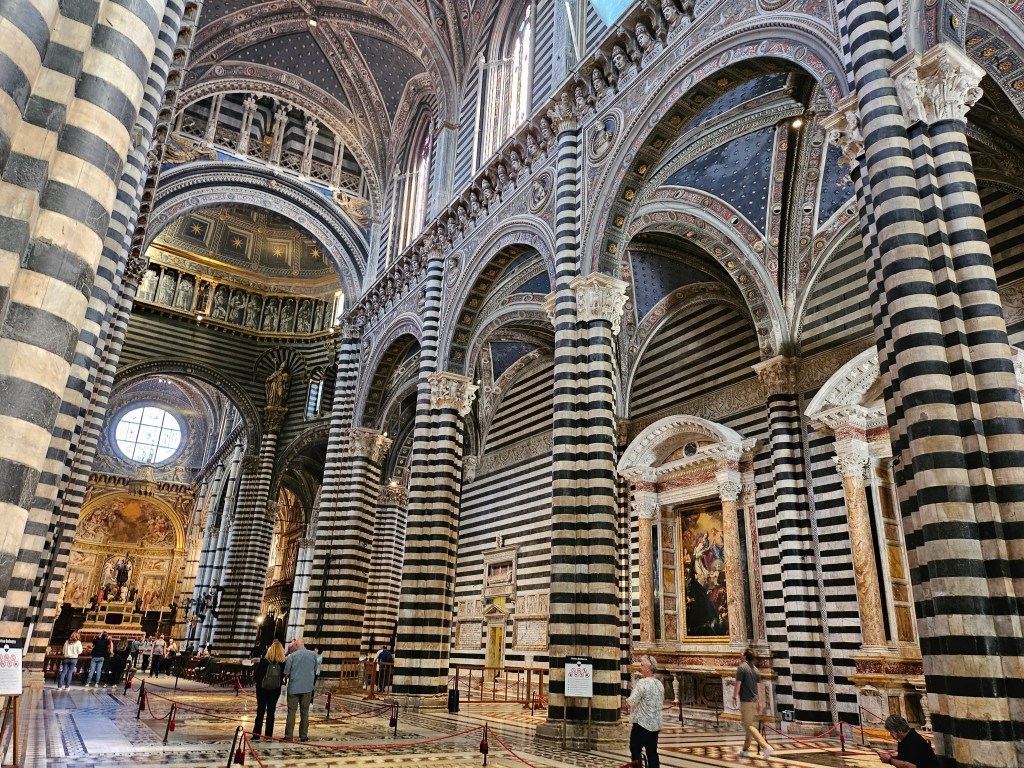
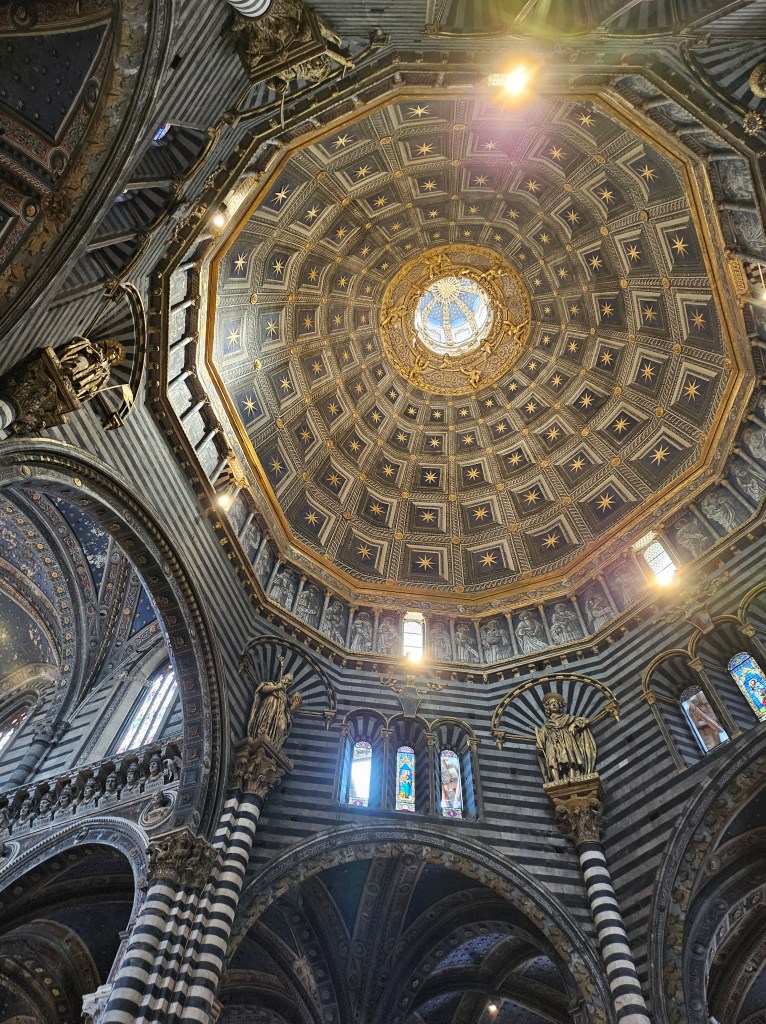
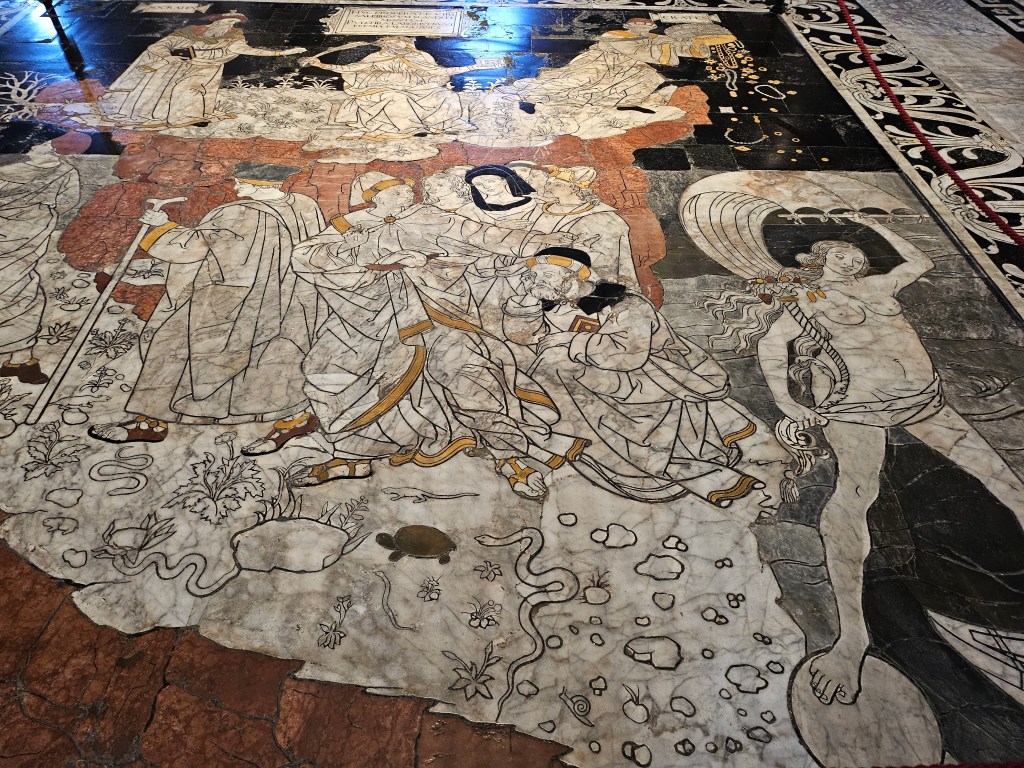
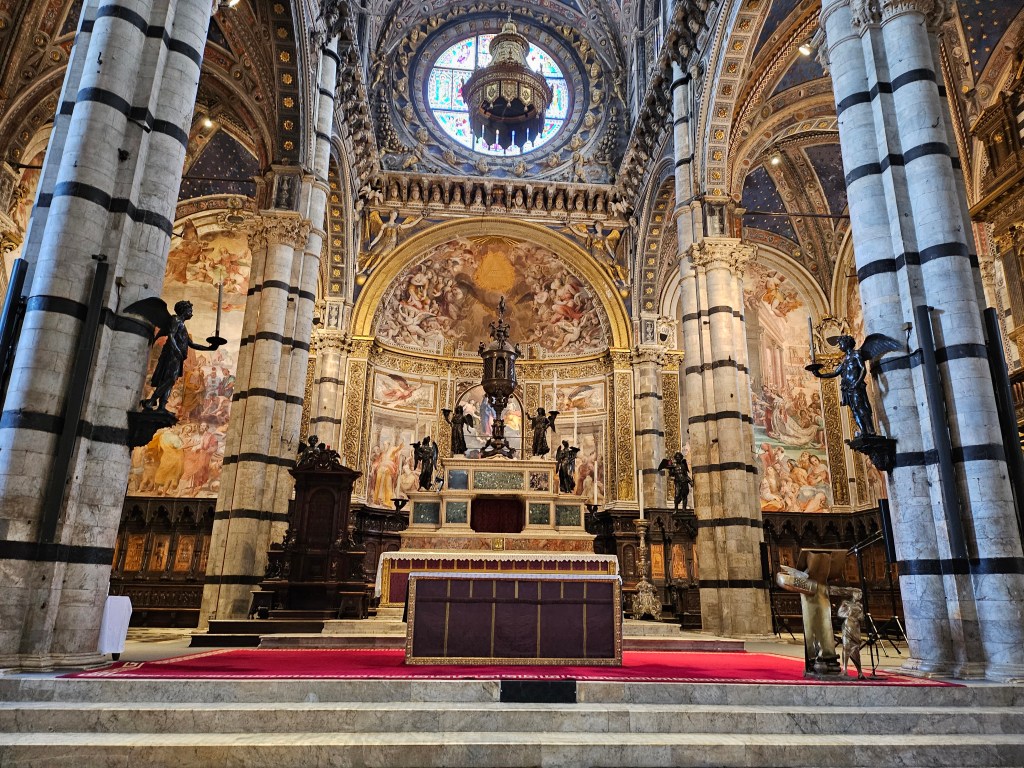
I wasted no time before setting off again to visit Siena Cathedral. My initial challenge was to work out which of the various combination tickets that were on offer provided best value for the parts that I wanted to see. I went first to the main part of the cathedral, entering through the impressive southern façade. Given the length of the roped off lanes to queue for access, it must get very busy at times. However, when I went there was no wait to get in and it wasn’t particularly crowded once inside. The cathedral, dedicated to the Assumption of the Blessed Virgin Mary, was completed in the 13th century. The interior is notable for its striped black and white marble columns and mosaics that adorn the floor. However the floor near the altar, where chairs for the congregation have been placed, was covered at the time of my visit. The floor is only fully uncovered for a brief period during high summer. There is a magnificent octagonal pulpit by Pisano. Accessible from the nave is the Piccolomini Library, whose walls are covered with colourful frescos depicting scenes from the life of Pope Pius II.
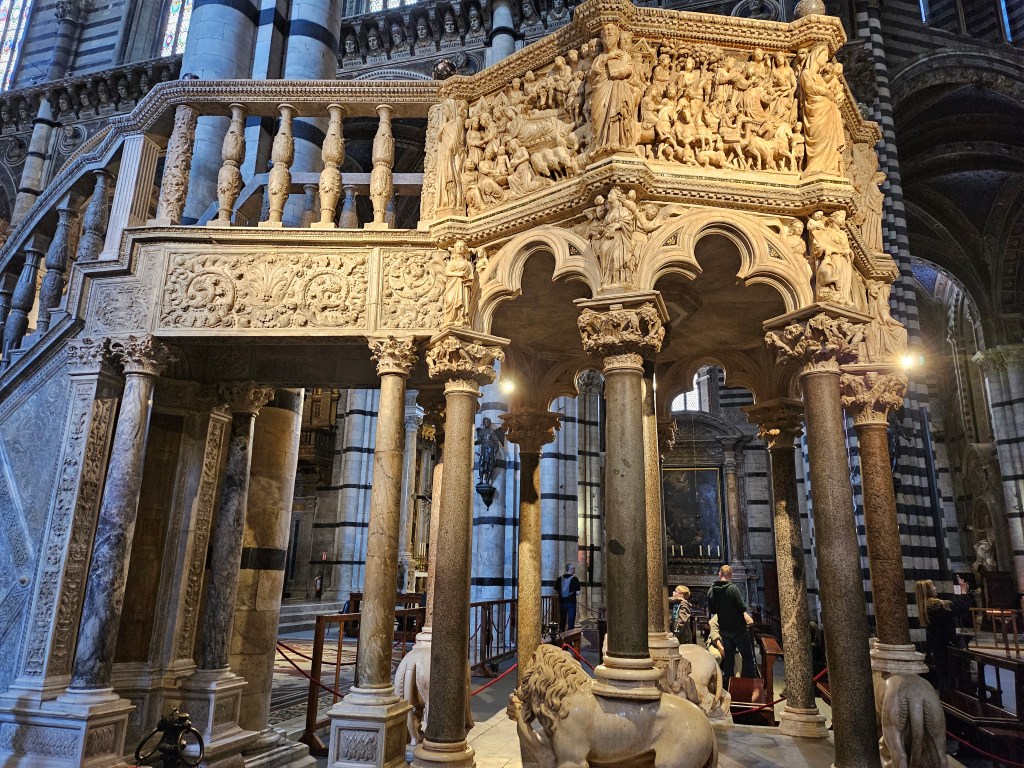
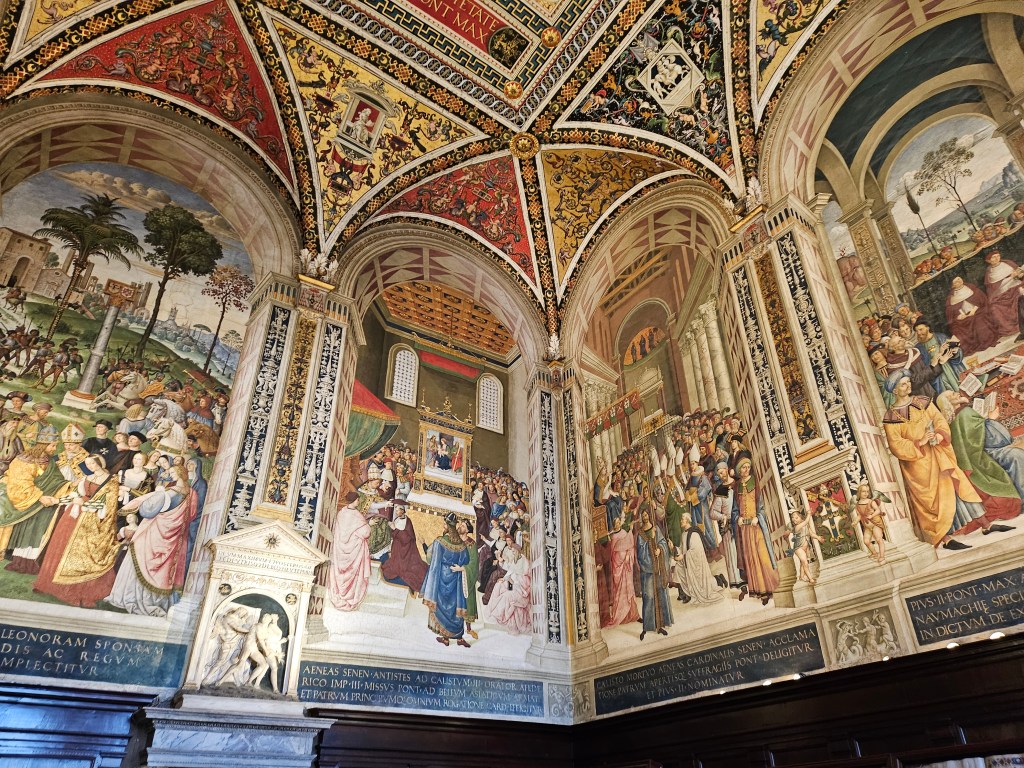
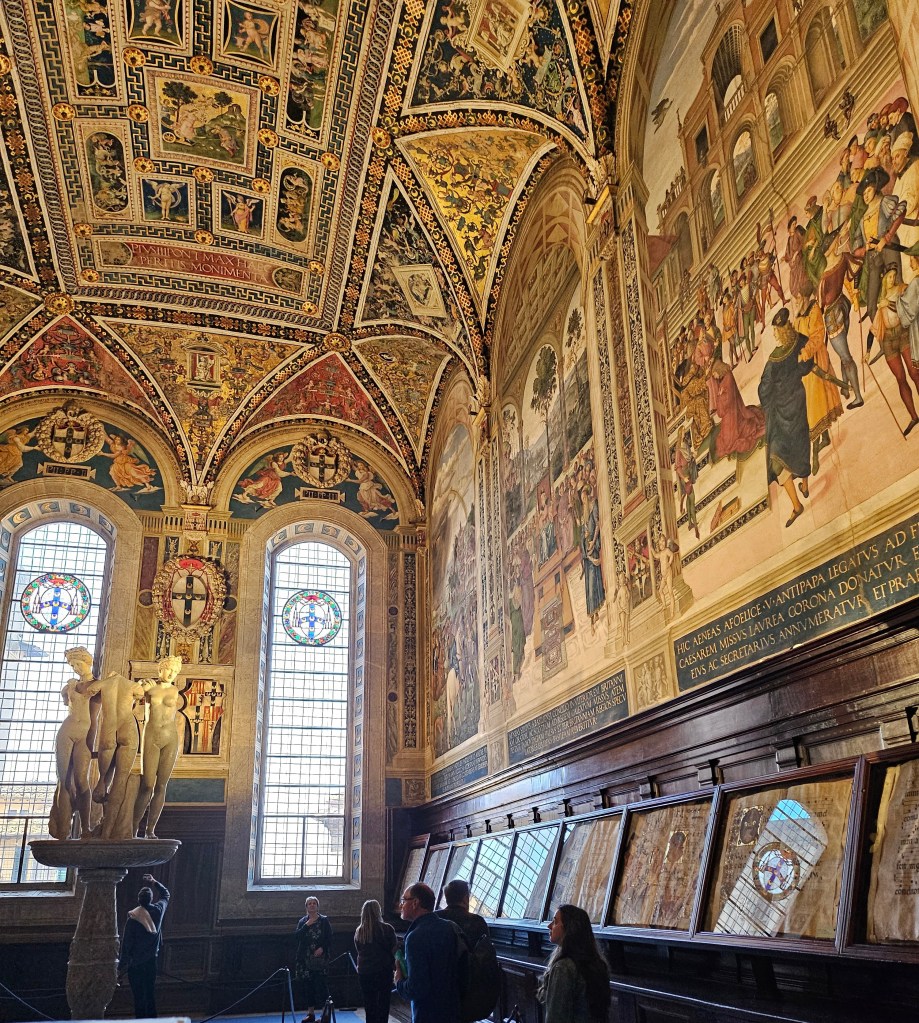
The crypt under the cathedral was only rediscovered during renovation work in 1999. This is accessed through a separate door on one side of the cathedral. When first rediscovered it was full of rubble, but careful removal of this revealed 13th century frescos depicting scenes from the Bible.
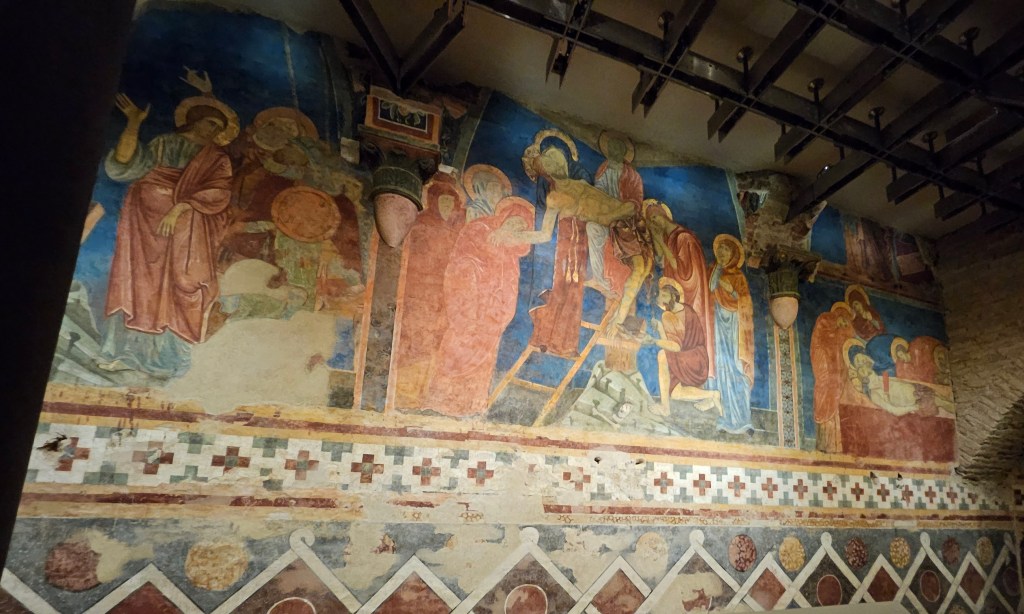
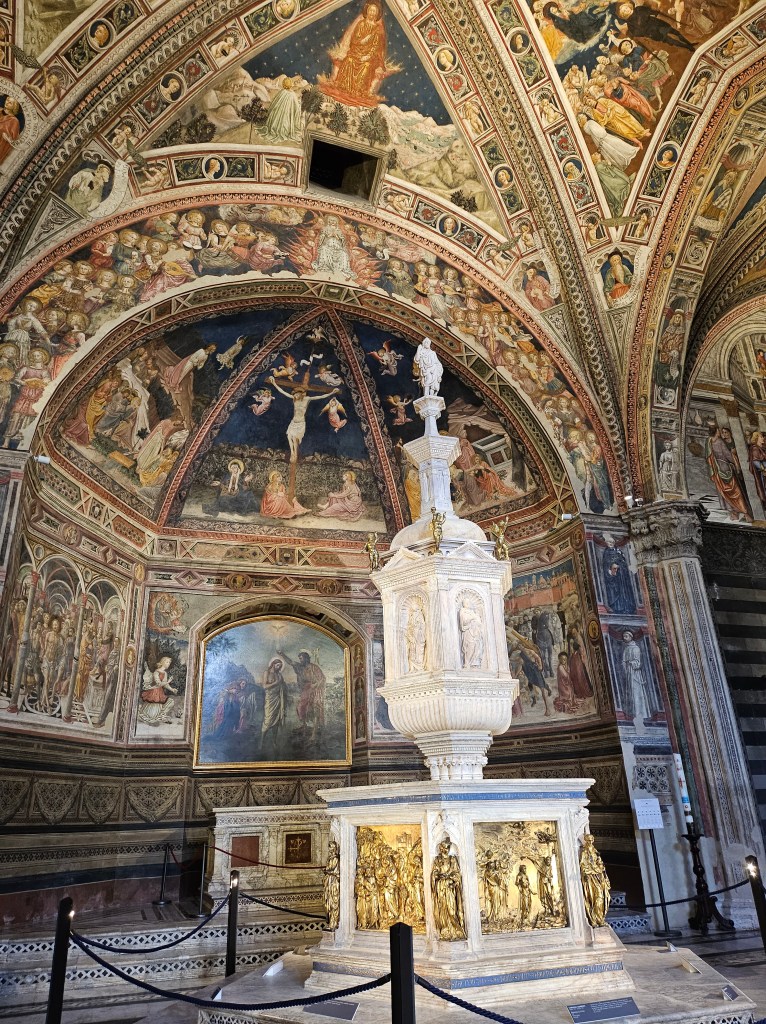
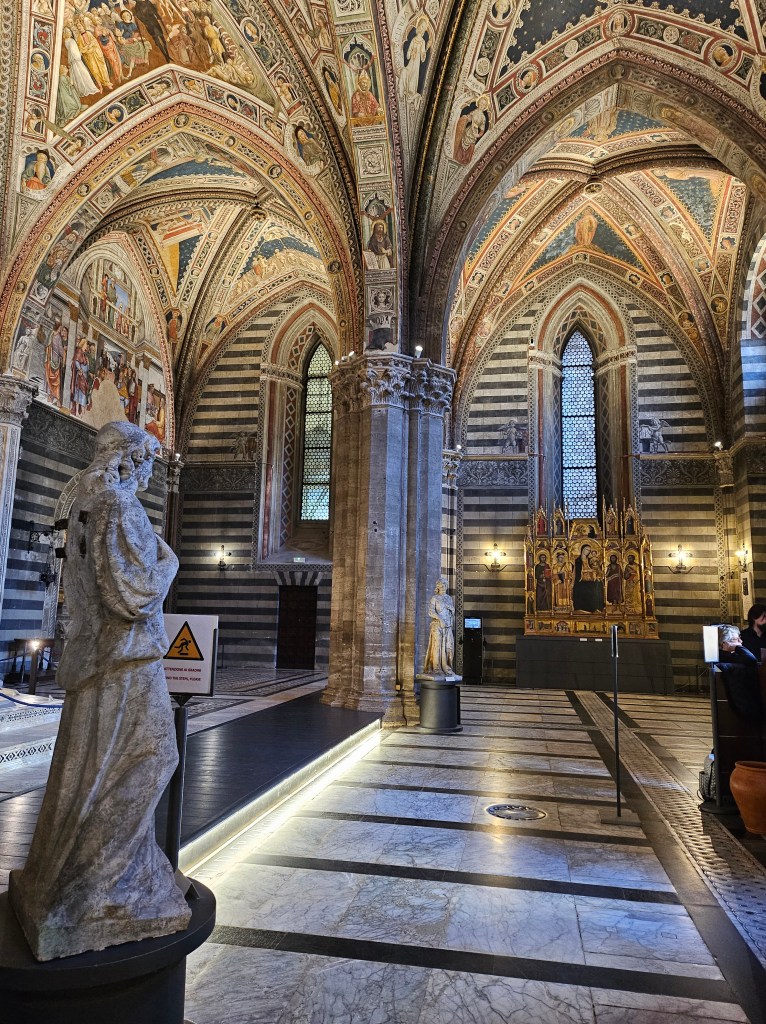
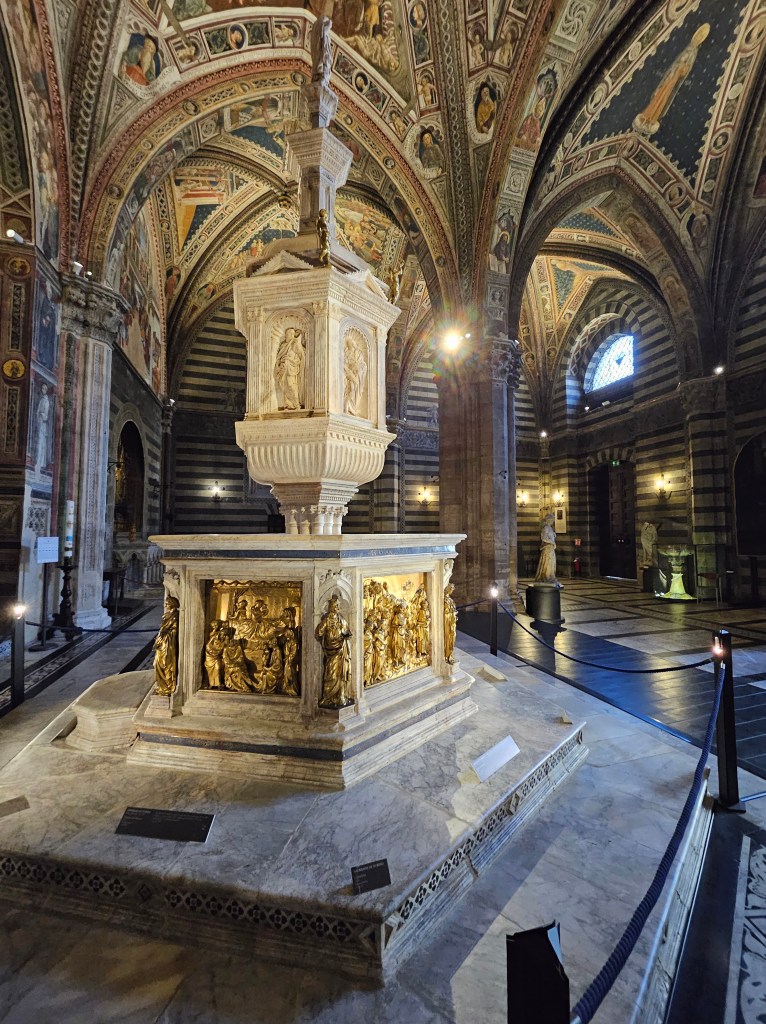
The cathedral’s baptistry is housed in its own building and accessed though another external door. The hexagonal baptismal font is surrounded by panels by, amongst others, Ghiberti and Donatello. The walls of the baptistry are covered in frescos by a number of artists.
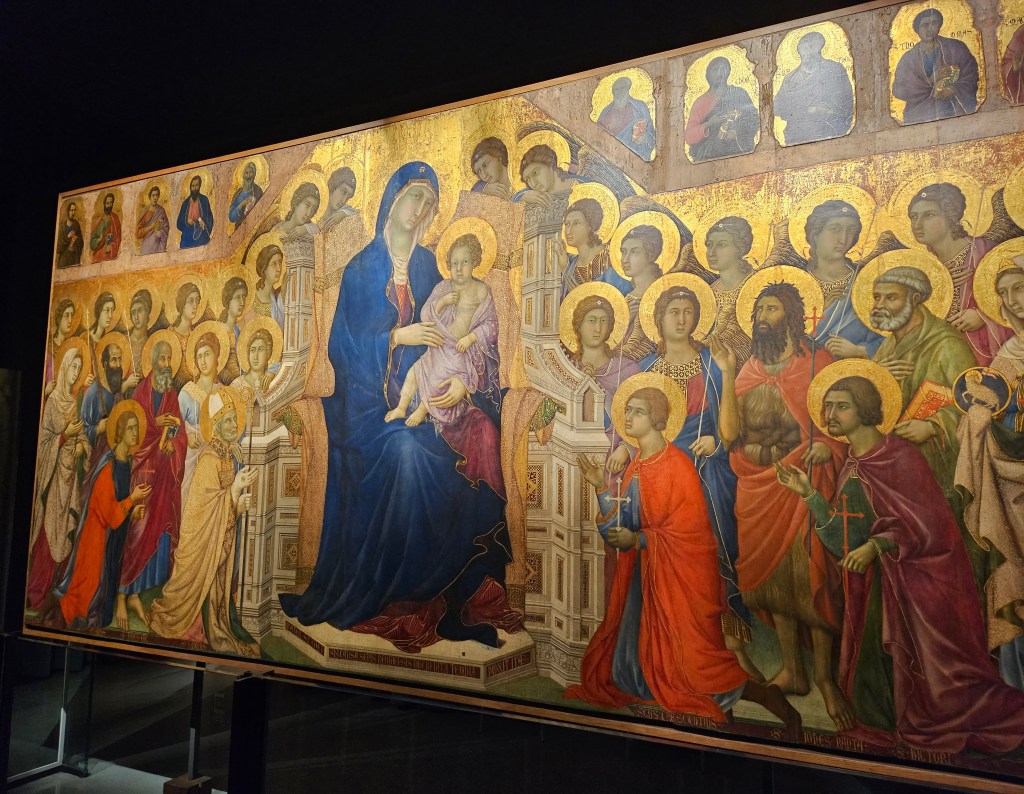
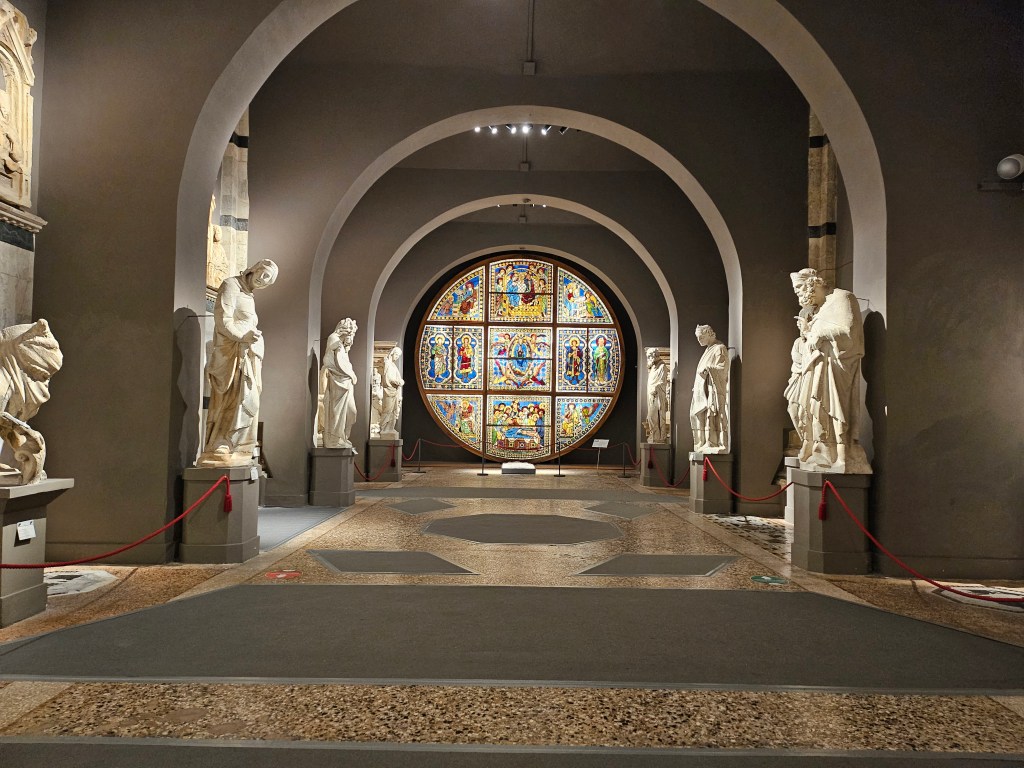
Opposite the cathedral is its museum, the Museo dell’Opera. As well as the cathedral’s treasures, the museum contains a number of artworks, some rescued from other churches in the area. It also contains the original stained glass rose window from the cathedral, by Duccio.
In the 14th century a major extension to the cathedral was started. However, the Black Death and the recession which followed, together with some dodgy foundations, scuppered the completion of the extension. All that remains is the outer wall of the extended nave. You can access this from the Museo dell’Opera and climb to the top with good views over the cathedral and beyond.


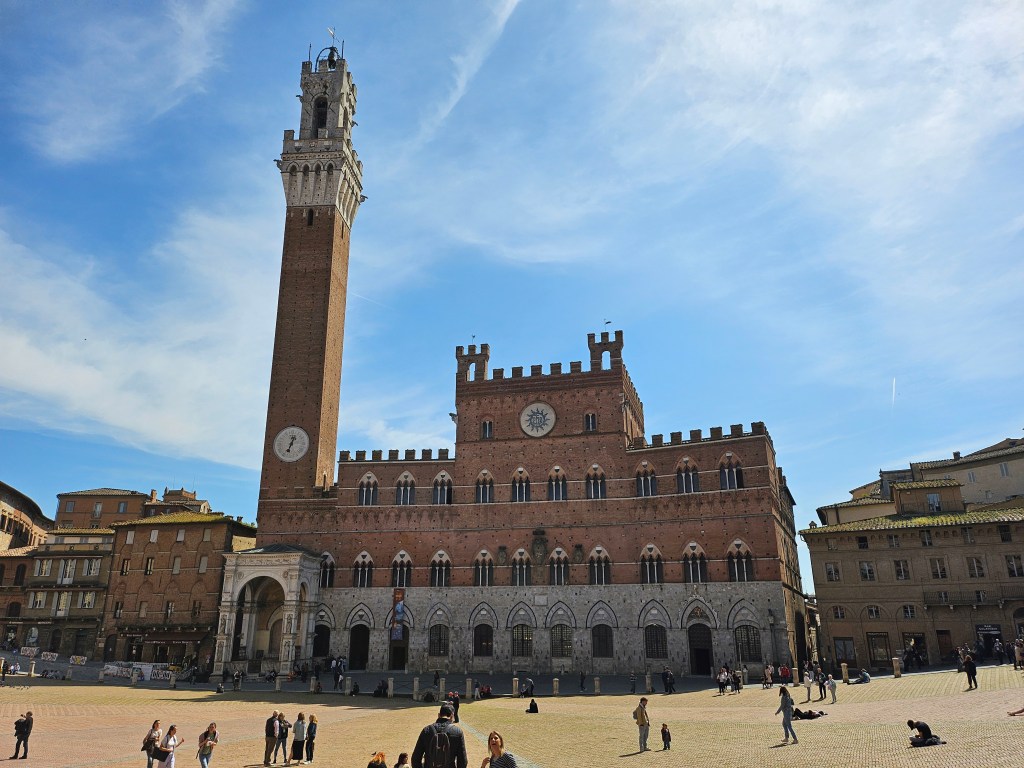
Towards the end of the day I went for a walk round the centre of the old city centred on the large Piazza del Campo, around the edge of which the annual Palio horse race is run every year on the 2nd July and 16th August. The weather was sufficiently warm for me to treat myself to an ice cream on my walk.
That evening, after large dinners on the three preceding nights, I decided to eat more modestly. I went to a well reviewed pizza restaurant, but I found it slightly disappointing. Although the toppings were generous, the pizza base did not seem freshly made and was served barely warm. The service was also rather less attentive than in the other places that I ate on this trip.
Day 5 – Friday 4th April 2025 -Siena
Siena can be considered the birthplace of modern western art. Shortly before this trip I had paid a visit to the special exhibition at London’s National Gallery “Siena: The Rise of Painting, 1300 ‒1350“, which developed this theme. My plan was to spend much of this day seeing examples of Sienese art in situ.
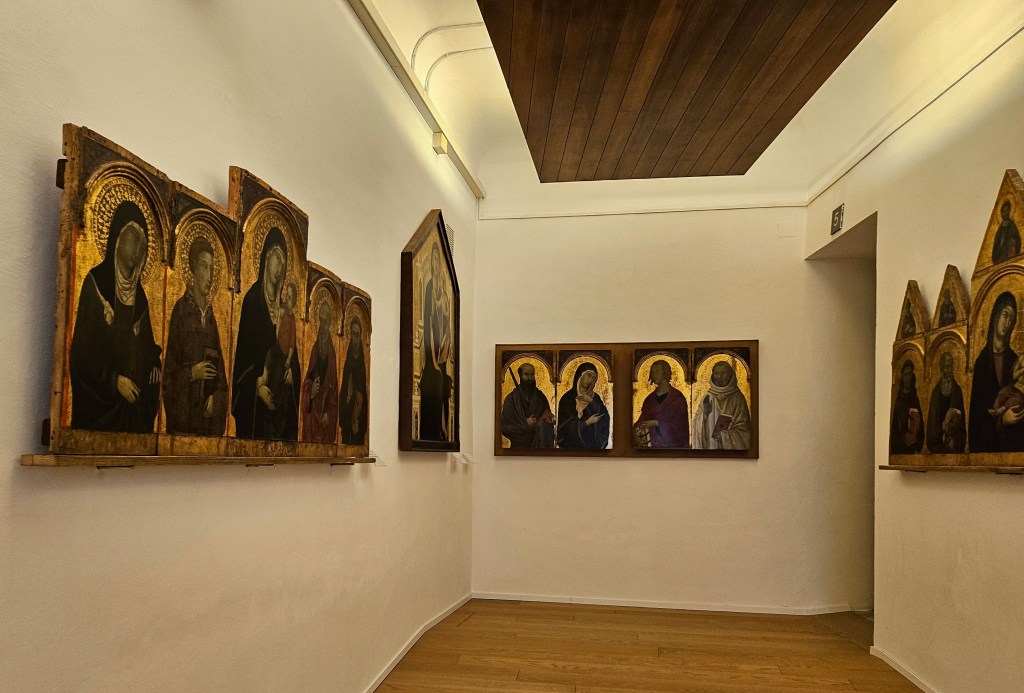
As it opened at 9am, before any of the other places I intended to visit, I went first to the Pinacoteca Nazionale di Siena, the main art gallery in the city. It is possible to buy a combination ticket to visit it and two of the other places I wished to go to that day, but rather annoyingly such tickets can only be bought at the other locations, which open later. Rather than waste my valuable time, I had to buy separate tickets for each at a small premium. The Pinacoteca Nazionale di Siena’s main focus is on 14th and 15th century art, with examples by many of the artists I had learned about in my visit to the Siena exhibition in London. There was an audio tour accessible via your own phone. It was striking how the technique developed over the space of only 50 years from crude Byzantine-like paintings on wood to exquisite finely detailed paintings which would set the standard for the Renaissance. It took me a couple of hours to see everything that was on display.


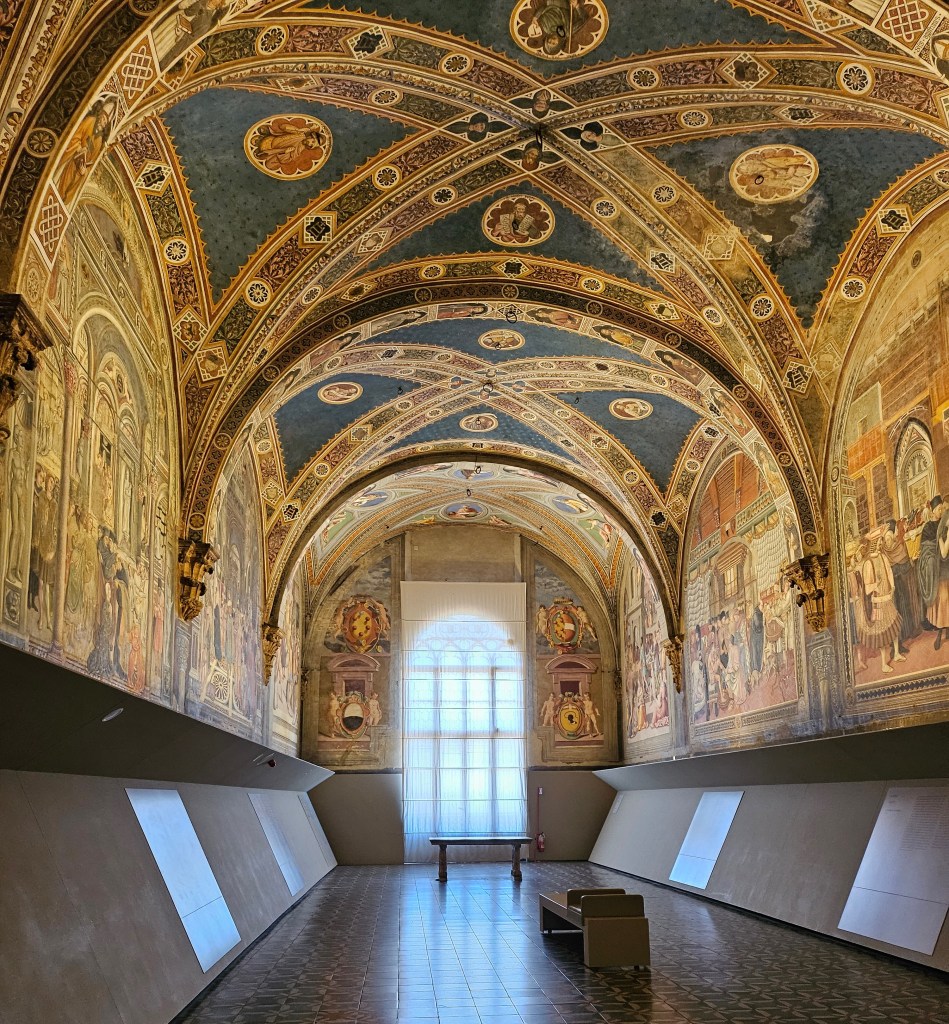
My next stop was at Santa Maria della Scala, opposite the cathedral. This was Siena’s main hospital up until the 1980s. It is now an art gallery and museum. What were once wards and waiting rooms are covered in amazing frescos. Below ground within the complex, at the level of what was once a Roman street, are an archaeological museum and a museum of Siena. Despite being directly opposite the cathedral, the hospital had its own richly-decorated church, which is still in use.
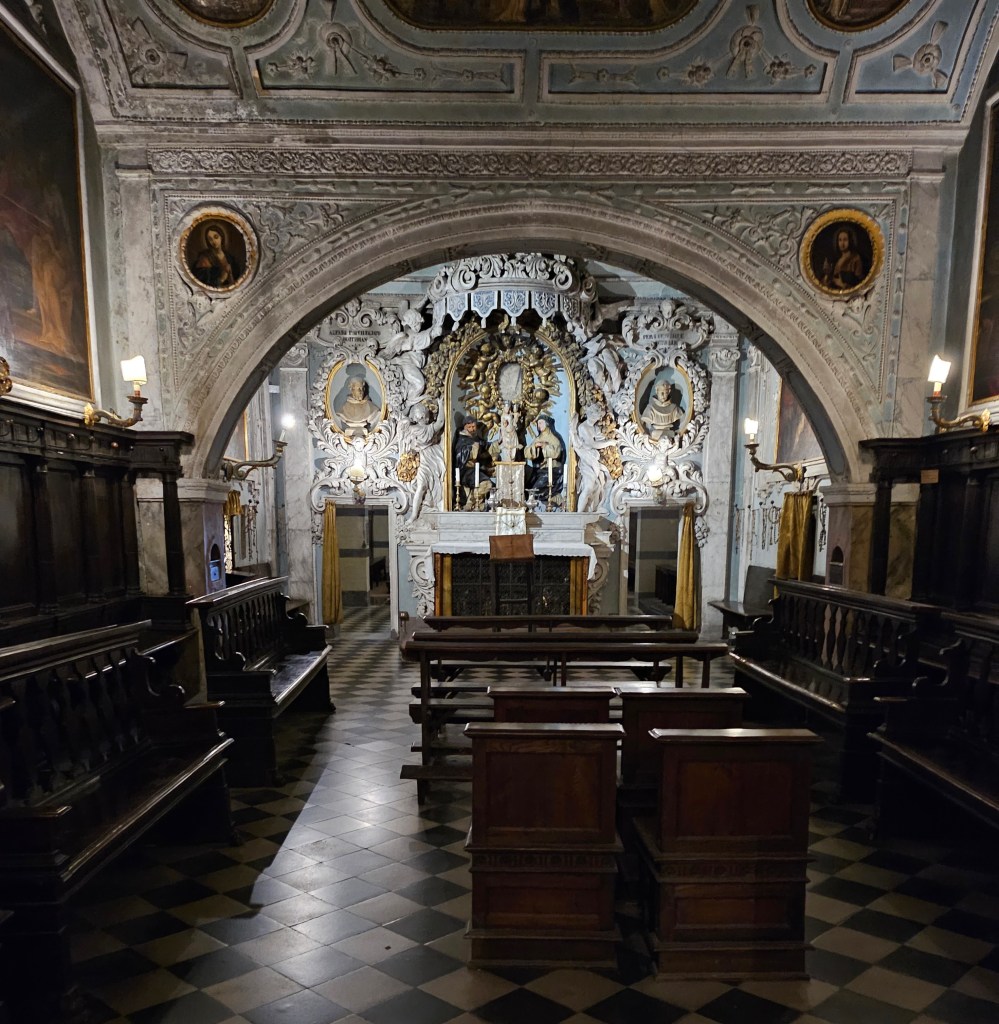
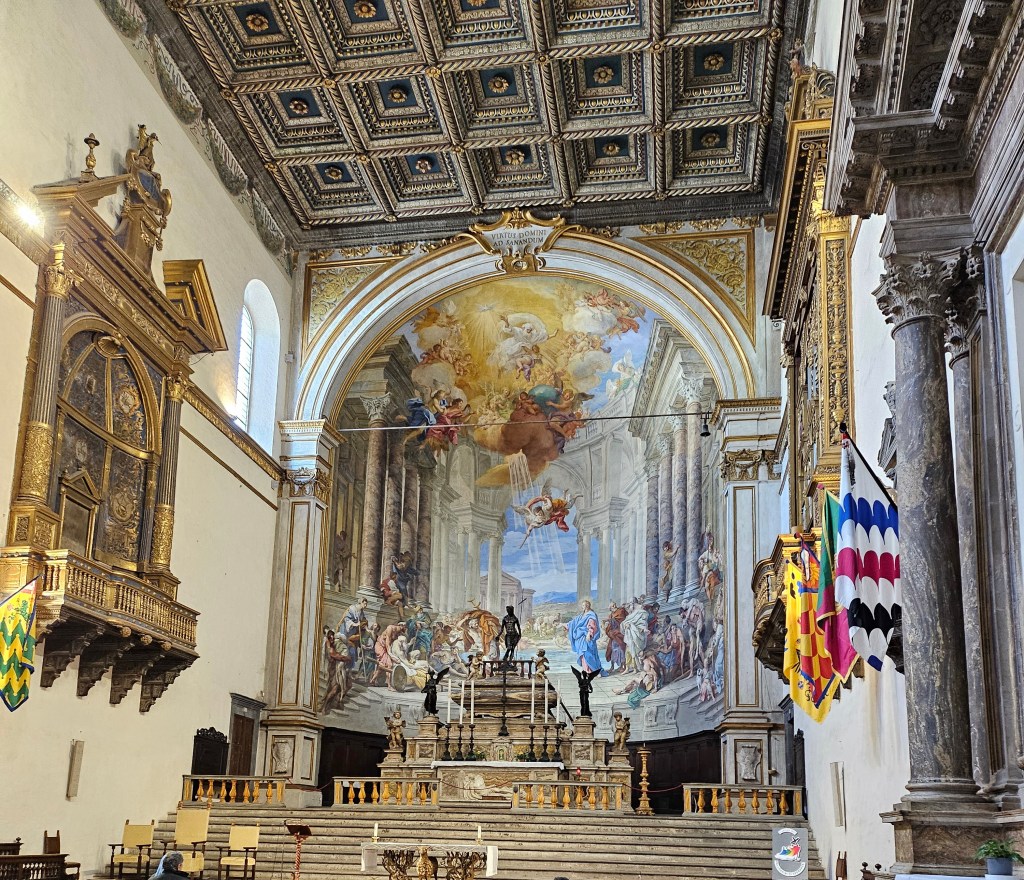
I then went for a walk through some other parts of Siena, picking up an ice cream on the way from the same shop as I had purchased one the previous day. I called in at the Basilica Cateriniana San Domenico, slightly away from the historic centre of Siena. Its current appearance results from an enlargement in the 14th century in the Gothic style. The interior of the Basilica is cavernous and rather plainer than the other churches I visited in Siena.
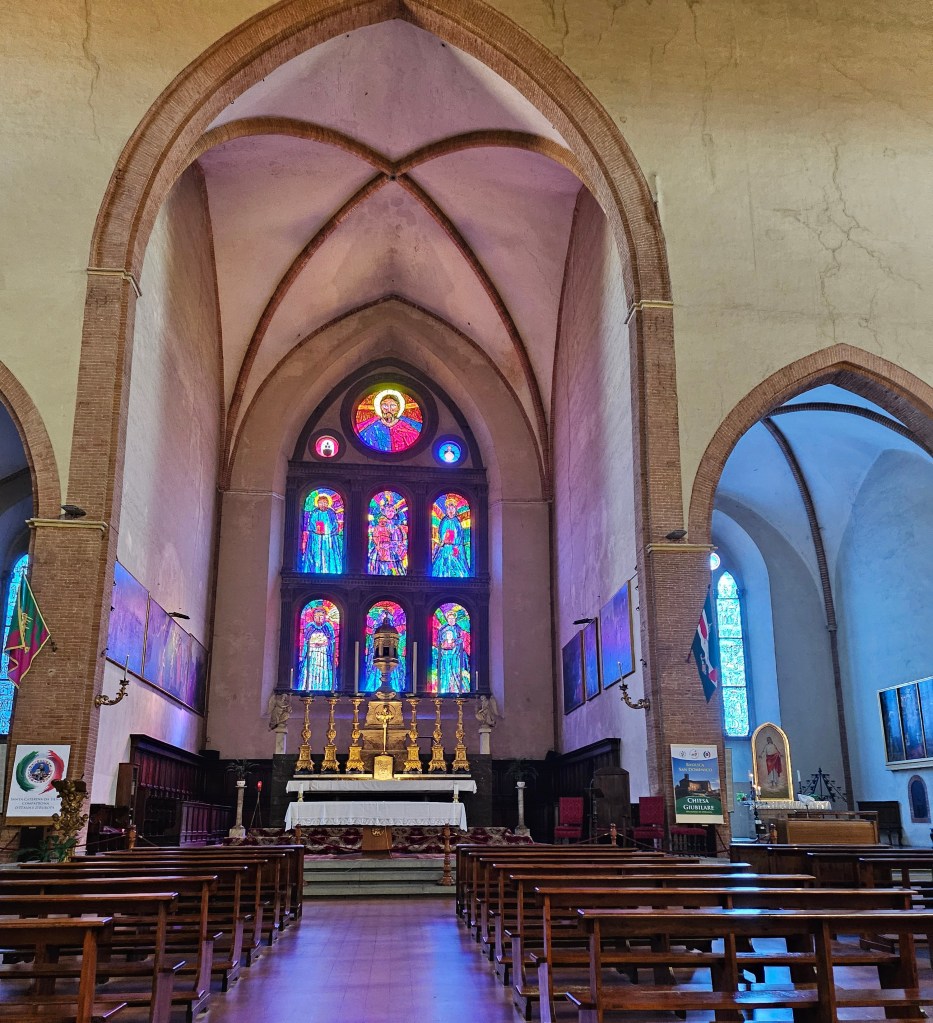
I returned to the Piazzo del Campo to visit the Palazzo Publico, which had by then reopened after a lunch-time break. This is Siena’s historic town hall and incorporates the Torre del Mangia. Having been up one tall structure in Siena the previous day, I decided not to pay extra for a timed ticket to ascend the Torre del Mangia. All of the many rooms in the Palazzo Pubblico are decorated with frescos from a variety of eras, ranging from pre-Renaissance to post-Risorgimento.
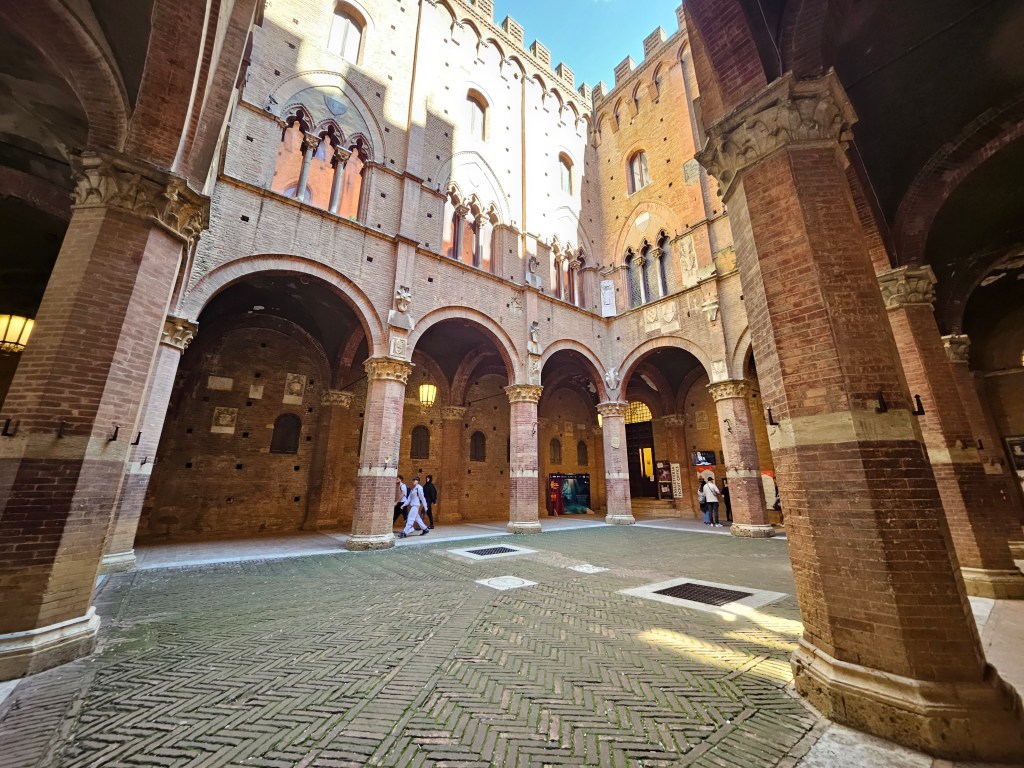
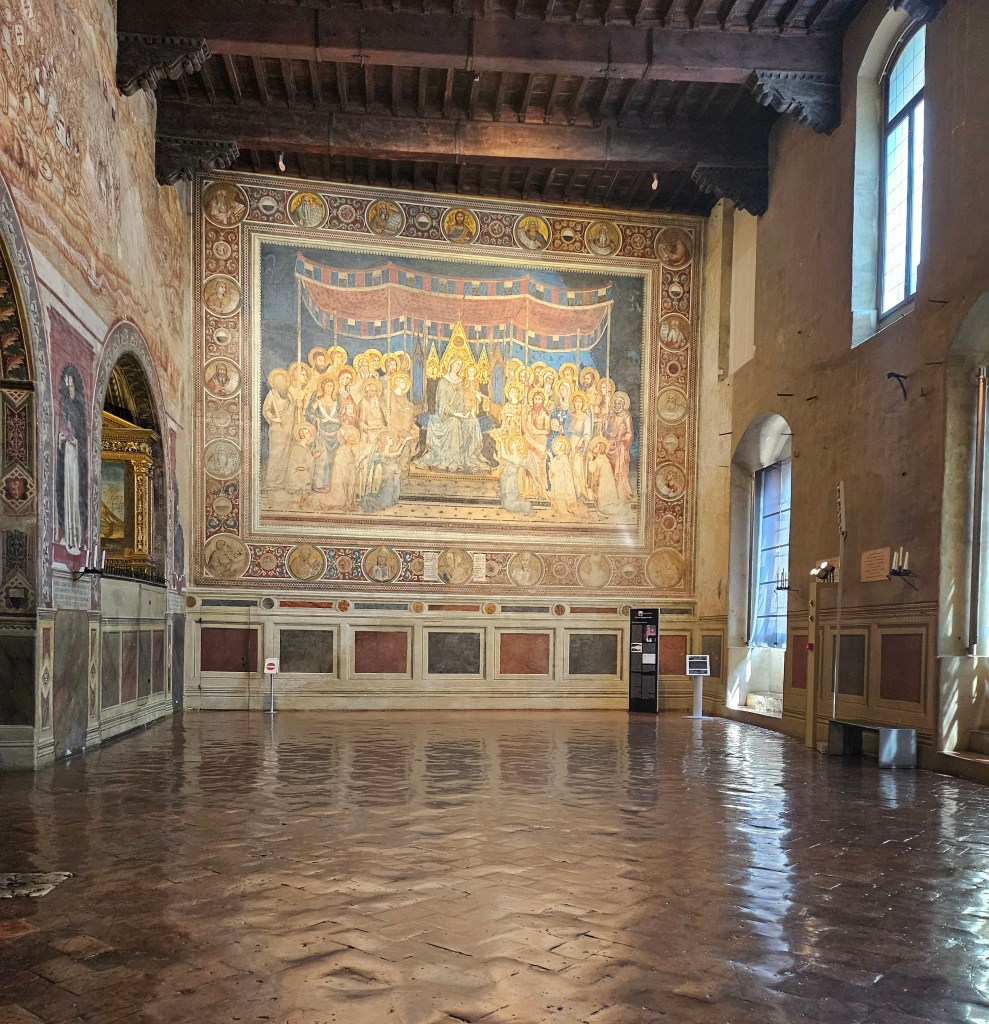

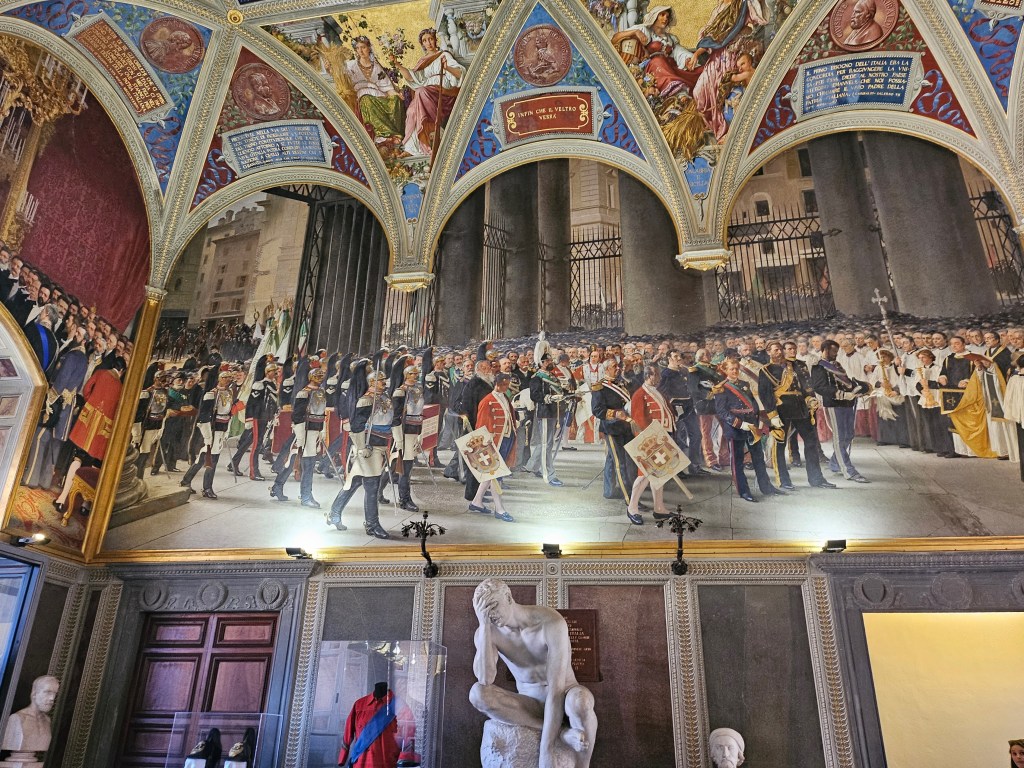
My final quest of the day, as it did not seem to be marked on Google maps, was to find the Oratory of the Compagnia di San Bernardino, admission to which was included in the multi-ticket that I had bought to visit the cathedral. I found it located next to the Basilica of San Franceso. The Oratory contains a small collection of early Sienese art, with one of the works being on loan at the time to the Siena exhibition in London.
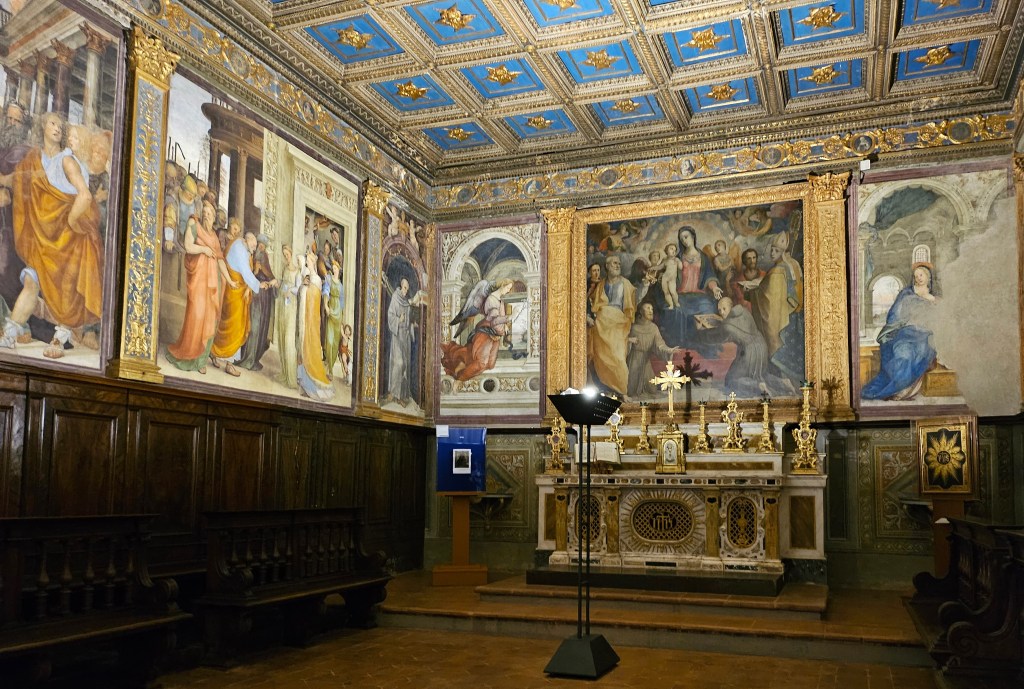
My next intended visit was to have been to the museum of the organisers of the Palio horse race, but it was closed when I arrived and further investigation suggested that pre-booking may have been required. I decided to use the extra time to check out the escalator route to the station, as when I had come through the shopping centre when I first arrived in Siena, its doors suggested that it only opened at 9am, which is later than the train that I would be catching to depart from Siena. My reconnaissance concluded that there was not an obvious way around the shopping centre, but I was not sure if the way through would be open if the shops were still closed.
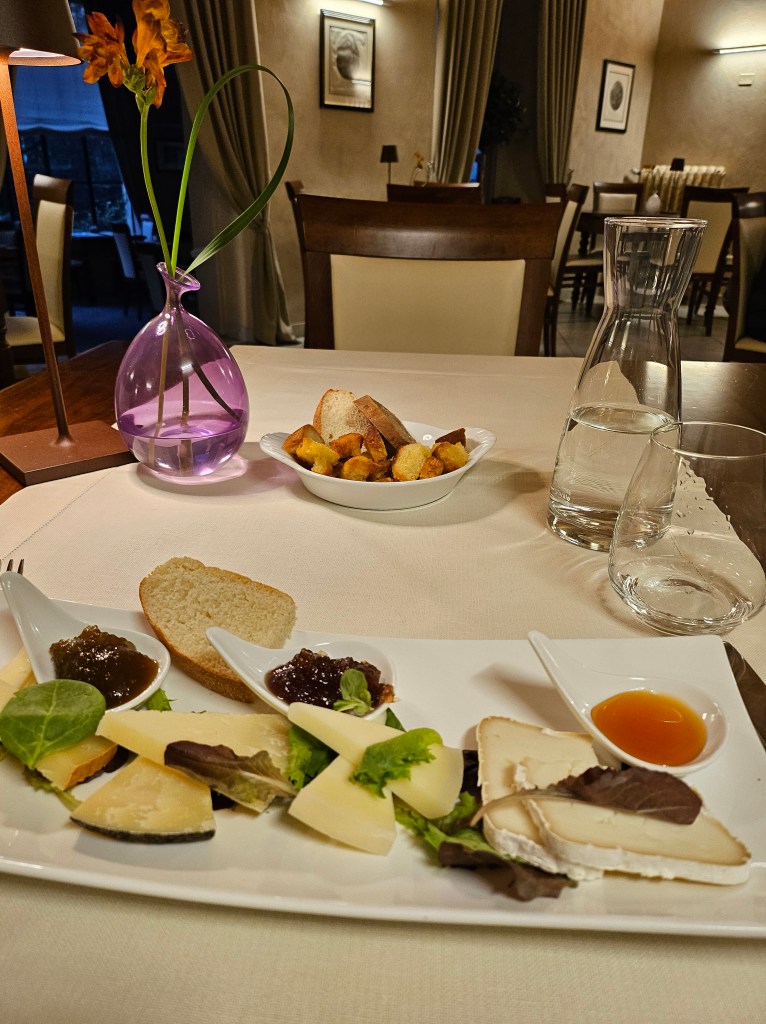
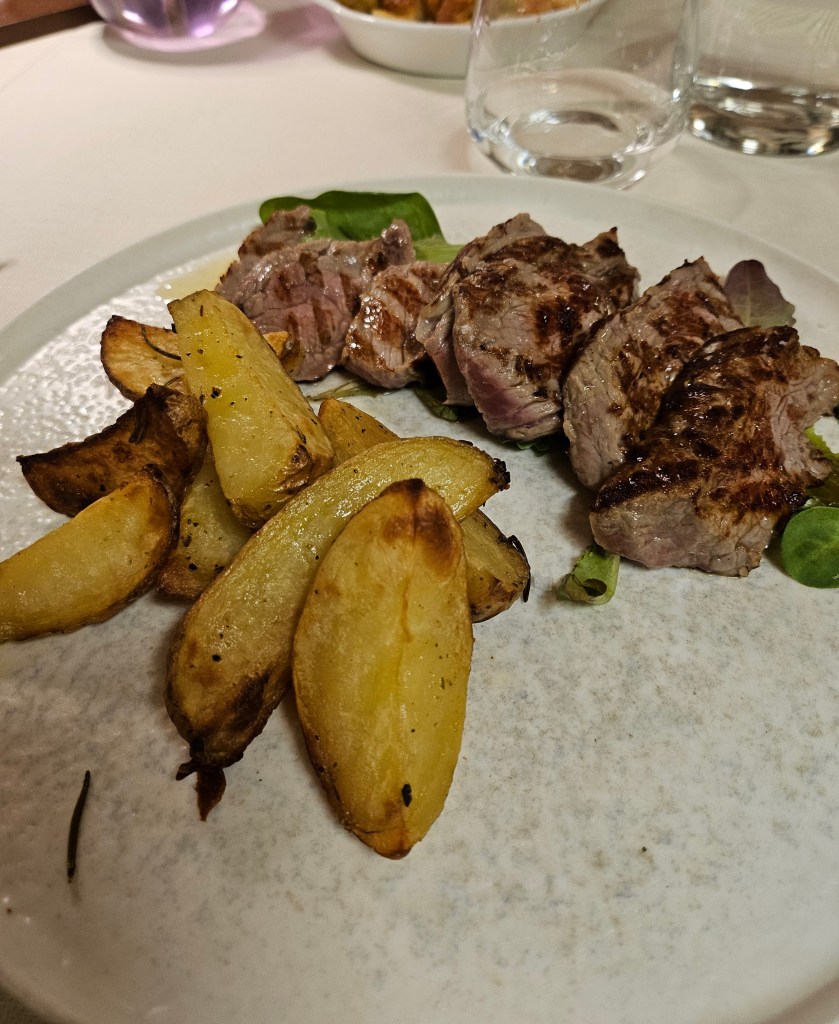
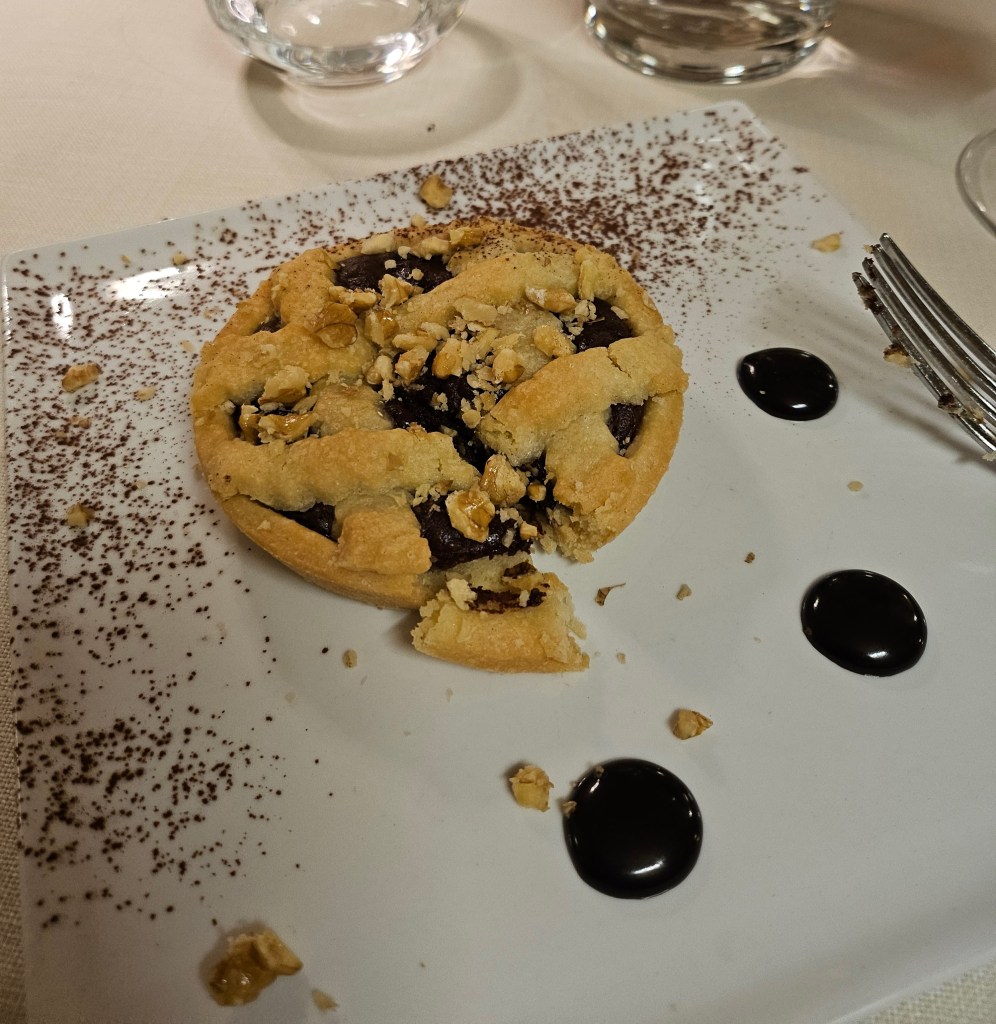
I had taken the precaution of booking a table for dinner at 7:30pm that night at a restaurant not too far from my hotel. As a reward for not having my room cleaned, the hotel had provided a voucher for a free drink in the hotel bar. Having checked that the bar opened at 6pm, I went to have my drink about 6:30pm with the intention of writing up my notebook in the bar. However, I found the bar was still shut, and enquiring at reception I was told that the bar was going to open at 7pm. I returned to my room to write up my notebook, before going back to the bar to have my free drink. From there, I went straight to the restaurant I had booked. I had a selection of Pecorino cheese to start and tartaglia of beef for main course. For dessert I had chocolate, pear and nut tart. As the restaurant did not offer carafes or half bottles of wine, I ordered a glass of wine with each course. It was noticeable that the quantity of wine poured increased each time, so that the glass to accompany my dessert was about twice the size of the one I had with my starter.
Day 6 – Saturday 5th April 2025 -Siena to Padua
As I was not sure that the route through the shopping centre would be open, I chose an alternative route back to the station. This was downhill all the way, so it was quite an easy walk. When I arrived at the station just before 8am I did check the shopping centre, for future reference, and the escalator route through was working, even though the shops had not yet opened.
My train to Florence, due to depart at 08:18, was already in the platform, so I went and got on it. Five minutes before departure a couple of policemen got on and did an ID/passport check of all the passengers, checking the details on electronic devices they were carrying. It was a more thorough check than any intra-Schengen cross-border formalities that I had experienced.
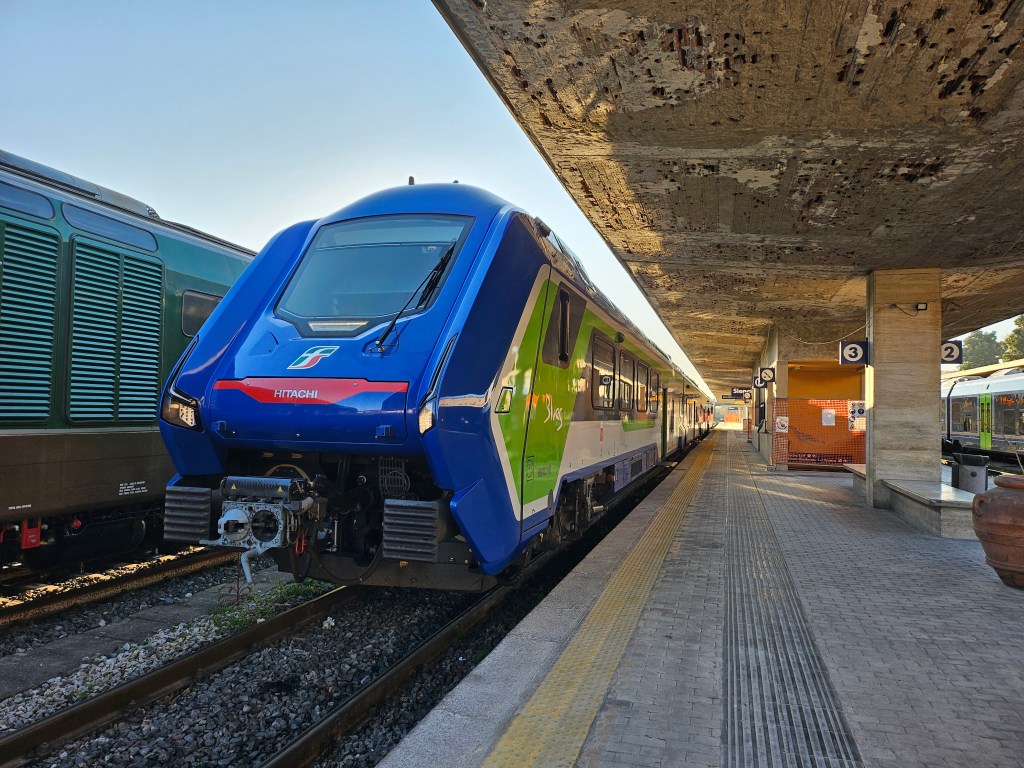
Once the checks had been completed, the train departed a couple of minutes late. As soon as it set off, a woman in a state of some agitation, sought out the guard who was in my carriage. It appeared that the woman was on the wrong train, so an unscheduled stop was made at the first station out of Siena to let her off. About this time, I received on my phone a text message from my mobile network welcoming me to Italy! This, and the passport checks, made me wonder if I had missed the news that Siena had reverted to being an independent city state.
The line from Siena to Empoli is not electrified and is largely single track. My train kept more or less to time until it had to wait for ten minutes just outside Empoli for a late running train coming the other way to clear the final section of single-tracked line. Once in Empoli station, it put up its pantographs to run on electricity and joined the Pisa to Florence main line. It made speedy progress, which, combined with the generous padding in the timetable for the arrival at the final destination, meant that it soon turned round the ten minute deficit and actually arrived at Florence Santa Maria Novella station a couple of minutes early.
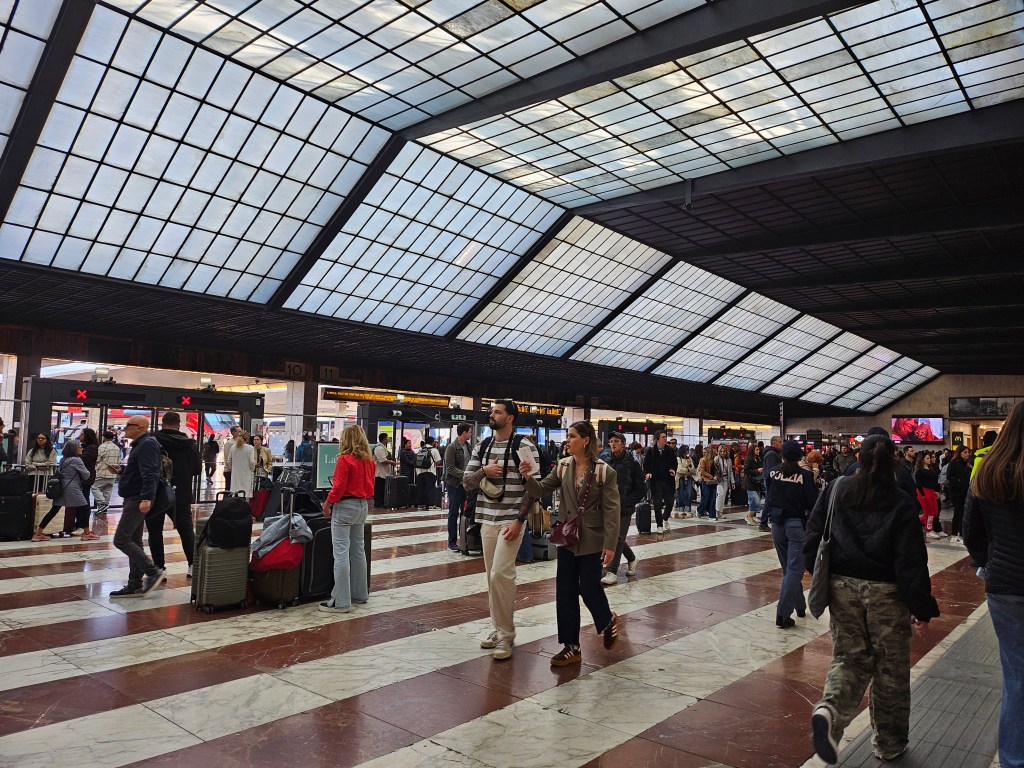
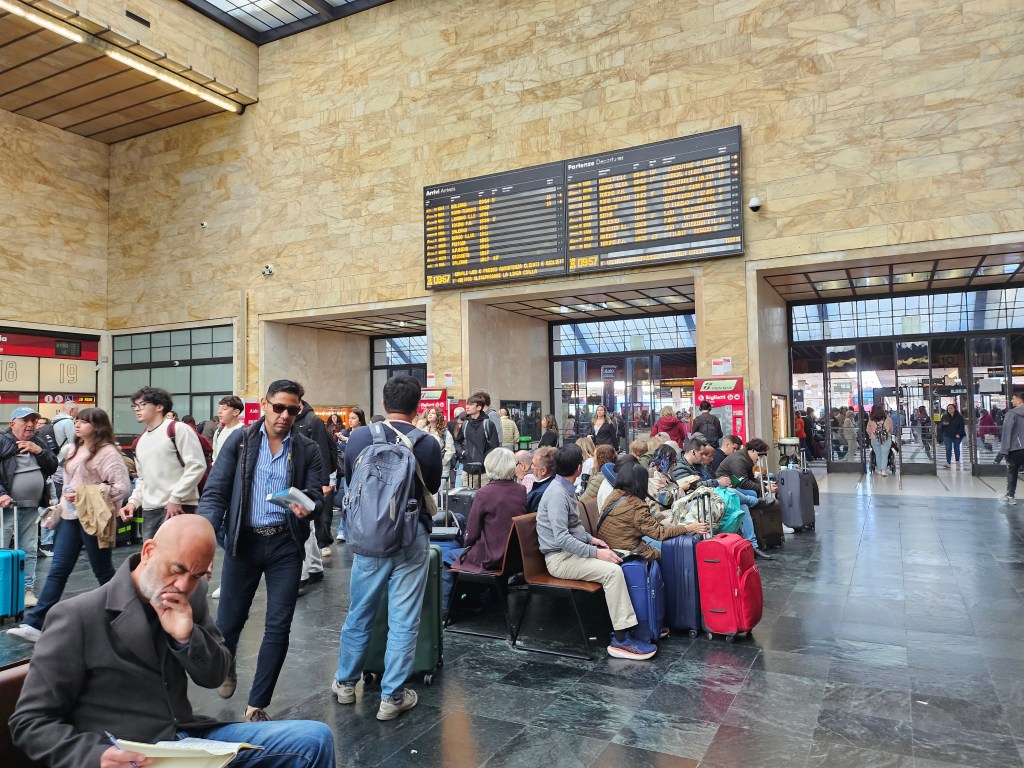
Firenze SMN was exceedingly busy with the concourse packed with travellers. I had 30 minutes for my connection, which was due to arrive 10 minutes before departure to allow time for it to change direction. I had been tracking my incoming train and it was on time as it approached. So I just had time to venture very briefly out of the station, but explore Florence no further – I had last visited the city on my 1983 Interrail trip to Romania and back. However, when I returned to the station there was still no platform shown for my train and the app on which I was tracking it was showing it stuck just outside the station. Apparently, it was delayed while a track fault was rectified, finally arriving 20 minutes late and departing 15 minutes late.

For the first time on this trip I was travelling on a high-speed Frecciarossa train and also going Business Class. At the time of booking a ‘Super Economy’ Business Class ticket was just as cheap as Standard Class. The high-speed line from Florence to Bologna is mostly in tunnels and the train clawed back five minutes of its delay. I was also pleasantly surprised by the complimentary snack offering – the last time I travelled by Frecciarossa, no snacks were provided on Saturdays, and on the other days they were limited to a bag of crisps and a bottle of water. This time I was given, in addition to a bottle of water, a ham roll, a filled croissant and a choice of fruit juice or coffee. After leaving Bologna, the high-speed line ran out and the train was unable to make up any more time, so arrived in Padua at 12:15pm, 11 minutes late.
Padua (Padova in Italian) is an ancient university city but, unlike Perugia and Siena, it is not situated on a hill top. Galileo taught at the university and, more recently, the increasingly ubiquitous orange aperitif, Aperol, is made in Padua. A few days before my arrival in Padua I had tried to book a timed ticket to see the interior of the Scrovegni Chapel with its Giotto frescos, but discovered that they had all sold out. From the station I went straight to the Scrovegni Chapel to see if any tickets could be had, but a notice confirmed that none were available all weekend. However, there was another notice saying that tickets for evening visits were sold at the tourist office in the centre of the city, so I went there next. The woman behind the desk at the tourist office was involved in a lengthy Sybil Fawlty-esque telephone conversation, but also sitting behind the counter were what looked like a couple of children. I asked the older looking one in Italian if he spoke English, to which he replied, in Italian, that he did. I then tried asking him about tickets for the Scrovegni Chapel, but he implied that none were available.
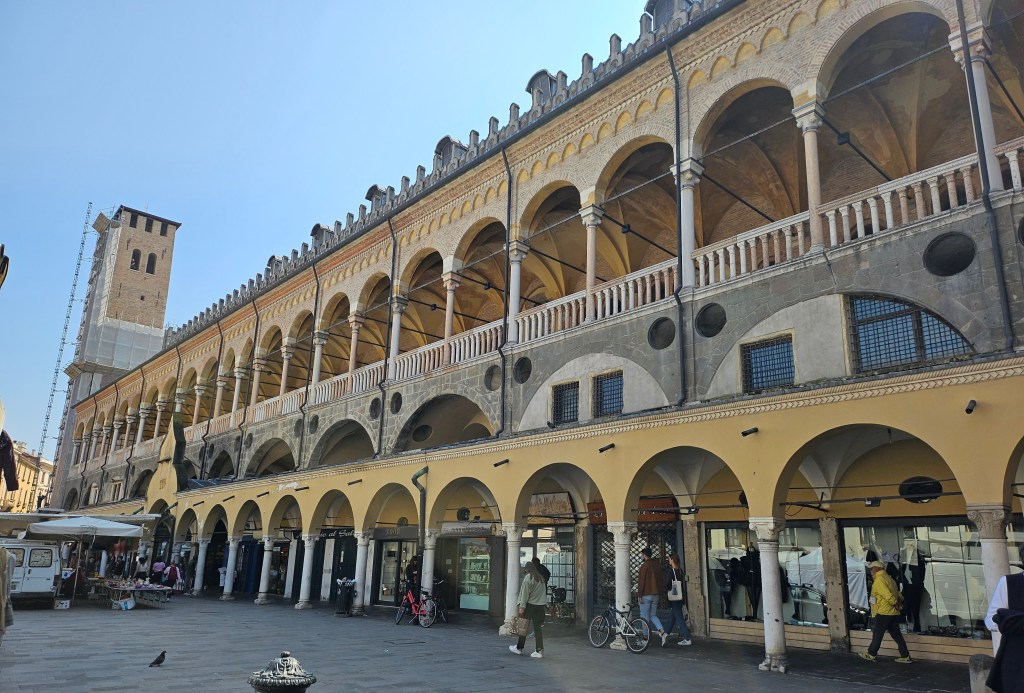
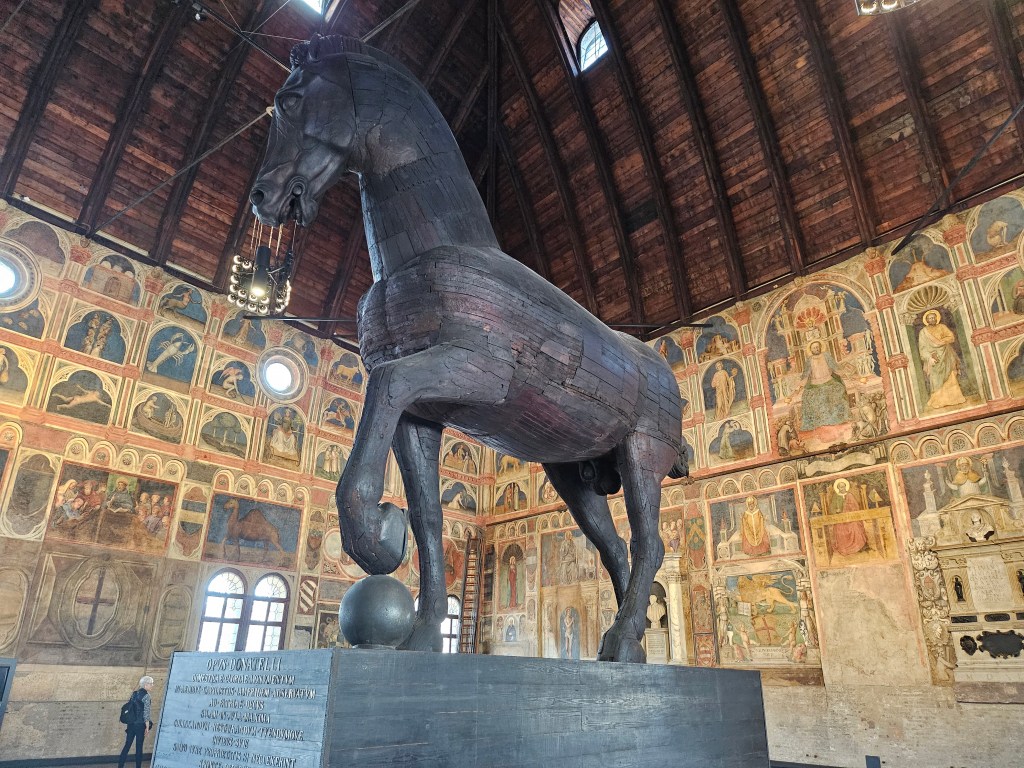
I next went to the Palazzo della Ragione, the medieval market hall in the centre of the city. At ground level there is still a bustling food market, with stalls selling a wide variety of produce. The upper hall is the largest raised public hall in Europe. All its walls are adorned with frescos, many of which were originally painted by Giotto, but were redone following a fire in 1420. At one end of the hall is an enormous wooden horse.

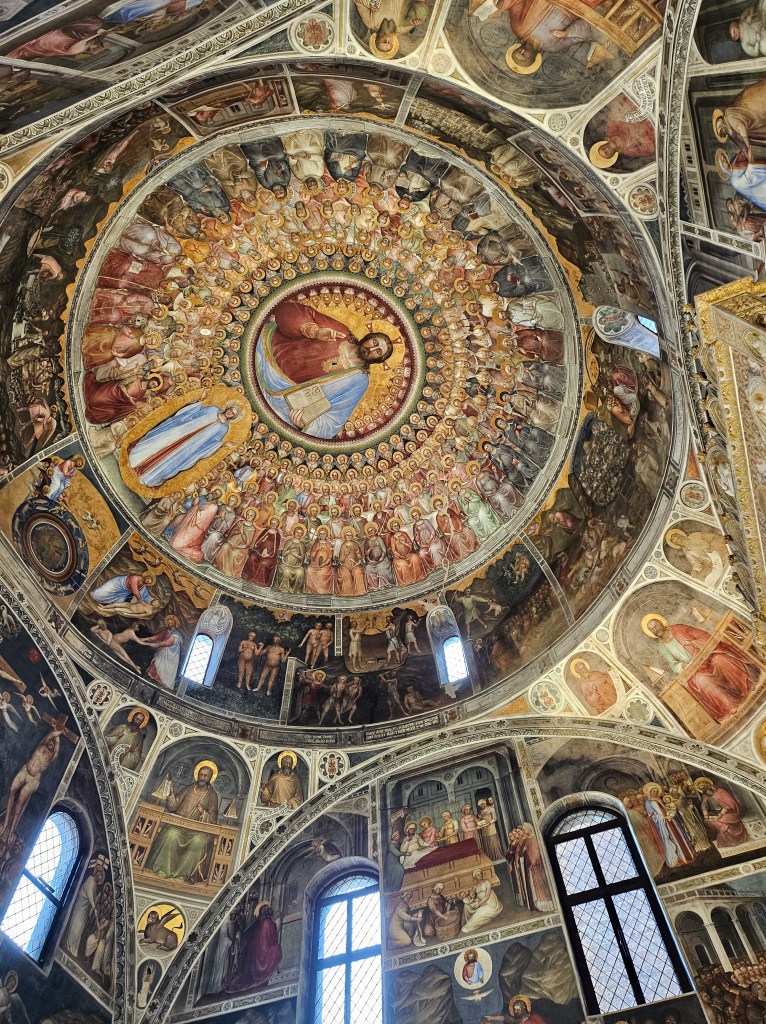
It was a short walk to Padua cathedral. It looks fairly modest from the outside and the interior was less ornate than the other cathedrals I had visited on this trip. To view the cathedral’s baptistry, one has to buy a timed ticket. I joined a small group who were ushered in – initially you watch an introductory video in an ante-room, before being allowed inside the baptistry for 20 minutes. It walls are covered in 14th century frescos by Giusto de’ Menabuoi depicting various biblical scenes.
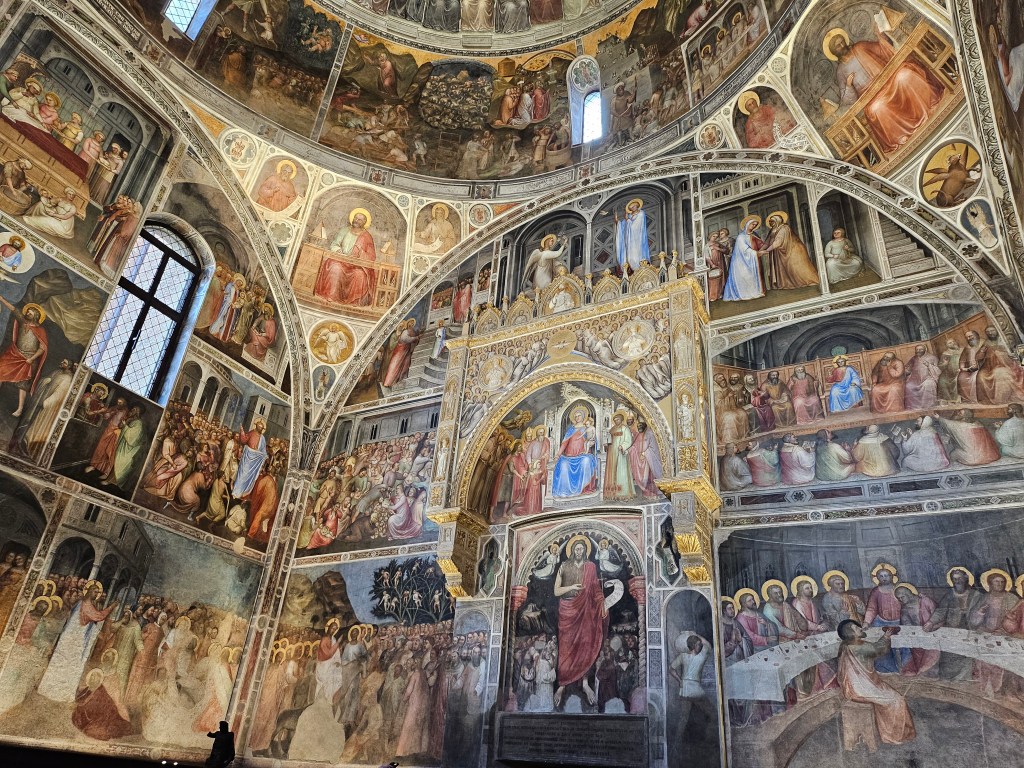
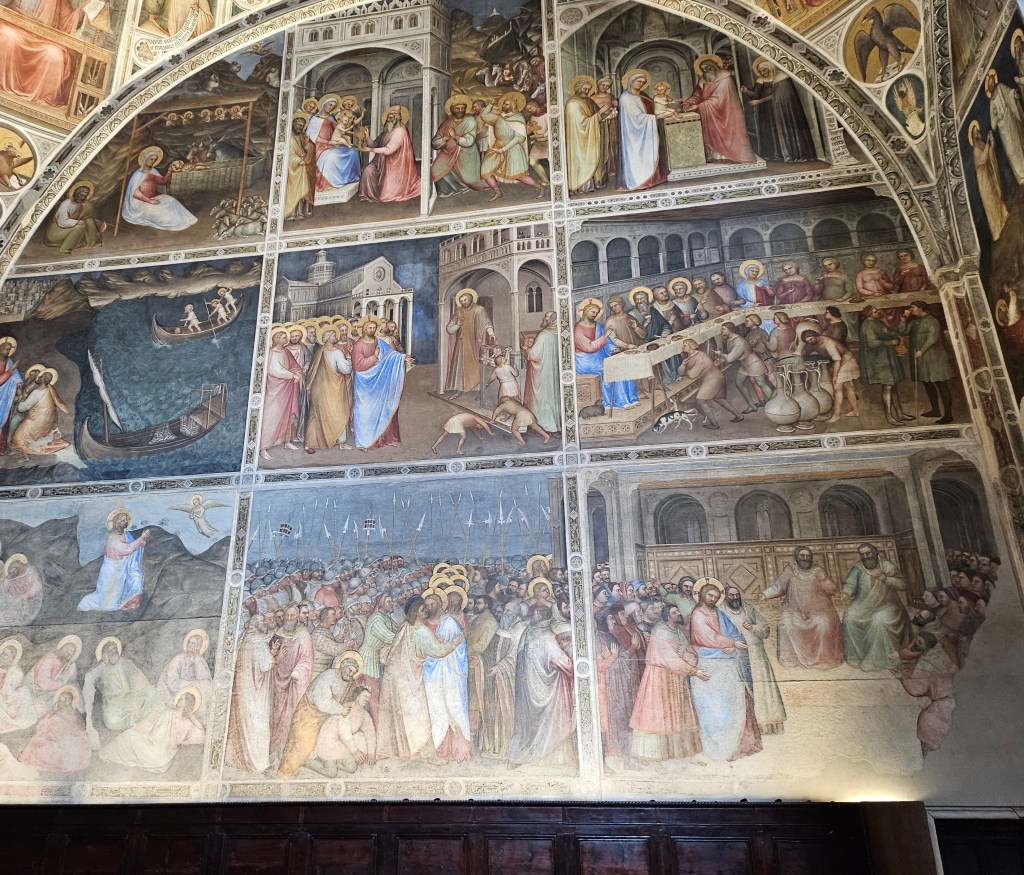
I then tried to visit the Oratory of St Michael, to the south of the city centre, but when I arrived it was firmly shut despite its website saying that it should be open. A rather fading noticeboard which showed its opening times had some tape stuck over the times it should have been open on a Saturday afternoon.
I walked along a spur of the Bacchiglione river to reach the Basilica of St Anthony. This is much larger and more ornate than Padua cathedral. It was very busy on the Saturday afternoon that I was there, with long queues inside of the faithful wishing to touch the tomb of St Anthony and to view the relics of the basilica that were on display. Outside the basilica is an equestrian statue by Donatello, but this was covered in scaffolding at the time of my visit. Nearby is the Oratory of St George – I wandered in there, misunderstanding the notice that said tickets had to bought elsewhere, but having briefly seen the interior, concluded that the €10 entrance fee was not really worth it.
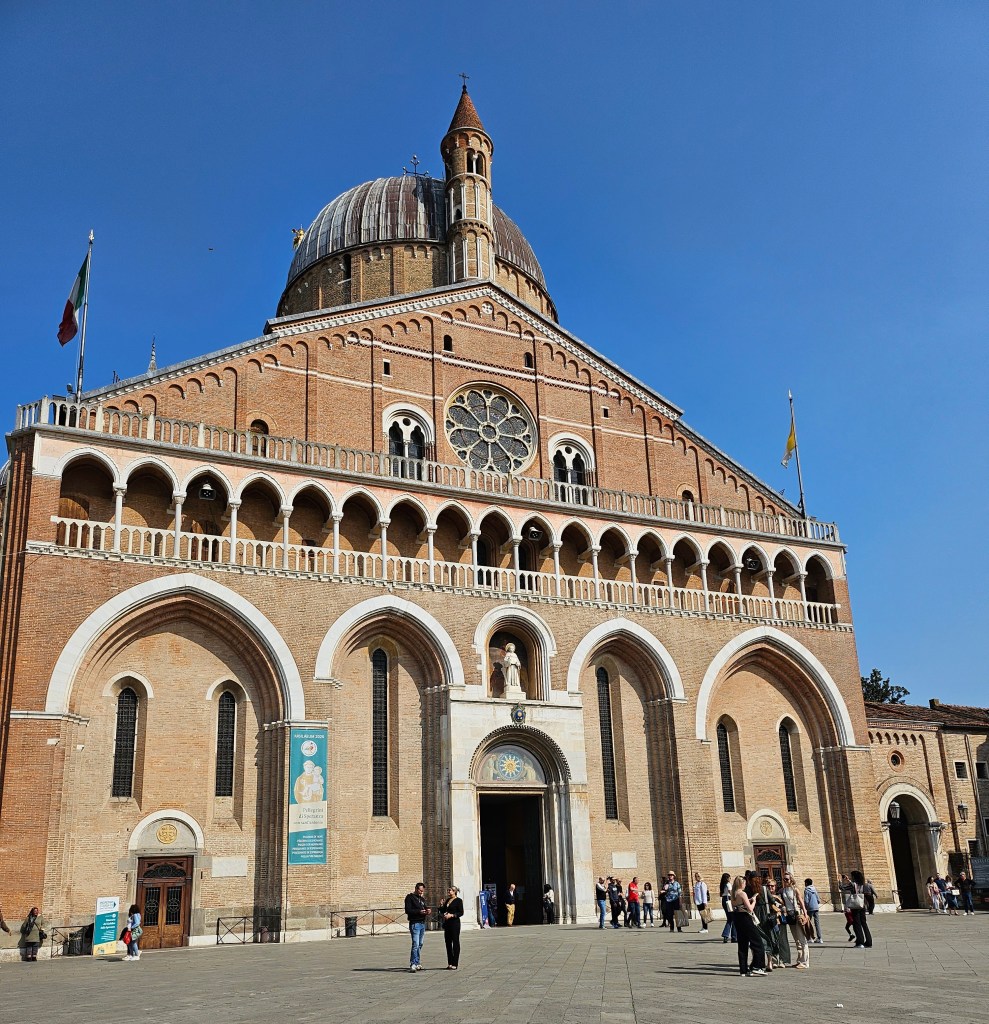
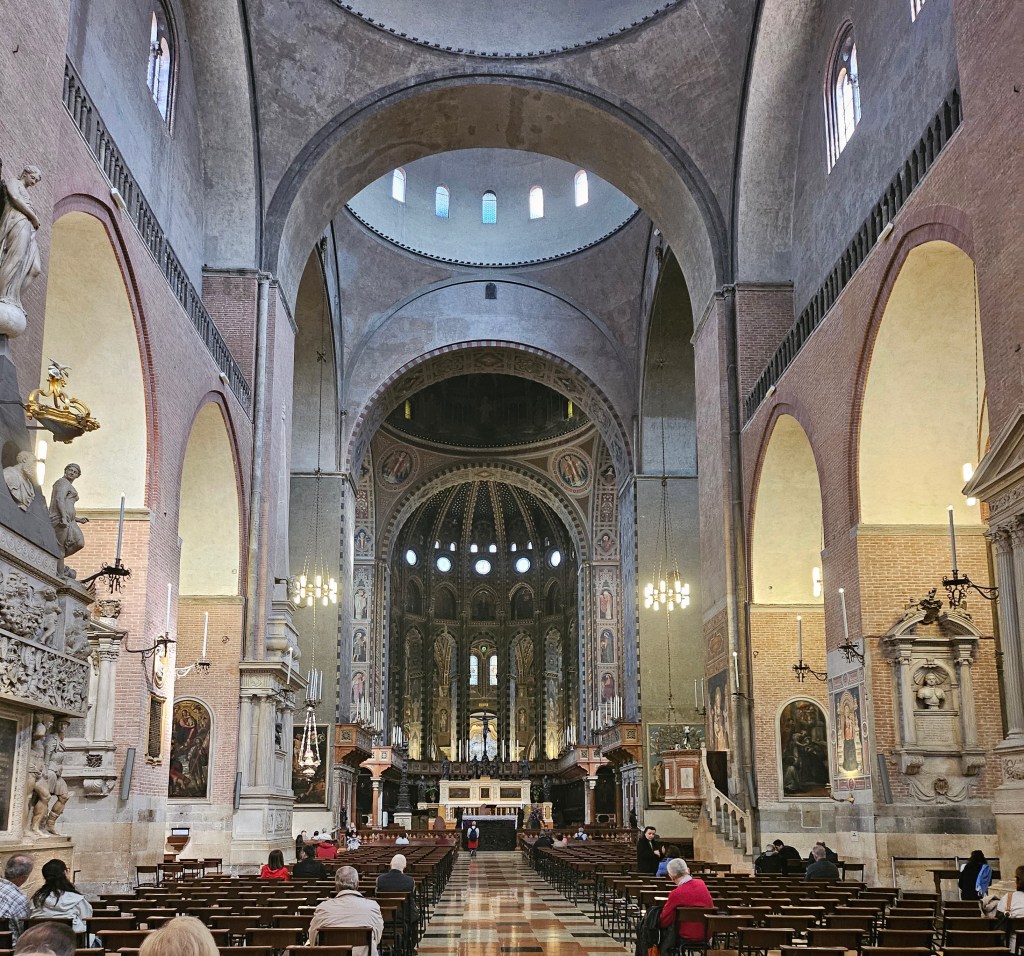
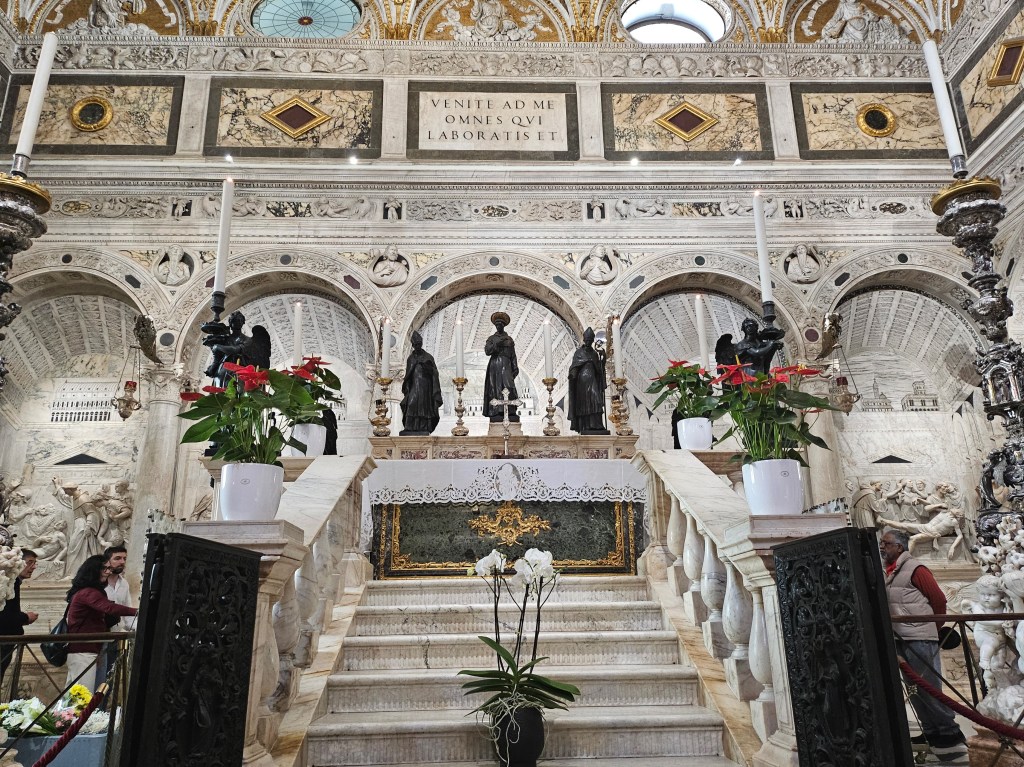
Finally that afternoon I went for a walk round some other parts of Padua that I had not yet visited, before checking in to my hotel. I decided to eat more modestly that evening, but being Saturday and not having booked, the first restaurant I tried had no tables available. I did manage to get a place in a busy pizzeria near my hotel.
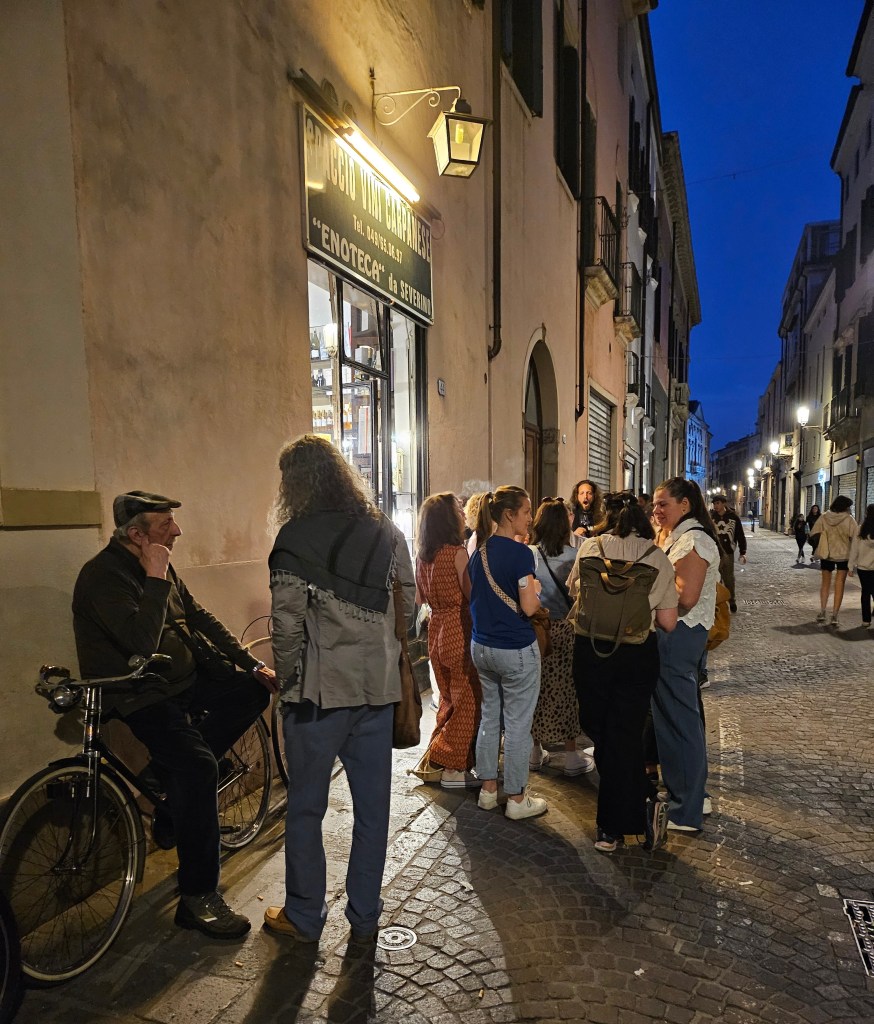
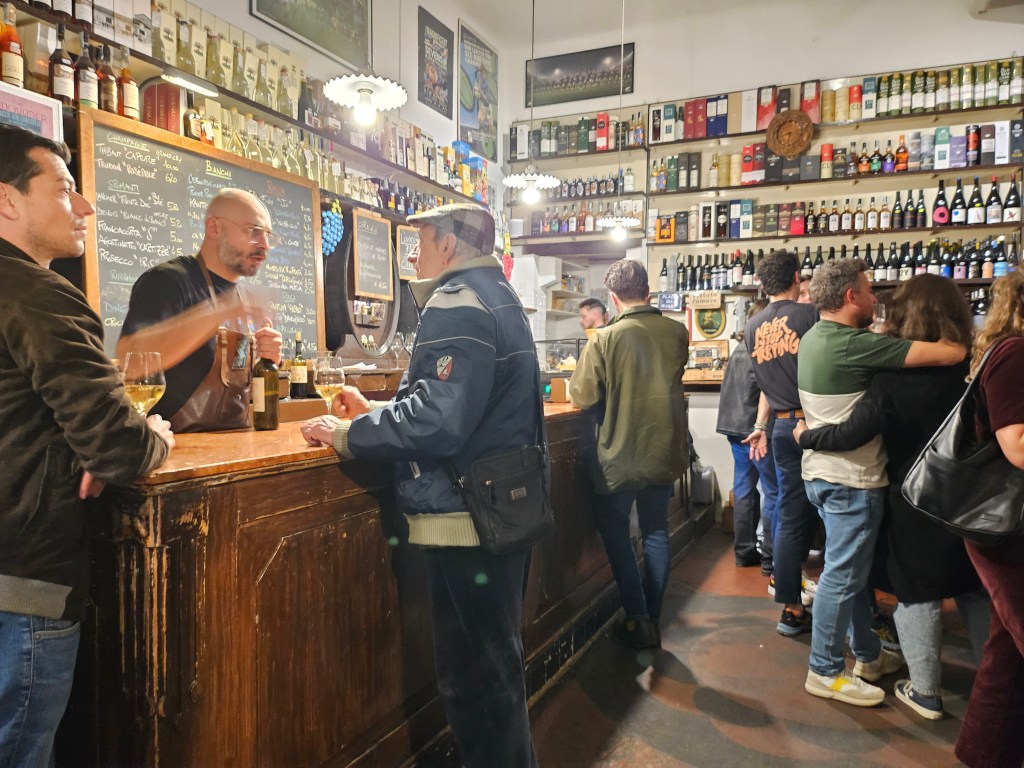
After dinner, I went to an enoteca I had walked past earlier. It had a long list of wines available chalked on a board behind the counter. I chose at random a glass of one of the red wines on offer and went outside to drink it in the street with many of the other patrons of the establishment. Although there was not much traffic, the street was not pedestrianised, so whenever cars did come along everyone drinking in the street had to move to one side to let them through.
Day 7 – Sunday 6th April 2025 -Padua to Milan
Compared with many other countries, museums in Italy tend to open fairly early, enabling you to pack quite a lot into one day. On this Sunday morning, I was having only my second hotel breakfast of the trip, and despite going to the breakfast room quite early, it was already nearly full.
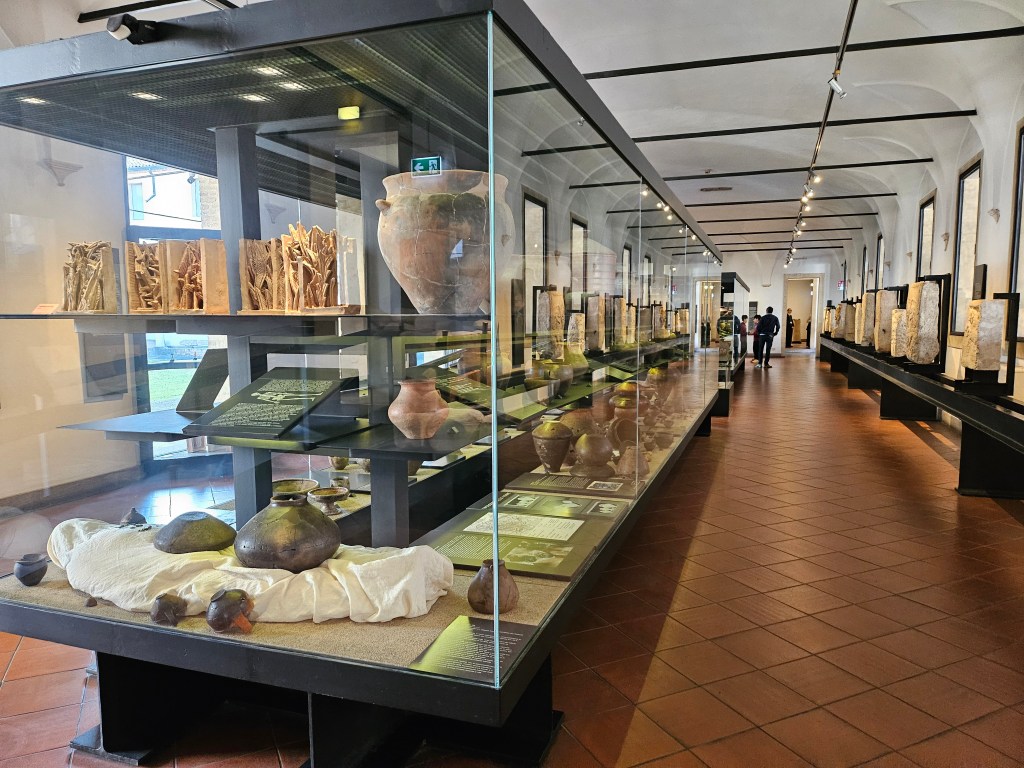
After breakfast, I headed to the Eremitani Museum to arrive when it opened at 9am. The museum is located in a former convent. The museum contains archaeological and other historical artefacts on the ground floor and an art collection on the first floor, including the Giotto crucifix that was originally in the Scrovegni Chapel.
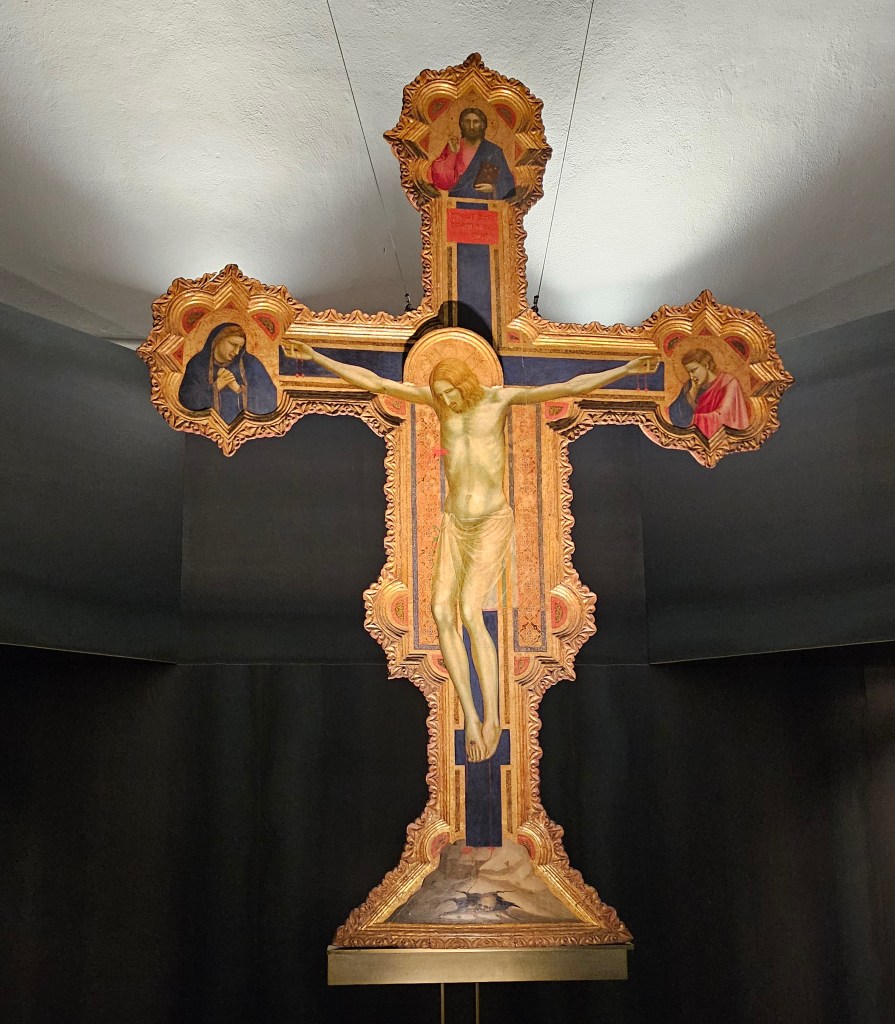
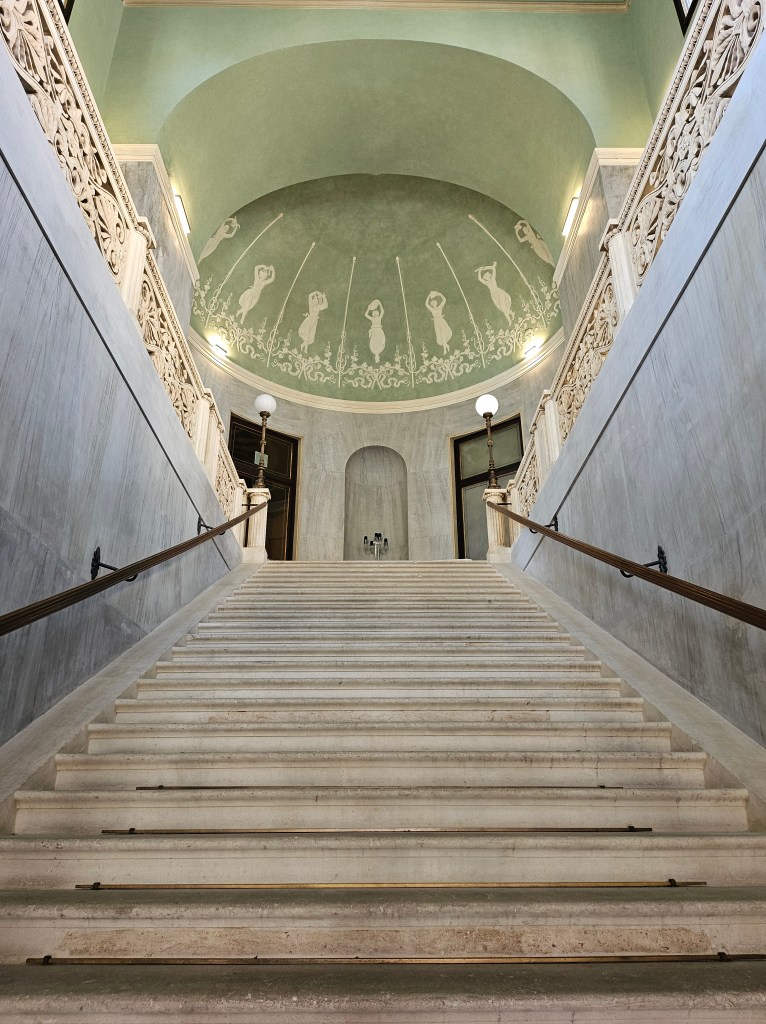
Included within the price of the ticket for the Eremitani Museum was entry to the nearby Palazzo Zuckerman. This building, originally built as a home for a wealthy industrialist, became Padua’s main post office, before becoming the museum of fine and applied art that it is today. It also contains an extensive collection of coins, from Roman times through to the introduction of the Euro.
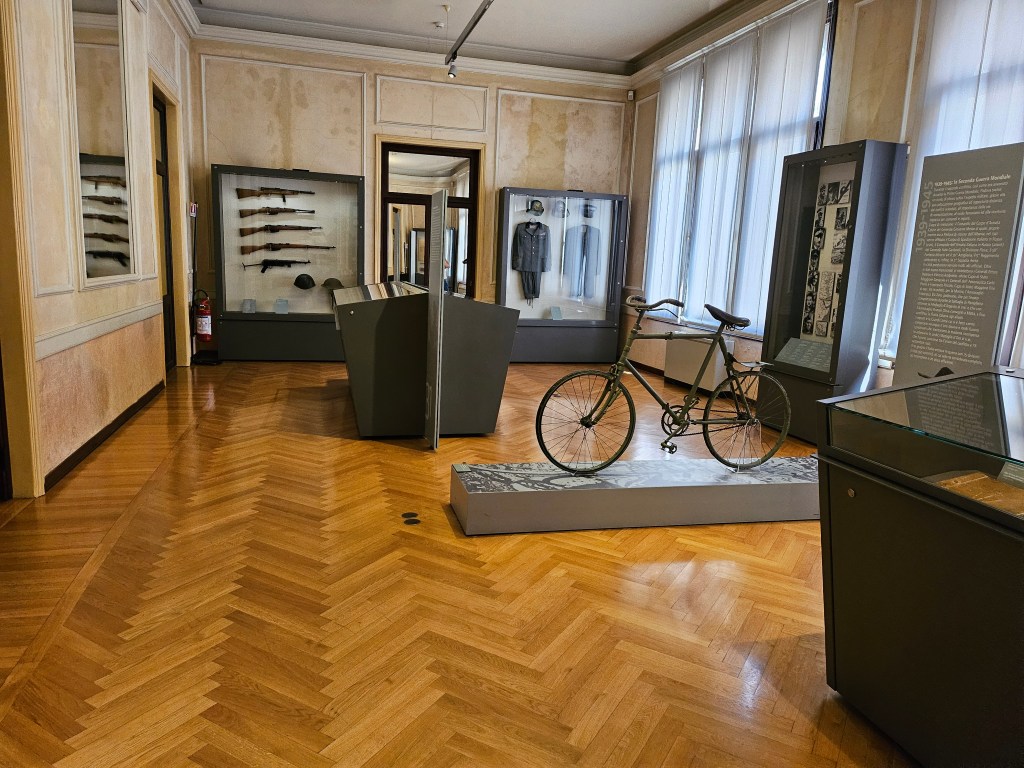
I walked towards the city centre to visit the Museo del Risorgimento e dell’Età Contemporanea (Museum of the Risorgimento and the Contemporary Age). This small museum covered the period from Italian unification to just after World War II. Despite its name, it was probably the most old fashioned museum I visited on this trip.
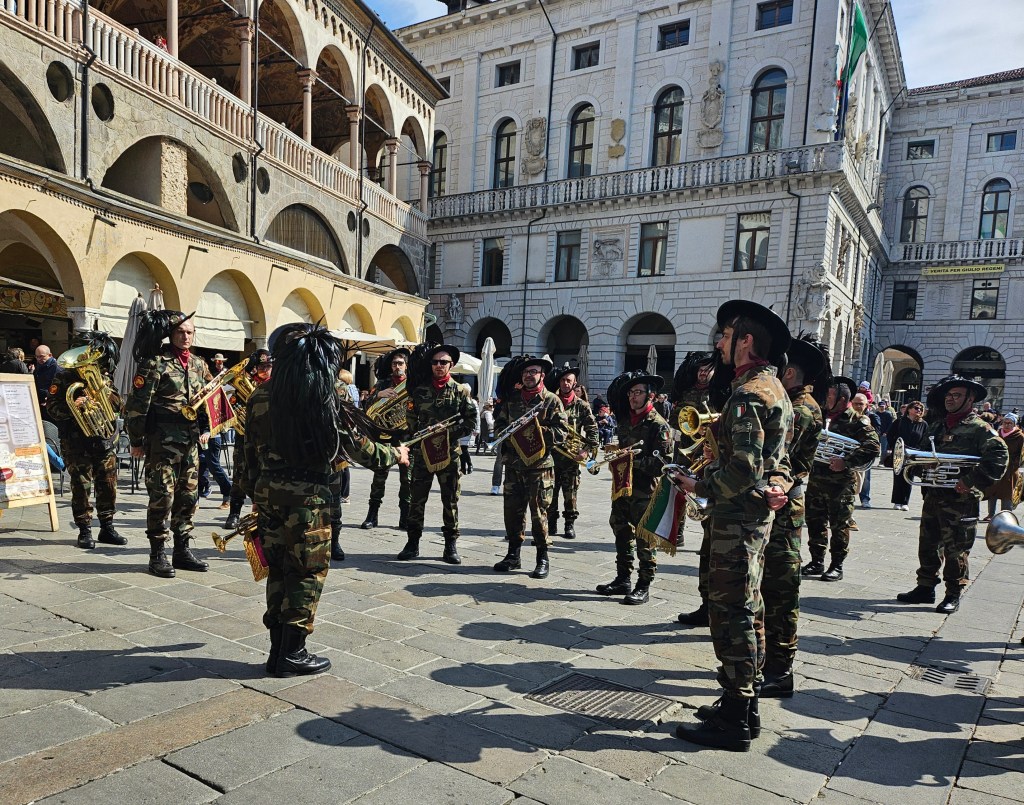
After I left this museum I was attracted to the square in front of the Palazzo della Ragione by the sound of music. There was a band dress in quasi-military uniforms blowing brass instruments and sometimes breaking into rousing songs. When their performance had finished their leader blew a whistle and they ran off at the double. I think their appearance was linked to a rally being held in the square by the local agricultural producers association.
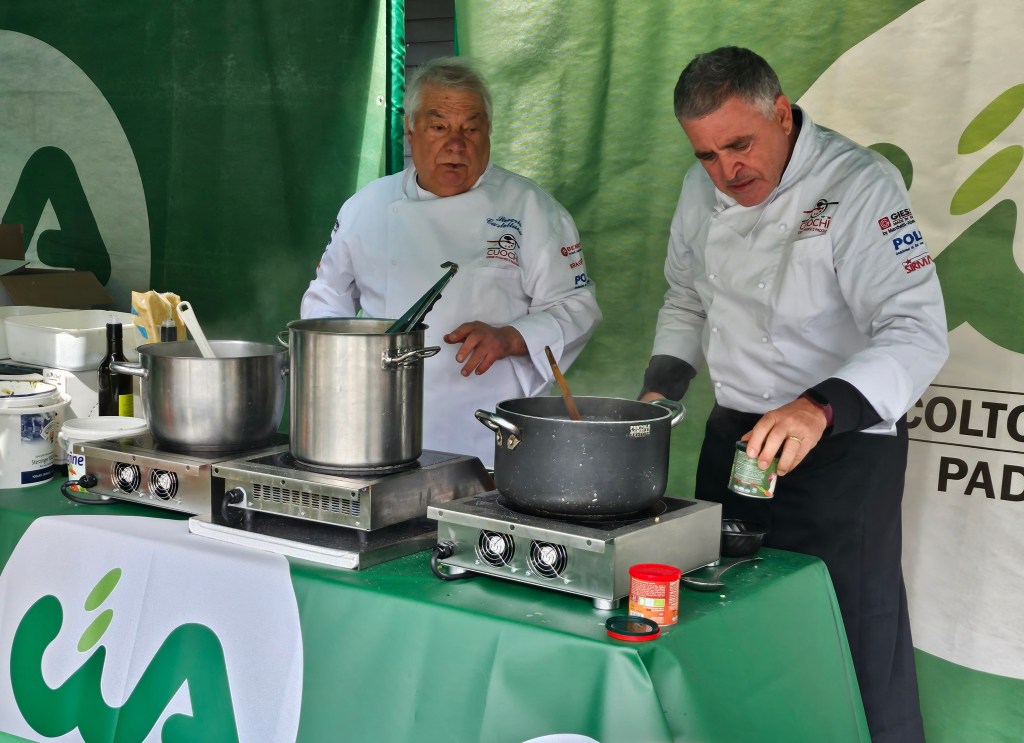
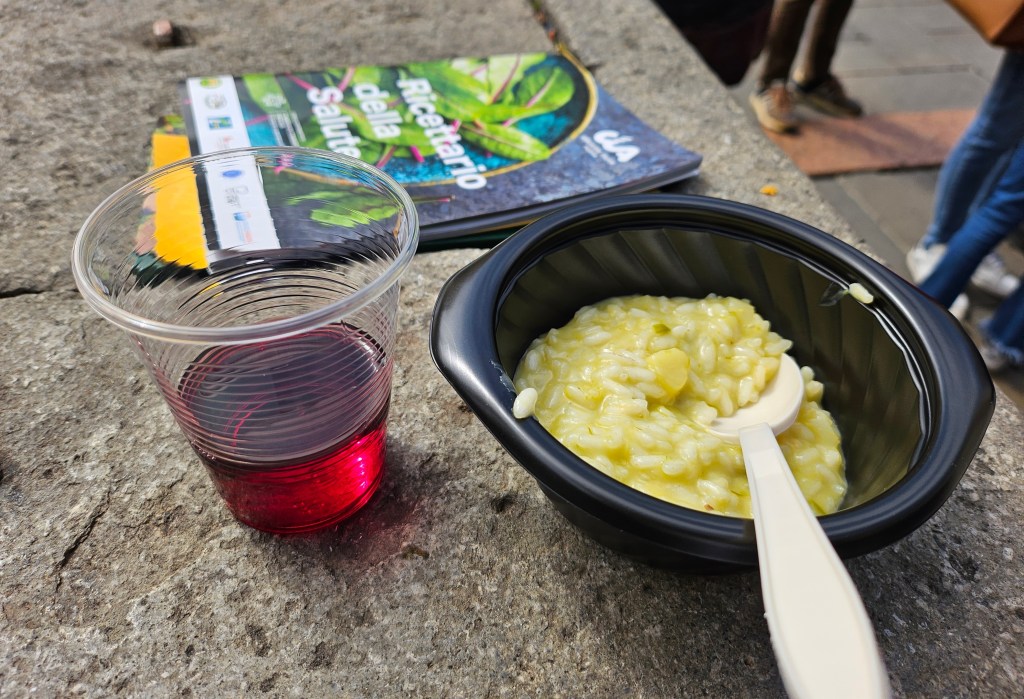
I next tried to visit Padua’s Jewish museum a short distance away. However, the man at the desk seemed surprised that I wanted to come in and said that there were no guides available. So instead I returned to the square where the band had been performing earlier. Here the farmers’ organisation was now cooking in a tent and there was a queue of people waiting to be served free food. I joined the queue and was rewarded with a bowl of very tasty hot asparagus risotto served with red wine.
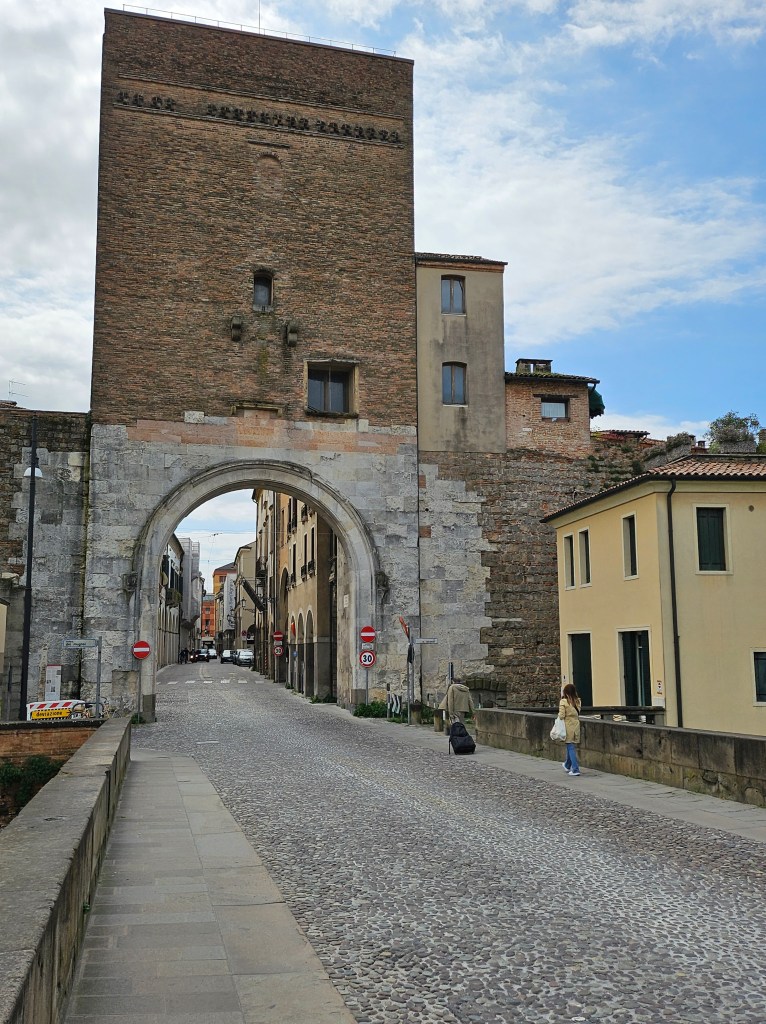
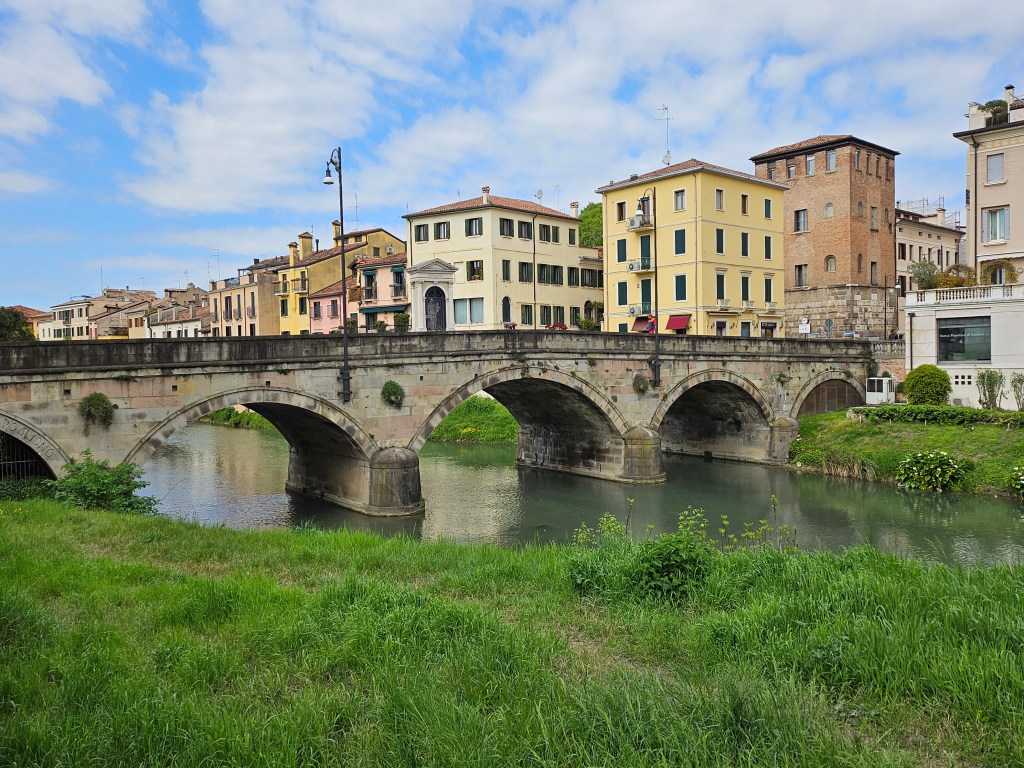
I took a roundabout route to get back to the station with the intention of seeing a Roman bridge across the river. However on the way there I came across a a modern art museum housed in a former church, which was free to enter. I went in and, although I did not think much of the art on display, in the basement were the uncovered excavations of the Roman building that had once occupied the site. From there I went through the Molina Gate to leave the old city and crossed the Roman bridge to make my way to Padua station.
My train to Milan departed at 13:46 and was more or less on time throughout its journey. On leaving Verona, which I visited in 2022 on my way to Ljubljana, there were views of the distant snow-capped peaks of the South Tyrol. A bit later the train’s route took us close to the shore of Lake Como, of which there were occasional glimpses.
The train arrived at about 15:50 at Milano Centrale, the vast cathedral like station, which must be one of the most impressive in the world. As I was having a very early start the next morning, I had booked a hotel near the station, where I walked to check in. I just left my bag and set off again.
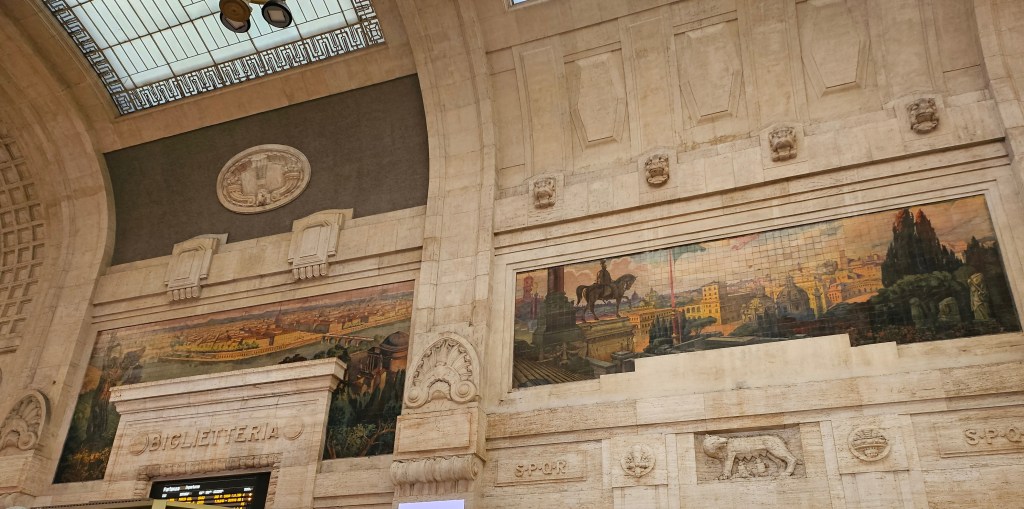
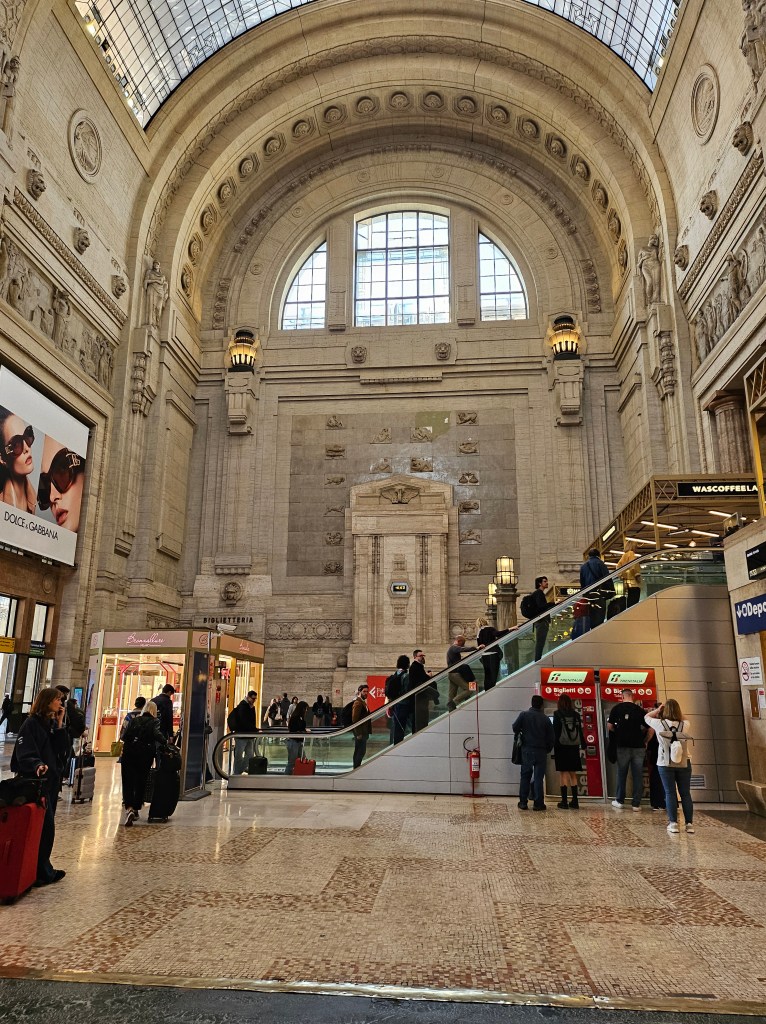

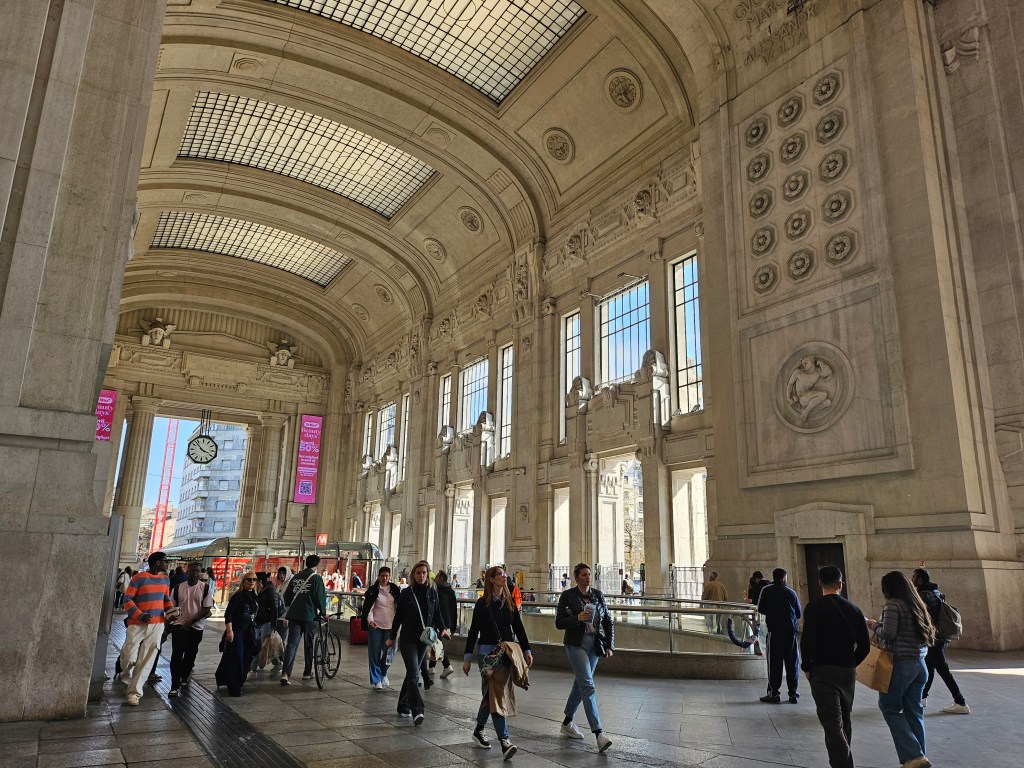

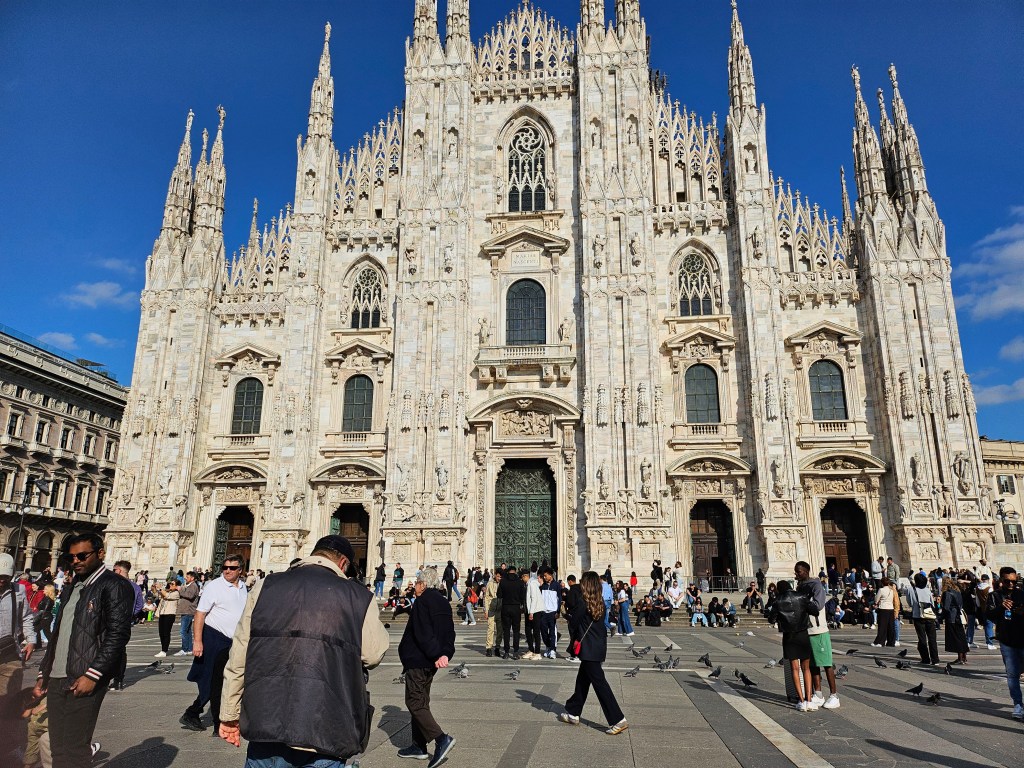
I caught the Milan Metro into the centre and got off at Duomo Metro station. The square in front of Milan Cathedral was busy, as I remembered it was when I visited in November 2022 on my way to Athens, but on this occasion even more so, because the Milan Marathon had been held that morning and the finish area by the cathedral was just starting to be dismantled. I went for a short walk past some of the sights of central Milan, before heading back to my hotel.
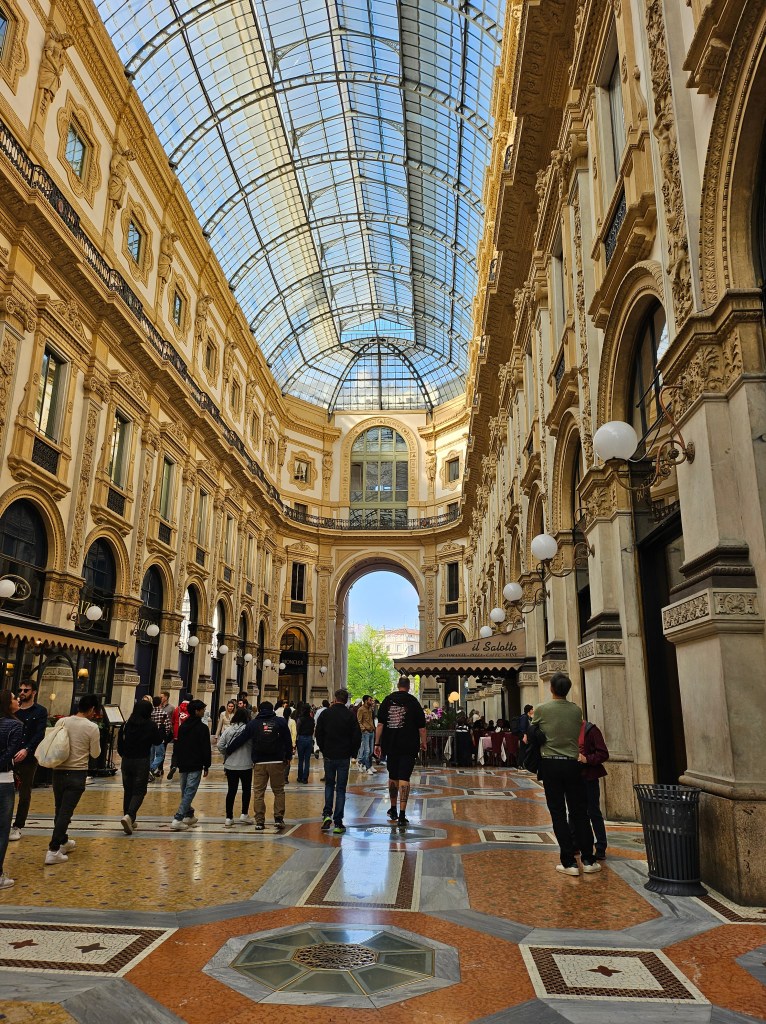
For dinner that evening, I found a nice restaurant not far from my hotel, where I had pasta followed by pizza. For both courses, the portion sizes were enormous and I was feeling very full by the time I left.
Day 8 – Monday 7th April 2025 – Milan to London (via Paris)
In planning this whole trip, I was relying on the direct Milan to Paris trains having started running again, which they were scheduled to do from the beginning of April. The route had been closed by a landslide just inside the French border in August 2023 and several planned reopening dates had come and gone without it happening.
I got up early and left my hotel before 6am for the short walk to Milano Centrale station. My train was due to depart at 06:25 and, although I could see it sitting in the platform, the departure boards were not yet confirming the departure platform. I positioned myself so that I could board quickly once the platform was confirmed, which it was at about 06:10. For this long ride, I was again travelling Business Class, having managed to obtain a very reasonably priced ticket. I was sitting in one of a pair of facing seats in the silent area, fortunately, nobody occupied the seat opposite throughout the journey and my seat did not have the horrible window covering reminding you to be silent that the one opposite did. We left on time. Just before departure a couple got on – the woman completely ignored that this was the silent area and talked loudly to her partner. When the ticket inspector came round, it appeared that they did not even have the correct tickets and were made to leave at the first stop, in Turin, reached after 45 minutes on the high-speed line.
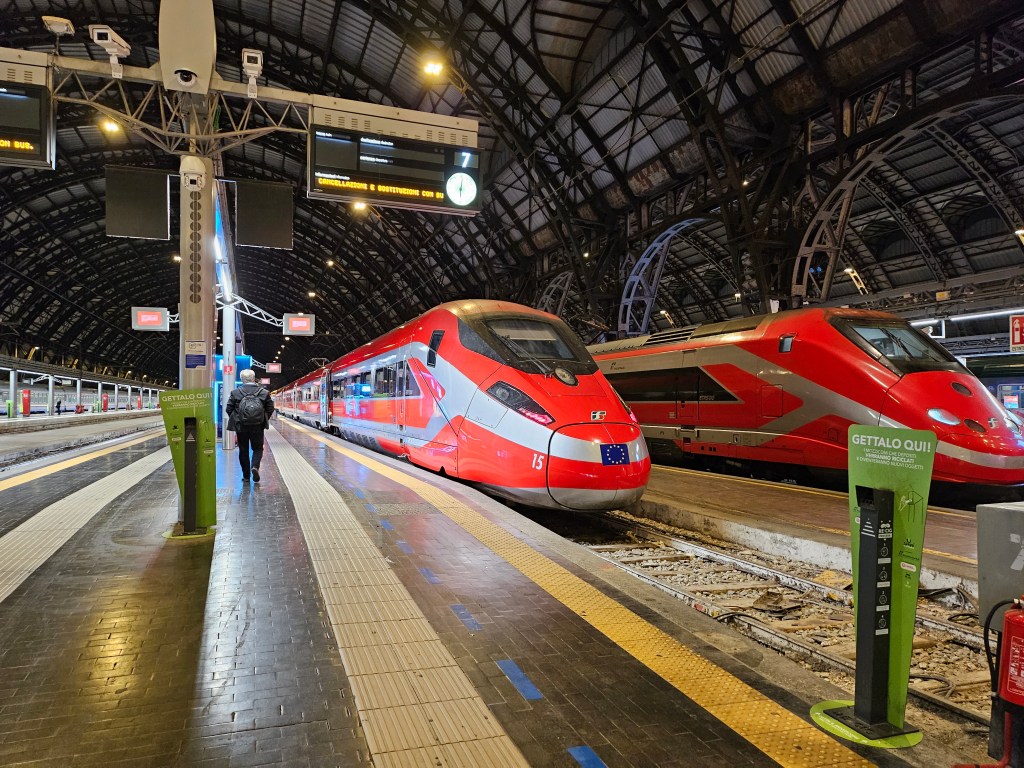
Dawn was breaking as the train departed from Turin. It left the high speed line and started to climb towards the mountains. As it did so, the clouds were down and it began to rain. It was misty and the views were limited. After a while the train entered the 14km long Frejus tunnel which crosses the border with France. Once we emerged from the tunnel, it was a beautiful sunny day, with clear views of the snow-capped mountains all around. At the first station in France, Mondane, the train had a scheduled 15 minute stop. This allowed the French border police to get on and walk through the train. They did not check the passports of anyone sitting in my carriage.
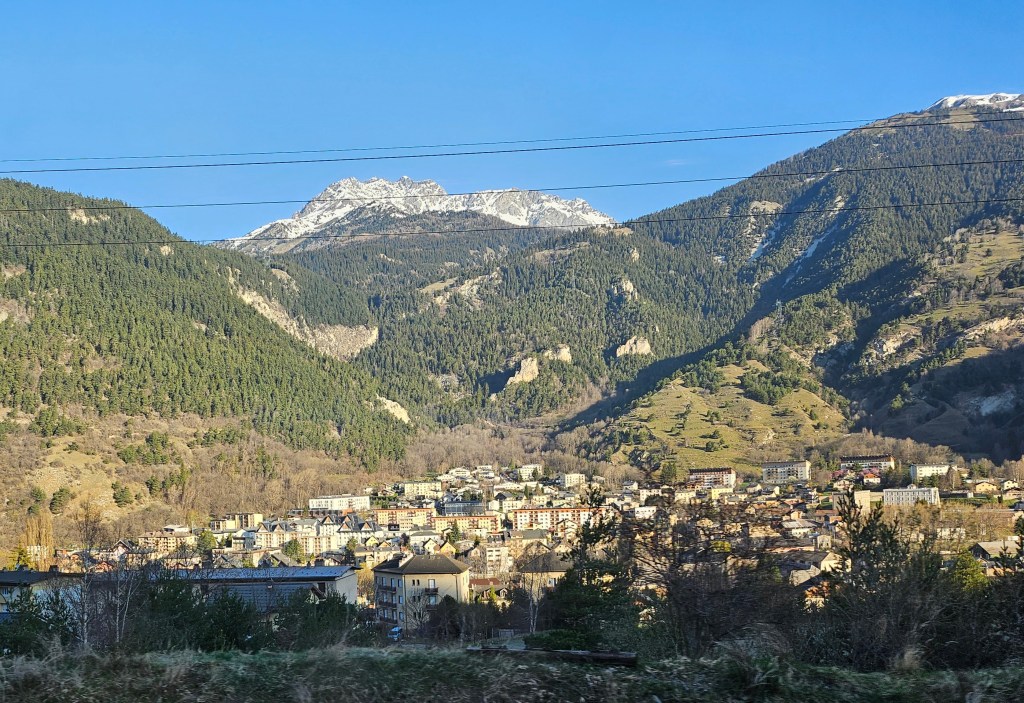
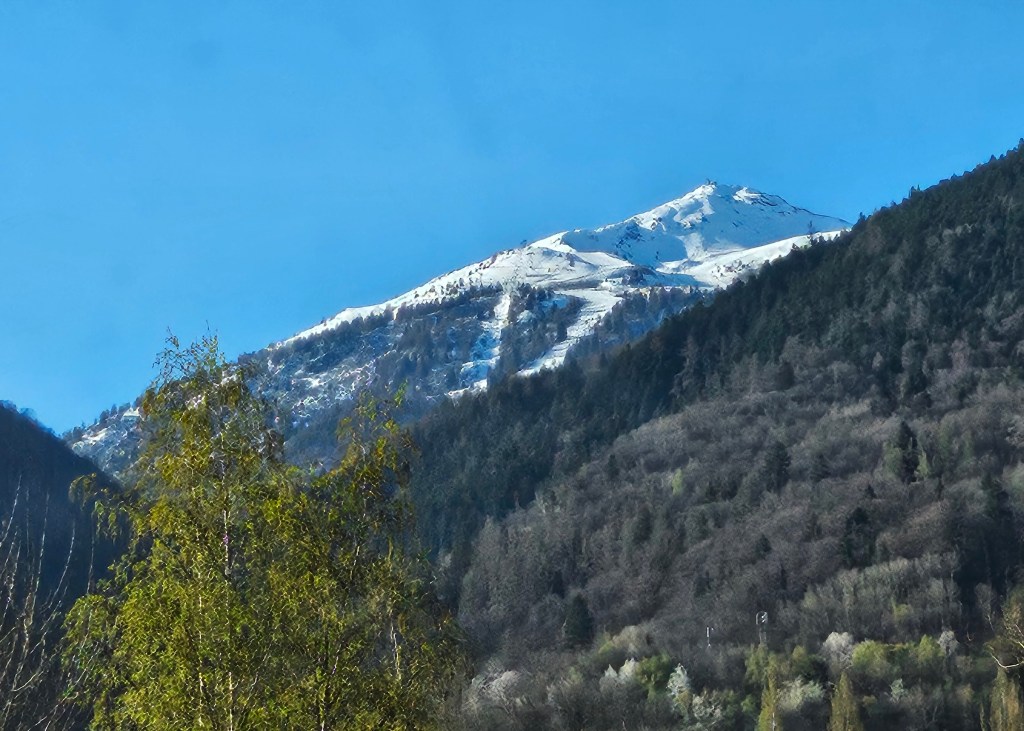
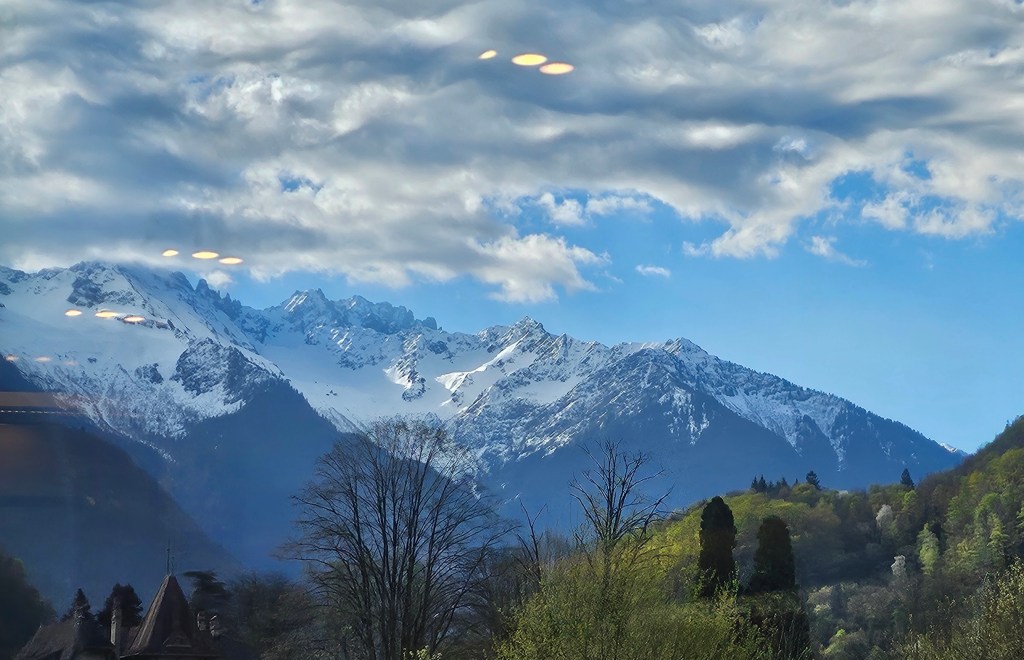
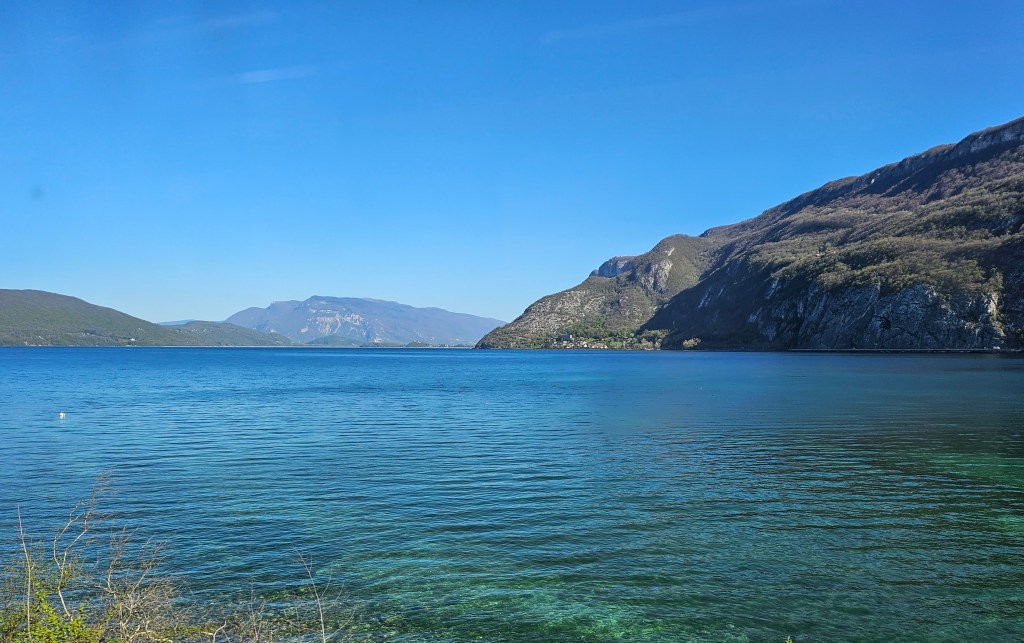
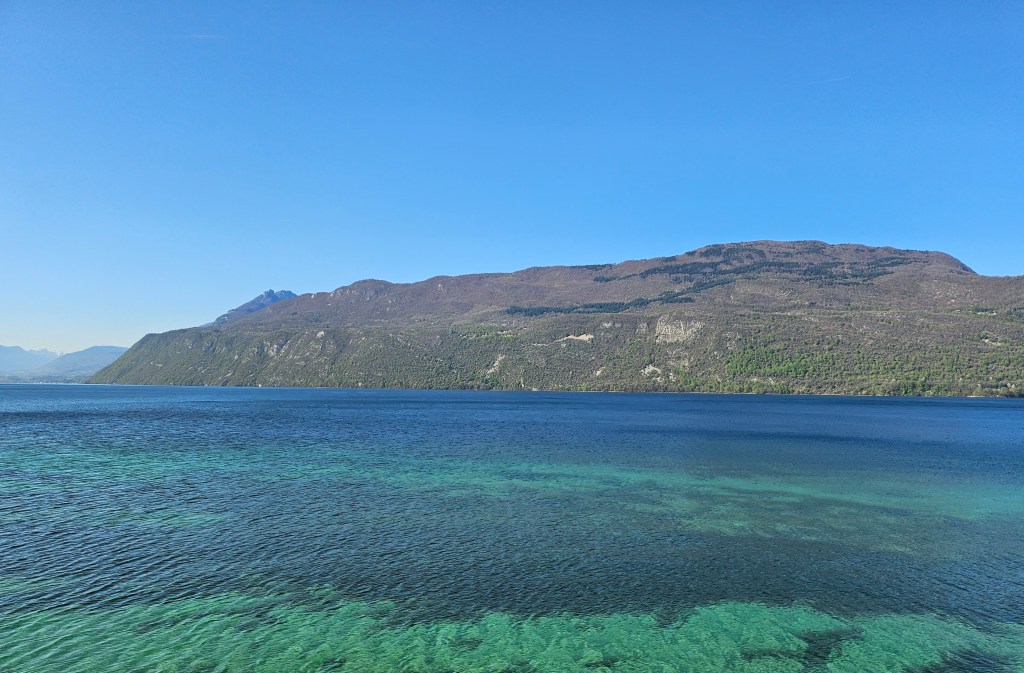
Just beyond Mondane, we passed the location of the landslide which had blocked the line for 18 months until it reopened the week before. Once the mountain views finally started to recede, the train began to follow the shore of Lac du Bourget, the largest natural lake wholly in France. From there it trundled relatively slowly to reach Lyon Part-Dieu station, where the train reverses direction. (I had visited Lyon in 2023 on a trip round the south of France.)
From Lyon, the train raced along the high-speed line all the way to Paris, taking only a couple of hours. It pulled into Paris Gare de Lyon, a few minutes early, just before 13:20, having taken under seven hours to travel from Milan. When I had been in Paris a few weeks earlier, my plan had been to visit the Musée d’Orsay, but that had to be abandoned so that I could catch a bus to Lille to escape the line closure caused by an unexploded World War II bomb. Unfortunately, the Musée d’Orsay is the one major Paris museum that is closed on Mondays (Tuesdays is the closing day for most), so I did not have the opportunity to visit it on this occasion either.
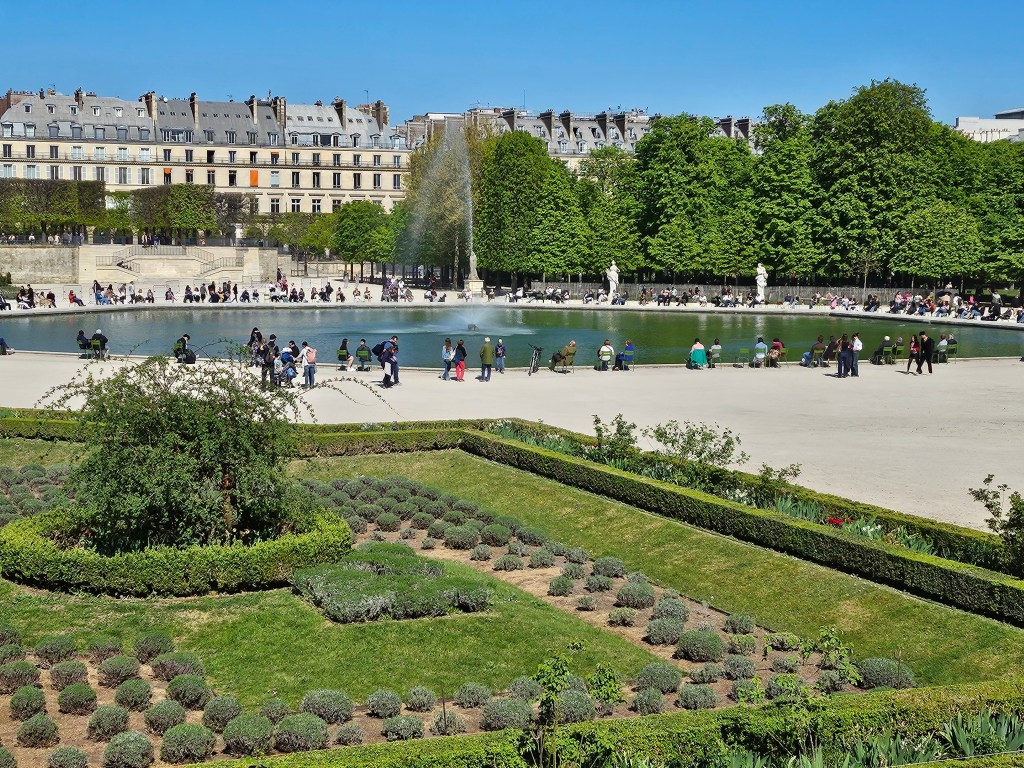
I hopped on the Metro, using for the first time tickets loaded on to my phone. My plan was to visit the art contained in l’Orangerie. I got off at Concord Metro station and walked through the Jardin des Tuileries. My heart sank when I saw the length of the queue to enter l’Orangerie. I contemplated abandoning my visit, but by timing how quickly the queue was moving I calculated that it should take no more than an hour to enter the gallery, which would still just about give me enough time inside. My calculations proved to be correct and I spent the rest of the afternoon looking at the Impressionist collections inside l’Orangerie, including some of Claude Monet’s massive depictions of water lilies. Although busy, l’Orangerie was nowhere nearly as crowded as I had feared given the length of the queue to get in.
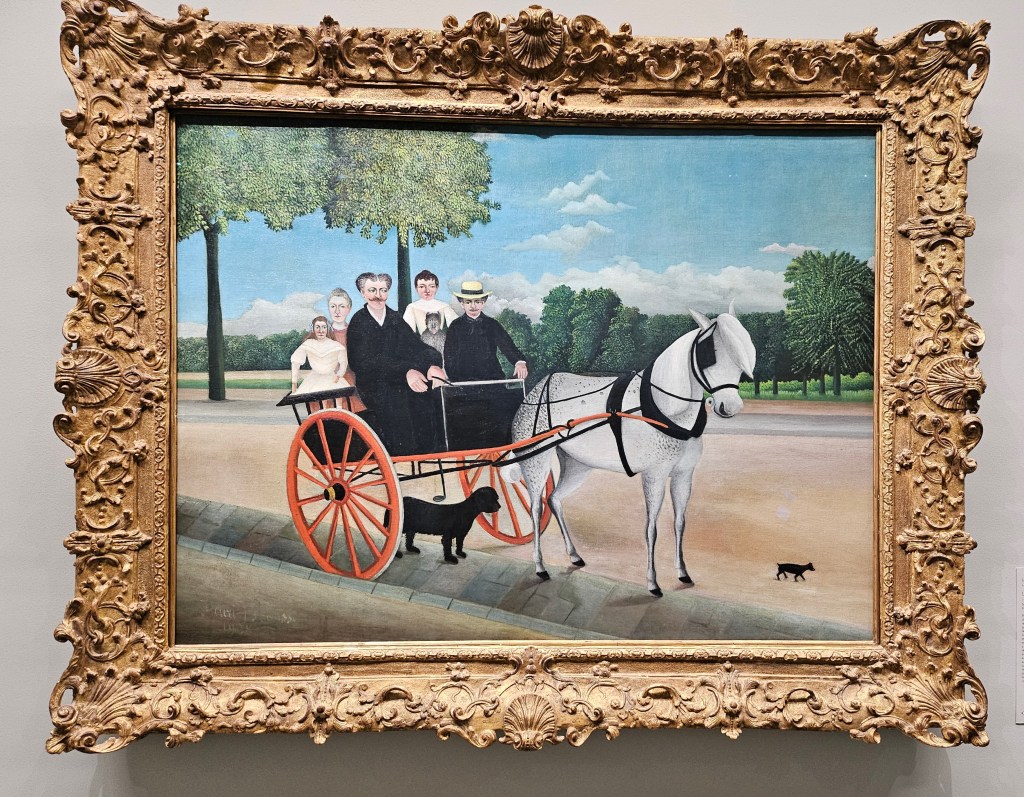
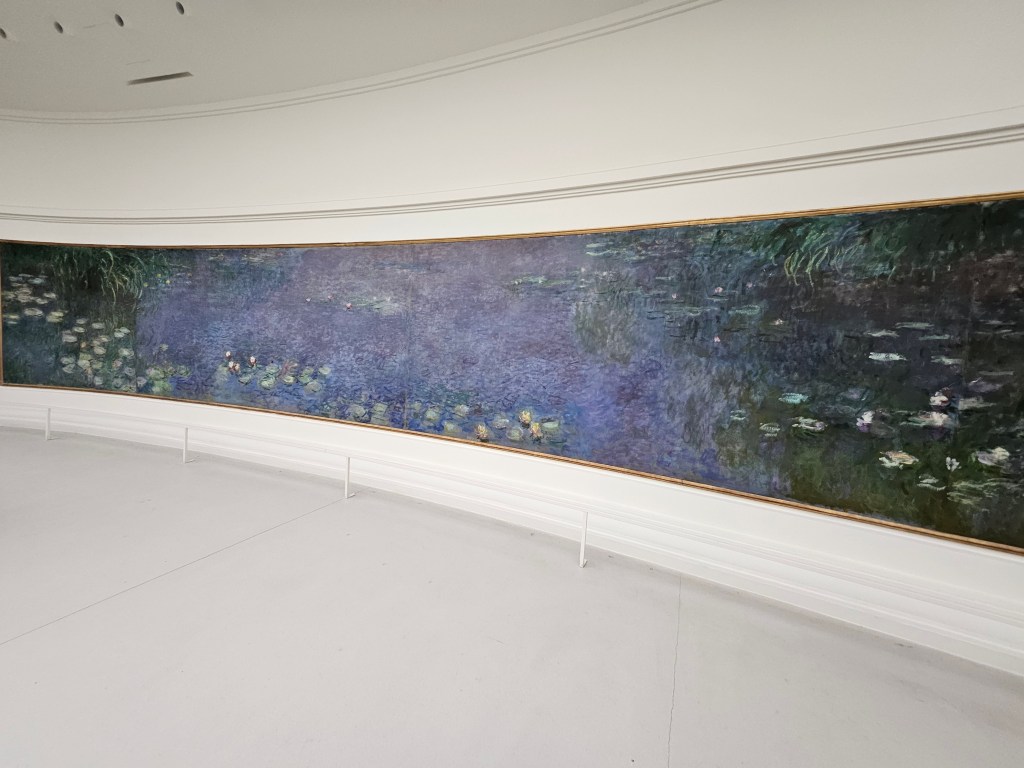
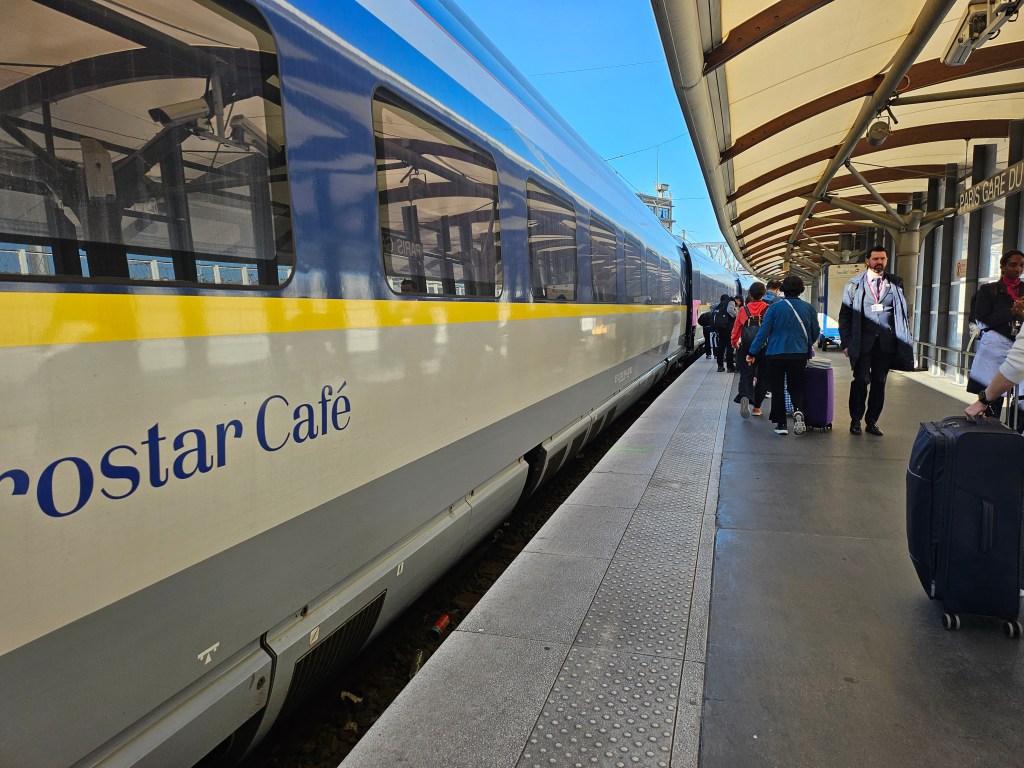
When I had finished in l’Orangerie it was time to head to Gare Du Nord. However, when I tried to change on to Metro line 4 at Chatelet, I found that it was not running to Gare du Nord due to a signal failure, so I walked the short distance to Les Halles to catch the RER instead. There was just time after I arrived at Gare du Nord to stock up on supplies from a supermarket a few blocks away, before going to check in for the Eurostar. My Irish passport let me use the e-gates for both the French and UK border controls, with no need to queue up to get my passport stamped.
The 18:08 Eurostar to London appeared to be completely full and left on time. I was just settling down and being thankful that there were not the problems that I had on leaving Paris a few weeks previously, when the train suddenly ground to a halt after about 20 minutes. Ironically, the place where we stopped was right next to the motorway that I had travelled on by bus to leave Paris last time. While waiting there, I saw the Aston Villa team bus heading towards Paris, presumably to pick up the players arriving by plane for their European Cup match against PSG. No explanation was given for the delay, but after 30 minutes we started moving again. A little time was recovered on the way to London, where we arrived at 8pm, 20 minutes late.
I had really enjoyed this trip. Although the places I visited in Italy are firmly on the tourist circuit, most of the museums I went to were quite empty. Apart from the problems with the brand new train leaving Ancona, the transport mostly worked well. The journey from Milan to Paris on the Frecciarossa was a particular delight.
 Europe Explored