
“… And now for something completely different” (Monty Python)
This post continues the account of my journey to Romania and Bulgaria in October 2024. Romania was a country that I had previously visited 41 years earlier, whereas I had never been to Bulgaria before. Bulgaria uses the Cyrillic alphabet, but all place names in this account have been transliterated into the Latin alphabet.
Day 8 – Tuesday 15th October 2024 – Bucharest to Veliko Tarnovo
Had I done this journey the day before, or on any day in the preceding four months, I could have caught a through carriage to take me from Bucharest to Veliko Tarnovo, which would eventually go all the way to Istanbul. However, the day I was travelling was the first day of the winter timetable for this service and two changes were required to reach Veliko Tarnovo. Had I travelled a day or so earlier, I wouldn’t have been able to see all the things I wanted to in Romania, bearing in mind the Monday closing of many attractions. But in any case, even with the two changes, I was scheduled to arrive at the same time in Veliko Tarnovo.
There is only one train per day from Bucharest that crosses the border to Bulgaria on the route I wanted to take and as it doesn’t leave until 10:47, I had one of my later starts. Romanian railways had saved their worst train for my final journey with them. It arrived at the platform at Bucharest Nord about 10 minutes before it was due to depart. It was a small two car diesel unit, whose exterior was almost completely covered in graffiti. Nominally I had a seat reservation, but the seat numbers appeared to have been written by pen on the walls of the train by the seats and my number did not seem to exist. Like most of the other passengers I just bagged whatever free seat I could find. When the train left it was fairly full. I managed to get one of the few window seats which actually had a view out – one of the large windows had completely shattered and many of the others were obscured by graffiti. The train uses a non-direct route, with a big dog-leg via Videle, to reach the border station of Giurgiu Nord. A new more direct line has recently opened connecting Bucharest with Giurgiu, but for whatever reason our train was not using it. It was another very slow train, rarely exceeding 25 mph. The one toilet on the train was blocked and after a while it disgustingly started overflowing into the corridor outside.
Both Romania and Bulgaria have joined the Schengen Area for air and sea transport, but not for road and rail links. Given that both countries are pressing for full membership of the Schengen Area, it is surprising that they maintain full passport checks between each other. The checks on leaving Romania are done at Giurgiu Nord station, where the train is allocated a 20 minute wait. That said, we had got progressively later throughout the journey and eventually pulled in to Giurgiu Nord at the time we should have departed. A Romanian border official got on the train and went through it checking everyone’s passport and keeping a large number of them (I think the non-Schengen ones) to take away with him to the border post within the station building. Except that he accidentally forgot to check mine – when he got to where my seat was he took away the passport of the person across the aisle from me and then walked on with his back to me. When he came back 20 minutes later he had the passports sorted in order to return them and seemed puzzled that he did not have one for me.
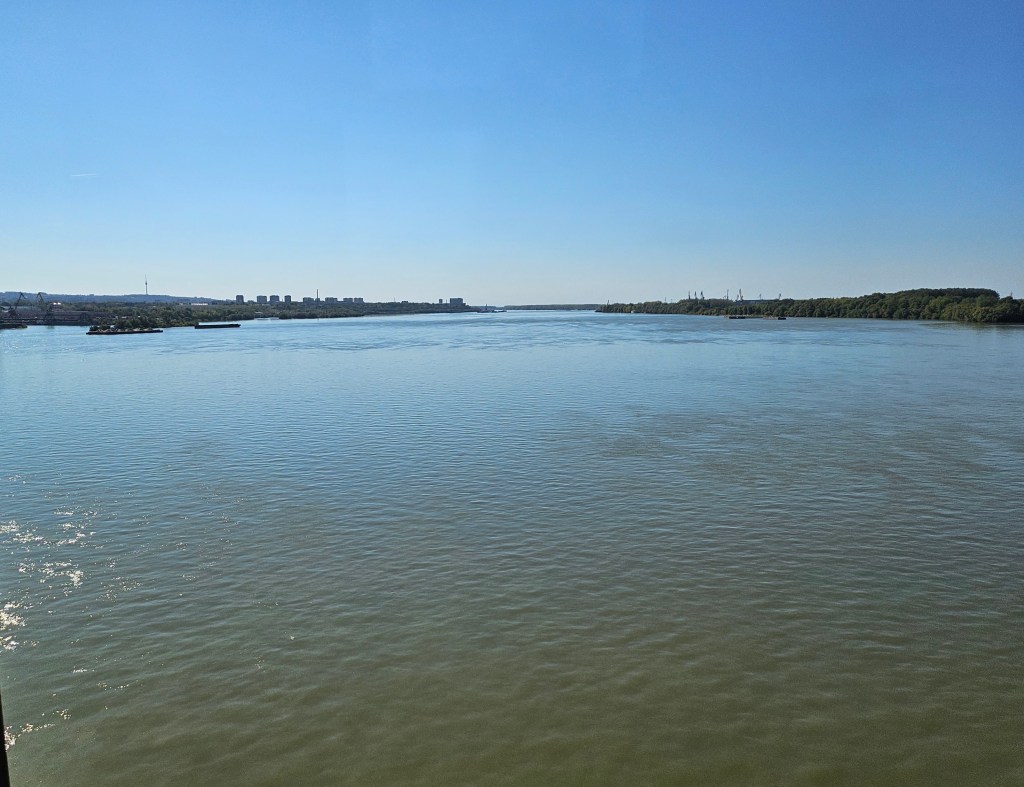
Leaving Romania 20 minutes late, we crossed the wide Danube on the Friendship Bridge linking the two countries. Although only a short distance from the Danube to Ruse station my train was delayed by some freight movements and we arrived 30 minutes late, just five minutes before the onward connecting train was due to depart. At Ruse, we were prevented from getting off the train until a border official had taken up position at each of the two sets of doors and everybody had to just hand over their passport as they got off. We were then allowed to wait on the platform, but there were a couple of policemen to stop anyone proceeding further until their passport was returned. As at Giurgui, the passports at Ruse were taken away to the station building to be examined. When the official returned there was a large scrum of people waiting and she placed the pile of passports on a concrete wall by the entrance to a passageway. She then went through the pile calling out each person’s first name, and if that produced no response, tried again with first name and country. However, it appeared that the pile of passports was now in reverse order to that in which they had been handed in and those at the back of the scrum could not hear their names being called.
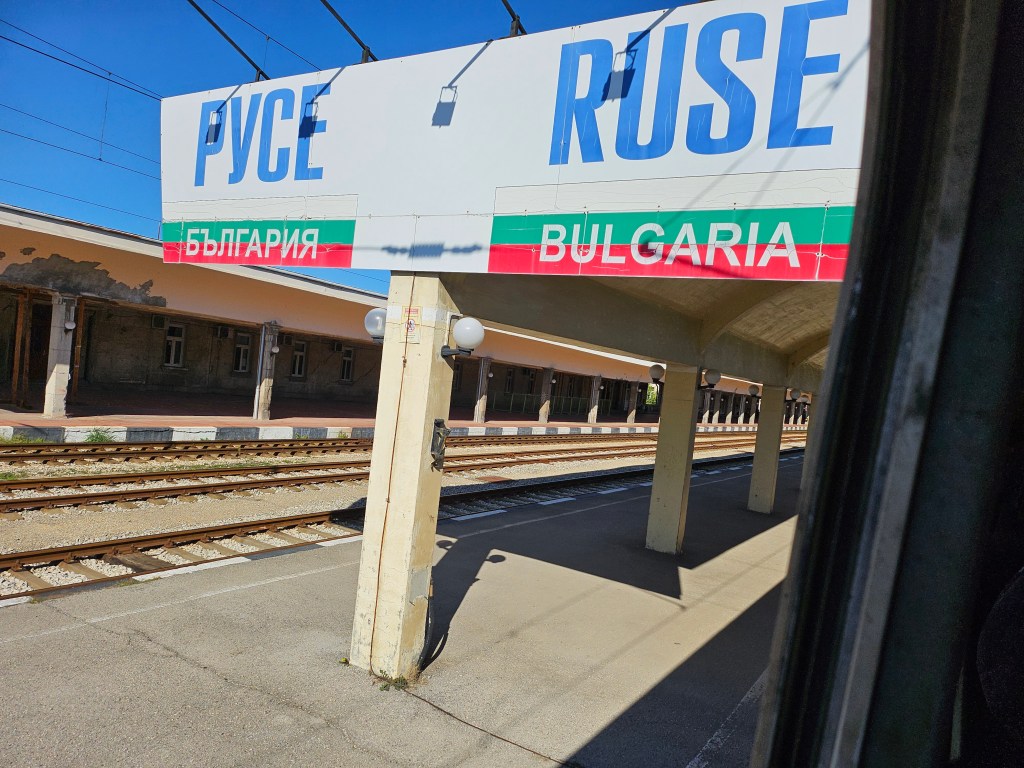
When I eventually had my passport returned I was free to get on the next train further along the adjacent platform, which finally left 15 minutes late when everybody who had been waiting was on board. Again there were reserved seats for this train, which this time people did seem to be adhering to. My carriage was an old fashioned compartment car, with eight seats per compartment (six is the norm these days in other countries). Unfortunately, not only were the seven other seats in my compartment occupied – by three Iraqi men, an Australian couple and an American man – but the Iraqis and the Australians had ridiculously large amounts of luggage, such that by the time I arrived it was difficult even to enter the compartment. The American showed some initiative and persuaded the initially reluctant Australians to let him take some of their luggage into the corridor outside. Even so, I spent most of this leg of the journey standing in the corridor, as it was more comfortable than trying to sit in the overcrowded compartment.
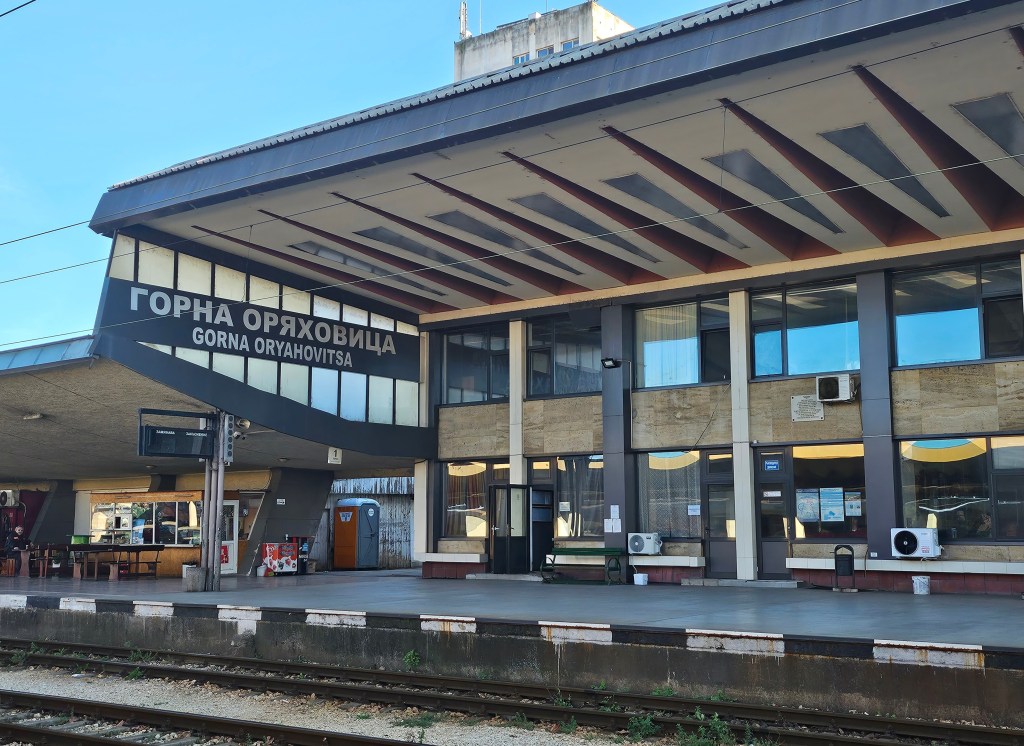
We pulled into Gorna Oryahovitsa at 16:30 having neither gained nor lost any more time on the 15 minutes that we were late leaving Ruse. Even though I had arrived late, I still had an hour to wait for my final train of the day to Veliko Tarnovo. The station at Gorna Oryahovitsa is some distance from the centre of the town, so it didn’t seem worthwhile going to explore. However, I realised that it is not very far by road from Gorna Oryahovitsa to Veliko Tarnovo – the road makes a bee-line over a mountain pass, while the train takes a more circuitous route round the mountain. I had read accounts that it is not very expensive to get a taxi and I had thought it might be worth it to arrive over an hour earlier in Veliko Tarnovo. However, unlike at most other stations on this trip, I was not approached by any taxi drivers touting for business when I walked out of the station. There was one solitary taxi waiting, manned by a rather elderly driver. I tried to ask him about the fare to Veliko Tarnovo, but he did not seem interested in my business, so I returned to the station to wait for my next train to depart. There were major shunting operations going on at Gorna Oryahovitsa, with carriages being detached from arriving trains to be coupled to others waiting. There were a couple of carriages already waiting at the platform from which my next train was due to depart, but no platform departure boards to confirm where they were going. When, about 20 minutes before departure, a locomotive was brought to attach to them I felt it safe to get on board.
The train departed on-time at 17:30 and arrived at Veliko Tarnovo on-time 20 minutes later. Inevitably, as I left the station I was approached by taxi drivers touting for my business. This is understandable, as the station is some way from the centre of the city. As I had been on trains all day, I thought a walk would do me good. What I hadn’t realised was that the initial part of the walk to Veliko Tarnovo was down a busy road with no pavement and I was glad that it was not yet dark. Having survived that part of the walk, the remainder was very attractive – crossing a footbridge over the steep valley in which Veliko Tarnovo nestles.
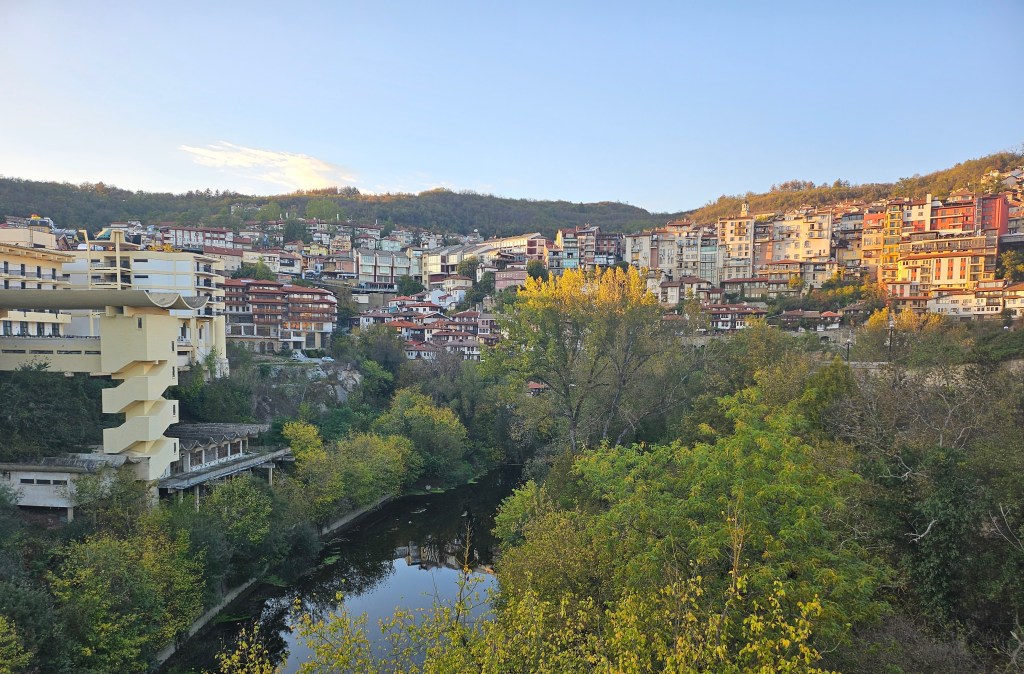
It took me about 30 minutes to walk to my hotel, so by the time I had sorted myself out after arriving it was just about time to go and find somewhere for dinner. I avoided the main road which is where most of the restaurants are, but instead went to a pub on a side street lower down the valley side. Here I had a very tasty meal, with a very attentive waitress who ensured that my beer never ran out. I asked for a few olives while my main course was prepared, but was brought a large plate of olives and onions, which I was still eating when my main course of succulent, slow cooked pork neck and potatoes arrived.
Day 9 – Wednesday 16th October 2024 – Veliko Tarnovo
Veliko Tarnovo was the ancient capital of Bulgaria, until it was captured by the Ottomans in 1393, and the whole of Bulgaria incorporated into the Ottoman Empire just three year later.
The citadel of the early Bulgarian Tsars was the Tsarevets fortress, which was just a short walk from my hotel. This enormous complex is situated on the Tsarevets Hill and is enclosed with thick stone walls all the way round. I arrived there just after it opened to visitors at 9am. Initially, there were very few other people at the site and and, as I had a whole day in Veliko Tarnovo, I could spare the time to explore it thoroughly. In the middle of Tsarevets near the highest point of the hill are Baldwin’s Tower and the Orthodox Cathedral of the Ascension. Both these buildings are 20th century reconstructions of earlier medieval originals. The interior of the cathedral is completely covered in ornately painted frescos.
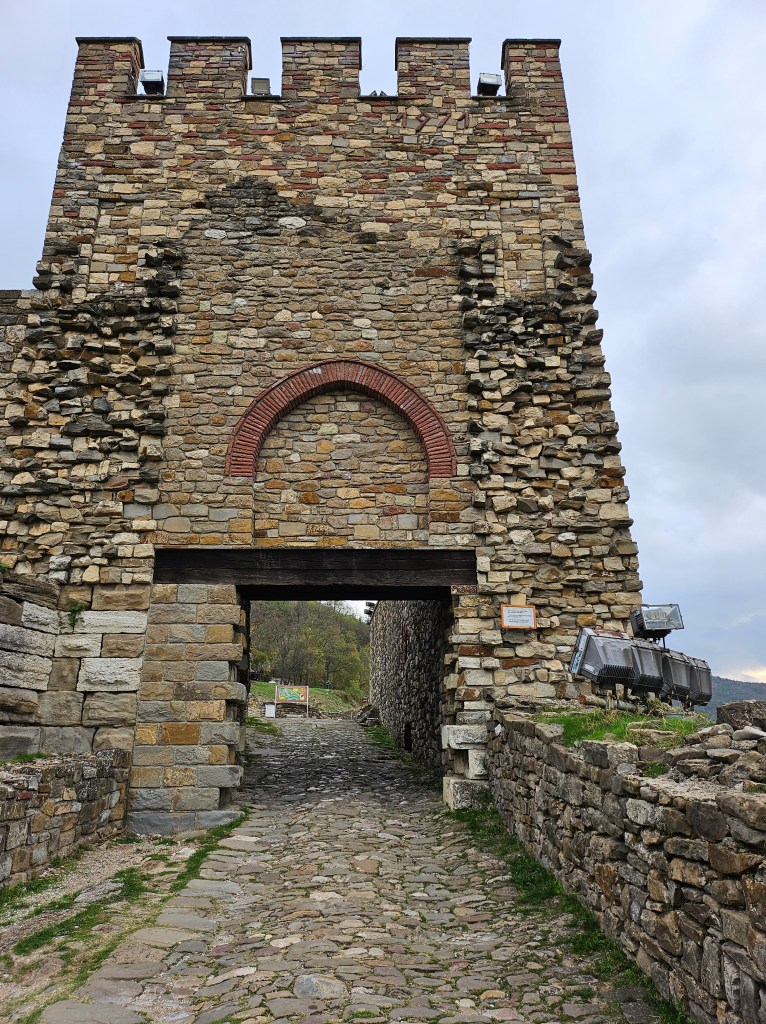
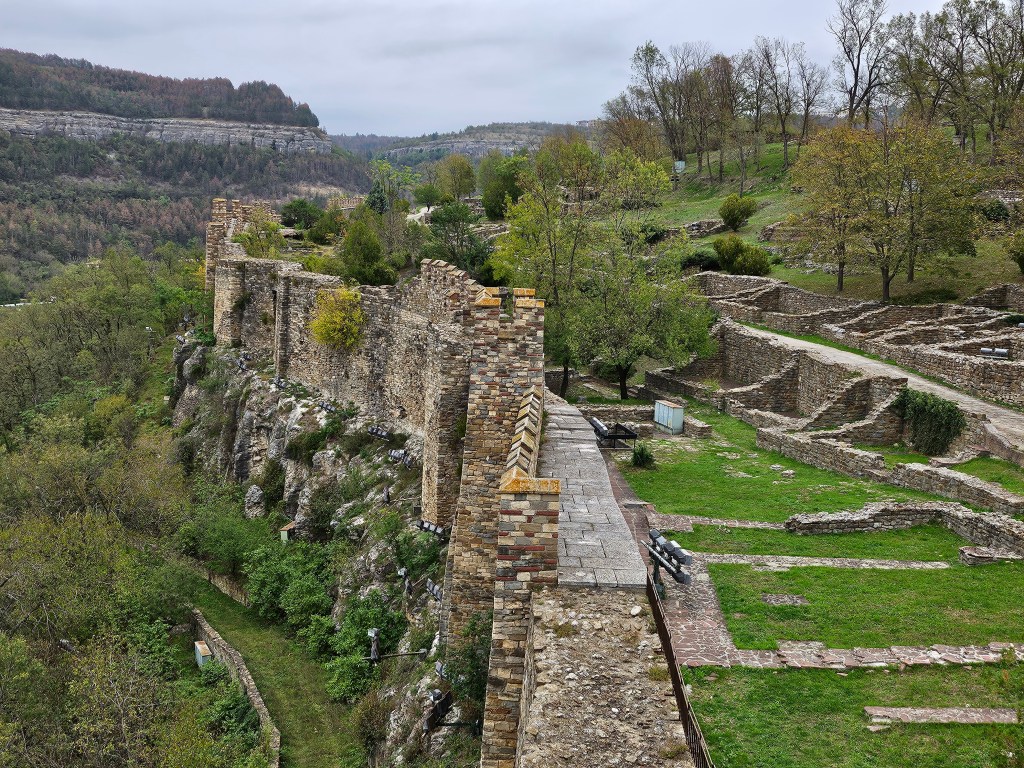
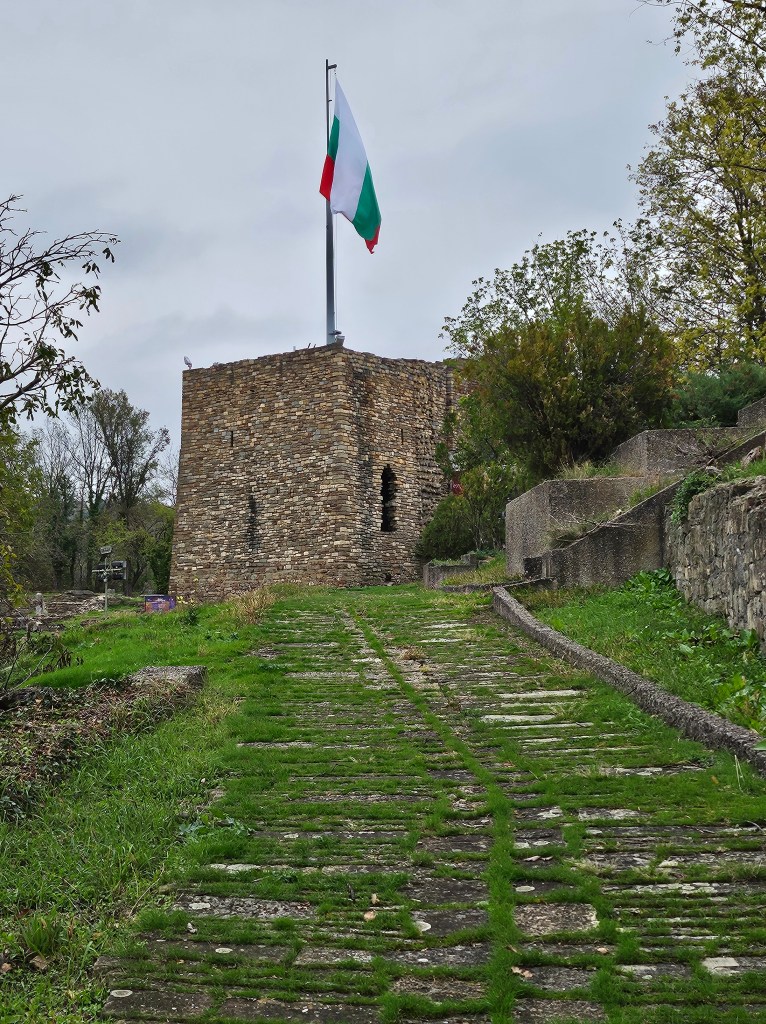
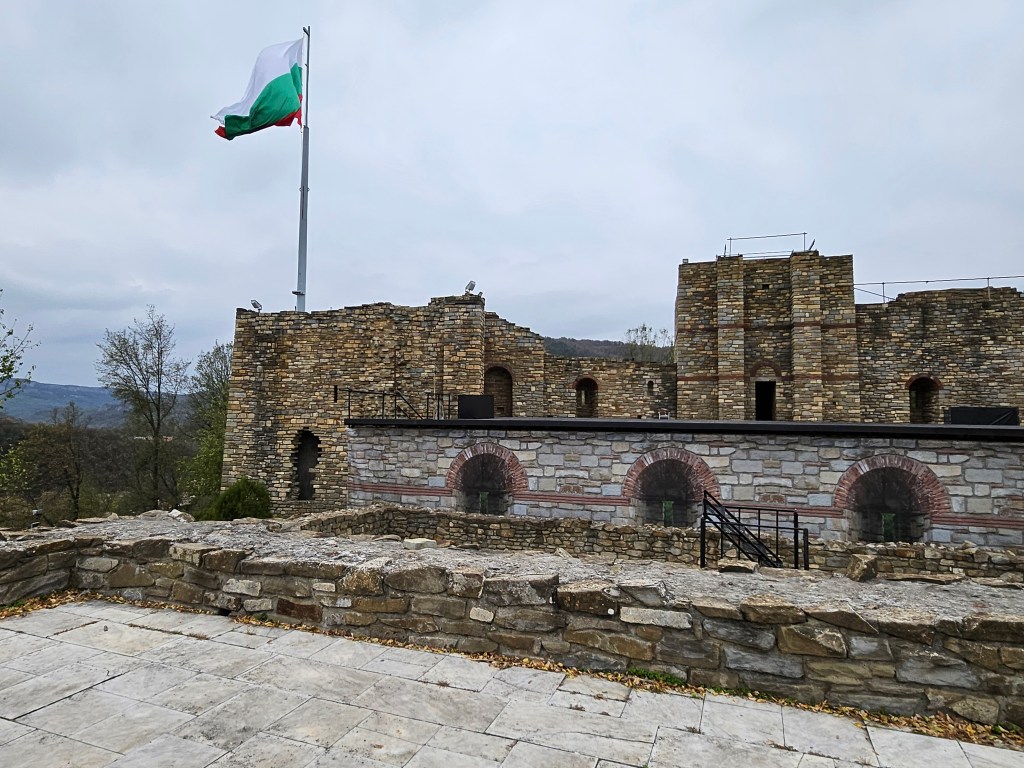
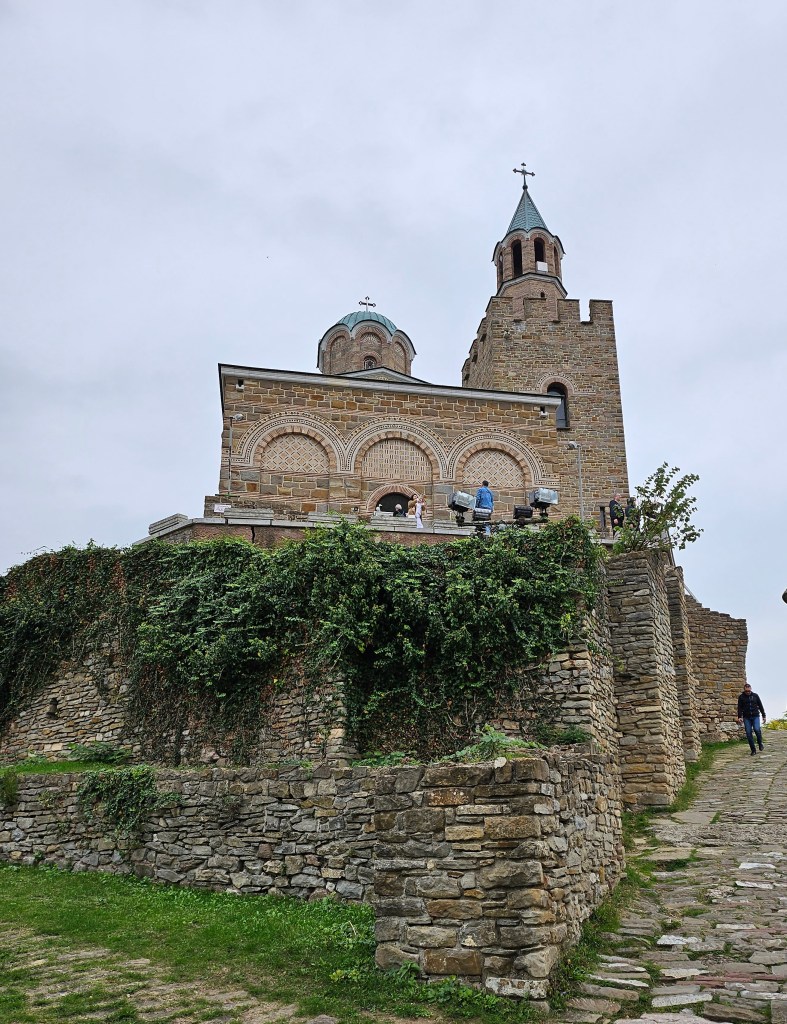
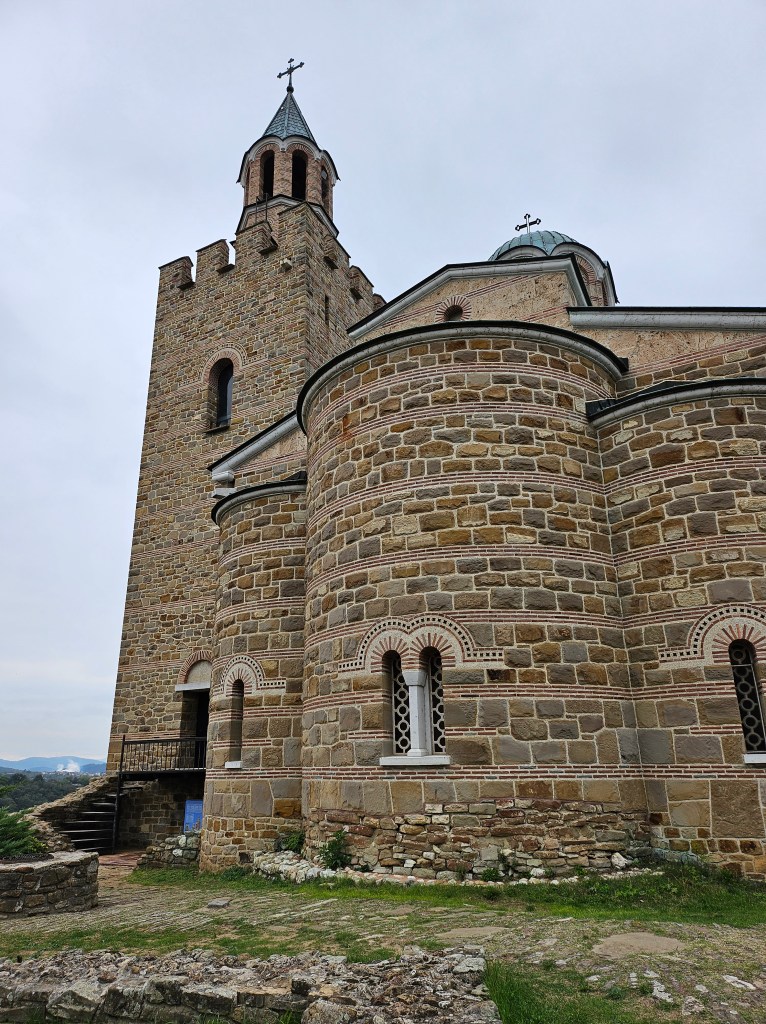
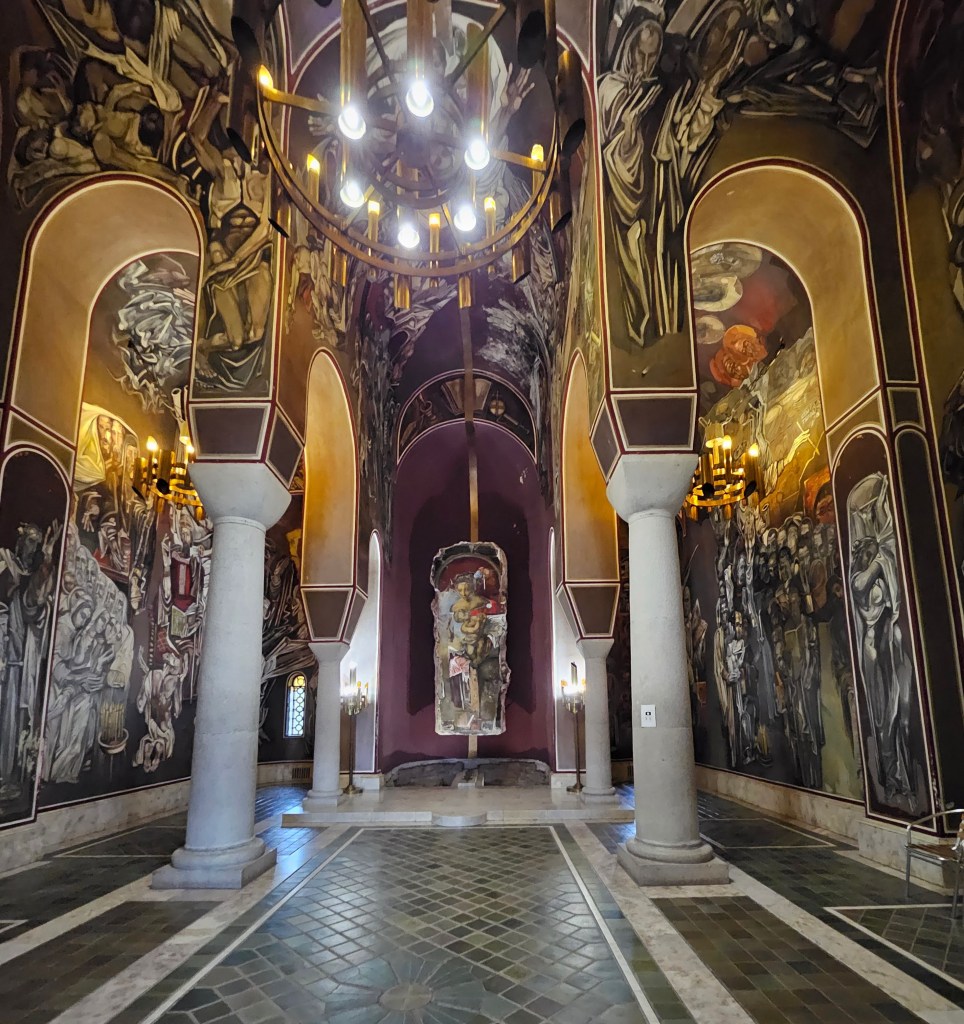
I spent about two and a half hours in Tsarevets and by the time I left there were a lot more people there. I then went to explore the rest of Veliko Tarnovo. As I was walking down the road from Tsarevets, I was greeted by a man with a British (possibly Scottish) accent asking me how I was doing. As I had absolutely no idea who this person was, I just made a non-committal response and walked on. Given that I am dreadful at recognising faces, I was slightly worried that I might have offended some acquaintance from the past, who was surprised to encounter me in such a far-flung location. However, on the next day I think I solved the mystery of who he was.
As it was now outside the summer season a number of the museums and other attractions were closed at the time of my visit. I wasn’t sure whether the first building I tried would be open, as in the section on its website listing its opening hours it just said it was closed until the end of 2023. As I approached, looking through the windows the interior appeared to be in complete darkness, so I was not hopeful. However, when I tried the door it was not locked, so I went in. A woman appeared out of the gloom and when I said I wished to visit, she indicated with her fingers the number of lev required and pointed for me to go upstairs. As I ascended, she turned on the lights in the upper rooms. This was an historic building in the history of Bulgaria. Following the overthrow of Ottoman rule in Bulgaria, the Bulgarian National Assembly met for the first time in this building and adopted the Tarnovo constitution, which laid out the principles of government of the modern state of Bulgaria. The Tarnovo constitution remained in place until abolished by the Communists in 1947. The upper floor contained a small museum describing the Tarnovo constitution and other local history, as well as a recreation of the hall in which the first National Assembly met.
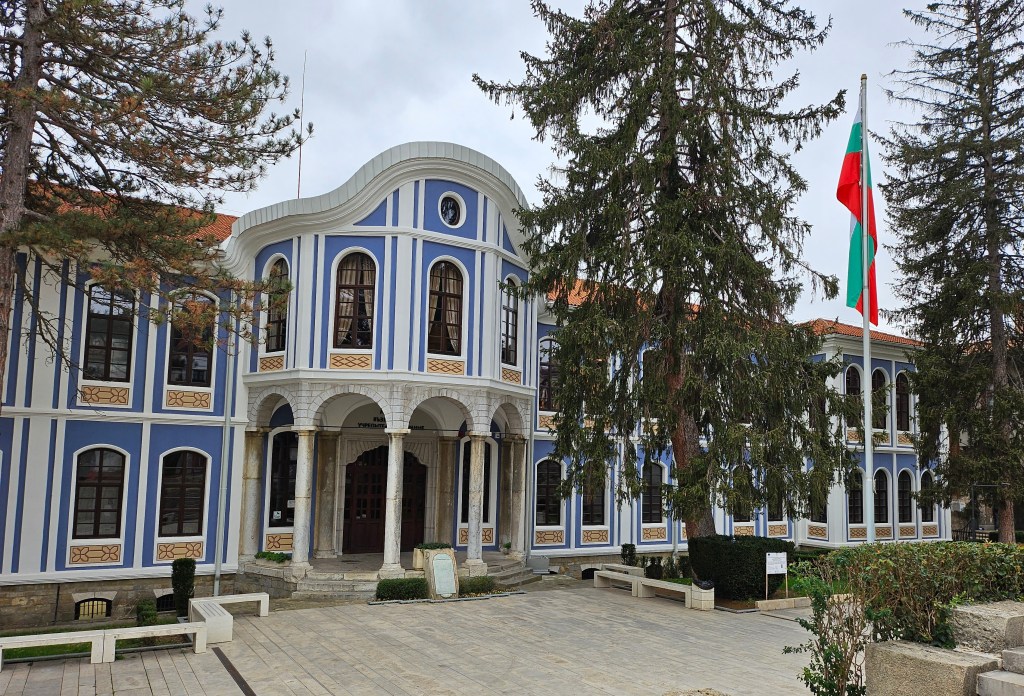
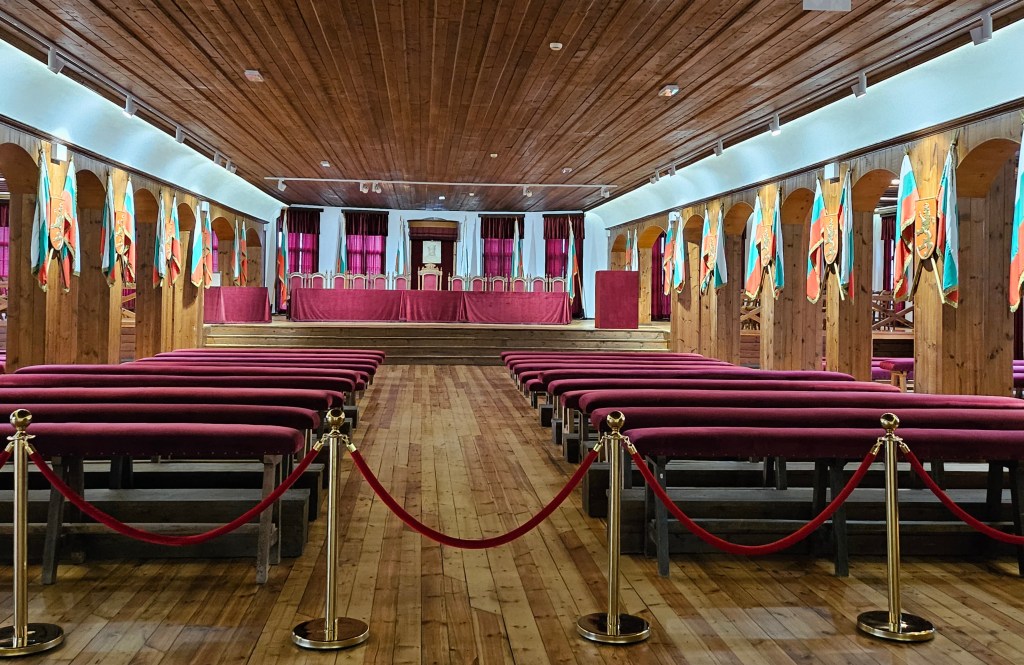
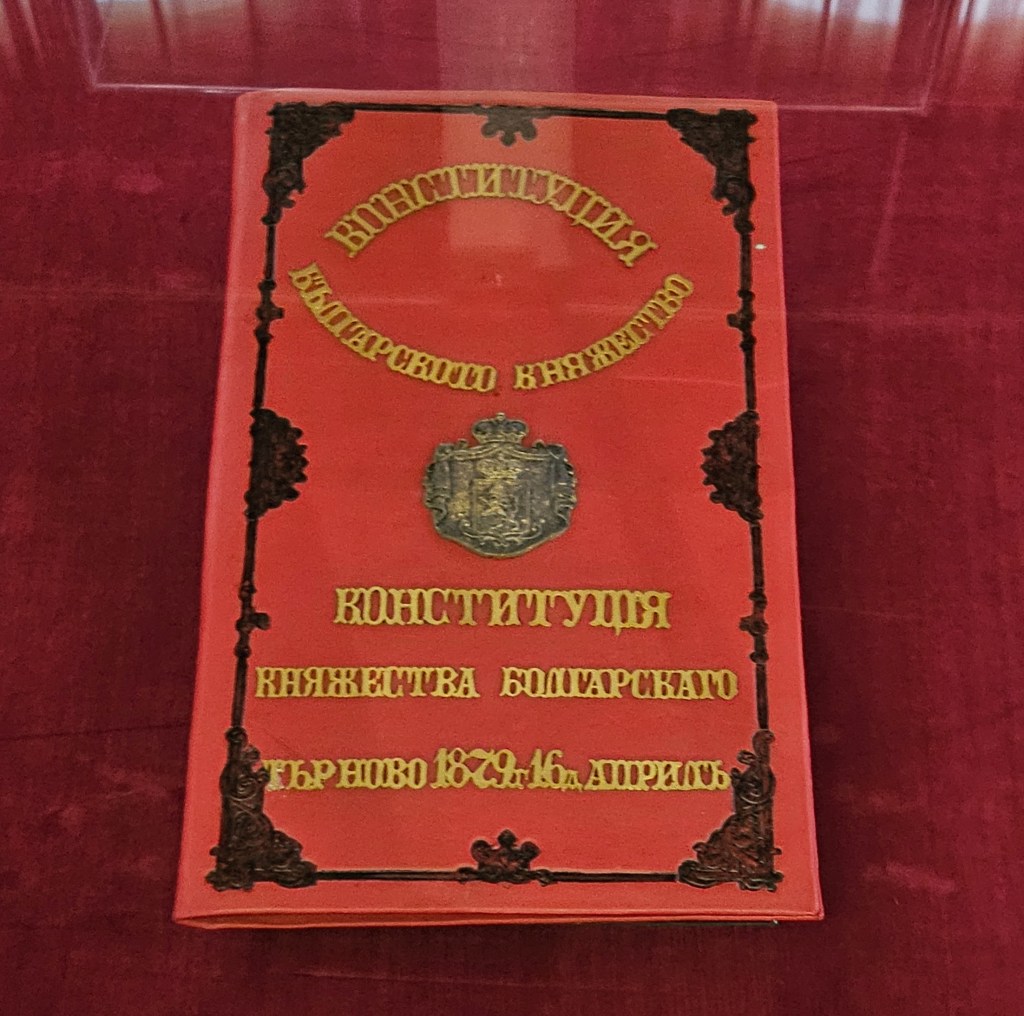
Next I tried to visit the nearby Archaeological museum, which contains many artefacts from Tsarevets. The notice outside confirmed that it should be open, but when I tried to enter, the door only partially opened, as it was on a chain to stop you opening it fully. Despite making a bit of noise to attract attention, nobody came to open the door, so I gave up. This gave me some spare time, so looking at the website I saw there was a museum based in a nearby house, which also should be open. However, when I got there, there was a paper notice stuck to the door, saying that it was closed that day.
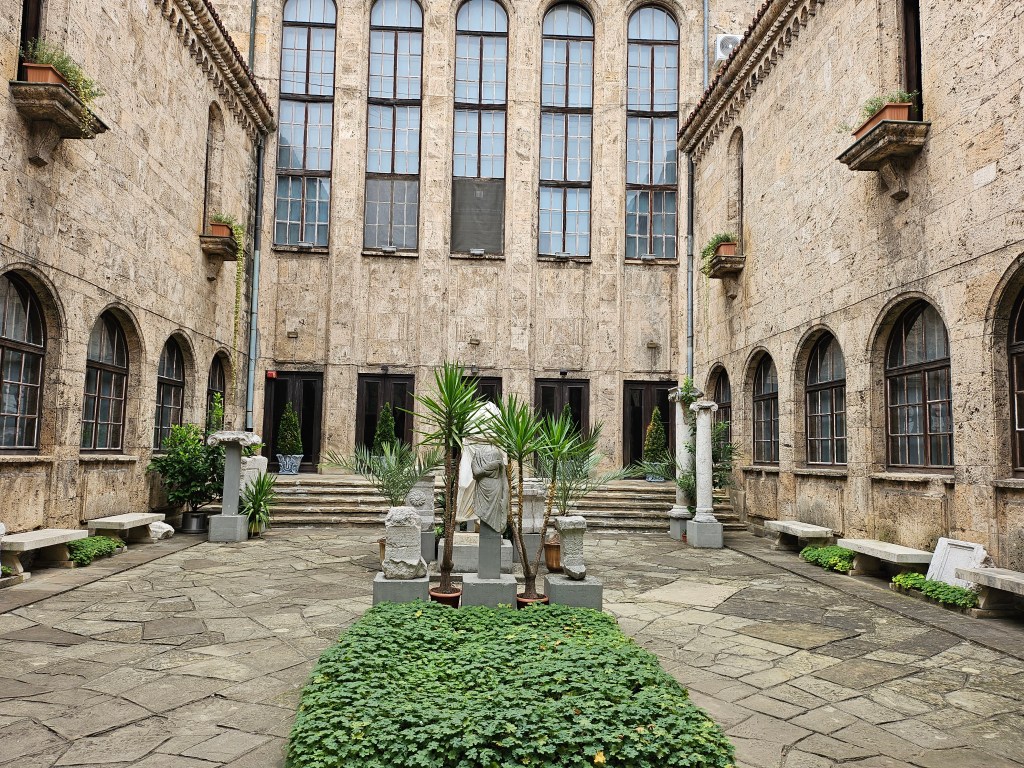
I then made sure that I did a thorough explore of Veliko Tarnavo, including going beyond the old town to ensure that I knew exactly where the bus station was for when I needed to go there the next day. My final visit was to an exhibition described as the Tsarevgrad Multimedia Centre – I wasn’t sure about this place, as looking at its website, it seemed to be just a waxworks museum, which is why I had left it until last, only to be visited if time allowed. I was correct that it was primarily a waxworks (I’m not sure where the multimedia bit comes in), depicting various scenes from medieval Bulgarian history. That said, it wasn’t as bad as I feared and there was plenty of information in the description panels telling you about the events depicted.
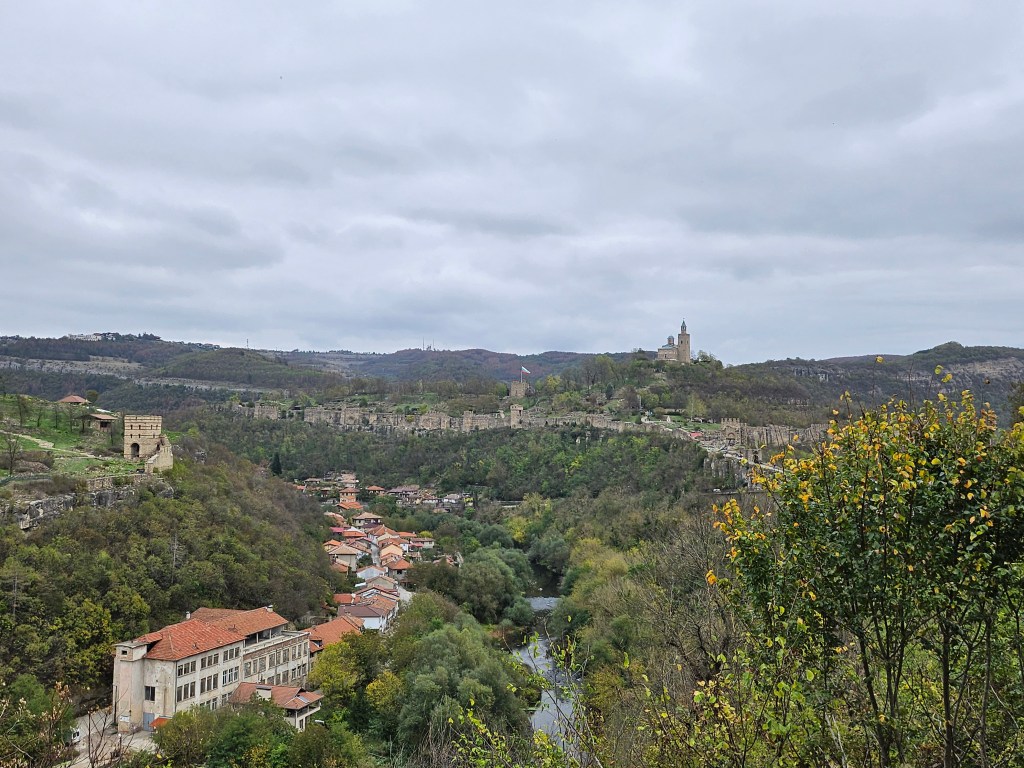
I contemplated going on a longer walk to visit some of the other historical sites just outside of Veliko Tarnovo, but decided against it and returned to my hotel. When I planned this trip I realised that I might have some spare time in Veliko Tarnovo, so I chose a rather more upmarket (though still quite reasonably-priced) hotel which had its own indoor swimming pool. I had time to go for a swim in the pool, before considering dinner.
I so liked the pub that I had visited the previous evening that I considered returning there for a second meal. However, I recalled that I had noticed a poster in the pub, which, if my translation was correct, implied there would be a stand-up comic performing there on my second evening, so I thought it best to give it a miss. So instead, I chose one of the many restaurants on the main road. The food was very nice there too – I dined on schnitzel, followed by ice cream. I don’t think I have been to a restaurant with so many waiters, they were hovering everywhere. Even so, the service was nowhere near as attentive as I had received in the pub the previous evening and it took an age for them to refill my beer.
Day 10 – Thursday 17th October 2024 – Veliko Tarnovo to Sofia
There are no through trains from Veliko Tarnovo to Sofia and when planning this trip I discovered that to travel between the two cities by train would require two changes and take all day. It would save a lot of time to take one of the many buses that make the journey direct. So before I left home I had booked a seat on the 08:50 bus to Sofia that morning.
Veliko Tarnovo’s bus station is a little way to the south of the old city and I got there in good time for my bus. Shortly after, while I was waiting for the bus to come, a small escorted group arrived who I remembered from the border crossing at Ruse two days earlier. Amongst this group was the man who had greeted me in the street in Veliko Tarnovo the day before – he must have seen me when we were all waiting on the platform for our passports to be returned. Although, I recognised the tour group escort and a few of the other participants from then, I had not noticed the man previously.
The bus, which had come from Varna, arrived at the bus station about 10 minutes before it was due to depart. The driver and many of the passengers already on the bus used this stop to take a comfort break. When I got on, my reserved window seat had a bag on it, so I sat in the next one by the aisle. The owner, who was rather a large woman, returned and reclaimed the seat where she had left her bag. In retrospect I was glad I didn’t have the window seat, as I could splay out into the aisle rather than be squashed against the window.
Initially, the road from Veliko Tarnovo was single carriageway with relatively light traffic, but after about 90 minutes driving we joined a dual-carriageway road and the speed of the bus increased. Shortly afterwards the road started climbing into the Balkan mountains which run to the north of Sofia. It was here on the old road that Georgi Asparuhov, the Bulgarian footballer, died in 1971 when he crashed his sports car into a petrol tanker. In 1968 I went on a school trip to see England play Bulgaria at Wembley and I remember that Asparuhov opened the scoring with a brilliant individual goal.
The only stop that the bus made before reaching central Sofia was to drop off some passengers, including the woman who had been sitting next to me, at Sofia airport. It then proceeded to Sofia’s main bus station, where it arrived at 12:15. From there I walked the short distance to my hotel to drop off my bag, before going on to explore Sofia.
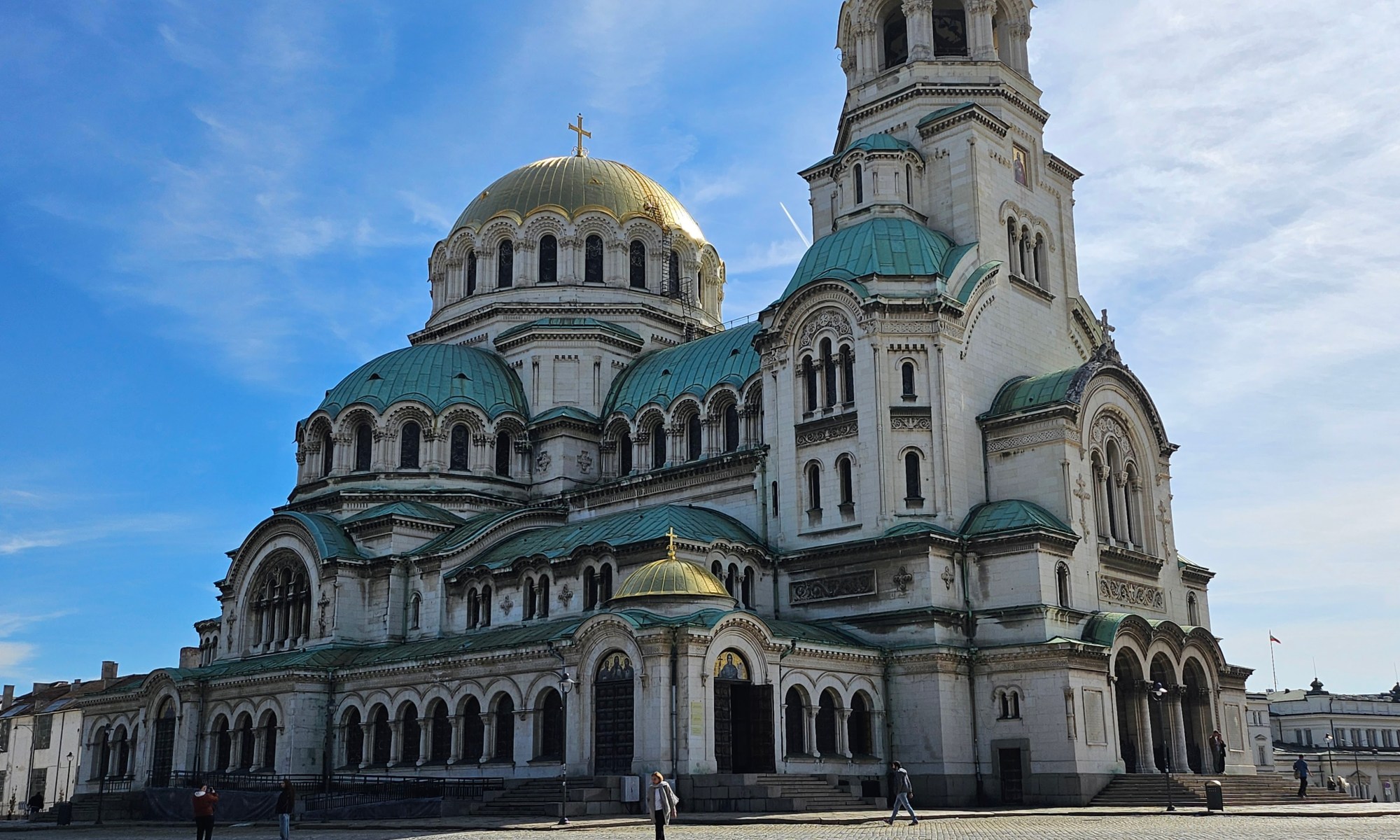
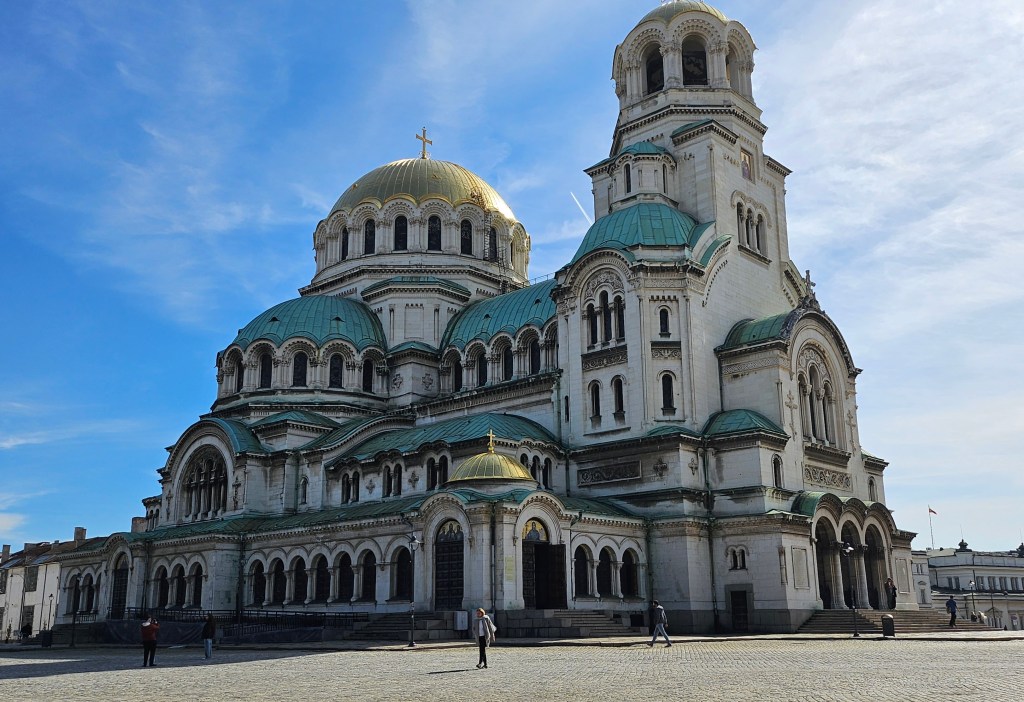
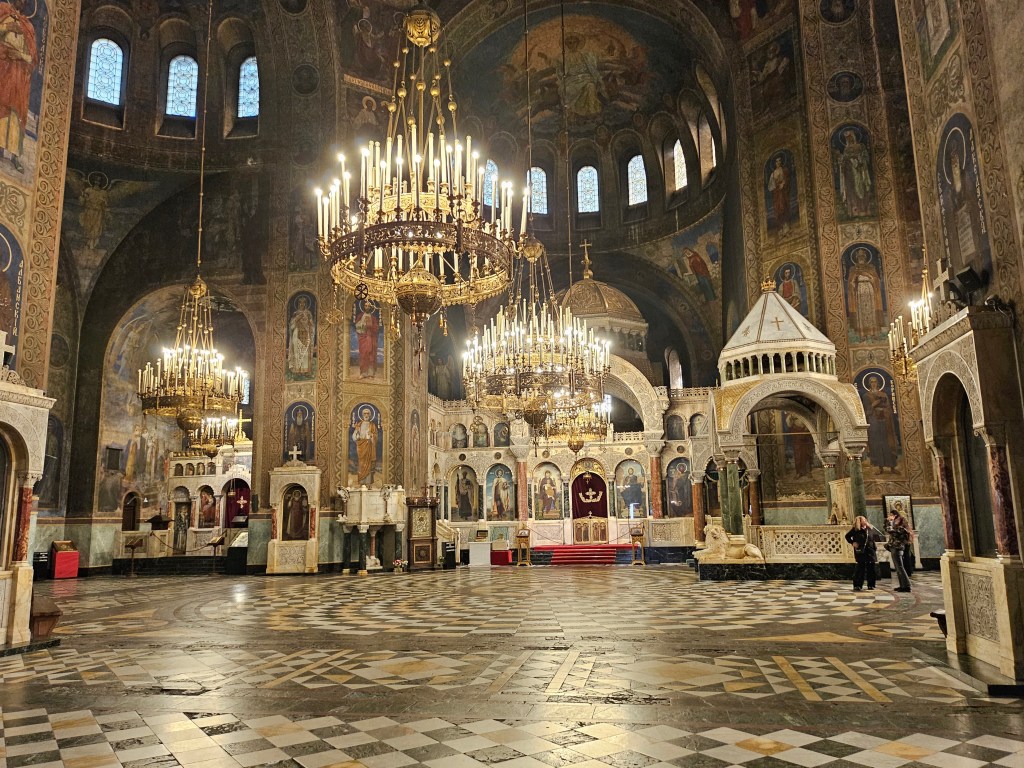
I walked through the centre of the city past the the parliament and main government buildings to reach the Alexander Nevsky Cathedral. This large, impressive building is the main cathedral of the Bulgarian Orthodox Church. Construction was started in 1882, shortly after the liberation of Bulgaria from the Ottoman Empire, but not completed and the cathedral consecrated until 1924. It is named after the Russian prince Saint Alexander Nevsky, in memory of the Russian troops who died helping liberate Bulgaria in the Russo-Turkish war of 1877-78. While the outside of the cathedral is impressive, the inside is breathtaking with ornate, colourful decorations covering all of the walls.
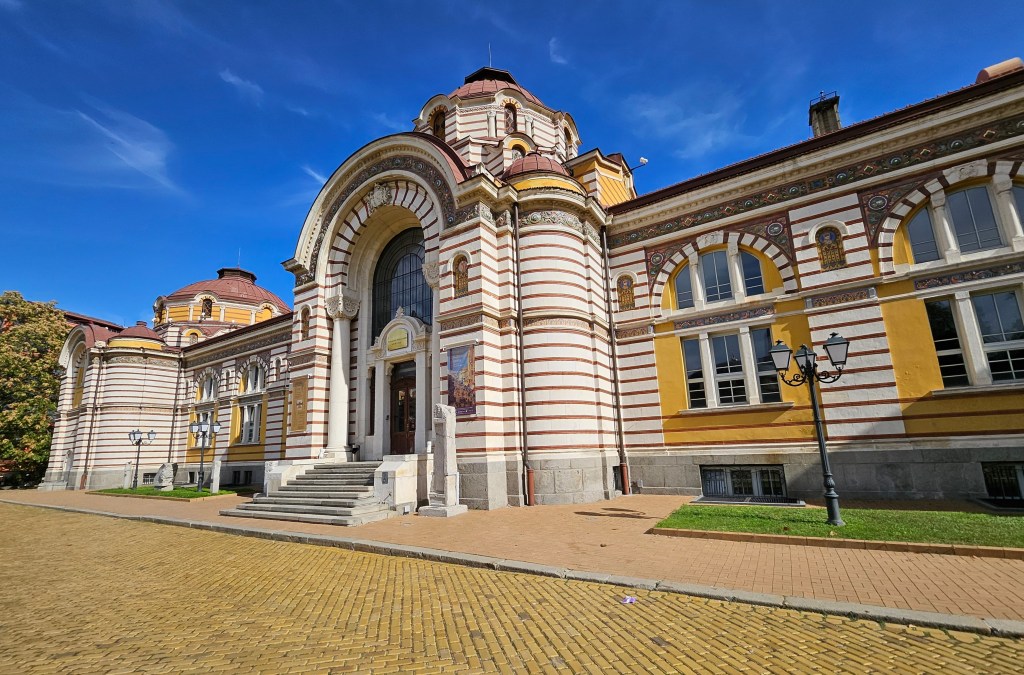
My next stop was at Sofia City Museum which is housed in a building that was once the Turkish Baths. On the outside wall of the building are water fountains dispensing warm mineral water from the hot springs which once fed the baths, and nearby is a whole bank of water taps fed from the springs where many people were filling up containers with the water. Sofia City Museum was one of the better museums that I visited on this trip – it presented a history of the city from earliest times, but only up to before World War II. In contrast with Romania, where most of the historical museums I visited covered the Communist period and demonised Ceaușescu, there was little mention of post-war history in Bulgaria’s museums. I got the impression that memories of Communist rule were rather different in Bulgaria – in fact, the reformed Communist party won the first free elections following the collapse of Communist monopoly power.
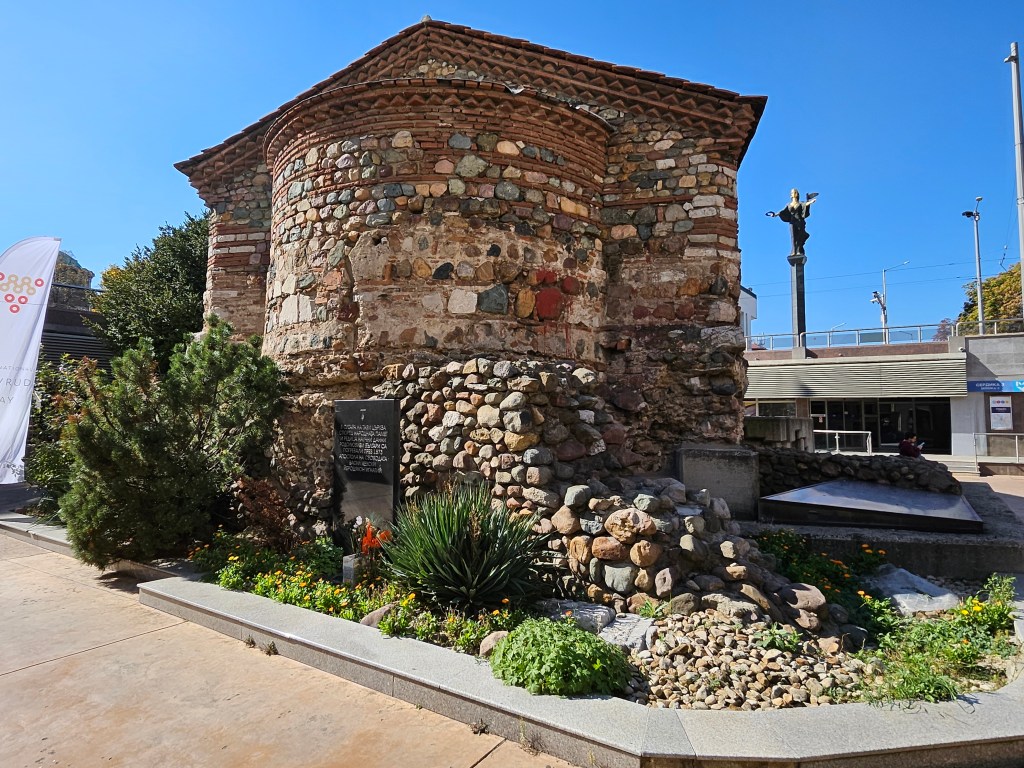
Serdika was the Roman name for Sofia and extensive Roman ruins were discovered when building a new Metro line in the city. Serdika Metro station is right in the centre of Sofia and it has been built around some of the Roman walls. There are even display cases on the platforms of Serdika station.
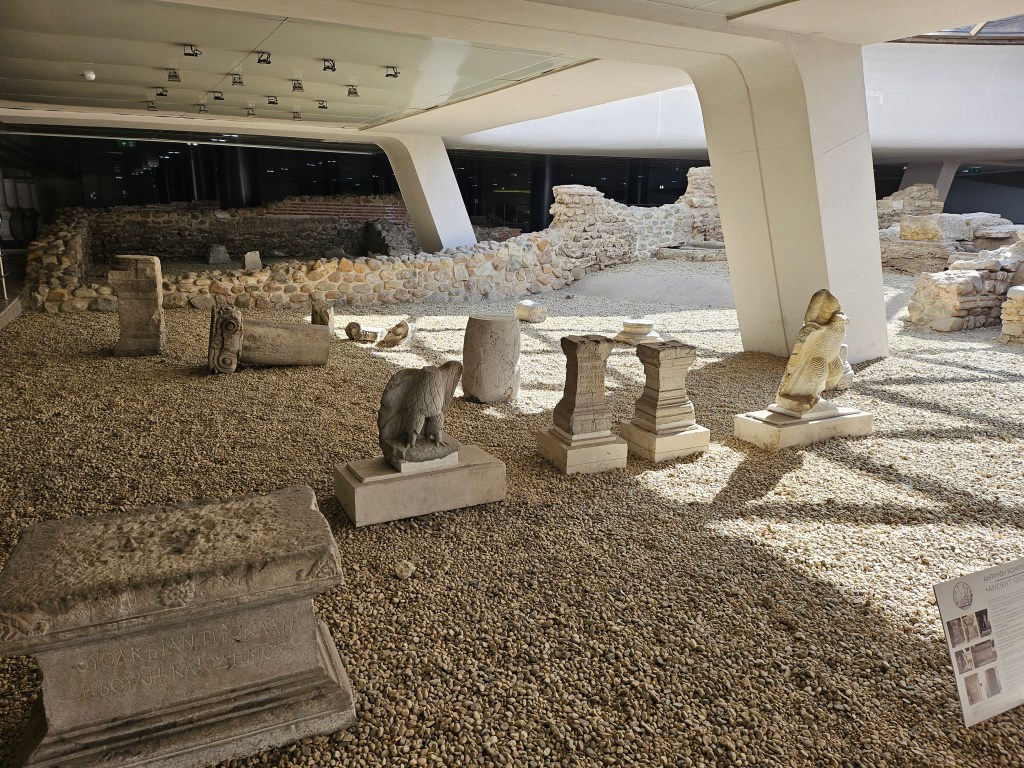
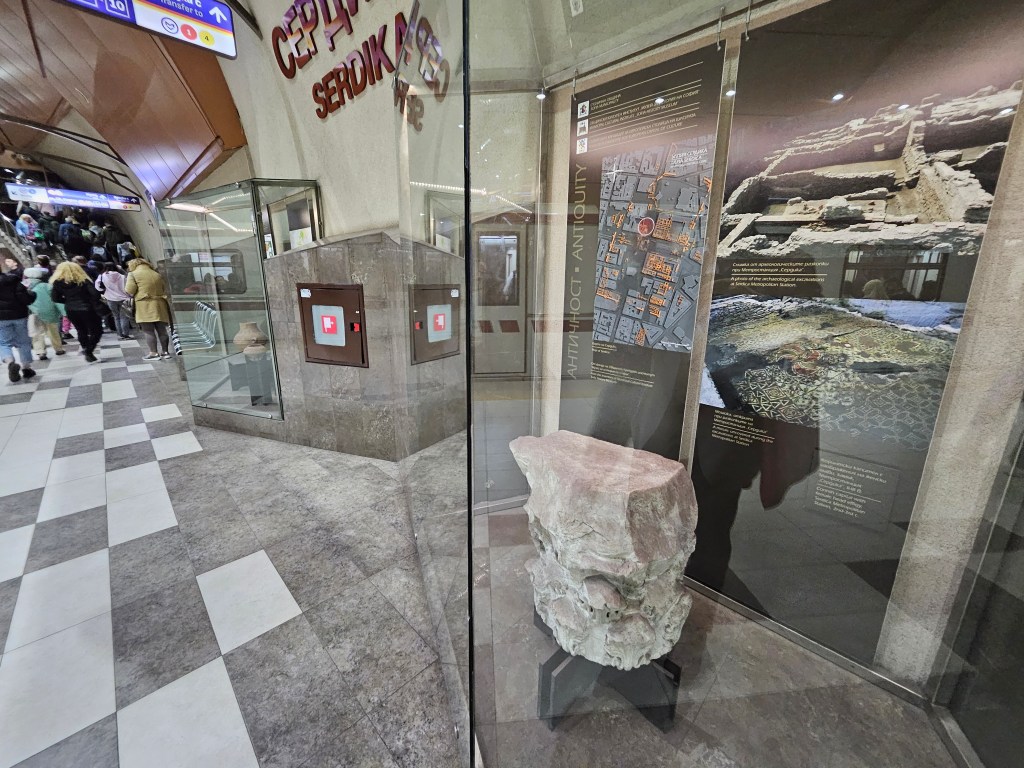
That evening I found a restaurant just outside the main shopping area of the city, where I dined on grilled vegetables and pork, leek and chilli sausages. Bulgaria is one of the few European countries which does not ban smoking in indoor areas. I might have lingered longer in this restaurant for my final evening’s meal, but decided against it when people on the surrounding tables started lighting up to smoke during their meal.
Day 11 – Friday 18th October 2024 – Sofia to London
Bulgaria’s National Museum of History is situated right on the edge of the city in the former presidential palace from Communist times. As it opens at 9:30am, I set off early from my hotel to get there. I initially caught a tram to the outer ring-road, where I was planning to catch a bus for the remainder of the journey. However, the ring-road was completely jammed with traffic, which I subsequently discovered was due to a broken down truck, so I thought it would be be quicker to walk the last part. The walk was not particularly pleasant, as the pavement that I had been following stopped and there was a section where I had to walk on the roadway.
The Bulgarian National Museum of History is large with exhibitions spread over several floors. It starts from very early times, but unlike Sofia City Museum it additionally covers the period of the Second World War, although nothing afterwards. At the time of my visit there was a special exhibition about Boris III, who was Tsar of Bulgaria from 1918 – 1943. He succeeded his father, Ferdinand I, who abdicated after military setbacks in World War I. Boris III died suddenly, apparently of heart failure, aged 49 – there are conspiracy theories that he was poisoned by the Nazis or the Soviets.
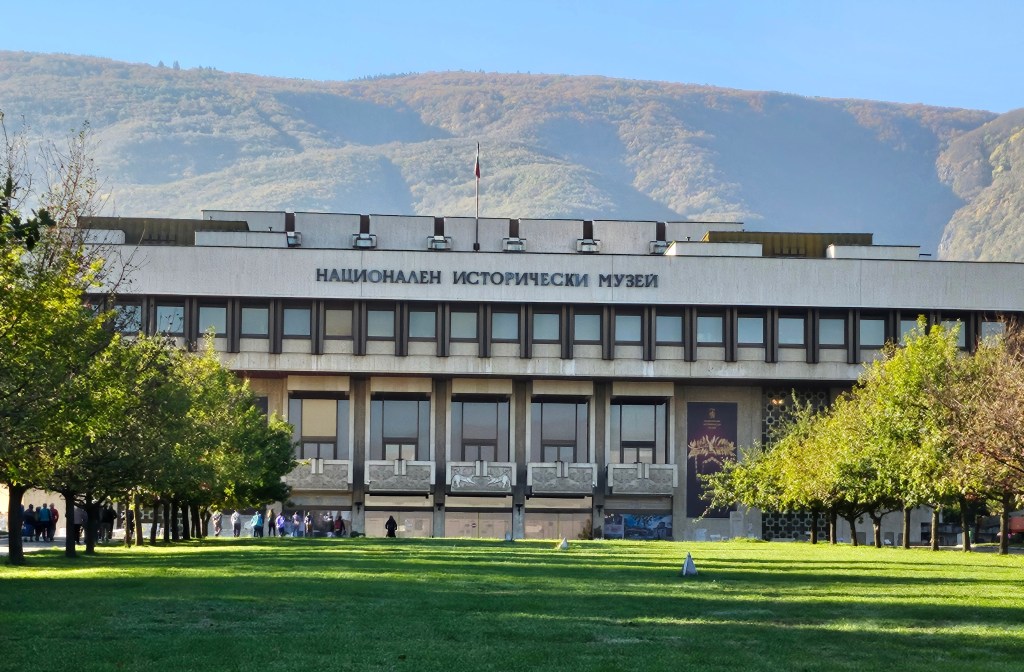
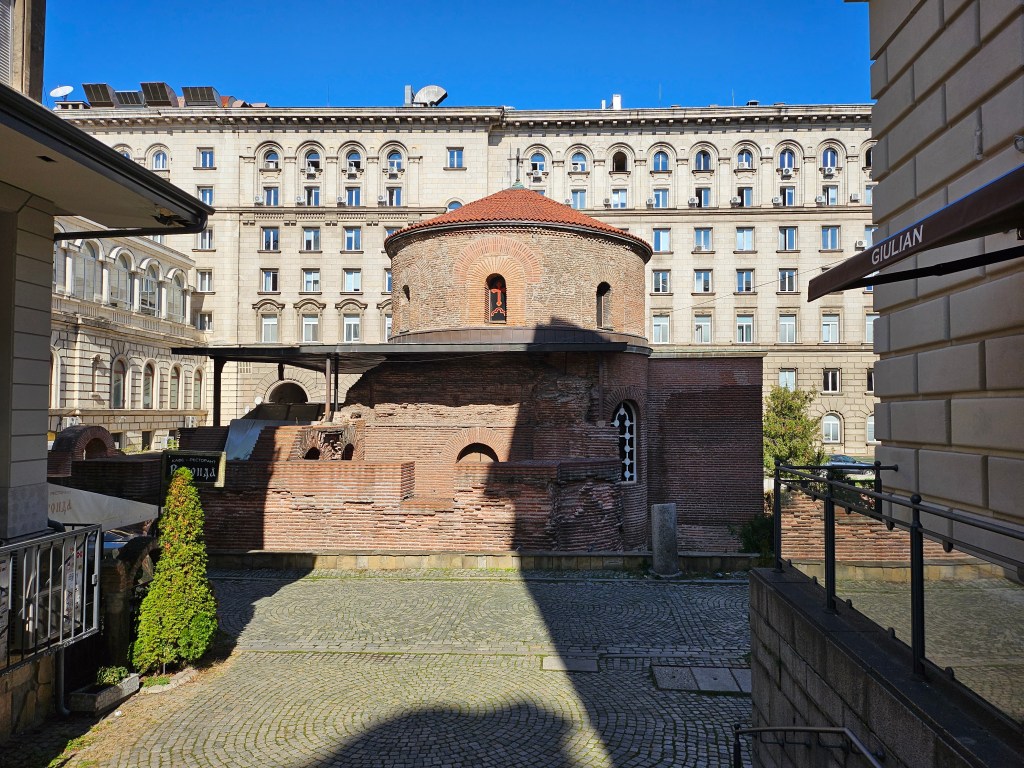
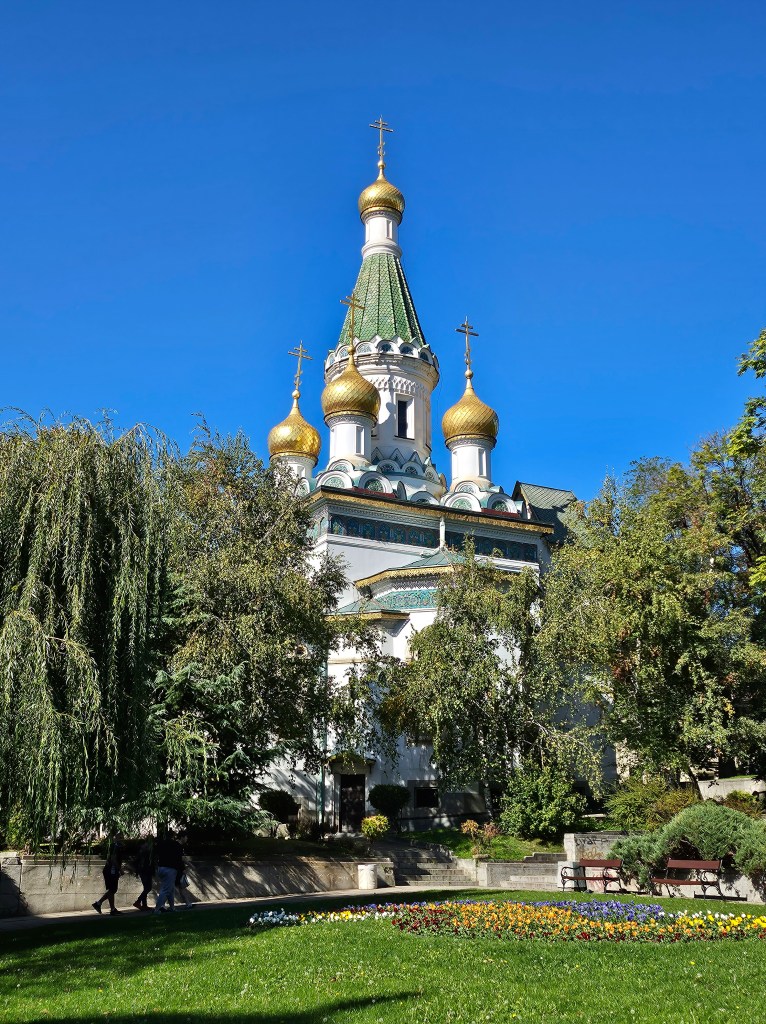
When I had finished in the museum I caught a trolley bus to the National Palace of Culture, where I walked through the adjoining park to pick up the Metro. From there I went to Lavov Most (Lions’ Bridge) station to start a walk to look at some of the sights of Sofia that I had not yet seen. The Lions’ Bridge spans the heavily canalised Vladaya river and, as the name suggests, has monumental Lions placed at each corner. In my walk I visited several other ancient churches – Sveta Nedelya, St. Petka, the Rotunda of St George and the Russian church (originally a private chapel of the Russian Embassy). Unfortunately, these churches did not allow photography inside.
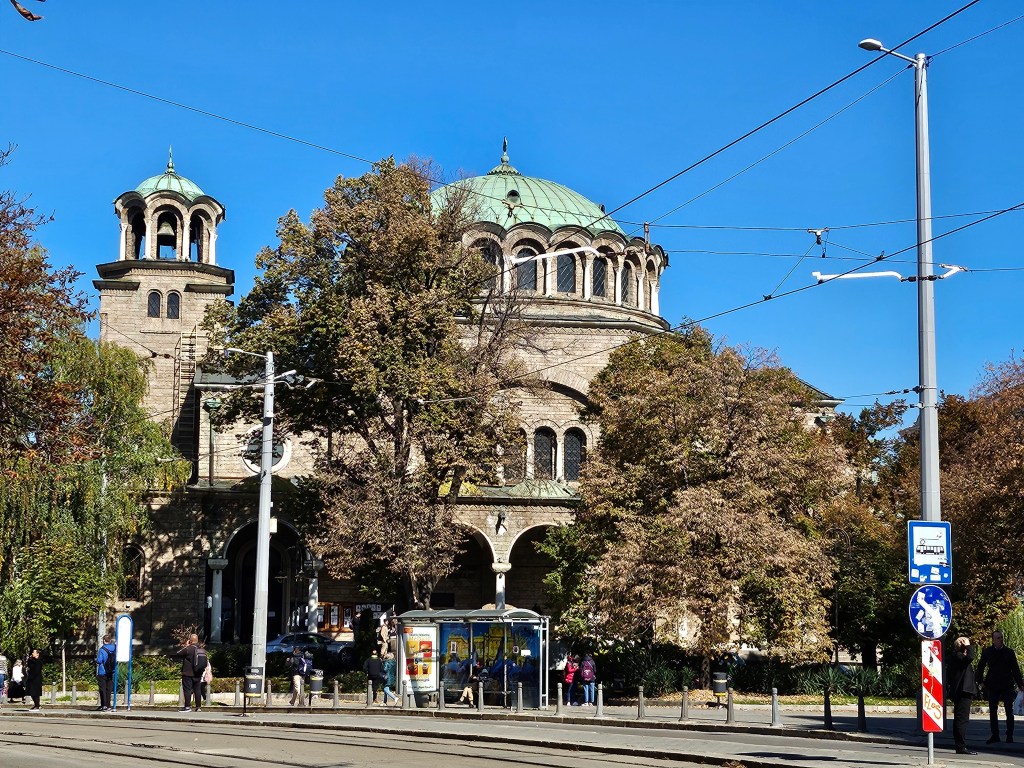
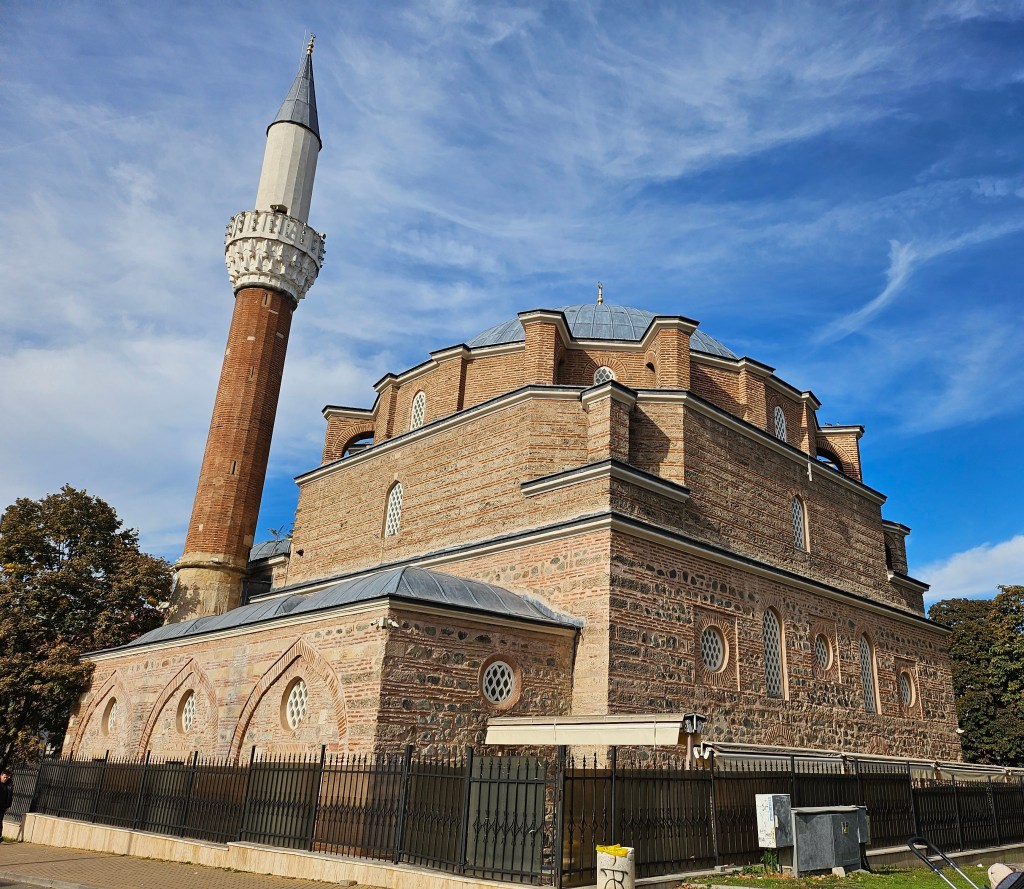
When I went past Sofia’s mosque it was during lunchtime prayers and some of the faithful were participating on the pavement outside the building. Very close to the mosque is Sofia’s synagogue, which also has a museum. I would have liked to have visited this museum to get the Jewish viewpoint on the claim that Bulgaria, although a member of the Axis during World War II, resisted German demands to participate in the Holocaust. However, due to a Jewish religious holiday, the synagogue and museum were closed.
I considered having a late lunch in Sofia before going to the airport, but I did not fancy the first couple of places I checked out and then concluded that there would not be time. The airport and airline were both saying that my flight was on time, but I had my doubts, as the scheduled plane had to come back from Barcelona and it had not even reached there when I looked on a flight tracking app. However, sometimes when flights are running very late the airline will switch aircraft to avoid paying compensation for a three hour delay – so, I could not risk arriving at the airport late.
I took the Metro to get to Sofia airport at about 4pm for my 17:50 departure. When I arrived, the departure boards were still saying that my plane was on time. There were no delays going through security and it was only after I had done so that I did receive notification that the flight was delayed – they were saying a 1h 20min delay, which I knew would be an underestimate, given where the plane then was. Sofia airport was quite pleasant as airports go, not too crowded and the food outlets not too expensive, so there could be worse places to be delayed. To pass the time and since I knew that I would not get home until late, I had an early dinner of pizza.
As I had foreseen, my flight back to London actually departed two hours late, meaning that it was dark all the way back. It arrived at Stansted Airport just before 9pm, and in what must must be my record time to get through the airport on arrival, I just managed to catch the 21:15 Stansted Express, finally getting home at about 10:45pm.
It had been good to experience a new country, albeit that my time in Bulgaria had been fairly brief. Bulgaria has the lowest GDP per capita of any EU country, but that was not particularly noticeable during my visit. I always think that to fully appreciate a country you need to visit some cities that are not the capital nor major tourist spots. There is still plenty of scope for me to do that in Bulgaria.
 Europe Explored