
“… You have nothing to lose, but your chains.” (Karl Marx, Friedrich Engels)
Day 6 – Monday 16th September 2024 – Leipzig to Augsburg
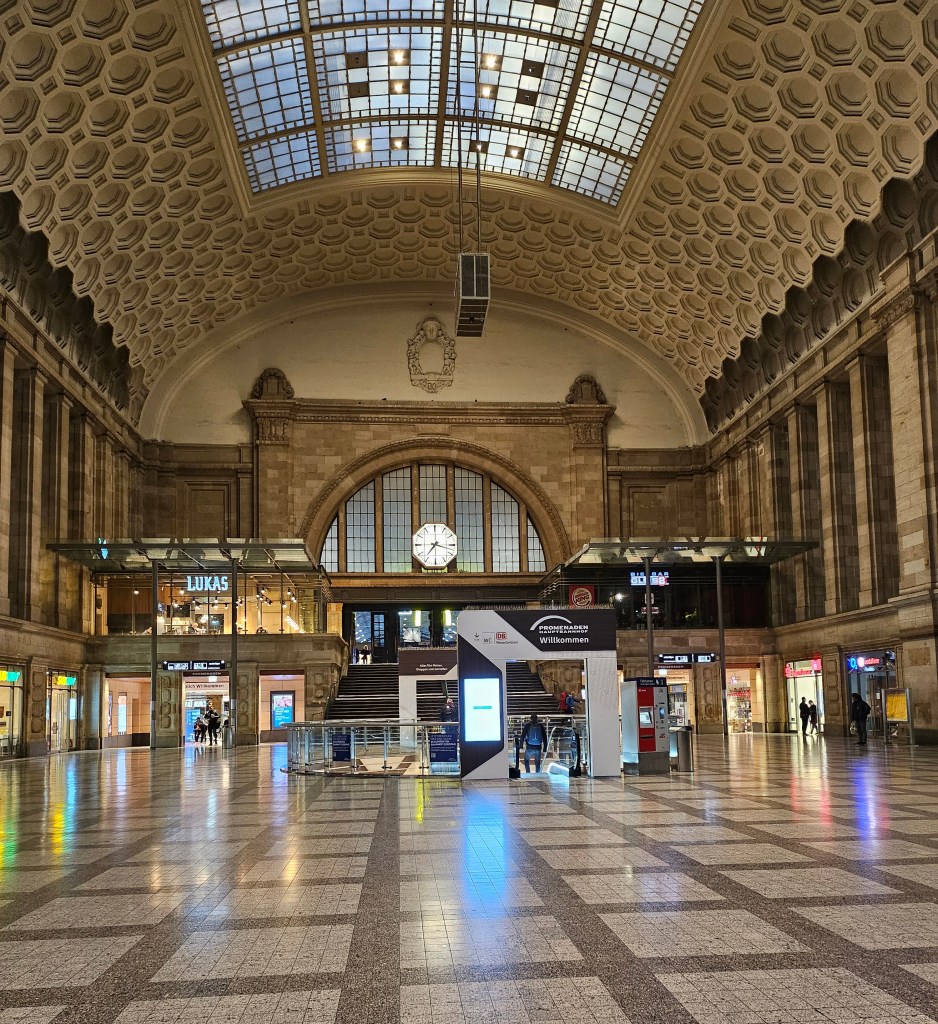
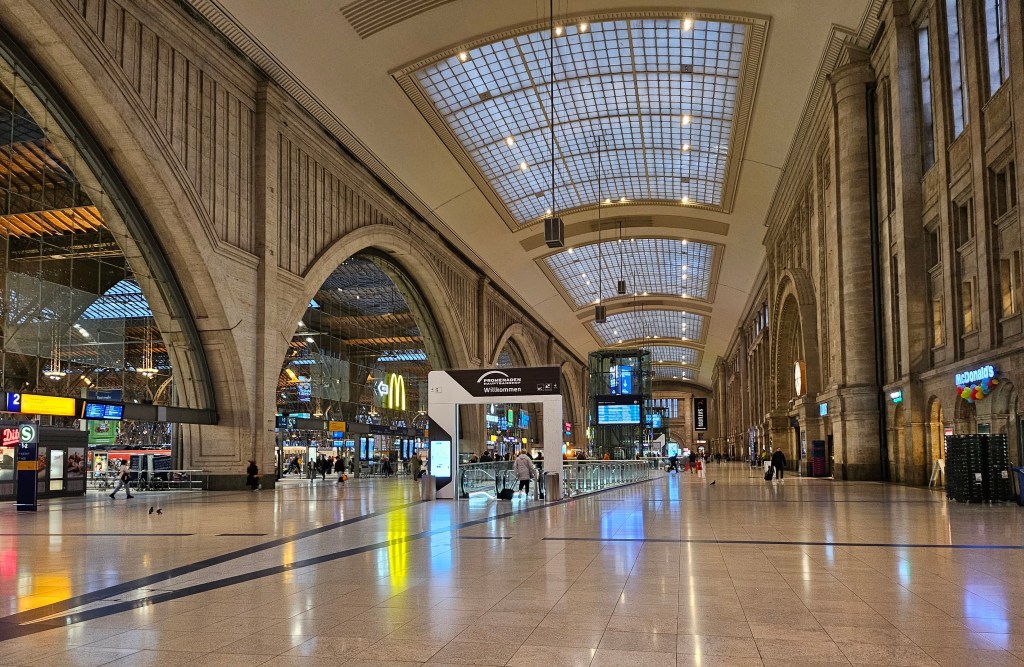
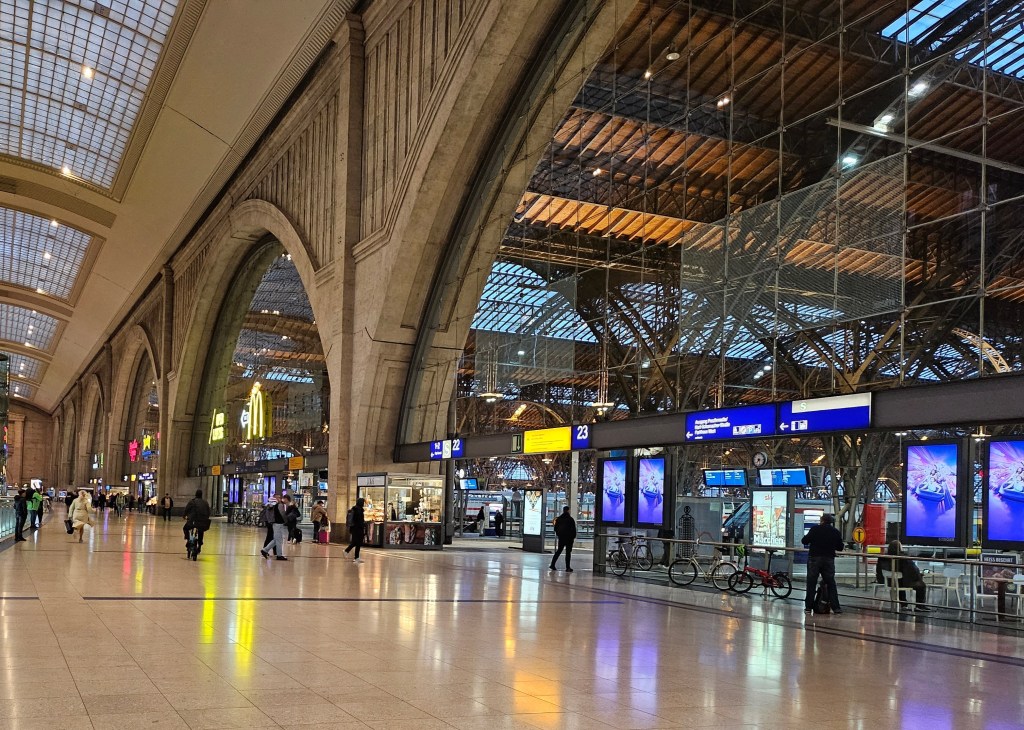
We were making an early start on this day and walked the short distance to Leipzig Hauptbahnhof in good time to catch the 07:48 train to Munich. The station was much quieter than when we had arrived, with no sign of football supporters or riot police. Fortunately, Storm Bruno which had led to the cancellation of nearly all trains in Austria did not seem to be affecting transport in south-eastern Germany, although the weather forecast was for heavy rain all day. Leipzig Hauptbahnhof is Europe’s largest station by area with 19 terminating platforms lined up opposite the long main facade and two more through platforms located underground. We had a little time to explore the station before our train was due. Having come in through the western entrance hall we walked the full length of the concourse to see the nearly identical eastern entrance hall. Our train was coming from Berlin and it arrived a few minutes before it was due to depart, to allow time for it to reverse direction.
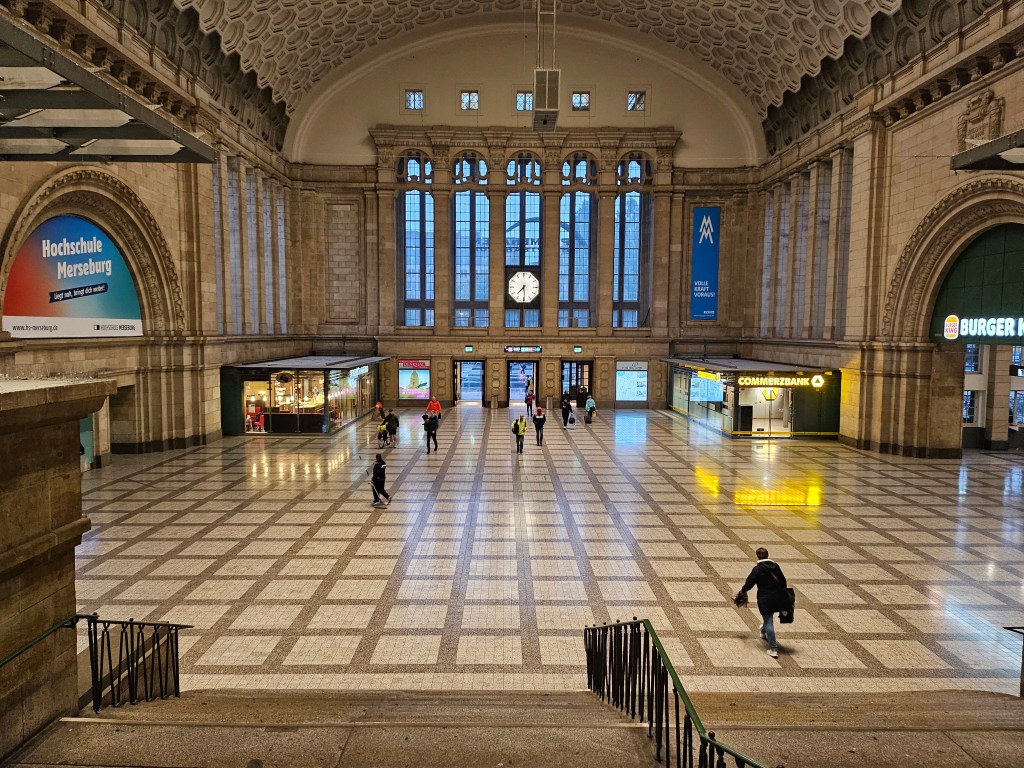
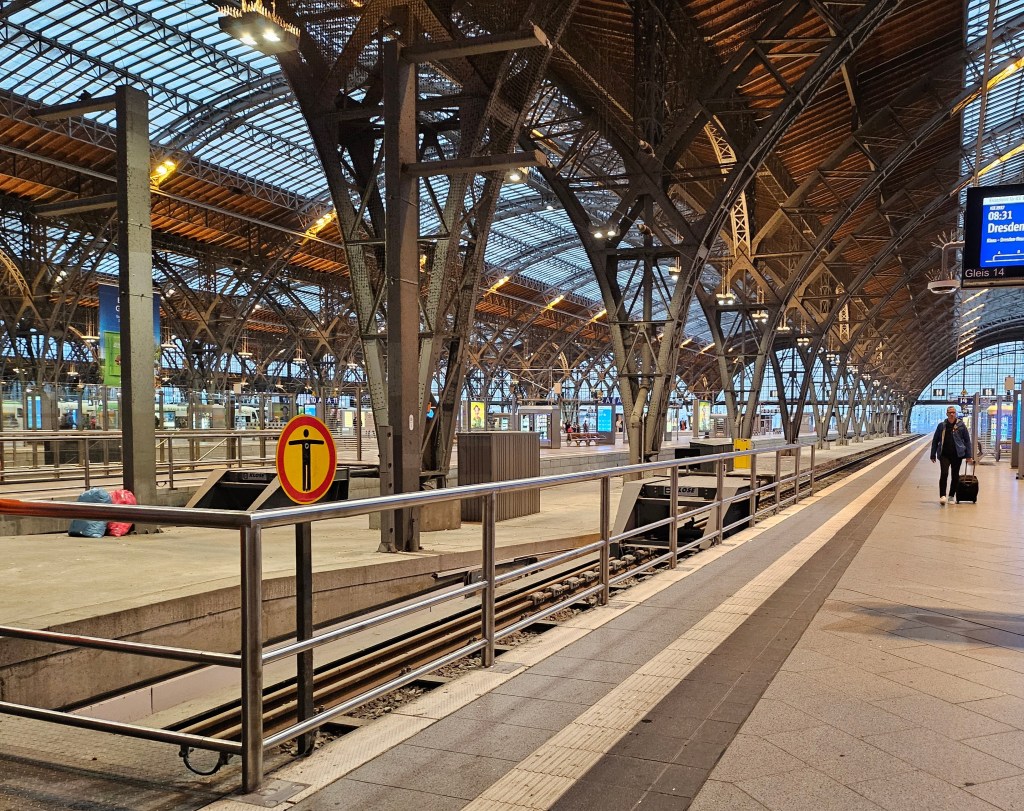
I had chosen to go via Munich to get to Augsburg on the basis that if our first train was delayed there were frequent subsequent trains to Augsburg from Munich. As it happened, for once both the trains we caught that day were more or less on time and the 10 minutes that we had for our connection in Munich was plenty, as we only had to go the next set of platforms along the concourse at Munich Hauptbahnhof. The journey from Munich to Augsburg takes only half an hour and we arrived at 11:45.
As expected it was raining hard in Augsburg, so we had to put up our umbrellas on leaving the station. In Germany, nearly all museums are closed on Mondays and we had factored this in to our planning of the trip, ensuring that there was enough to do in Augsburg on this Monday. Given the heavy rain, a walking tour of the streets was not a sensible option.
Our first stop, a short walk from the station was at Augsburg’s Synagogue and Swabian Jewish Museum. There was heavy security to enter the building, with an airlock system of doors and airport style bag scanning. No photography was allowed inside the building, so I have no pictures to illustrate this account of our visit. Augsburg’s synagogue was restored between 1974 and 1985, after it had been partly burned down in 1938, one of the few synagogues in Germany attacked by the Nazis to have been rebuilt. There was a small museum providing information on the Jewish faith and details of the community in Swabia. One could also go into the gallery to look down on the impressive main hall of the synagogue.
As our hotel was in this part of town, we took the opportunity to drop off our bags, even though it was too early to check in, because while we were likely to get wet on this rainy day, we didn’t want our belongings to as well.
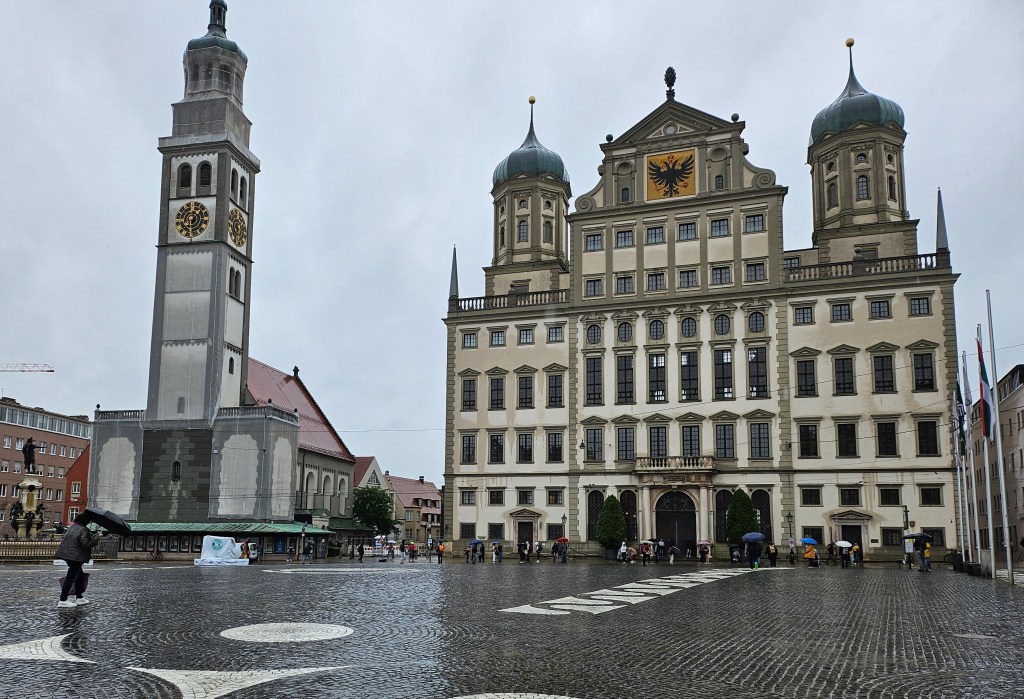
We then walked into the city centre, past Augsburg’s city hall on a wet Rathausplatz, to get to the Fuggerei. The Fuggerei is the oldest social housing complex in the world still in use. Founded by the Fugger family, wealthy merchants and bankers, it first opened in 1523. It now consists of number of streets and a church, with the small apartments each having their own front door onto the street. Although there have been some changes to the conditions for admittance, the core principles have remained the same: you need to be a member of the deserving poor of Augsburg and of the Catholic faith. The rent has also not changed, being one Rhenish Guilder (now €0.88) per year. Not surprisingly there is a long waiting list for admission, so while age is no longer a condition for entry, and there are a few young families, the majority of residents are elderly. Three of the apartments have been turned into exhibition spaces: one on the history of the Fuggerei, one showing a typical apartment and how it has changed over time, and a third giving information about some of the residents and the administration of the Fuggerei.
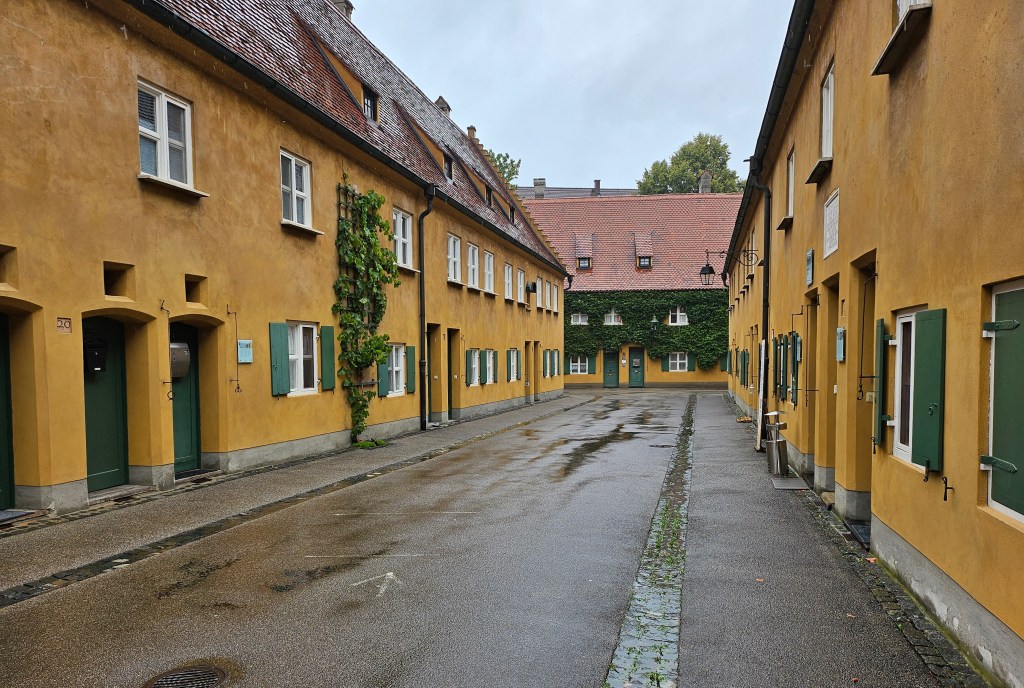
In addition to these three apartments, one can also visit the small Fuggerei church, which in line with its benefactors wishes remains a Catholic place of worship, and the bunker which was used as an air raid shelter during World War II. The bunker has an exhibition about the Fuggerei during the war and the damage it suffered from bombing.
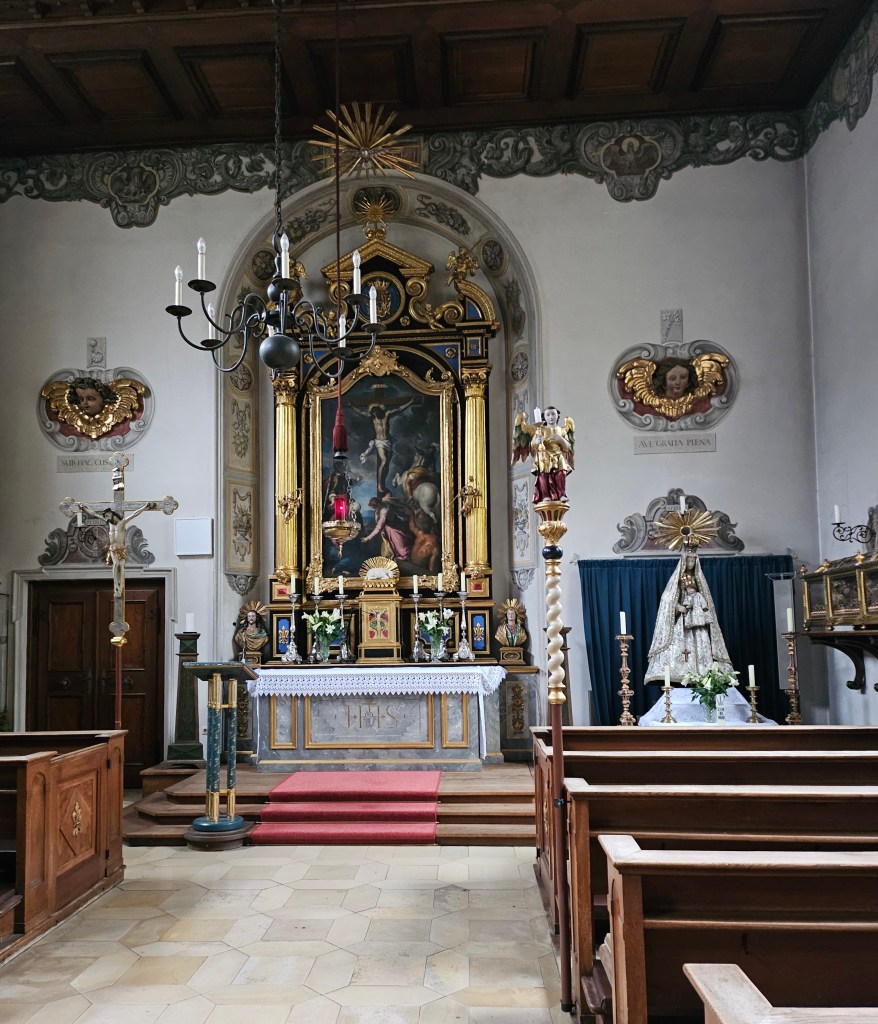
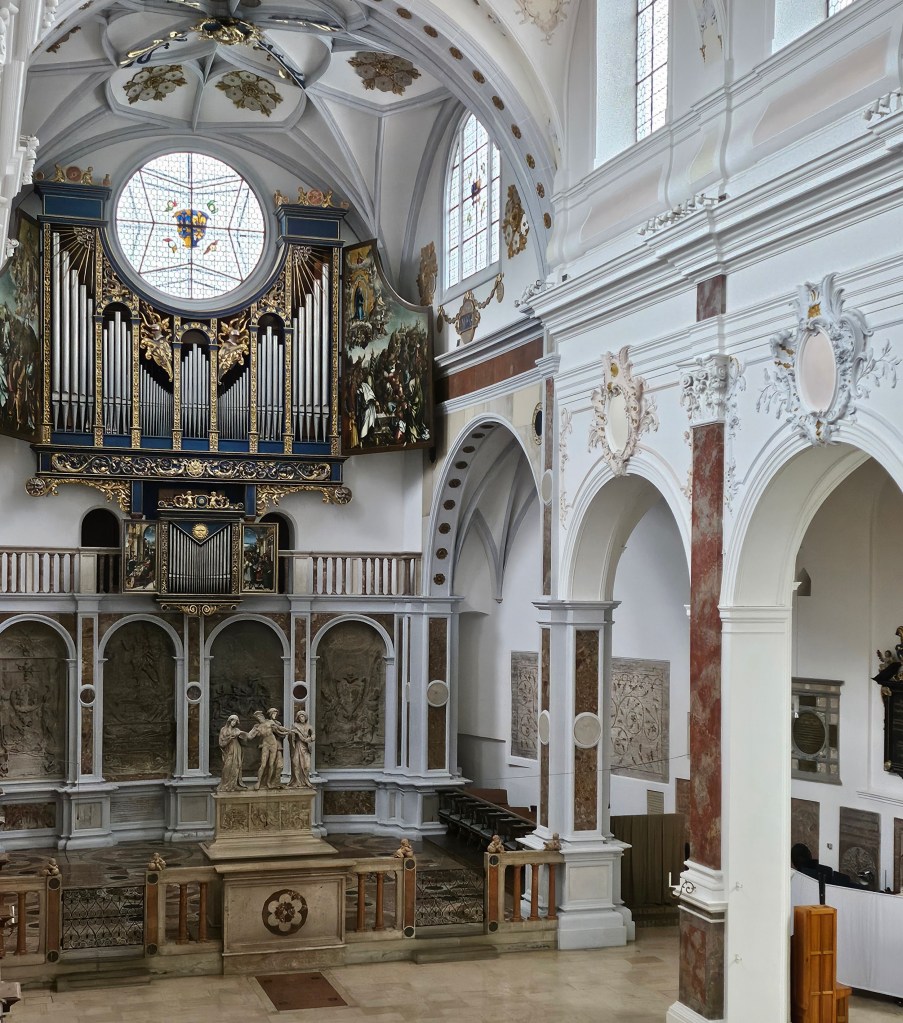
By the time we had finished in the Fuggerei the rain had started to ease slightly, although it was still unseasonably cold. We walked back through the city centre to visit St Anna’s Church. This contains the Fugger chapel, where the remains of the Fugger family have been interred over the ages. Although St Anna’s church became Protestant in 1548, the Fugger chapel (whose upkeep is paid for by the Fuggers) remains Catholic and is highly decorated in a Renaissance style. Within the church you can also see the Goldsmiths’ Chapel, whose walls are adorned with Gothic frescos, the cloisters and a museum on Lutheranism located in the first floor balcony.
At the time of our visit to Augsburg, the Rathaus (town hall) was closed for renovation. The only part which was accessible to visit was the Ratskeller restaurant located in the basement, so that is where we went for dinner that evening. We were lucky to acquire one of the last few unreserved tables. Given the coldness and dampness of the day, I started with a bowl of warming potato soup, which I followed with a schnitzel, We so much enjoyed our meal in the Ratskeller that we booked a table to eat there again the following evening.

Day 7 – Tuesday 17th September 2024 – Augsburg
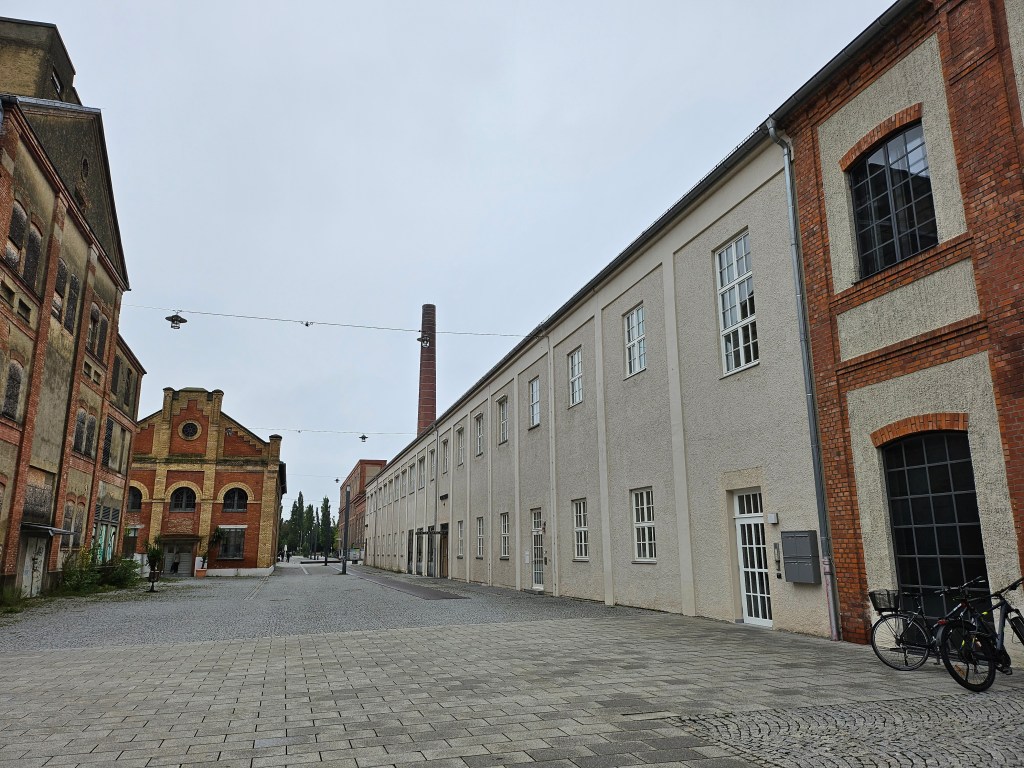
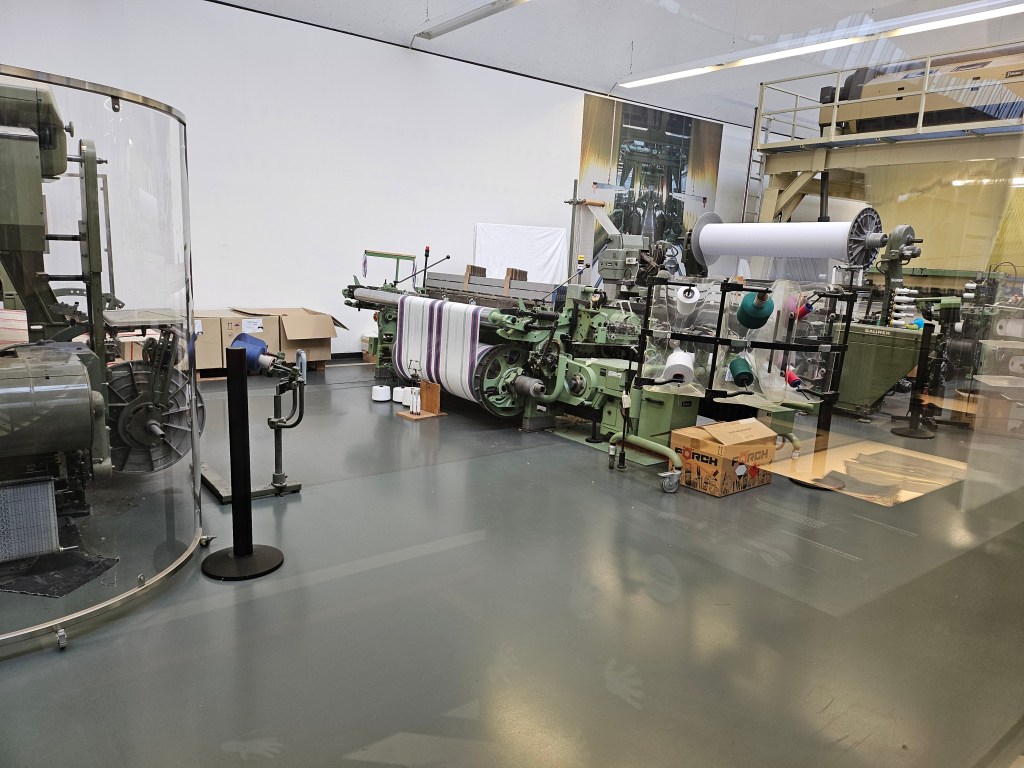
Like Wuppertal where we had visited earlier on this trip, Augsburg was once a textile town. All that remains of this legacy is the Textile and Industry Museum. As this museum opens at 9am, an hour before the others in the city, we went there first. Thankfully, the rain had stopped so we could walk there without having to put our umbrellas up. As we knew we would be pressed for time that day, we just bought a ticket to the permanent exhibitions, rather than the special exhibitions located on the upper floors. These permanent exhibitions explained the various weaving and printing techniques used with a variety of materials and the history of the textile industry in Augsburg.
We then walked across town, partly following one of Augsburg’s many watercourses, to reach the Fugger and Wesler museum. This describes the history of the wealthy Fugger and Wesler families built from mineral and other commodities trading. The Fugger family business still survives to this day, supplemented by their banking activity of lending money to rulers. The Weslers were undone by the devaluation caused by the glut of silver from the Spanish conquest in the Americas in the 16th century. After feeling good the previous day about the Fuggers benevolence in funding the Fuggerei housing complex, this museum brought home how much of their wealth was obtained from colonial exploitation.
Nearby is Augsburg Cathedral, which dates from the 8th century, which we next went to visit. Some of the more ornate decoration which was removed during the reformation was restored in the 17th and 19th centuries. The cathedral only suffered minor damage during World War II.
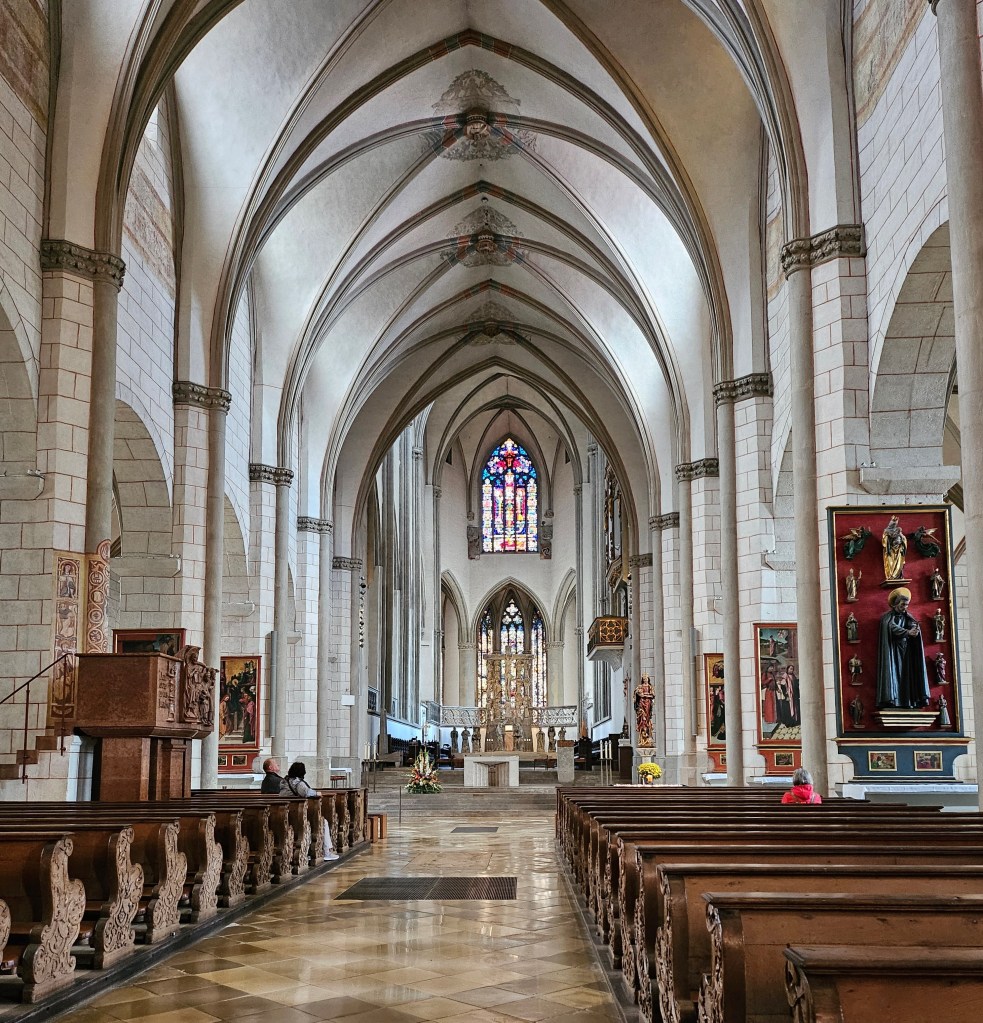
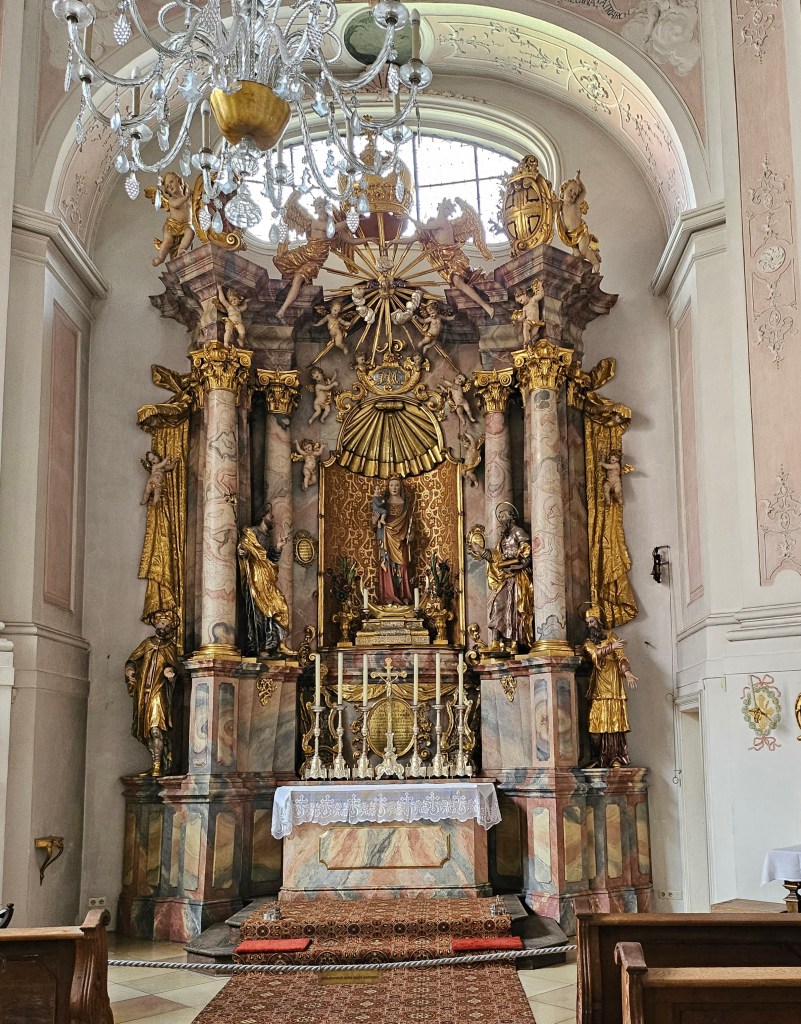
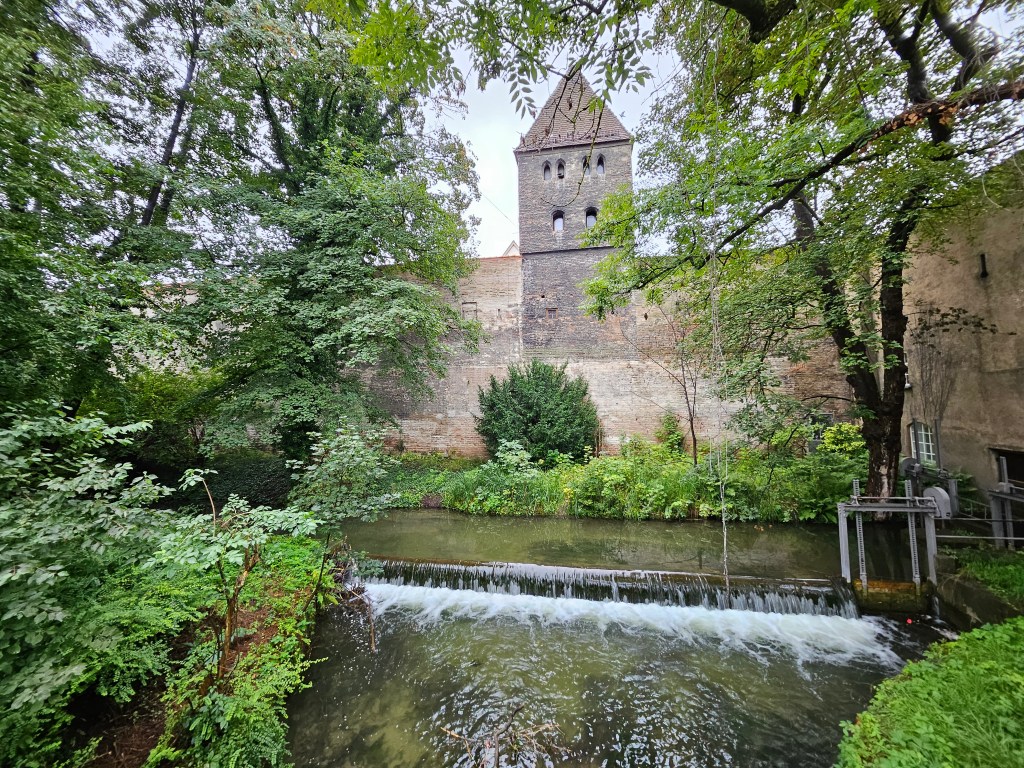
Augsburg is a UNESCO World Heritage site, not for its many splendid Baroque buildings, but for its water management system. An elaborate system of watercourses and canals keeps water from the River Lech separate from drinking water from the local springs. In the Town Hall Square there is an information office describing the unique features of the city’s water system of which it is justifiably proud.
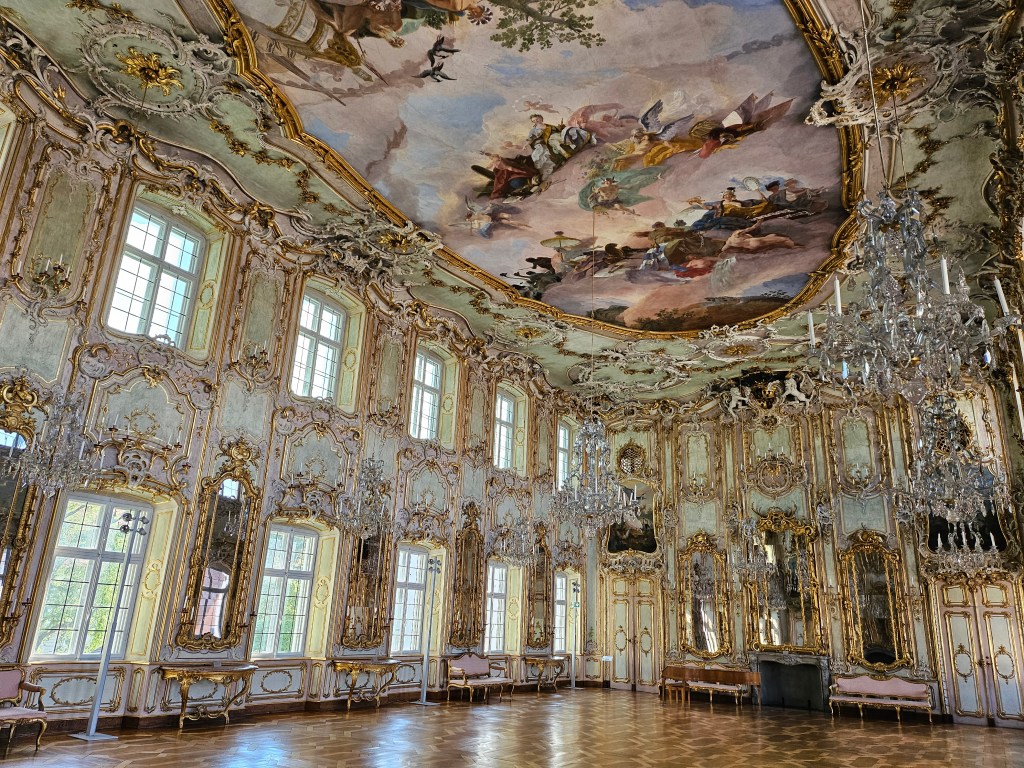
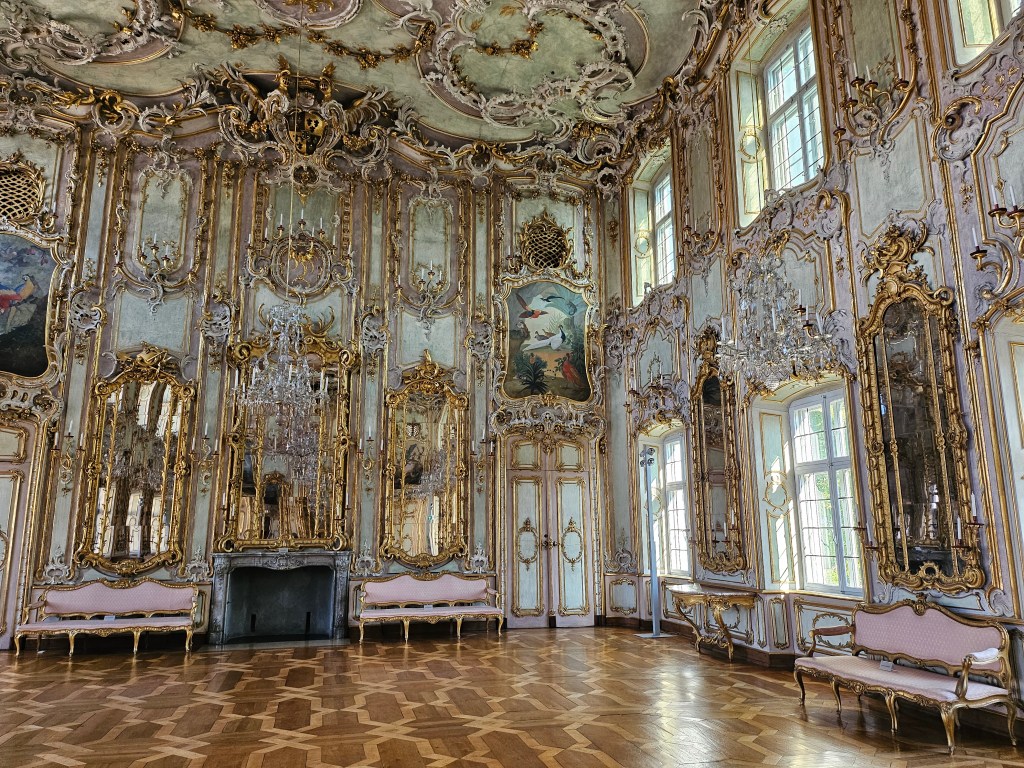
Our final visit that afternoon was to the Schaezlerpalais, which serves as one of the the city’s art galleries. There was a special exhibition of the works of Holbein the Elder, which we found quite interesting, whereas the permanent collection contained nothing particularly special. However the absolute star of the Schaezlerpalais is the Festsaal, which can be accessed through a door from the permanent exhibition. The Festsaal dates from 1770 and has survived intact. It is an amazingly decorated gilded ballroom with a painted ceiling. While the art exhibitions had a number of visitors while we were viewing them, we were the only visitors during our time in the Festsaal.
In the evening, we returned to the Ratskeller for dinner, where we had booked a table. I dined on beef with fried onion, served with spaetzle (a type of German pasta). I also had apple strudel for dessert.
Day 8 – Wednesday 18th September 2024 – Augsburg to Tübingen
Our train this morning was just coming from Munich, half an hour away – once again it was being announced as an ersatz train with the same timetable to replace the originally scheduled one. However, unlike the train we caught from Wuppertal, our seat reservations would still be valid, so it appeared that the same type of train was being used and I was not sure what made it ersatz. It departed late from Munich and allowing a later train to get ahead of it made it later still, so it eventually left Augsburg 13 minutes late. Nonetheless, it was predicted to make up up this delay by the time it reached Stuttgart where we needed to change. For once, there was some credence to this prediction, as the the train would be able to use the new high speed line between Ulm and Stuttgart, whereas the timetable still seemed to based on the the old slow line timings.
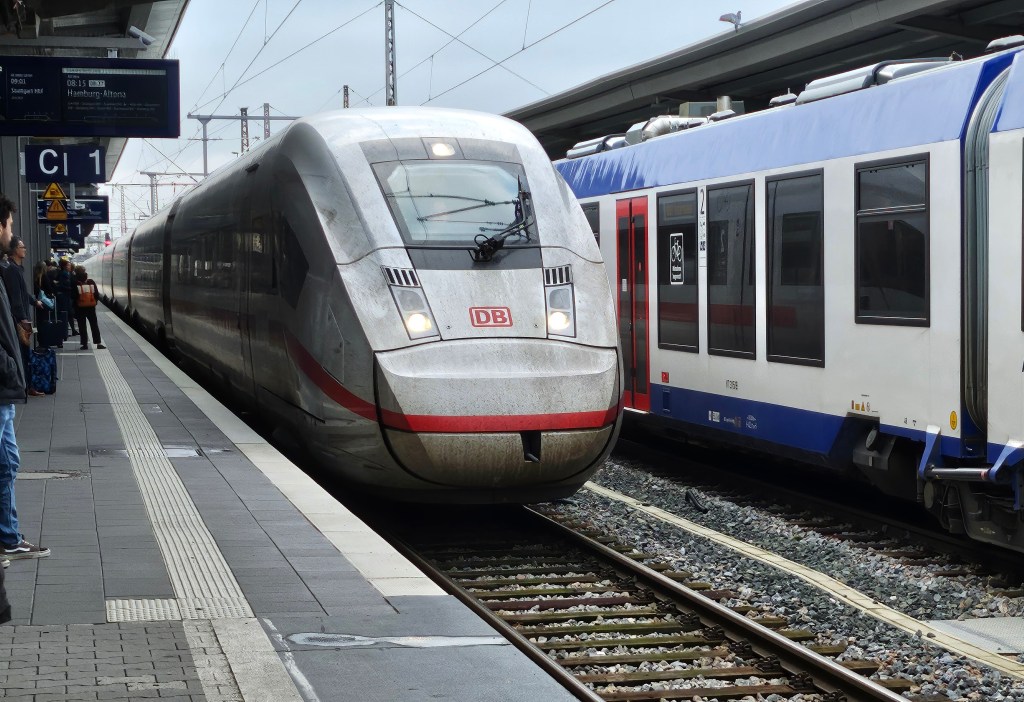
However, we had not factored in the ever more ingenious ways that Deutsche Bahn was finding to enliven our journeys. At the first scheduled stop, Günzburg, the train went sailing through the station and then slammed on the brakes shortly after leaving the town. It sat around for a while, before reversing very slowly back to Günzburg, where it sat around for more time, before eventually leaving nearly 40 minutes late. As anticipated, it did claw back some of this time by taking the high speed line on leaving Ulm, but congestion on the approach to Stuttgart delayed us again.
We arrived in Stuttgart about half an hour late, which meant that we not only missed our originally intended connection but also the one after that, which was just leaving its platform as we arrived. This gave us a little time to explore Stuttgart station and its surroundings. The station is currently a building site as it is in the process of being redesigned from being a terminus station where the platforms lie north-south to a through station where the platforms will be aligned east west. At the end of one of the platforms there is an exhibition which describes the project. In addition to constructing a new station, there will also be a plethora of new railway lines in and around Stuttgart to align with the new configuration. It is forecast to be another three years or so before everything is complete. Given the whole project was given the name Stuttgart 21, this gives a clue to how late it is running.
An hour later than expected, we caught the 10:54 for the 40 minute ride to Tübingen. As our hotel was quite near the station, we succeeded in dropping off our bags before setting off to explore. Tübingen is an old university town picturesquely situated on the River Neckar. The Neckar here is much smaller than when it flows through Heidelberg, another old university town, and punting on the river seems a popular pastime.
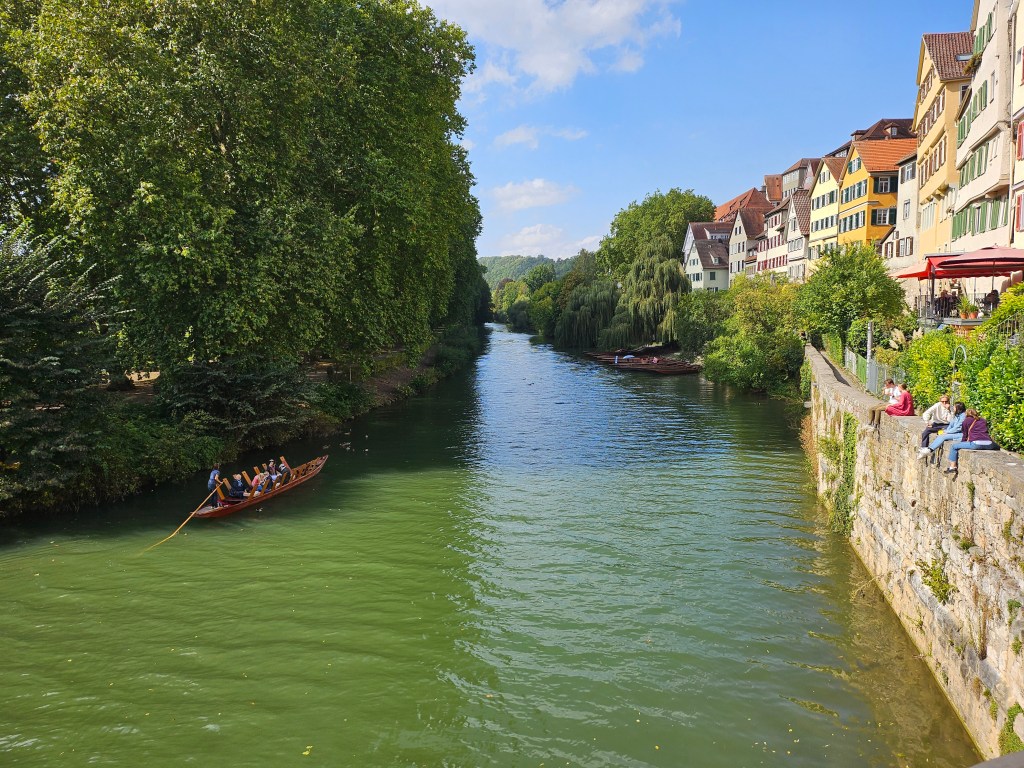
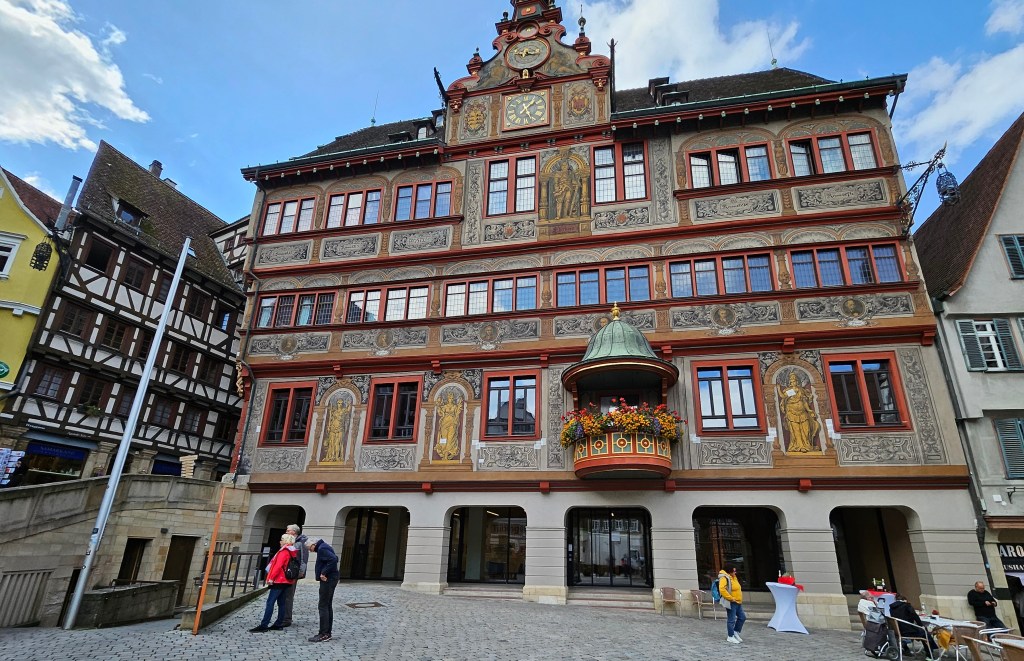
We crossed over the Neckar and walked through the old town, pausing to admire the painted front of the city hall, to reach the city museum. The museum seems to be in a permanent state of reconstruction, with its exhibitions laid out rather higgledy-piggledy over several floors.
On leaving the museum we walked uphill to reach Tübingen’s castle. The castle is now owned by the university and houses some of the university’s departments. There is also a small observatory within the castle grounds. It was in a laboratory within the castle that Friedrich Miescher first identified the substance now known as DNA within the nuclei of cells, but it would be nearly a century later before the structure of DNA was uncovered. There is a small exhibition in the castle on Miescher’s work.
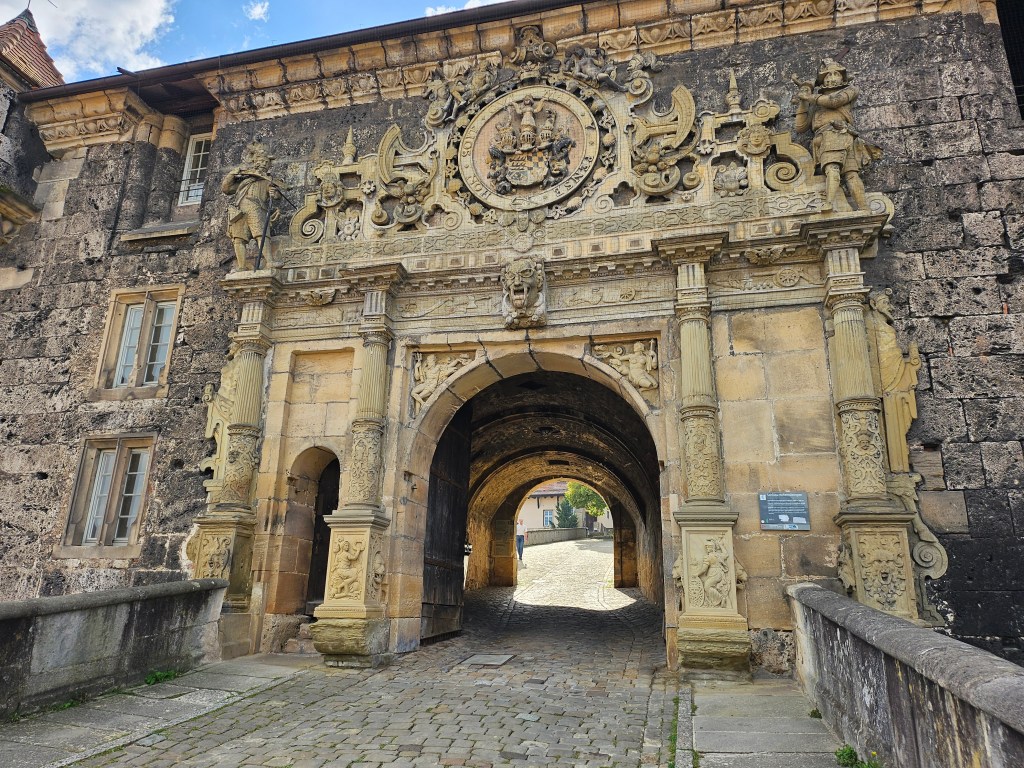

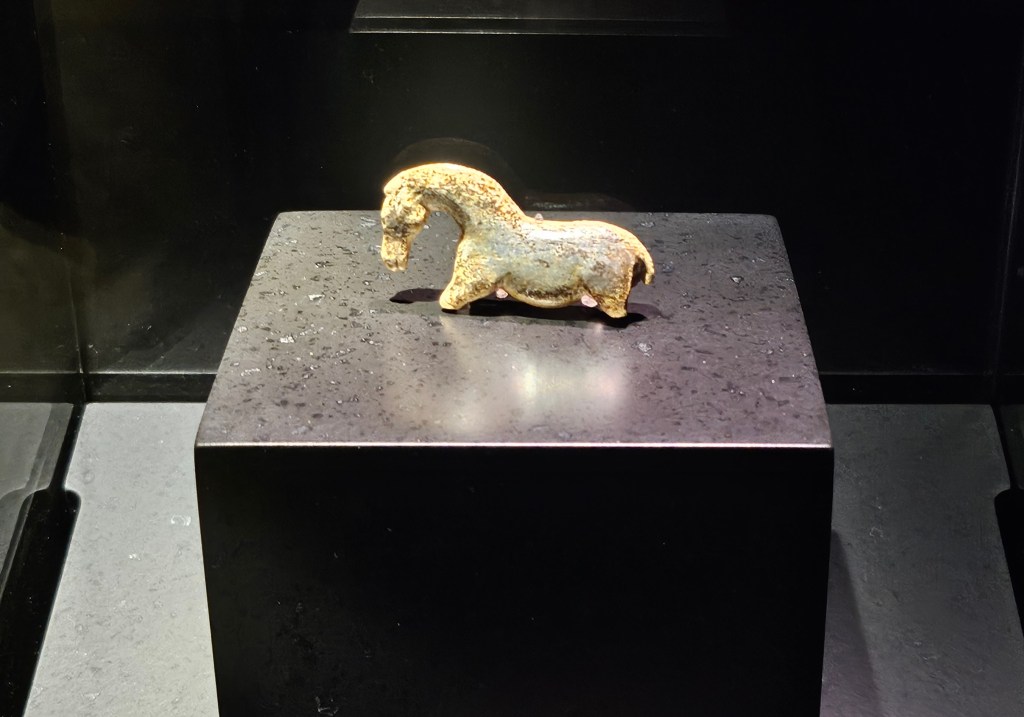
The castle also houses a museum of ancient art. The exhibits in this museum were delightfully and informatively presented, with an audio-guide available via your phone to assist. The highlight of the varied collection is a 30,000 year old figurine of a horse carved from bone, which had been found in the nearby Vogelherd cave in 1931.
On leaving the castle we went for a walk through the old town, identifying the main sights with a booklet we had acquired from the tourist office on arrival. Tübingen had escaped largely unscathed from allied bombing in World War II, due to the town’s lack of heavy industry.
For dinner that evening, rather than going back into the old town, whose bars and restaurants we had noticed during our walk were already very busy, we instead went to a pizza restaurant near our hotel. Perhaps we should have realised that the service left something to be desired when shortly after we arrived the waitress poured a tray of drinks over the couple sitting at a nearby table. After an interminable wait from placing our order and after people who had arrived later had been served, my wife’s pizza was delivered, but with no explanation as to why only one had come. After failing to attract the waitress’s attention for a while, eventually a hard stare from me caused the chef to come out to ask what I had ordered. Clearly my pizza order had been overlooked, when it eventually came cooked from fresh it was very good, but I still felt justified in removing the suggested tip from our bill.
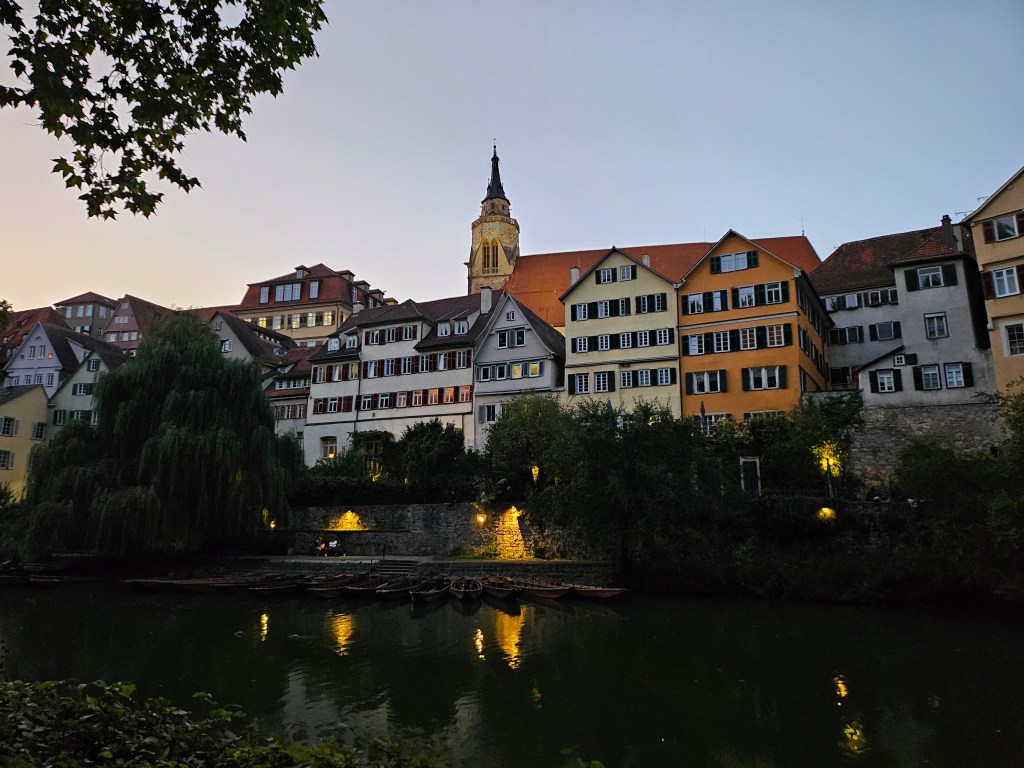
After dinner, when it was just starting to get dark, we went onto Neckarinsel, the elongated wooded island, which divides the Neckar into two streams as it goes through Tübingen. From here you get a good view of the houses in the old town which front the river. Although nearly dark, there were a number of games of boules going on on the island and we had to be careful not to accidentally kick any of the boules as we walked through in the gloom.
Day 9 – Thursday 19th September 2024 – Tübingen to Trier
The journey we were undertaking today was the first on this trip where we were due to catch three trains. Not long after booking, we were informed that the train we were due to catch from Mannheim to Trier had been removed from the timetable, now giving us nearly 90 minutes to make the change in Mannheim. Additionally, that morning DB’s app notified me that the train from Stuttgart to Mannheim would only have half its number of carriages and consequently was expected to be very crowded. Finally, the advised train from Tübingen to Stuttgart gave us only 9 minutes to make the connection, which we did not have confidence would be sufficient, given there were usually delays approaching Stuttgart due to congestion.
So we set off to catch a train nearly an hour earlier from Tübingen than the DB app was advising. As this was not an Inter City train our ticket was valid on any service that day. The train we caught was on time, but our caution proved to be correct, as the later train was indeed delayed and we would have missed our connection. We arrived in Stuttgart just before 9am, with 50 minutes until our onward train. We went for a walk in the Schlossgarten, before looking at the gutted remains of Stuttgart’s main station hall, which is being rebuilt as part of the remodelling of the station.

When we returned to the platforms to the north of the original station building, the departure board was saying that our train to Mannheim was running 15 minutes late, but that there was another late running Mannheim train which was now due to depart in about 10 minutes. Because of the multiple problems that day, we were allowed to catch any train, so we went to catch the late running train which was shown as departing about the same time as we had hoped to leave had our intended train been on time. However, as we approached the platform we saw the late train leaving several minutes before the revised time shown on the departure board. So we went back to our scheduled platform and were surprised to find a train sitting there, as the late running incoming train should have not yet arrived. Apparently DB had found some additional carriages to join up with the rest of the train when it arrived, so we got on these. They had not been cleaned and were littered with debris from a previous journey, but were quite empty. After a while there was a jolt as the rest of the train had arrived and was joined with the portion we were sitting on. In the end we left only five minutes late, most of which we recovered on the half hour journey to Mannheim.
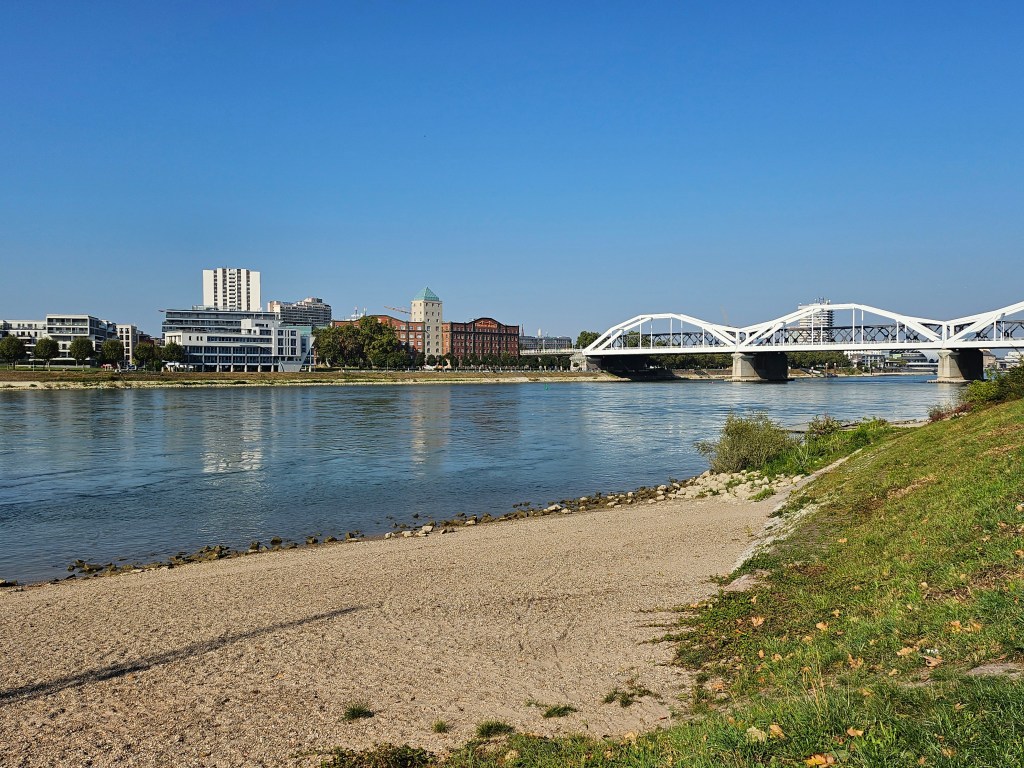
As we now had some spare time in Mannheim, we took the opportunity to walk from the station through a park to the banks of the River Rhine. From the Rhine we then looped back through more of the park to view the exterior of Mannheim’s Baroque Schloss. On the way back to the station, I sought out a bakery to buy a filled roll for my lunch. Unlike elsewhere, nearly all the rolls here had slices of boiled egg added as part of their garnish. As I have a lifelong revulsion to eggs, I had to buy one of the few rolls available that was egg free.
Although one of our longer train trips, lasting two and a half hours, the journey from Mannheim to Trier was on a local DB Regio train. It passed through the German state of Saarland, the smallest non-city state in the country. After both World War I and World War II Saarland was occupied by the French for a number of years, and only returned to Germany on both occasions following plebiscites. At St Ingbert, just before Saarbrücken, a very large number of schoolchildren got on the train completely filling all the seats and aisles. A short time later, the train suddenly stopped, apparently as a result of someone pulling the emergency alarm. There was a delay while the guard had to fight his way through the packed train to reset it. Thankfully, the schoolchildren left the train at Völklingen, presumably to visit the enormous former iron works there, which are now a world heritage site.
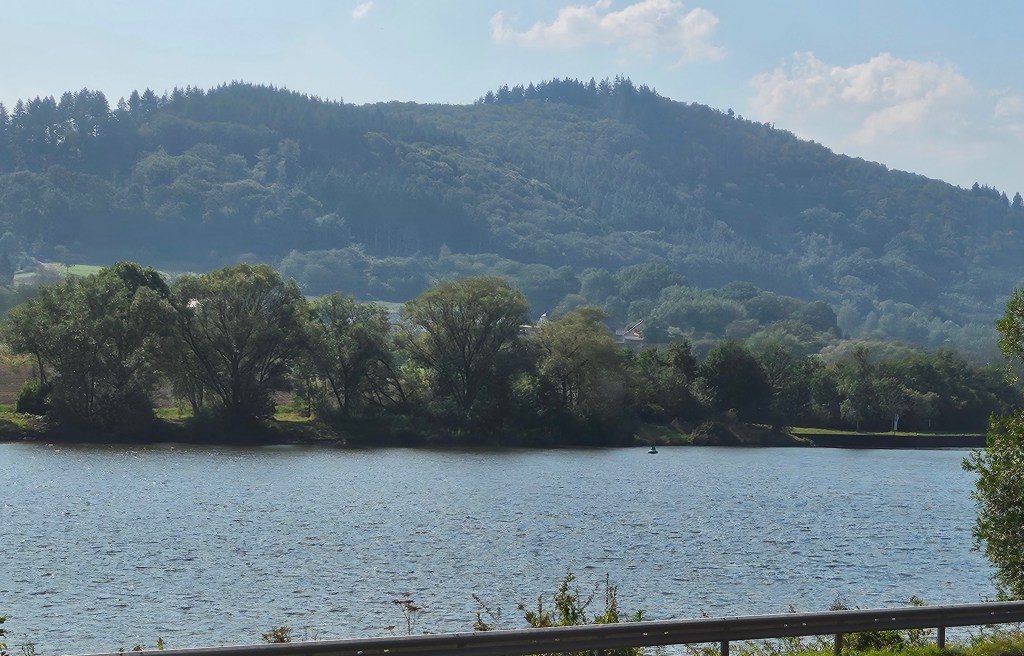
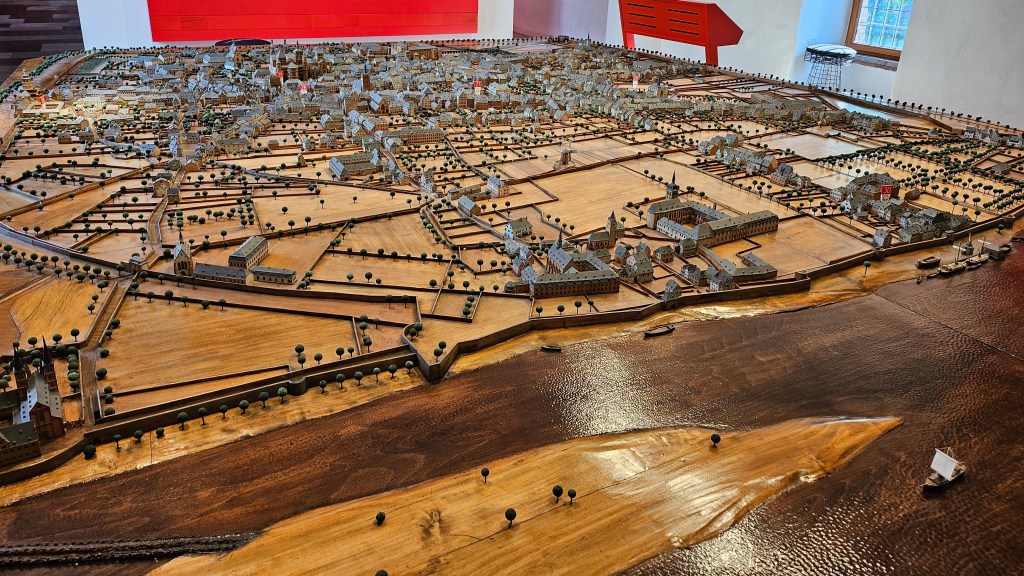
The train ran alongside the Saar and Moselle rivers for much of the rest of its route, arriving in Trier more or less on time at 2:30pm, despite its earlier emergency stop. It is about a ten minute walk from Trier station to the centre of the city. First we called at the city museum, which contains on the ground floor a number of statues recovered from many sites around the city to protect them, with replicas being placed in their original locations. On the upper floors, there are exhibitions on the history of Trier, including a large scale model of the city as it was in 1800.
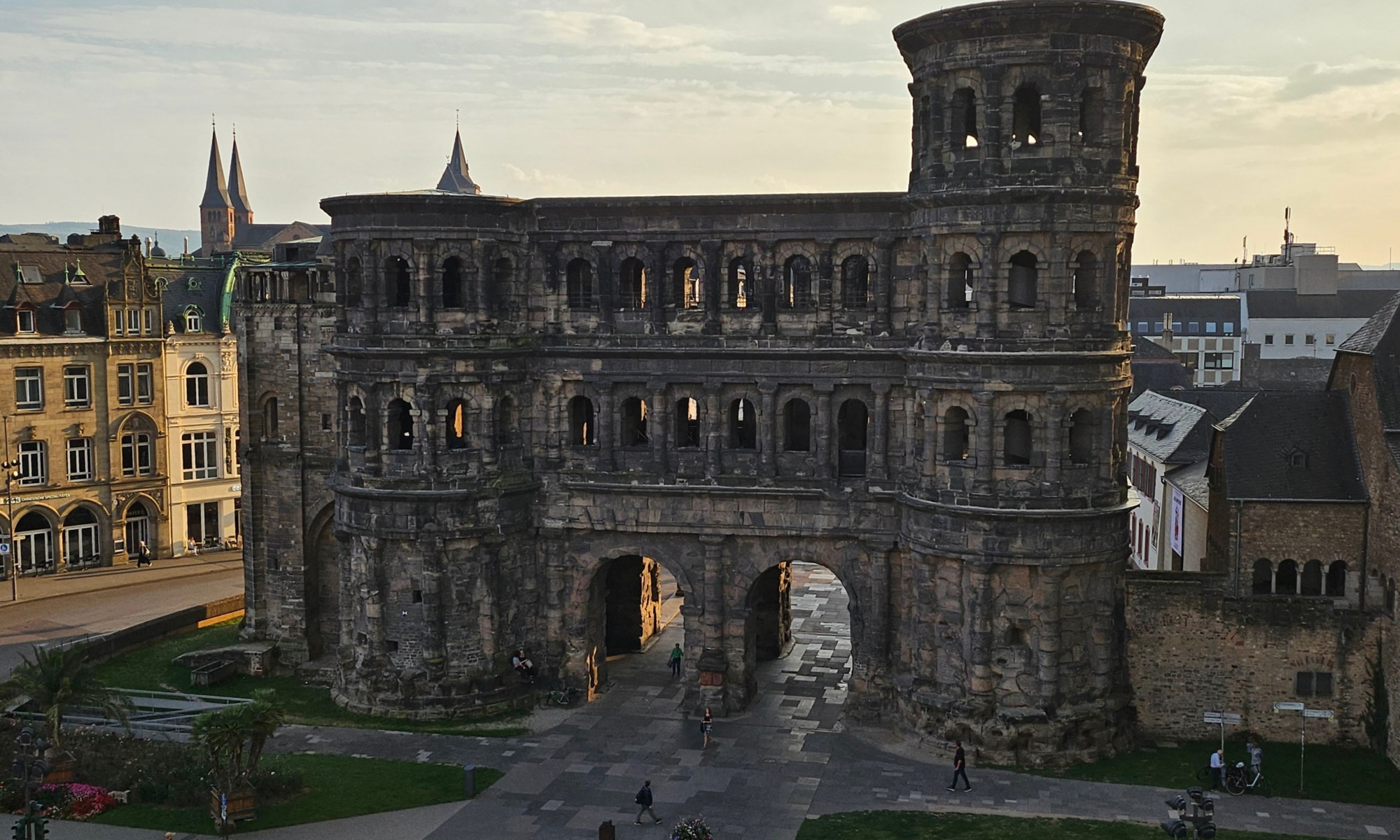
We bought a card from the tourist office to give us admission to the various Roman sites around the city. The only one we had time to visit that afternoon was the Porta Nigra, an impressive four-storey Roman gate that was originally part of the Trier’s city walls. If you do the Duolingo German language course, you will have been urged to visit Trier to see the Porta Nigra. In the Middle Ages the Porta Nigra was incorporated into two churches, but these were pulled down in 1804 on Napoleon’s orders during French control of the city, and the Porta Nigra returned to its original Roman form.
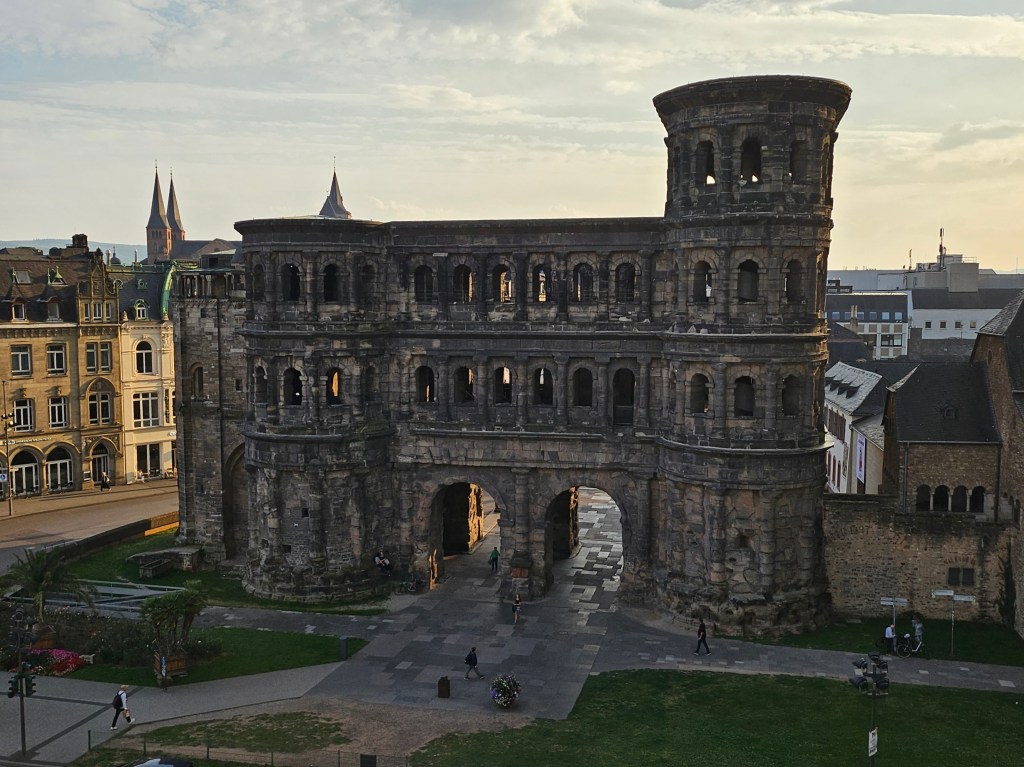
Our hotel was directly opposite the Porta Nigra, with views of it from our bedroom window. That evening, we went out to find dinner. We first called in at a restaurant which had good reviews, but it had no free tables, so we booked one for the next evening instead. A short way further down the street we found another busy establishment which did have space for us. Here I ordered the local Rhineland dish of Himmel un Ääd (in the local dialect) or Himmel und Erde (in German). This translates as heaven and earth, and consists of blood sausage with mashed potato and stewed apple. To accompany it I sampled the local Kölsch beer from the Früh brewery in Cologne. After dinner we went for a walk round the pedestrianised city centre which was thronged with people.
Day 10 – Friday 20th September 2024 – Trier
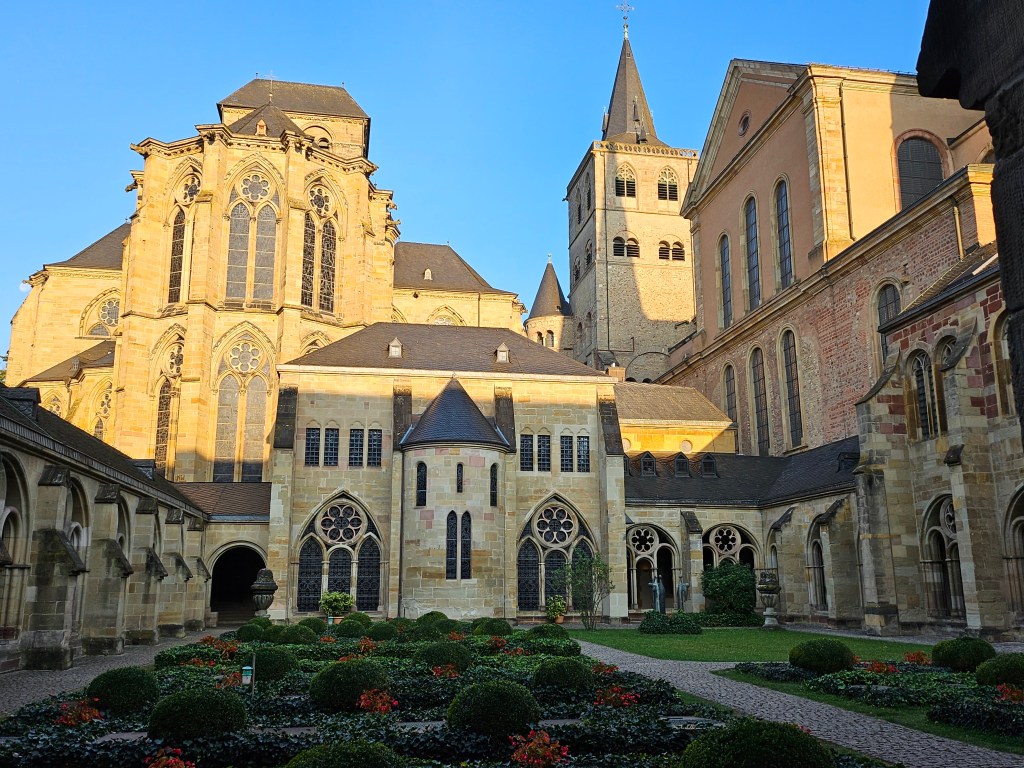
We got up early as we had a lot to pack into this full day to be spent in Trier. First we went to Trier Cathedral, getting there at 8am, to be able to visit it between the two scheduled morning masses – the cathedral is Catholic and is dedicated to Saint Peter. The earliest parts of the cathedral date back to Roman times, but it has been added to many times over the centuries.

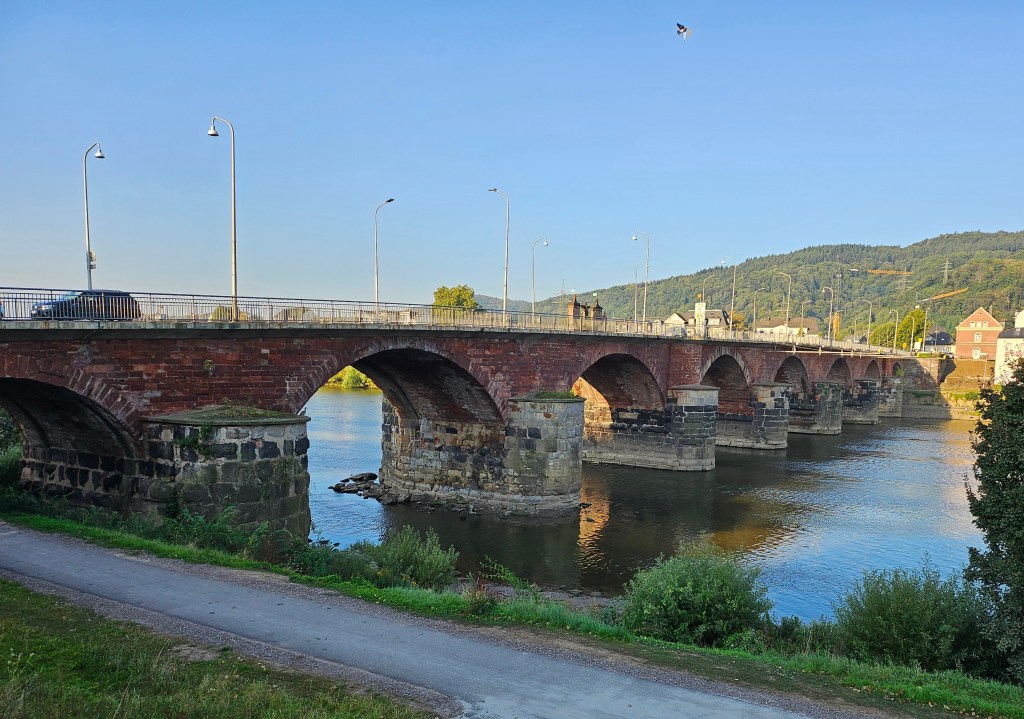
From the Cathedral we walked to the Roman Bridge which crosses the Moselle to the west of the city. The pillars of the bridge are Roman, but the upper part of the structure dates from the 18th century. The Roman Bridge is still used by road traffic today.
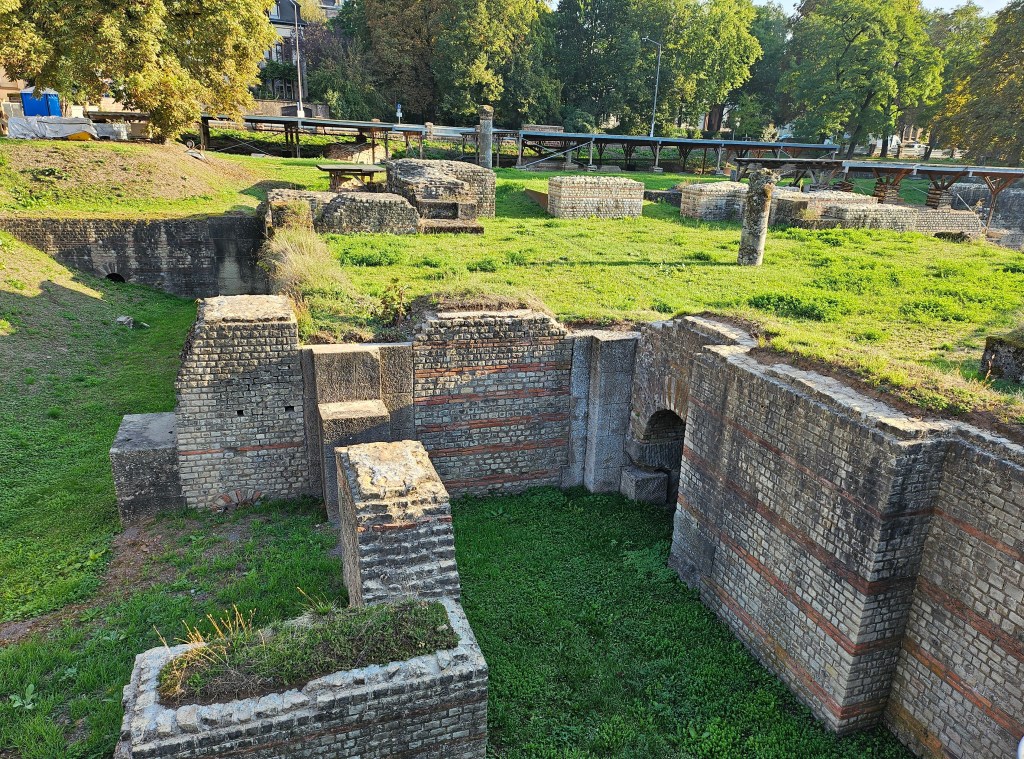
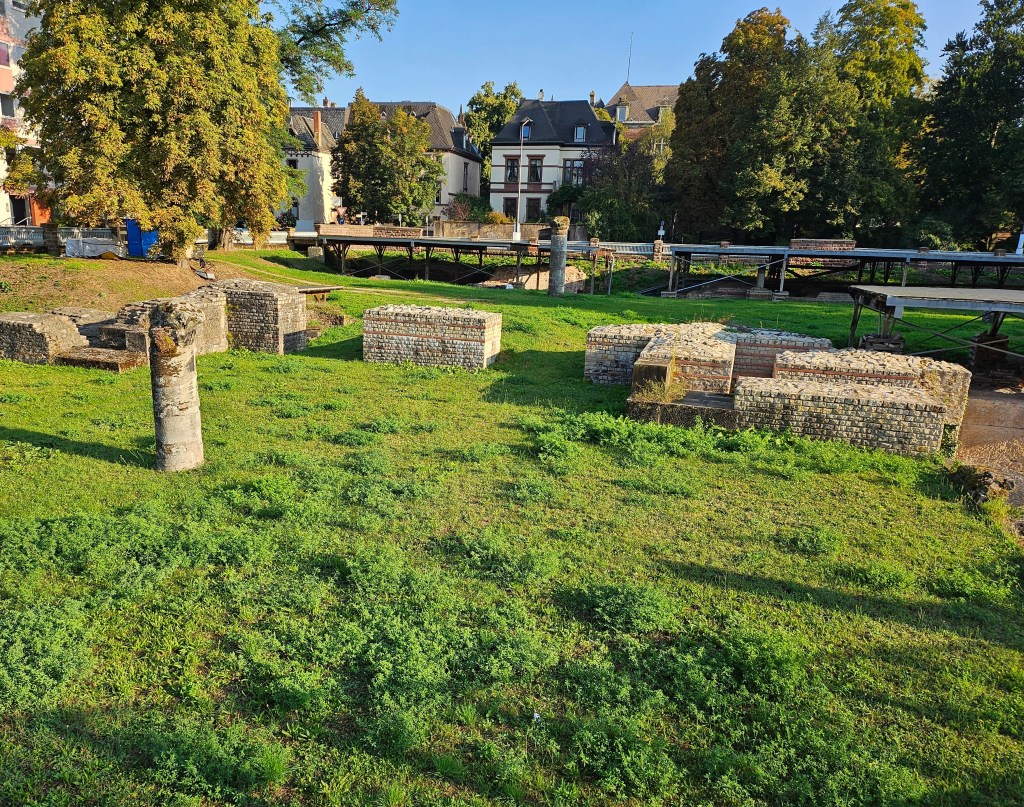
Near the Roman Bridge are the Barbarathermen (Barbara Baths). These extensive ruins are the remains of one of the largest bath complexes in the Roman Empire and possibly the largest outside Rome. As there are few structures standing above ground, the Barbarathermen are free to view at any time, with a wooden walkway to enable you to cross the site.
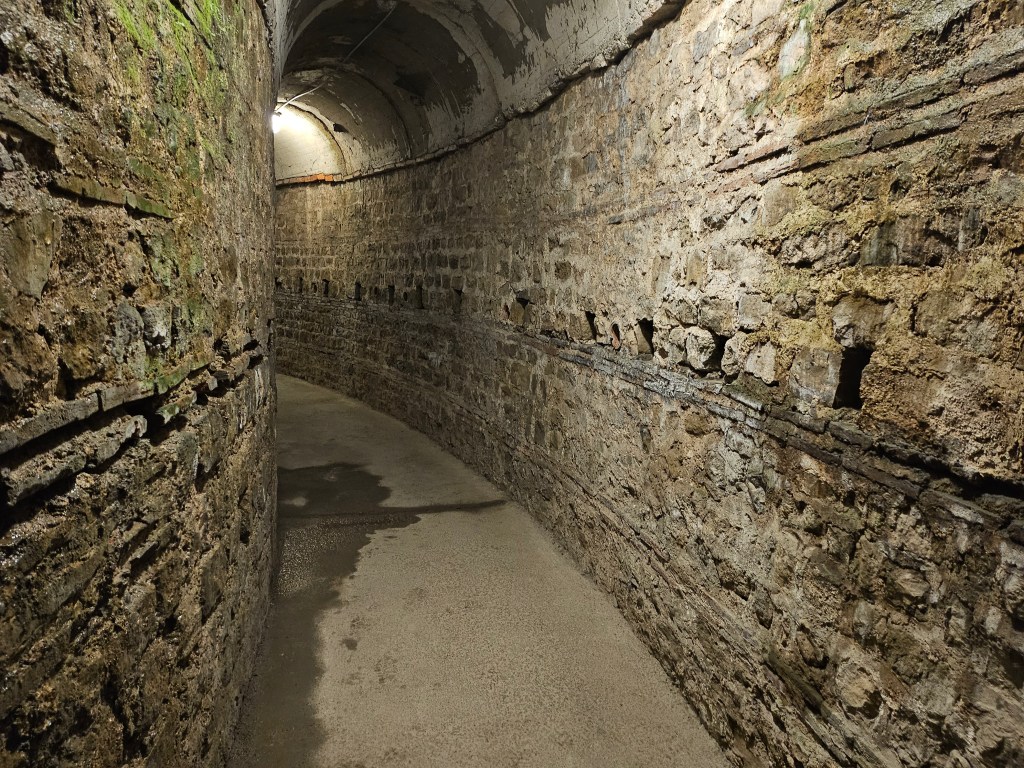
We then used the card we had purchased the previous day to access the well-preserved Roman Amphitheatre. It is cut into the side of hill, which today has vineyards growing on its upper reaches. The amphitheatre was used for gladiatorial contests and could accommodate 20,000 spectators. One can explore the passageways underneath the arena, as well as climbing up into the stands.


Not far from the Amphitheatre are the Kaiserthermen (Imperial Baths). These are the best preserved of the three Roman Baths in Trier. There is a small exhibition at the entrance to the Kaiserthermen. We walked all over the large site, including exploring some of the many underground passageways. The baths were built by the Emperor Constantine, but were never completed, after he apparently lost interest in Trier, and were converted into a barracks.

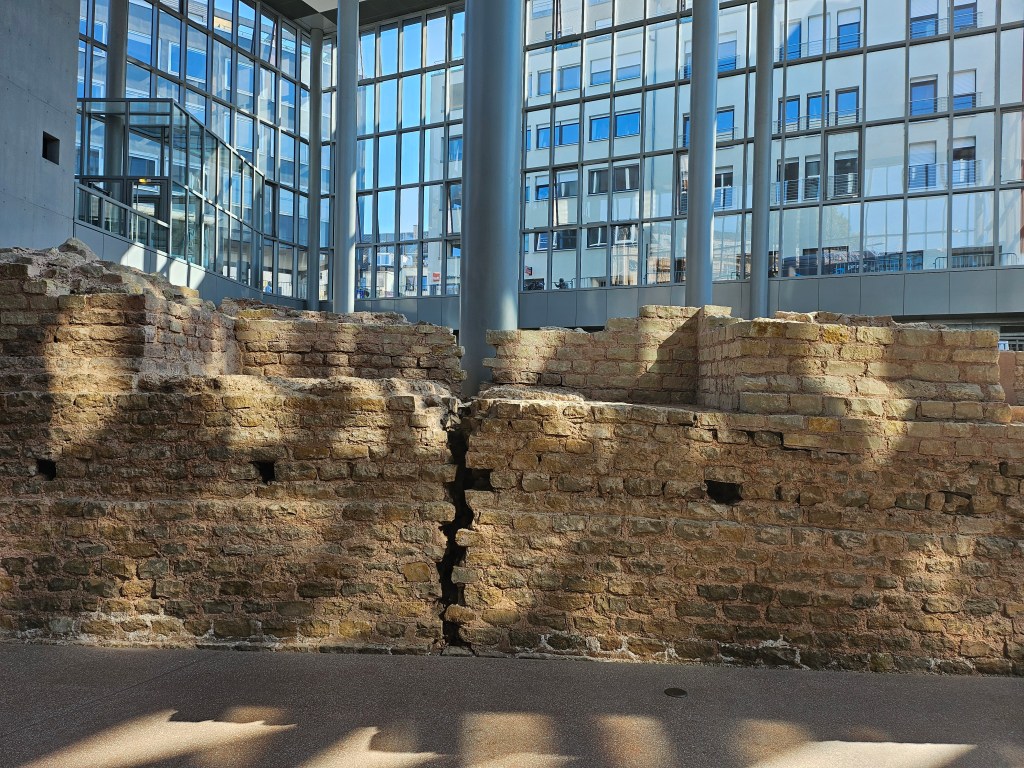
The final set of Roman Baths are the Forum Baths located underneath the former cattle market in the centre of Trier. The remains of the baths are enclosed in a large glass structure. These are the oldest of the three baths in Trier, but were only rediscovered in 1987.

In searching for a filled roll for my lunch, I encountered the same problem as I had in Mannheim. I had to visit several bakeries before I found one that had any rolls that were not garnished with slices of boiled egg.
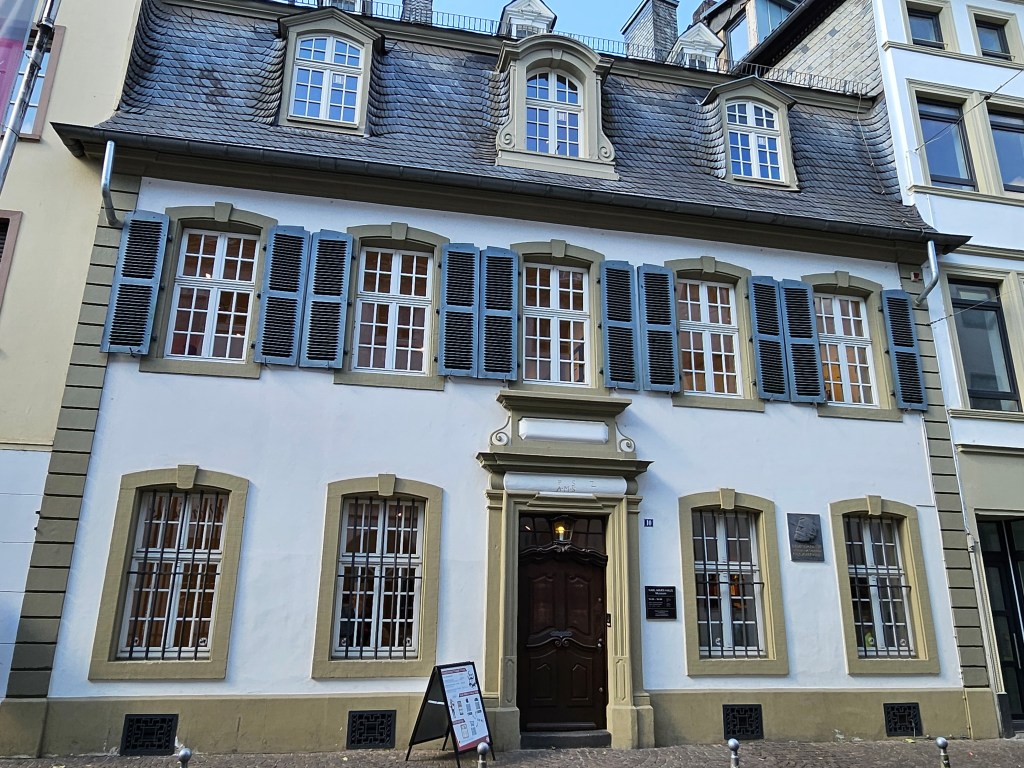
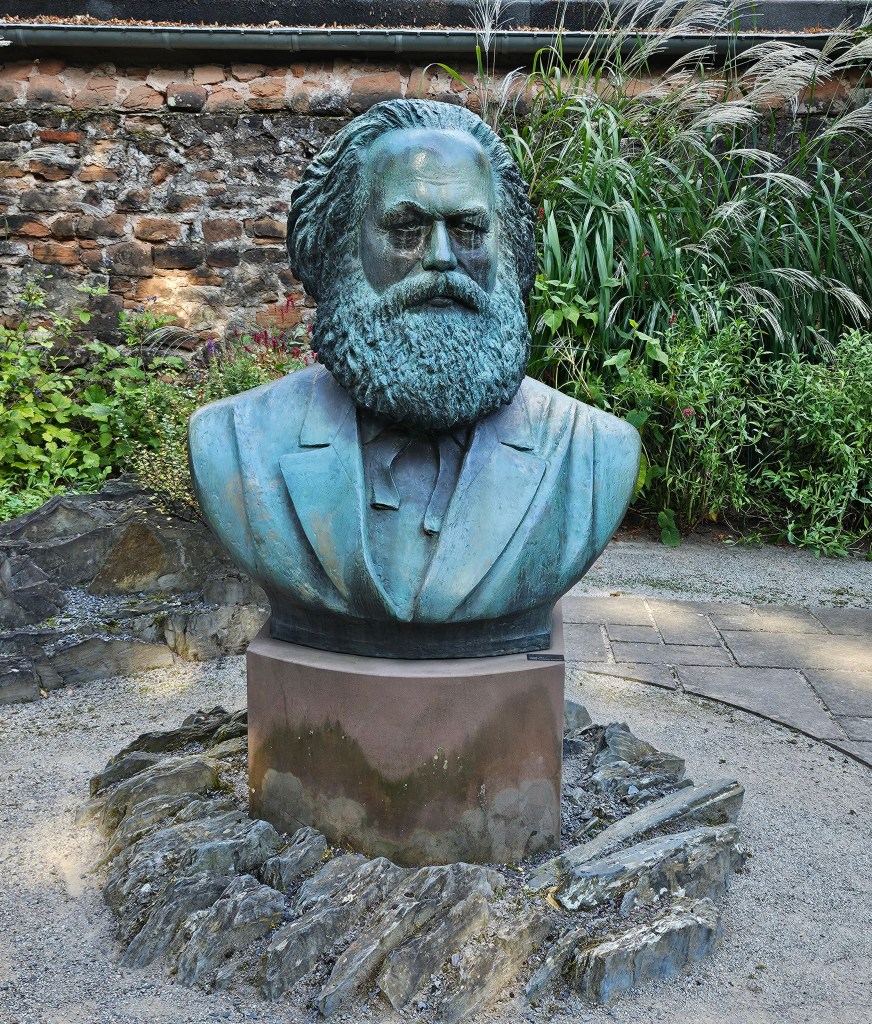
Having started our time in Germany with a visit to the childhood home of Friedrich Engels, it seemed appropriate to finish it with a visit to the birthplace of Karl Marx. Marx only lived in this house for the first 18 months of his life before the family moved to anther home near the Porta Nigra. The Karl Marx birthplace is now a museum. Compared with the Engels House, I felt it was rather more hagiographic in its portrayal of Marx as an individual. During our visit we shared the building with a large Chinese tour party, whose members were continually taking selfies throughout the museum.
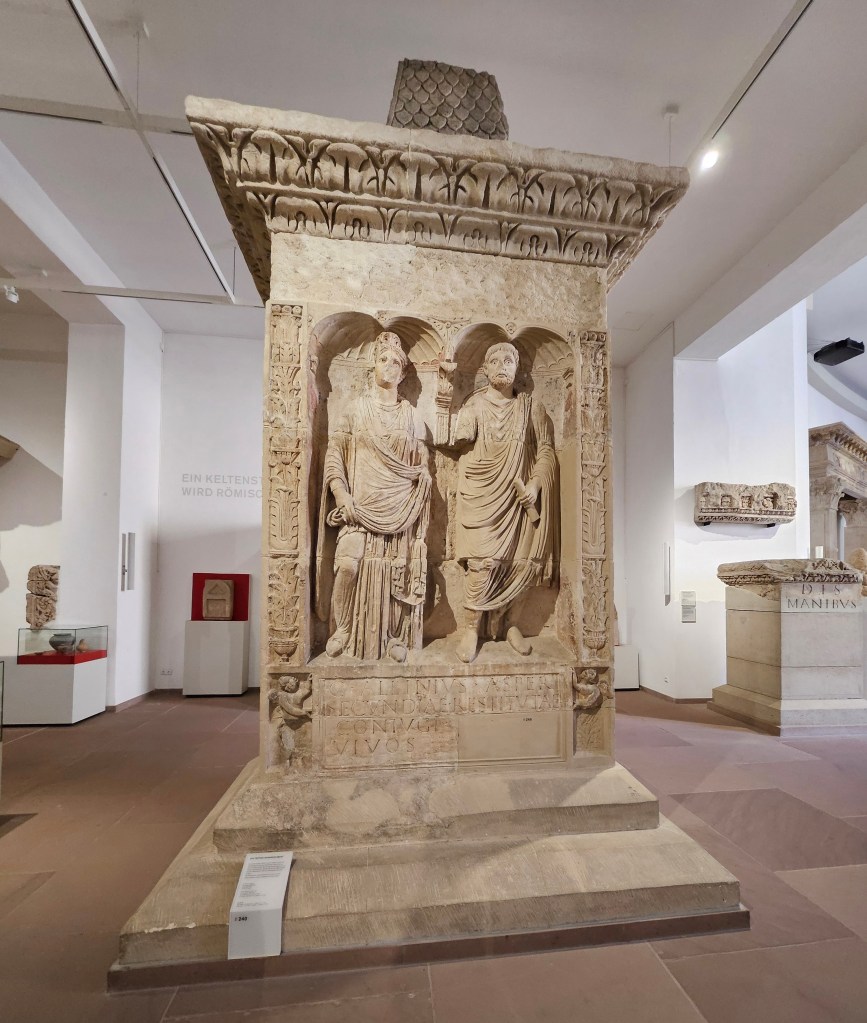
After leaving the Karl Marx House we then walked across the centre of Trier to visit the Rheinisches Landesmuseum. This museum displays a large collection of Roman artefacts from many of the Roman sites that we had already visited that day, as well as some later material. It also has an impressive collection of Roman mosaics collected from houses and public buildings in the area.

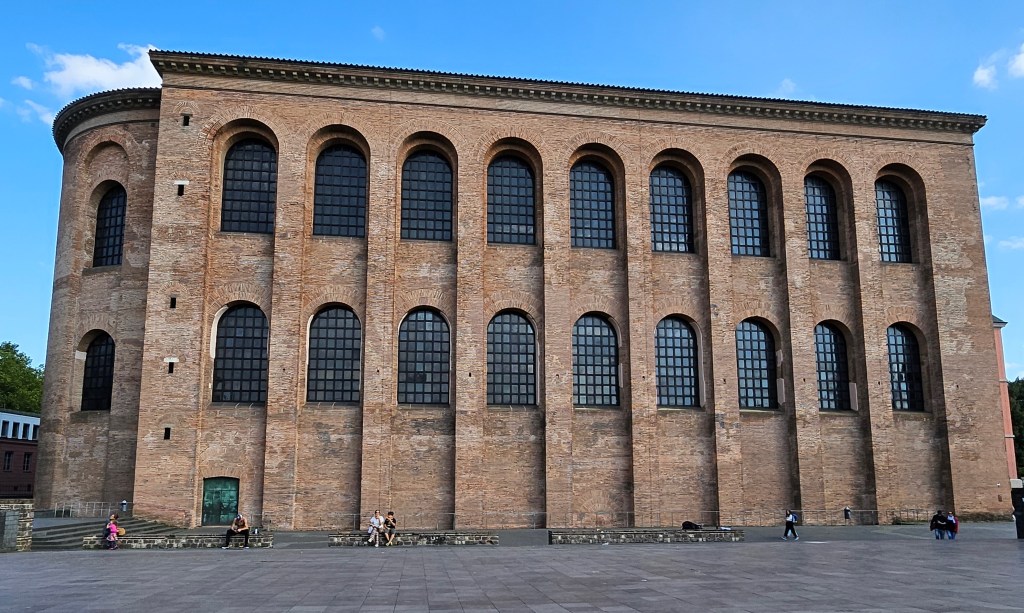
We next tried to visit the Constantine Basilica, originally built by Constantine the Great and now used as Trier’s main Protestant church. Unfortunately, when we go there we found a notice attached to its door saying that the Basilica was closed due to rehearsals for a concert, so all we could do was admire the impressive structure from the outside.
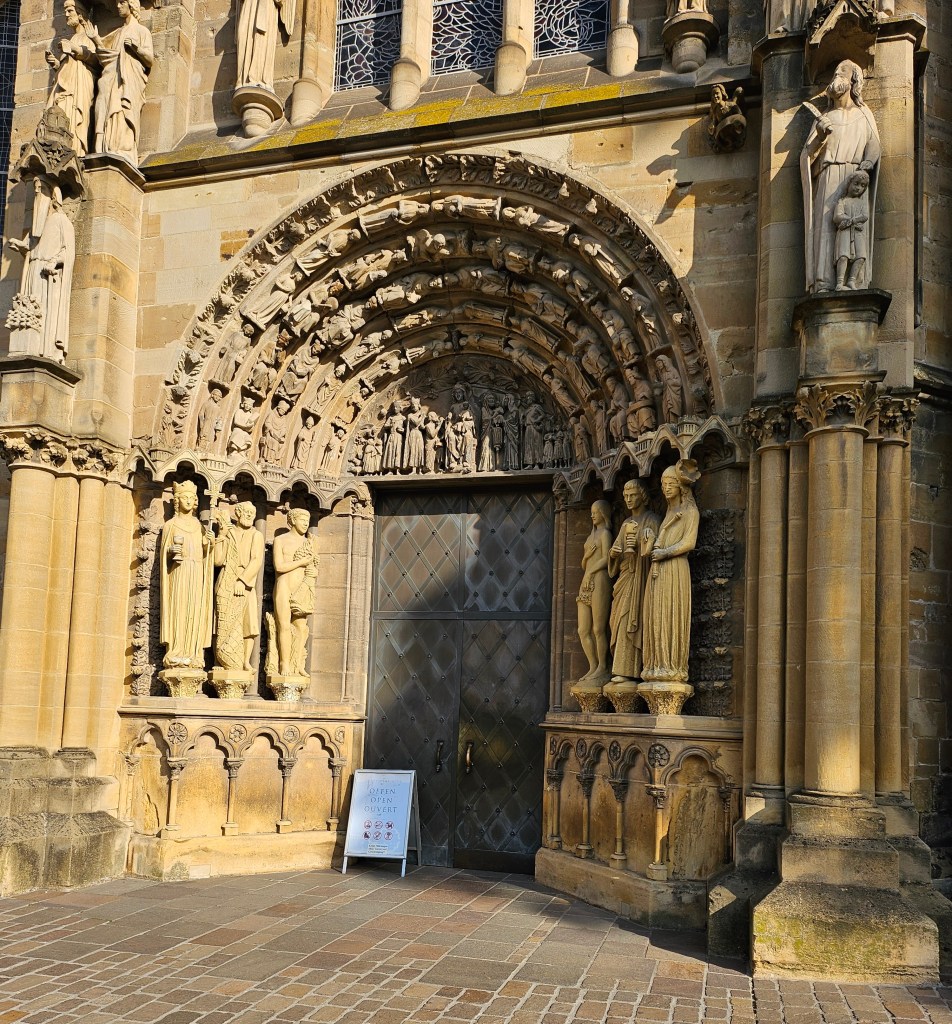
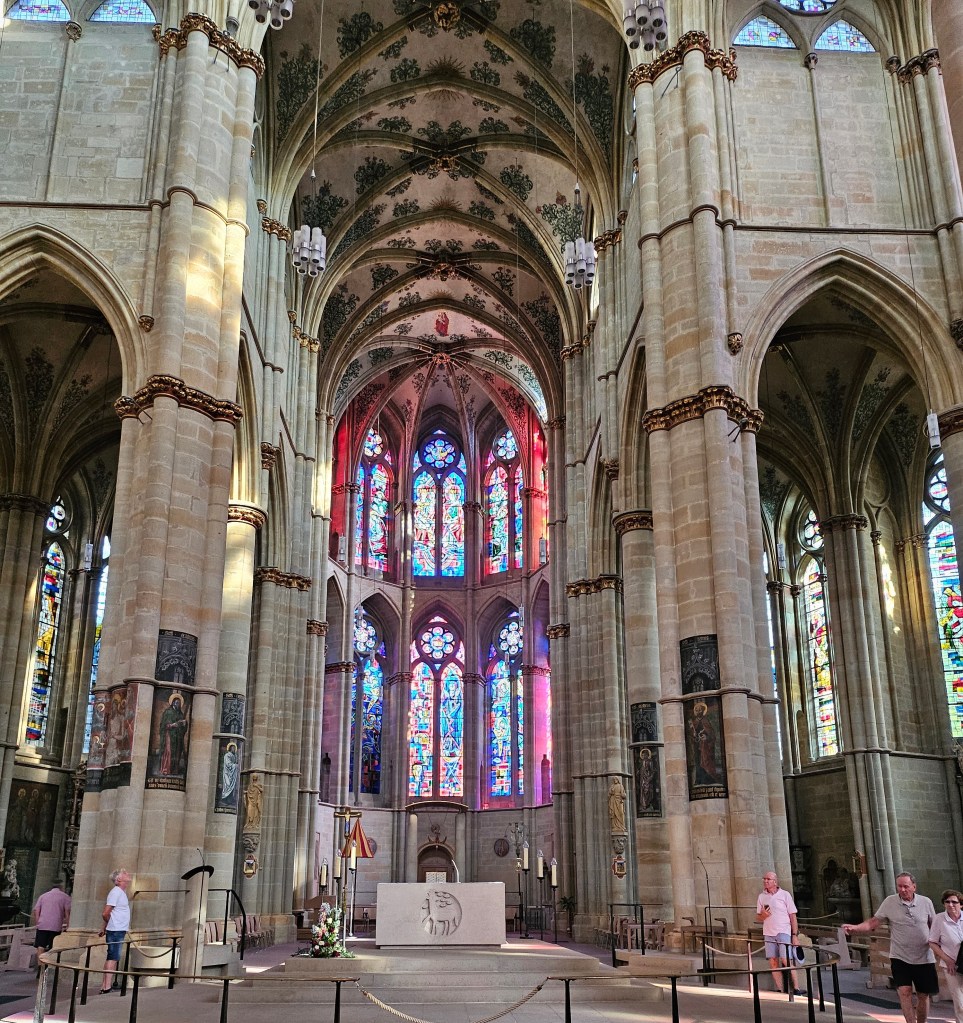
Our final visit that afternoon was to the Liebfrauenkirche (Church of Our Lady) which adjoins the Cathedral. (We couldn’t visit it when we went to the Cathedral earlier, as the Liebfrauenkirche is only open in the afternoon.) It has an impressively carved stone entrance, and the interior of the church is almost circular in shape.
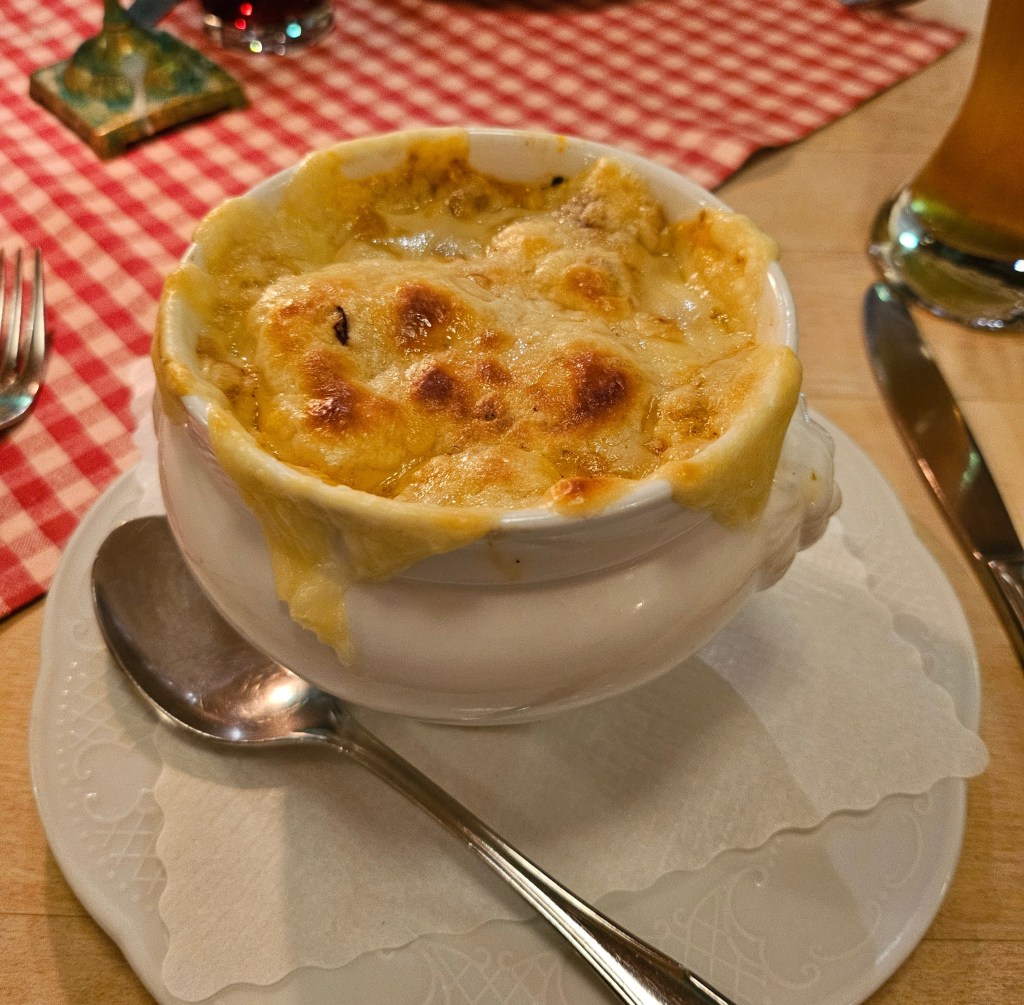
That evening we ate in the restaurant where we had booked a table the night before. I had onion soup to start with, followed by a schnitzel stuffed with ham and cheese.

Day 11 – Saturday 21st September 2024 – Trier to London
We walked for 10 minutes from our hotel to Trier station to catch the 08:37 to Luxembourg. Our incoming train divided into two parts at Trier, but it wasn’t difficult to work out which half we needed, as one part was made up of DB Regio rolling stock and ours of CFL (Luxembourg Railways) carriages.
We left Trier, as we arrived, following the River Moselle, but soon crossed over the river and a short time later entered Luxembourg. The journey to Luxembourg City only took 45 minutes.
We had 45 minutes to wait until our next train to Brussels at 10:11. As Luxembourg station is some way from the old town, there was not time to get there and back. However, we did go as far to get a good view across the valley to view the Luxembourg Corniche. I also took the opportunity to show my wife where I had had dinner on my visit to Luxembourg in April.
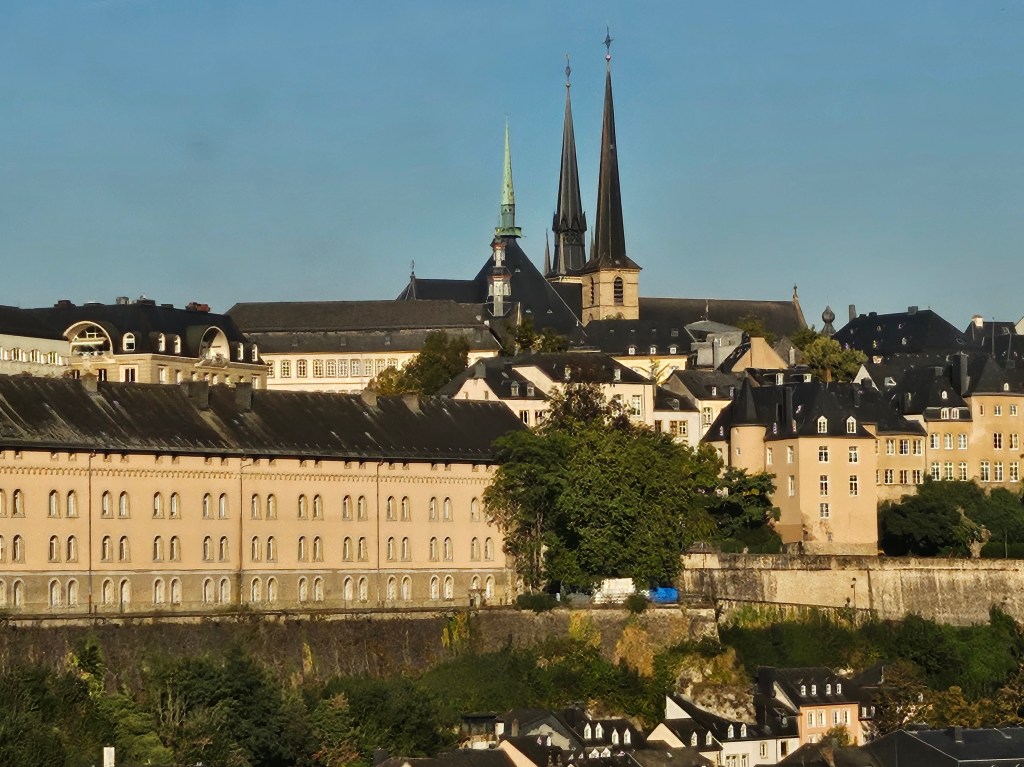
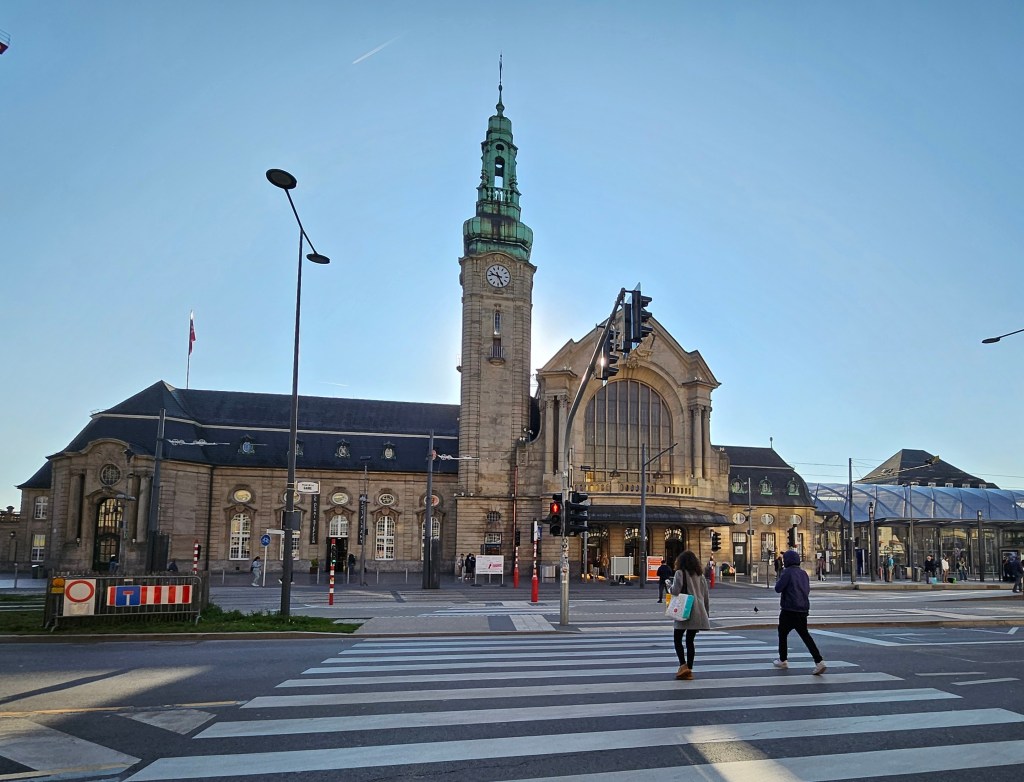
The 10:11 train to Brussels left Luxembourg on time. At the first stop, 20 minutes later, in Arlon in Belgium there was an announcement (in French) that due to a fault with a locomotive there would be a delay of 50 minutes here. After a little while there was another announcement that our train had been cancelled and that we should go to another platform to catch the service an hour later. We took the opportunity to leave the station to have a look at those parts of Arlon that were in the vicinity. When we got back to Arlon station we saw our original train still sitting at the platform, where it had arrived, and an incoming train from Brussels pulling into the adjacent platform. The passengers from this incoming train were then transferring to our original train to continue to Luxembourg. My speculation is that, since Belgian and Luxembourg railways operate on different voltages, the incoming train from Brussels was not able to switch to Luxembourg operation and that is why our train had been taken out of service.

At 11:36 the next train to Brussels arrived at Arlon. Unlike our original train this was a double-decker, so there was still plenty of room to accommodate the additional passengers. Much of the line to Brussels via Namur is undergoing engineering work and in April I was prevented from travelling on it at all. Our train seemed to travel very slowly, albeit to timetable, throughout much of its route. Rather than go all the way to Brussels Midi, we got off the train at Brussels-Luxembourg station at 14:06.
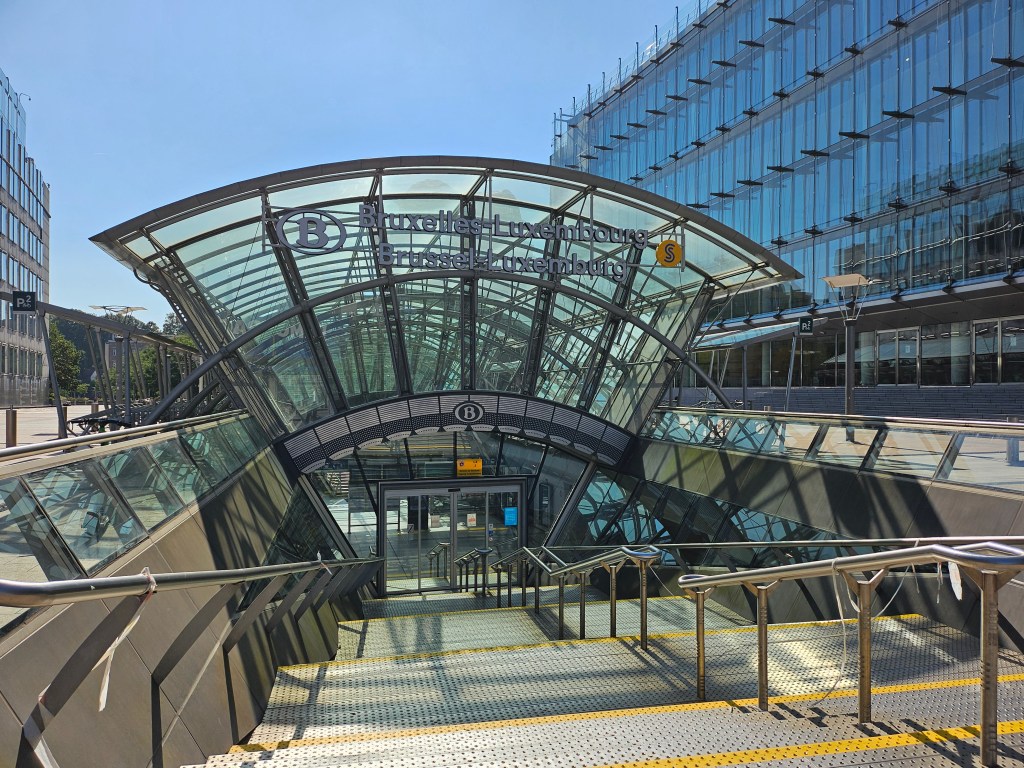
From Brussels-Luxembourg station it is short walk past the European Parliament and through Parc Leopold to reach the House of European History. This is a museum sponsored by the European Parliament covering the history of Europe, but with an emphasis on its more recent past. On arrival you are given a hand-held tablet which uses interactive technology to guide you round the exhibits. Due to the cancelled train we had an hour less in the House of European History than planned, so we had to rush through it a bit. That said, if you were to look at everything on the interactive tablet it would probably take all day to look round.
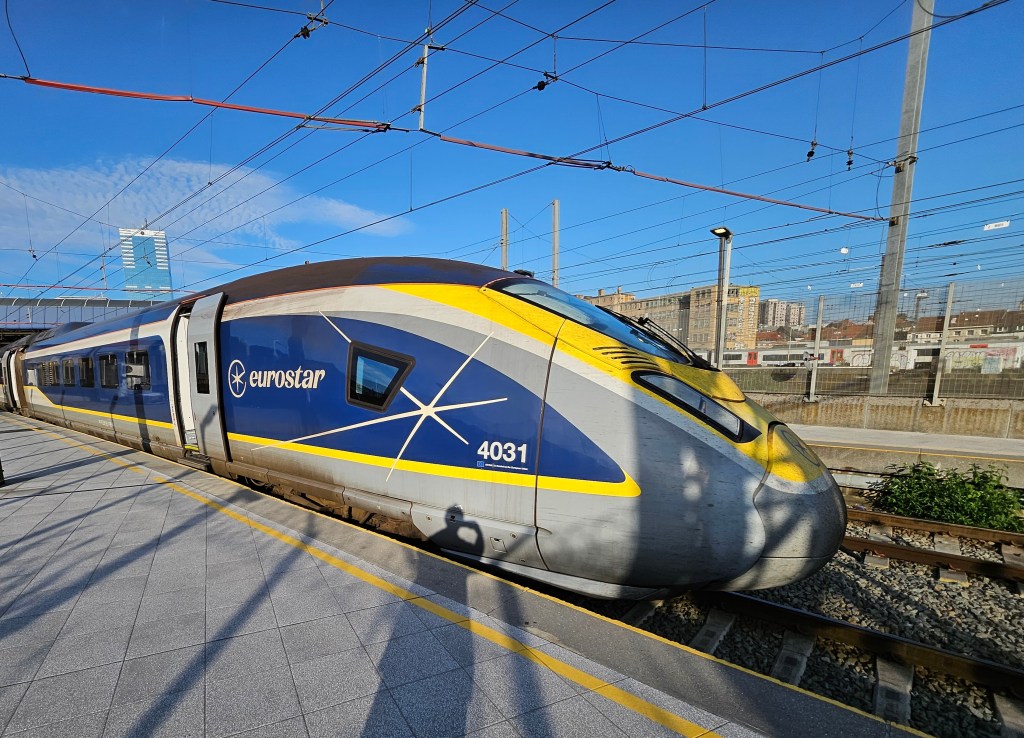
We returned to Brussels-Luxembourg to catch the 16:06 train, which arrived at Brussels Midi at 1630. This gave us 30 minutes to have a quick snack, before we needed to check in for the Eurostar to London. Brussels Eurostar terminal is still as unpleasant as ever, with half its space devoted to a large duty free shop selling massively overpriced goods. Fortunately boarding of our train started early and it departed on time. At Lille, all the remaining free seats in our carriage were filled – was it only last year that Eurostar were claiming that, because of the additional time for passport checks, they could only run trains at about 75% of capacity? We arrived back at St Pancras only a couple of minutes late at 7pm.
Overall our wanderings around Germany had been very enjoyable. Despite some late trains, we got to everywhere we wanted to no more than an hour late. Going back to Leipzig was a revelation – in one sense it had obviously changed completely since my previous visit in communist times, but in another it had changed very little, with most of the city centre still looking much the same. All of the new cities we visited lived up to expectations and it was worth concocting this rather roundabout route to visit them all.
 Europe Explored