
“Between Scylla and Charybdis“
After a three month gap since my previous excursion to Europe, I decided to head south on a short trip in the hope of catching some warmth.
Day 1 – Tuesday 27th February 2024 – London to Naples
As usual when I fly to my initial destination, I was going to depart from Stansted Airport. My flight was scheduled to leave at 0945, which meant an early, but not ridiculously early, start from home. I had a slight scare on the way to Stansted when the Stansted Express was delayed by a signal failure, but the delay was only for 15 minutes so I still got to the airport in plenty of time for my flight. I bought some breakfast when I arrived and found a quiet corner of the airport in which to eat it, away from the crowds that throng the main departure area.
Boarding started well before the scheduled departure time, but this just meant a long wait in the cold on the tarmac while some problem near the rear door of the plane was fixed. Nonetheless we managed to get away on time. The route we took was not the most direct, as it seemed to be avoiding flying over either France or Switzerland. Most of the time the view was obscured by clouds, although they parted to give a glimpse of a snowy Arlberg pass in Austria. Once in Italy, when the plane had started to descend, we encountered a bit of turbulence, which I think caused a few people to lose their drinks. The final descent into Naples involved sweeping round Mount Vesuvius before coming into land. The circuitous route meant we arrived about 10 minutes late at 1330.
Getting through the formalities at Naples Airport was fairly quick and I was soon on a bus to the city centre. This dropped me at the Piazza Garibaldi, close to Napoli Centrale station. From there I caught the Metro a few stops to my hotel, where I left my bag before immediately setting out again.
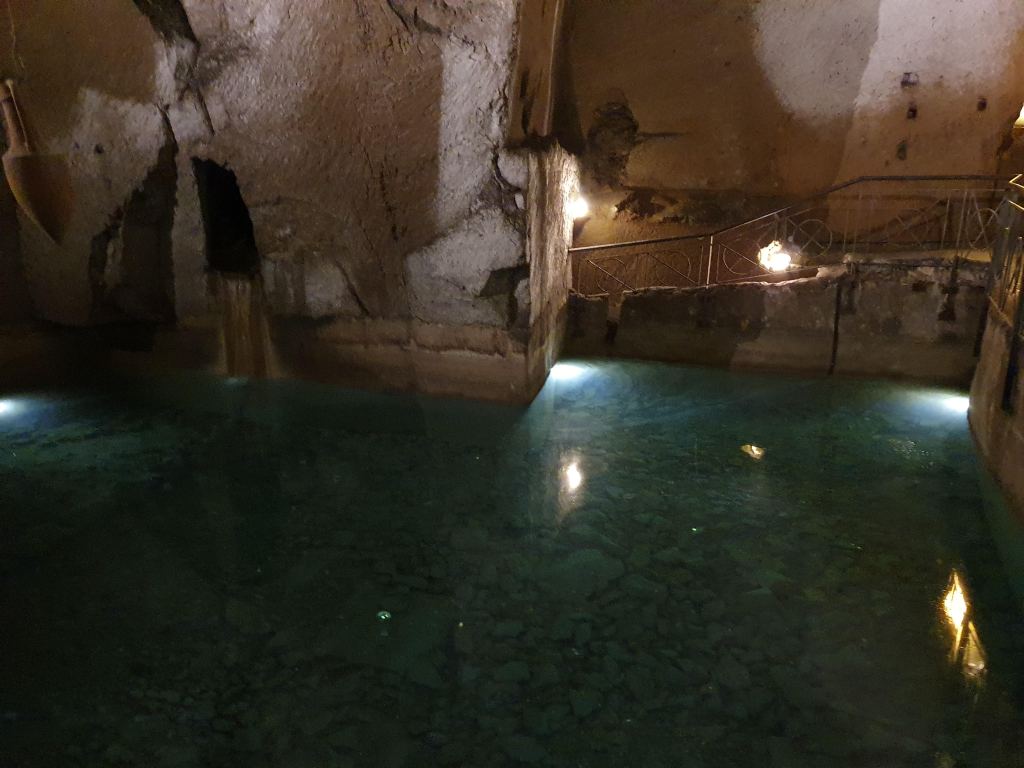
That afternoon I went on a tour of subterranean Naples. Our group had an enthusiastic guide, who was originally from Finland. Making our way through some narrow passageways we explored the Roman system of underground aqueducts, which once supplied Naples with water. Some of the underground caverns were drained in World War II and were used as shelters for the population, initially from allied, and then later, German, bombing. Emerging from the tunnels we walked at street level before descending again to observe the far from obvious remains of Naples’ large Roman theatre.
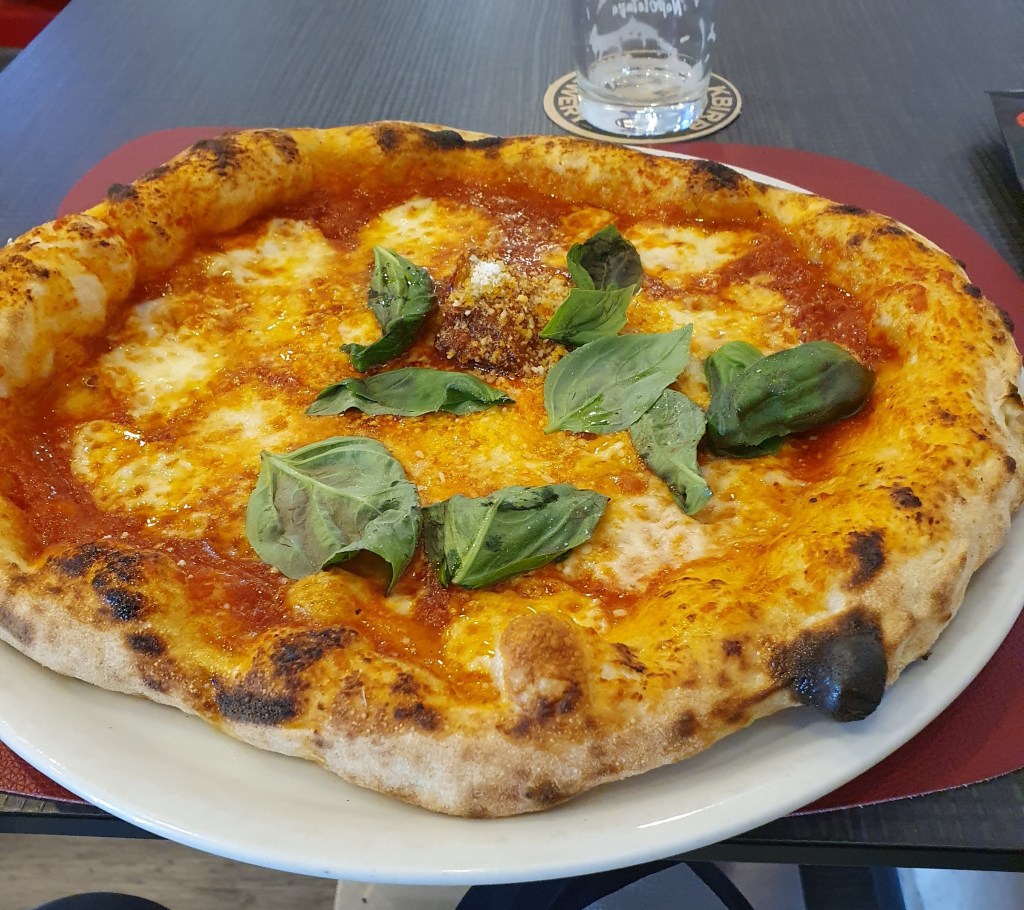
As is my habit, I had researched carefully where to have dinner that night. Being in Naples, the traditional home of pizza, I fancied one for my first night meal, so I headed in the evening to a well reviewed pizzeria. Despite it supposedly being open that night, it was completely shuttered when I got there and there were no signs that it was going to open any time soon. So, I had to revise my plans, and headed to another pizzeria a short walk away, where fortunately the pizza was good.
Day 2 – Friday 28th February 2024 – Naples
Before departure on this trip I had booked a ticket to visit the Cappella Sansevero, located not far from my hotel in the heart of the old town, for when it opened at 9am. Arriving in good time I waited outside the front entrance until opening time, only to discover that there was a queue of people lined up around the corner also waiting to get in. The Cappella Sansevero was a private chapel built in the late 16th century by a member of the local nobility. The interior is ornately decorated – most impressive is the marble sculpture, by Guiseppe Sanmartino, of the Veiled Christ, in the middle of the main floor of the chapel. The translucent effect of the shroud covering the body of Christ is spectacular and it is hard to believe that it has been carved from marble. Unfortunately, photography was not permitted within the chapel and there were strategically placed guards to enforce the rule.
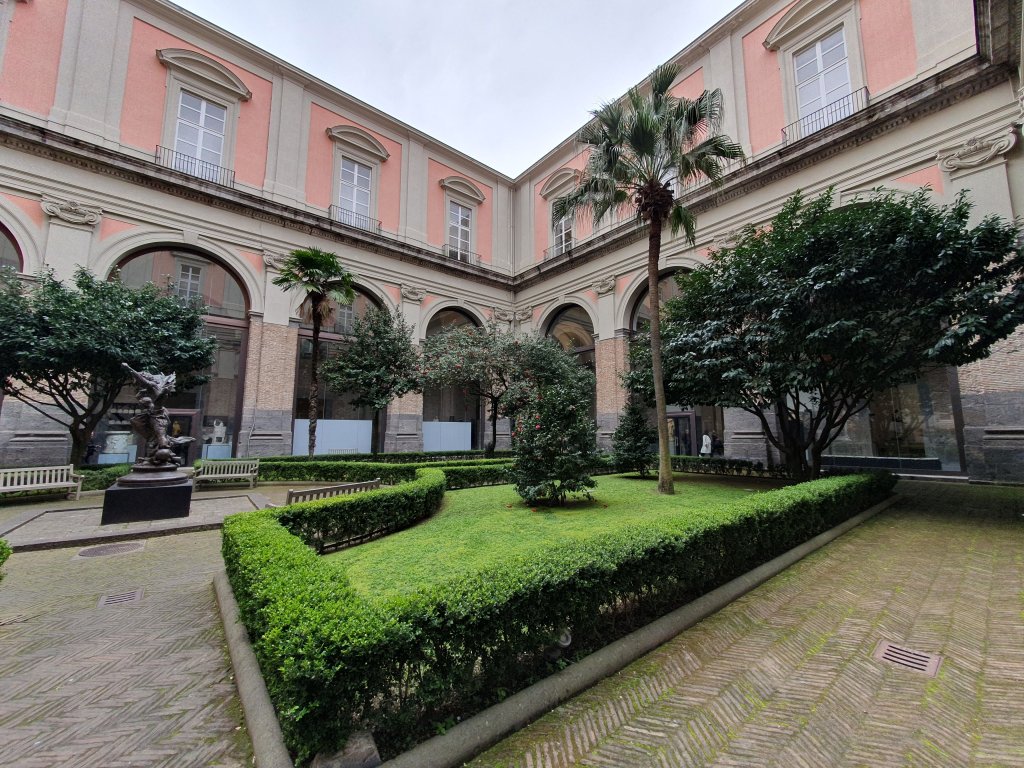
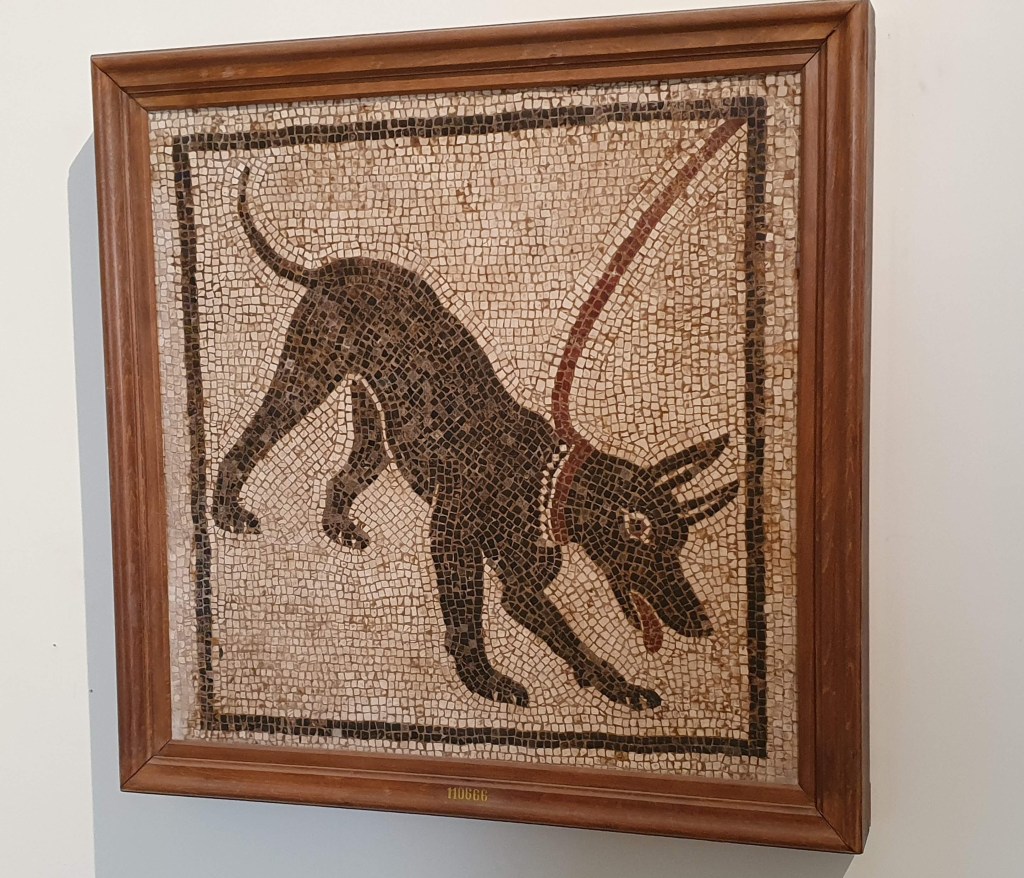
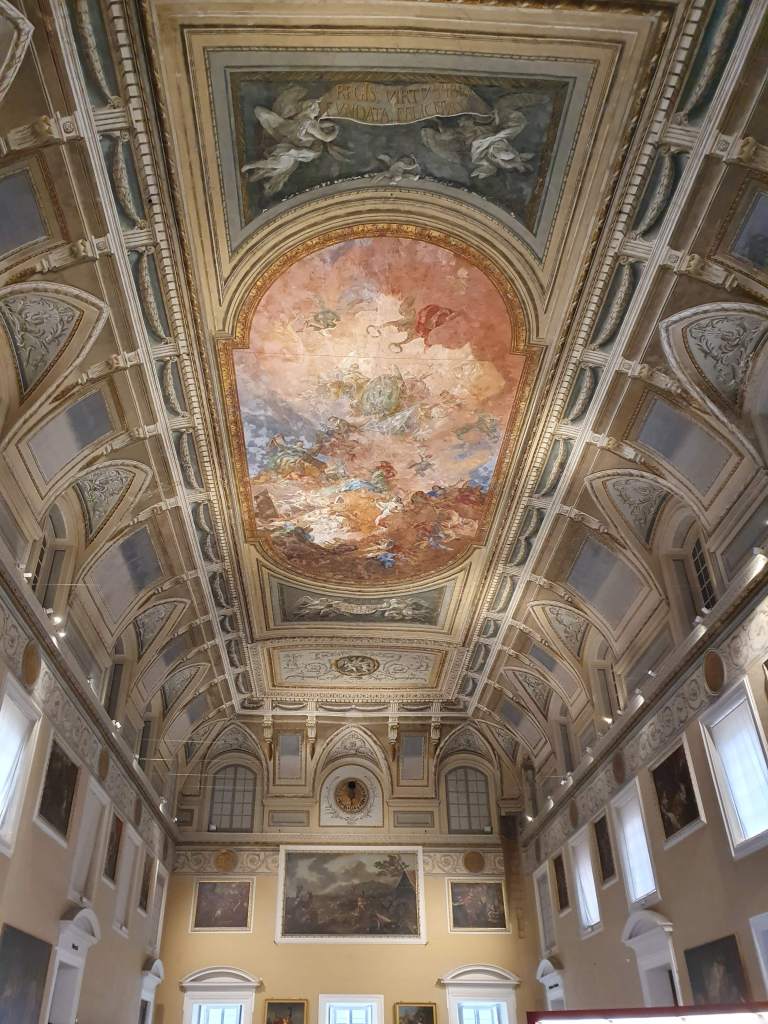
When I had finished in the Sansevero I walked uphill through the old town to Naples’ National Archaeological Museum. This is an enormous museum containing many items from Pompeii and other surrounding sites. There was a small supplementary charge to visit the Magna Grecia area of the museum, which houses items from the areas of southern Italy populated by Greek settlers from about the 8th century BC. (The additional charge may have been to cover the costs of the disposable shoe coverings that you had to wear to protect the floor in this area of the museum.) In one corner on the top floor of the museum is the Secret Chamber, containing a collection of Roman pornography, which was only opened to the general public in 2006. I stayed in the Archaeological Museum until lunchtime.
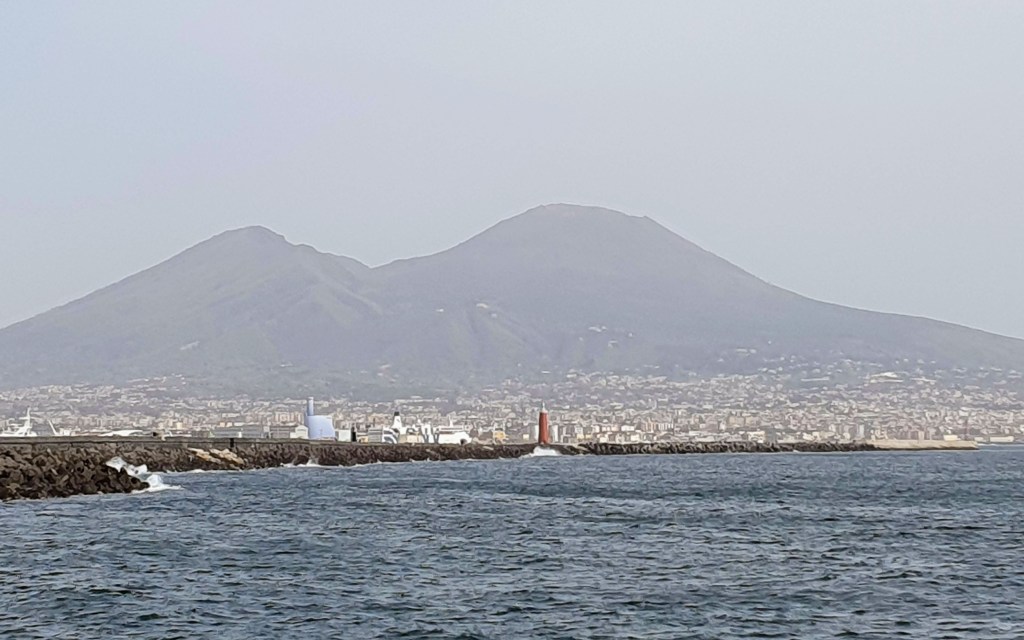
From the Archaeological Museum I walked through Naples’ busy streets down to the dock area, hoping to get a good view across the bay to Mount Vesuvius. However, I found that the view from the road, which runs alongside the entrance to the port, was obscured by buildings. So I entered the port, since looking at a map showed that there was a promontory sticking out to sea. I ignored the signs for departures as I didn’t want to catch a ferry. I think there must have been a recent arrival, as there was a steady flow of people streaming out of the port. I walked against the flow until my route ahead was closed off and then crossed to the other side where I could see people walking outwards. It was only after I crossed over that I realised that those now progressing outward had come through the security scanners guarded by armed police and were now heading to board a ferry. I had managed to bypass this security checkpoint, but didn’t fancy trying to explain to the armed police what I was trying to do. Trying not draw attention to myself, I noticed a small group of stragglers who had recently disembarked and I surreptitiously changed direction and tagged along behind them to leave the port.
I was still trying to find a good viewpoint, but the next area along from the ferry terminal was a restricted military area. However, a bit further along, there was a marina with its own pier. There may have been a couple of notices saying this was a private yacht club, but I felt fairly safe in walking out along the pier to get a good view across the bay.
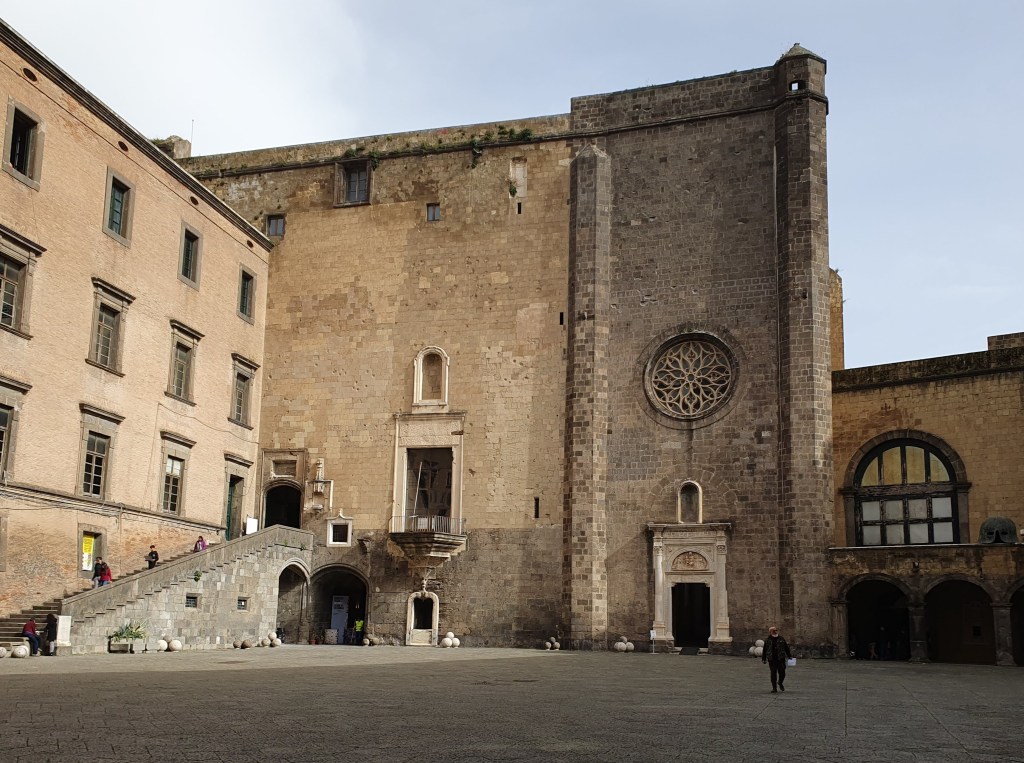
This area of the port is overlooked by the Castel Nuovo. I climbed up to the castle and had a look in its courtyard. These days the interior of the castle is used to house art exhibitions, which I decided not to visit.
Next stop was the cloisters of Santa Chiara (Saint Clare). This was a haven of tranquillity from the sometimes manic Naples streets. The gardens of the cloisters are decorated with majolica tiles and pillars. Although it had been remodelled in a Baroque style in the 18th century, the church of Santa Chiara was destroyed by allied bombing during World War II and has been painstakingly reconstructed back to its original Gothic style. There is also a small museum which contains items recovered from the destroyed church and other archaeological finds.
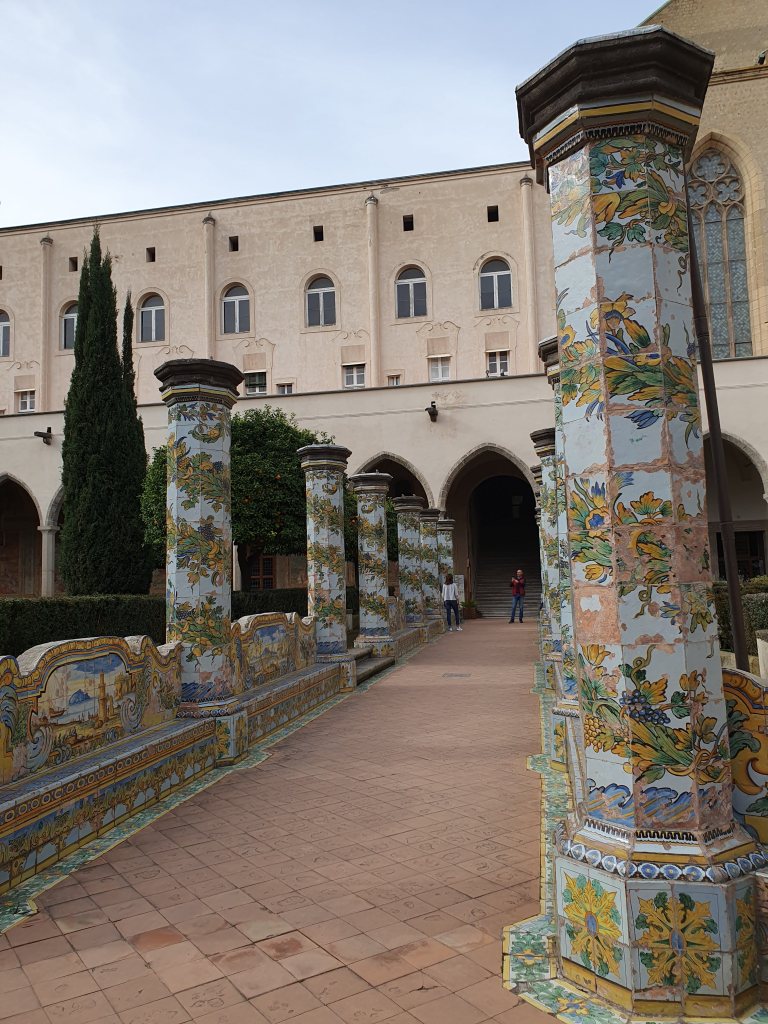
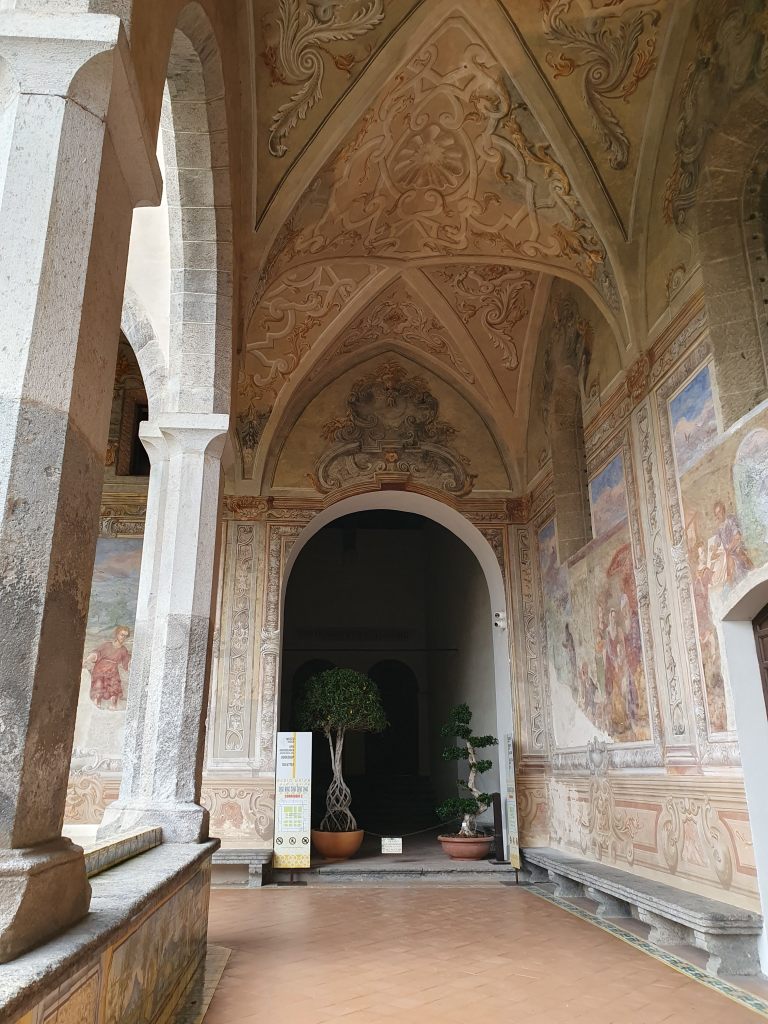
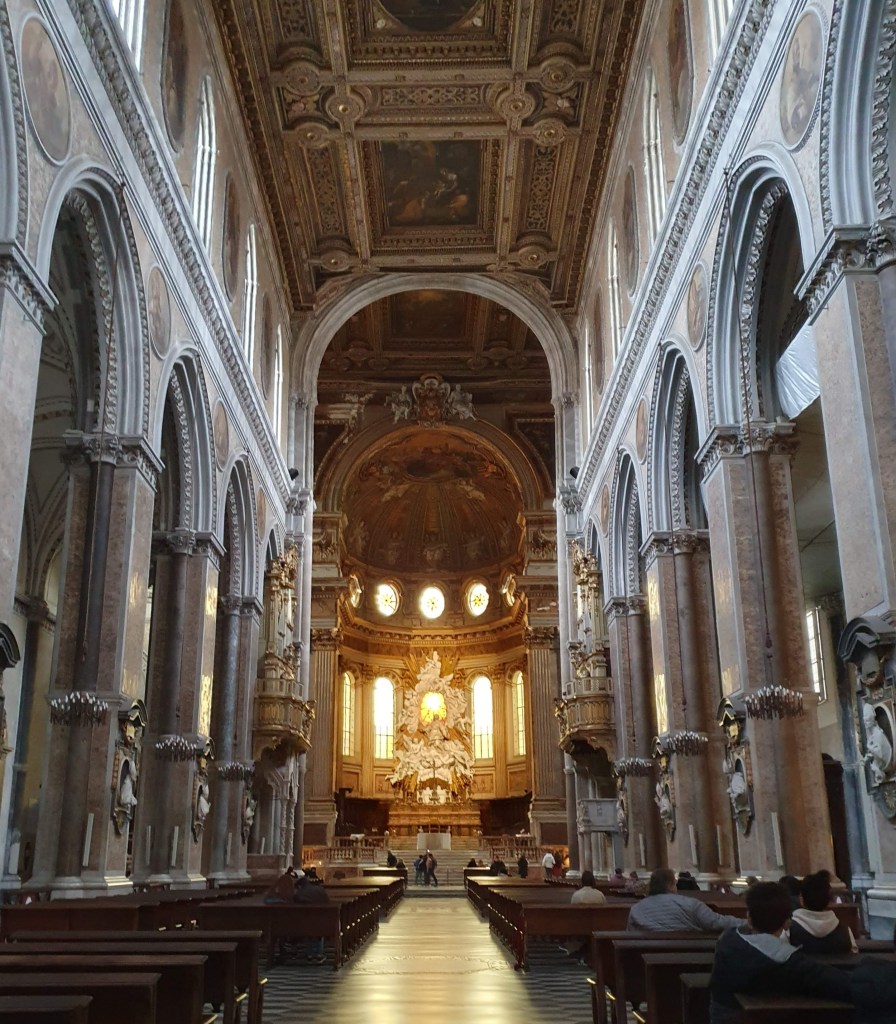
My final visit that afternoon was to Naples Cathedral (San Gennaro). The cathedral was completed in the 14th century. One of the side chapels contains a vial of San Gennaro’s blood, which is brought out for viewing three time a year and usually ‘miraculously’ liquefies.
When I went for dinner that evening, Napoli were playing away in the early evening televised fixture. Consequently, all the bars were packed with people watching the football, but the ‘proper’ restaurants (i.e. those without a TV in their dining room) were relatively empty. I found a suitable establishment where I dined on Pasta Genovese, followed by salsiccia with sprouting broccoli, and finally a lemony dessert.
Day 3 – Thursday 29th February 2024 – Naples to Taormina
After breakfast in my hotel, I caught the Metro to Piazza Garibaldi and walked the short distance to Napoli Centrale station. I was in good time for my train, which was due to depart at 0950, but arrived from Rome some 20 minutes prior to that. As I would be spending most of the day on this train, I had treated myself to a first class ticket, which when booked in advance was a bargain at €24.90. The train was in two halves, which eventually would split and make their separate ways upon reaching Sicily. My half, with a final destination of Syracuse, had just one first class carriage, which was not very full.
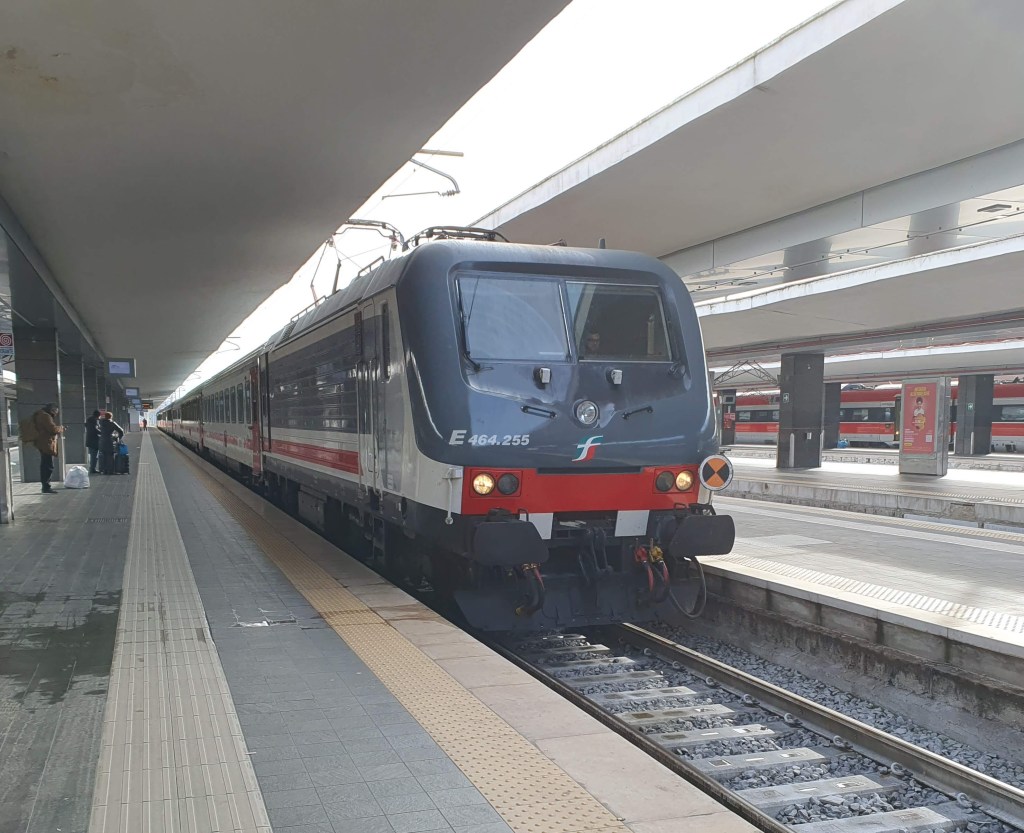
It would seem that the timetable for this train has a lot of slack built in, presumably to ensure that the connecting ferry is not delayed. At Salerno, the first scheduled stop after leaving Naples, we arrived 20 minutes ahead of schedule. The train kept to time throughout the rest of its route along the Italian coast, with views out to sea on one side and low cloud rolling down off the hills on the other.
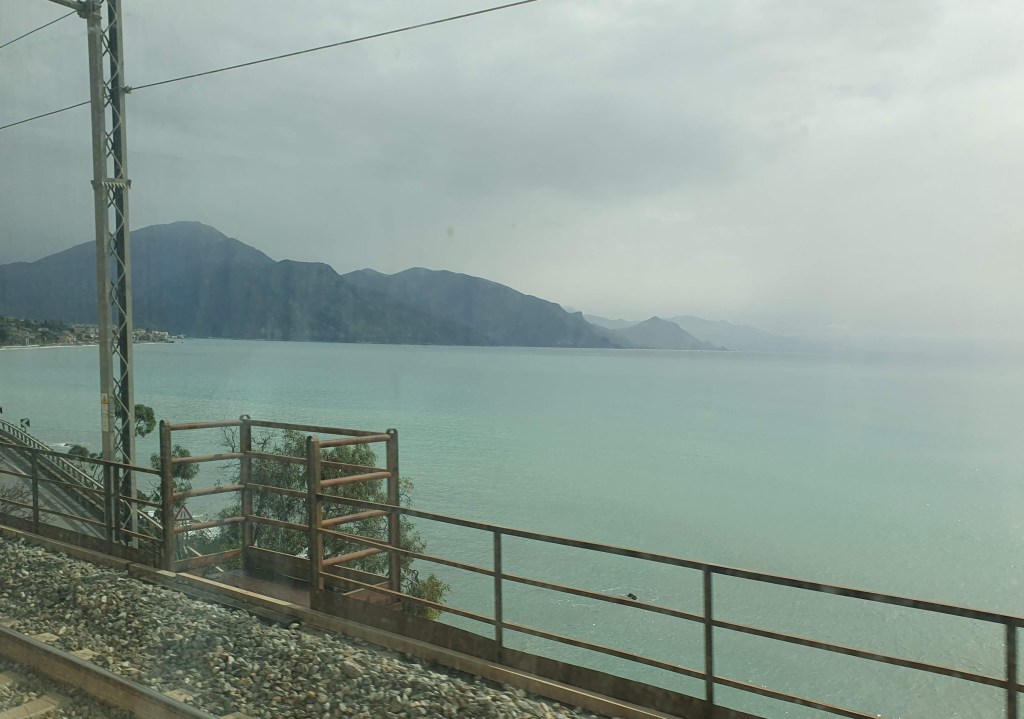
About four and a half hours after leaving Naples the train pulled into Villa San Giovanni station. As we came into the station, I could see the ferry from Sicily coming in to dock alongside. This ferry is the last one remaining in Europe where the train goes onto the boat. This is probably unnecessary for the daytime service I was travelling on, but a great convenience for those travelling overnight on the sleeper who don’t need to leave their beds.
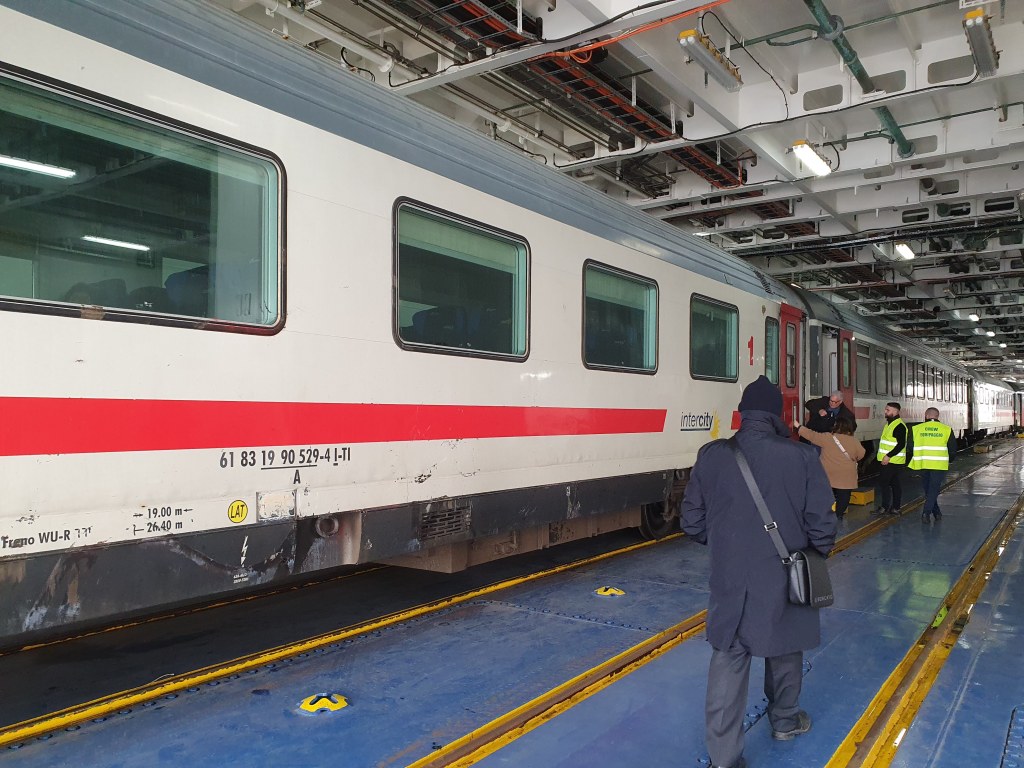
The train sat around at Villa San Giovanni for about 15 minutes, before being shunted into sidings. At the same time I could see the train travelling in the other direction being pulled off the the boat to be parked in the sidings alongside us. Our train was split and reversed direction as it was slowly shunted onto the waiting boat. My half of the train went on first and occupied the right hand set of rails. As soon as the train was on the ship the passengers, if they wished, were allowed to get off and go on deck, from where I observed the other portion of the train being placed on the left hand set of rails.
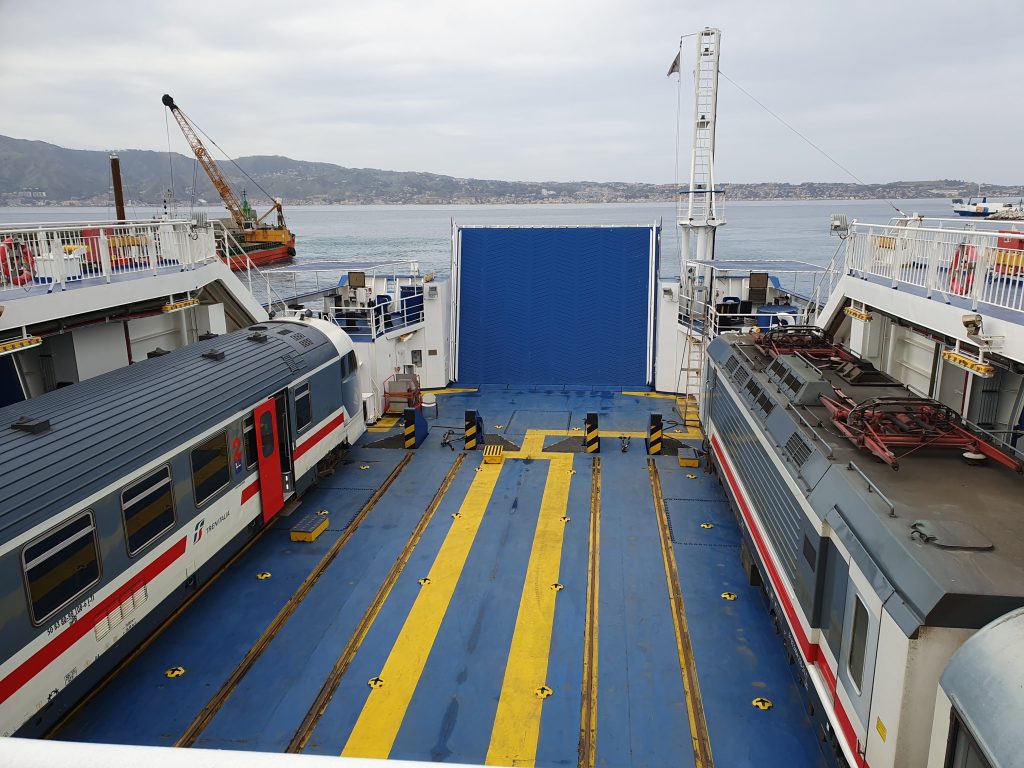
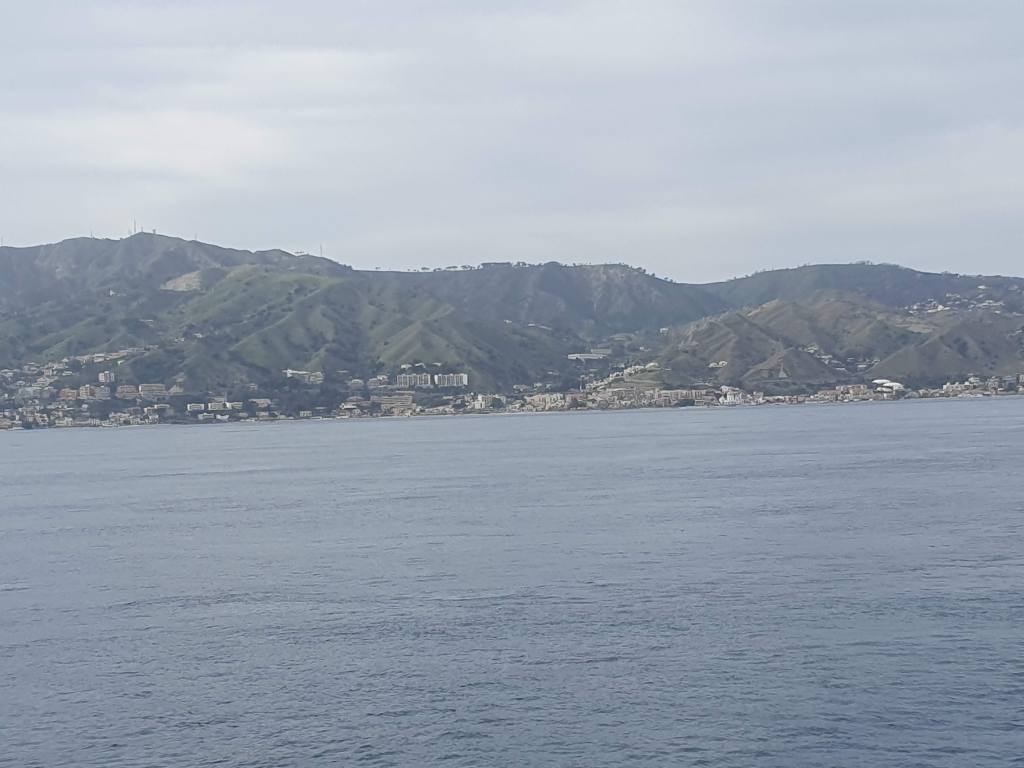
Once the the whole train was on board, the ship set sail across the Straits of Messina. The crossing only took about thirty minutes, and as we were to coming into Messina port there was an announcement requesting that all passengers retake their places back on the train. As soon as we had docked, the process of unloading the train from the ship began. The other portion, which was heading to Palermo was taken off first. At Messina, unlike Villa San Giovanni, no change of direction was required. To my uninformed mind, it was not clear why the Palermo section of the train came off first, as it was due to depart from Messina Centrale 10 minutes after our Syracuse-bound portion, and initially both sets ended up on the same platform. Further shunting was required to bring the other half of the train on to an adjacent platform before we could depart.
We eventually left Messina Centrale about 10 minutes late. However, these 10 minutes were crucial, as most of the line ahead is single track. Having lost our path we had to wait on a couple of occasions for a train coming in the other direction to clear its section of line. This meant that I eventually arrived at Taormina-Giardini station just before 5pm, about 25 minutes late. When booking my train ticket, for a small supplement, I could have obtained a through ticket to the centre of Taormina on a connecting bus. I decided not to, as after a day of sitting on a train, I thought a walk would do me good. As it turned out the connecting bus had not waited for our late train and there was a phalanx of taxi drivers waiting outside the station touting for business.
I knew that Taormina was located high above the coast where the railway line ran, but I hadn’t appreciated quite how steep the unsurfaced track would be which zig-zagged up the cliff. An added challenge was that to reach the cliff path, I had to walk for a short distance along the busy coastal road which had no pavement. I was just grateful that it was not yet dark and that the threatened rain had not yet arrived. After about half an hour of steady climbing I arrived at my hotel in Taormina, rather hot and sweaty, and needing a shower before I was fit to go out again.
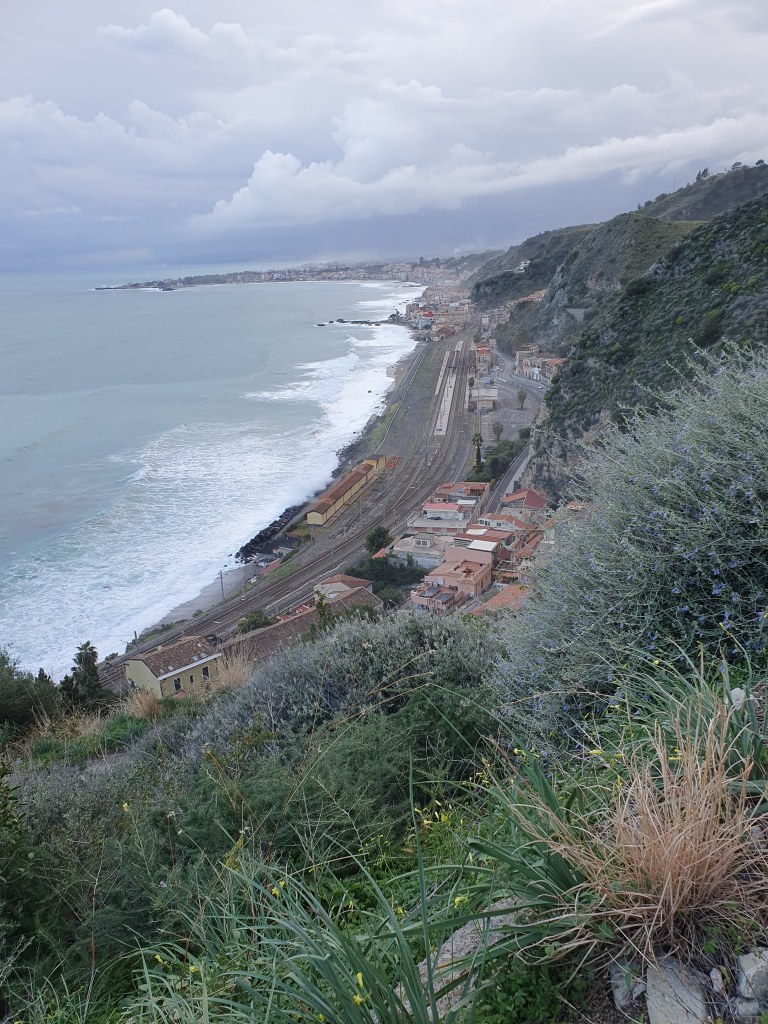
In the evening I found a very nice restaurant where, in addition to bruschetta provided on the house, I dined on Caponata followed by grilled lamb with salad. When I left the restaurant, the rain which had been threatening all day had finally arrived and I had a wet walk back to my hotel.
Day 4 – Friday 1st March 2024 – Taormina to Syracuse
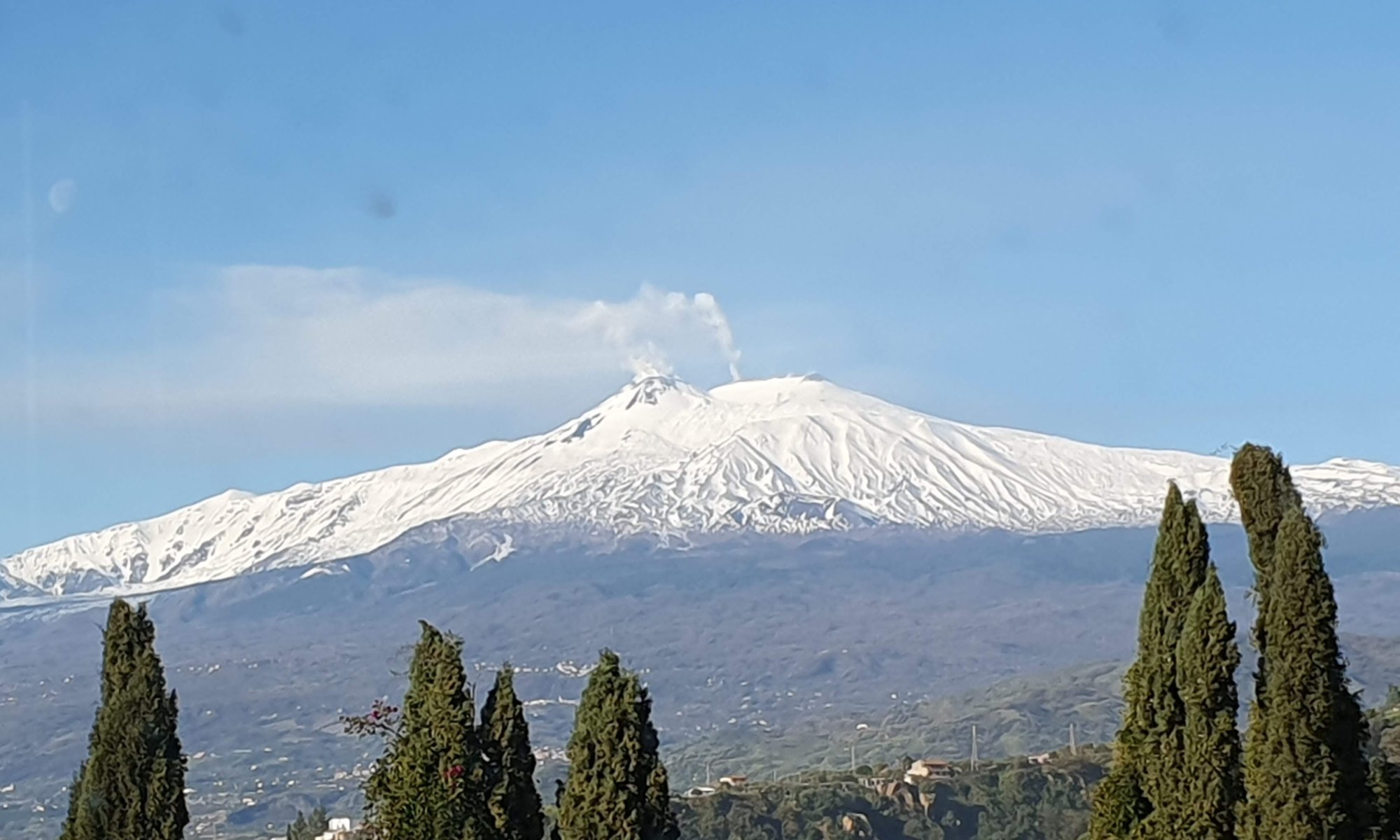
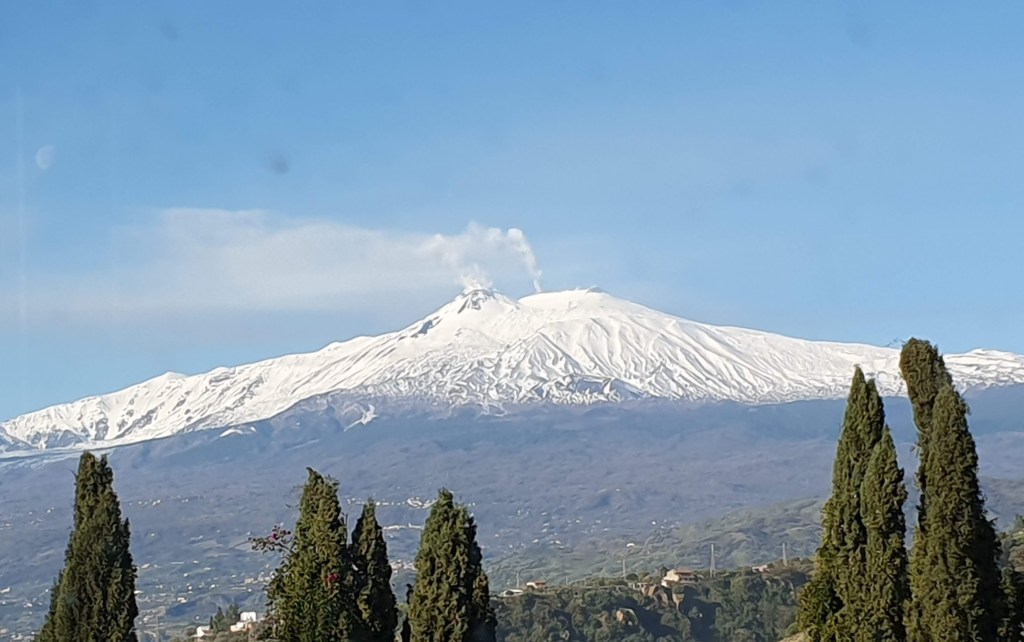
From the breakfast room of my hotel I was treated to a magnificent view of a snow-capped smoking Mount Etna, which had been obscured by clouds when I had arrived the previous evening.
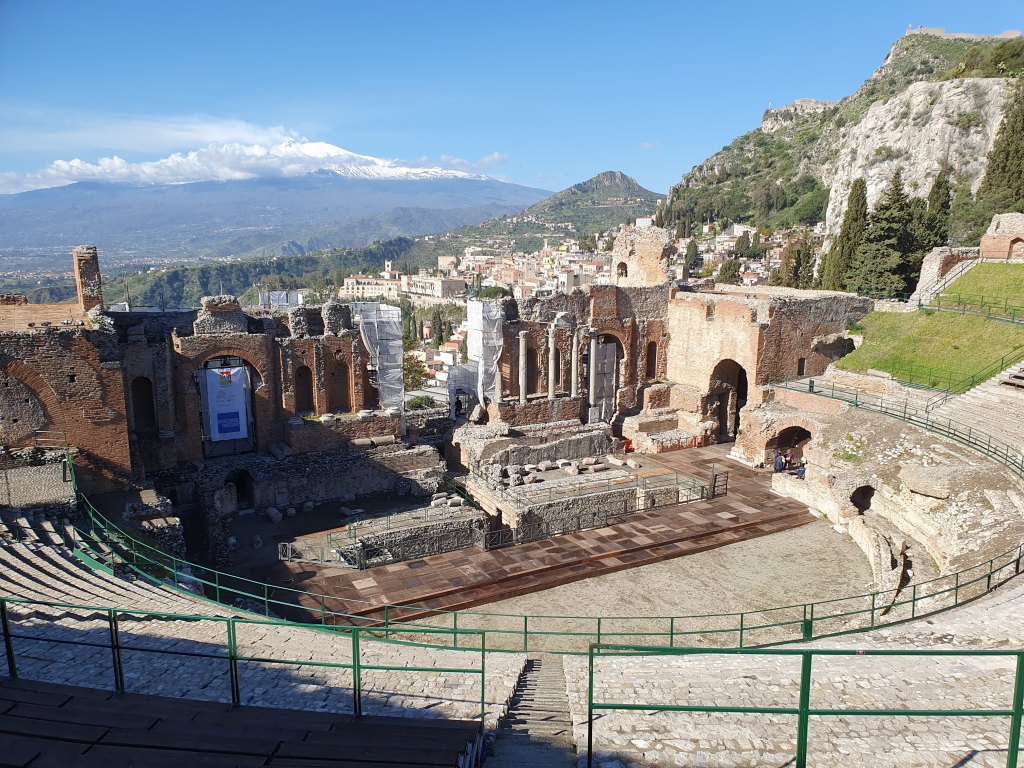
After breakfast I walked through the narrow streets of Taormina to the Graeco-Roman Theatre to arrive at its opening time of 9am. (There is an alternative entrance to the theatre right opposite the hotel I stayed in, but it was not open during the time of my visit.) I paid extra for an audio-guide to accompany my visit. The remains of the theatre are largely of Roman construction built on the site of the Greek original. The theatre in Taormina is unusual in that the audience faces south (towards the sun) – in part this is due to the geography of the hillside where the theatre is built, but also ensures great views of both Mount Etna and the Ionian Sea.

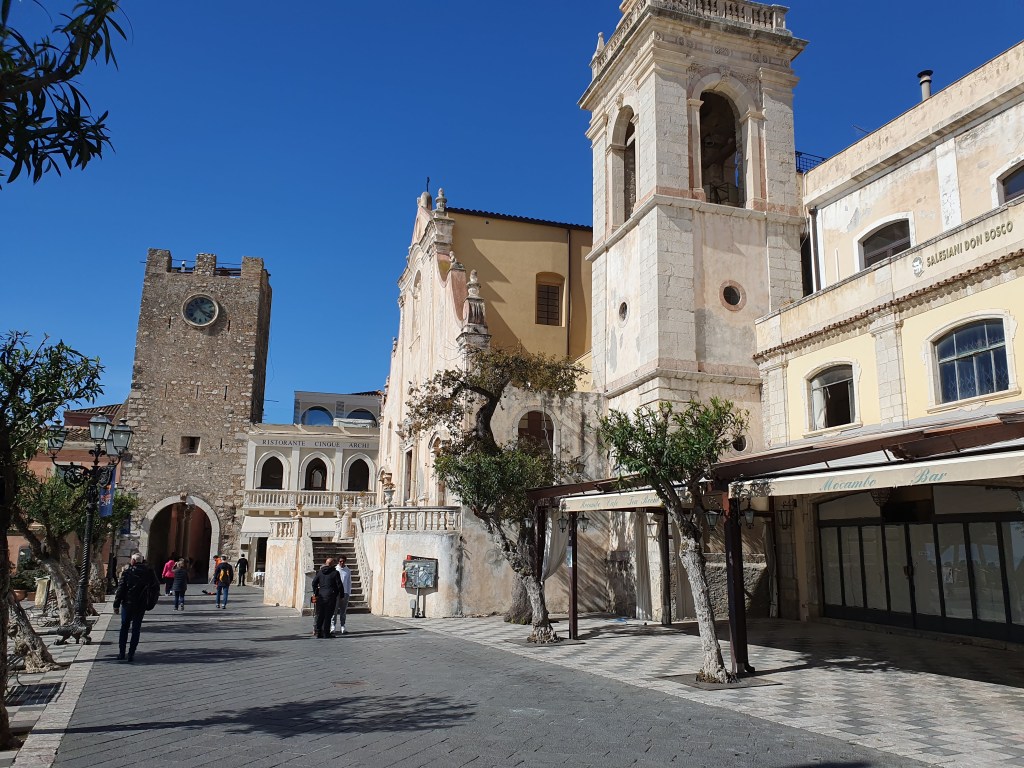
When I had finished in the theatre, I set off to explore the rest the town, walking down the length of the main street (Corso Umberto) to the cathedral, calling in at a couple of churches on the way. Halfway down Corso Umberto is the Palazzo Ciampoli, which acts as a museum and exhibition space. It had a banner outside proclaiming that it should have been open at the time I tried to visit, but it was firmly shut. Taormina had hosted the G7 Summit in 2017, attended by Donald Trump and Theresa May. After wandering its narrow streets I could could understand the logistical challenges of the location – the streets are too narrow and winding to accommodate a presidential motorcade.
Before leaving my hotel that morning, I had booked a ticket on the Trenitalia app for the 2pm train to Syracuse. However, by late morning I discovered that I had visited most of what could be seen in Taormina. Fortunately, it is possible to change, without charge, a ticket for a regional train to another on the same day. So I used the app to change my ticket to be valid for the train before the one I had originally booked. I then descended the path that I had climbed up the previous evening – going down was a lot easier (and quicker).
I got to Taormina-Giardini station in good time for the 1156 train, which was running a couple of minutes late. The journey to Syracuse (Siracusa in Italian) at the end of the line takes a couple of hours and the train arrived early, just before 2pm.
The hotel I had booked in Syracuse was not far from the station, so I took the opportunity to drop off my bag before going on to explore further. The hotel was rather grand, but it offered single rooms, making it cheaper than some of the more modern hotels, which only have standard size double rooms. In the event, I was upgraded to a double room which was by far the most spacious of the rooms I had on this trip – there was even a jacuzzi in the bathroom. In addition, I had booked at the room-only rate not including breakfast, but the receptionist was most insistent that breakfast was included in the price – so my stay was a bargain.
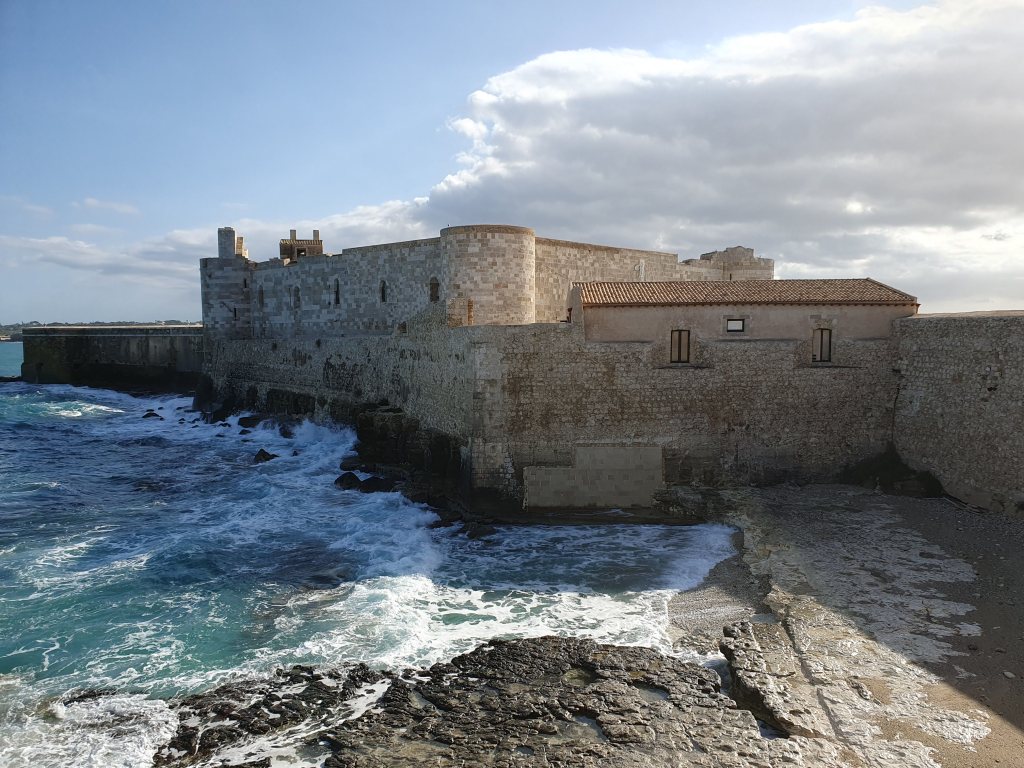
I spent the rest of the afternoon on Ortygia, the island at the southern end of Syracuse, which is the historical heart of the city. First stop was at the Castello Maniace, the fortress right at the tip of Ortygia. Built in the 11th century and originally used as a palace, it has been modified over the centuries to become primarily a defensive fortification to guard the approach to Syracuse from the sea.
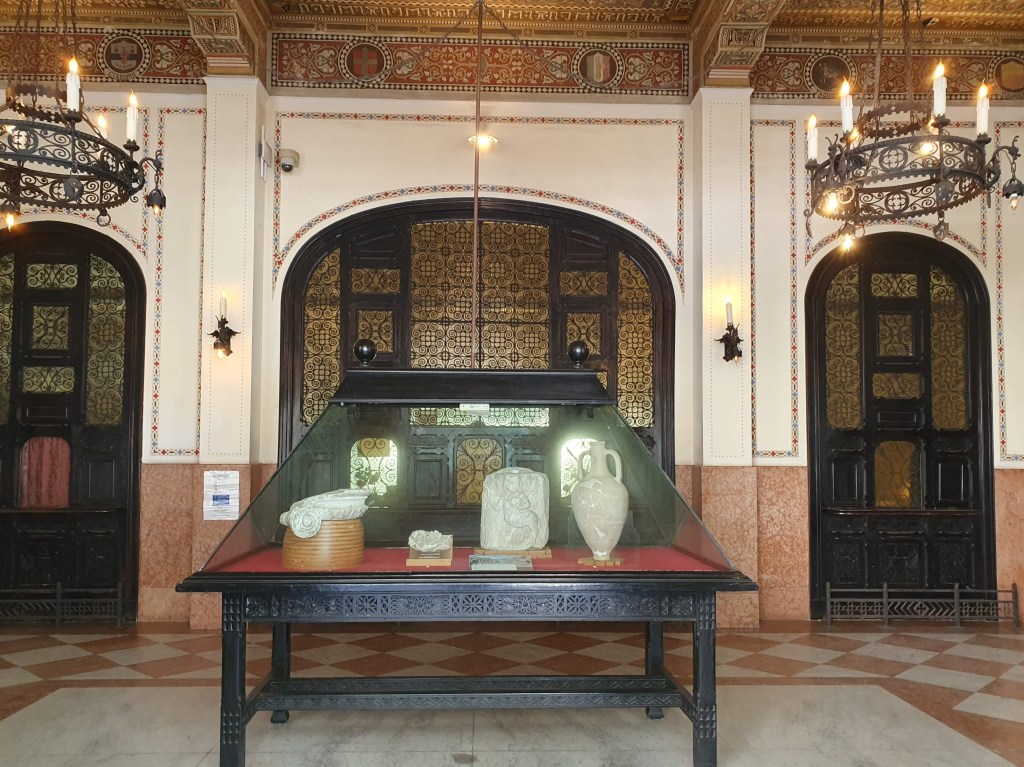
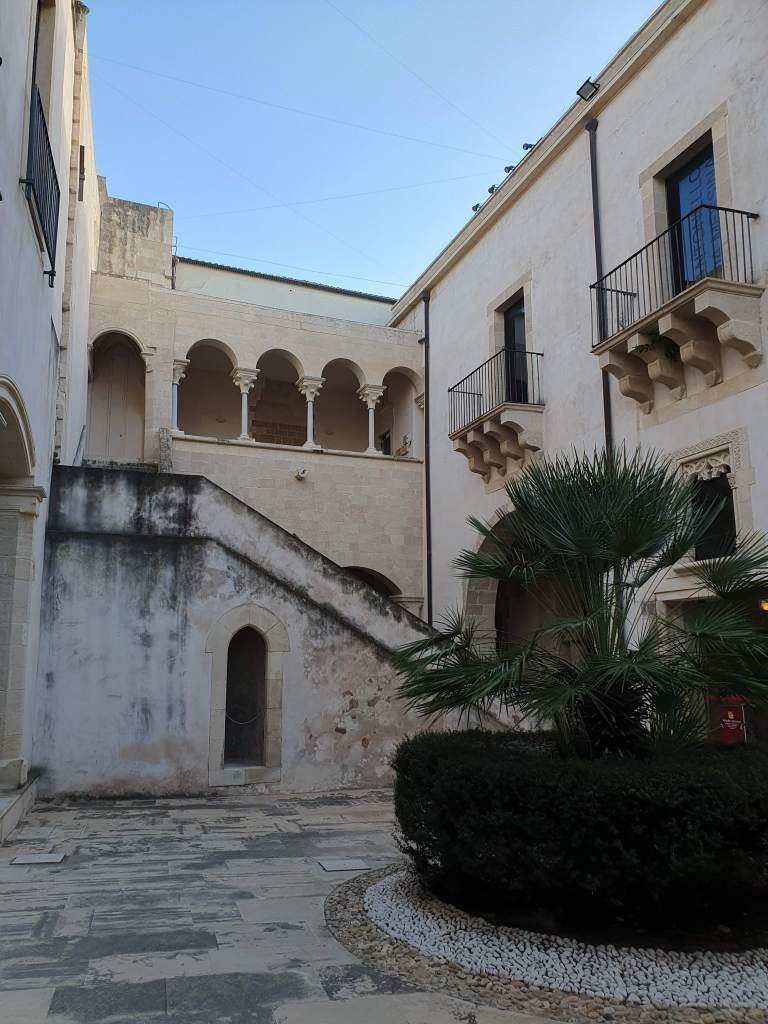
My next visit was to the Palazzo Bellomo, which now houses the regional art gallery. It contains an an interesting collection of Sicilian art, my understanding of which was enhanced by an audio-guide.
That evening I found an excellent pizzeria, where I had cheese balls as a starter, followed by a bresaola and burrata pizza. I was tempted by their desserts and chose a warm chocolate heart served with pistachio ice cream. The restaurant also had a good choice of draught German beers – I sampled the very tasty Oberdorfer weissbier.

Day 5 – Saturday 2nd March 2024 – Syracuse
I got up early so that I could partake of the unexpected breakfast and left my hotel at 8am to walk to Syracuse Archaeological Park, arriving at its opening time of 8:30am. The park contains a number of different sites and I obtained an audio-guide to help me understand them. When I bought my ticket at the entrance I was told that the area of the park containing the so-called Tomb of Archimedes was currently out of bounds.
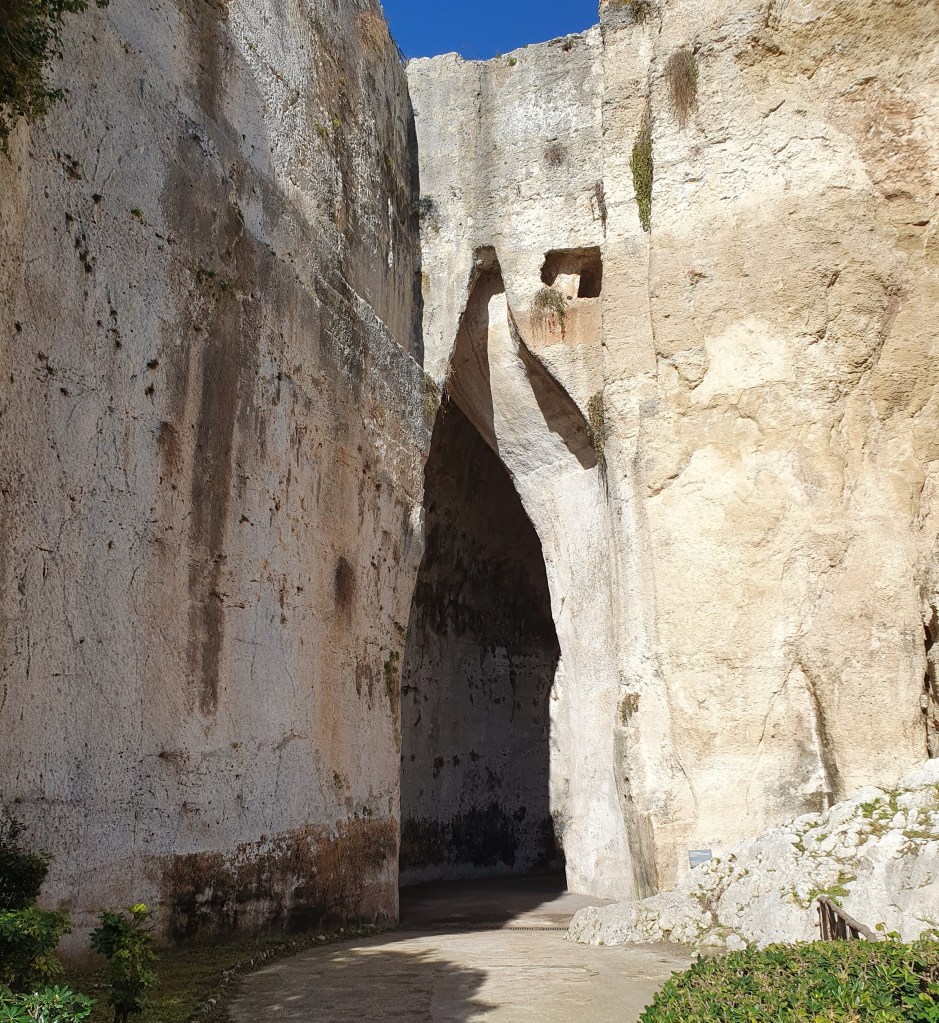
The first part of the park I visited was an area occupied by former limestone quarries. On the edge of these were a number of caves, some of which you could enter. The most spectacular cave was called the Ear of Dionysius, so named by the artist Caravaggio following a visit in 1608. There is a bend in the cave shortly after its entrance making the interior quite dark. It has interesting acoustics, with small sounds being amplified. Even though I was the only visitor, there seemed to be some murmuring sound while I was in the cave.
From the area of the quarries I moved on to the Greek Theatre. This was similar in design to the one I had visited the previous day in Taormina, but none of the structure behind the stage was still standing. Like Taormina it offered a view of the sea, albeit a more distant one, from the upper reaches of the auditorium. It was only when I was leaving the Greek Theatre that I first saw any other visitors to the park.
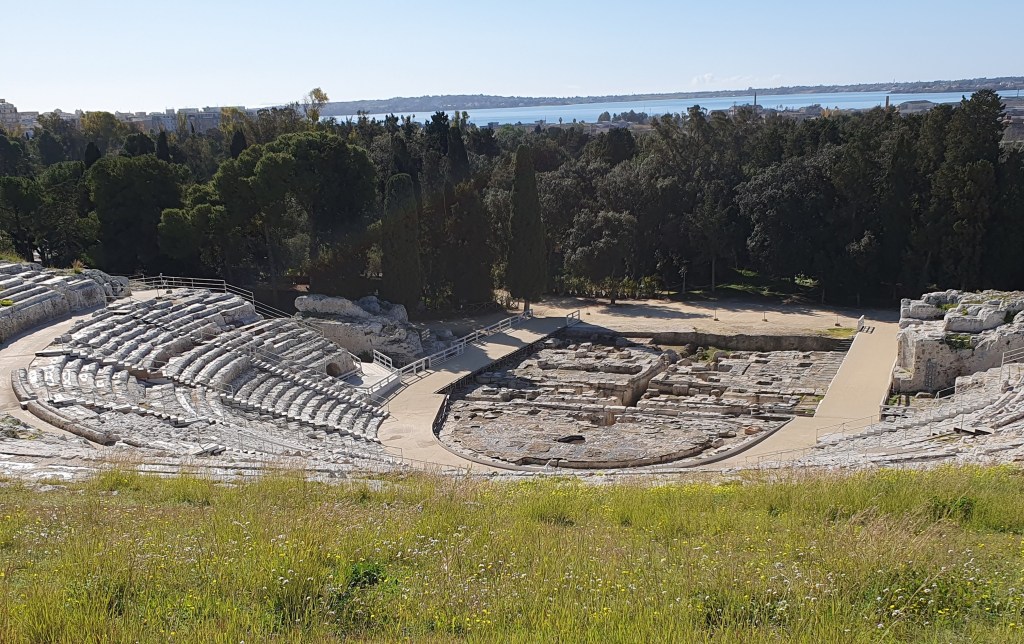
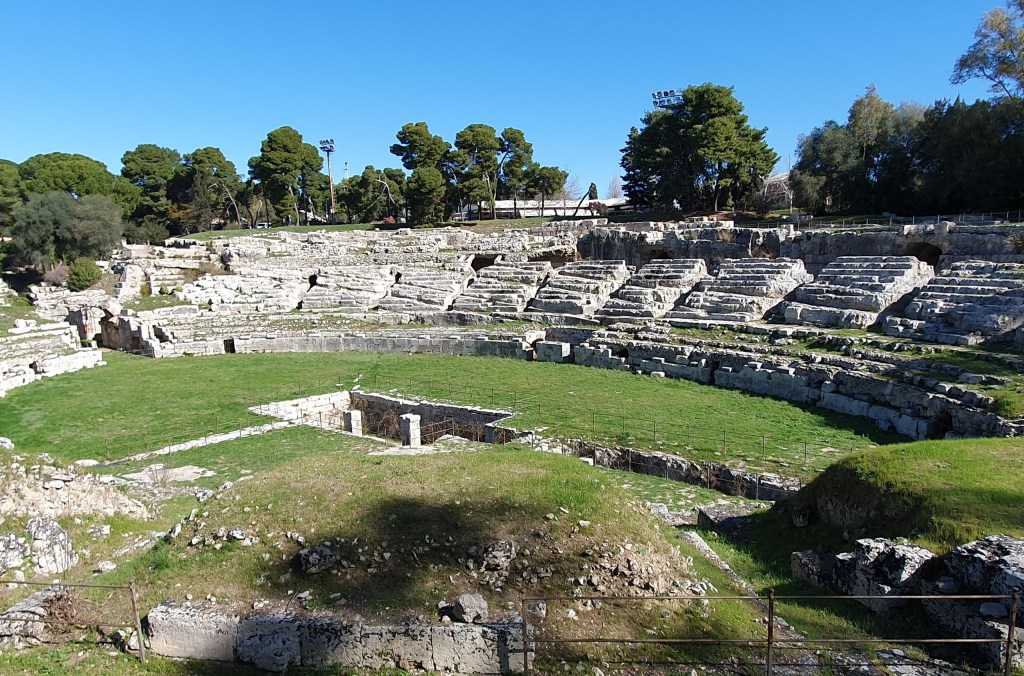
A short walk from the Greek Theatre back towards the entrance to the park are the remains of the Roman Amphitheatre. Of a much later construction than the Greek Theatre, the Roman Amphitheatre was used for gladiatorial contests and other entertainments.
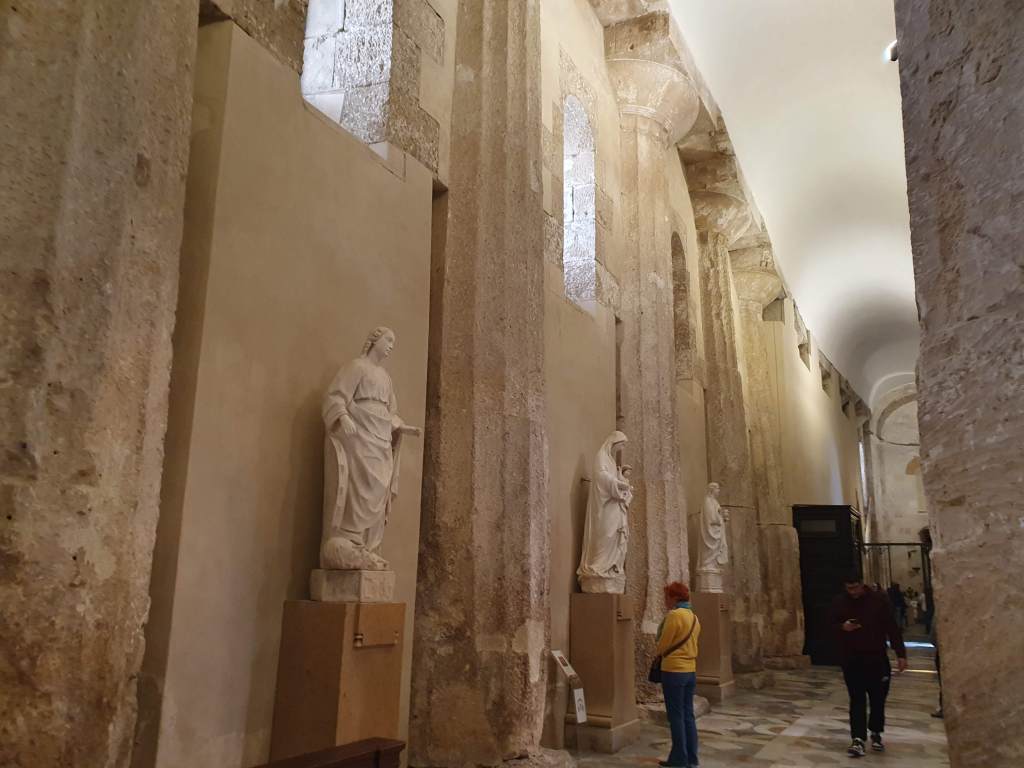
When I had finished in the Archaeological Park, I walked back into the centre of Syracuse and again onto Ortygia island. I called in at the cathedral, which is unusual in that it was built on the site of a former Greek Temple of Athena, some of whose original columns are built into the side wall of the cathedral.
Strolling through Ortygia on a sunny Saturday afternoon, I called in at two further museums. The first was a museum of Papyrus, describing how it is cultivated and processed. Although small, I found it interesting.
The second was devoted to the discoveries of Archimedes and Leonardo da Vinci, containing working models of their various inventions, ranging from the Archimedes screw for raising water through to Leonardo’s parachute. Some models you could play with yourself, whereas others had notices strictly forbidding any touching. Although interesting, this museum was much smaller than I had been anticipating and I found slightly off-putting the notices everywhere telling you what it was forbidden to do in the museum.
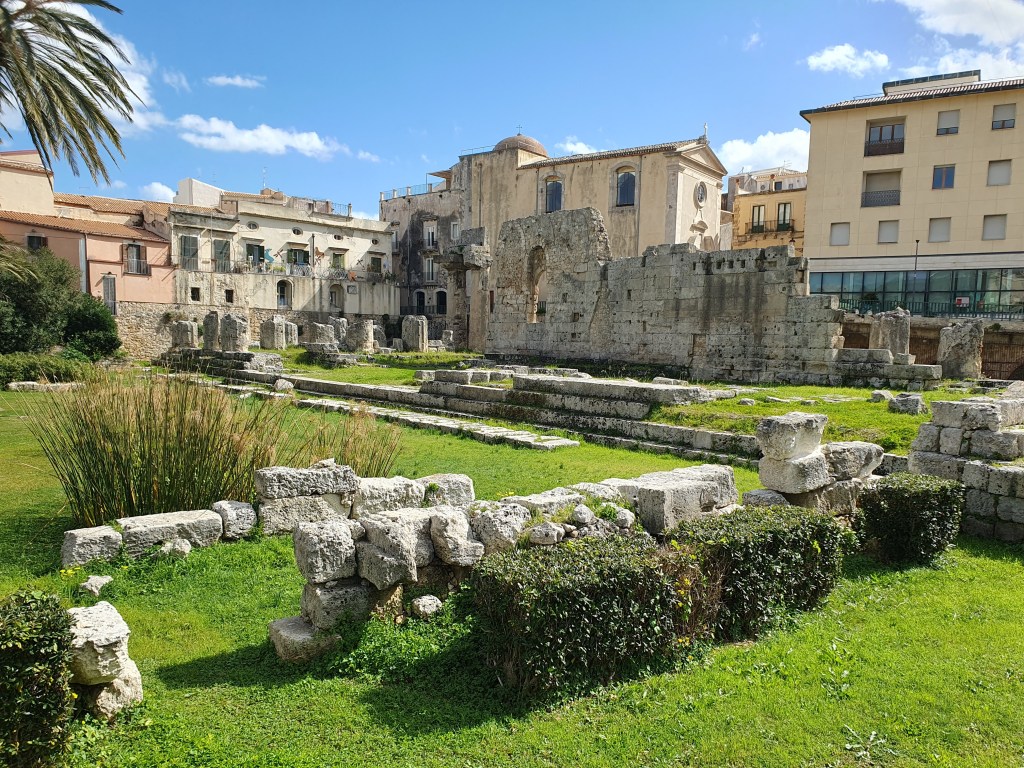
There were a number of other potential museums on Ortygia according to Google, but none of them seemed to be open that afternoon, so I contented myself with looking at the sights, including the Temple of Apollo, eating an ice cream and sitting for a while looking out over the harbour.
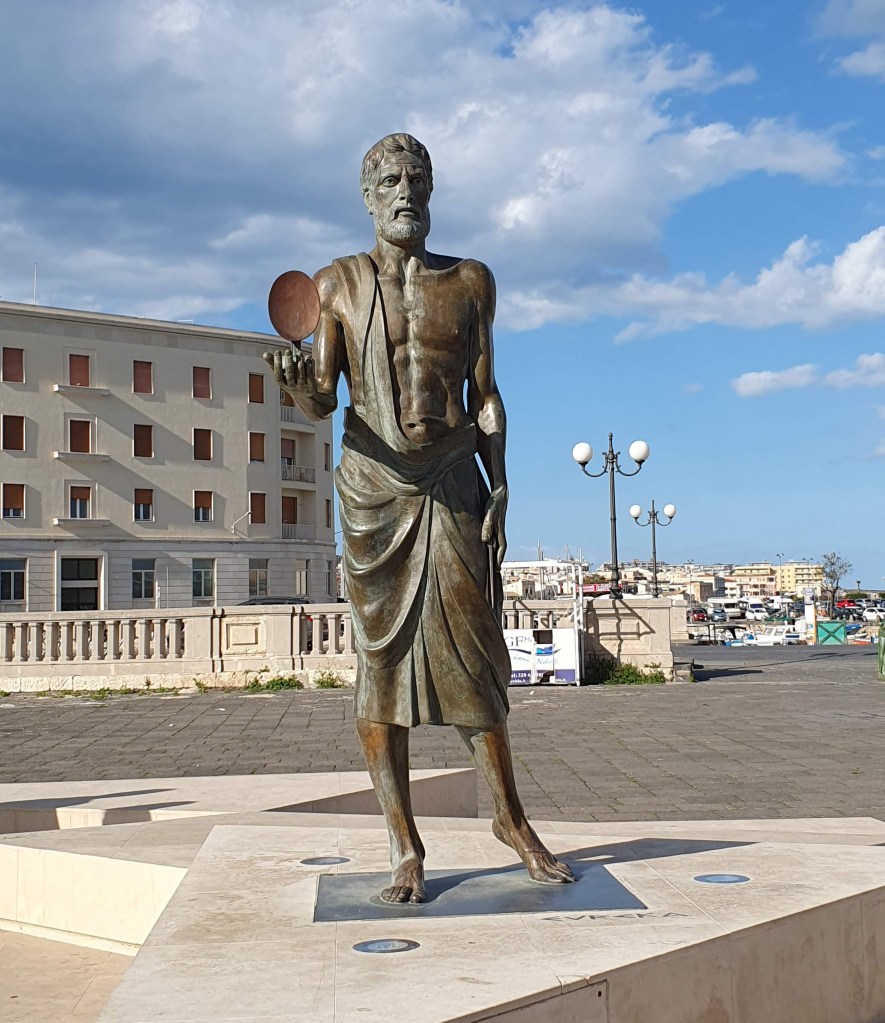
In the evening I went to a restaurant near my hotel, where again I had Caponata as a starter, followed by spaghetti with sardines.
Day 6 – Sunday 3rd March 2024 – Syracuse to Catania
I walked the short distance to Syracuse station to catch the 0850 train to Catania. It was already in the platform when I arrived at the station, but I had to wait a short while for the driver to come and open up the train before I could board. The train departed on time, but before it reached its first scheduled stop, it ground to a halt. The guard came through the train explaining to passengers that we were being delayed. My Italian was not good enough to establish the reason, but the on board information display confirmed shortly afterwards that it was due to a faulty level crossing. After about 30 minutes of being stationary we started moving very slowly and soon passed the offending level crossing, where uniformed officials were stopping the traffic.
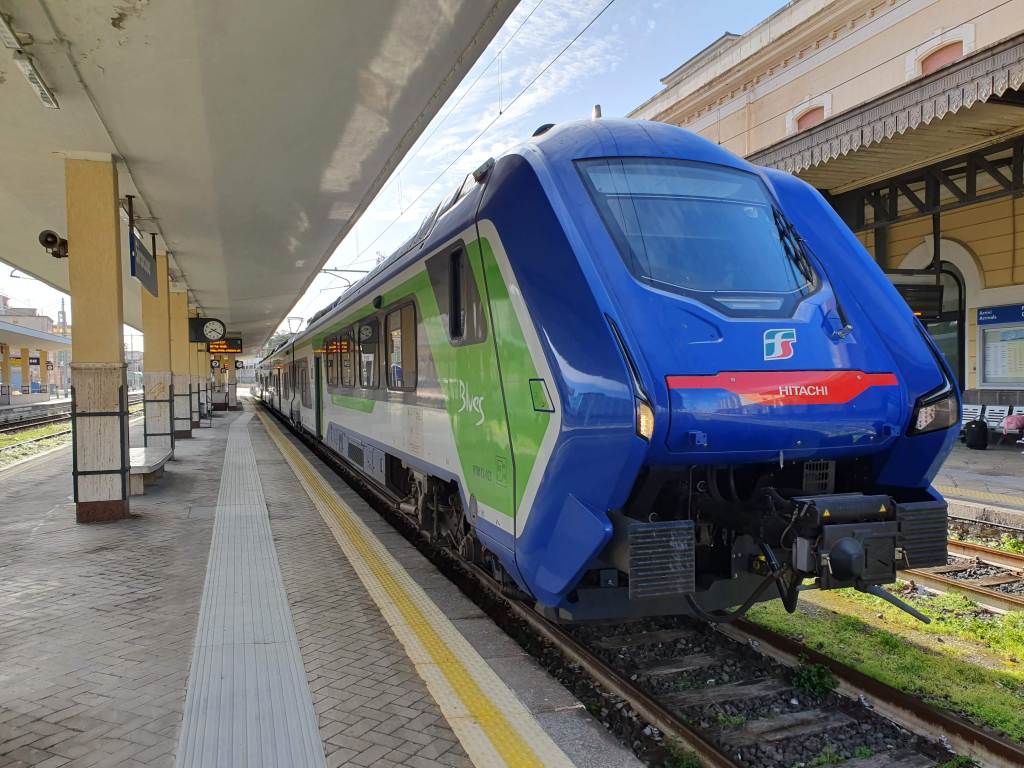
Given my experience on the way from Messina of delays being compounded due to having to wait to enter single track sections of the line, I feared that the 30 minutes delay might grow. Fortunately, the train managed to claw back a lot of the delay and passed the later of the two southbound sleeper trains from Rome on a rare double-tracked section of the line near Catania airport. I arrived in Catania at about 1020, just 12 minutes late.
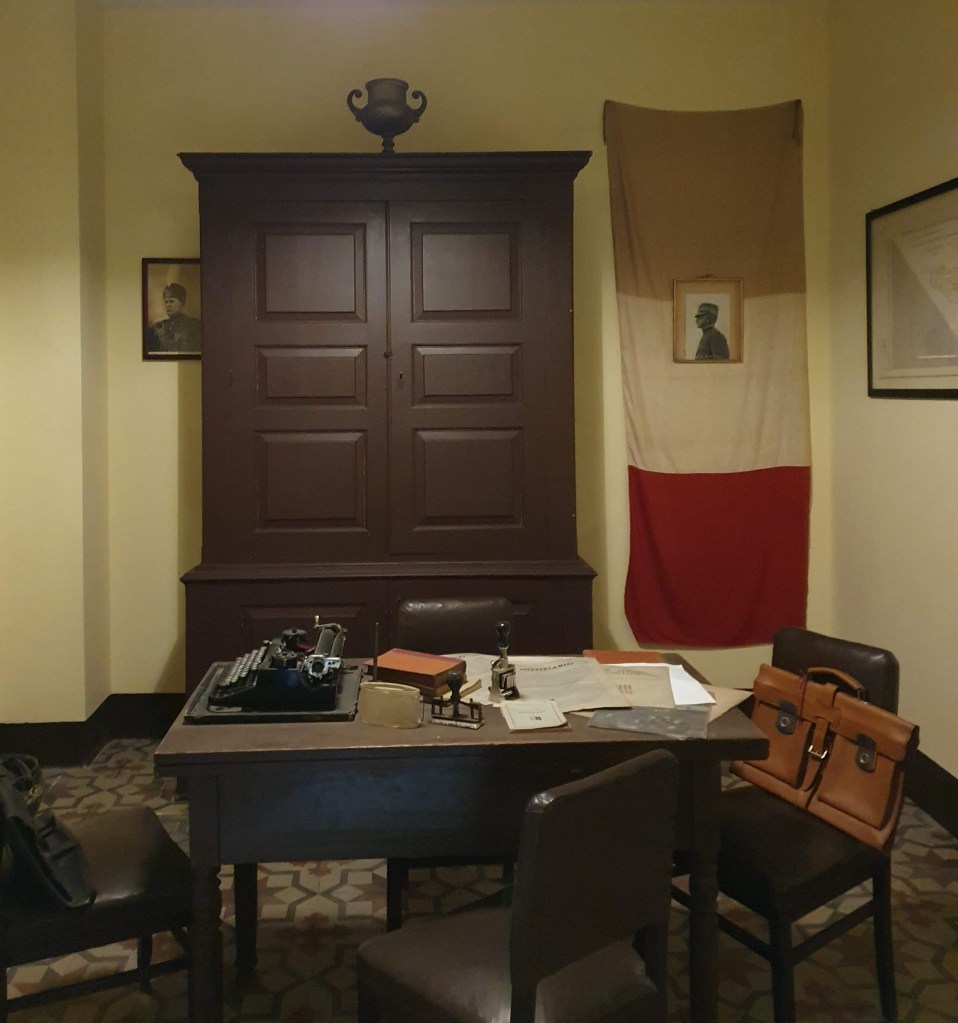
The station in Catania is a little way from the historic city centre, but not far from the station is a cultural area in a former factory site containing a number of museums and other buildings hosting cultural events. I went first to the Museo Storico dello Sbarco in Sicilia 1943 (Museum of the Sicily Landings of 1943). Entry to the museum is in half hour time slots, as the first part of the museum involves a guided tour (in Italian). Arriving a little after 10:30am I was allowed to catch up with a tour that had just started. After we had experienced sitting in a mock-up bomb shelter, which shook as the bombs rained down overhead, our guide left us and I was free to explore the rest of the museum at my own pace. The museum was much more extensive than it appeared to be from the outside and it took me a couple of hours to see everything. It tells the story of the allied invasion of Italy in 1943 and its aftermath. The British had landed on the east coast around Syracuse and Catania, with the Americans landing on the south coast. Their joint objective was to push northwards to capture Messina and from there to cross to mainland Italy. Sicily was conquered just over a month after the first landings, and its capitulation was one of the factors that led to the downfall of Mussolini. It is alleged that in the American areas the new (non-fascist) mayors that were installed were largely from the Mafia with help from American Mafia contacts. This may explain why the west and south of Sicily was such a Mafia stronghold in the immediate post-war years.
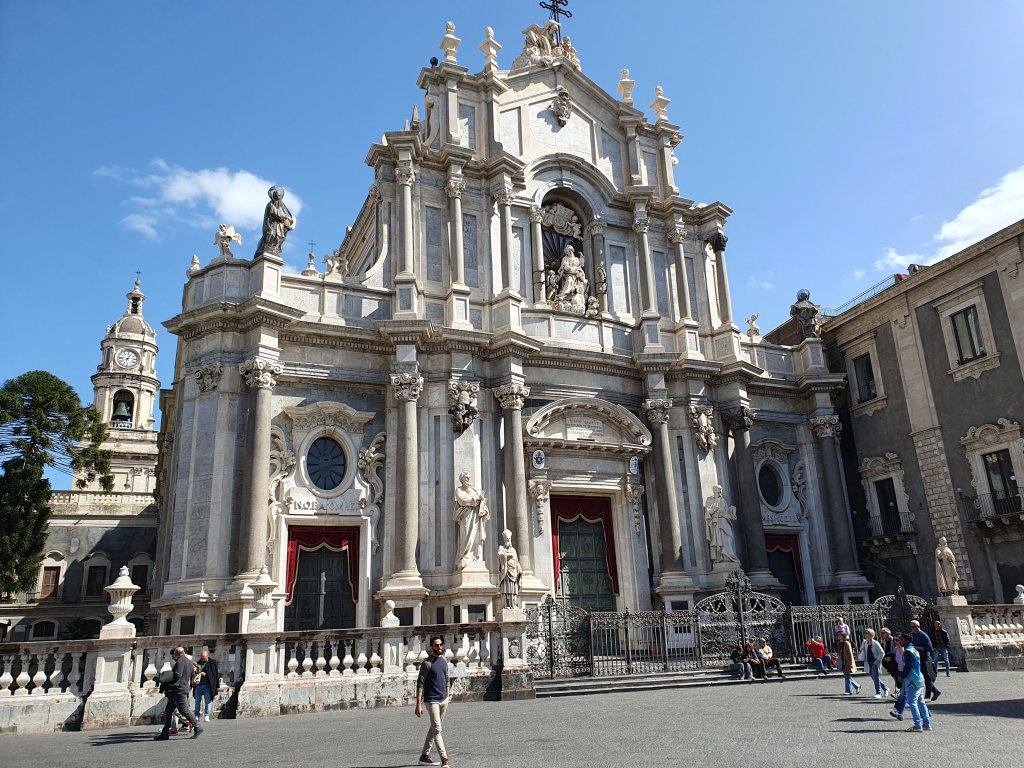
I walked to the historic centre of Catania, which was busy with people. Some were just leaving church and the many restaurants and bars were doing a thriving business. On the first Sunday of the month (which it was), the museums in Catania run by the city authorities are half price, although most of them are only open in the morning. I decided next to visit the Castello Ursino, which houses Catania’s main civic museum and is open all day on Sundays. While the Sicily Landings museum had been more comprehensive than I was expecting, Castello Ursino was the opposite. Not all of the castle’s areas were accessible and the collections, which included a small art gallery, were not very large.
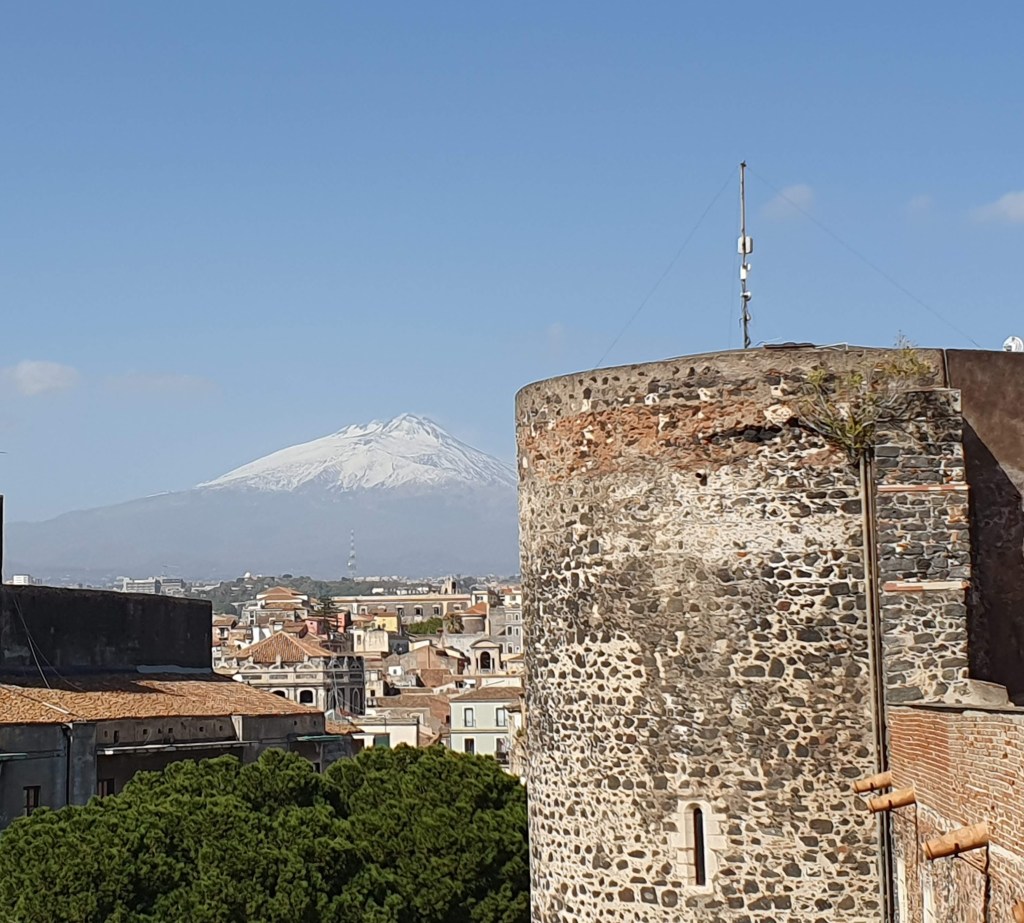
Having expected to spend most of the afternoon in the Castello Ursino, I was in fact done by early afternoon, by when most of the other museums in Catania had closed, so I went to the nearby Museum of Contemporary Art. It did not detain me long, and I remembered why I usually give contemporary art galleries a miss.
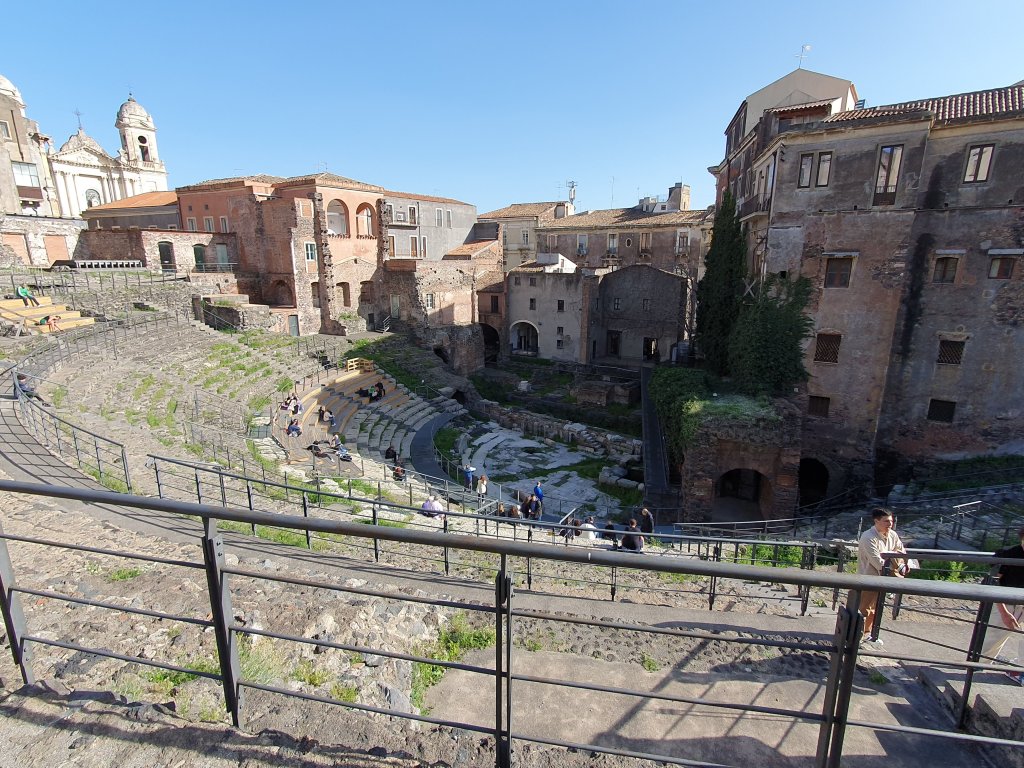
Catania also has a Roman Theatre, and an adjacent Odeon, which had free entry on the day I was there. Unlike those in Taormina and Syracuse, Catania’s Roman Theatre is more enclosed by present day buildings, being situated right in the heart of the city – but at least it has survived in an easily recognisable form, unlike the one in Naples.
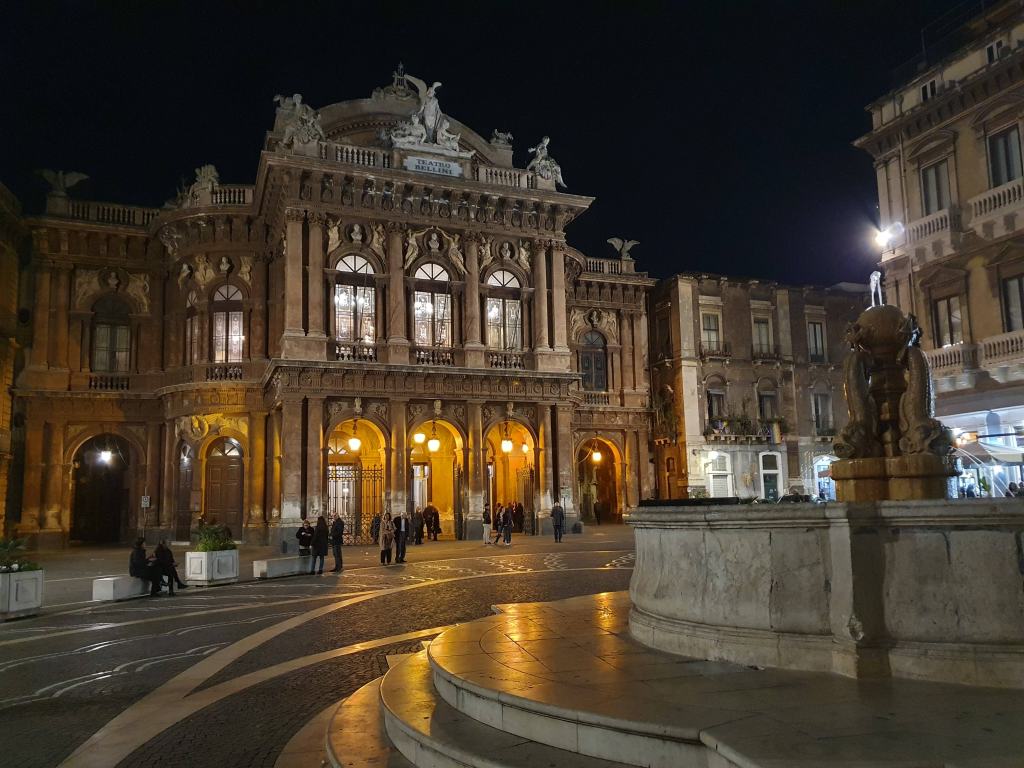
I then went to find the hotel I had booked for the night, near the Teatro Massimo Bellini, Catania’s Opera House. I knew that my hotel was located in a converted warehouse – what I had not realised was that to access it you had to press a buzzer on an almost anonymous door on the street. (When I returned from a subsequent walk, I had to help a very puzzled French couple get in.)
That evening, for my final night, I considered going to a slightly more upmarket restaurant, but most of the better restaurants in Catania specialise in fish and seafood, which is not my favourite. So in the end, I reverted to having a pizza again. The pizza I was served, was the least good of the three that I had on this trip – the base was rather hard and I suspect that the dough had not been freshly made.
Day 7 – Monday 4th March 2024 – Catania to London
All I had time do after leaving the hotel that morning was to make my way to the airport. While there is a railway station serving the airport, I decided to catch the bus as it is cheaper, runs more frequently, and stops closer to my hotel and to the terminal building. I had researched the previous evening where the bus stop was and was pleased to note it had an electronic display showing the time to arrival of the next buses. However, when I came to use it on this morning, the electronic display was not working. Also, I was slightly concerned that the centre of Catania seemed to be gridlocked with morning rush hour traffic and was beginning to wonder whether I should have caught the train after all. I shouldn’t have worried, as a bus arrived, albeit rather full, at the expected time and managed to bypass a lot of the traffic jams by going through barriers to enter the port area of the city.
I arrived at Catania’s small airport in plenty of time and made the mistake of going through the passport control too early to enter the small non-Schengen departure area, which had very limited facilities. (Most of the flights from Catania seemed to be internal to Italy.) The plane arrived on time, but unusually for a budget airline an air-bridge was connected. This meant that unloading and loading of passengers was only via the front door of the plane which slowed things down, so that we were slightly late departing.
The flight back had cloud cover for most of the way with limited views and it landed at Stansted approximately on time. I just managed to catch the Stansted Express departing 25 minutes after the plane landed, which meant I was home by 3pm.
I had enjoyed my short trip to Italy, enhanced by the weather being good and everything working more or less as expected.
 Europe Explored