
“La France est un livre dont chaque chapitre est une découverte.” (France is a book in which every chapter is a discovery.) – Gustave Flaubert
Having renewed my Carte Advantage Senior from the beginning of 2023, during one of SNCF’s periodic half-price sales, I realised that I had not yet used it this year. So for my final trip of 2023, I decided to go on a solo expedition to the south of France. Not everything on this trip went exactly according to plan, but overcoming these little problems is part of the adventure of travel.
Day 1 – Tuesday 21st November 2023 – London to Lyon (via Lille)
Setting off a month after I had returned from Poland on the Baltic coast holiday I took with my wife, this trip was to be by train with no flying to or from either end point. My initial route was to be similar to that I had taken a year earlier on my way to Greece. I was catching the 0901 Eurostar to Lille Europe. Since Eurostar charge the same price to go to Brussels as they do to go to Lille, I had bought a ticket to Brussels, as I had done in 2022. Should my plans change it is more useful to have a Brussels ticket than a Lille ticket, and there are no ticket checks on leaving Lille Europe station. The departure lounge at St Pancras seemed less crowded than on the previous two occasions that I had used it, probably helped by all the trains departing on time while I was there.
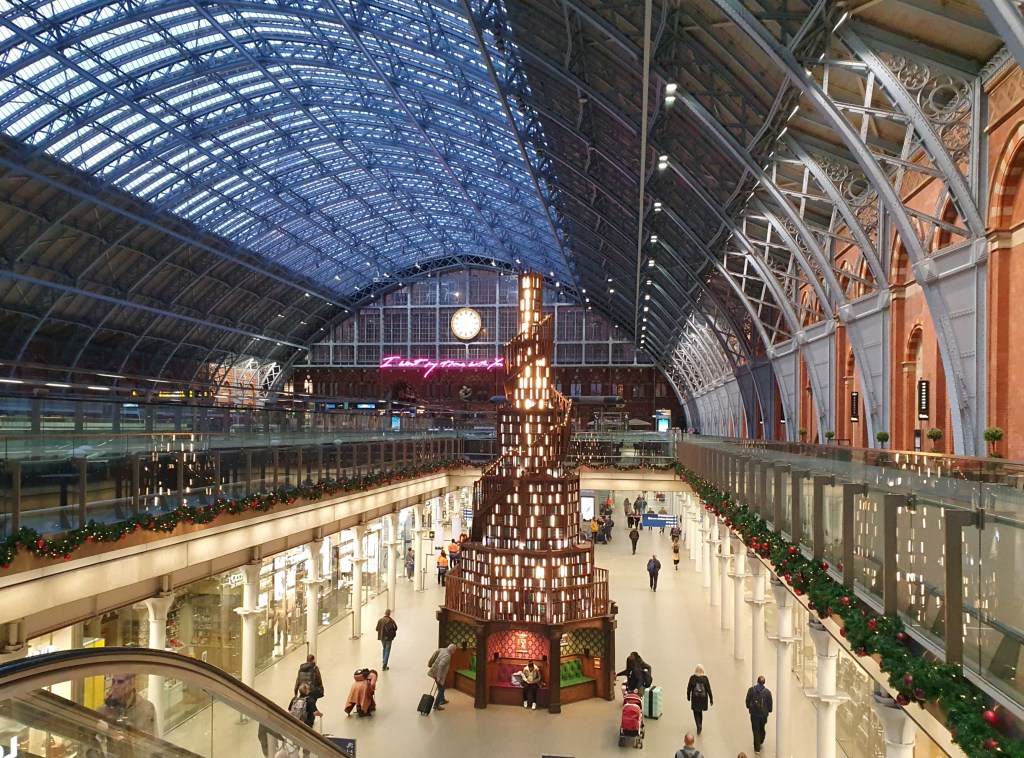
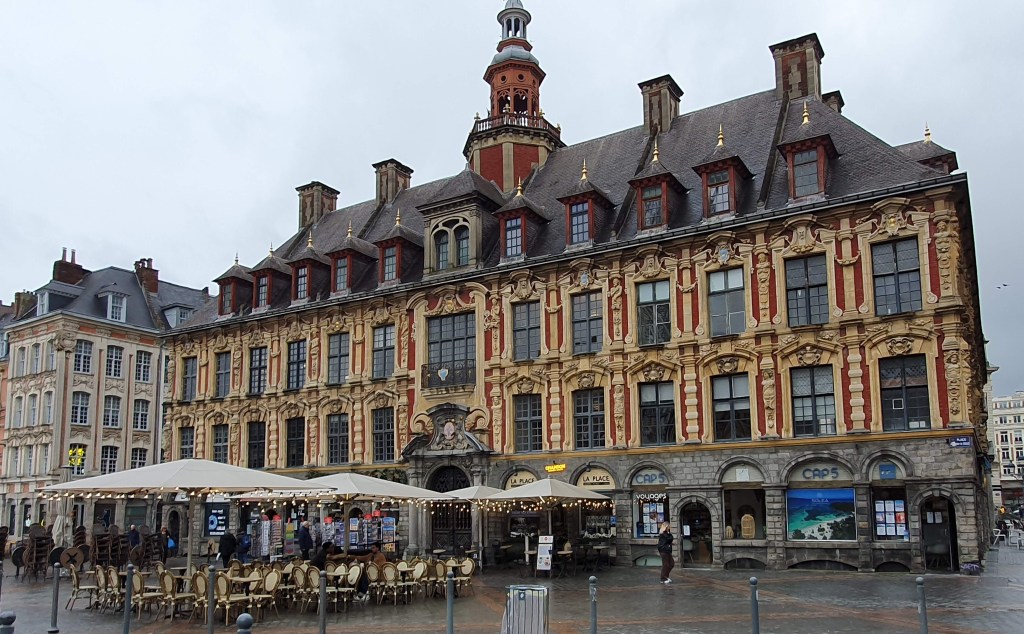
It was dark when I left home that morning, so my first glimpse of daylight was when my train left St Pancras, before it entered the tunnels to take it under east London. It arrived at Lille Europe at 1126 (French time), just 85 minutes after leaving London. It was raining as we sped across northern France but this had stopped by the time I got off. Unlike in 2022, when my train from London was 45 minutes late, I had some time for a brief explore of Lille. I had spent a couple of days in the city in 2018, so I went for a walk revisiting some of the sights I remembered from that earlier trip. About halfway through my planned walk, it started raining again quite hard, so rather than continue, I made my way directly to Lille Flandres station, getting there a little earlier than originally planned.
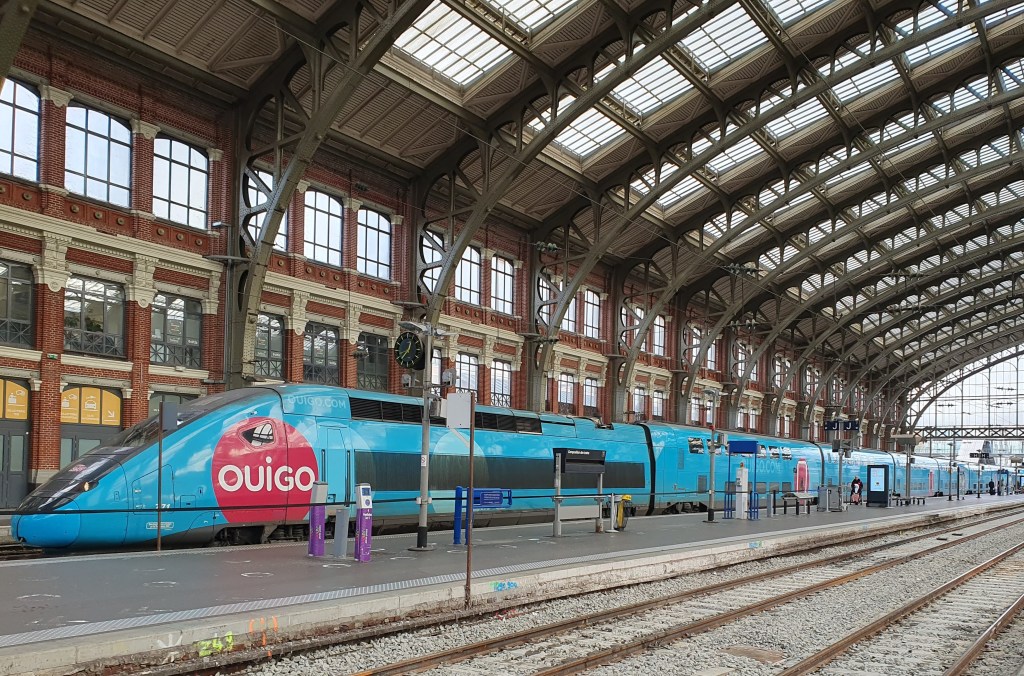
I was again catching the 1301 Ouigo departure to Marseilles, as I had done the previous year, but this time only going as far as Lyon, whereas in 2022 I went to Avignon. In 2022, boarding had been delayed by an unclaimed bag on the platform, but there were no such problems this year. Ouigo TGV trains are SNCFs answer to budget airlines – cheap tickets, but with an attempt not to divert regular fare paying TGV passengers by having many of the annoyances of budget airline travel. My ticket from Lille to Lyon was a bargain – costing just €16 (plus €3 for my choice of seat). The train was much busier than my previous journey on it, with all the seats in my compartment being full once we left Marne-la-Vallée–Chessy to the south of Paris. The train arrived at Lyon Part-Dieu on time at 1600.
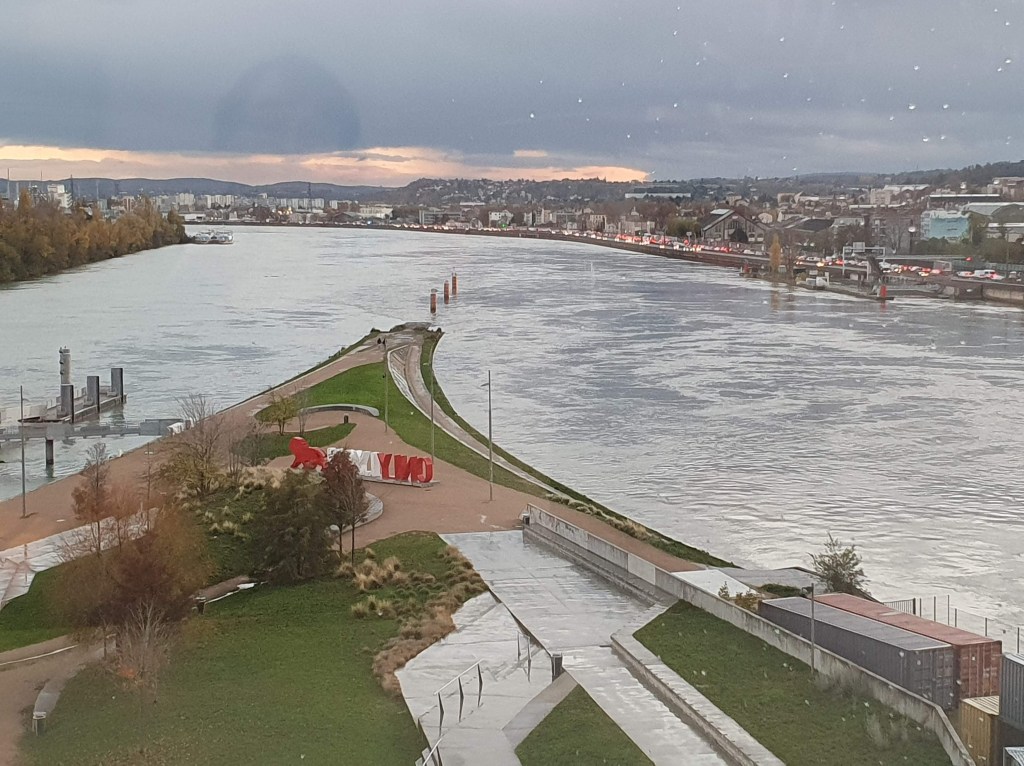
From Lyon Part-Dieu I caught a tram to the Musée des Confluences. The museum is named after where it is – at the confluence of the Rhône and Saône rivers to the south of the city centre. It is a museum of mankind – the permanent collection covers the creation of the earth, evolution, man’s early development and social customs in various societies. At the time of my visit there were also a number of temporary exhibitions on topics ranging from the meaning of love to Antarctica. The museum is housed in a large modern purpose-built building fitting into the peninsular formed by the confluence of the two rivers. I stayed in the museum until just before its closing time.
From the Musée des Confluences I caught another tram to the hotel that I had booked for the night. When planning my expeditions I normally book the critical transport stages first, before turning my attention to hotels. When trying to book a room in Lyon, I had a bit of a shock. The normally reliable chain hotels were either charging ridiculous prices or were fully booked. Some research showed that at the time of my visit there was a major packaging trade fair in Lyon, expected to attract 50,000 visitors, and while I was in the city I discovered that there was also a cosmetics trade fair taking place at the same time. Fortunately, I had managed to find an independent hotel which was not excessively exploiting this demand for rooms that night.
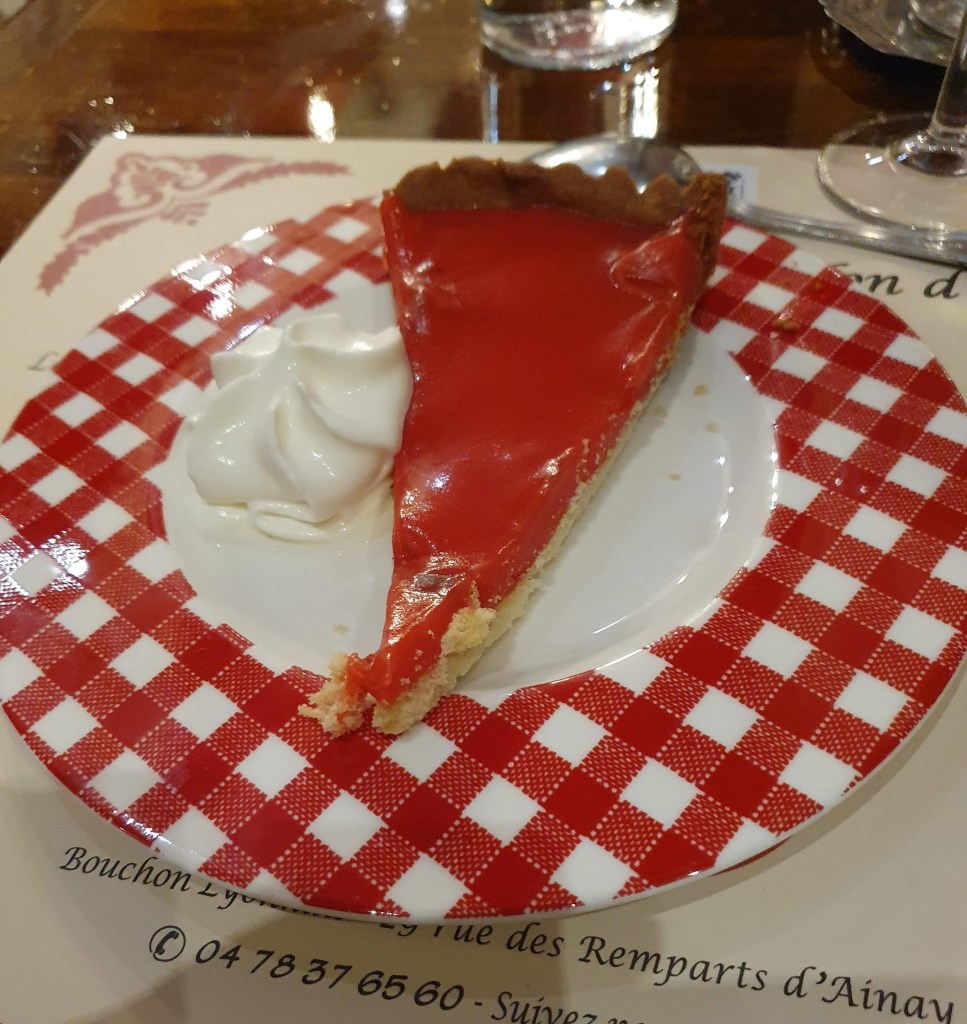
Given the demand for hotel rooms, I had thought it advisable to book a table for dinner that night, which I had done a couple of days before I departed. The restaurant I chose, which had good reviews, was about 20 minutes walk from my hotel. While the service was very attentive, I found the food a little disappointing for the price. The starter was best – warm local St Marcelin cheese on toast in a salad. For main course I chose poached sausage in red wine sauce – I found the sausage rather bland, the red wine sauce no more than a drizzle of gravy, and the accompanying potatoes slightly undercooked. For desert I had a piece of tart made from the local pink pralines, which was a bit too sickly sweet for my taste.
Day 2 – Wednesday 22nd November 2023 – Lyon to Valence
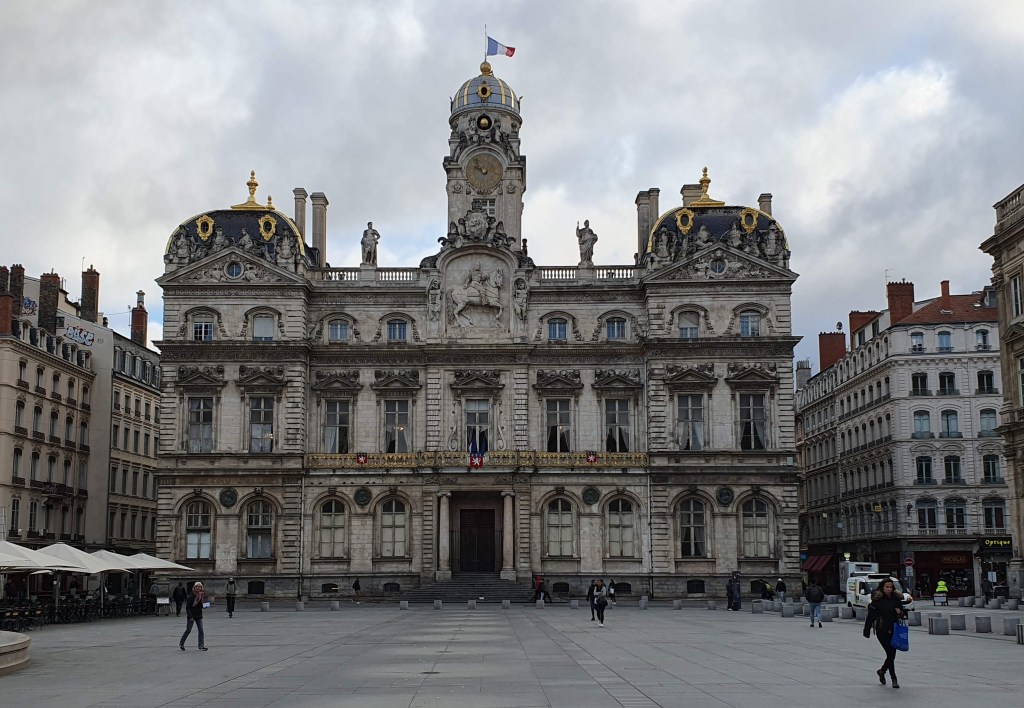
Before anything had opened I went for a walk through the centre of Lyon, observing the Basilica de Notre Dame perched high on a hill overlooking the city. As I was to find elsewhere on my journey through France, many of the public spaces were being got ready for Christmas markets. I timed my walk to arrive at the Musée des Beaux-Arts for when it opened at 10am. The museum occupies one side of a large square, the Place des Terreaux. Lyon Town Hall is on one of the other sides of the square.
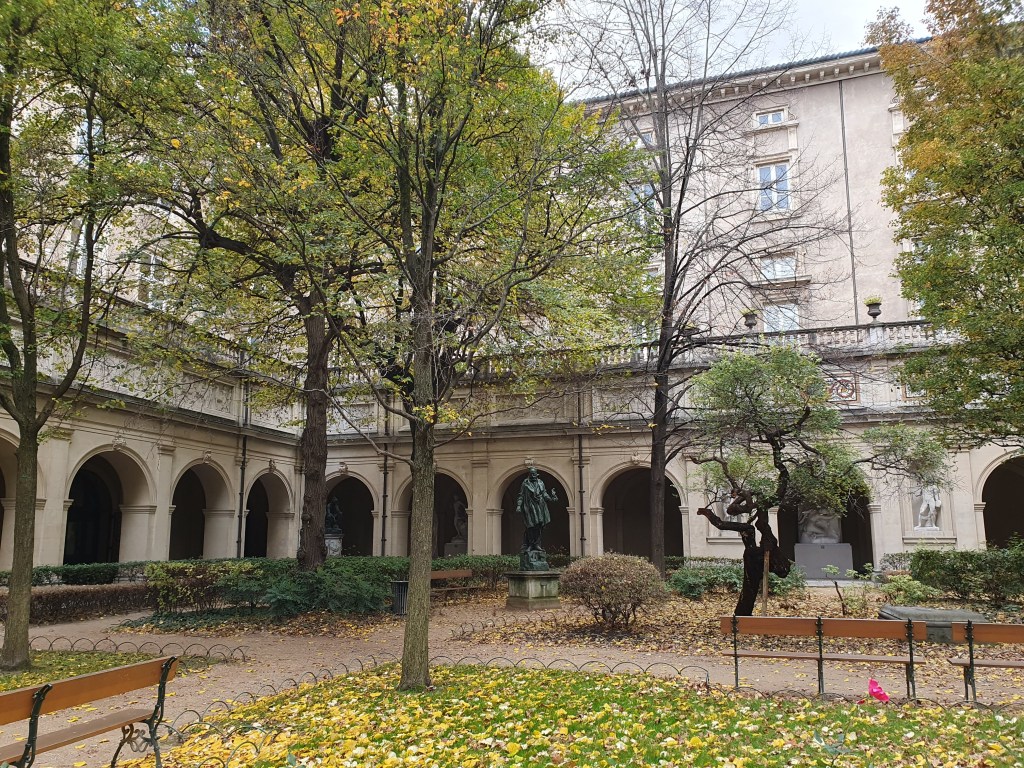
The building of the Musée des Beaux-Arts was once part of a former royal abbey. On arrival I purchased an audio-guide for my visit. The museum is on two levels enclosing a central courtyard on four sides, plus the former chapel where most of the sculpture collection is located. The museum was more comprehensive, and more interesting than I was anticipating. Its collections range from ancient times through to modern art. I spent two and a half hours in the museum, which I felt was the minimum to do it justice.
The museum was some way from Lyon Part-Dieu station, so when I left it, I caught a trolley bus there to ensure that I would be on time for my 1320 train. The main entrance to Lyon Part-Dieu is being renovated, so you can’t see the main façade and you are directed into the station via a temporary side entrance. Inside the station I noticed various meeters and greeters for the packaging and cosmetics trade fairs which had caused the spike in the price of hotel rooms the previous night.
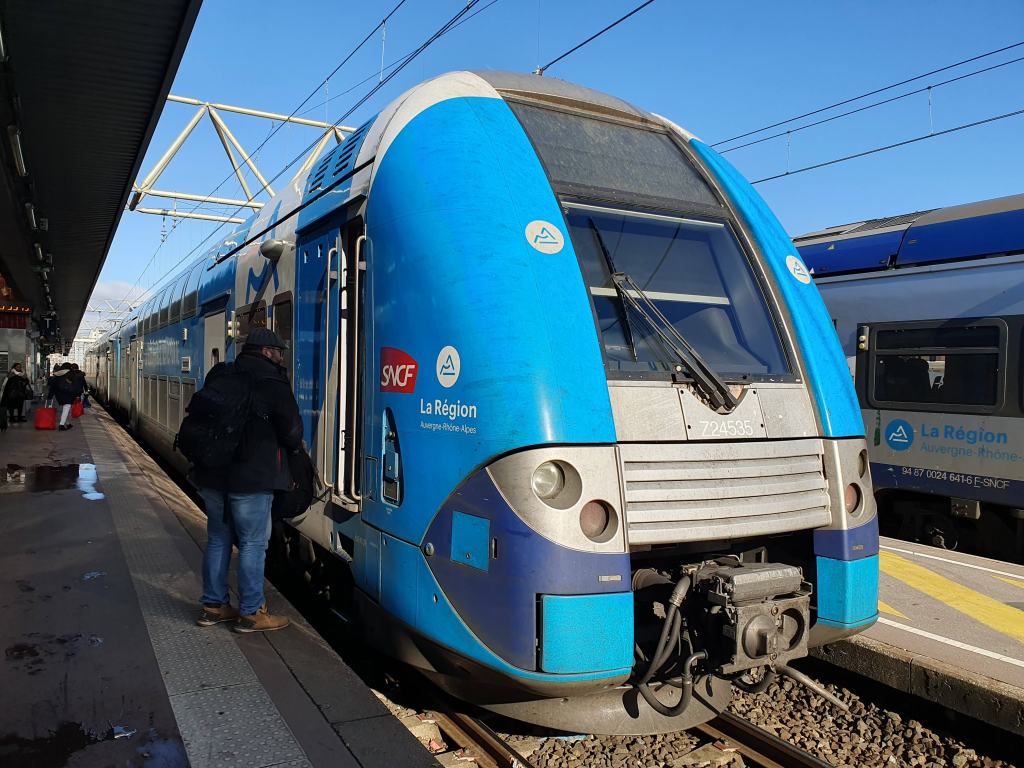
When I got to the platform, my train was already waiting. It was a double-decker, so I chose a seat upstairs, but failed to pick the right side for views of the Rhône, which the train followed for much of its journey. Shortly before it departed I received a message via the SNCF app warning of a likely 10 minute delay due to a signal failure. Approaching its first stop, the train proceeded at walking pace for a while through the affected area. However, once clear of the problem, the driver seemed determined to make up the lost time, meaning that by the time the train arrived in Valence Ville at 1432 it was on time again.
There were two museums that I wished to visit in Valence, the main Musée de Valence and the Centre du Patrimonie Armenien. I wasn’t sure how long the latter would take so I went there first.
Le CPA (Centre du Patrimonie Armenien – Armenian Heritage Centre) tells the story of Armenian culture, the diaspora, and the genocide by the Turks in the dying days of the Ottoman Empire. Apparently, there is a large Armenian community in Valence, who came to France through the port of Marseilles and then moved up the Rhône valley to settle in the city. I again purchased an audio-guide from the helpful staff at the front desk, to provide more information. I appeared to be the only visitor throughout my visit.
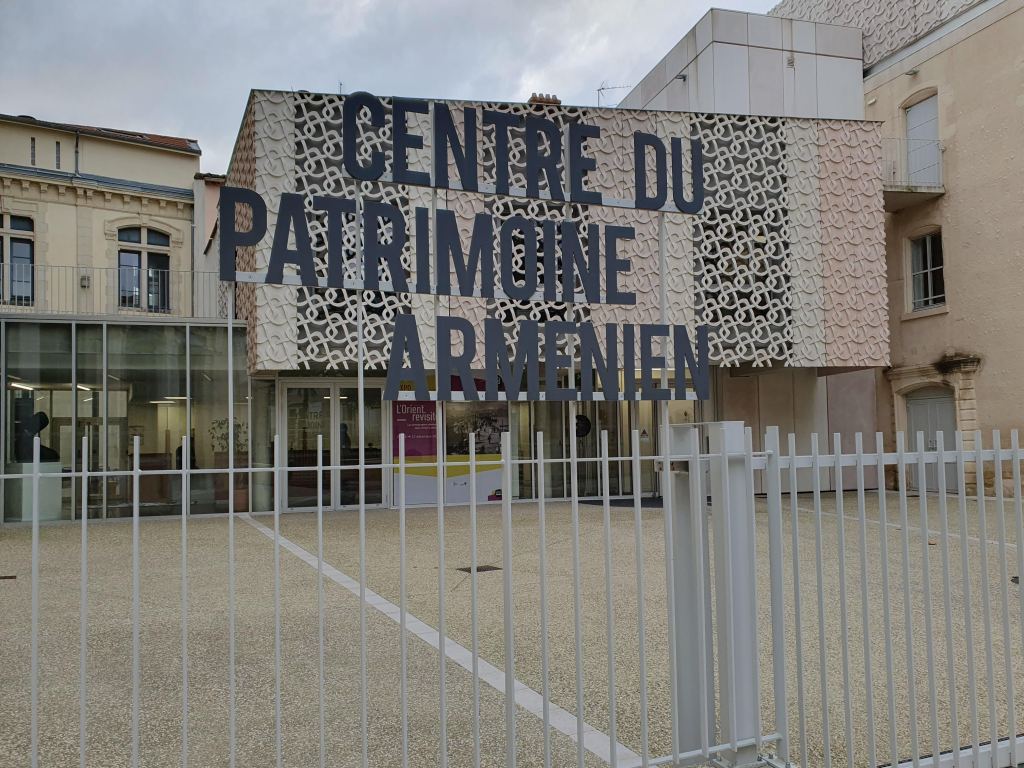
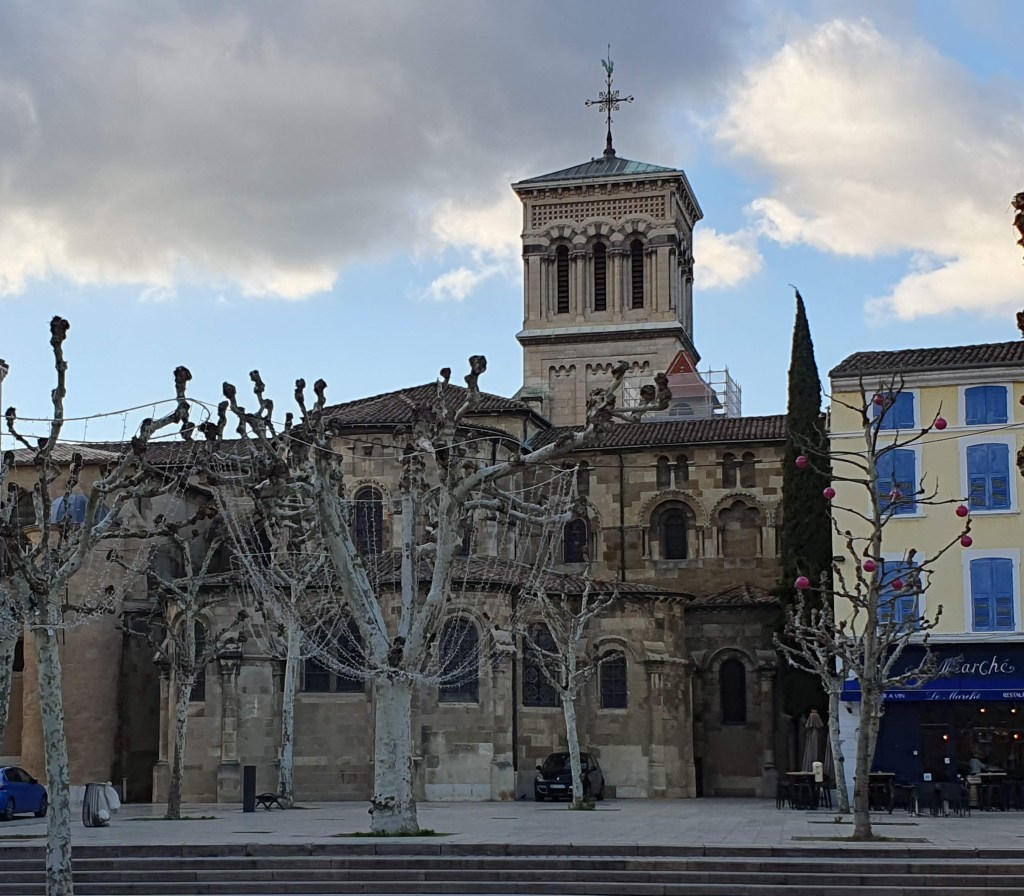
I left the CPA after about an hour to allow me to spend the rest of the afternoon in the Musée de Valence, which has an extensive collection of Roman artefacts. I walked there via the Cathedral. As I approached the museum, its large illuminated sign was lit up and I could see people moving about inside. But the entrance door was locked, with a piece of paper stuck to it saying that because of a serious technical incident the museum was closed until further notice. This was very disappointing, as it looked to be one of the more interesting museums I was planning to visit on this trip and the main reason that I had stopped off in Valence. Instead, I began a walk around the town centre looking at some of the main sights. It started to get dark early because of some very ominous black clouds filling the sky, which I feared would soon turn to torrential rain, so I truncated my walk and went to find the hotel that I had booked for the night.
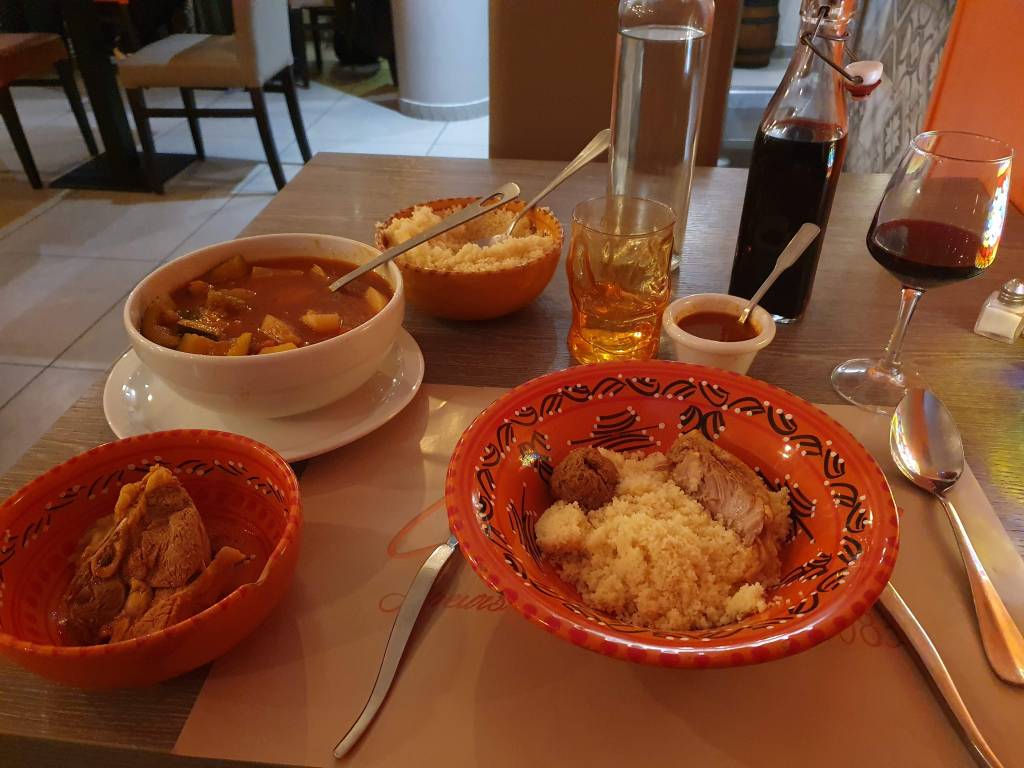
That evening I dined in a very good and reasonably priced north African restaurant near the station, where I had an enormous lamb couscous for main course. It was served in four separate dishes – a large piece of lamb on the bone and a lamb meatball in one, a bowl of couscous, a steaming bowl of vegetables and a small pot of spicy sauce. For dessert, I had a plate of cheese.
When I was back in my hotel and researching the detail of of my next few days, I discovered that there was going to to be a train strike on the Friday of my trip, affecting the TERs run by LiLO, the Occitane transport operator. Given I was planning on using one of these trains that day, this was a bit of a blow. Confirmation of what trains would be running would be provided by 5pm on the day before. I was slightly heartened that ICs and TGVs did not seem to be affected, which could give me a possible, though less conveniently timed, alternative.
Day 3 – Thursday 23rd November 2023 – Valence to Montpellier (via Orange)
When I arrived at Valence station to catch a 0837 train, the departure board informed me that it would be 10 minutes late. However, as I waited on the freezing platform the delay grew and the train eventually arrived 20 minutes late. I shared my wait on the platform with three members of the transport police, who I saw subsequently escorting someone from the train at one of the intermediate stops on the way to Orange.
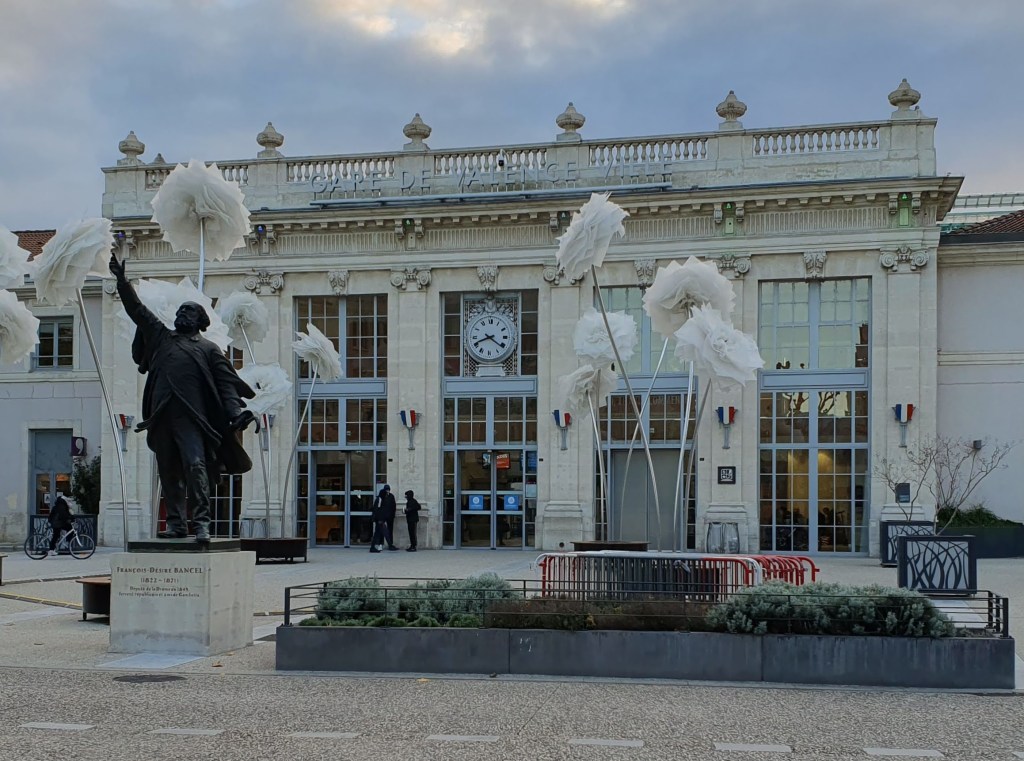
Although just a TER, the train from Valence was locomotive hauled with some old fashioned rolling stock. It didn’t make up any time on the hour long ride to Orange, so I arrived just before 10am. The station is a little way from the city centre and the walk there was into a stiff wind. I went first to the museum opposite the Roman theatre, where I picked up an audio-guide. The woman at the museum suggested that I visit the Roman theatre first and then come back to the museum. I decided to ignore her advice, on the basis that the temperature would have risen by the time I needed to go outside to explore the Roman theatre. I was wrong, as the stiff wind I had encountered walking from the station was the Mistral starting to blow. As the morning progressed it got stronger, so by the time I wanted to go outside it was blowing freezing air from the Alps at 50mph down the Rhône valley. The museum was not very large, with a few rooms on each of two floors, covering the history of Orange and various Roman artefacts. The Princes of Orange who originated from here, indirectly went on to found the ruling dynasty in the Netherlands.

When I had finished in the museum I went across the road to enter the Roman theatre. The audio-guide for the theatre was very detailed with numerous stops, but because the Mistral was now blowing with full force I tried to find shelter in the passageways at the back of the theatre, rather than at the appointed spots, to listen to the commentary. Orange’s Roman theatre is considered to be one of the best preserved and it is still used for performances throughout the summer.
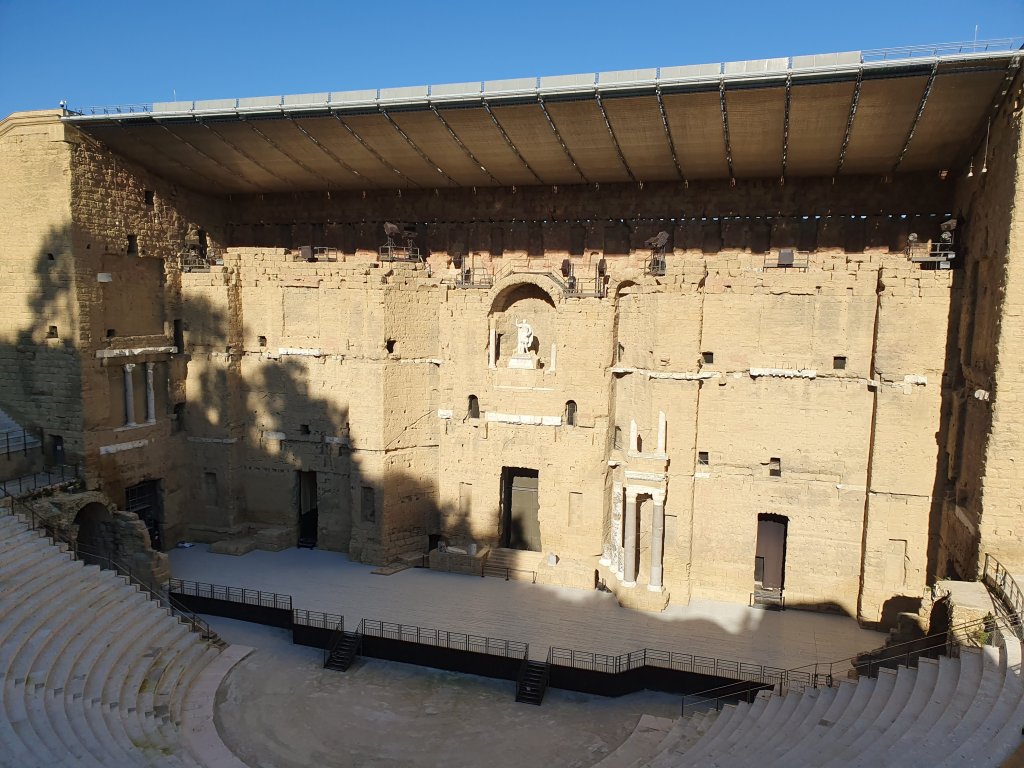
When I had finished in the Roman theatre it had been my original intention to visit the Roman triumphal arch located on the edge of the city centre about a mile to the north. However, I decided not to go there for three reasons:
(i) walking there, straight into the Mistral, would not be fun;
(ii) the delays which affected my train this morning appeared to have got worse, and I was worried that if I stuck to catching my original planned train, I might miss my connection in Avignon for the train to Montpellier; and
(iii) Visiting the attractions in Montpellier that afternoon, rather than Friday morning, would give me more flexibility to find a train that was running to leave Montpellier on Friday.
So I headed back to Orange station, feeling the full force of the Mistral on the way. It was educational to experience at first hand a meteorological phenomenon vaguely remembered from school geography lessons many years ago. My SNCF app was telling me that the 1132 train from Orange was running 30 minutes late, so I aimed to catch that train. It was a good job that I arrived a few minutes early, as I walked on to the platform just as the train pulled in, now only about 20 minutes late. As the doors of my intended carriage opened I was confronted with the sight of three transport police pinning a young woman to the floor of the carriage as she was struggling violently with all her belongings strewn about. When the train pulled out of the station, I observed her handcuffed on the platform still trying to attack those who had arrested her.
It was only a 15 minute ride to Avignon, where I had visited the previous year. I had been planning to have a brief look at Avignon again, but realised that, having gained 10 minutes on the train’s original estimated arrival time, I should just be able to catch a train to Montpellier without any hanging about. I nearly missed it, not realising it departed from a separate bay platform at the end of the main platform, from where I had caught a train to Nîmes the year before.
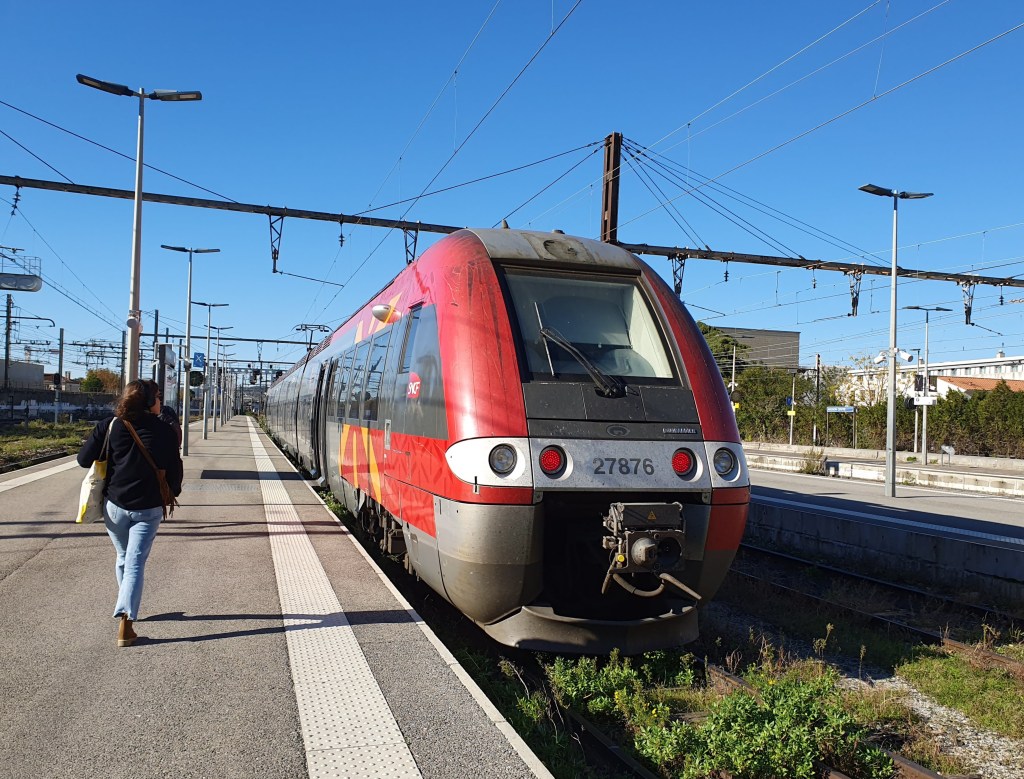
The journey from Avignon to Montpellier takes an hour and a half, going via Nîmes. On alighting at Montpellier the contrast with the weather in Orange was striking. It was about 20°C warmer and there was no wind. I dropped my bag off at the hotel I had booked, before going on to the Musée Fabre, which is a rather splendid art gallery housed in a building which has been recently modernised inside. Although there was no audio-guide available in English, I was given a glossy booklet to guide me round the extensive collections.
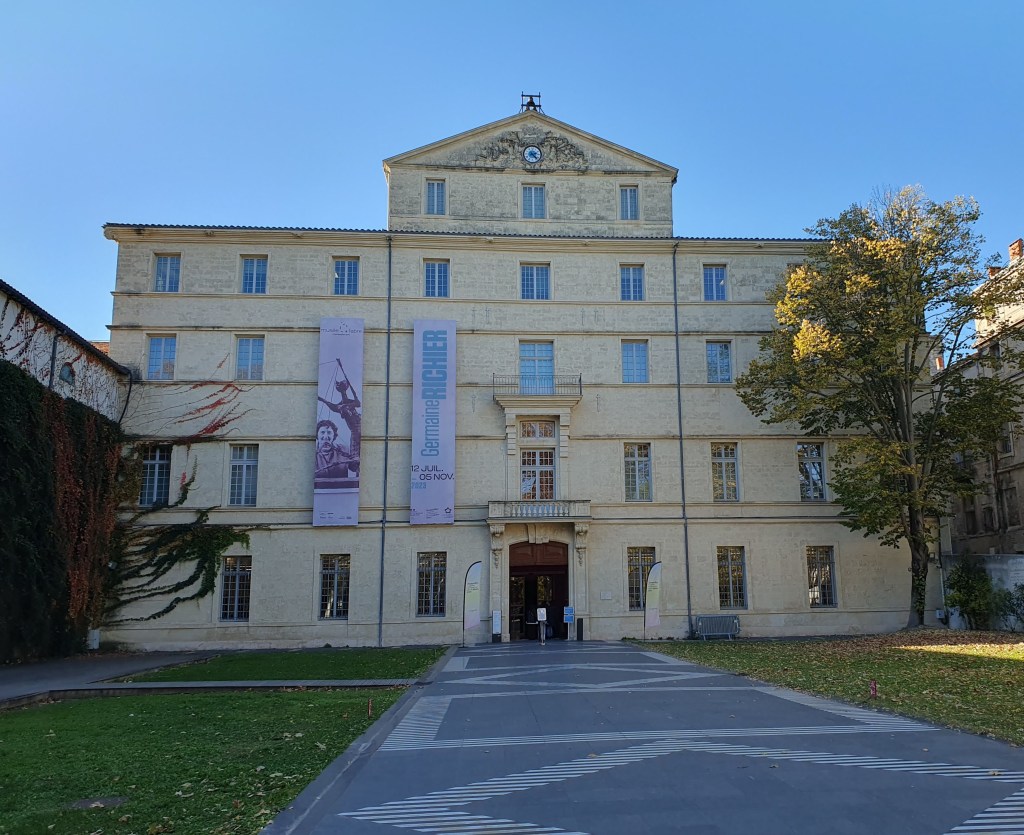
My next stop was at the Musée de Vieux Montpellier. This is a small, volunteer run, local history museum. As it contains only four rooms, it did not take very long to look at everything. This gave me a chance to wander back to my hotel before it got too dark.

That evening I went to a traditional French restaurant where I had an interesting starter of shredded leeks in a creamy sauce with hazelnuts and truffle shavings, followed by a steak.
Day 4 – Friday 24th November 2023 – Montpellier to Béziers
Having brought forward my time in Montpellier to maximise the opportunity to leave on this train strike day, I established that there was a TER train to Béziers due to be departing at 0853. (Ironically, one of the few other TERs scheduled to run that day was the one at lunchtime that I was originally planning to get.)

After a not very good breakfast in my hotel (the only one I was having on this trip) I set off in time to catch the 0853 train, despite the SNCF app telling me that it was 20 minutes late. Montpellier St Roch station is of modern design with a high curved arch over the central concourse from which you descend to the trains. Despite the departure board on the station concourse confirming that my train was still due to be running 20 minutes late, when I got down to the platform the delay had shrunk and it rolled in more or less on time. Given there were so few trains running, I was expecting it to be packed, but although it was fairly busy the numbers soon thinned out as it stopped at the intermediate stations after leaving Montpellier. It travelled for a while along the coast, giving me a few glimpses of the Mediterranean around Sète.
It took only 45 minutes for the train to reach Béziers. The most pleasant way to the city centre from the station is normally through a large park, but this was unexpectedly closed due to some works being undertaken within it. I was surprised when I came to the main square to see that it seemed to be covered in snow, but soon realised that this was fake snow and another Christmas market was in the process of being constructed. My first stop was at Béziers’ main Post Office, where I bought a stamp for a postcard home. (The postcard arrived more quickly than the one I had posted in Nîmes a year earlier, but more slowly than postcards I had posted in Germany, Switzerland and Finland on previous trips.)
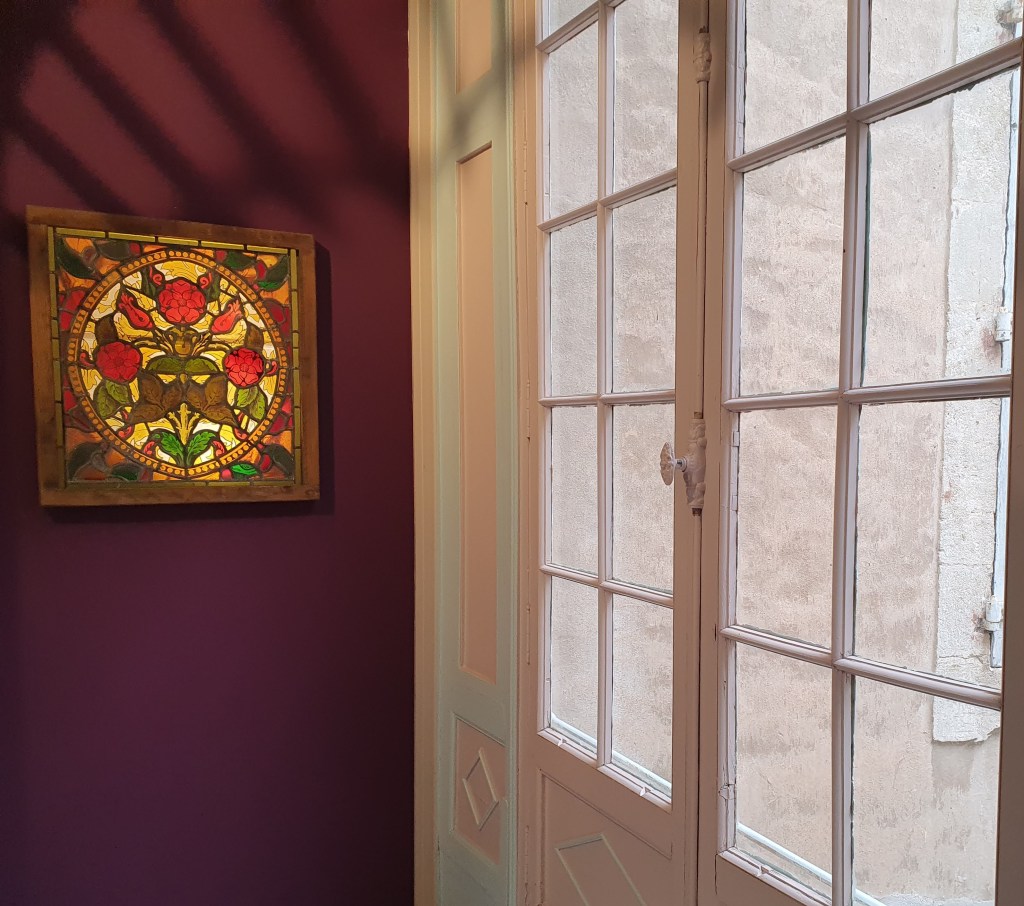
My next stop in Béziers was at a small gallery, the Musée Fayet, which contained some works by local artists and a collection of model pieces by the sculptor Jean-Antoine Injalbert, who specialised in large public sculptures, often adorning buildings. There was until recently another much larger local history museum in Béziers, the Musée de Biterrois, but this closed permanently about three years ago. A further bull-fighting museum is only open in the summer.
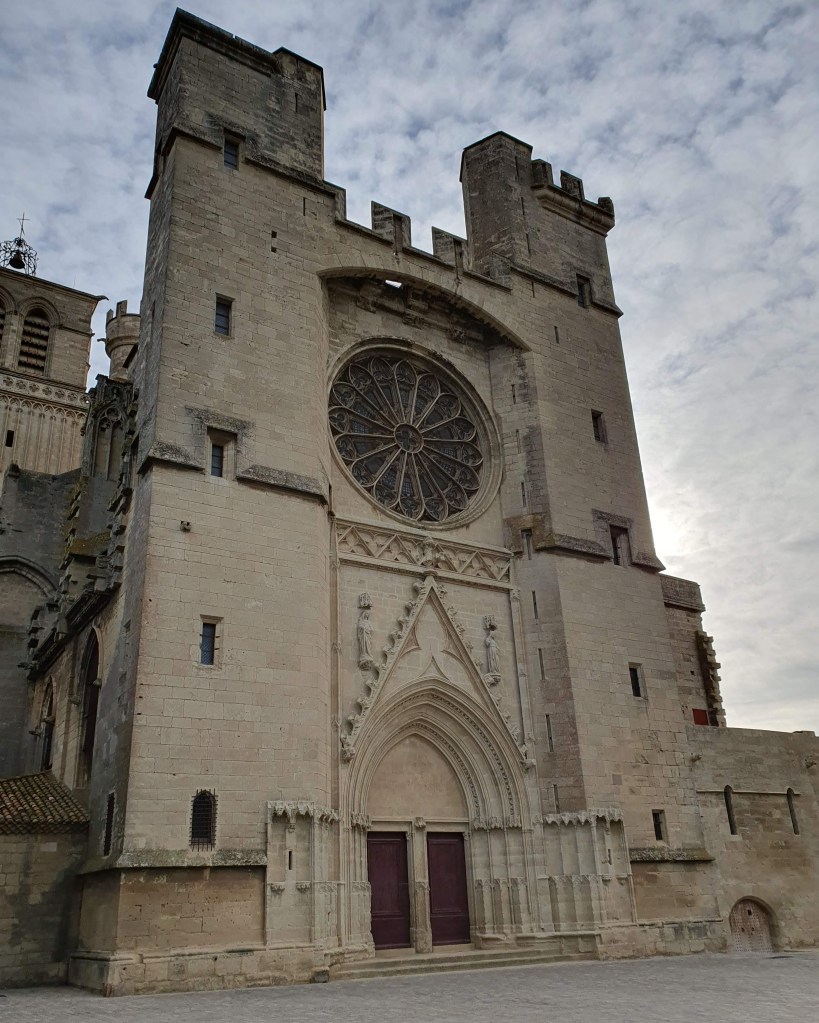
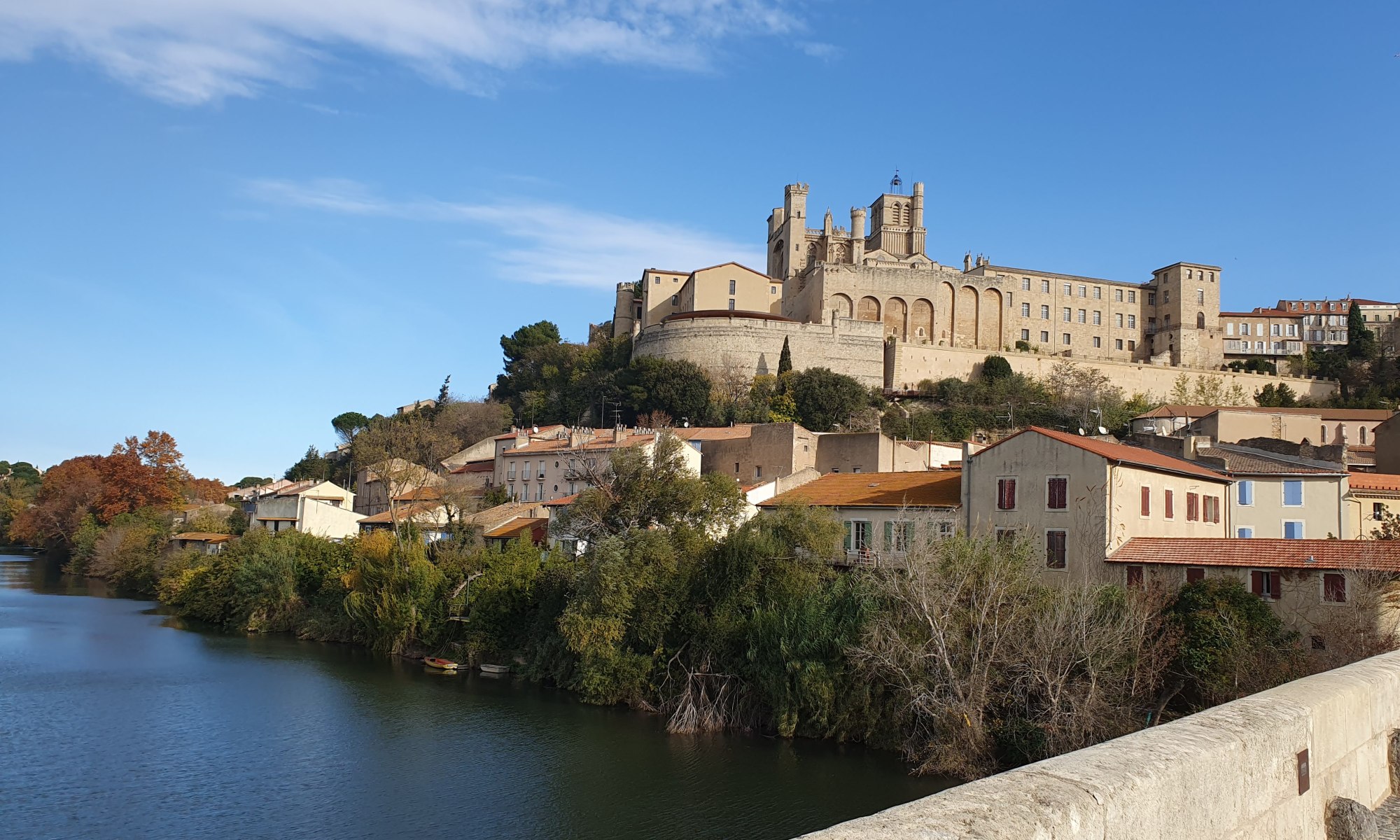
From the Musée Fayet I went to the Cathedral St Nazaire, which is spectacularly located on cliffs above the River Orb. The current building dates from the 13th century after its predecessor was destroyed in the Albigensian Crusade.
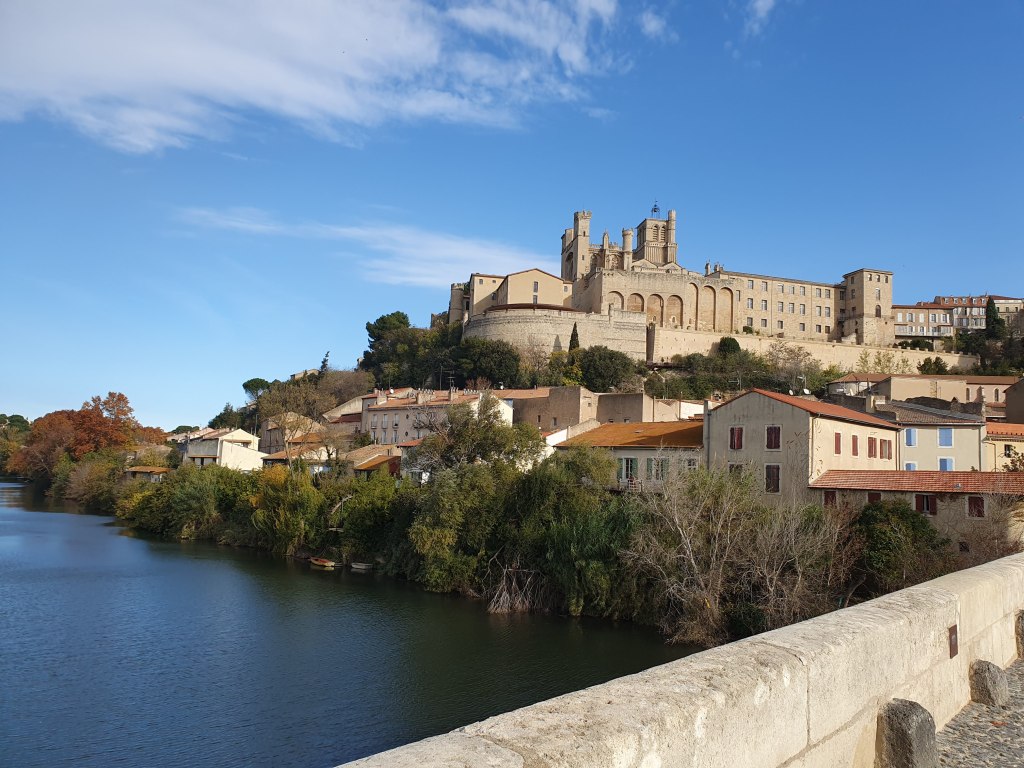
There is a wooden walkway and several series of steps from the cathedral to take you down the cliffs to the river. I went down these and across the pedestrian-only Pont Vieux. As the weather was good, and I had more time in Béziers than originally planned, I went for a walk along the Orb and up the Canal du Midi until I reached the Ecluses de Fonseranes. This is a spectacular series of nine staircase locks in rapid succession on the canal, though I was slightly disappointed that there were notices forbidding you from walking onto the actual lock gates, which would have been the best place to fully appreciate the ascent made by the Canal du Midi.
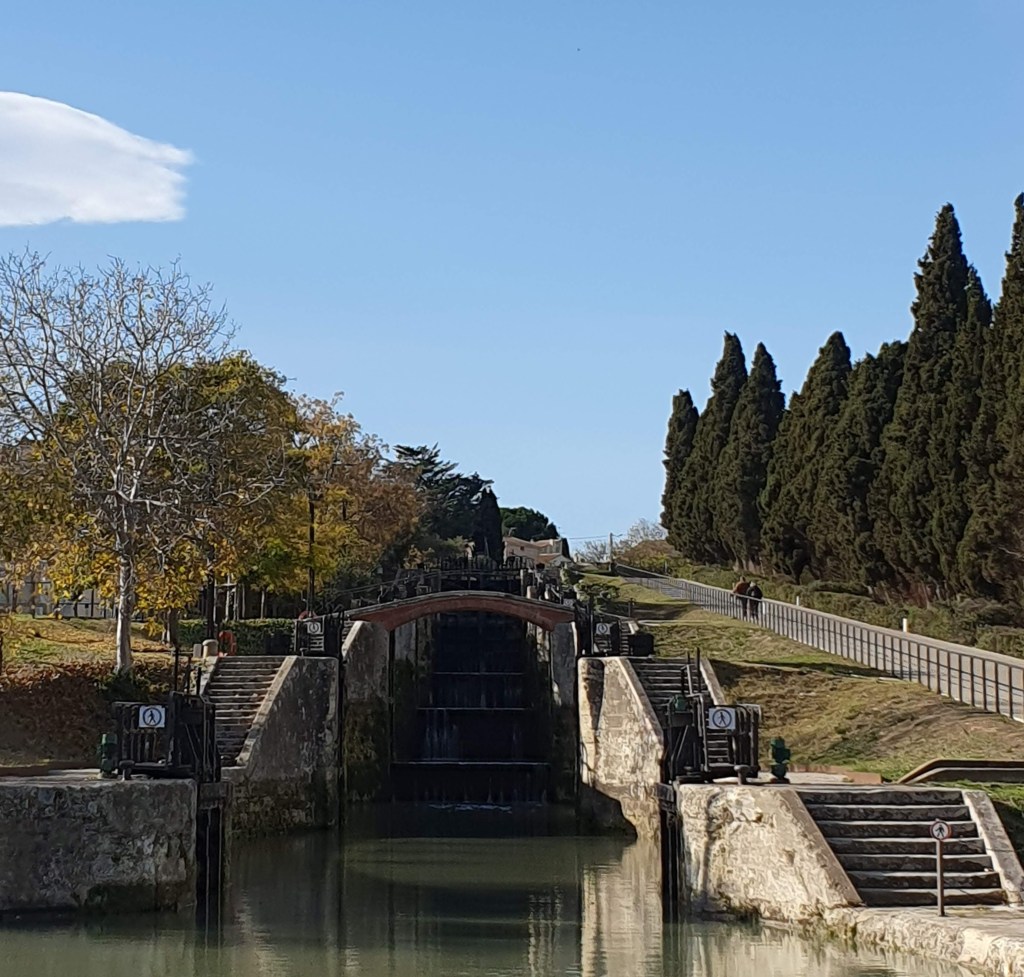
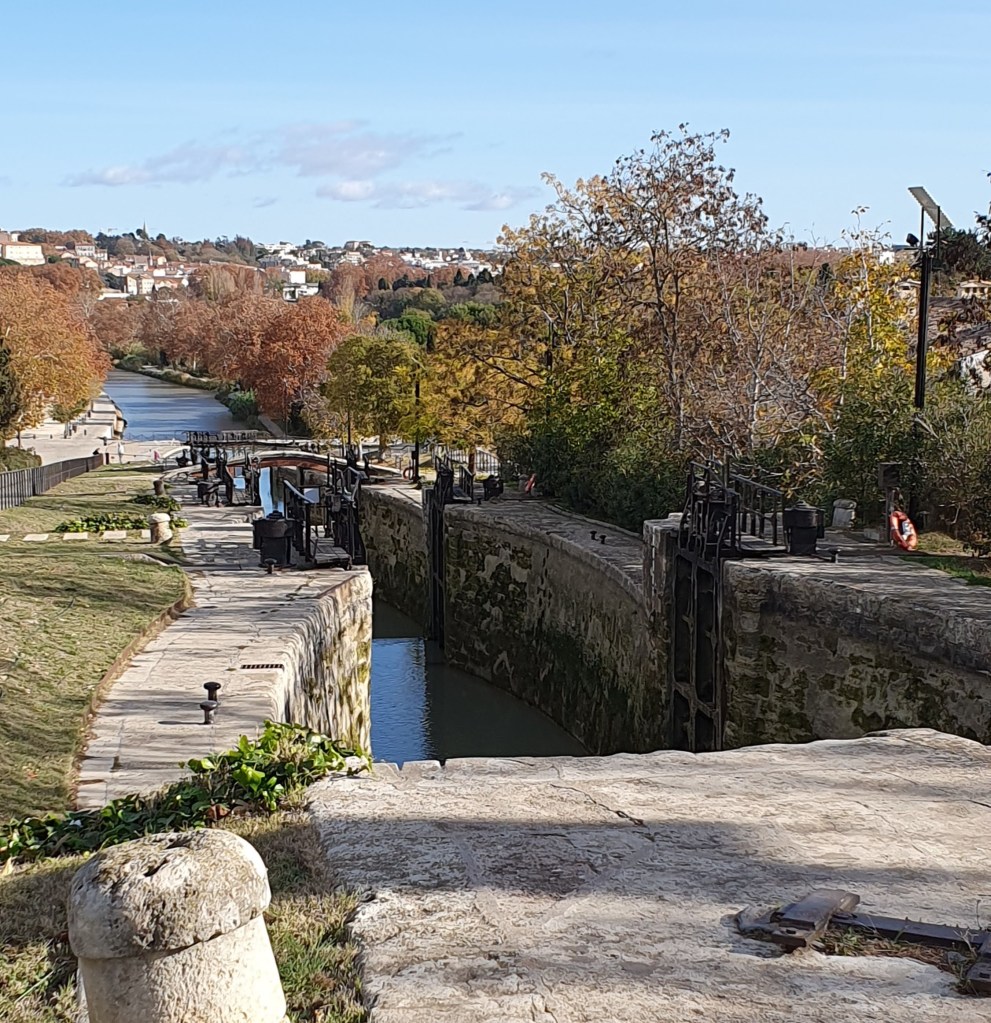
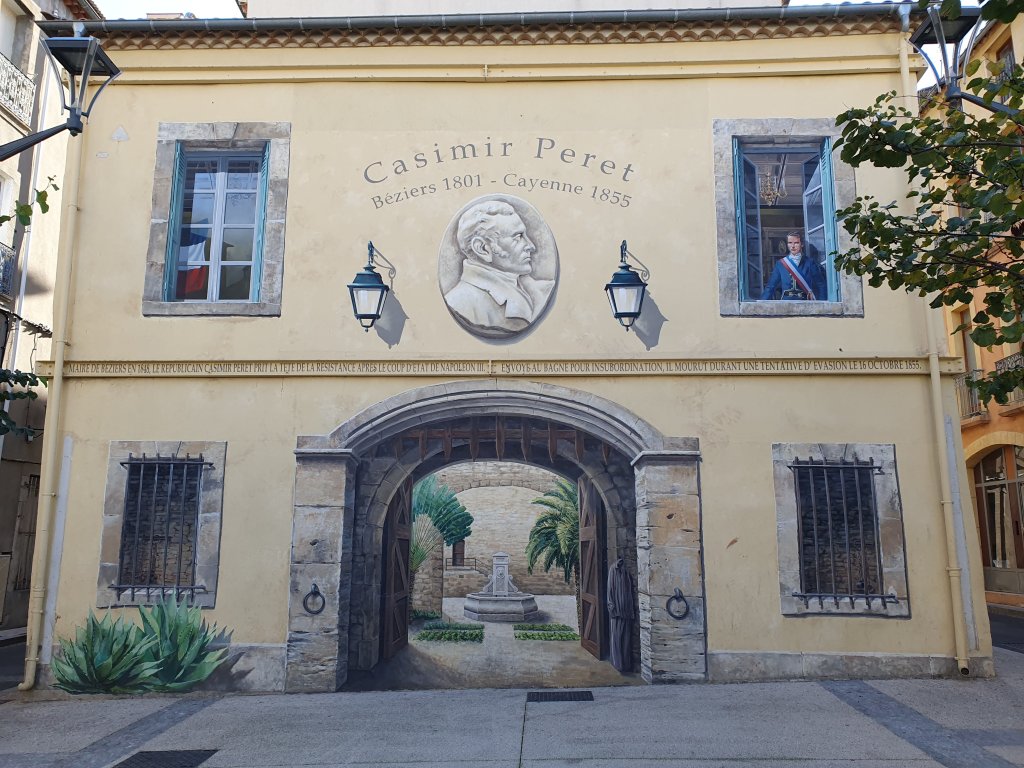
I retraced my steps and went back to the city centre. There I called in at the tourist office and picked up a map which showed the location of the trompe l’oeil murals which adorn many buildings around the town. From the map, I discovered that some of these are way out in the outskirts of the city, but I devised a walk to see the twenty or so that are located within the confines of the original town. This walk also took me past the remains of a Roman theatre, but smaller and not so well preserved as the one in Orange.
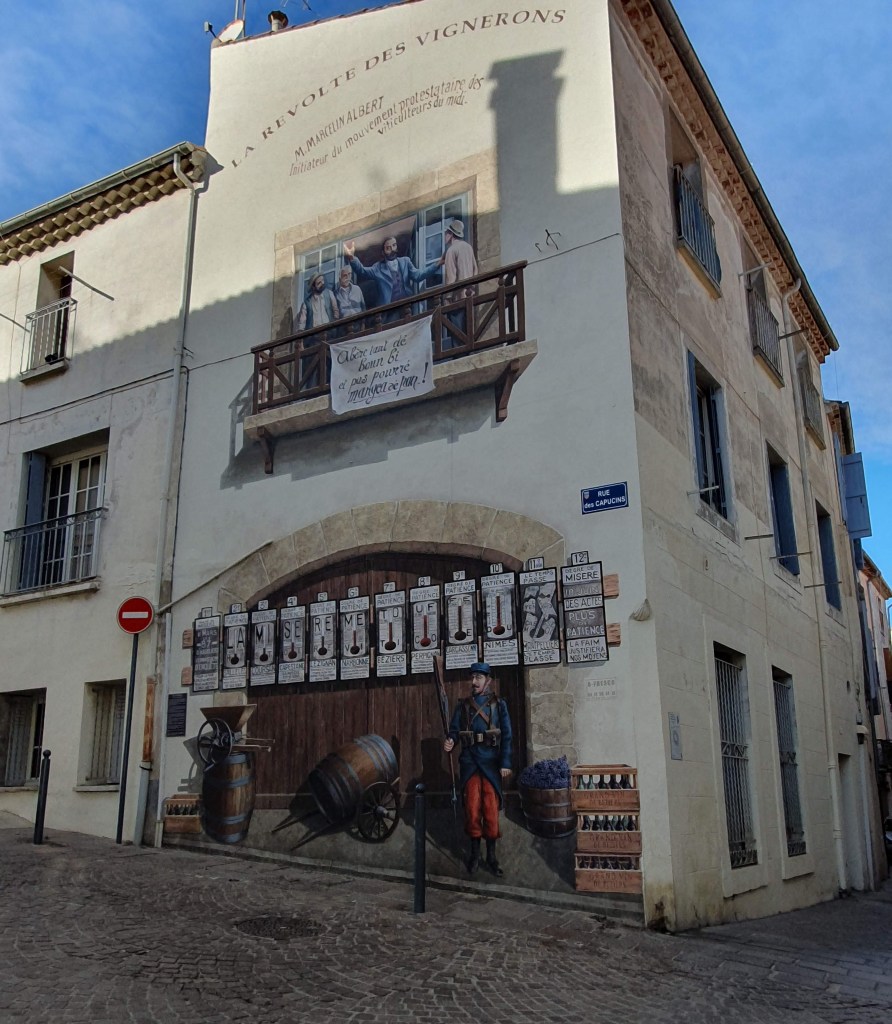
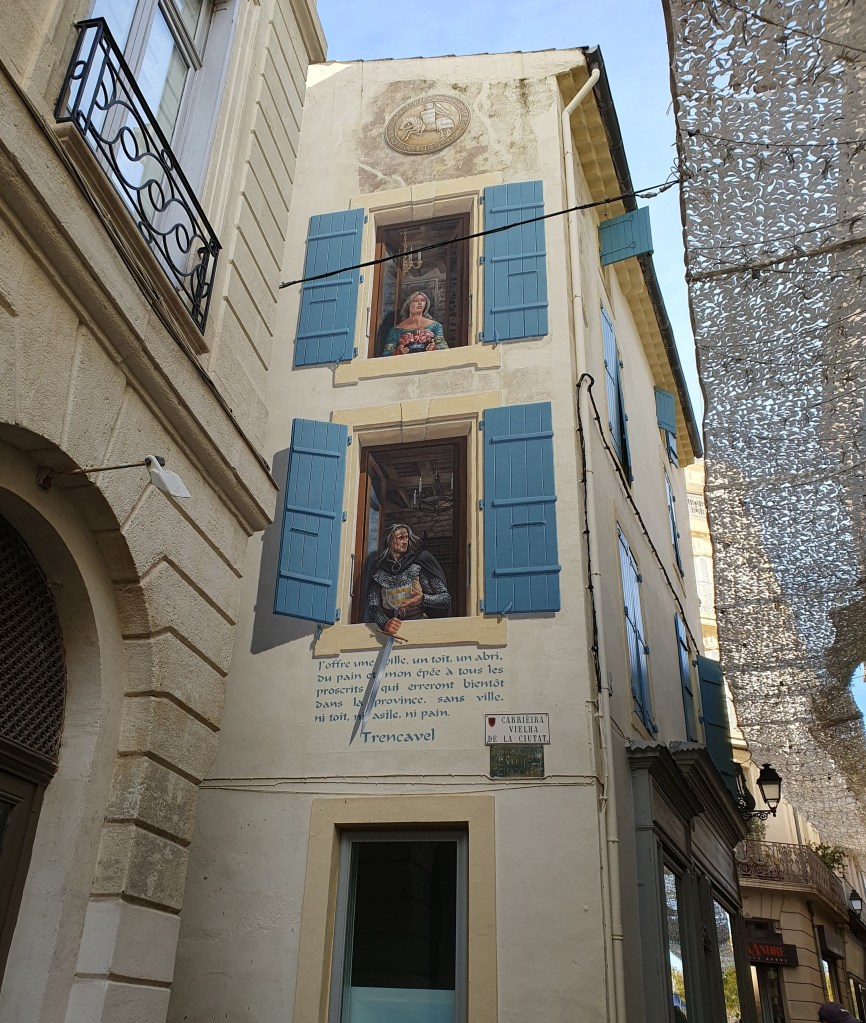
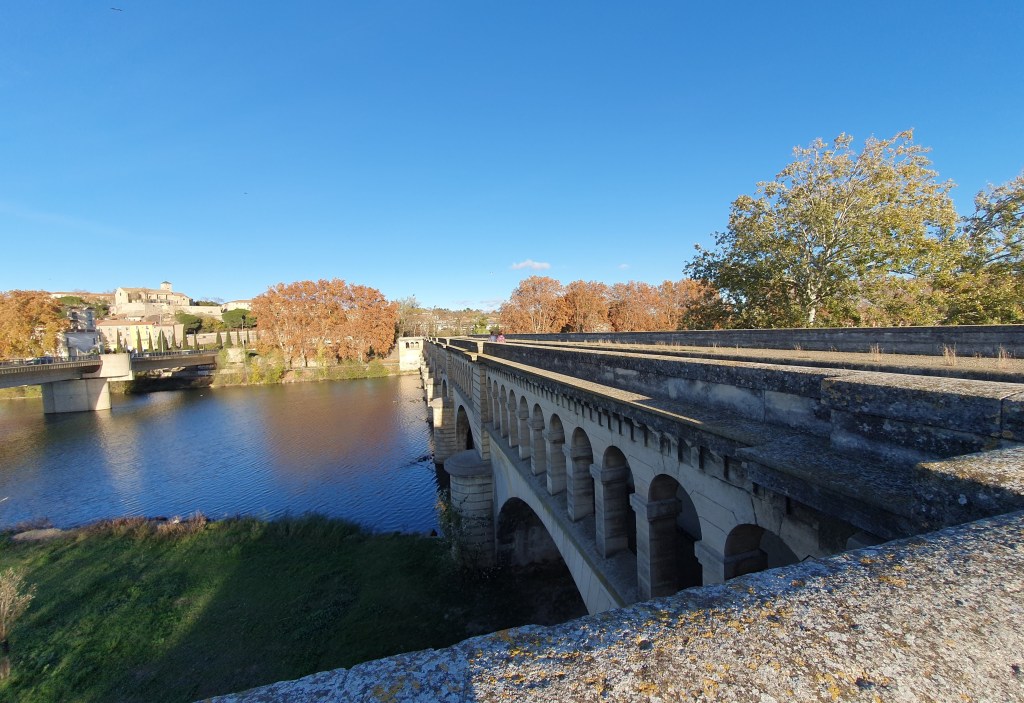
By the time I had found all the trompes l’oeil that I had intended, I was beginning to feel a little tired from all my walking that day, so I called in at my hotel to drop off my bag, before venturing out again on another walk. I returned to the Canal du Midi, but this time further downstream from the the Ecluses de Fonseranes, so that I could see where the canal is carried over the River Orb on a aqueduct. On my route to and from the canal I passed a group of men playing boules in the late afternoon sunshine.
While in my hotel, before I went out to dinner, the arm fell off my two-week old pair of spectacles. As these were the only glasses I had brought with me, I needed to make some repairs. I could see that the screw holding the arm in place had come out, but without being able to see clearly, nor with the right equipment, I couldn’t get it to go back in. Fortunately, I always bring a few sticking plasters with me in case of minor injuries, and they proved useful in patching my glasses together – each repair lasting about a day before it needed to be redone.
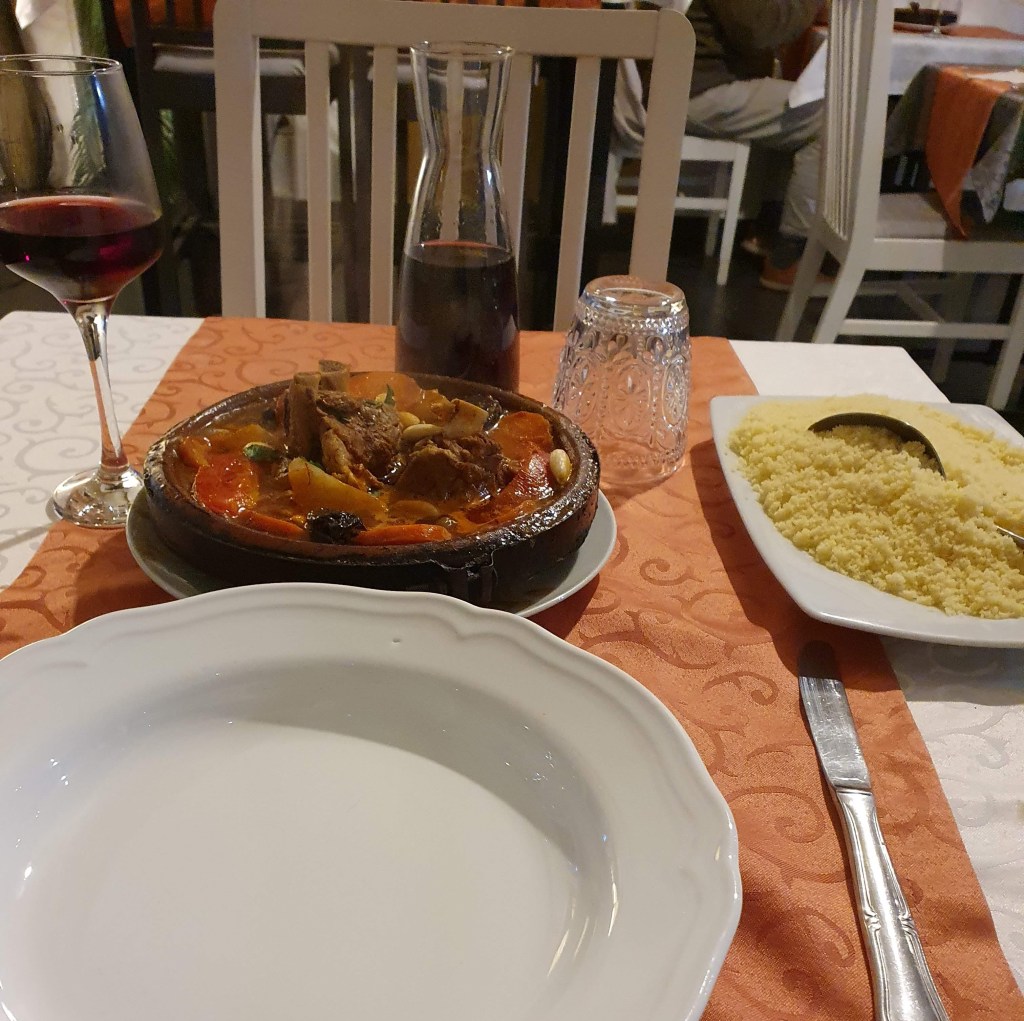
After that excitement, I decided not to venture too far for dinner that evening, but again went to a north African restaurant almost opposite my hotel. As two days previously I had had lamb couscous, this time I tried lamb tagine with prunes. It turned out to be very similar to my previous dish, except this time the lamb and vegetables were served in one steaming dish, rather than separately, but again accompanied by a large bowl of couscous. For dessert, I chose a couple of pastries from the restaurant’s cake stand, which may have been a mistake, as they tasted as if they had been sitting there for a while.
Day 5 – Saturday 25th November 2023 – Béziers to Toulouse
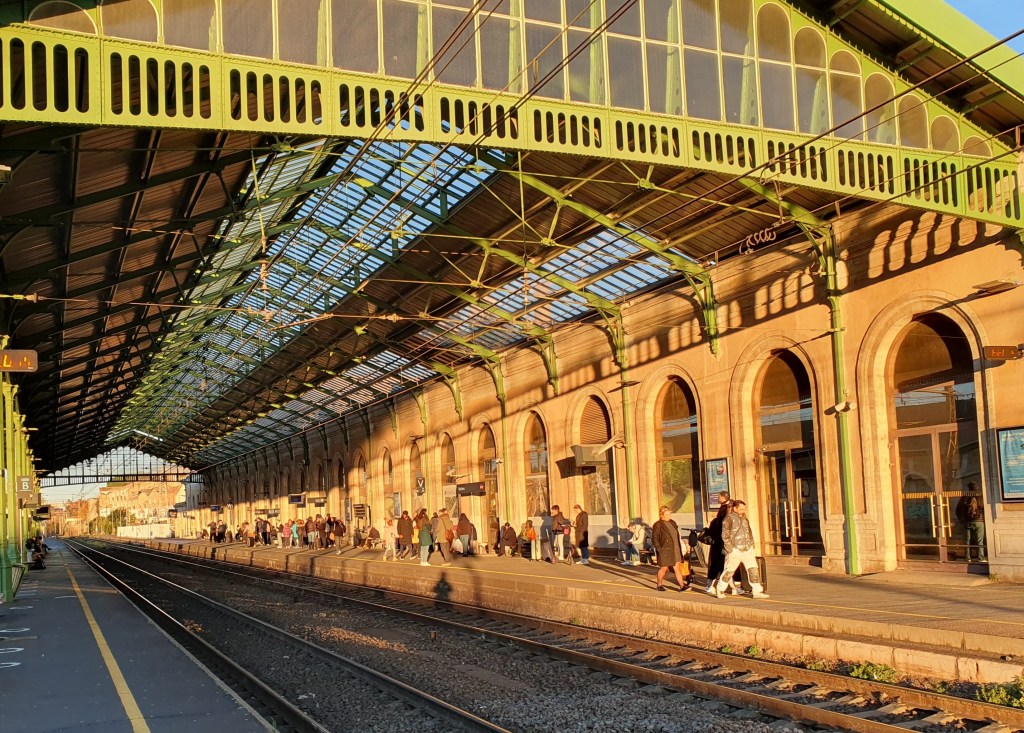
The direct route from my hotel to the station through the park was still closed, so I allowed time to go the longer way round following the streets. Waiting on the platform at Béziers station the sandstone walls were bathed in a glorious light from the early morning sun. My 0837 train to Narbonne was on time and fairly empty.
It is less than 15 minutes to Narbonne, where I changed trains. Narbonne looks an interesting city and when planning this trip I considered stopping off there, but decided not to on this occasion, as it might be a useful calling point on a journey to Catalonia. My next train to Toulouse departed on time, 15 minutes after I had arrived in Narbonne, but this one was nearly full by the time it left. It stopped at a number of stations on the way to Toulouse, including at Carcassone, a fortified city which is the burial place of Simon de Monfort. As I had been to Carcassonne before, albeit many years ago, I chose not to go there this time, but reminded myself that another visit was probably overdue. At the stations on the way to Toulouse there were more people getting on the train than were getting off, such that by the final few stops the aisles were full of people standing and the new passengers struggled even to get on board.
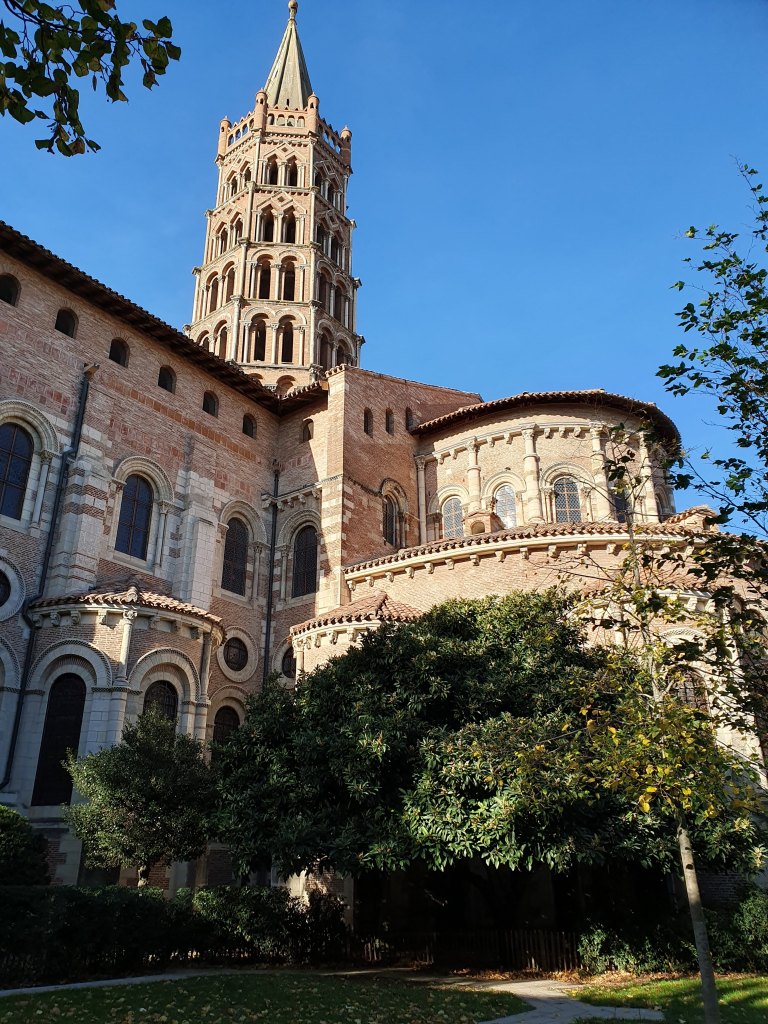
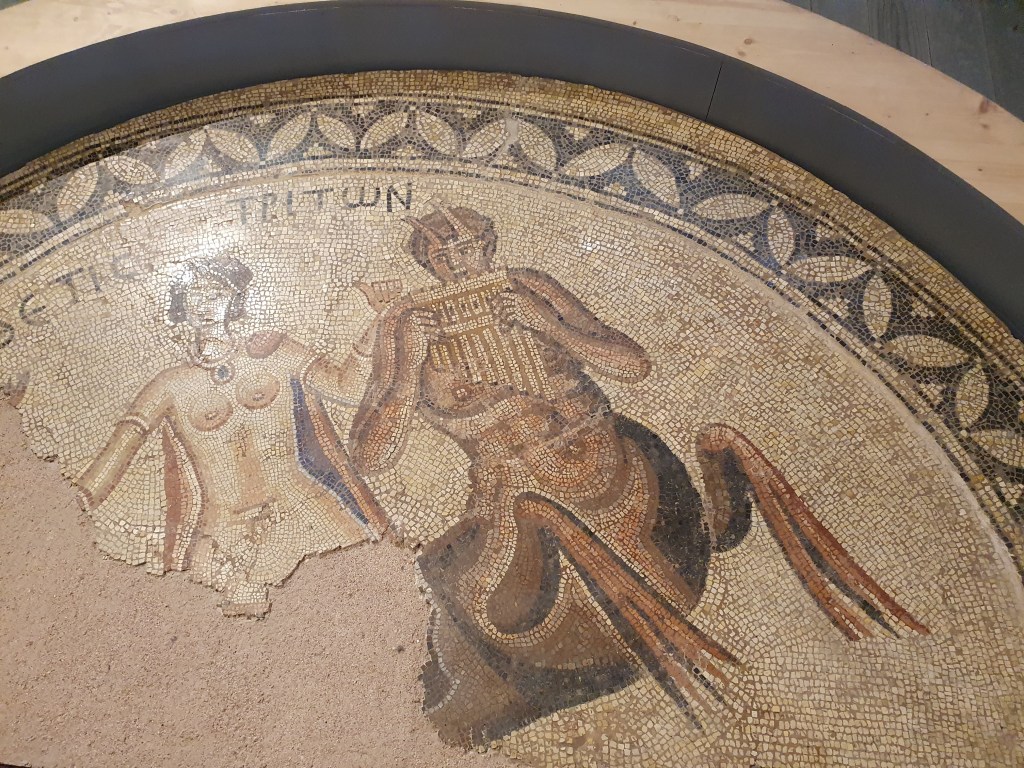
The train arrived at Toulouse Matabiau station on time at 1040. From there I made the short walk to the centre of the city, which was filling up with Saturday shoppers, to first visit the Basilica of Saint-Sernin. The current Romanesque building was started in the 11th century on the site of an earlier basilica. Next to Saint-Sernin is the Musée Saint-Raymond, which contains archaeological specimens from the Roman and Celtic periods.
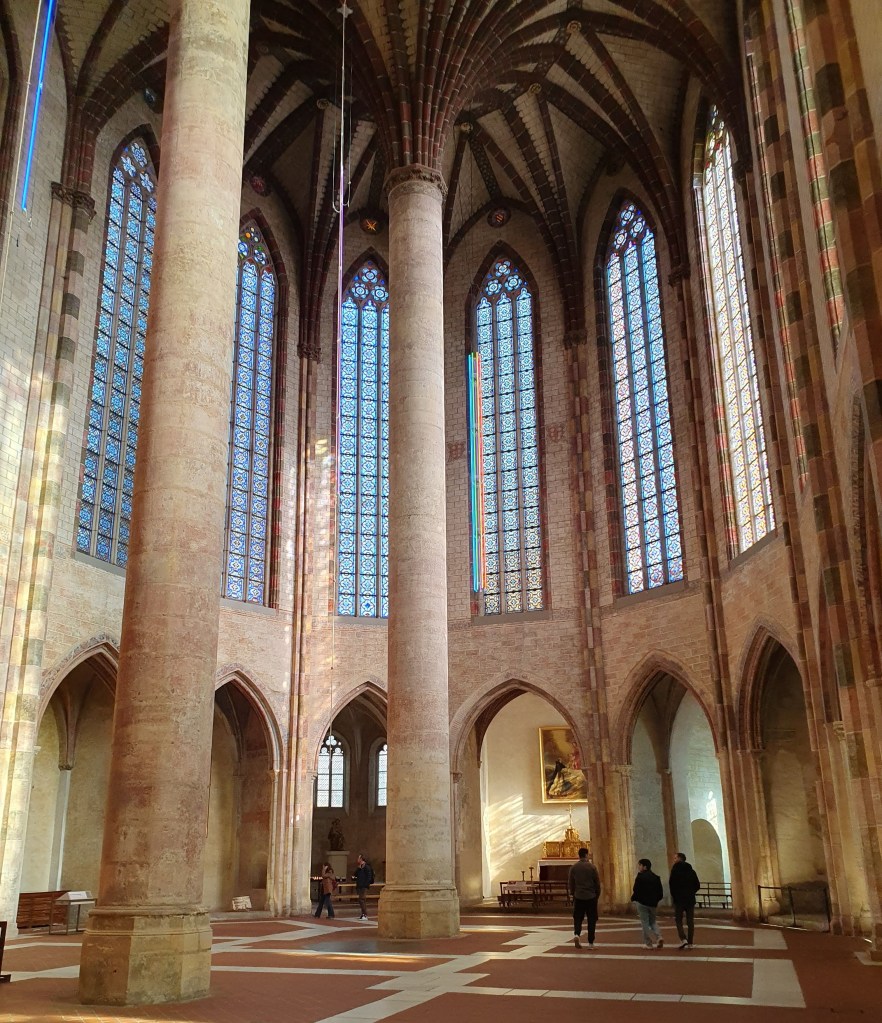
My next visit was to the Convent of the Jacobins. The name is slightly confusing as the place never was home to nuns, but rather to Dominican monks. The word convent was used to describe a mendicant, rather than monastic, community. The Jacobins part of the name has nothing to do with French revolutionaries, but was another name for the Dominicans. The convent now consists of a deconsecrated church which is free to enter, containing the remains of Thomas Aquinas, and the cloisters and other buildings for which a small fee is charged.
I then walked to the south of the city centre to visit the Musée Paul Dupuy, which is a museum of the decorative arts, whose top floor has a large collection of clocks and watches.
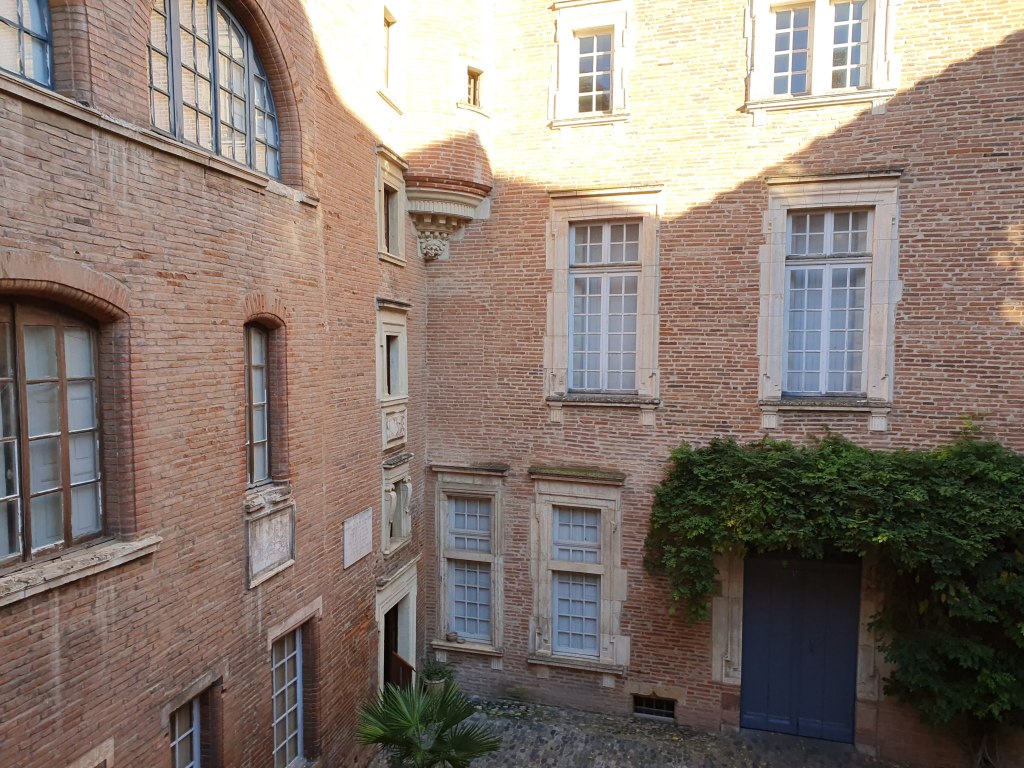
I returned to the heart of the old city to go the Musée de Vieux Toulouse, which is a small volunteer run museum describing some of the history of the city. It occupies one upstairs floor round a courtyard of an old building. The smallness of the museum is more than made up for by the enthusiasm of the volunteers in every room who want to tell you about the exhibits.
By the time I left the Musée de Vieux Toulouse, the city centre was heaving. There was a huge Christmas market filling the square in front of the Capitole, the large city hall. I briefly went into the market to have a look around. The stalls mostly seemed to be selling a range of Christmas themed food and drink, but it was so crowded that I did not stay long. I called in at my hotel to leave my bag, but then headed straight out again. There seemed to be other smaller Christmas markets dotted all over the city centre and there was a marching band going between them. I decided I would rather find somewhere more peaceful, so I headed to the Garonne river and walked along the bank in the late afternoon sun.
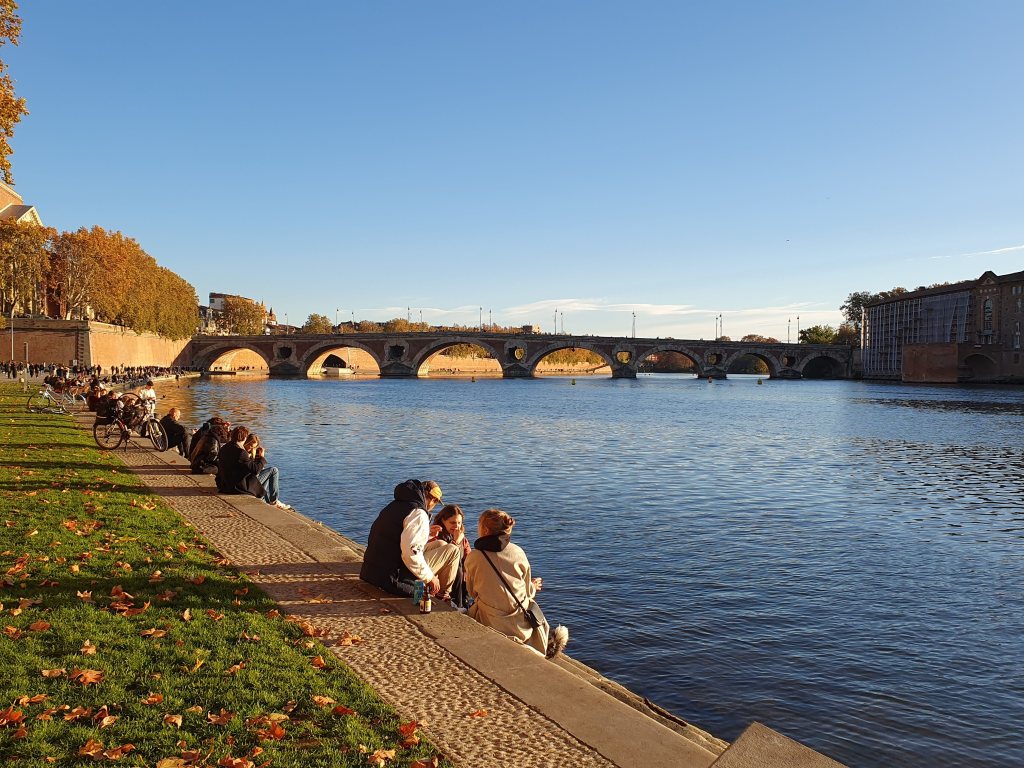
On the way back to my hotel the crowds showed no signs of thinning out, so I had some concerns about finding somewhere available for dinner, as I had not booked a table. I researched a number of possible restaurants, which I planned to try in a specific order as soon as they reopened at 7pm or 7:30pm. The hotel that I had chosen for the night was rather more upmarket than I would normally pick, but it was one of the few that offered single rooms, which made it slightly cheaper than the alternatives offering single occupancy of a double room. That said, when I checked in and went to my room, I discovered that I had been given a spacious double room after all. Bizarrely, the hotel had a 1980s Manchester music scene theme to it, with memorabilia and decorations from that era. The welcome drink I had at the hotel was from a Manchester craft brewery, served with a generous bowl of olives and other nibbles.
I was lucky to get one of the few unreserved tables at my first choice of restaurant. I had an interesting starter of warm (but otherwise raw) ducks’ gizzards with salad. This was followed by pork with mustard sauce, served with both fries and gratinée potatoes. I was persuaded to have a pistachio mousse for dessert.
Day 6 – Sunday 26th November 2023 – Toulouse to Cahors
I knew from when I planned this trip that there was engineering work affecting trains to and from Toulouse Matabiau station on the Saturday evening and Sunday morning. The first couple of trains on the Sunday morning were being replaced by buses, which took considerably longer, so rather than catch one of those I decided to have a bit of a lie in and travel on the first train at 1101.
When I set off from the hotel in good time for my train, I was encouraged that the SNCF app was confirming that it was running on time. However, when I got to Toulouse Matabiau the departure boards were telling a different story. The 1101 departure was shown as cancelled, as were most other trains at about that time. Apparently, there were power supply problems following the overnight engineering works. There was nobody to ask about alternatives, as the queue for the ticket office was disappearing into the distance out of the station and down the street. Since the train two hours later was still shown on the departure board as being on time, I thought I would go for a further explore of Toulouse and come back and catch that one. Had I done so, it would have been a mistake, as the problems were not resolved and the cancellations continued for the rest of the day. I was just about to leave the station when I half heard an announcement which mentioned the words ‘autobus’ and ‘Montauban’. I knew that Montauban was half way to Cahors, so I went straight away to the nearby bus station to investigate. There the departure board confirmed that there should be a bus to Montauban at 1110, and when I got to to the bay from which it was due to depart there were already about a dozen people waiting. Within a few more minutes the throng by the empty bus stand had grown to about a hundred people, which I realised was far more than would fit on one bus. 1110 came and went with no sign of any bus arriving. About 10 minutes later a bus did arrive, with nothing to indicate where it was going, but rather than hang around to ask, I joined the scrum of people jostling to get on board. As expected, the capacity of the bus was far less than the numbers waiting, so when it eventually departed it left many unhappy passengers behind.
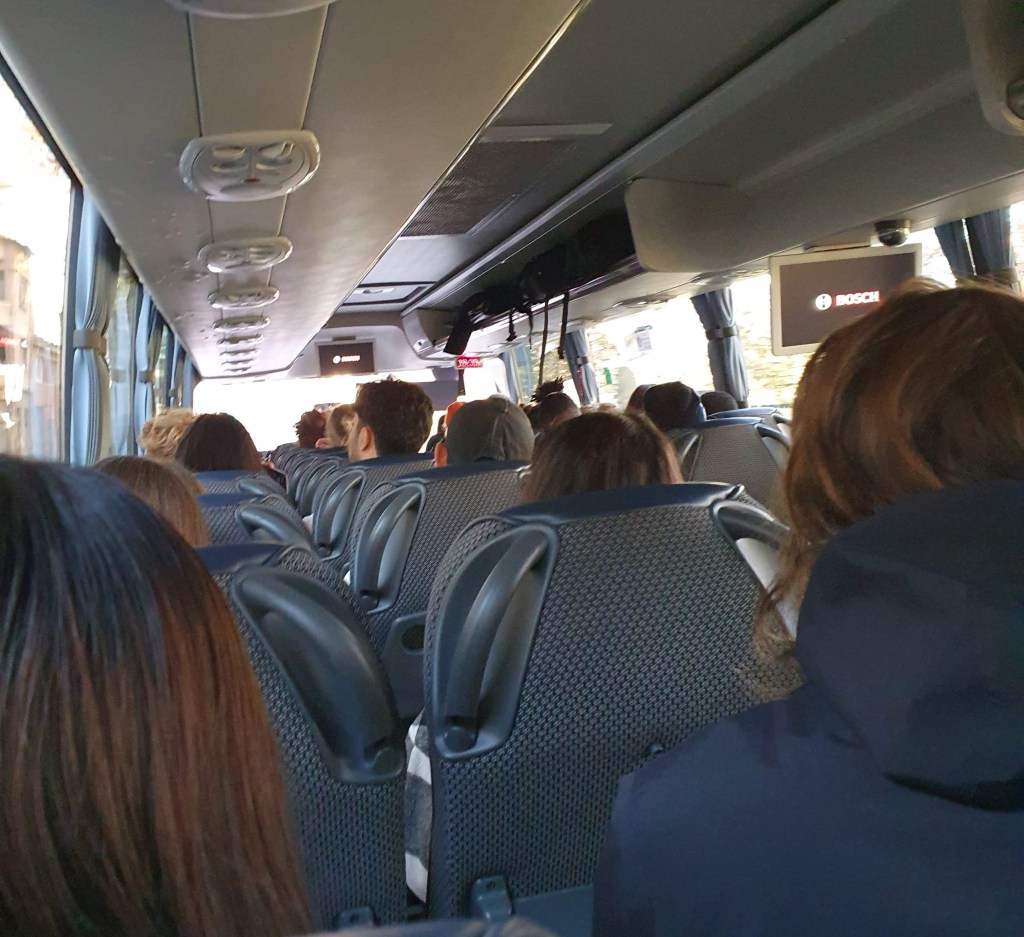
Once we got going, various passengers shouted out to the driver the name of intermediate stations they wished to get off at. However, it became apparent that the driver did not know where these stations were and we spent some time driving round small villages off the main road trying to find the station. Once a station had been found and the passengers dropped there, it was often the case that there was no room for the bus to turn round. Much manoeuvring ensued, which in one place nearly led to the demolition of a street light.
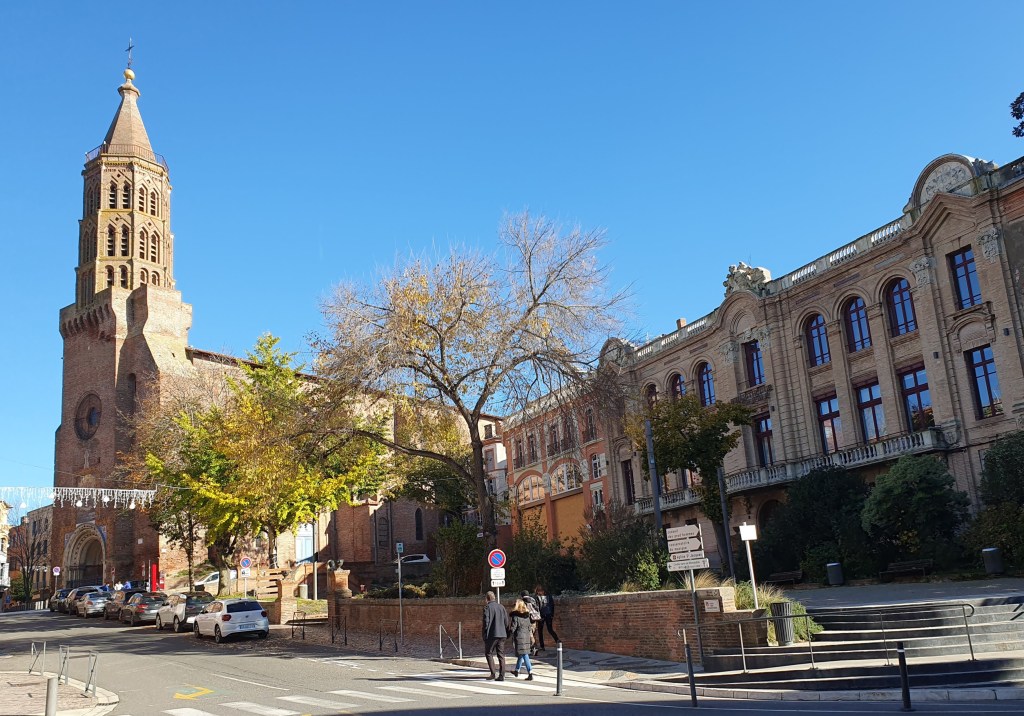
All the twists and turns of the bus through village speed bumps had left me feeling slightly sick, probably not helped by the raw duck’s gizzards I had eaten the night before. At about 1245 we eventually arrived in Montauban, some 20 minutes after the time I should have got to Cahors. At Montauban station the departure board said that there should be a train to Cahors in an hour at 1341. I decided to walk to the centre of Montauban, which is a little way from the station. Montauban has an Ingres museum, which looked quite interesting, but I sadly concluded that I would not be able to go inside and still be back in time to catch the 1341 train.
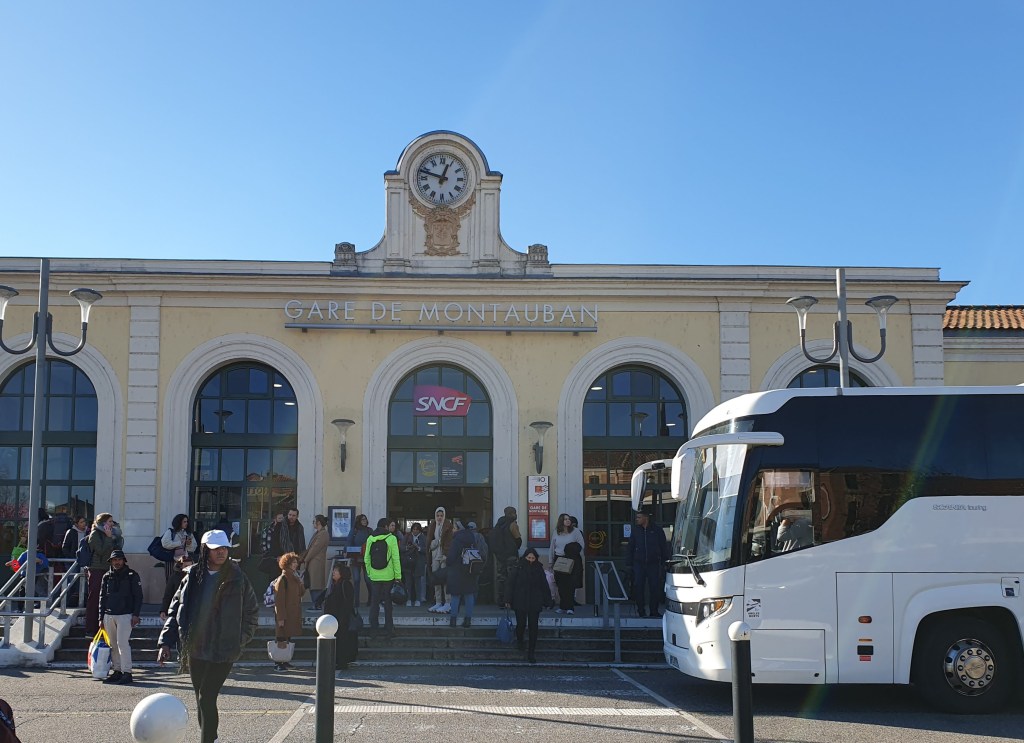
Returning to the station, the Cahors train was still shown as being on time. I went to the platform, where there were already a large number of people waiting and a train sitting there. However, the train doors were locked and we could not get on board. The 1341 departure time came and went with no sign of any train crew, but the departure board still saying the the train was on time. Ten minutes after it should have gone, the departure board changed to showing it being delayed by 35 minutes. But again after 35 minutes there was still no sign of any action. Eventually, a driver (but no other train crew) appeared an hour after the advertised departure time, opened the doors and we departed shortly afterwards.
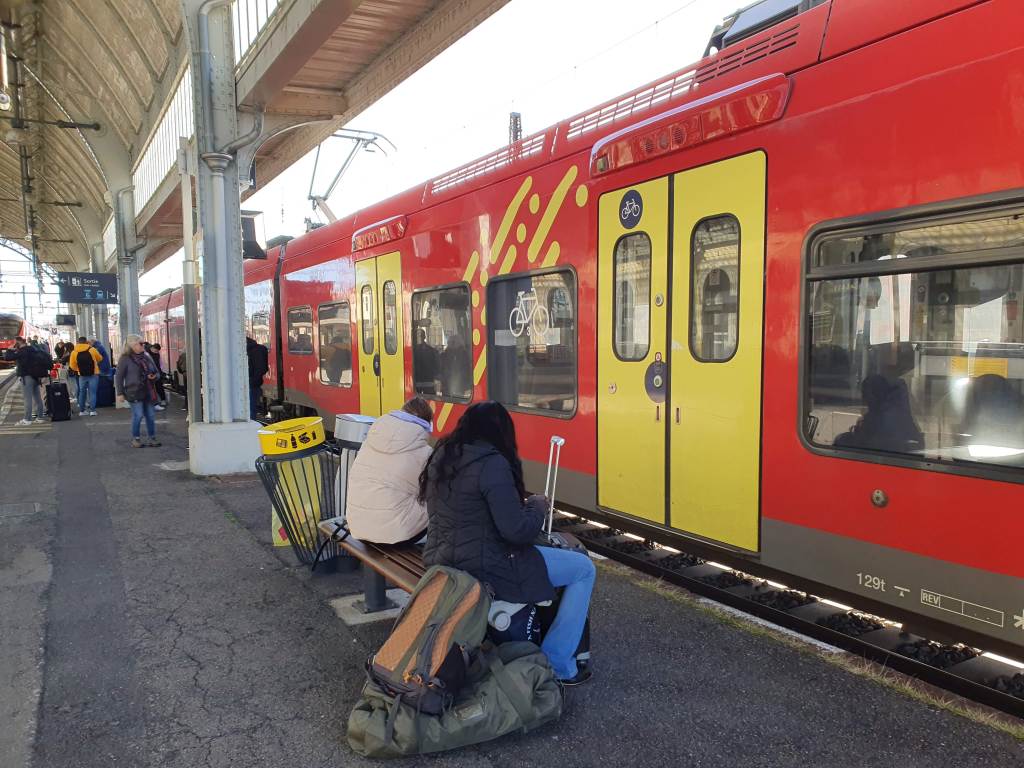
The train arrived in Cahors at 1530 – three hours later than I expected to be there. The hotel that I had booked for the night was very near the station, so I quickly dropped off my bag before going on to explore Cahors. The old town of Cahors is situated on a peninsular created by a meander of the River Lot. The river is spanned by the 12th century Valentré bridge. I walked across this bridge and on the far side of the river went to visit an old pumping station, which opens as a museum at weekends. The woman who was in charge was having a cigarette break on the riverside path as I approached, so she told me just to go straight in. When she came back inside, while I was still looking round, she tried to engage me in conversation, but my French is poor and her English was non-existent. When she realised that I was an English speaker she tried to find all the leaflets she had in English about the pumping station, and a variety of other subjects, which she insisted I take away with me.
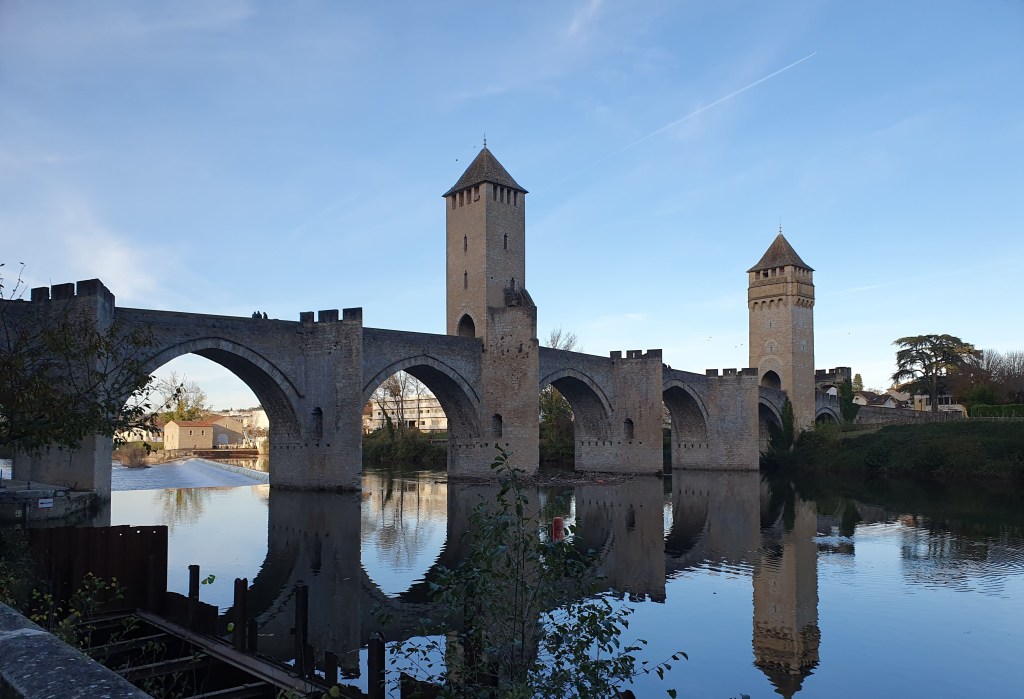
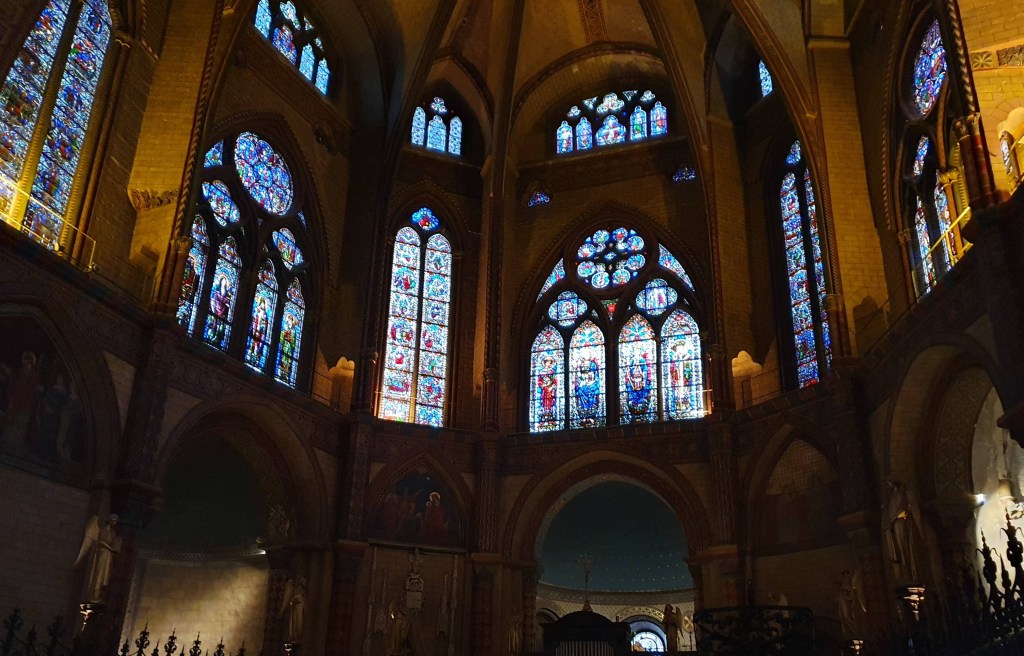
By the time I had finished in the pumping station, the sun was beginning to set. I recrossed the Valentré bridge and made my way to the centre of the old town. I called in at Cahors Cathedral. It is Romanesque in design, first built in the 12 century. I was rather taken by its simple elegance, its interior being dimly lit in the fading late afternoon light.
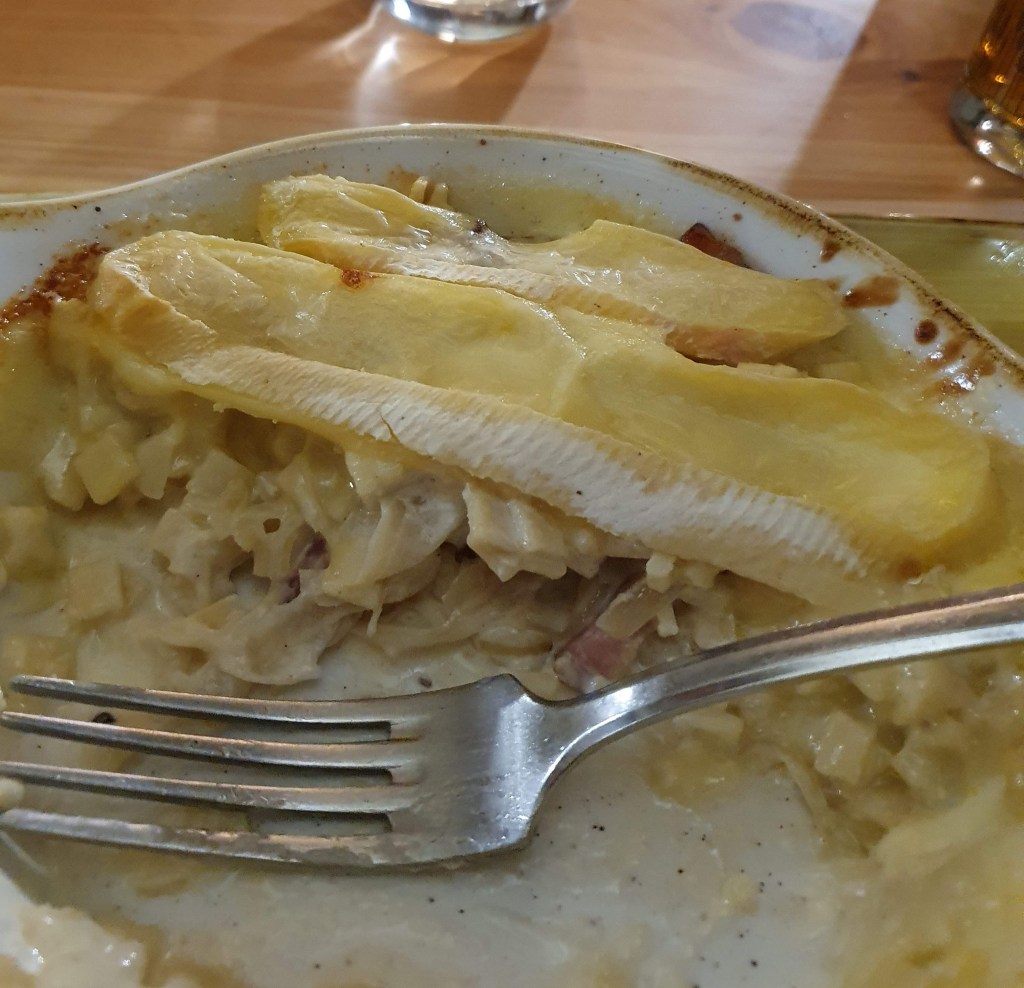
I returned to my hotel, which was by far the cheapest on this trip. The reviews were not particularly favourable, but although the room was rather spartan, it was fine for a one night stay. That evening I went to a seasonal restaurant, which is only open from the beginning of November to the beginning of April, which specialises in hearty cheese-based dishes. I had onion soup to start, which had more melted cheese and croutons than soup. For my main course I tried the classic croziflette, which is like tartiflette except that a local form of diced pasta replaces the potatoes in the baked dish of cheese, bacon and onions. For dessert I had a type of cold apple crumble served in a glass.
Day 7 – Monday 27th November 2023 – Cahors to Limoges
When I awoke, I heard the unwelcome sound of a notification on my SNCF app informing me that the IC train I was due to catch to Limoges would be 20 minutes late. It was starting in Toulouse, where to compound the problems of the previous day, an engineering train had now derailed blocking a number of lines out of the station. As I got dressed and started to make my way to the station the estimated delay to my train got steadily longer, such that by the time I arrived at Cahors station the departure board was showing it being 90 minutes late. I decided that this gave me time to go back to the centre of Cahors and explore a bit more in daylight some of the sights I had not properly seen the previous evening.
The estimated delay continued to increase and after it was being shown as more than two hours late the train was cancelled. I had by this stage worked out that there was an alternative way to get to Limoges by catching a couple of TERs. However, unlike the TERs I had caught previously, whose tickets could be used on any train that day, my ticket was for the specific IC train that had been cancelled. So I returned to Cahors station and joined a queue at the ticket office to get my ticket changed or validated for my new route. The queue moved slowly and seemed to mainly comprise people who wanted to rebook to Paris, who were being given the unwelcome news that all the Paris trains that day were now fully booked. When I reached the head of the queue my ticket was duly stamped as being valid on my alternative route.
I caught the 1037 train from Cahors to Brive-la-Gaillarde (two hours later than my intended direct train to Limoges), which arrived in Brive at 1143. From Brive there was a connecting train to Limoges at 1225. This gave me a brief opportunity to explore Brive-la-Gaillarde. I had an uncertain recollection that I had stopped off overnight in the town when touring France by car some 40 years ago, and I wondered if I would recognise any of it. The town centre is quite a way from the station, and when I was nearly there it started to rain hard, so I gave up my quest and returned to Brive-la-Gaillarde station. When I arrived at the station, the train to Limoges was already waiting in the platform, so I got on it.
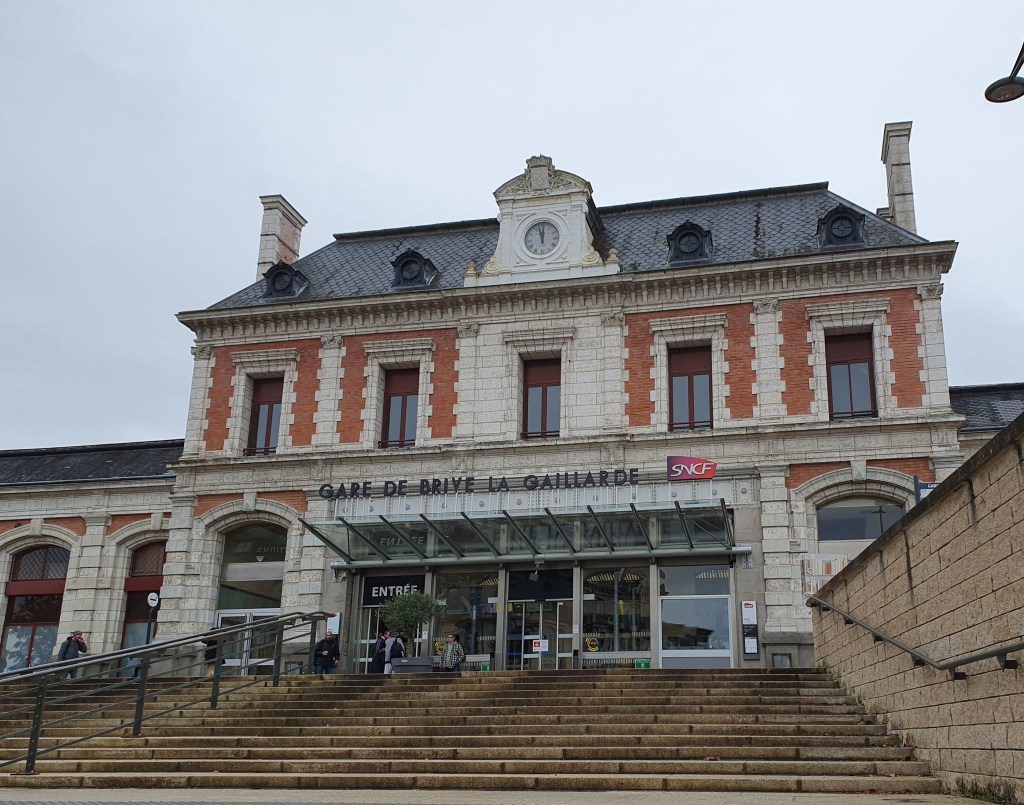
The train left on time. In my compartment, I counted seven ticket inspectors, which was more than the number of passengers. I think that some of them were trainees, because when a young woman came and scanned my ticket she seemed puzzled and started to say that it was not valid, until an older colleague looked at it and pointed out to her the overstamping by the ticket office in Cahors. The train took a scenic route following the Vézère river (a tributary of the Dordogne) through wooded hills. We arrived in Limoges on time at 1344 (nearly three hours later than originally intended). All seven ticket inspectors from my compartment congregated by the exit from the train, and when the doors opened we were met by another group of transport police. I was not allowed to get off until one of the ticket inspectors had identified to the police a suspect on the train who they wished to be detained.
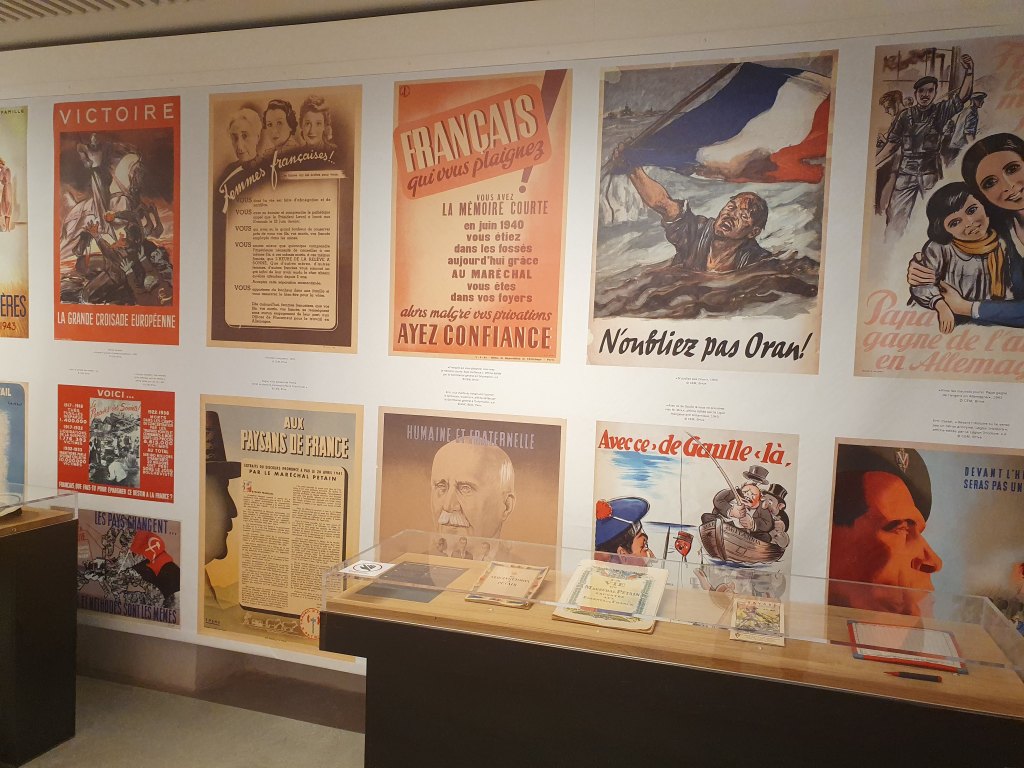
When I emerged from Limoges Bénédictins station it was raining hard, so my route for exploring the city was designed to give the least walking outside. My first stop was at the Musée de la Resistance. Once I had shaken my umbrella sufficiently to go inside, I purchased an audio-guide to the permanent exhibition. Although there was a school party visiting the temporary exhibition on women in WWI, during my time there I was the only visitor in the permanent exhibition. The audio guide was very detailed, translating all the information boards which were otherwise only in French. I thought the museum was very good. It tried to dispel the myth, which was promulgated afterwards, that the Resistance enjoyed popular support during the war. It portrayed a picture of widespread cooperation with the Nazis, both by the Petain regime and by the population more generally, with anger at the activities of the Resistance, only partly because of the reprisals that followed.
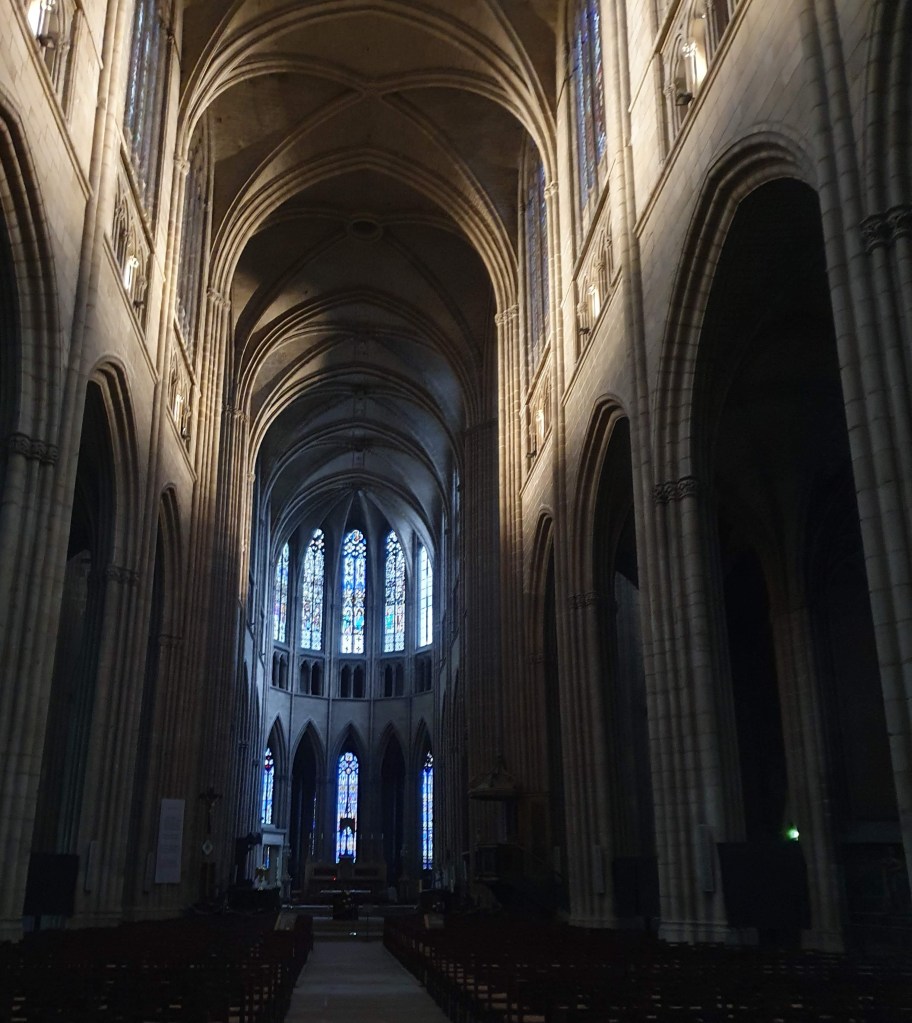
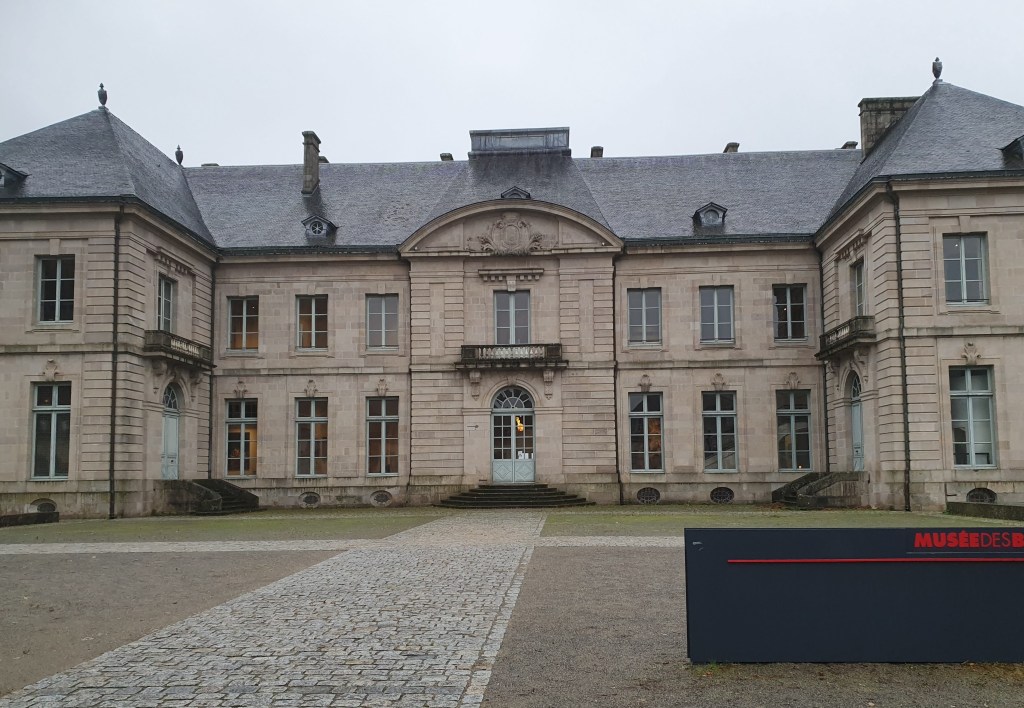
From the Musée de la Resistance I paid a brief visit to the Gothic St Etienne Cathedral, and then went on to the nearby Musée des Beaux-Arts housed in the former Bishops Palace. As well as being an art gallery, the Musée is a local history museum and also contains some relics from ancient Egypt. The art on display is largely by (to my knowledge) obscure local artists, and is not of the same quality as I had found in Lyon and Montpellier. I spent the rest of the afternoon in the Musée des Beaux-Arts. This meant that I had no time to venture to the pottery museum as originally planned – Limoges is famous for its porcelain. I also learned while in Limoges that the adjectival form of the name of the city is Limousin (which is also the name of the surrounding area). How this came to be used as the word for an upmarket car is not clear.
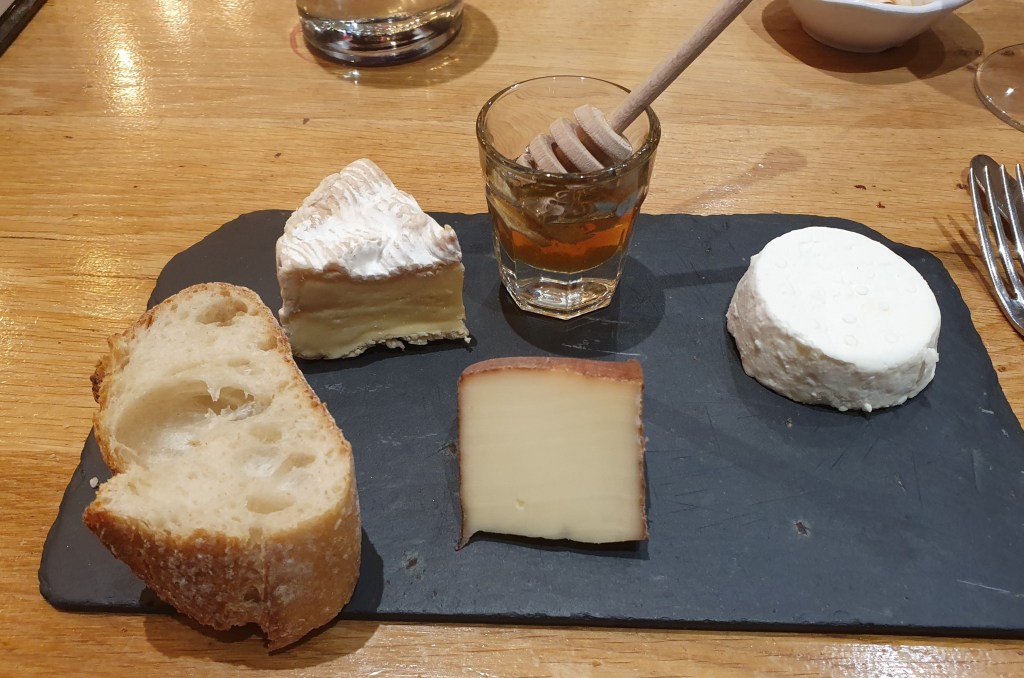
I went to the hotel I had booked for the night in the centre of the city. As it was still raining, I didn’t want to wander about looking for a restaurant for dinner, but being my last night in France I wanted somewhere traditional, so I reserved a table at a promising restaurant about 15 minutes walk from my hotel. Fortunately, the rain had eased considerably by the time I needed to go out again. I was very pleased with the place I chose for dinner, the portions were enormous and the quality good. I started with a home made terrine, followed by a steak with shallot sauce. After two courses, I was quite full, but I had promised myself three courses for my final dinner, so I finished with a plate of local cheeses.


Day 8 – Tuesday 28th November 2023 – Limoges to London (via Paris)
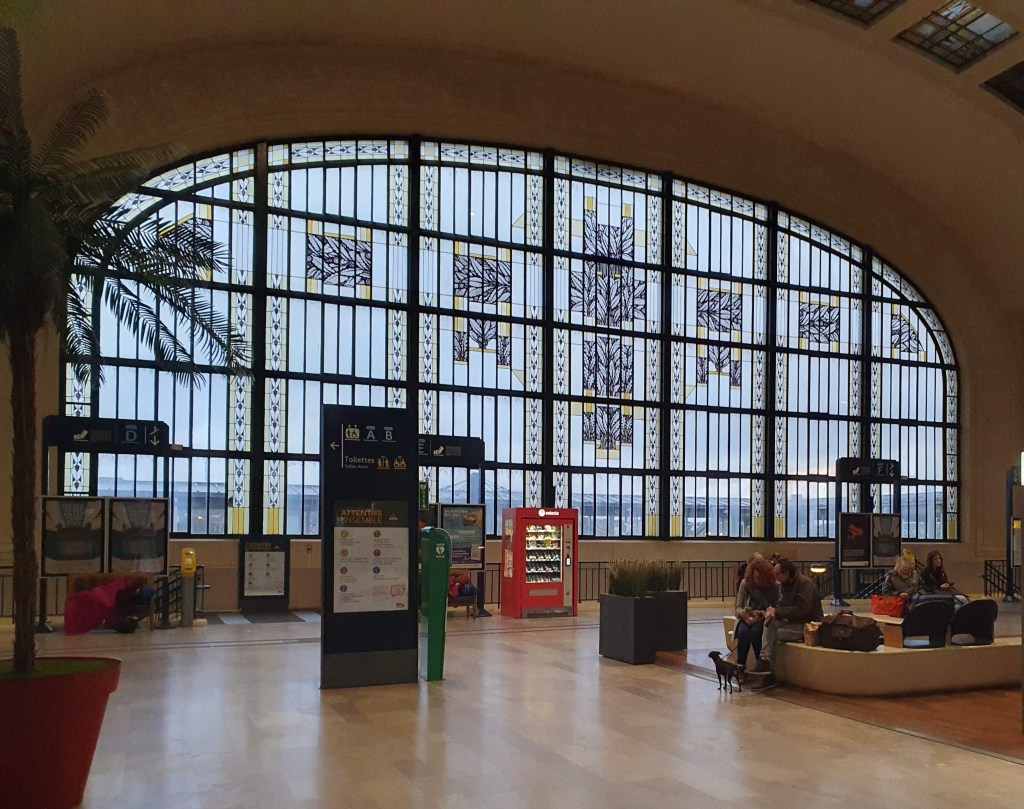
When I turned on my phone after I awoke, I was dreading the familiar sound of a notification from SNCF indicating that my train would be late or cancelled. But no sound was heard and the train was shown as running as scheduled. I walked the short distance back to Limoges Bénédictins, arriving in sufficient time to admire the architecture of the station.
My train was the 0858 to Paris Austerlitz and, despite what my app was telling me, I was still amazed when it pulled into the platform on time. For the 3h 20m journey to Paris I was travelling first class for the only time on this trip, having secured a ticket for just €25. The first class carriage I was in was completely full and I had to evict someone who was sitting in my reserved seat.
The train crossed the Loire at Orleans, but otherwise the scenery was not particularly interesting and the journey was uneventful. We arrived at Paris Austerlitz on time at 1218. Yet again when I got off the train, I observed the transport police detaining three youths who had been on board. Perhaps the French should put as much effort into making their trains run on time as they seem to expend on cracking down on fare dodgers.
I contemplated going to a museum or gallery while in Paris, but concluded that I wouldn’t have time to get value from the entrance fee for the bigger museums, while for many of the smaller ones Tuesday is their closing day. Instead, rather than catching the metro, I decided to walk along the route of the Canal St Martin, via the Place de la Bastille, towards the Gare du Nord. I didn’t want to arrive too early at the Gare du Nord, as I find the immediate area rather insalubrious and unpleasant for wandering, so I called in at a small café just off the canal where I spent a while having a snack.

When travelling back from the Gare du Nord, I always call at a supermarket a couple of blocks away to buy some of my favourite French beer, 3 Monts. However, on this occasion they didn’t have any in stock.
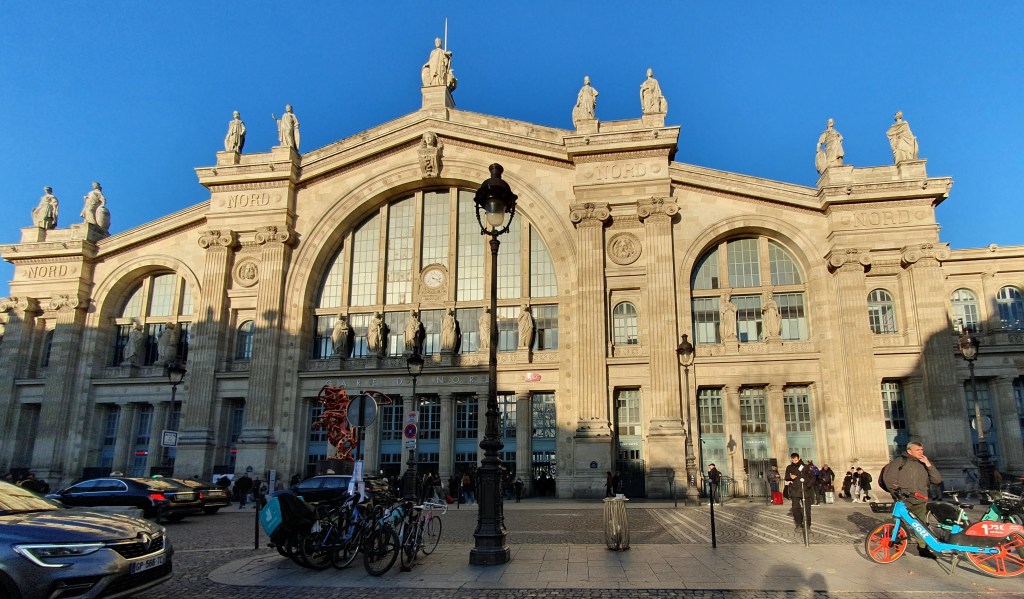
I checked in at the Eurostar terminal about an hour before my 1709 departure. The train left on time, but slowed noticeably as it approached the entrance to the Eurotunnel, resulting in it being six minutes late on its scheduled 1830 arrival into St Pancras.
This trip had more little annoyances than most of my previous ones – including cancelled trains, shut museums and broken glasses. Nonetheless, I still got to all my intended destinations eventually, learned a lot and had some really good meals. Coping with the unexpected is all part of the fun of travelling.
 Europe Explored