
“The air soft as that of Seville in April, and so fragrant that it was delicious to breathe it.” (Christopher Columbus)
[Continuing the account of the holiday in southern Spain that I took with my wife in early 2023.]
Day 5 – Monday 27th February 2023 – Cordoba to Cadiz
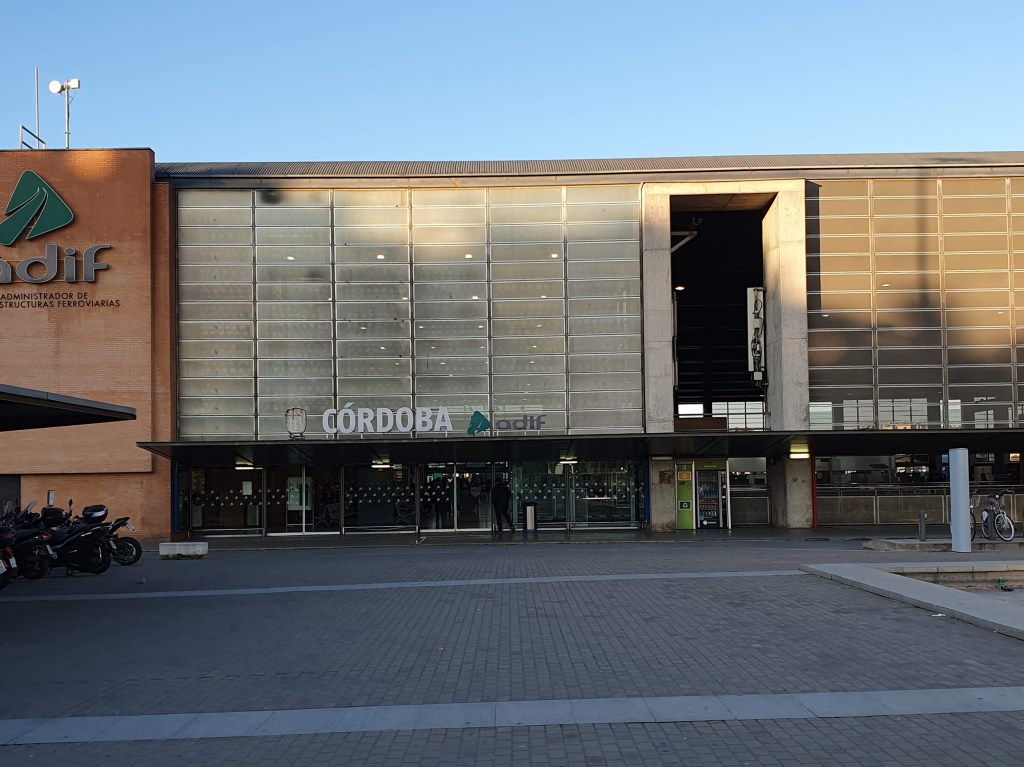
We walked the short distance from our hotel to the station in Cordoba. For such a beautiful city Cordoba has a remarkably ugly station, which looks like a concrete box. We were slightly alarmed when we walked into the station to see our train to Cadiz was not shown on the main departure board. However, looking at the smaller monitor displays it was shown there. After a very cursory security check we went down to the platform to wait for our train to Cadiz – it was coming from Madrid and pulled in a couple of minutes late, shortly after 9am.
For this journey we were travelling Confort class, the Spanish version of first class. On this train, Confort class did not bring you any extra benefit other than more widely spaced seats, and throughout this journey our carriage remained nearly empty. On the outskirts of Seville the train stopped for a while and then proceeded at walking pace, but nonetheless pulled into Seville on time – I think this was due to the train’s gauge being changed from standard on the high-speed line from Cordoba to broad for the run down to Cadiz.
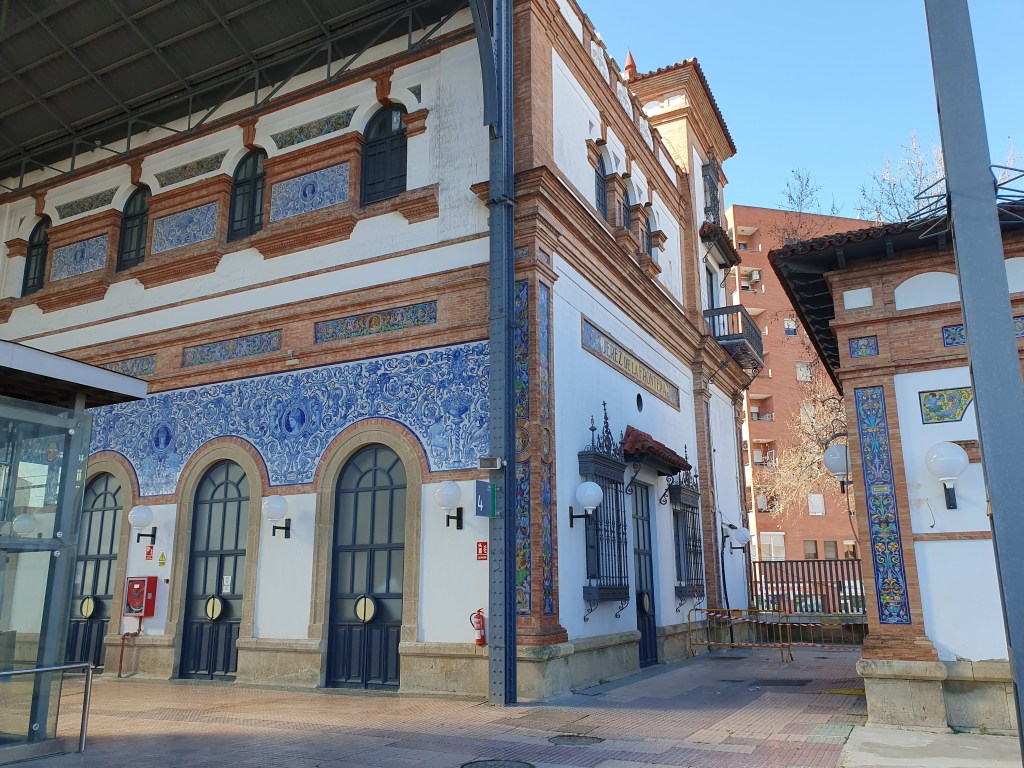
After leaving Seville the train passed through Jerez de la Frontera, the town at the centre of Andalusia’s sherry region, which has a lovely tiled station building.
The train travelled in a big arc to get to the narrow sand spit which joins Cadiz to the mainland, and arrived in Cadiz on time just before 11:30am. We knew that it had been the final weekend of Carneval in Cadiz just before we arrived and on leaving the station we encountered an army of cleaners who were tidying up the city. We walked to our hotel in the old part of the city and left our bags, as it was too early to check-in.
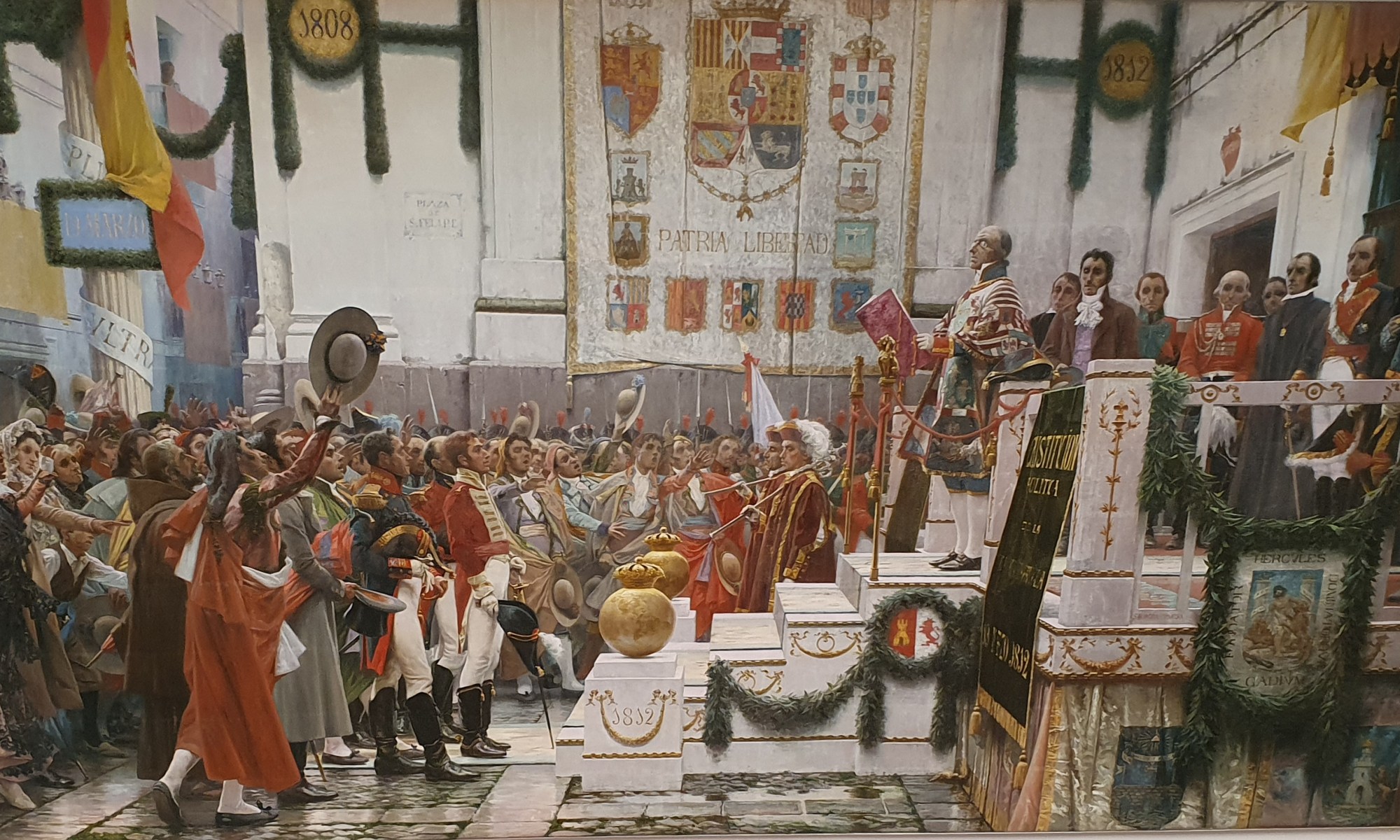
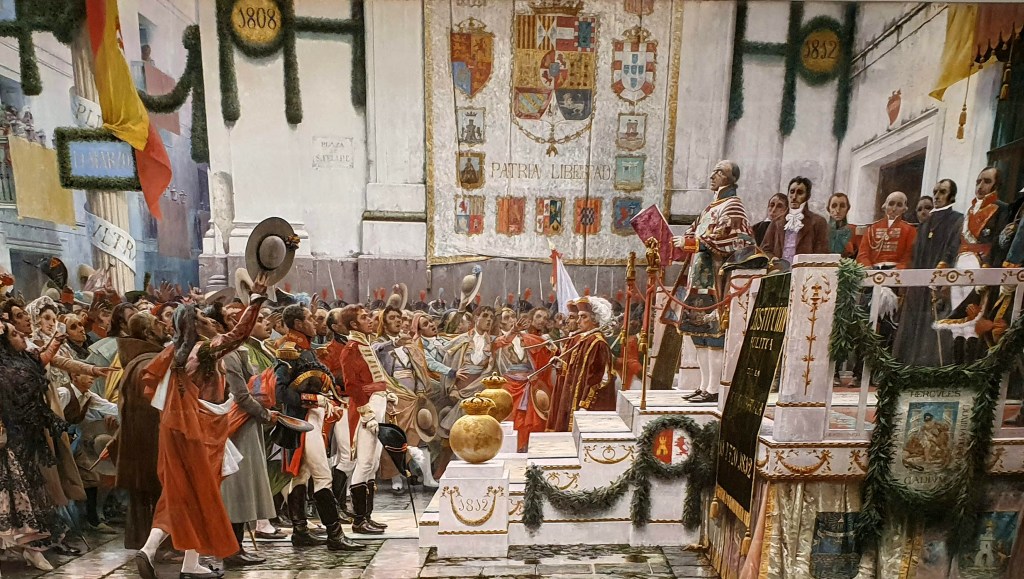
Our first visit in Cadiz was to the Museum of the Cadiz Constitution. A gathering in 1812, when Cadiz was one of the few places in Spain to hold out against Napoleon’s occupation, drew up a new constitution for Spain based on a constitutional monarchy and an elected Cortes. The museum contained a model of the layout of Cadiz in the early 19th century and a large painting by Salvador Viniegra depicting the declaration of the new constitution. There were also displays covering the Peninsular War, or the War of Independence as it is known in Spain.
When we had finished in the museum we walked through the market area. There many stands selling food of different types and from one I bought a warm bocadito containing ham and cheese.
As with all the cities we visited on this trip, Cadiz has the remains of a Roman theatre, which has a small museum attached. We spent a while exploring this in the pleasant early afternoon sunshine.
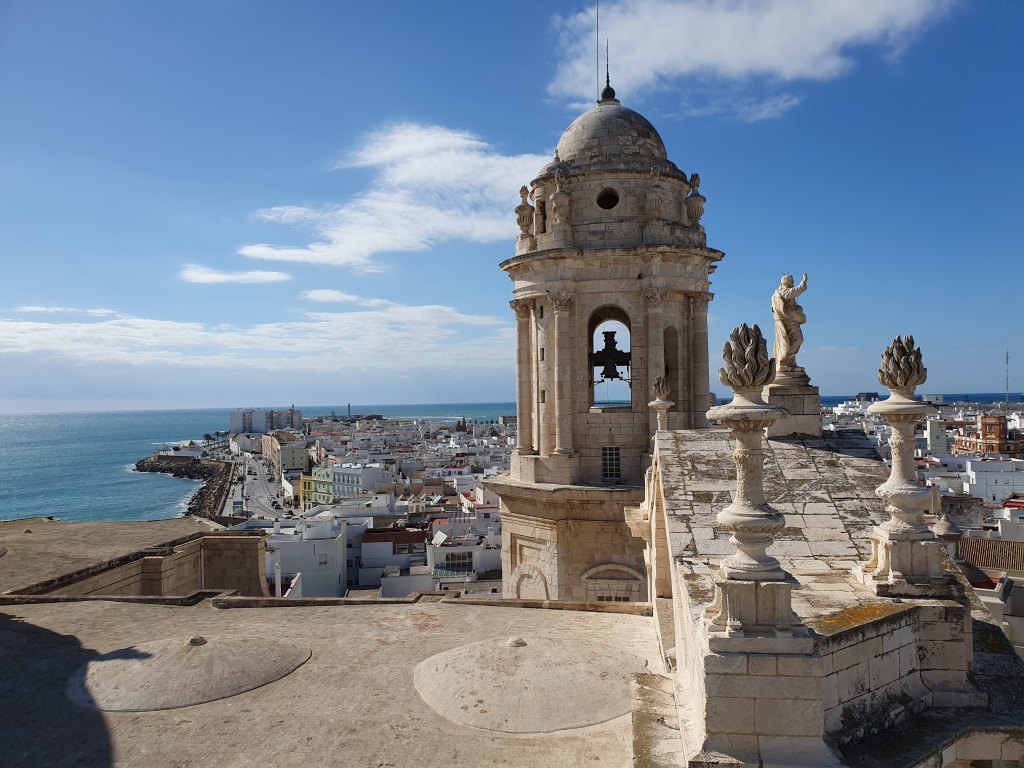
Cadiz Cathedral is near the Roman theatre and we went there next. Not finished until the 19th century it is mainly neo-classical in style. After the usual audio-tour of the main body of the church and the crypt, we climbed the bell tower. There were good views in all directions from the top and while we were adjacent to the bells they chimed for three-quarters of an hour, which was deafening.
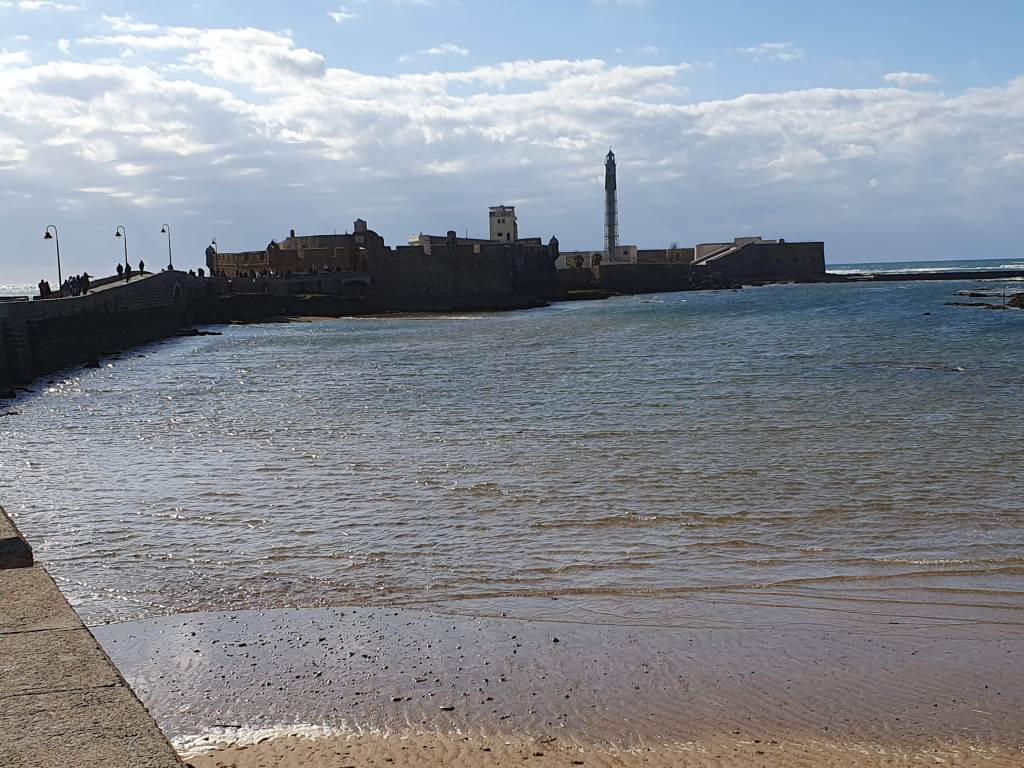
We then walked along the main promenade in Cadiz, which unlike Malaga fronts the Atlantic Ocean not the Mediterranean Sea. At one end of the promenade is a causeway to the Castillo San Sebastian which we walked out to, although access to the Castillo at the end is closed at the moment.
We walked back through the old town and checked into our hotel. That evening we dined in a Middle Eastern restaurant, where I had lentil soup, followed by lamb kebabs.
Day 6 – Tuesday 28th February 2023 – Cadiz to Seville
Although we had factored in avoiding the Cadiz Carneval in our planning for this trip, it wasn’t until we arrived in Spain that we realised that 28th February is Andalusia Day, a public holiday in the region. Some places that were normally open on a Tuesday were closed on Andalusia Day, causing some replanning of our activities.
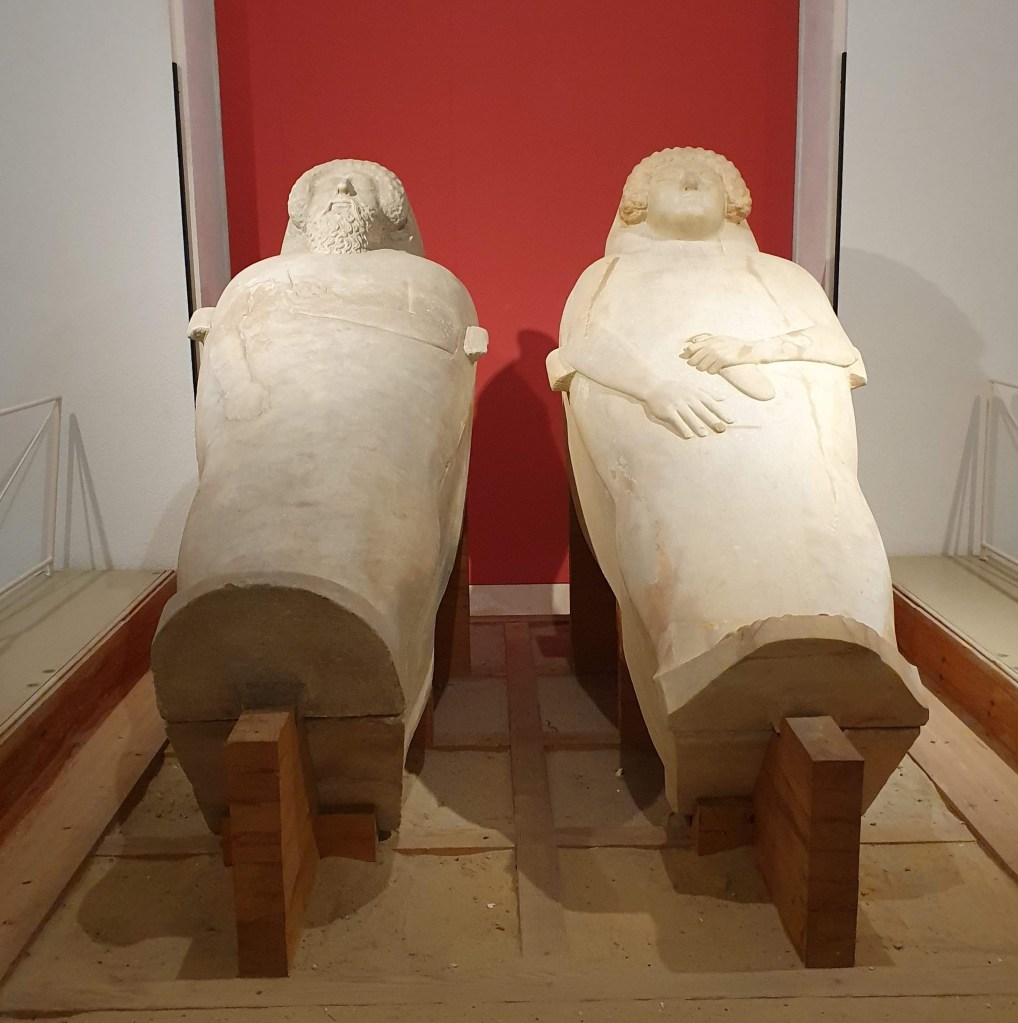
Fortunately, the Museum of Cadiz was open and we got there just after it opened at 9am. The museum is spread over three floors. The ground floor is devoted to early history – covering the pre-historic, Phoenician and Roman periods. One of the star exhibits is a pair of male and female marble sarcophagi from the Phoenician period. Most of the first floor is an art gallery, consisting mainly of Spanish works from the 17th to 20th centuries. There are a number of large canvasses by Francisco de Zurbarán which had been removed from a monastery in Jerez de la Frontera. The top floor also contained a collection of puppets.
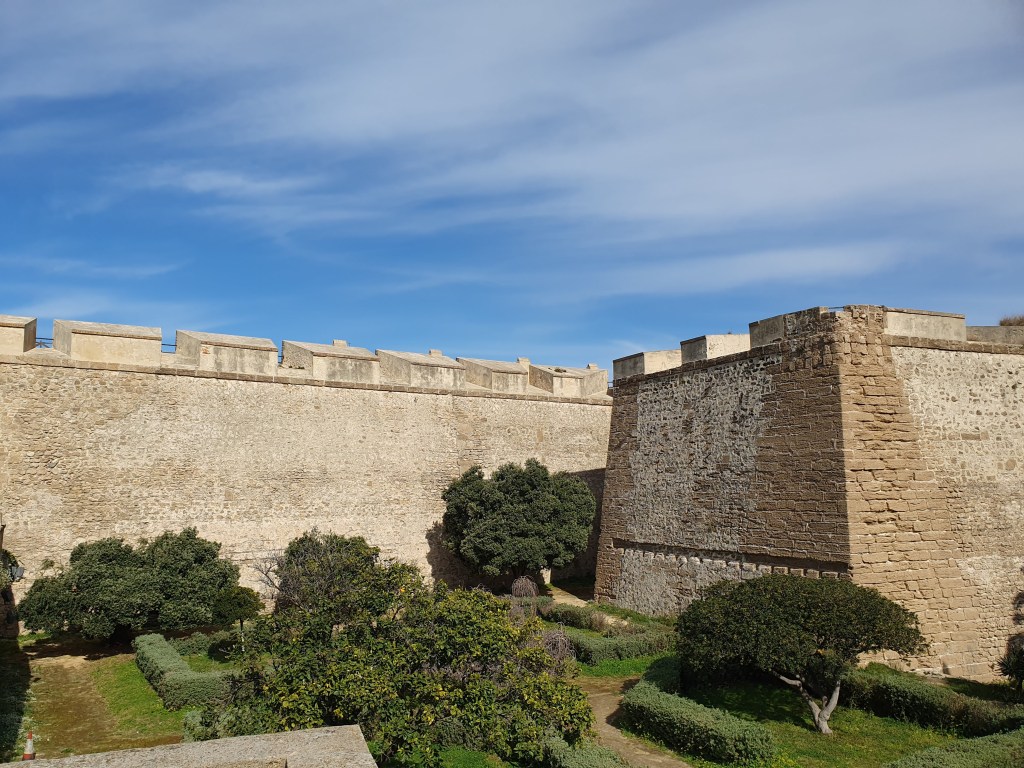
When we had finished in the museum we walked back through the centre of the town to the fortifications which guarded the approach from the mainland. We had hoped to go on top of these, but it was not possible at the time of our visit. The market where we had lunch the previous day was even busier when we went back to it again, with no spare tables to eat what you have bought, so we didn’t bother to get food on this occasion. Adjacent to the market is Cadiz’s postal headquarters and we took the opportunity to post our postcards into the ornate lion’s mouth on the wall of the building which served as a postbox.
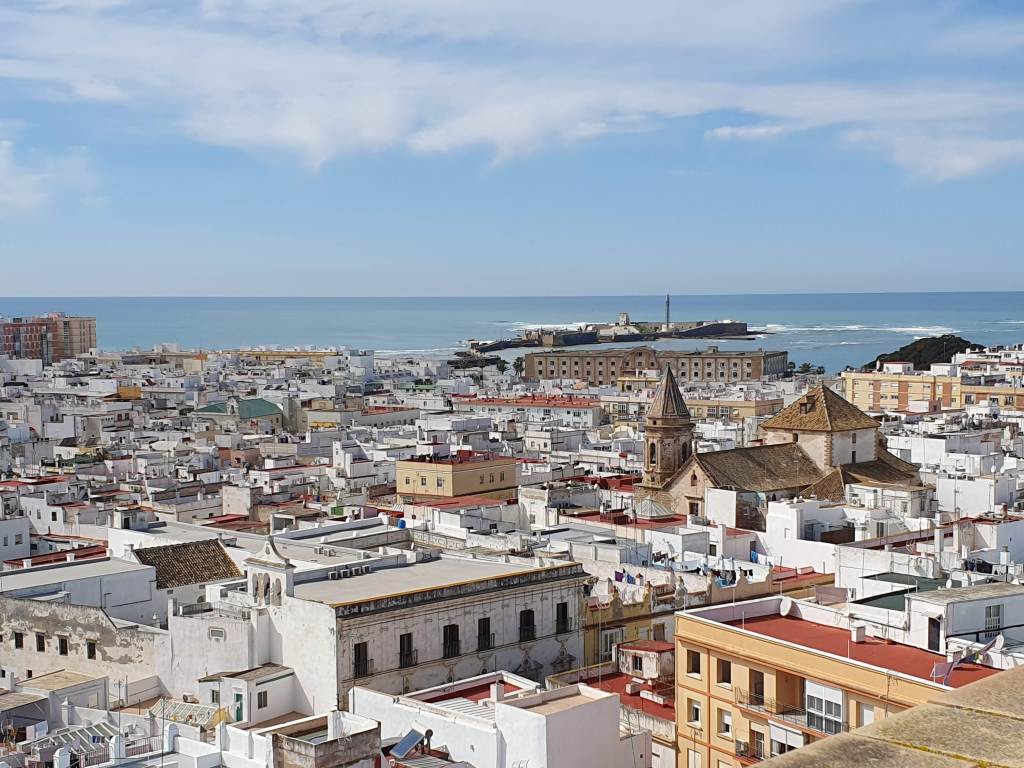
During our wanderings we had booked a timed ticket for a display of the camera obscura in the Torre Tavira and at the appointed time climbed the tower. The top of the Torre Tavira is the highest point in Cadiz and there were good views in all directions. We were ushered into a darkened room to view the camera obscura show – this seemed slightly voyeuristic, observing the activities on the flat roofs of nearby buildings. It was pointed out that many of the buildings in old Cadiz had watchtowers, so that the residents could look out for any invasion attempts on the city.
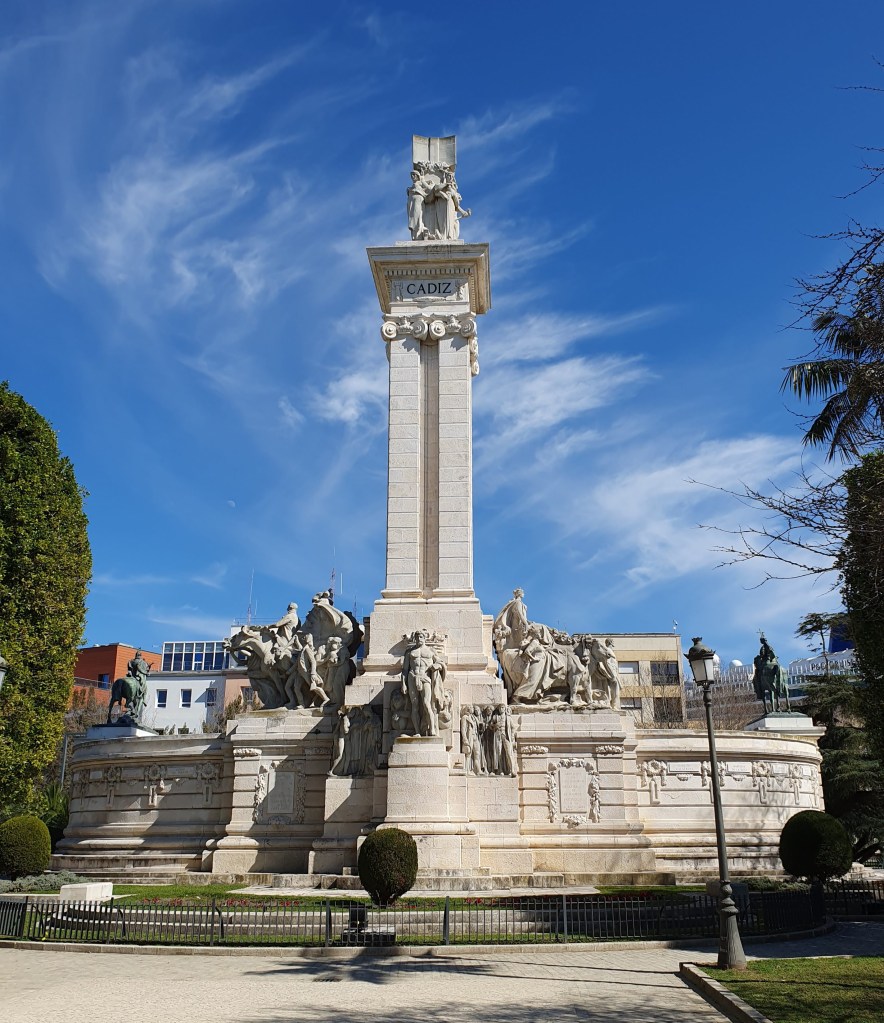
We had a late lunch of delicious homemade ice cream, bought from a shop on one of Cadiz’s tree lined squares. After a bit more wandering, including visiting the monument to the Cadiz Constitution, we collected our bags from our hotel and made our way to the railway station.
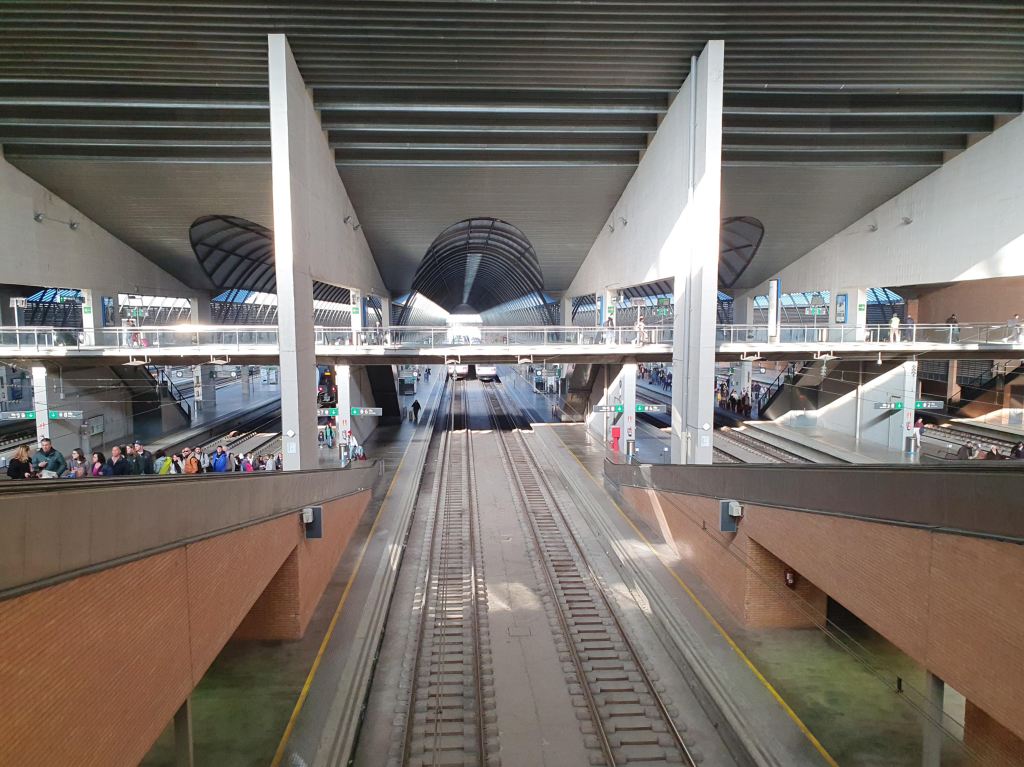
We were catching the 1540 train to Seville. This was a more local train than the one on which we had arrived in Cadiz, stopping at more places on route and taking just under two hours to arrive at Seville Santa Justa station.
Our hotel in Seville was within walking distance of Santa Justa, where we had a spacious room on the top floor. We also were entitled to a free welcome drink which we had on the rooftop bar – as the sun began to set, it became quite chilly sitting in the open air. As it was Andalusia Day, we were not sure sure what restaurants would be open, so we chose one not far from our hotel. It was excellent – we shared some tapas dishes to start and for main course I had Iberian Pork in a sherry sauce.
Day 7 – Wednesday 1st March 2023 – Seville
Our hotel in Seville was the first on this trip to have included breakfast in the price, so we made sure that we got up in time to partake of it – there was a good selection on offer. Being near Santa Justa station meant that the hotel was a little way from the centre of Seville, so we had a twenty minute walk to get there. Our first visit of the the day was to Seville’s Alcazar. Getting there was not helped by Google maps plotting a walking route which tried to gain access via a non-existent gate. Once we realised the problem we walked round the outer wall until we came to the actual entrance, where, as usual, we obtained audio-guides for our visit.
The Alcazar is a sprawling complex with mixture of Mujedar and Christian architectural styles. It was built by Pedro I in the 14th century on the site of a Muslim fortress and is still used as a residence by the Spanish royal family when they visit Seville.

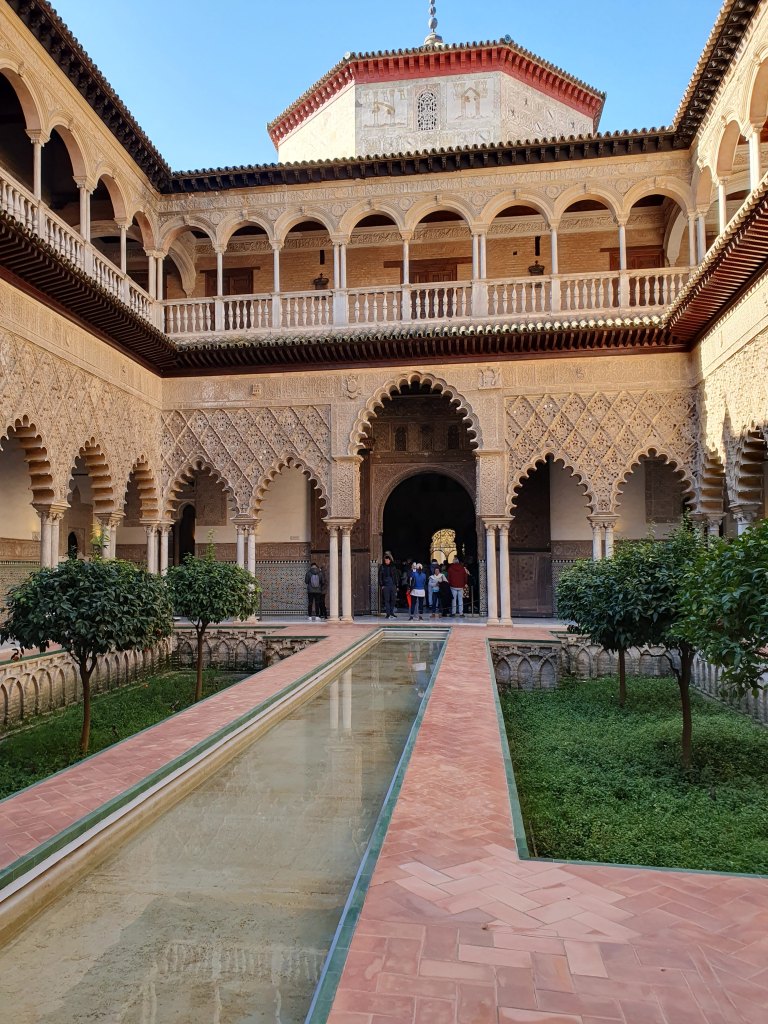
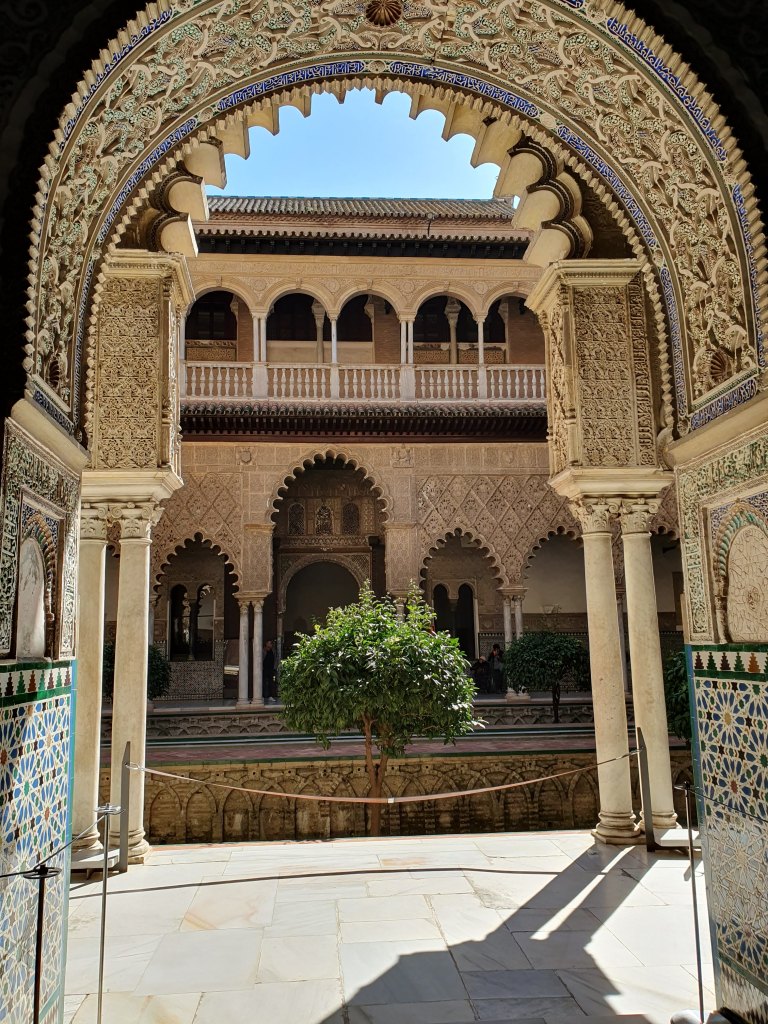
After we had spent a while exploring the main courtyards of the Alcazar, we remembered that the upper floor was only open in the morning and that we had paid extra to be able to see this when we had bought our tickets on-line before we departed for Spain. When we went upstairs to access this area, we discovered that we had made a mistake. Access is by timed ticket and the time printed on our ticket for the Alcazar was the time we should have started the tour of the upper floor, some 90 minutes earlier – not that it said this anywhere on the printed ticket. So we had to wait for a while to see if any no shows meant that we could join a later group. After waiting for about fifteen minutes we were summoned to be allowed to go in. The upper floor is still used as a royal residence, so we had to pass through a security screening for access and be accompanied by a guard throughout our visit. You are given a special audio-guide, which plays at a set pace to regulate your passage through these areas. Unlike the rest of the Alcazar, no photography is allowed in the upper floor – our accompanying guard made sure that this rule was adhered to, as well checking that there there were no stragglers from our small group.
When we were discharged from the upper floor we continued our exploration of the rest of the complex, before going out into the extensive surrounding gardens.
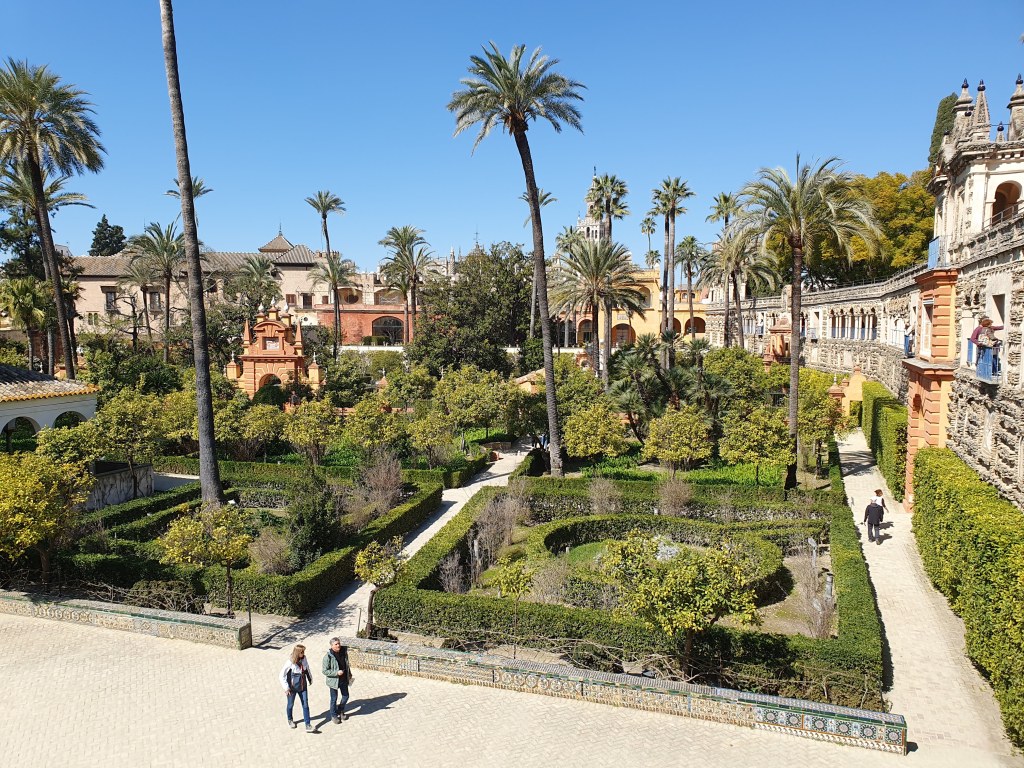
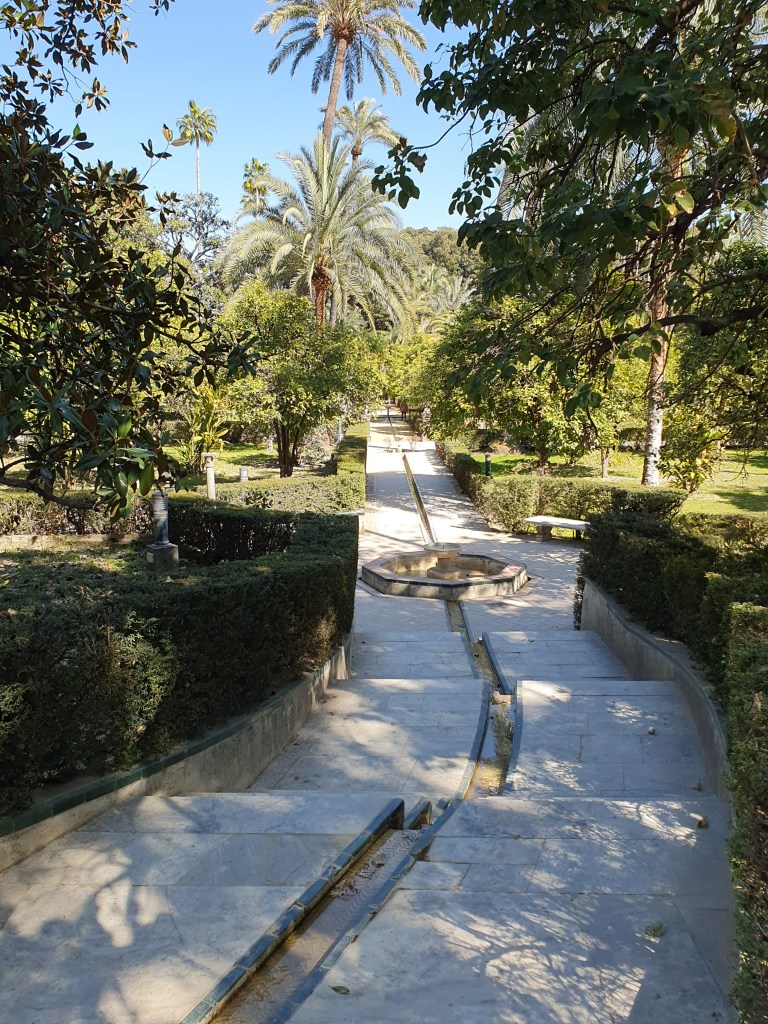
It was mid afternoon by the time that we had finished in the the Alcazar and its gardens. From there we walked to the nearby sprawling park which had been the site of of Ibero-American Exhibition of 1929. This World Fair hosted pavilions for the USA, Portugal, many South American countries, as well as different Spanish provinces. Towards the south of the park there is the Museum of Popular Arts and Customs housed in the former Mujedar Pavilion from the Exhibition. This interesting museum had displays showing traditional crafts of Andalusia, ranging from domestic furniture to the production of sherry.
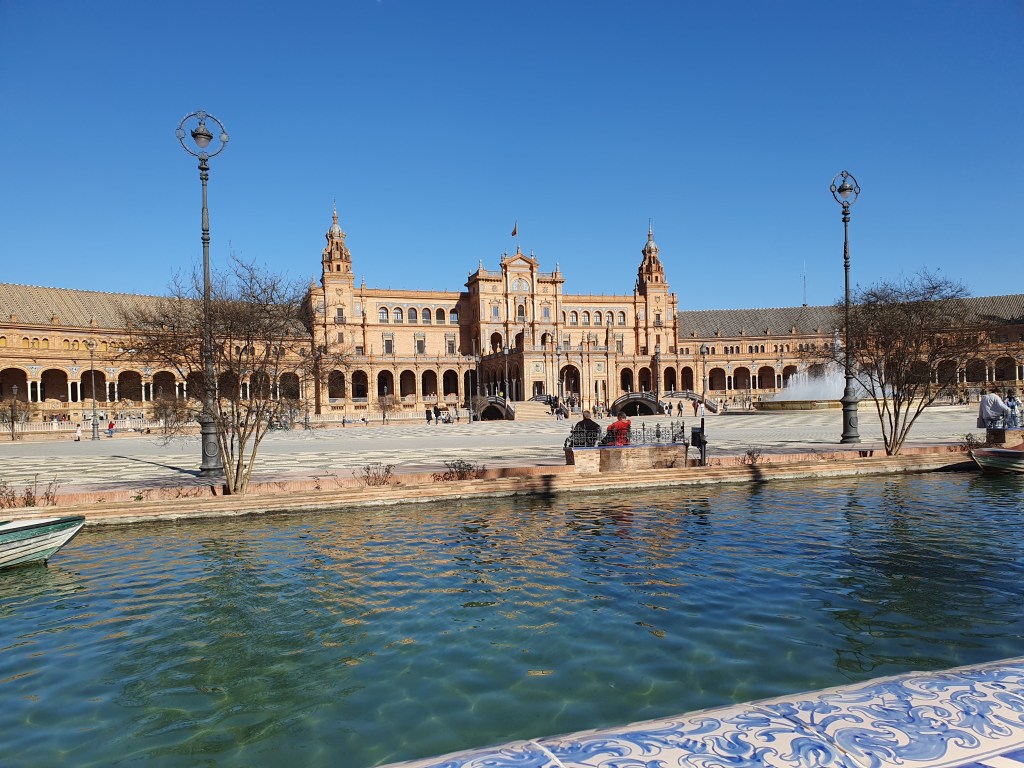
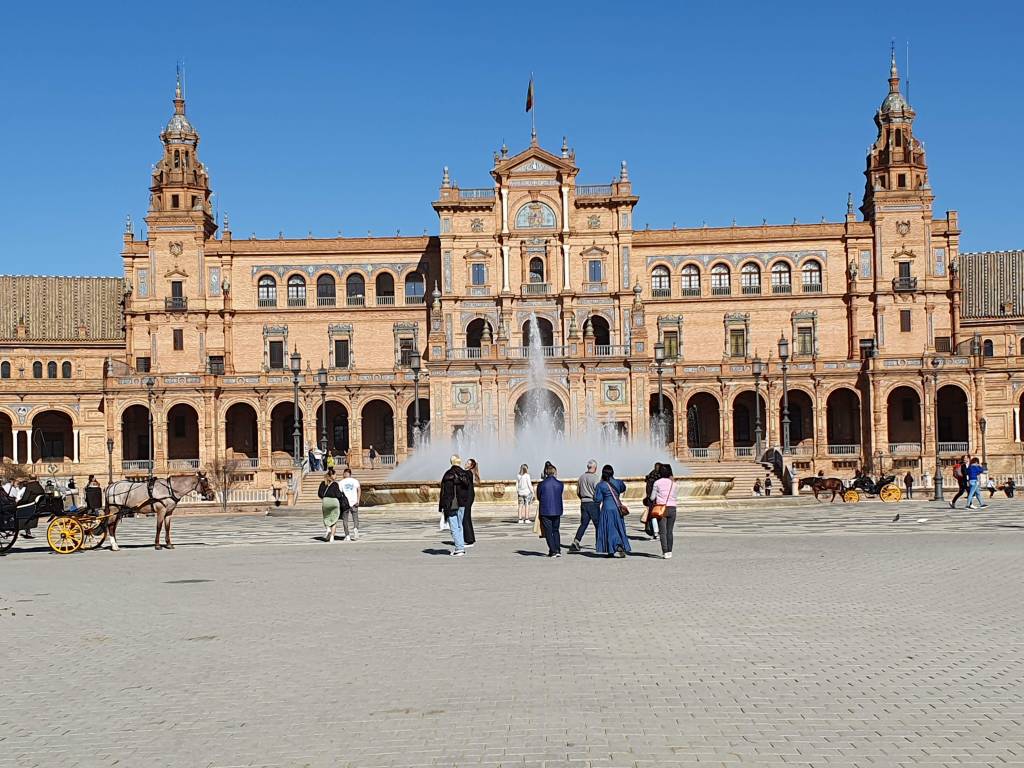
By the time we had finished in the Museum of Popular Arts and Customs it was late afternoon, so we walked back to our hotel. We considered where to eat that evening, but all the other restaurants we found in the vicinity did not look as good as the place we dined in the previous evening, so we returned there. We chose a different selection of tapas to share, which I followed with chicken in cheese sauce. This time we also had a bottle of Rioja to drink.
Day 8 – Thursday 2nd March 2023 – Seville
After breakfast we walked to the city centre, passing on route a still standing part of a Roman aqueduct. We carried on across the Canal de Alfonso XIII, the waterway which acts as a by-pass route for the Guadalquivir. Our first stop was at the Castillo San Jorge, which once housed the Seville branch of the Spanish Inquisition. The remains of the original building can been be seen underneath a modern day market. This small museum, which was free to enter, also had a multi-media display telling some of the grim stories from the Inquisition.

From Castillo San Jorge we went back to the city centre to visit Seville’s Museum of Fine Arts (Museo de Bellas Artes). Situated in a former convent, the galleries are on two floors of four sides of the former cloister, with the former chapel also acting as an exhibition space. The museum has a good collection of Spanish masters, including a number of paintings by Murillo. Following the exhibition chronologically, it was noticeable how Spanish painting seemed to stop developing in the 19th century, say compared with France.
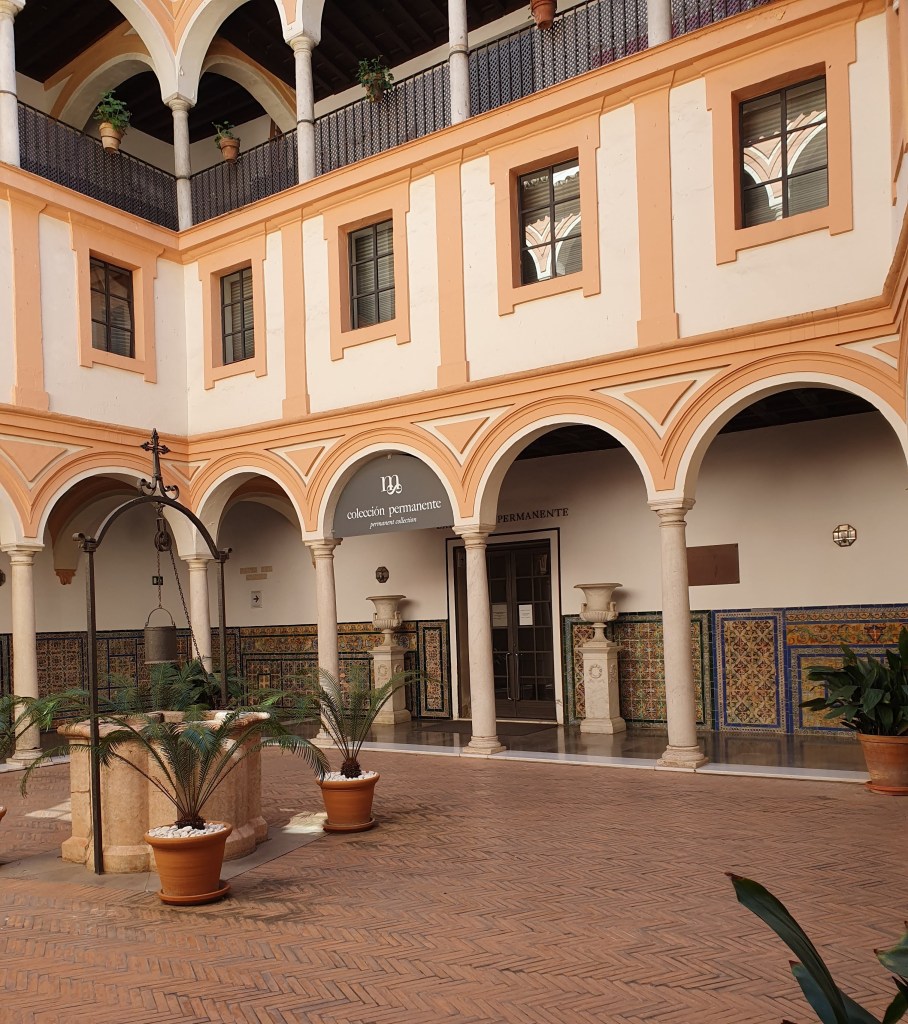
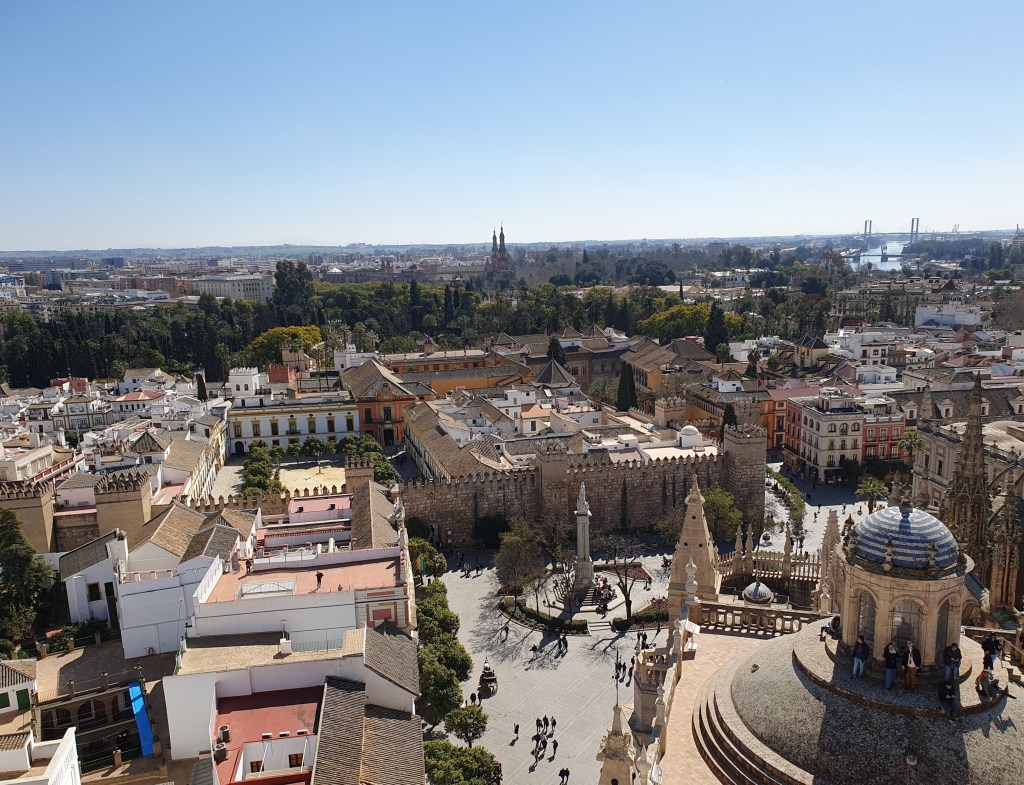
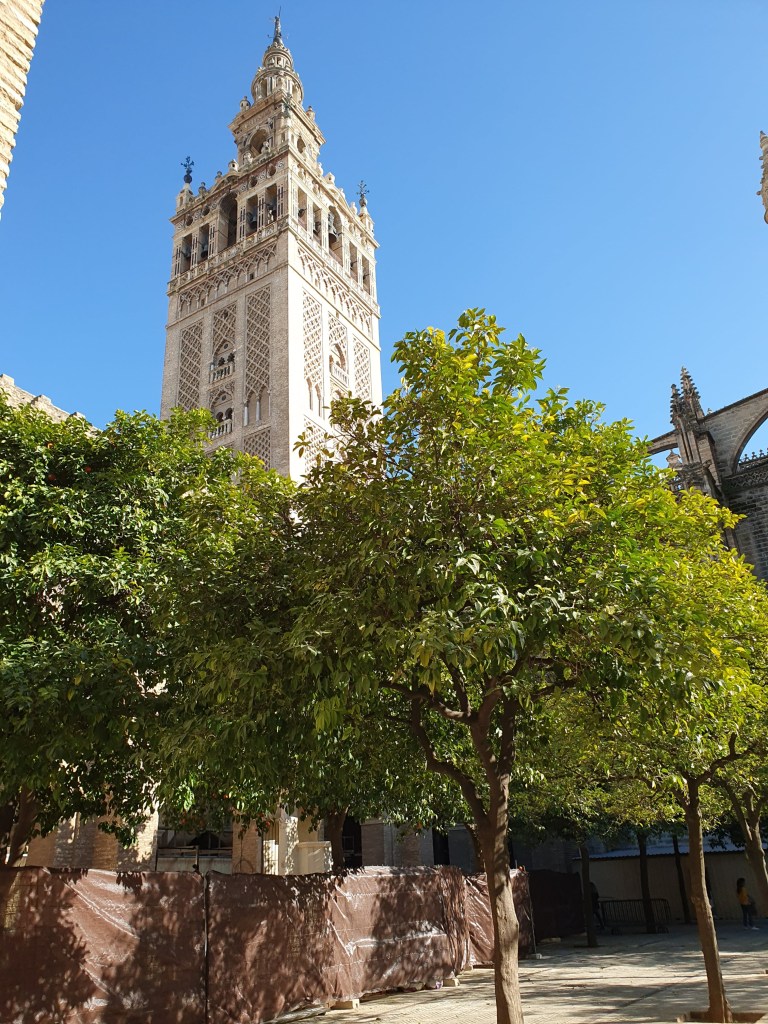
The remainder of the day was devoted to visiting Seville’s cathedral, the fourth we had been to on this trip. We had bought in advance timed tickets for entering the cathedral and ascending the Giralda (the bell tower) – however, unlike some other places we had visited nobody seemed concerned about what time the tickets specified. So immediately on entering the cathedral we climbed the Giralda, which has a sloping ramp, not steps, all the way to the top. We were rewarded with good views in all directions from the top, including looking down on the Alcazar that we had been to the day before.
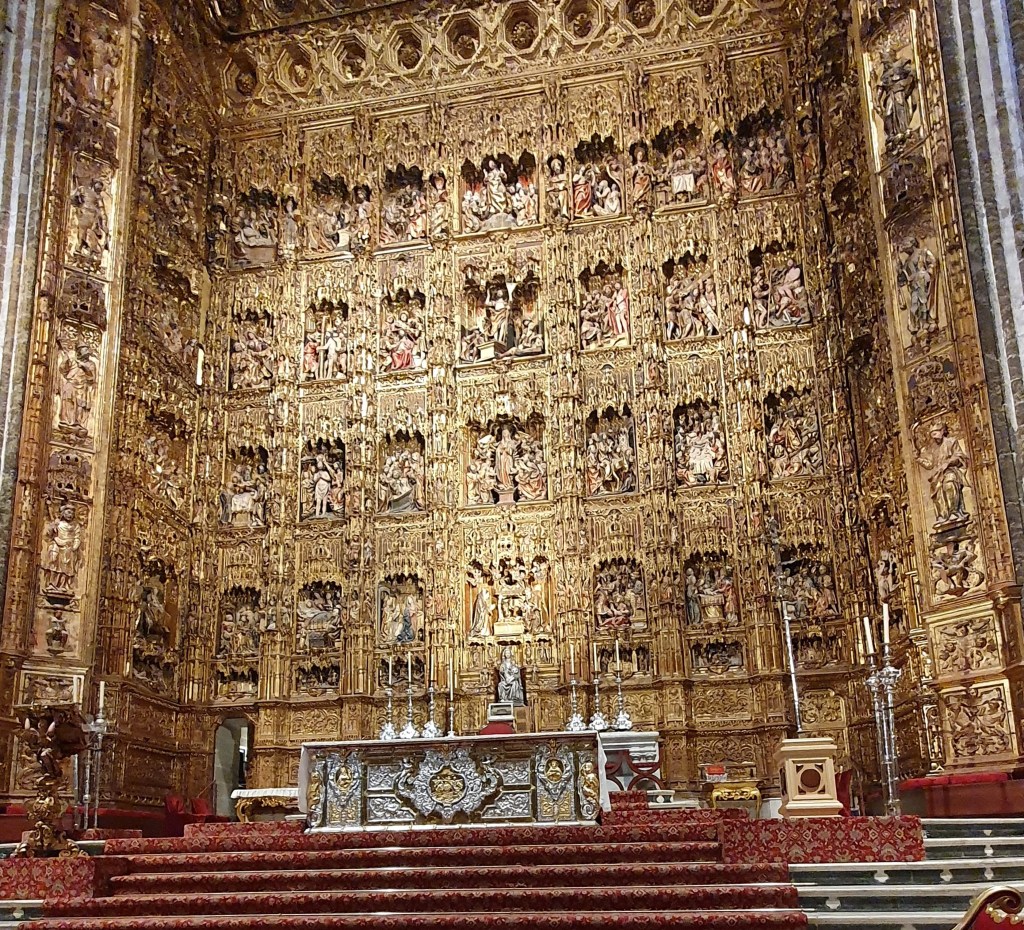
The cathedral itself is enormous – the largest in Spain, just pipping the Mezquita in Cordoba – and having numerous side chapels. As usual, we had a detailed audio-guide to assist our viewing.
One of the most ornate tombs in the cathedral is that of Christopher Columbus who was interred in Seville when his remains were returned from Cuba at the beginning of the 20th century. However, there is some doubt about the authenticity of the bones now residing in Seville.
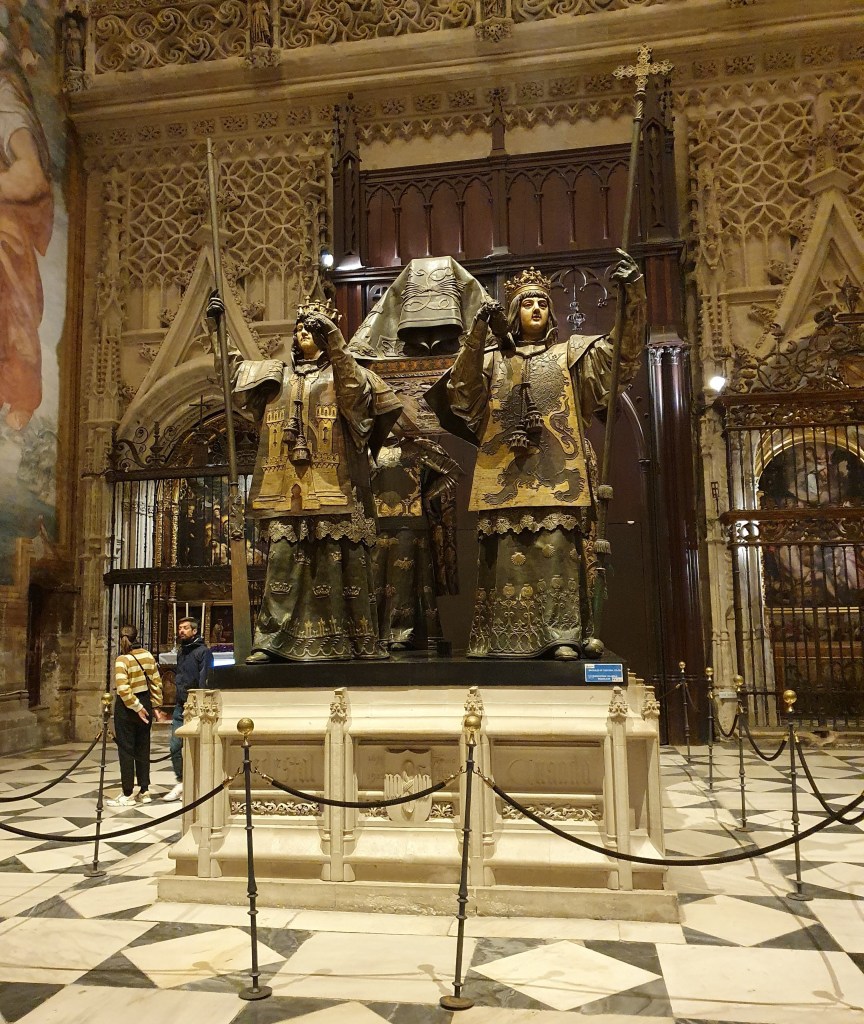
Our audio-tour of the cathedral also took us to the richly decorated sacristy. Included in our ticket was entry to the nearby church of El Salvador, which we paid a brief visit to on the way back to our hotel.
For a change of cuisine that evening we decided to visit a nearby pizza restaurant. Despite arriving about 20 minutes after it was supposed to open, we found it shuttered and completely closed. There was someone standing outside, who we later discovered was our waiter for the evening. He was waiting for the owner/chef to come and open up. When we came back a bit later, we had the place to ourselves, although it did seem to be doing a brisk business in takeaway orders. We shared beef carpaccio to start with served with rocket and freshly baked bread from the pizza oven. I followed this with a pizza topped with bacon, sausage and cream.
Day 9 – Friday 3rd March 2023 – Seville and Italica
We initially retraced our route of the previous morning to the city centre, but rather than crossing over the Canal de Alfonso XIII, we made our way to Seville’s main bus station which is located on the eastern bank. We had come here to catch a bus to Italica, which leave every 30 minutes. We thought that we had plenty of time to catch the 0930 departure, but when we arrived in the bus station we discovered that there were over 40 bus stands and that the electronic departure boards were full of buses going to all over Spain all due to leave at 0930. So we had go upstairs to the enquiry desk, to find out that the bus we wanted went from one of the furthest stands from there. So a brisk run was needed to get there and we just caught it.
Italica is located near the modern town of Santiponce about 10km from Seville, a bus ride of just over 30 minutes. Italica was an ancient Roman city – despite being in a far flung corner of the empire, two Roman emperors, Hadrian and Trajan, came from the city. As no modern city was built over the site, it was exceptionally well preserved when it was rediscovered in the 19th century. After visiting a small building which provided introductory information we wandered about the site. Many of the buildings still have their original mosaics in situ.
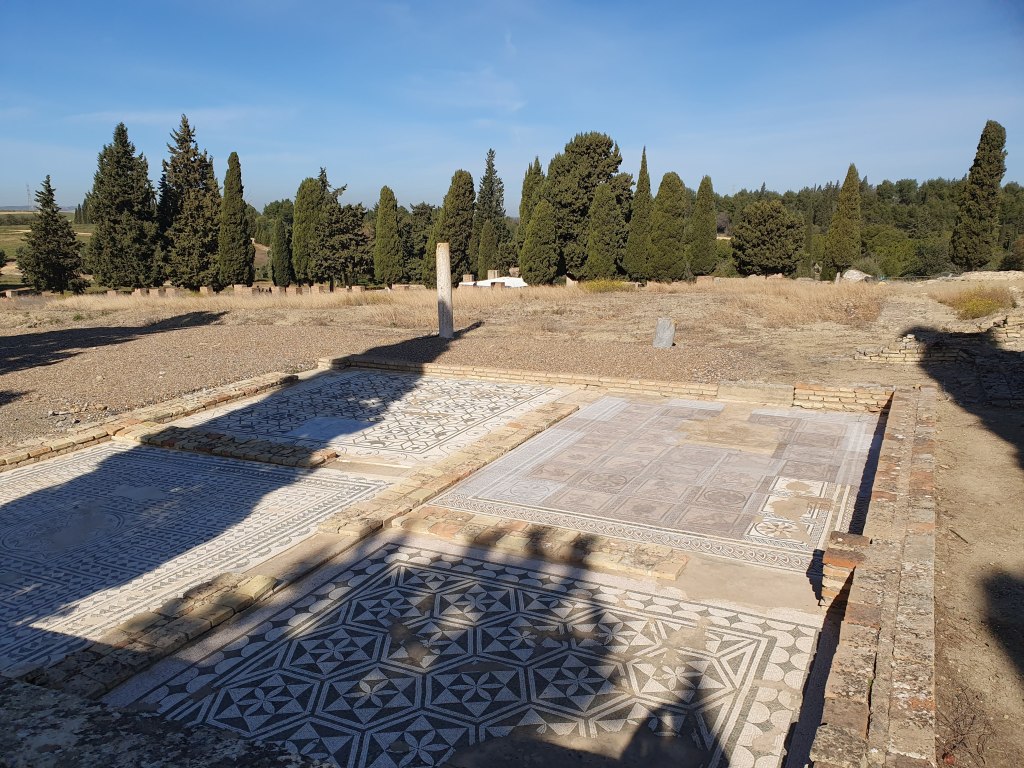
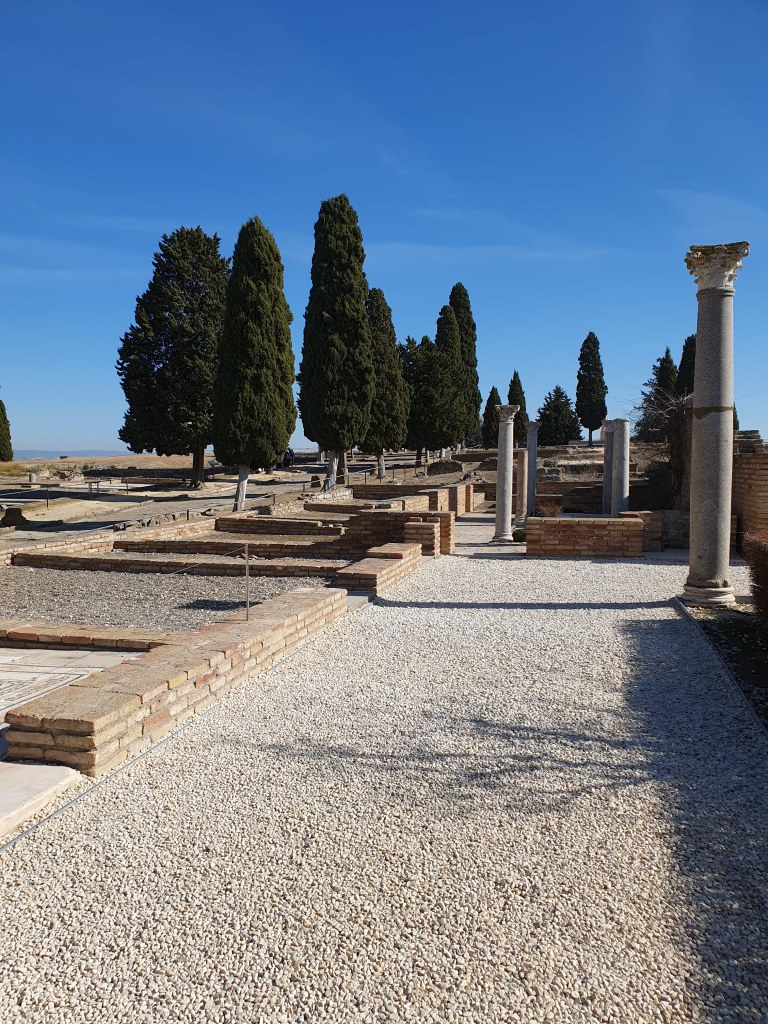
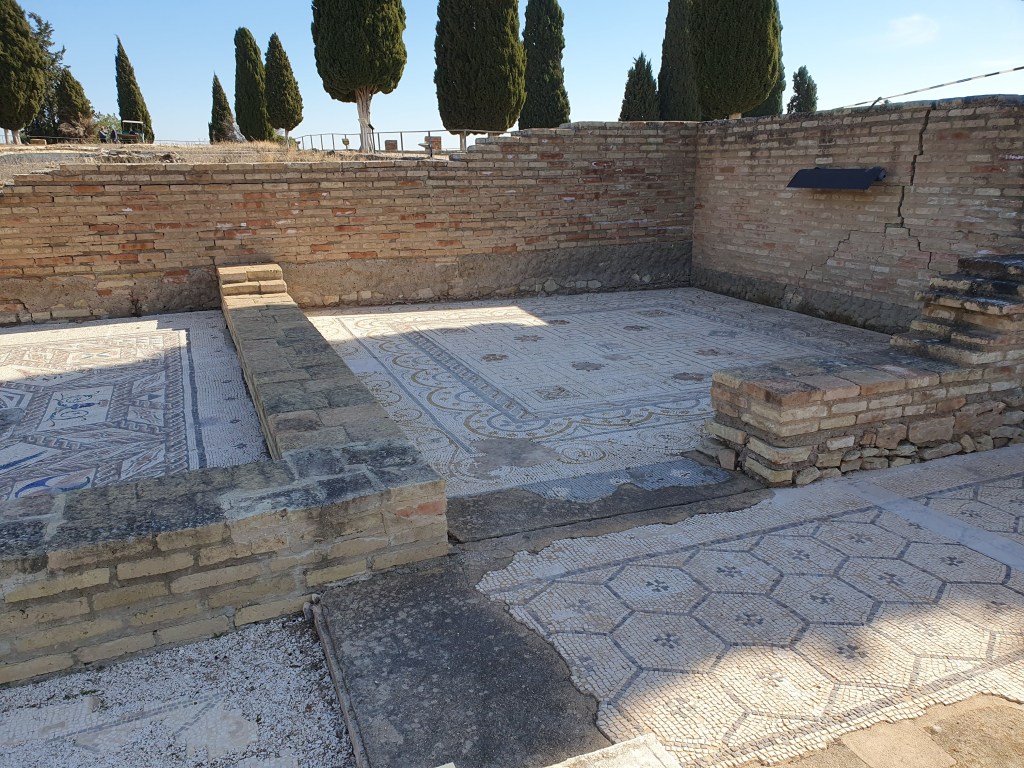
The site also has the remains of a major bathhouse and a large amphitheatre, which we explored thoroughly.
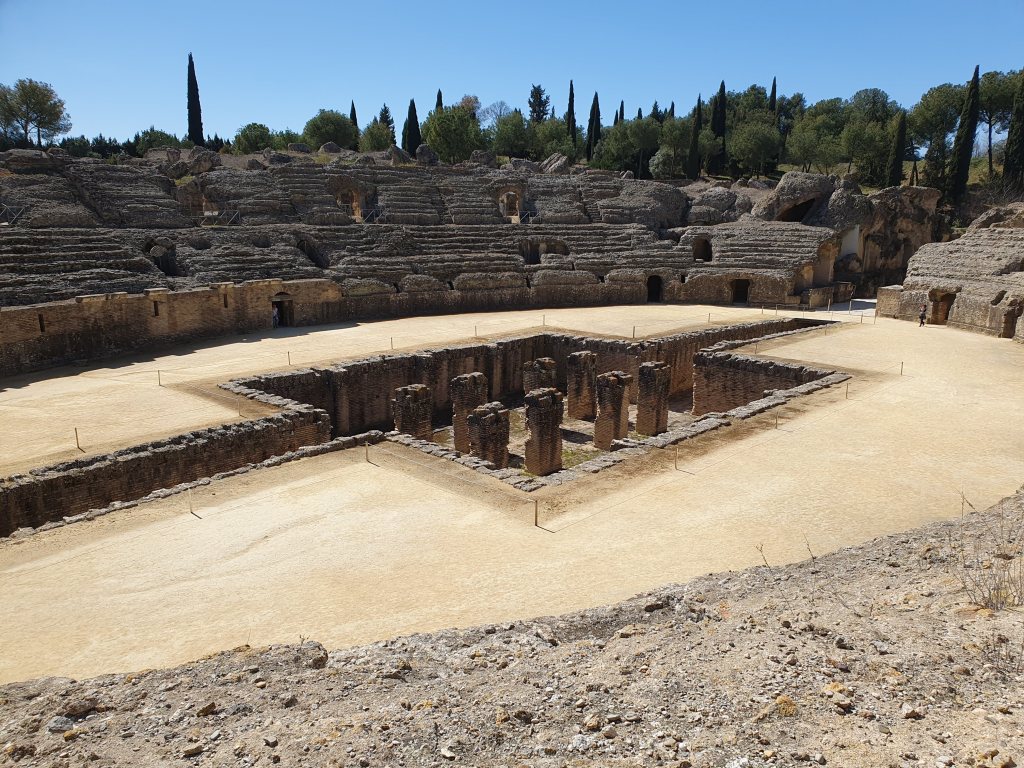
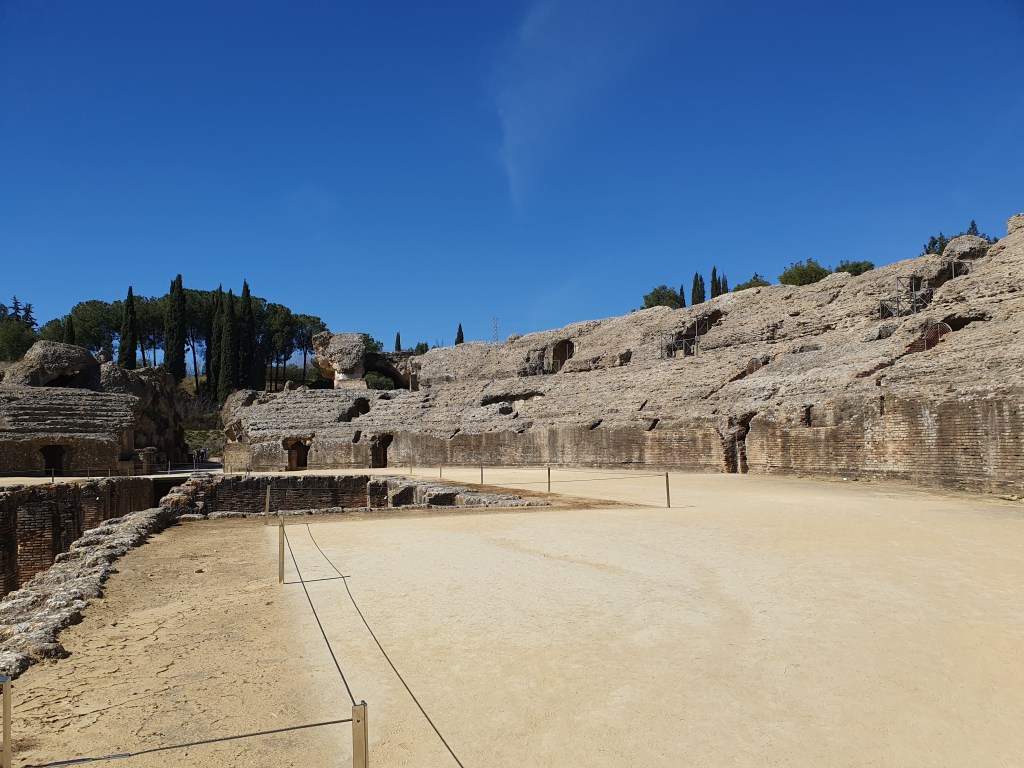
Away from the main site, on the edge of the modern town of Santiponce, is the Roman theatre. This is still used for performances today, but was unfortunately closed at the time of our visit, so we had to content ourselves with peering at it through a fence. We returned to the bus stop at which we had alighted earlier to catch the 2:30pm bus back to Seville. Unlike the bus we came on, this was a coach with no interior space for luggage, so when an old lady with a large shopping trolley got on after a couple of stops this blocked the aisle making it difficult for those subsequently trying to get on or off the bus. Fortunately, she was only travelling a few stops and not all the way back to Seville.
We got back to Seville just after 3pm. Although it had been cold each morning, the temperature this afternoon climbed to 20°C, so we bought ice creams and ate them while sitting on the banks of the Canal de Alfonso XIII in the pleasantly warm sunshine. For our final visit of the afternoon we went to he former Royal Tobacco Factory of Seville, which is now part of the university. Had Carmen, in Bizet’s opera of that name, been a real person this is where she would have worked. Not that I am familiar with tobacco factories, but this was rather more architecturally ornate than I was expecting. Within the building there was an exhibition of plaster casts of famous sculptures from around the world.
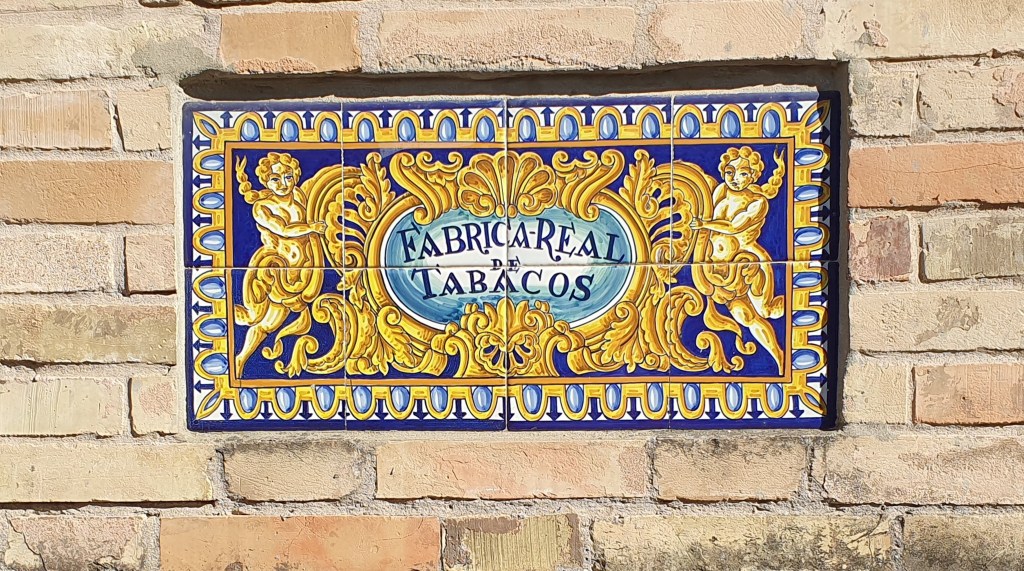
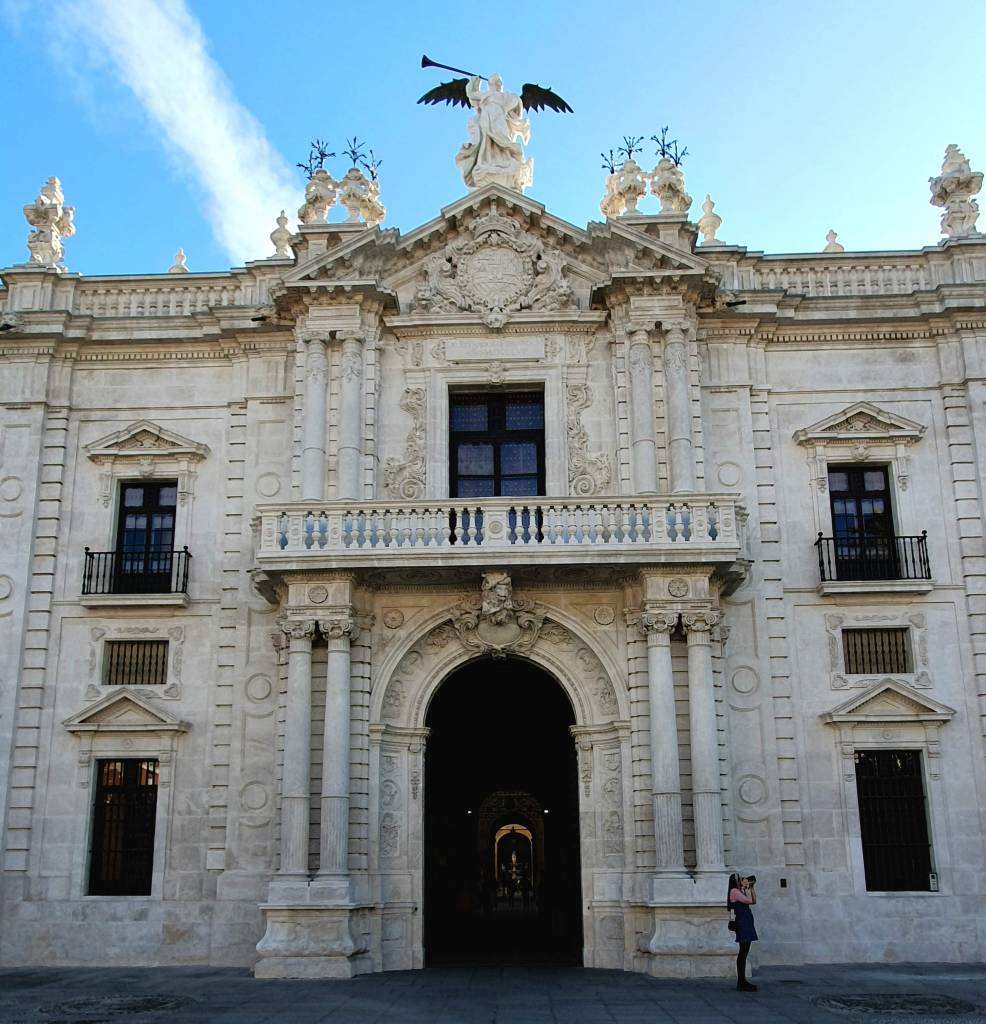
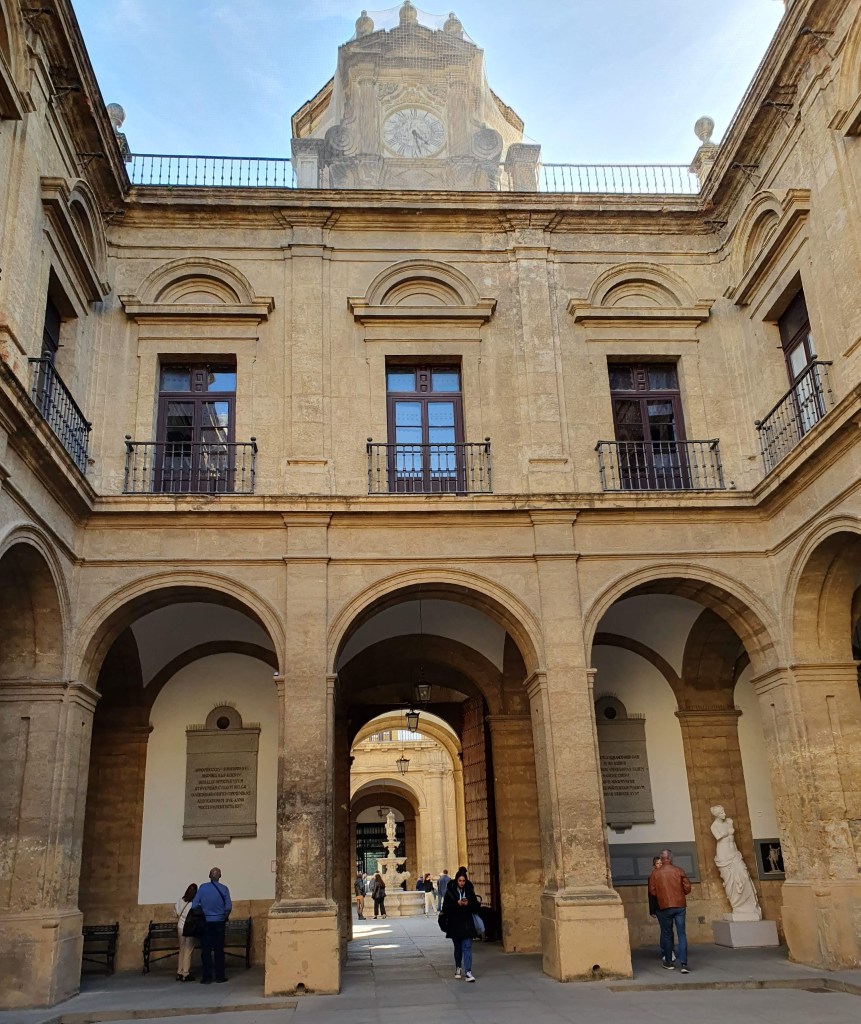
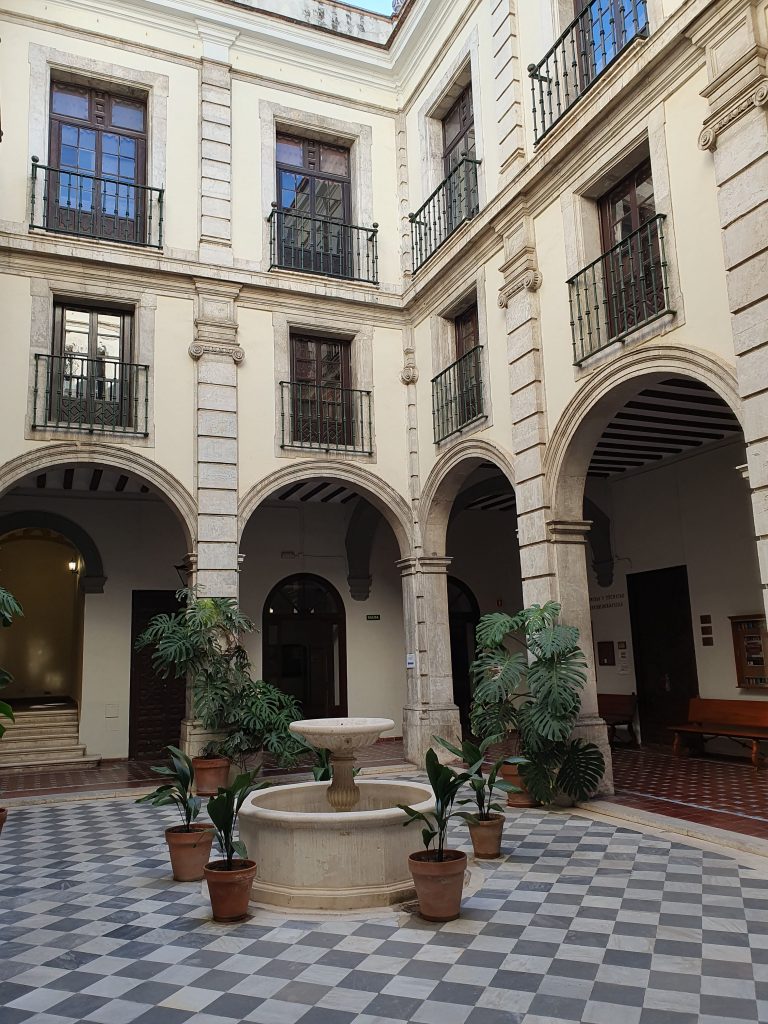
We took a different route back to hotel, going through the public park adjacent to the Alcazar. For dinner that evening, we went back to the same restaurant as we had visited on our first two evenings in Seville. Being a Friday, it was considerably busier than on the previous occasions. We shared some ham croquettes to start with, which I followed with beef sirloin with shallots, trying a different Rioja to share.
Day 10 – Saturday 4th March 2023 – Seville to London
Our hotel was on the bus route to the airport, so after breakfast we walked the short distance to the bus stop. Buses to the airport were supposed to depart every 20 minutes at that time on a Saturday morning, but ours turned up exactly half-way between the two advertised times. The bus was nearly full when we got on, and at the next stop, Santa Justa station, it filled up completely. From there it went non-stop to the airport. Seville Airport was very pleasant, with minimal queues for security and passports. The one downside was that we were bussed the short distance from the terminal building to where our plane was waiting. Although everyone had boarded the plane in good time, we were kept on the tarmac for a while and eventually departed about 10 minutes late. There were clear skies across Spain, including good views of the snow capped Cantabrian mountains, but once the flight crossed the coast of France, the cloud cover meant that nothing more could be seen on the ground until we landed. The plane circled for a while once it was in the vicinity of Stansted, so our ten minutes late departure turned into a thirty minute delay arriving. Fortunately, we arrived at a gate which did not require waiting for the shuttle train and the queues at passport control were relatively short.
A ride on the Stansted Express got us home by mid-afternoon, I thought in plenty of time to go shopping for food, only to discover that my car wouldn’t start. Back to the realities of domestic life after a very enjoyable 10 days in Andalusia.
 Europe Explored