
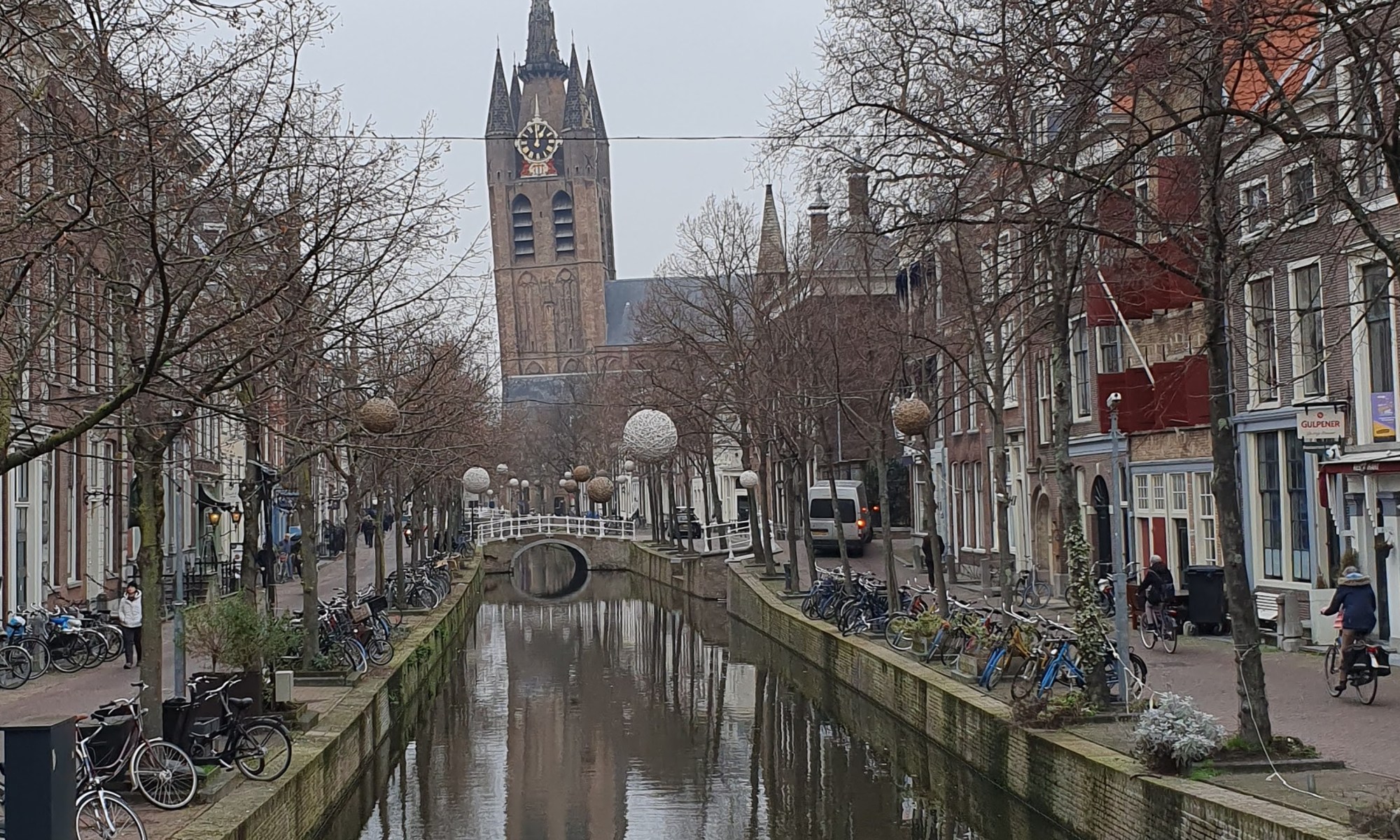
“Haastige spoed is zelden goed.” (“Hasty speed is seldom good” – Dutch saying)
When Eurostar had one of their periodic seat sales at the end of 2022, I took the opportunity of getting some relatively cheap tickets to and from Rotterdam. However, I decided to base myself in Delft, an historic Dutch city about 10 miles to the north of Rotterdam, for this short three day/two night trip.
Day 1 – Tuesday 26th January 2023 – London to Delft
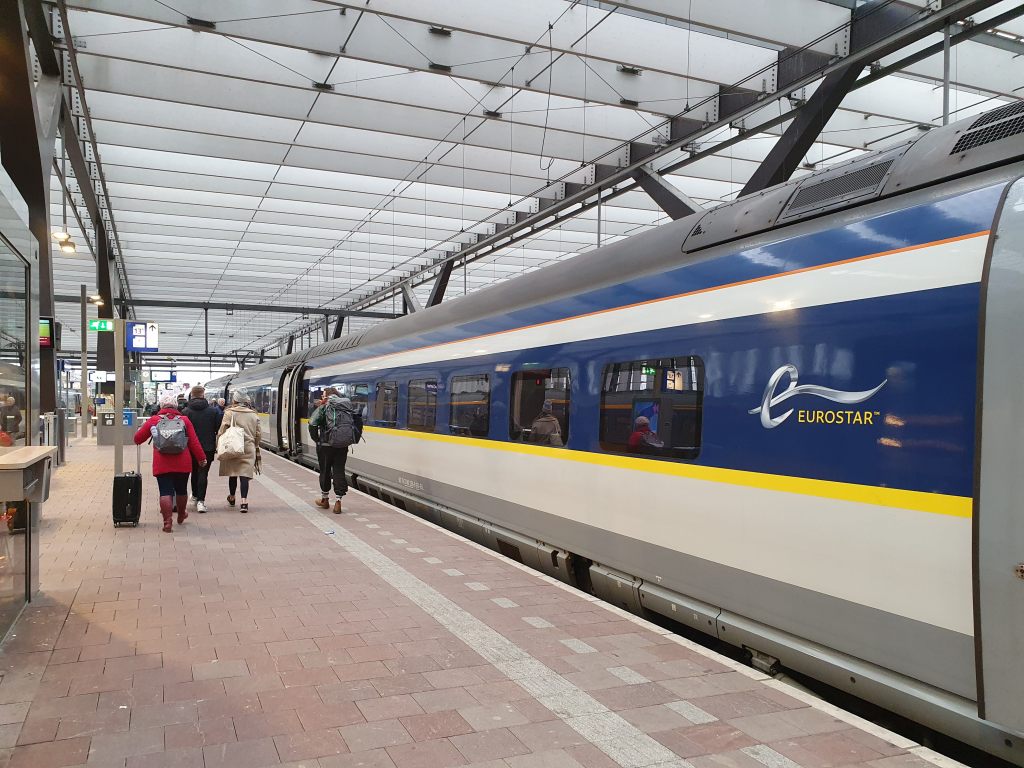
My train to Rotterdam was the 0816 from St Pancras. I arrived at the station before 7am, which gave me time to have breakfast before checking in at the Eurostar terminal. After the experience of my previous two Eurostar trains being significantly late, I was a little wary about what I would experience this time. As there are a number of departures scheduled for around this time of the morning and an earlier Paris train had been delayed, the departure area soon became crowded. Fortunately, my train starting boarding early at 0750, and although the carriage I was in was fairly full I didn’t have anyone sitting next to me.
The train was on time throughout its journey. When it stopped in Brussels, I thought I would use the opportunity of a stable phone connection to try to buy a ticket on the NS app from Rotterdam to Delft, but it kept crashing at the payment stage. This meant that when I arrived in Rotterdam I had to exit through the barriers to buy a ticket from a machine, missing the first train I could have caught to Delft. Also a paper ticket cost €1 more than one bought on the app. (In retrospect, I might have been better off forking out to buy a reloadable chip card, which I could have used on any public transport in the Netherlands.) As trains to Delft from Rotterdam are every 10 minutes, it did not matter too much that I had missed one by having to stop to buy a ticket.
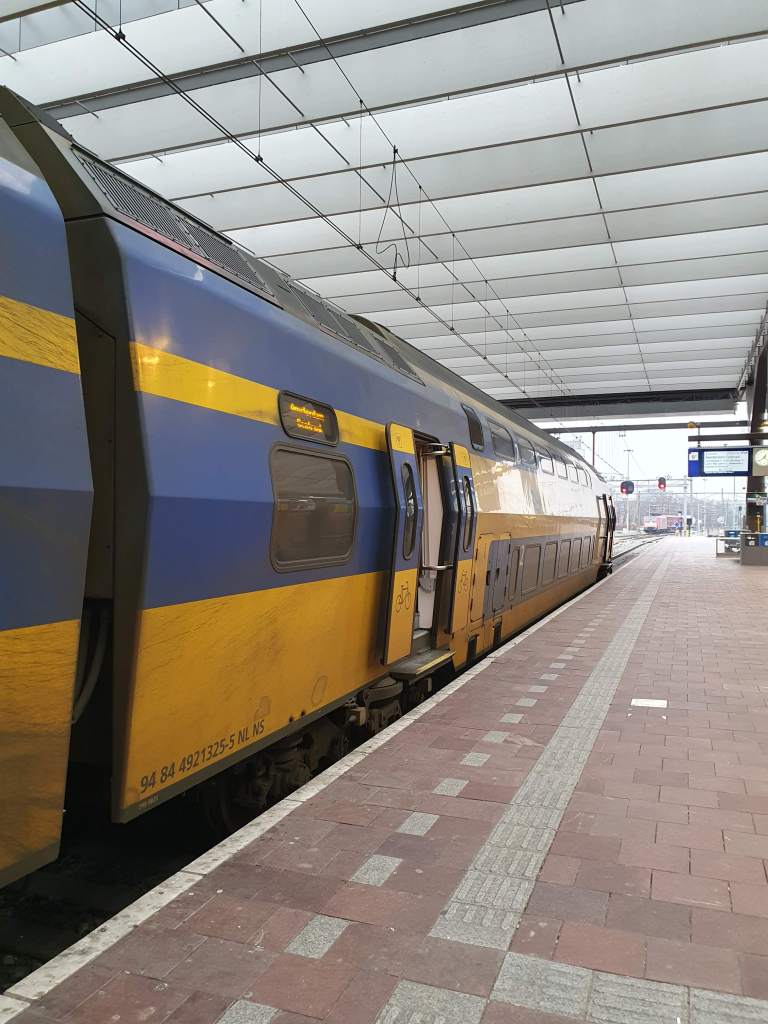
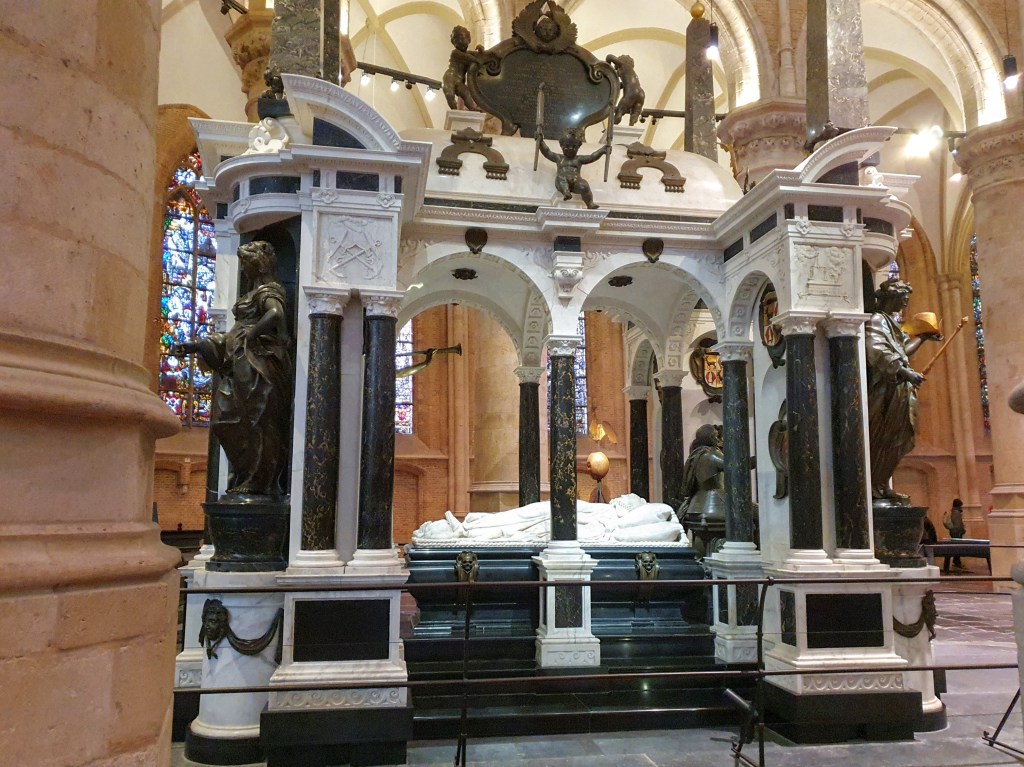
The journey to Delft took just 10 minutes and I arrived there just before 1pm. I walked from the station to the historic centre of the city. My first stop was at the Nieuwe Kerk, completed in the 15th century, and located in the main square opposite the town hall. This is the church where the Dutch royals are buried. The centrepiece of the church is the elaborate memorial to William the Silent, founder of the Dutch House of Orange. As is typical for a protestant Dutch church, there is no altar. The crypt which contains the more recent royal tombs is not open to the public.
From the Nieuwe Kerk I walked the short distance to the Oude Kerk, constructed about 150 years before the Nieuwe Kerk. The tower of the Oude Kerk leans at a distinct angle. Its interior is rather more plain than that of the Nieuwe Kerk and contains the tombs of many notable residents of Delft, including those of the artist Johannes Vermeer, the scientist Antonie van Leeuwenhoek, and naval commanders Maarten Tromp and Piet Hein.
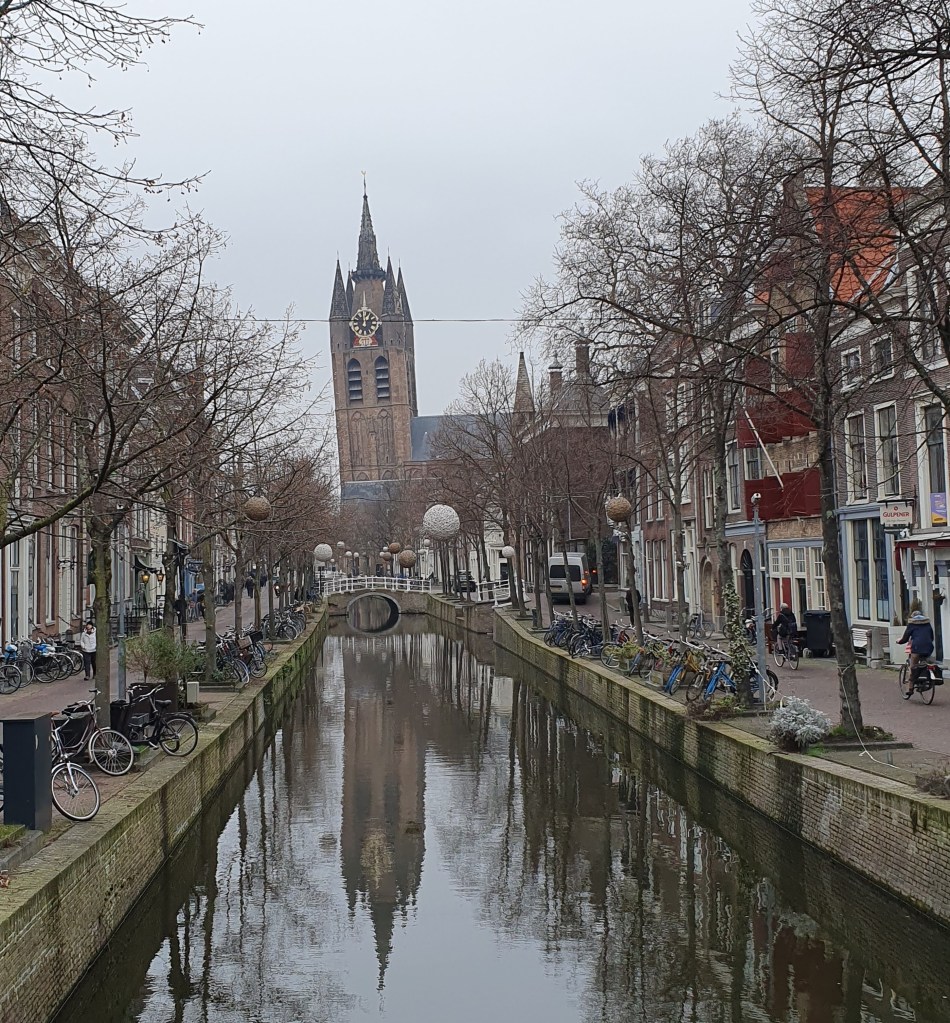
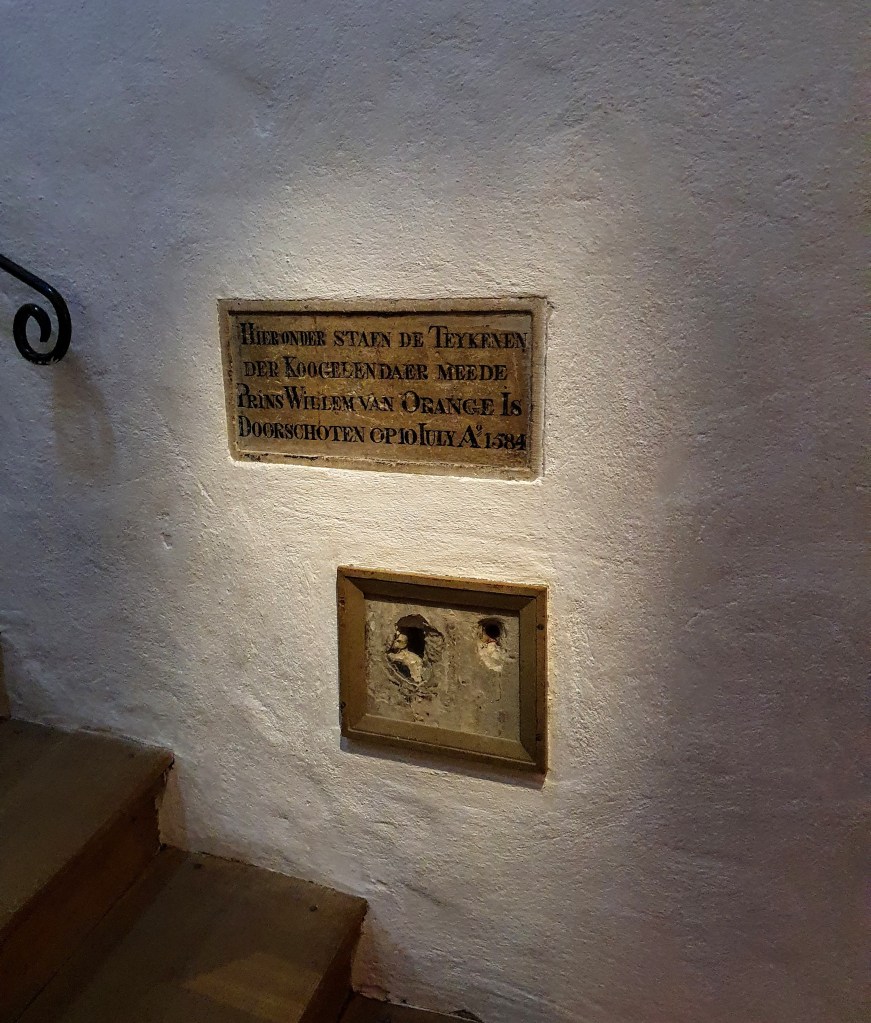
Down an alley opposite the Oude Kerk is the the Prinsenhof. Originally a monastery, it was the residence of William the Silent and is now the main museum in Delft. Shortly before my trip I had been listening to the BBC Radio 4 series on the Invention of the Netherlands presented by Misha Glenny, from which I learnt that William the Silent was the first head of state ever to have been killed by gunshot. You can still see the bullet holes in the wall in the Prinsenhof where he was assassinated. By the way, in the Netherlands William the Silent is more commonly know as William of Orange, but in England the soubriquet the Silent is more commonly used to avoid confusion with the English monarch William III. The museum provides a history of Delft as well as having a small art collection. I had arrived a couple of weeks too soon to view the special exhibition of views of Delft from Vermeer’s time, which they were still in the process of constructing.
Delft seems justifiably proud of one of its most famous sons, Johannes Vermeer, but there are none of his original paintings in the city any more. So my final visit of the afternoon was to the Vermeer centre, which displays photographed copies of all of Vermeer’s works as well as describing his life and artistic techniques. I was intrigued to learn that Vermeer and van Leeuwenhoek (an early pioneer of microscopy and microbiology) were acquaintances, and that van Leeuwenhoek was the executor of Vermeer’s estate after his death.
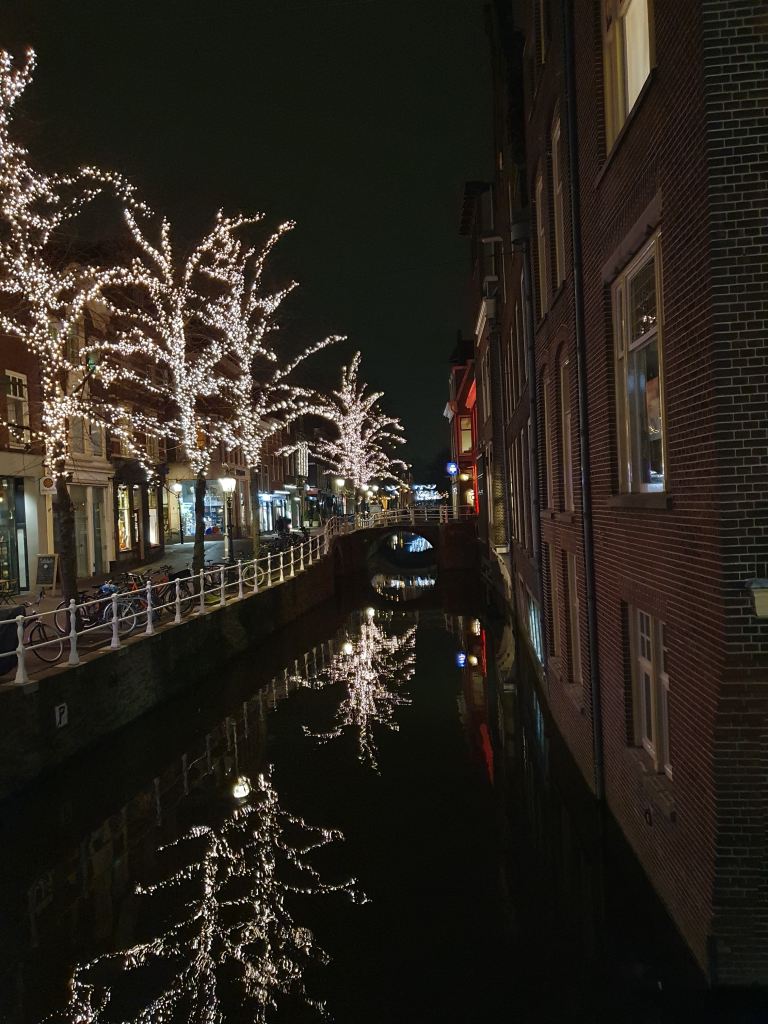
After checking in to my hotel, which was slightly more of a challenge than normal because its front door was broken, I set out to find dinner. I chose a canal side restaurant, which when the weather is warmer provides overspill seating on a barge. There I had a warming spicy lentil soup, which was needed on a freezing evening, followed by chicken satay.
Day 2 – Wednesday 27th January 2023 – Delft, Den Haag and Voorburg
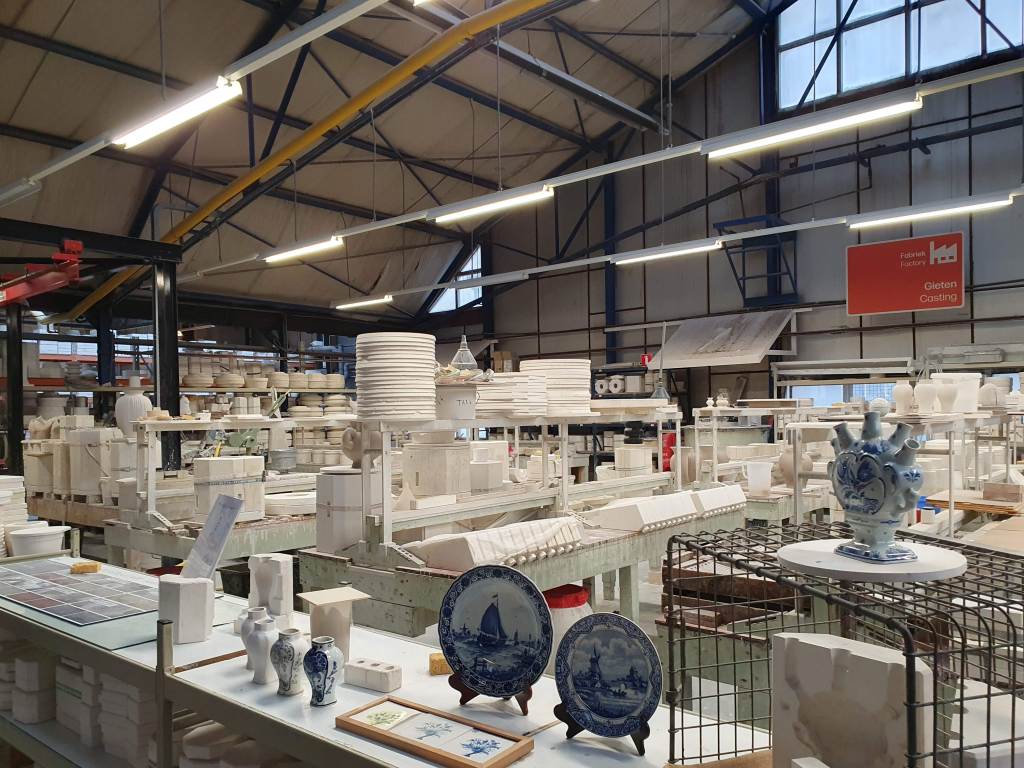
I set off from my hotel for the 20 minute walk to the Royal Delft factory to the south of the city centre, which I timed to arrive at its opening time of 9:30am. It was a murky morning as I followed a route almost entirely by the side of canals to reach my destination. I was a little wary about visiting the Royal Delft factory, as my guide book said that it was a major stop on the coach tour circuit and I didn’t fancy sharing my time there with a tour party. I needn’t have worried as there were no other visitors during the hour or so I was there. Royal Delft is the name that is used for brand marketing purposes in English, in Dutch it is known as the Porceleyne Fles (Porcelain Bottle).

Initially I went through a multi-room audio visual presentation of the history and manufacturing techniques of the factory, which emphasised that the basic handmade approach had not changed. Then there was a museum giving some more of the history and showcasing different Royal Delft products through the ages. Finally, you could walk round the working factory, while the staff around you went about their normal business. I found the whole place fascinating and well worth a visit. Of course, on the way out you had to pass through the shop, but one look at the prices soon dissuaded me from buying anything.
Once I had finished in the factory I made my way to the station back in the city centre. I had by now got the NS app to work and had bought a ticket to Den Haag. The journey to Den Haag takes less than fifteen minutes and I arrived there shortly after 11am. I had spent a day in Den Haag (The Hague) as part of a family holiday in 2018, when we visited the International Court of Justice, the International Criminal Court and the Dutch Parliament. This time, given that I had heard so much about Vermeer while in Delft, I thought I should see some of his original paintings. I came to the Mauritshuis an art gallery housed in the former home of John Maurice of Nassau. It does not have a large collection, but makes up for the lack of quantity with quality, including Vermeer’s Girl with a Pearl Earring and View of Delft.

Also included within the ticket price is entrance to the Prince William V Gallery, located on the other side of the Dutch Parliament from the Mauritshuis. This has its pictures crammed together adorning the walls of a long gallery, which is how they would have been originally displayed, trying to impress with the sheer quantity on view.
I then went back to Den Haag Centraal station to catch a train to Voorburg, which these days is just a suburb of Den Haag. The reason for coming here was to visit the Huygens Hofwijck, home of the statesman, poet and composer, Constantijn Huygens and his son Christiaan, the mathematician, physicist, astronomer, engineer and inventor. I had always wanted to come here after seeing it featured in Carl Sagan’s 1980 documentary Cosmos. When I arrived at the entrance gatehouse, which is a little way from the main building, it was staffed by an elderly woman. Unfortunately, her ticket machine was not working, but being the only person I encountered in my whole trip who didn’t speak very good English, it was not clear what she wanted me to do. At first I thought she was suggesting that I go to the museum in the centre of Voorburg to buy a ticket there, but the direction she pointed just led to the Hofwijck itself. I went to the house and explained to the guide there that I didn’t have a ticket. The interior is quite small, spread over four floors, so it didn’t take me very long to look round. By the time I returned to the gatehouse the ticket machine had been mended and so I could pay for my visit. I contemplated going to the museum in Voorburg next, but decided if I did that I would not have time to visit the other place in Den Haag I wished to see.
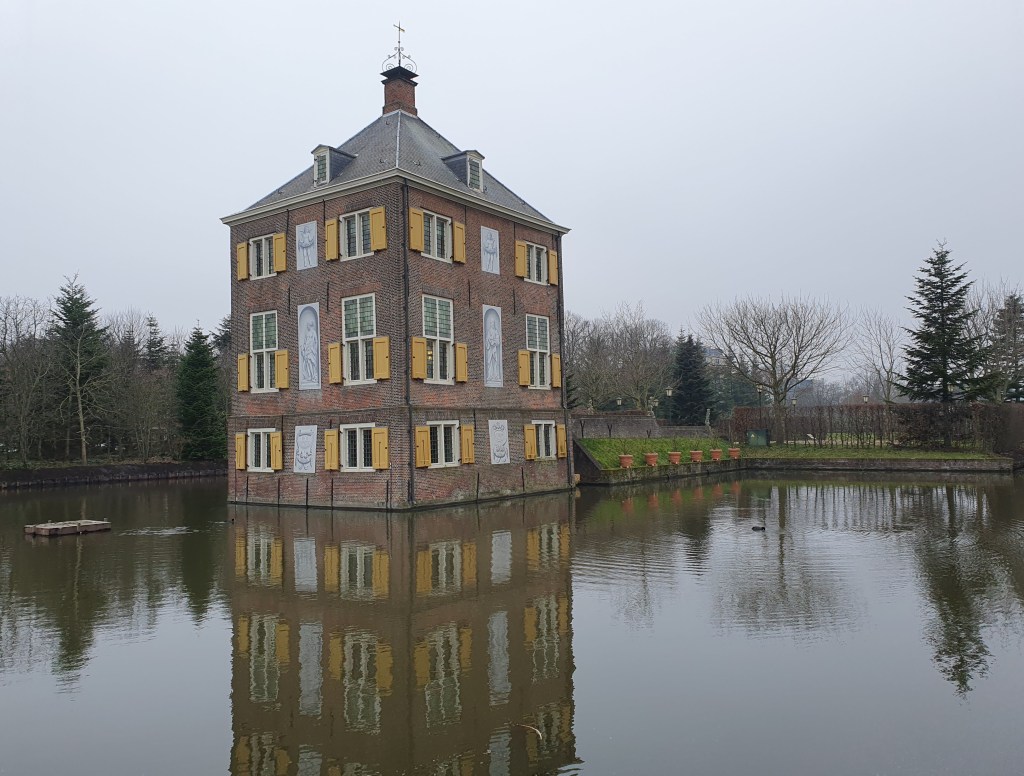
I returned by train to Den Haag for my final visit of the day. I have always been a fan of the works of the Dutch artist M C Escher. When my now wife and I visited the Netherlands in the late 1980s, we had come to Den Haag because we had read (in the pre-internet age) that an art gallery there contained a number of his drawings – but when we got there discovered that it only had a couple on display. However, we did see advertised on a poster that there was a special exhibition being held in Baarn (a town to the south-west of Amsterdam), so we made a special expedition there the next day. Thirty-five years on there is now a permanent home for Escher’s works in Den Haag – Escher in het Paleis, which is housed in the former residence of Queen Emma, the Queen Mother in the Netherlands in the early part of the 20th century. The exhibition was very good, containing an extensive collection of Escher’s works, as well as telling you about the history of the building in which it is housed. I spent the rest of the afternoon in Escher in het Paleis, before catching a train to return to Delft for the evening.
For dinner that night I went to a pub in one of the squares of Delft. I had croquettes to start with, followed by venison steak, together with a number of interesting beers. By the time I walked back to my hotel the night-time mist was beginning to form.
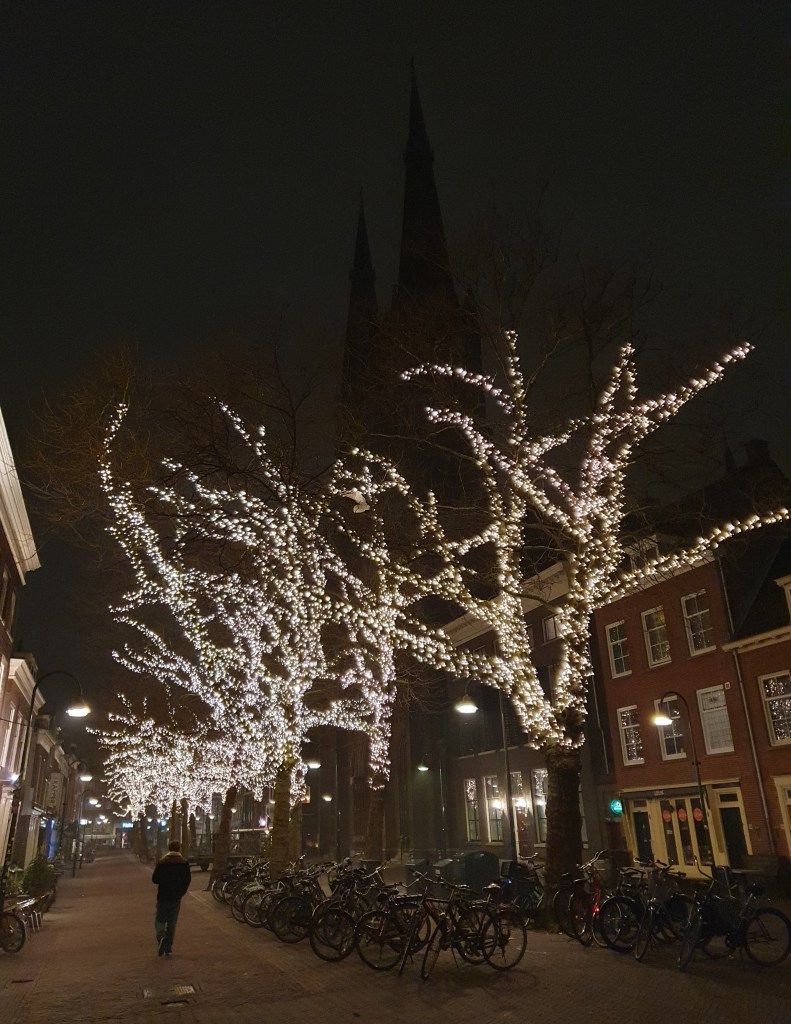
Day 3 – Thursday 28th January 2023 – Delft to London via Rotterdam
I caught a train a little before 9am to return to Rotterdam. I had timed my departure carefully, as for my first call in Rotterdam I wanted go round the ship SS Rotterdam moored in the harbour. As its website was somewhat ambiguous about whether you needed to do this on a guided tour and what time they would run, I wanted to get to the SS Rotterdam by 10am in case that was the only timed tour of the morning. From Rotterdam Centraal it requires a Metro and then a bus to reach the SS Rotterdam. But I had real problems trying to buy a ticket to do this. The ticket machines at the Metro station wanted to charge me €12 for the privilege (the cost of reloadable chip card plus a two hour go anywhere ticket), which seemed excessive for a short journey. So I tried to buy a ticket on a Dutch public transport app I had on my phone, but the payment failed on the first attempt. On the second attempt I succeeded, only for there now to be two tickets loaded on the app (I was only ever charged for one). These app tickets required you to find one of the few ticket gates equipped with barcode readers at the Metro station, but at the first couple I tried the barcode reader didn’t work and the barriers refused to open. There were no staff available at the gateline to assist, as you would find on London Underground. I eventually managed to access the Metro, but had wasted so much time that I missed the connecting bus I was aiming for. As there was not another bus due for a while, when I got off the Metro I concluded that it would be quicker to walk to the SS Rotterdam, but I would not get there before 10am which had been my original intention.
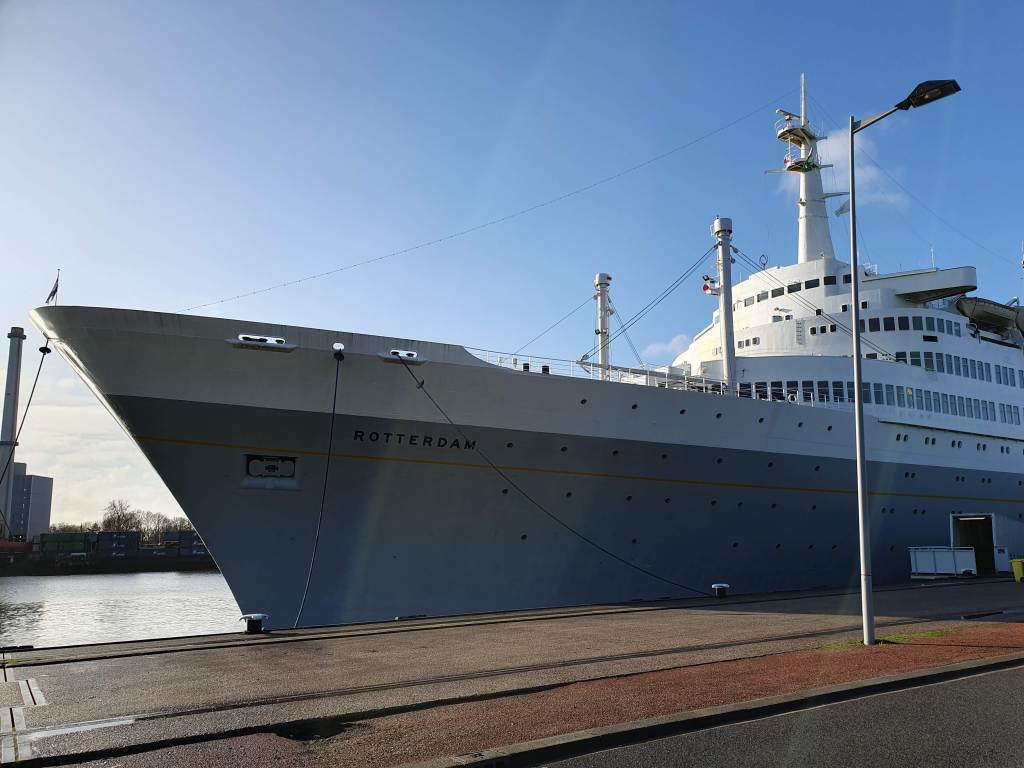
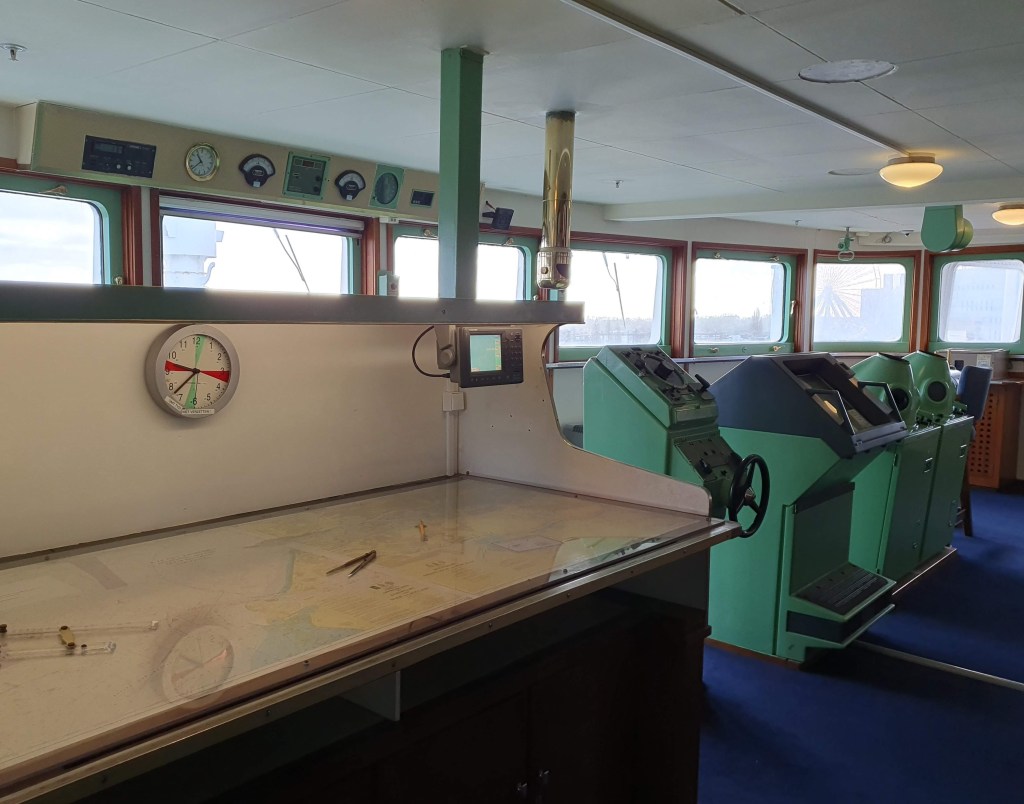
The SS Rotterdam was a luxury liner built in 1958 originally for the transatlantic route, but in later life converted to be a cruise ship. (The conversion to being a cruise ship involved removing the strict segregation between first and second class passengers.) It has now been converted again to be a hotel permanently moored in Rotterdam. I needn’t have worried about the timings. Touring the main public spaces of the ship could be done by yourself with an audioguide, but you needed a guide to go round the boiler rooms of the ship. I booked my boiler room tour for 11 am, knowing that I would need to break off my self-guided tour to be at the meeting point at the required time. As well as visiting the various lounges of the ship and other public areas, the self-guided tour also took you to the bridge, map room and captain’s quarters. At various points there were members of staff who were happy to explain more.
Just before 11am, I made my way to the bowels of the ship to meet my guide at the entrance to the ship’s indoor swimming pool for the tour of the boiler rooms. The swimming pool was decorated with tiles specially manufactured by the Porcelyne Fles factory that I had visited the day before. There were five of us on the tour, which although conducted entirely in Dutch, I understood enough to get a good appreciation of the sophisticated mechanical engineering which powered the vessel. As well as the engines for propulsion, there was major engineering relating to the water supply for the ship and generation of electricity. The guided tour lasted just over an hour and when it had finished I resumed my previous self-guided tour on which a few stops still remained.
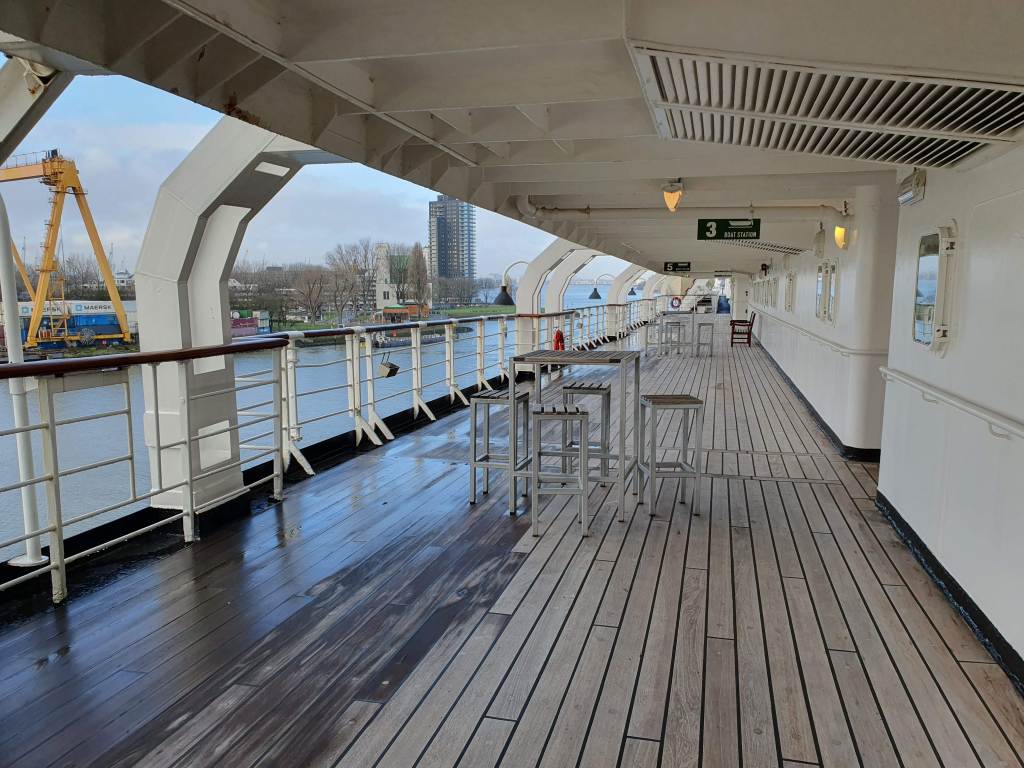
When I had finished my exploration of the SS Rotterdam, I walked back to the centre of the city to visit the Maritime Museum located in the old harbour area. The Maritime Museum was slightly disappointing and not a patch on the excellent Maritime Museum in Hamburg that I visited in 2018. The main display was of the development of the different parts of the port of Rotterdam. There was also a rather gimmicky interactive installation simulating life on an oil rig, which was very popular with the numerous school parties which were visiting the museum that afternoon.

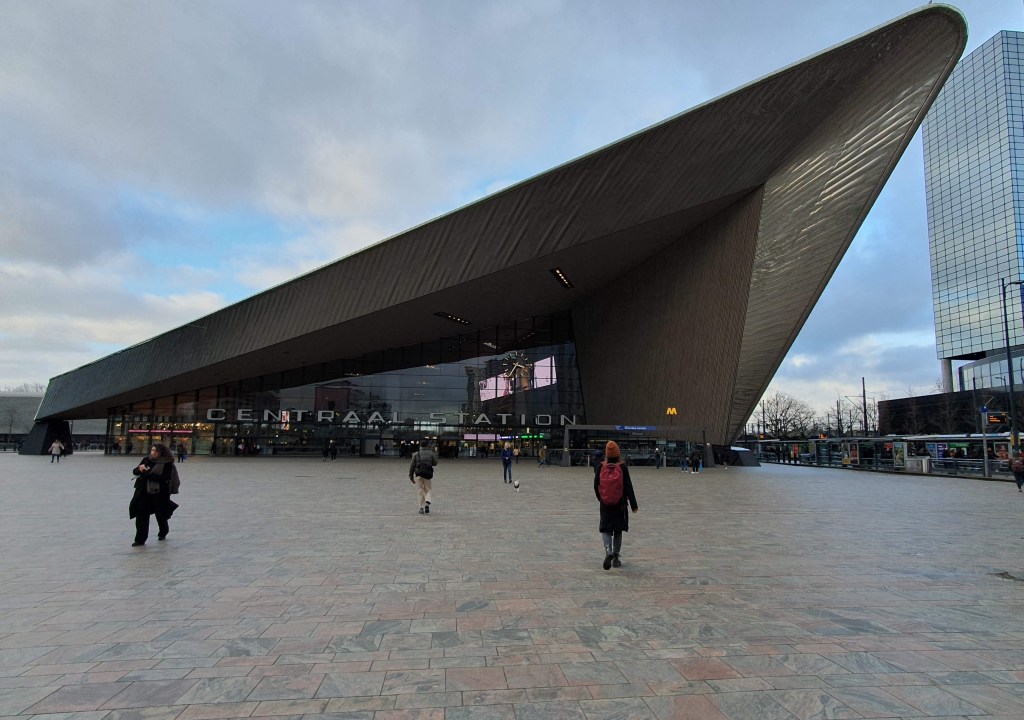
As the Maritime Museum took less time than expected, I had time for a quick bite to eat in a restaurant near Rotterdam Centraal before I went to check in at the Eurostar terminal just after 4.15pm. The security at the Rotterdam Eurostar check-in was the fussiest I have ever encountered. A supervisor was called to examine the few bottles of beer that I was bringing back with me and made me promise not to drink them in the terminal building, which was never my intention. They also made me remove my mask when going through security and wanted to examine the inside of it. The waiting area became progressively more crowded, before we were eventually allowed down to the platform a few minutes before our 1728 departure was due. The train was already crowded with passengers who had got on at Amsterdam and I had to evict a person sitting in my seat. As on the way out I was lucky and had a spare seat next to me throughout the journey back to London. Although a little late leaving Rotterdam, the train made up the time at the pick up point in Brussels, before arriving back in London seven minutes before its scheduled 8pm arrival.
Postscript
On the Sunday morning after I returned I tested positive for Covid, the first time that I had caught the disease. I assume that I caught it while in the Netherlands. As I am a Covid cautious person, I still wear a mask in nearly all enclosed spaces, but obviously one can’t do this while eating. I can only surmise that I caught Covid during my time in the fairly busy bar in Delft where I had eaten on Wednesday evening, despite my table not being near to anyone else.
 Europe Explored
Hey, just a quick comment to say I’ve been following your blog since you posted the link on RailUK Forums ages ago. Still enjoying it! Sorry to hear you came down with Covid, I hope the recovery is going well. I’m the same with being cautious about it, I had it last summer and it basically wiped out my athleticism. To go from being at the peak of my physical fitness to pretty much a zombie the next day was horrible, I’m still not back to normal and I wouldn’t wish it on anyone. My very best wishes for a speedy recovery!
LikeLike