
“There is no night life in Spain. They stay up late but they get up late. That is not night life. That is delaying the day.” (Ernest Hemingway)
I’m continuing my account of my recent trip from Lisbon to London, picking up from where I left off in Porto in northern Portugal.
Day 4 – Saturday 26th February 2022 – Porto to Vigo
I got up relatively early and made my way by metro to Porto Campanhã station to catch the 0813 train to Vigo in Spain. The train, which is the only advertised international connection from Portugal at present and only runs twice per day, was just a small three car diesel unit.
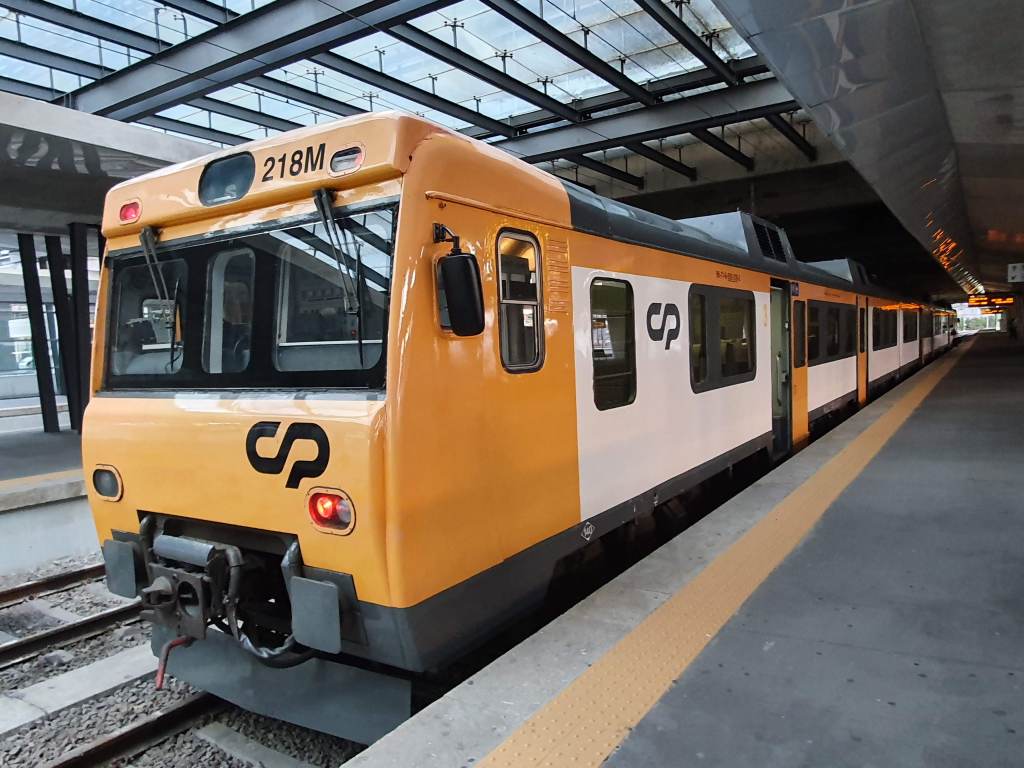
It left on time, but after about 45 minutes it made an unscheduled stop at Barcelos station. I could see the guard from our train on the platform talking on his mobile phone. After nearly half an hour of waiting the guard came round the train talking to all the passengers. When he realised that I could not understand him and I established that he could not speak English, he found another passenger who could speak English to provide a translation. It transpired that there had been cable theft on the line ahead and we would have to wait at Barcelos until we received permission to proceed. We eventually set off again and trundled at little more than walking pace with frequent stops along mainly single track sections of the line where the signals had been affected by the cable theft. We eventually got clear of the problem area and proceeded more briskly, initially along the Atlantic coast then inland following the south bank of the Minho river which forms the border with Spain to the north.
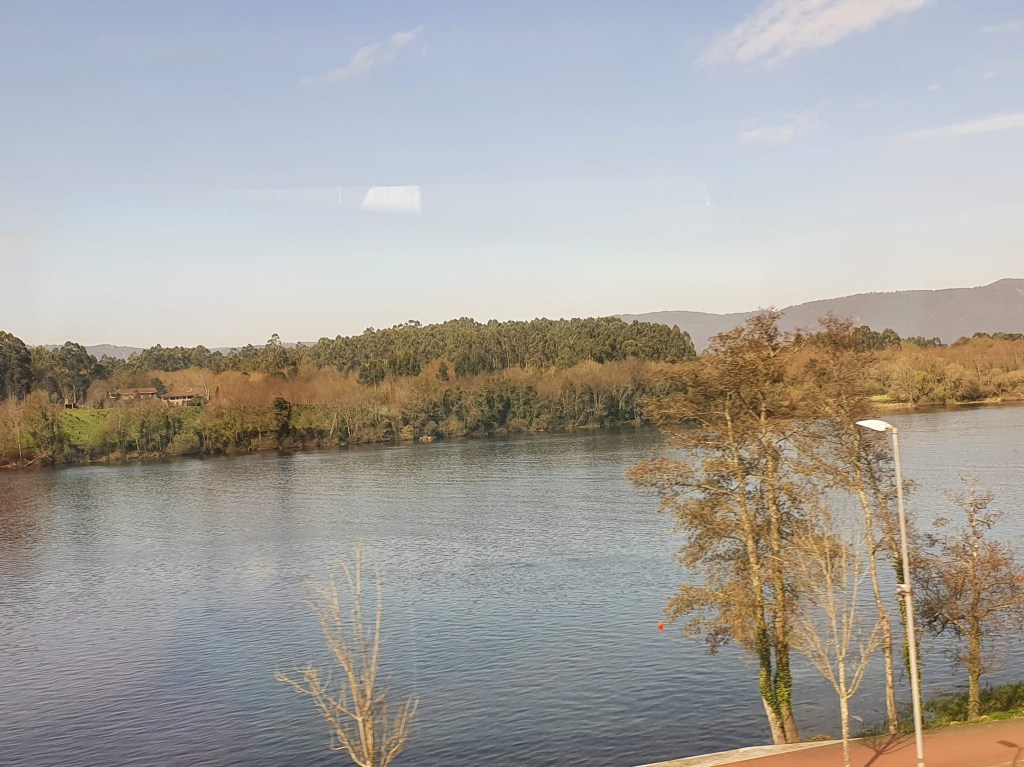
At Valença the Portuguese driver and guard of the train were replaced by their Spanish counterparts. Upon leaving the station the train crossed the bridge over the Minho and entered Spain. From there it was a 30 minute ride to Vigo, where the train arrived at Guixar station at 1255, 80 minutes late.
Close to Guixar station is Salinae, a museum built on the site of Roman salt beds, which explained the significance of salt in the Roman economy and the methods of extraction. As I knew this museum closed at 1400 on Saturdays, I wasted no time in heading straight there. It was an interesting, though fairly small museum, so the hour that I had available before it closed was sufficient.
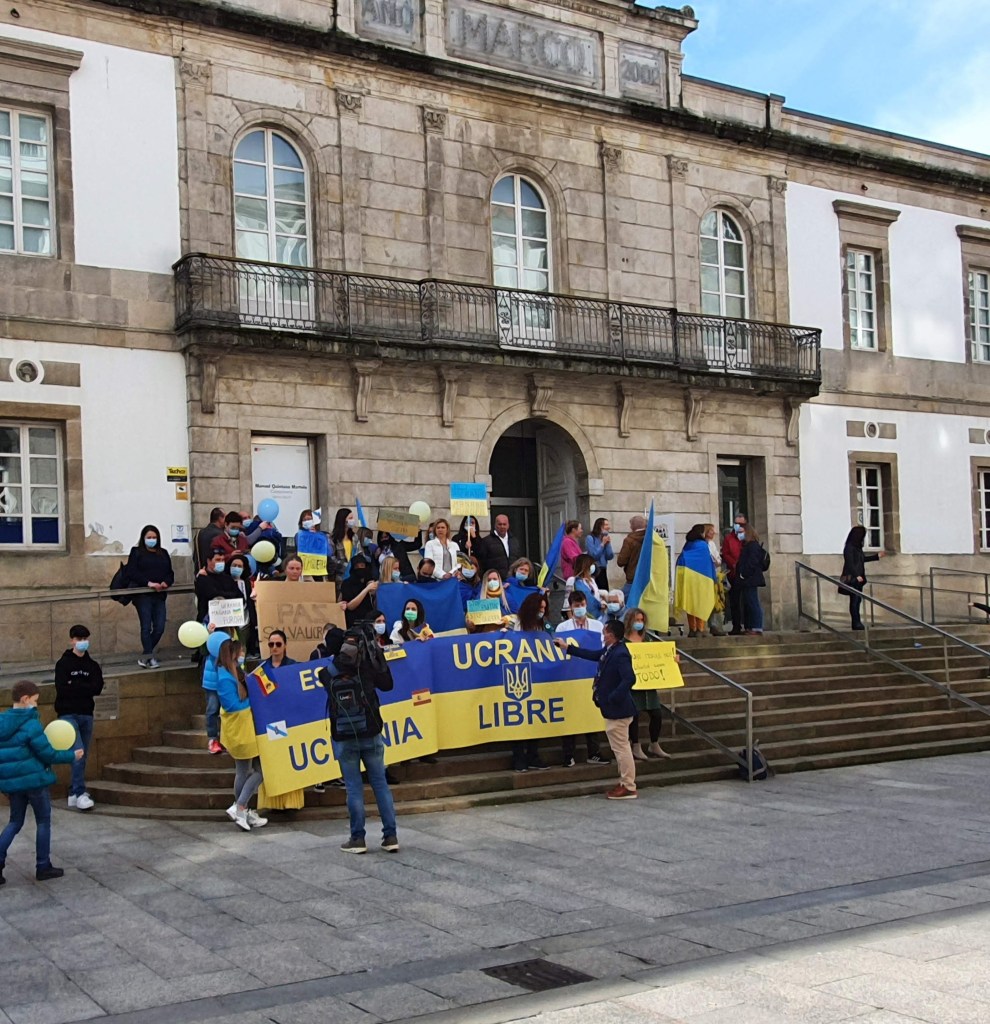
After I had finished in the salt museum I knew that all the other indoor attractions in Vigo would be closed until about 1800, so I decided to climb to the remains of the castle on a hill overlooking the city. On my way there I passed a small pro-Ukraine demonstration gathering outside what had been the city’s prison, but is now the modern art gallery.
It was a steep climb to the castle, not helped by the fact I was still carrying my bag (not yet having visited my hotel), but the views from the top were worth it.
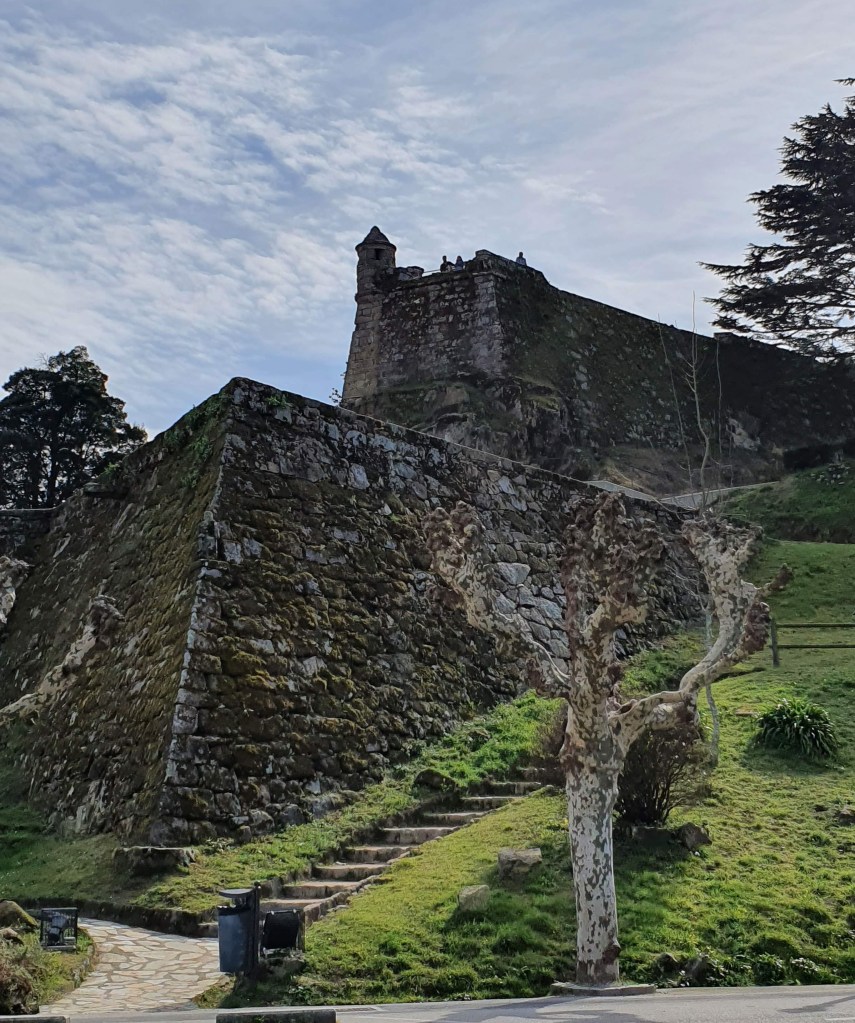
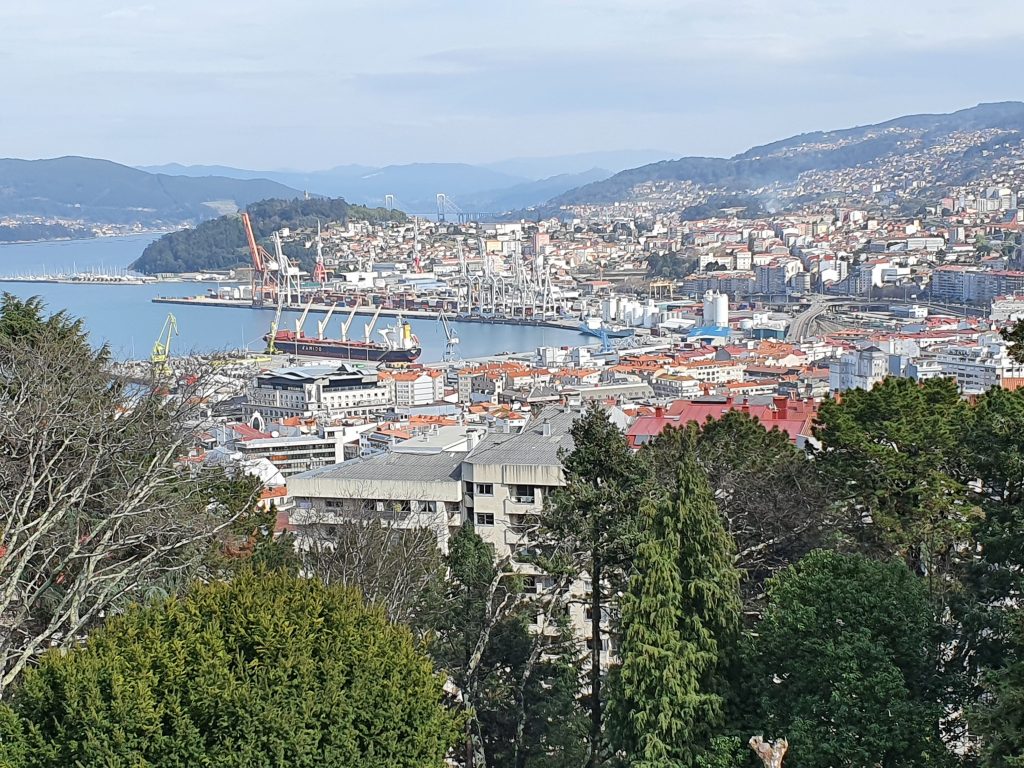
After admiring the view I walked down the hill back to the city centre. At this point I began to notice that nearly everyone was in fancy dress with their faces painted. Parents often had more elaborate costumes than their children. I learnt that it was the main day for Carnival in Vigo, and there would be a parade later with the main street closed for a concert in the evening. The bars in the city were packed with customers. As I discovered later, the region of Galicia (where I now was) still had a minimum distance policy for the spacing of tables in restaurants – significantly reducing restaurant capacity – but obviously you can’t catch Covid if you are just drinking standing up. On my way to check into my hotel I observed, in the gardens nearby, an old man with a saucepan on his head dancing with a group of young women.
While waiting for everything to reopen in the evening, I decided to check out the location of Vigo’s other station, Urzáiz, where my next train was due to depart from in the morning. Urzáiz is a giant shopping centre, pretending to be a station. It was thronged with Saturday afternoon shoppers and when I entered I wondered if I had come to the right place as it was not obvious where the trains were. There were lots of signs directing you to Primark, but you had to look very hard to spot any signs to the trains. I eventually discovered that the platforms were deep in the bowels of the shopping centre below all the shops.
After the excursion to Urzáiz, things were beginning to open up again for the evening. I paid a brief visit to the modern art gallery, where the main exhibition consisted of endless paintings of rubbish skips. After a walk along the harbour front, I visited a museum devoted to Francisco Fernandez del Riego, a Galician author and intellectual. Spread over several floors it exhibited his personal artefacts, as well as an extensive art collection. The staff were very enthusiastic and in every room I was greeted with a lengthy explanation about its contents in Galician (or maybe Spanish, I’m not sure which). I nodded appreciatively, but didn’t have the heart to tell them that I didn’t understand a word they were saying.
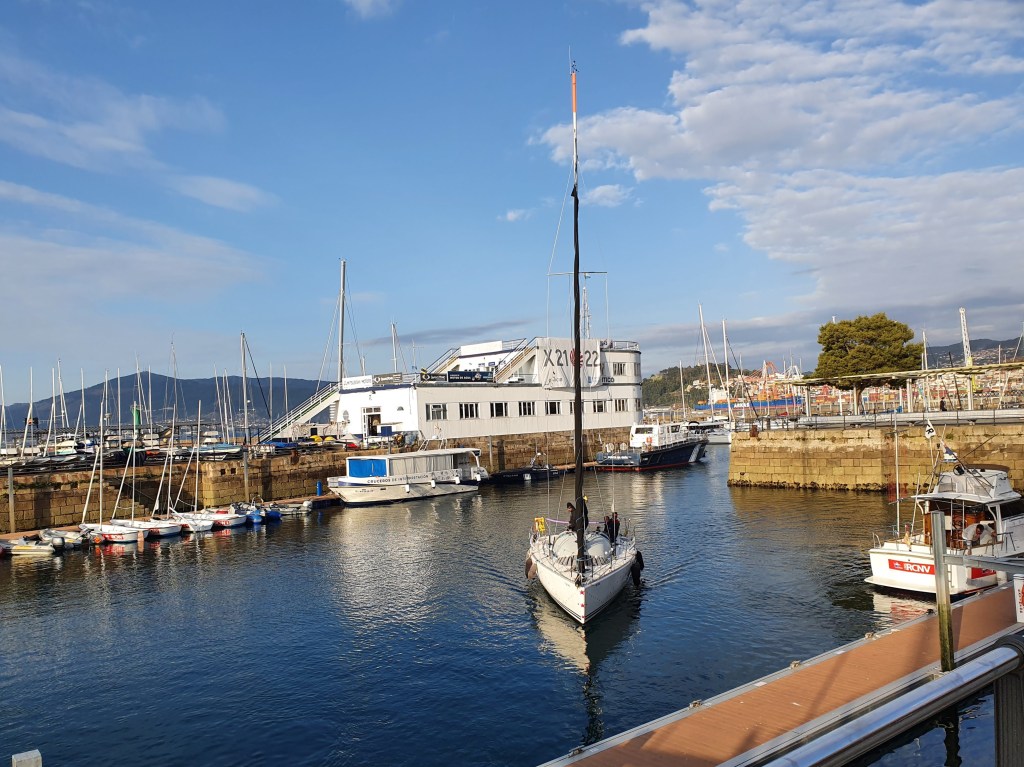
Because the city was packed with people for the Carnival and because of Galicia’s Covid restaurant table spacing policy reducing capacity, it was not easy to secure a table for dinner. I found a place in a bar which had a few tables in a restaurant area in the back on the condition that I would eat my dinner in an hour, as the table had been reserved for later.
Day 5 – Sunday 27th February 2022 – Vigo to Santiago de Compostela
When I walked to Urzáiz station on the Sunday morning, the streets were much emptier than they had been the day before. None of the shops in the shopping centre pretending to be Urzáiz station were open, so the whole place was deserted. I descended to where the entrance to the platforms was, but you were not allowed to access the actual platforms until shortly before departure. When they opened up, I had to go through an airport-style security scan, and as well as an examination of my ticket I was also asked to show ID.
The train I boarded was eventually going to Madrid, but I travelled for just under an hour to get to Santiago de Compostela, arriving there at 1015. The station in Santiago de Compostela is a little way from the historic centre, which I then walked to directly.
I headed straight to the Cathedral of St James, the destination of pilgrimages from all over Spain and beyond. After admiring the outside of the Cathedral, I went inside and paid my respects to the relics of St James which are housed in a passageway underneath the main altar. (Or perhaps I should have said the alleged relics of St James, as modern scholarship casts doubt on whether St James’ body was ever even brought to Santiago de Compostela.)
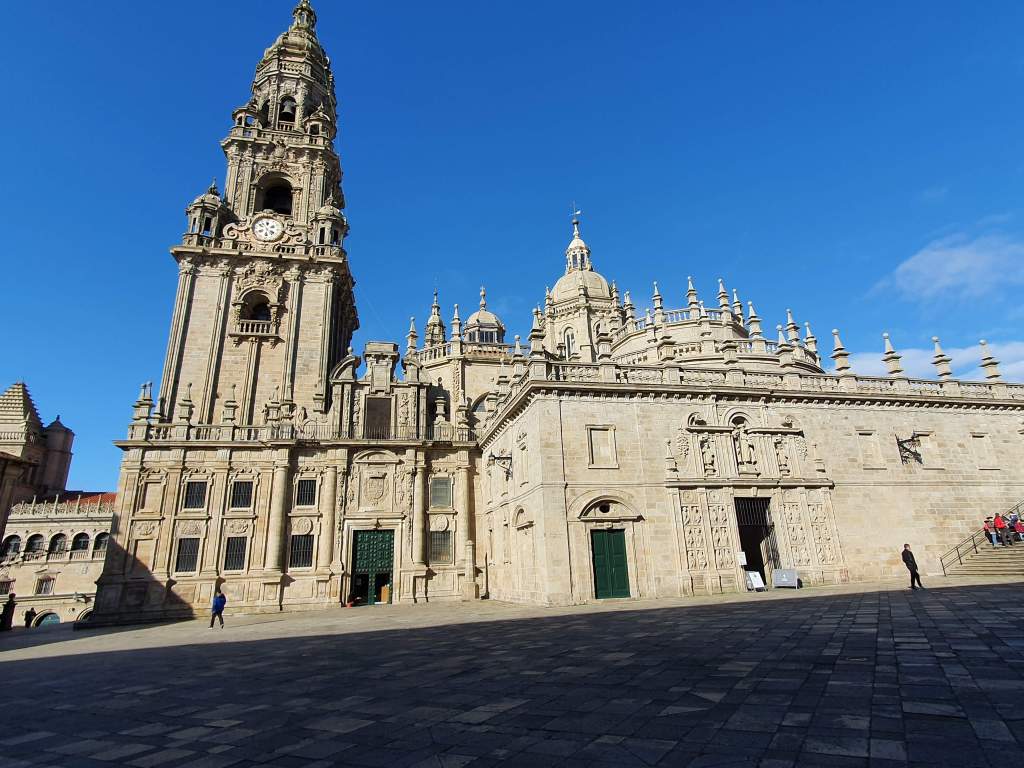
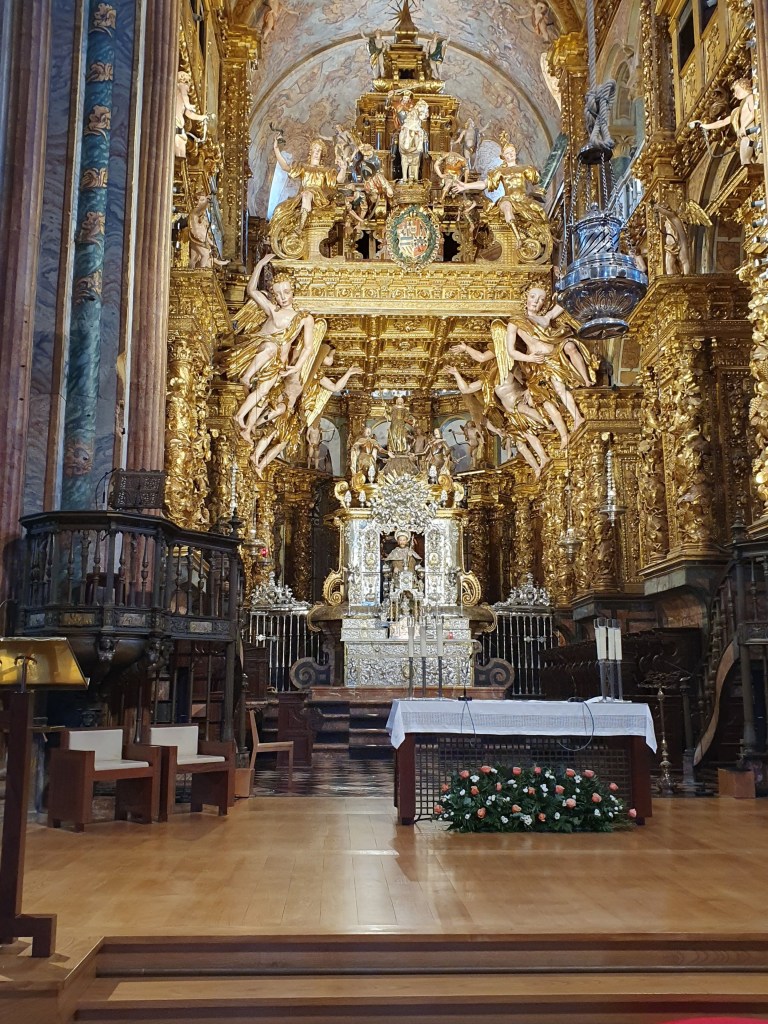

On leaving the cathedral I went to the Museum of the Galician People. I was fortunate that it had free entry on Sundays. This excellent museum, which explains the history and culture of Galicia, is housed in the former Convent of Santo Domingo de Bonaval. I spent nearly two hours exploring it.

On Sundays in Santiago de Compostela, all the museums shut for the day at 2pm, so I just had time to return to the cathedral to have a look round the cathedral museum and visit those parts of the cathedral, such as the cloisters, which you can’t access for free.
On leaving the cathedral for the second time I began to explore the historic streets nearby. Clouds had been thickening all day, and despite the Weather App on my phone saying there was a 0% chance of rain, it began to rain quite hard. In the circumstances, I thought I would make my main meal of the day lunch rather than dinner and I went to an Italian restaurant that I had identified as a possibility – however I think everyone else had had the same idea and there were no tables free. The restaurant said that it would be less busy in a couple of hours time. So instead I found my hotel which was located back towards the station and checked in early to avoid the rain. I ventured back to the Italian restaurant at about 4pm and had a very late lunch there. By the time I had finished my late lunch the weather had much improved and the sun had come out, so I recommenced my exploration of the ancient streets of Santiago de Compostela and returned to my hotel just before it got dark via a park to the south of the city.
Day 6 – Monday 28th February 2022 – Santiago de Compostela to Burgos
As many places to visit are shut on Mondays, I had planned my trip so that today would be the longest day spent travelling. There is a through train from Santiago de Compostela to Burgos, but it only runs four days a week at present, on the other three days, which include Monday, you need to change at Ourense.
My train to Ourense was due to depart at 0834, but arrived late and did not leave until 0840. This caused me some concern as the connection time in Ourense was just five minutes and if I missed it there was no other train to Burgos that day. We crawled out of Santiago de Compostela, but after a while picked up speed for the forty minute run to Ourense. I knew that the connecting train was due to leave from the adjacent platform, but we came into Ourense eight minutes late, which was three minutes after my connection should have left. I had a panic when I saw that the adjacent platform was empty as we pulled in, but fortunately the connection was itself running ten minutes late. This train runs all the way across Spain from Vigo to Barcelona, a journey which takes 14 hours in total.
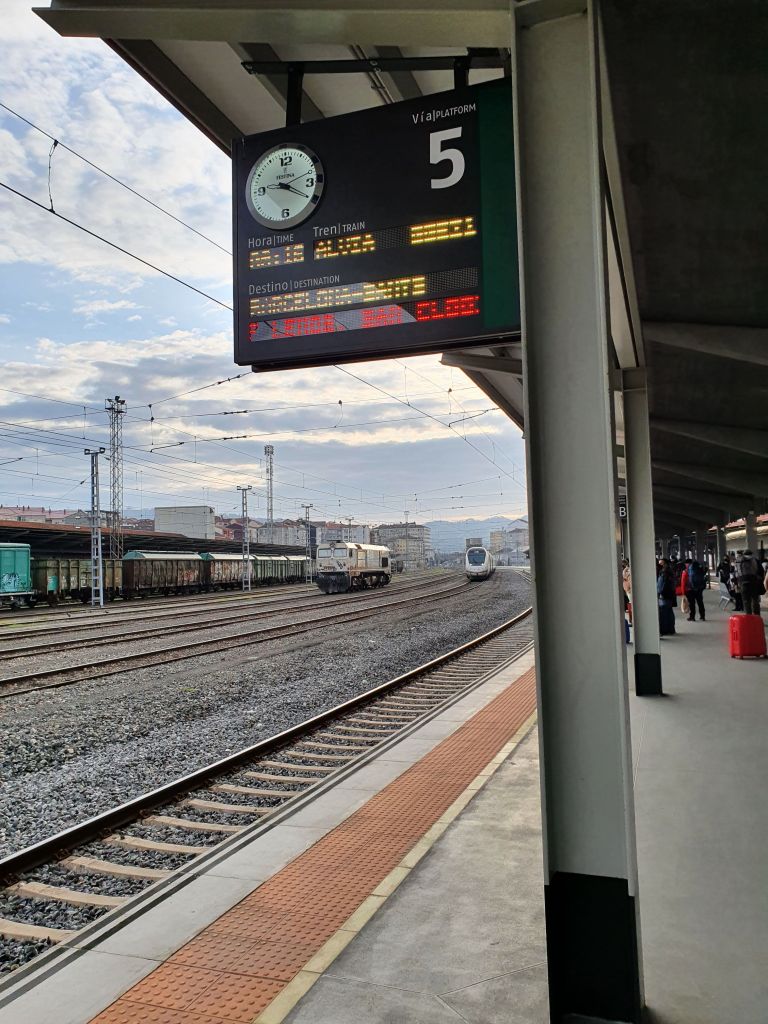
When I found my reserved seat I saw that there was a bag on the seat next to it. Initially nobody came to claim it, so I began to wonder if it had been inadvertently left behind, and whether I should report it to the guard. But after about ten minutes its owner returned. As the journey progressed I discovered that at every station stop the bag’s owner would nip out on to the platform for a smoke and jump back on to the train just as it was about to depart. As he stank of tobacco smoke, I was secretly hoping that he might misjudge one of his cigarette breaks and get left behind.
The train initially followed the steep valley of the River Sil, going quite slowly along a single track line for much of the route. It then climbed onto the high Spanish plateau spiralling round to gain altitude, where the landscape became more barren.
After about four hours we reached Leon, where the last few remaining seats in the carriage were filled. It was then another couple of hours to Burgos – although the train had been getting steadily later all along its journey as far as Leon, it managed to regain its lost time and was approximately on time as it pulled into Burgos. Burgos Rosa Manzano (which confusingly still only bears signs for its former name of Burgos Rosa de Lima) is a new station about 6km from the city centre. Buses from the station run about every twenty minutes and I had found on-line a bus timetable which showed that there was a bus due to depart seven minutes after the train arrived. But when the train arrived in the platform, the train doors refused to open for five minutes. When I eventually got off, I proceeded smartly to try to catch the bus which was now due to go in two minutes. Only I and one other passenger caught the bus, which departed on time, despite there being a stream of passengers still emerging from the station.
Getting off the bus in the city centre I entered the old part of the town through the city gate and went to my hotel which overlooked Burgos cathedral.
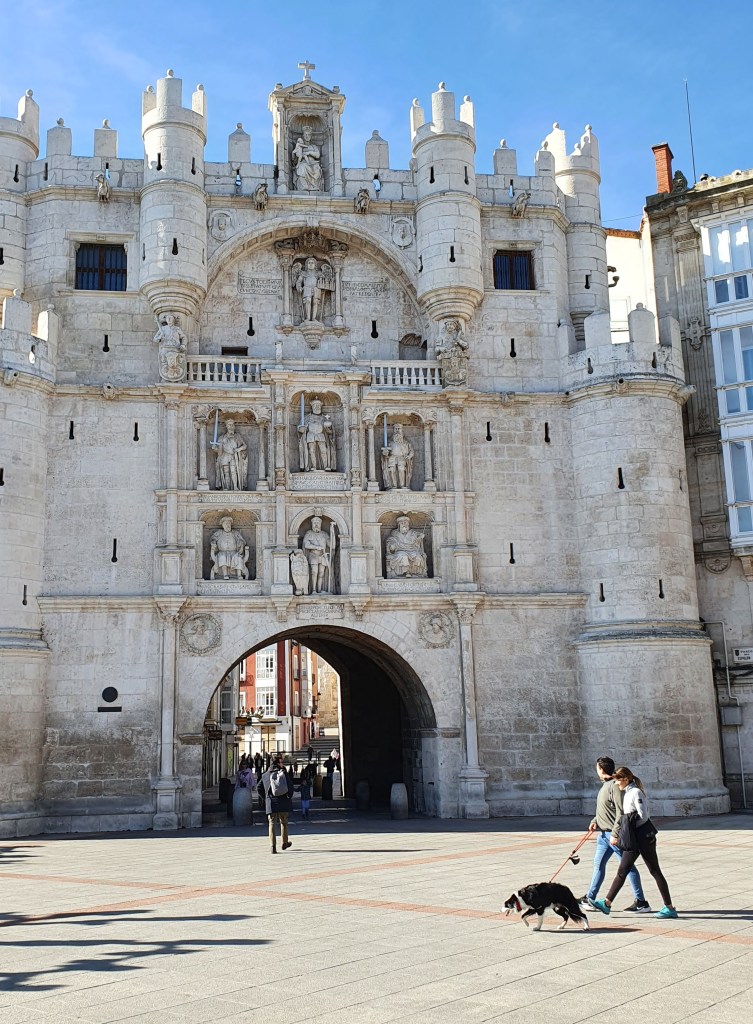
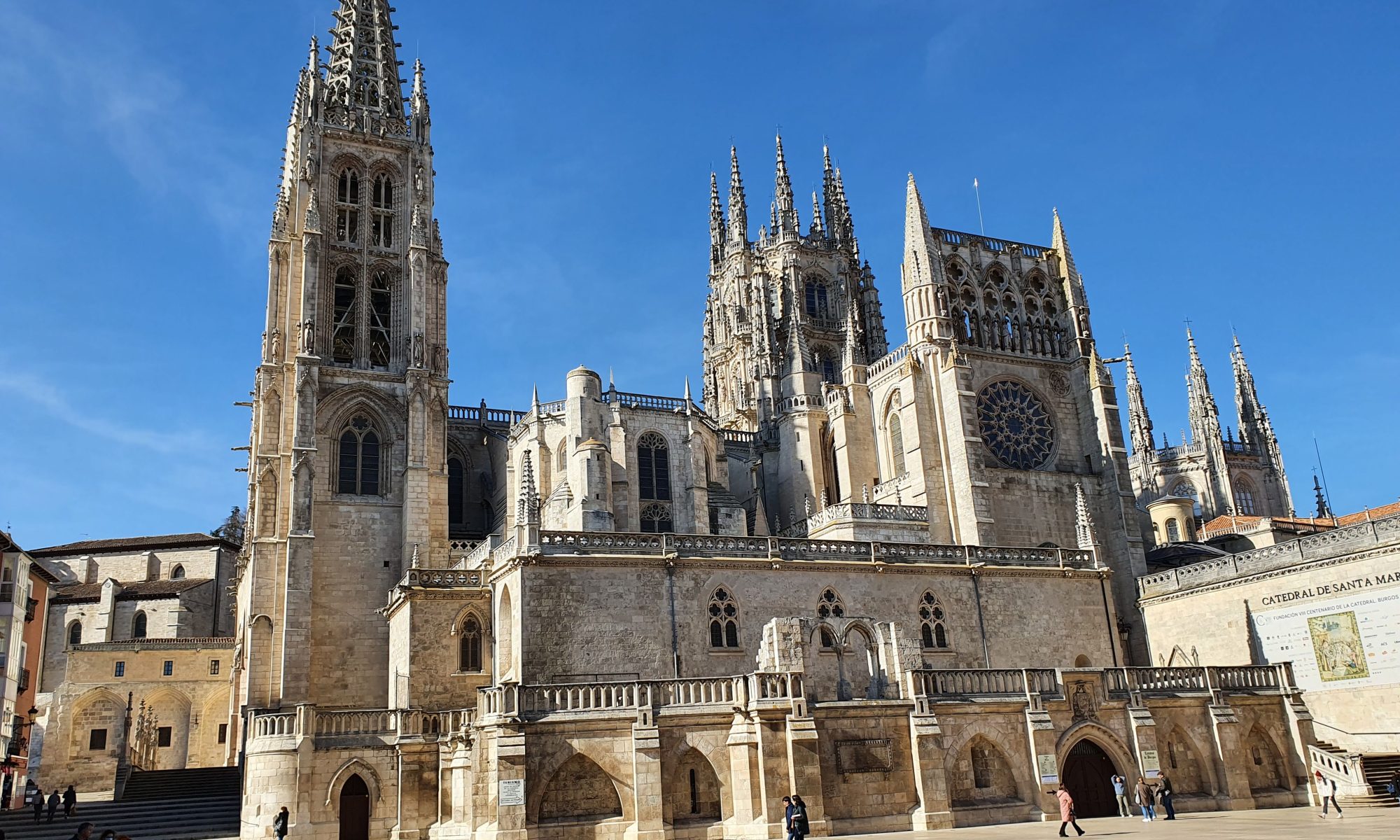
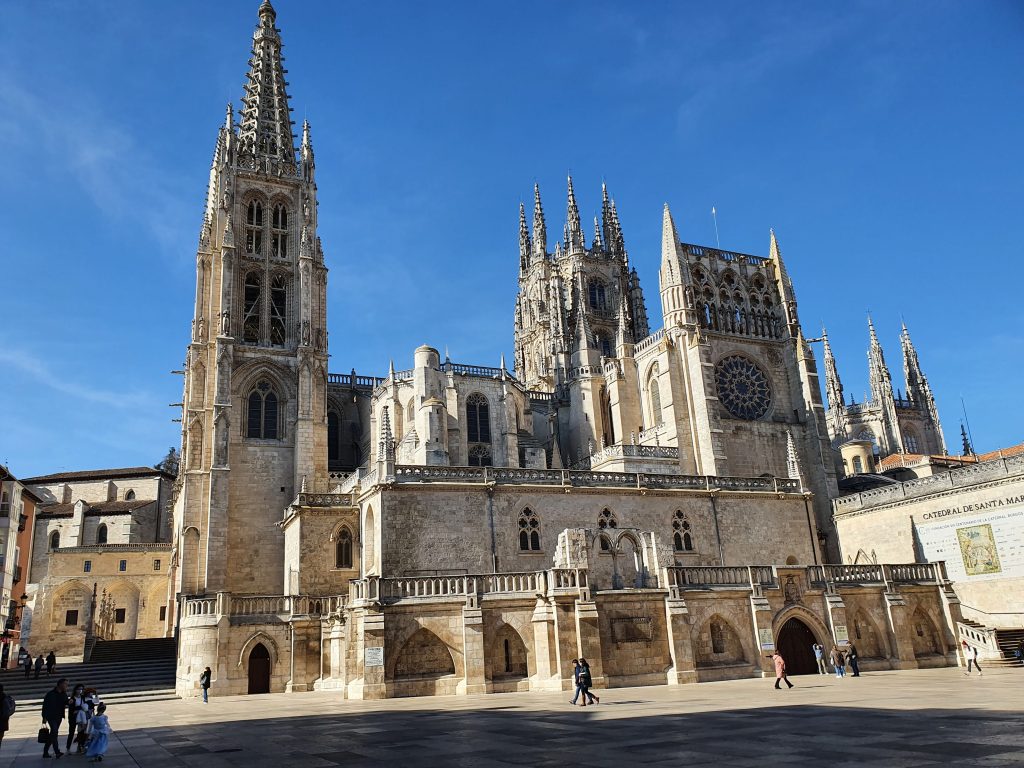
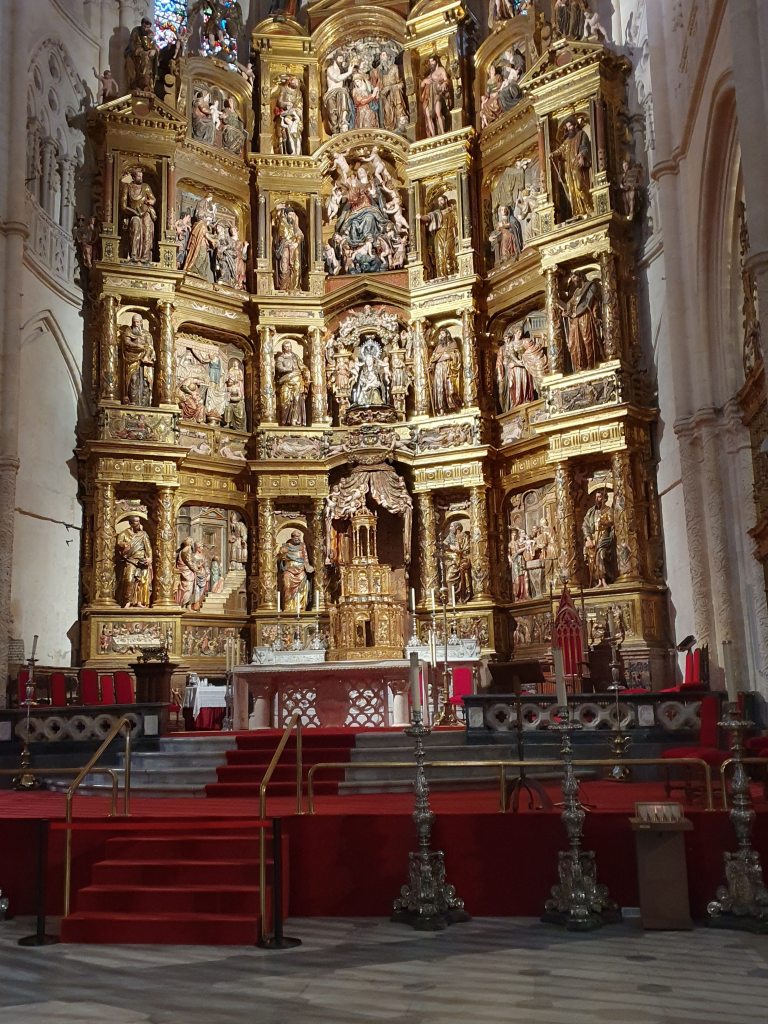
Burgos cathedral was well worth stopping off for. Of Gothic design dating originally from the 13th Century, the cathedral was enormous. Some of the side chapels were larger and more ornate in themselves than some other cathedrals. It is also the burial place of El Cid.
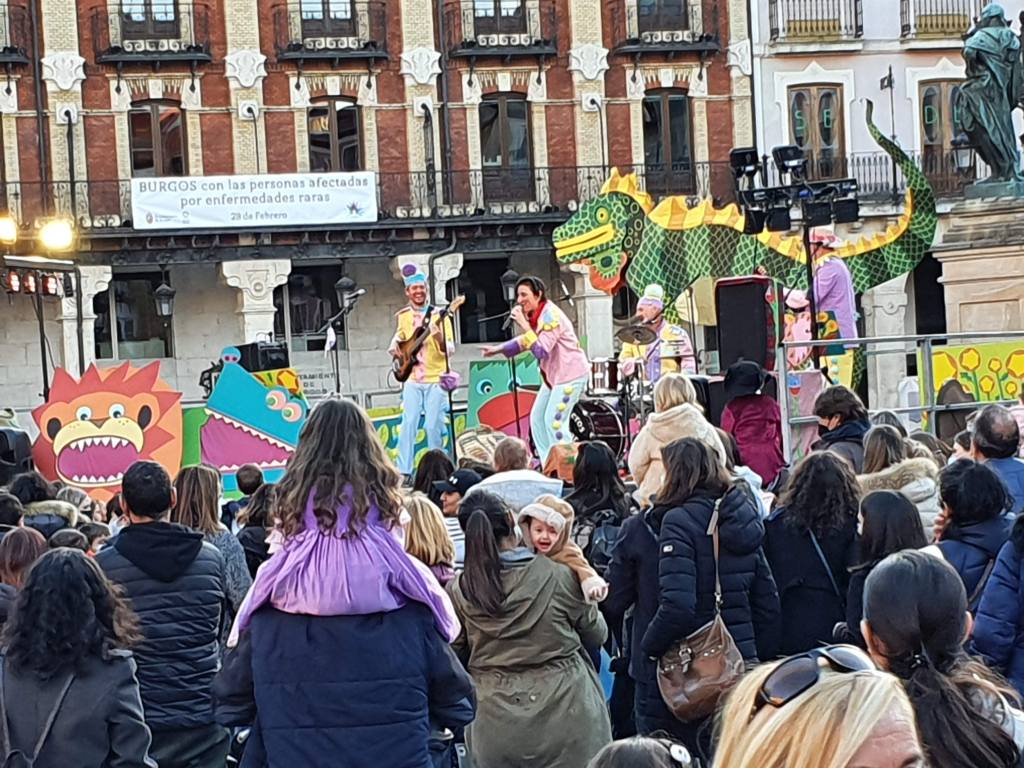
As in Vigo, it was also Carnival time in Burgos, with a band playing in the main square attracting a large crowd of small children and their parents. Although many of the children were in fancy dress, unlike in Vigo their parents were not.
In the evening the centre of Burgos was thronged with people, and because of its altitude (865m) once the sun went down it was rather colder than anywhere else I had encountered on my trip so far. I had originally identified a couple of potential eating places, but when I visited them one was only serving drinks that evening and the other was completely packed. In the end I found a table in a restaurant on the edge of the old city centre serving upmarket burgers.
Day 7 – Tuesday 1st March 2022 – Burgos to San Sebastian
Increasingly these days hotels do not include breakfast in the price, but charge for it as an optional extra. As I am not an eater of big breakfasts, I usually choose not to pay extra, as I don’t think I get good value for the amount that I wish to eat. The hotel in Burgos had included breakfast in the price, so it was the only hotel breakfast I was having on this trip. Ideally, I wanted breakfast at about 8am, but as a Covid prevention measure, the hotel was only doing breakfast slots at 0730, 0815 or 0900 – so I chose the 0815 sitting.
When I awoke that morning and turned on my phone I had an unpleasant surprise. I was greeted with just a black screen and an error message. Give that my phone is my method of communication, resource for finding information, map provider, camera and the means to complete my Passenger Locator Form for entry back into the UK, not having a working phone would be fairly disastrous. (Fortunately, I had paper back-ups of all my tickets and Covid passes.) I managed to find a way of getting into the phone settings, from where I could launch any application, but I could not switch from one to another without rebooting the phone and starting again. This was very cumbersome and draining on the battery. However, it did give me a means of of identifying a solution to the problem, which was to uninstall all the updates and reset the part of the phone’s operating system which controls the screen layout. I did not have time to do this before breakfast – so rather than enjoying my one hotel breakfast on the trip, I just had a very quick breakfast, so that I could return to trying to mend my phone. Fortunately, the solution worked, albeit at the expense of losing a lot of pre-set information, which was a nuisance, but not the disaster it would have been without a functioning phone. I could now check where the bus back to the station departed from, as I remembered that the route back was not the exact reverse of the route into Burgos the previous day.
I got to Burgos Rosa de Lima/Manzano station in good time for my departure to San Sebastian. For my ride this morning, I was travelling Confort class (Renfe’s name for first class). This was not due to any extravagance on my part, but simply that Confort was cheapest ticket available at the time that I booked. Confort class used exactly the same seats as in standard class with no other extras, but the seats were more widely spaced. Given my phone problems had drained the battery, I had hoped that Confort might have charging facilities at your seat – but it was no different in that regard to the other Spanish trains I travelled on.

For much of its journey to the coast the train followed the Ebro river, descending quite steeply at times. It arrived in San Sebastian (or Donostia as it is known in Basque) at 1350, 15 minutes late. From the station, I went to my hotel to see if I could check-in and leave my bag, and also charge my phone which was nearly drained. Unfortunately my room was not yet ready, so I sat in the hotel lobby for 15 minutes, while giving my phone enough charge to last the rest of the afternoon.
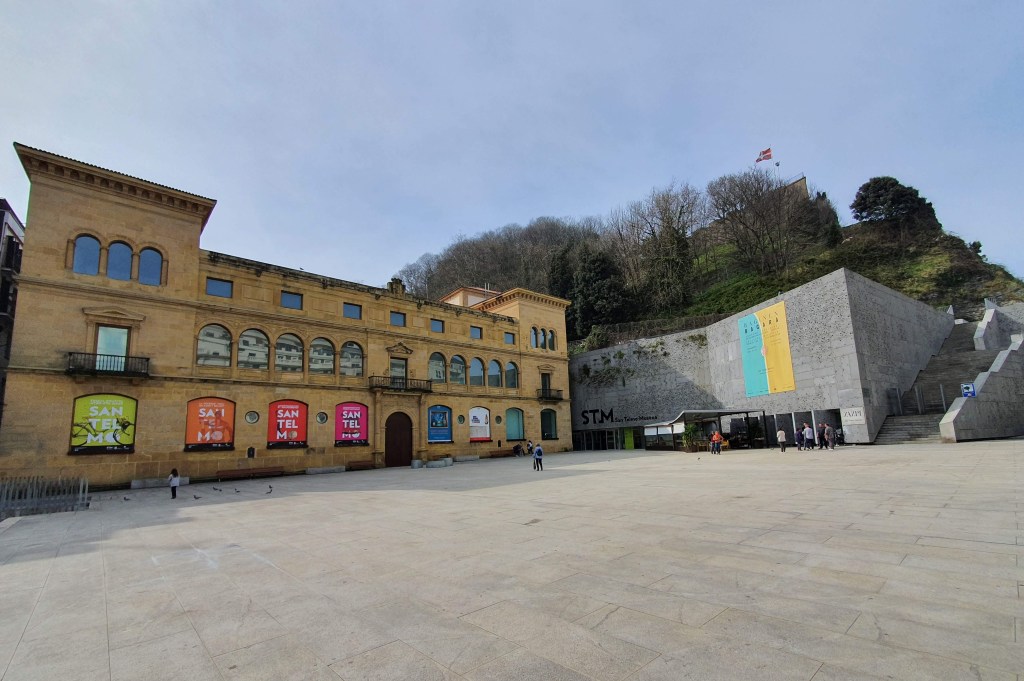
My first stop in exploring San Sebastian/Donostia was at the San Telmo Museum, the museum of Basque Society located within a former Dominican monastery with a modern extension. As for the Museum of the Galician People in Santiago de Compostela, I had picked the one day of the week to visit San Telmo when there is free admission. In the former church there are exhibited eleven large canvasses, commissioned in 1929 when the museum first opened, depicting an almost mythologised portrayal of the Basque people. The remainder of the museum presents a social history of Basque society up to the present day, as well as a small collection of Basque art. At the time of my visit there was also a special exhibition on female artists, exploring why they have largely been written out of the history of art.
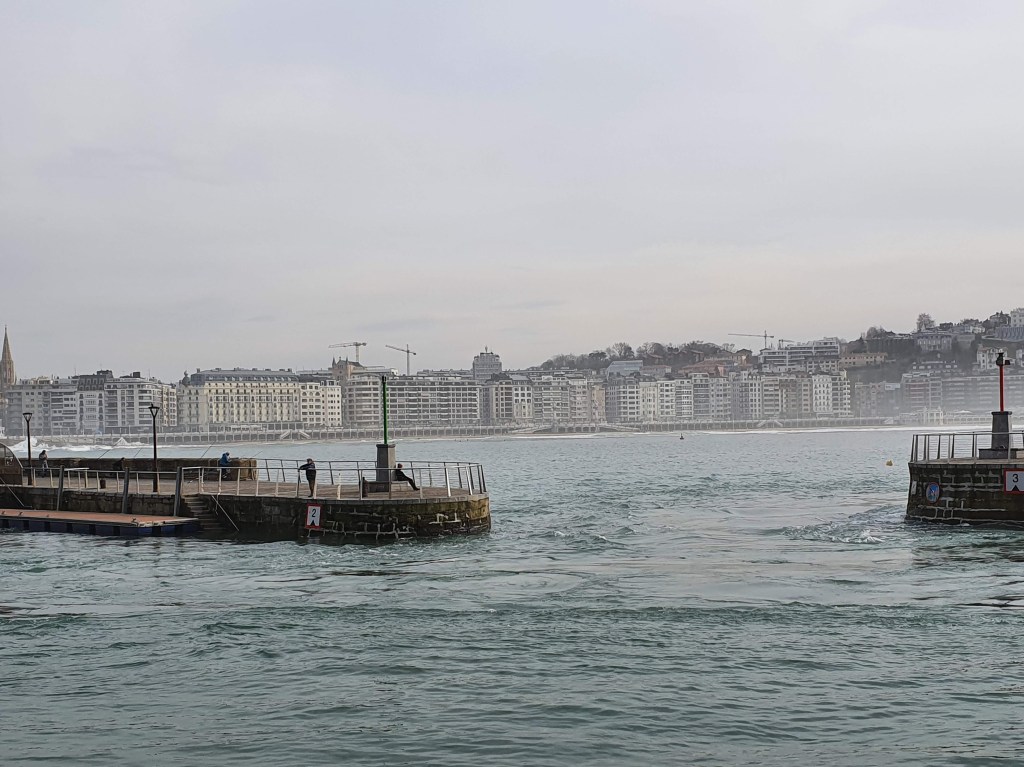
From the San Telmo Museum I wandered to the harbour which had views across the bay to San Sebastian. The harbour front was the location of the Maritime Museum. Unusually, this museum did not appear to have a permanent exhibition, but instead the whole space was devoted to a newly opened special exhibition telling the story of the deserted island of Tromelin in the Indian Ocean where 80 slaves were abandoned in 1760 for fifteen years. It was a disgraceful episode in the slave trade, which I am surprised is so little known.
That evening, rather than waiting for the restaurants to start serving dinner at their normal late hour, I visited a bar and had tapas to accompany my beer for my final evening in Spain.
[To be continued. Coming next – through France and home.]
 Europe Explored