
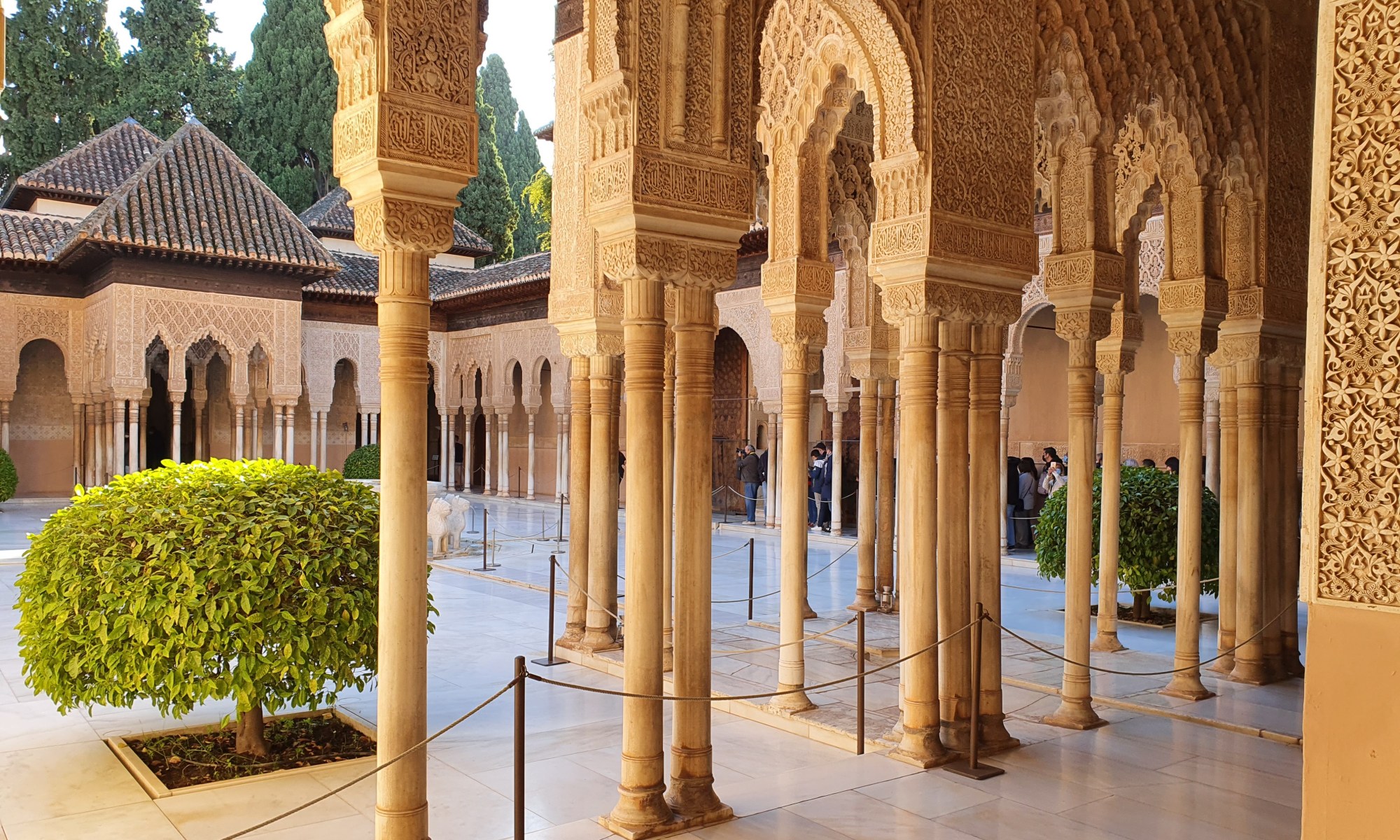
“No sé si llamé cielo a esta tierra que piso, si esto de abajo es el paraíso ¿Qué será la Alhambra, cielo?” (“I do not know what to call this land upon which I stand. If what is beneath my feet is paradise, then what is the Alhambra? Heaven?”) – Lope de Vega
My wife and I had promised ourselves a trip to the Alhambra Palace in Granada in Spain in the Autumn of 2019. However, unexpected personal circumstances at the time meant that it was not possible for us to go then, so we decided to postpone until 2020. Of course, by late 2020 a second wave of Covid was sweeping Europe and travel was not a sensible option. Again personal reasons precluded travel in the summer of 2021, but following my successful solo trip to SW England and Normandy in October 2021, we took the decision only a couple of weeks in advance to travel to Granada in early November 2021.
To get to Granada we looked at the possibility of travelling by train, but the cheapest return train journey would be over six times the cost of flying and even these prices could only be obtained by booking several weeks in advance, meaning that we would risk the Covid rules changing in the intervening period from when we booked. So in the end we decided to make it a short City Visit style trip rather than a full Europe Explored rail adventure.
Wednesday 3rd November 2021
As there did not appear to be any direct flights from the UK to Granada at the time we wanted to travel, we chose instead a flight to Malaga. To maximise our time in Spain we chose flights with a very early departure and a very late return, meaning that it would not be possible to get to and from the airport by public transport. Since there were two of us travelling, the car park fee was about what we would have paid for Stansted Express rail tickets.
Our flight was due to depart at 7:20am, with an advised check-in time of at least two hours prior to that, so a very early start was required. After the shock of getting up so early, the next unwelcome surprise was that overnight had seen the first hard frost of the season – in my calculation of the time when we needed to leave I had not factored in the need to de-ice the car windows!
The queues to get through security at Stansted Airport were shorter than I had experienced in pre-Covid times, so the advised arrival time was far too early. After purchasing some breakfast, rather than hang around to eat it in the main departure area of the terminal which was unpleasantly crowded, we made a guess about where the flight was likely to depart from and made our way there to eat the breakfast we had bought. This proved to be a sensible crowd avoidance policy, as this area was fairly empty until our flight information was posted on the information boards.
The flight was nearly full and so we kept our FFP2 masks on for the duration. At one stage it looked like we would arrive early into Malaga airport, but in the end the plane had to circle for a short while over the Mediterranean before touching down exactly on time at 11:15am (Spanish time).
We had booked seats on a bus leaving the airport at 12:30pm to go to Granada, which given the prompt arrival we thought would be plenty of time. However, upon entering the airport we encountered a massive queue for immigration. It was shorter for EU passport holders, but I was travelling on my British passport so I could stay with my wife who does not yet have an EU passport. It took about forty minutes get through immigration, but that was not the end of the queuing. We then joined another queue to have our Covid documentation checked. As my wife had not been able to to upload her vaccination certificate to the Spanish system, we thought that this might cause problems, but when we eventually got to the head of this queue the fact that we had printed out the Spanish certificate was sufficient (even though in my wife’s case her vaccination status was entirely self-declared). The authorities were not interested in seeing any documentary proof of vaccination.
We only emerged from all these queues about ten minutes before our bus was due to depart. We made a quick dash through the arrivals hall and were relieved to find our bus waiting immediately outside the terminal building. There were only a few passengers on board when it left the airport. It then went to Malaga’s main bus station where many more passengers got on.
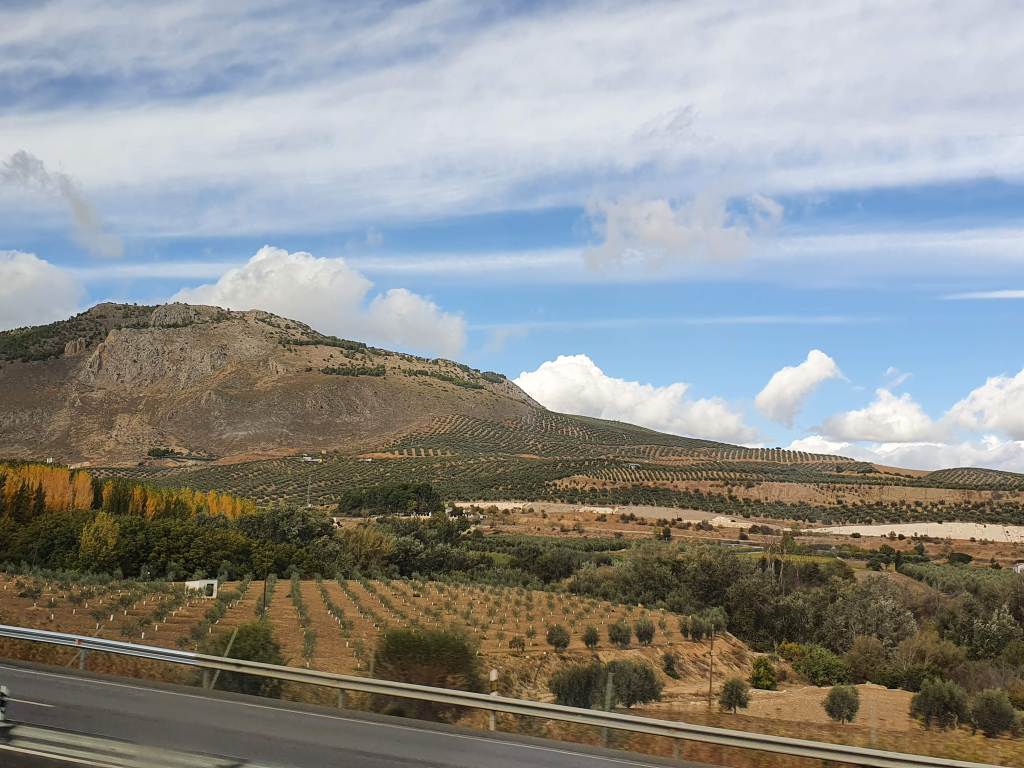
The journey to Granada took a couple of hours, climbing through the spectacular scenery of the Sierra Nevada.
The bus arrived at Granada’s main bus station at around 2:45pm. Strangely, the bus station is on the edge of the city, a couple of miles or so from the historic centre, so we then had to catch a local bus to complete our journey.
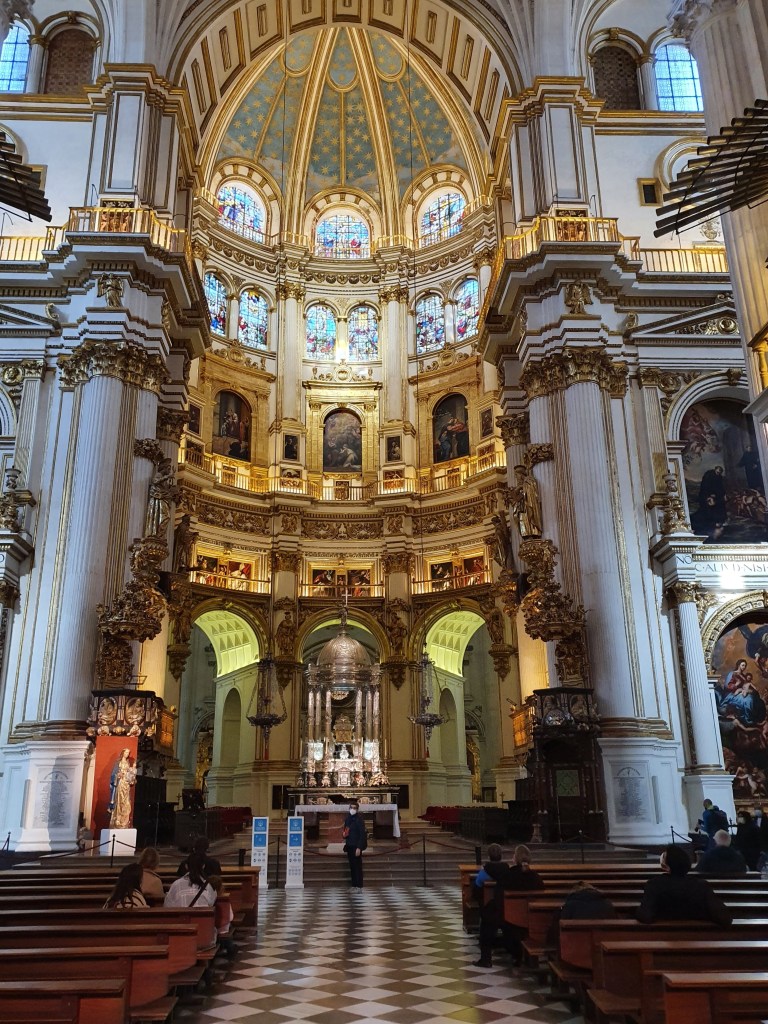
We alighted near the cathedral and made our way to the nearby tourist information office to obtain a map of the city. Our first stop was to visit the cathedral which had been constructed on the site of the former main mosque in Granada after the Muslims had been driven out in 1492. The interior of the cathedral exhibits a variety of styles, with the Baroque features particularly catching the eye.
After visiting the cathedral we went for a wander round old Granada, including visiting the small botanical garden, before making our way to the hotel we had booked in the Albaicin district of the city. Our hotel was down a little alley and was an historic building in its own right. It was in the traditional mudejar design, with the bedrooms surrounding an open courtyard.
Before setting out for the evening we researched places to eat dinner. We identified two, the nicer one we thought we would save for the next day. At our first chosen restaurant there was some confusion, as while they would serve us drinks, they didn’t seem to want to serve us food – I assume that they may have been fully booked for later. So we then went to the restaurant we had originally chosen for the next day, but that turned out to be fully booked, and was also fully booked for the following evening. In the end, we found a restaurant/tapas bar nearby. For main course we both had what the menu described as ‘pork in pastry’, but turned out be be pork schnitzel. While the meal was adequate, it was nothing special, but at least it was fairly cheap.
Thursday 4th November 2021
We got up early this morning, as we wanted to maximise our time in the Alhambra and we left our hotel before they had started serving breakfast. We had booked on-line our tickets for the Alhambra at the same time as we booked the rest of the trip. Your ticket gives you access to all parts of the Alhambra complex – but you have to specify a time for your entry to the Nasrid Palaces, we had chosen a 9am entry.
We had high expectations for our visit to the Alhambra and we were pleased that it lived up to them. I had remembered an account by the mathematician Marcus du Sautoy in his book Finding Moonshine of his visit to the Alhambra. As Muslim art does not depict living creatures, the palaces of the Alhambra are famous for their intricate tiled patterns. There are essentially only 17 types of replicating pattern possible on a plane surface and Marcus du Sautoy on his visit had tried to find examples of all 17. Given that, even as a trained mathematician, he found it tricky to identify easily the different patterns and that he only found the last one by jumping over a rope to enter an area which was not open to the public, in the end we decided not to replicate his quest.
As there is general public access to parts of the Alhambra, to enter ticketed areas your passport is scanned (you provided your passport details when you bought the ticket), and it is your passport which acts as a ticket rather than the on-line printout of the ticket. As we were not totally sure how the ticketing system worked, we accessed the site through the main entrance when it opened at about 8:20am and walked through the old Medina area towards the Nasrid Palaces where we needed to be by 9am. My wife had bought a guide book the previous day, which augmented our understanding of the place.
The Nasrid Palaces consist of three main groups of buildings – the Mexuar Palaces, the Comares and the Palace of the Lions. These were at the heart of the royal court during the reign of the Nasrid dynasty from 1238 until the Christian conquest of the city in 1492.

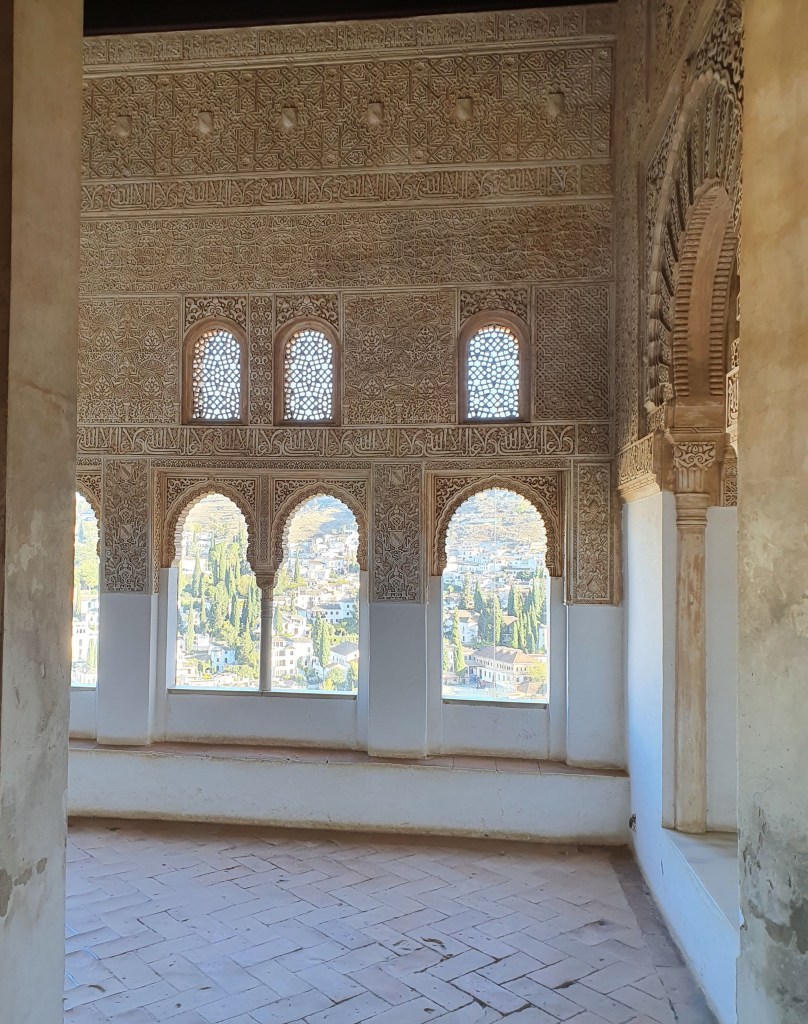
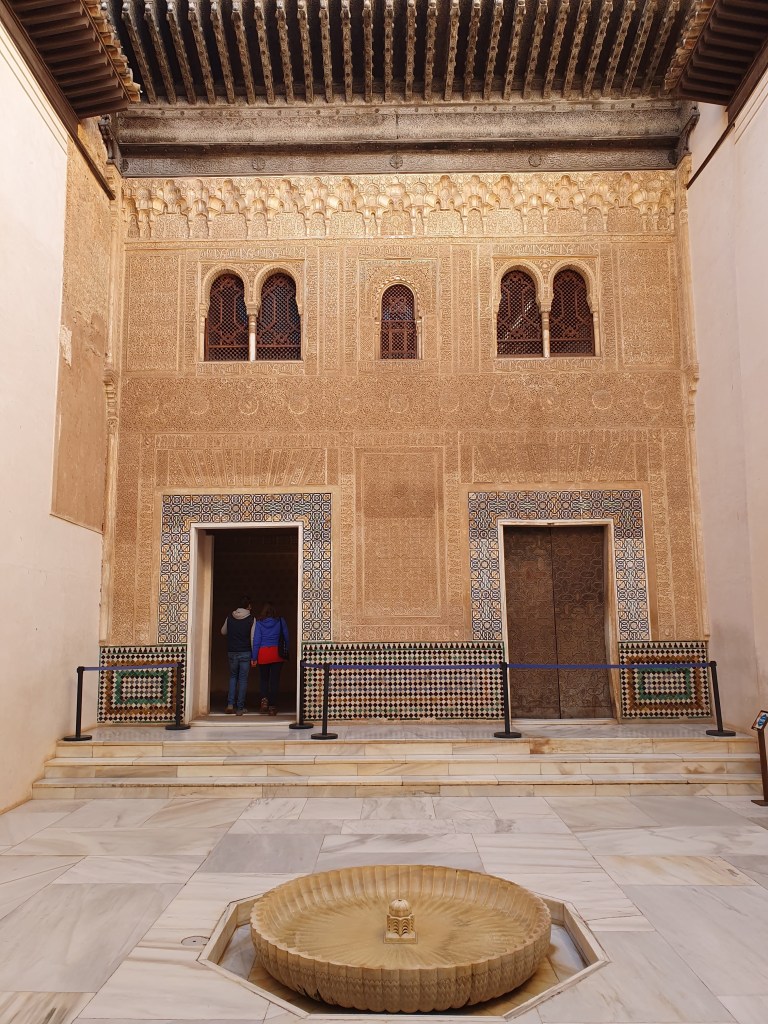
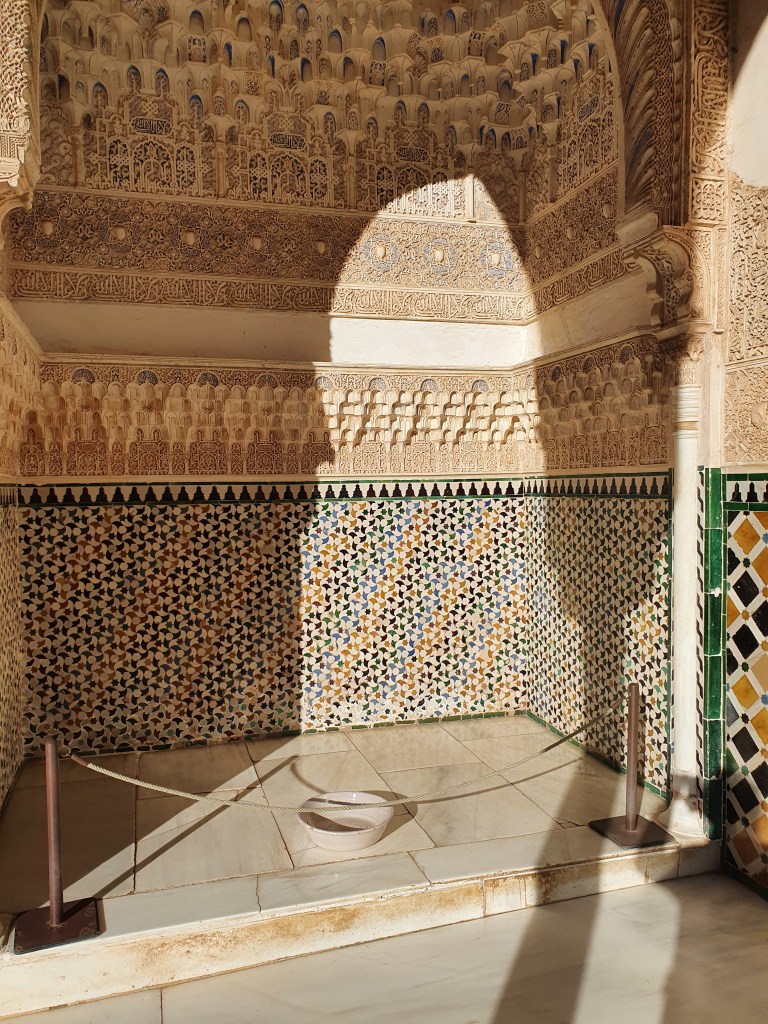

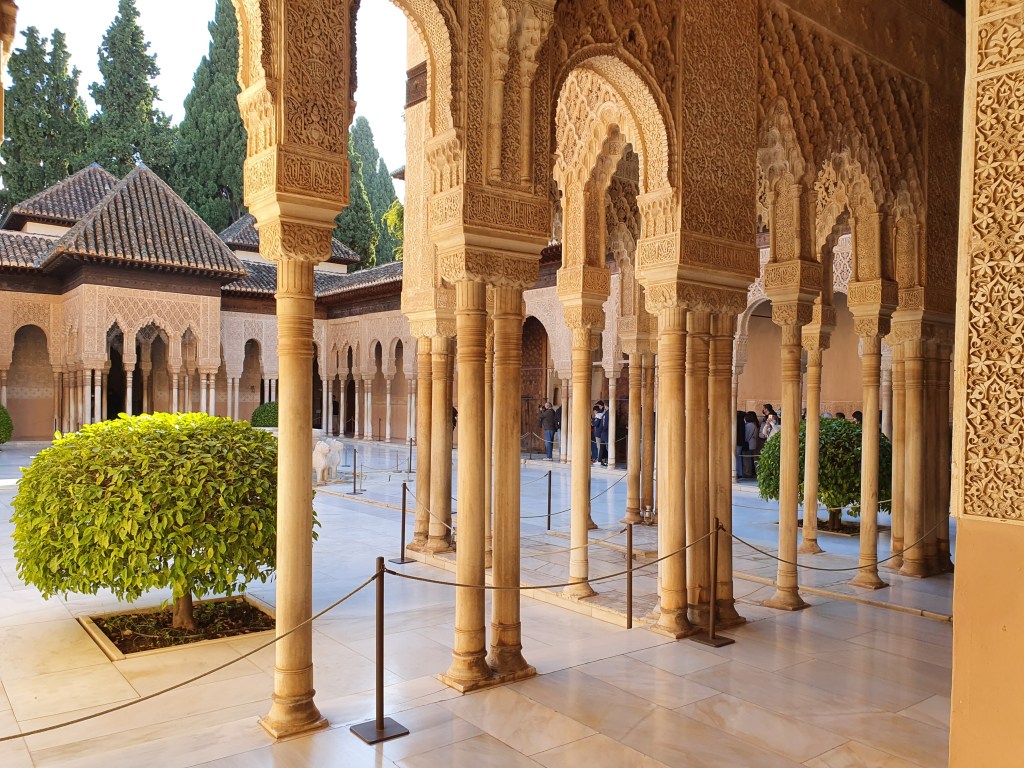
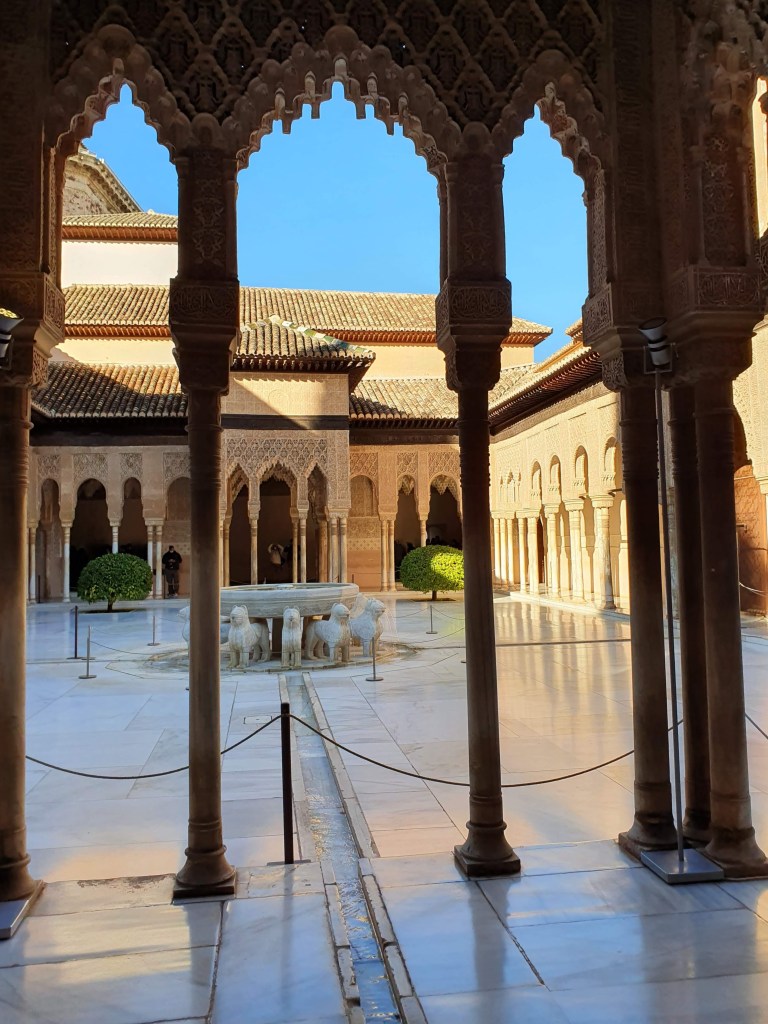
Although the Nasrid Palaces were quite busy with other tourists, if you were patient it was possible to find some quiet moments, as the above pictures show. Everywhere you looked the intricacy of the detail was amazing. We did not want to rush as there was so much to admire. Eventually, after a couple of hours or so, we dragged ourselves away to explore more of the complex. We walked through the Partal Gardens and made our way to the Alcazaba.
The Alcazaba is the oldest part of the Alhambra and its tower dominates the view from the city. The inner structures no longer remain, just the towers and outer walls. We climbed the Torre de la Vela, which has superb views over the city below.
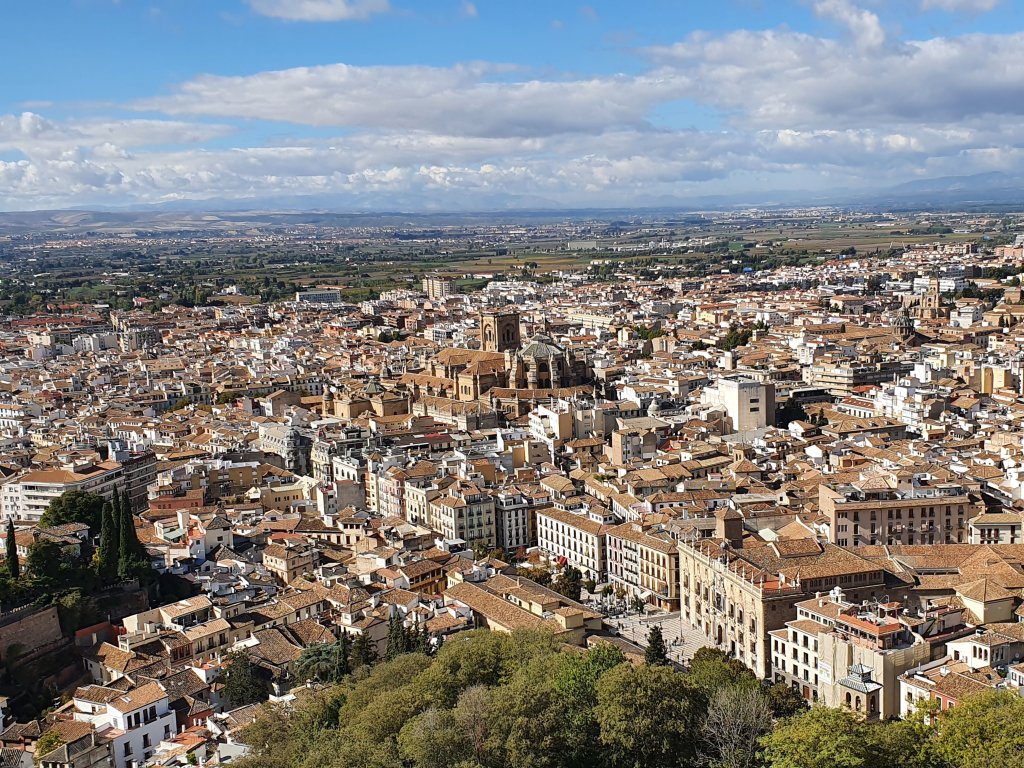
After a quick lunch of bocadillos purchased from a kiosk, we then went to the Palace of Charles V. This was built by the conquering Christian forces to be in complete contrast to the Muslim architecture which preceded it. The Palace of Charles V is of an unusual design in that it is square on the outside, but has a circular courtyard in the interior. If seen in isolation one would be impressed by the splendour of the building, but compared with the Nasrid Palaces it seemed quite stodgy. The building contains an art gallery and a museum. The art gallery is free to enter for EU citizens, otherwise it costs €1.50. We found the depictions of the local area rather more interesting than the collection of religious art. The museum (free for everybody) contains many artefacts recovered from the Alhambra and helps explain more of the history.

We then walked back through the main site, with a quick look at an ancient bathhouse, to the Generalife, the gardens attached to the Alhambra, which in former times would have supplied much of the fruit and vegetables to the palaces. A major feature of the Generalife is the water supply system which is still in use today. The gardens are irrigated by a series of aqueducts which draw water from Darro river and store it in water tanks until it is needed.
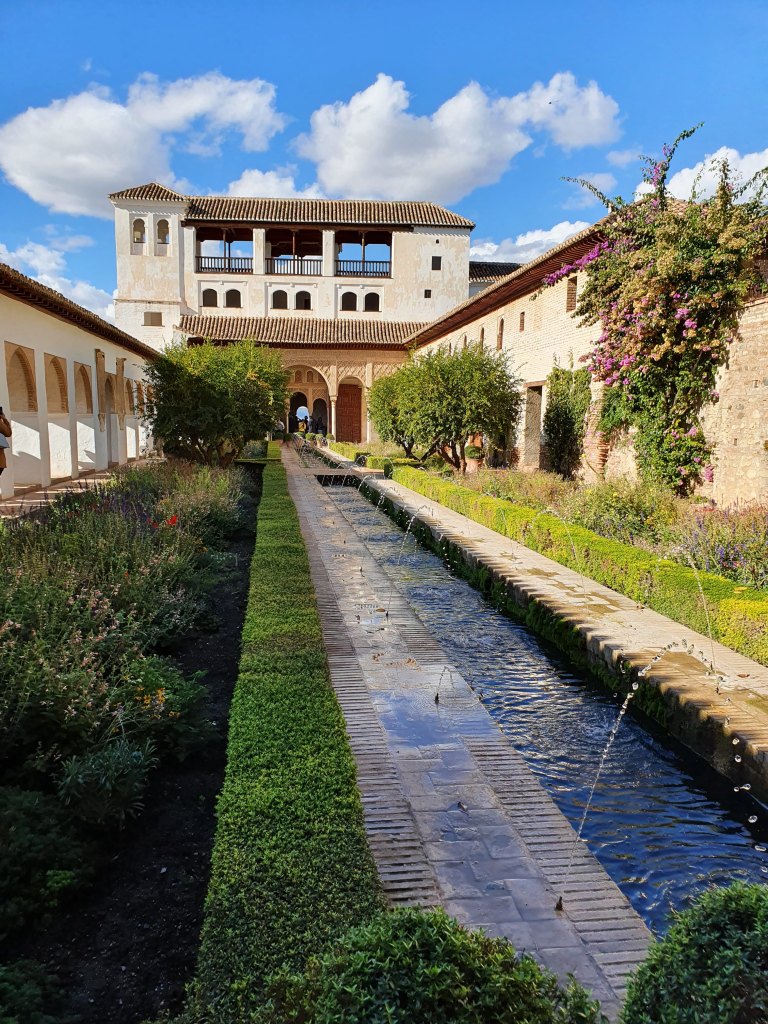


We walked for a short while in the upper gardens above the Generalife, which we accessed by climbing the water stairway, an original feature which has streams of water running down the handrails on either side of the steps. On leaving the Generalife we then walked the entire length of the Alhambra again, reluctantly to leave by the Justice Gate.

We then returned to our hotel. One task we had to do before heading out for dinner that evening, was to complete our Passenger Locator Forms for our return to the UK, as these cannot be finalised until 48 hours before your arrival. When I had been to France the previous month I had taken the precaution of filling in most of the form on-line in advance and saving it to be returned to, so only the final few bits of information needed to be input on one’s phone while abroad. My wife and I had done the same for this trip to Spain, but when we came to retrieve our saved forms, we discovered that most of the previously input information had disappeared and most had to be input from scratch again, including proof of full vaccination. In my wife’s case, despite multiple attempts, the system refused to recognise her Covid certificate (despite having happily done so previously when in England), so she had no option but to self-declare her vaccination status and was told she would need to show her vaccine certificate upon arrival in the UK.
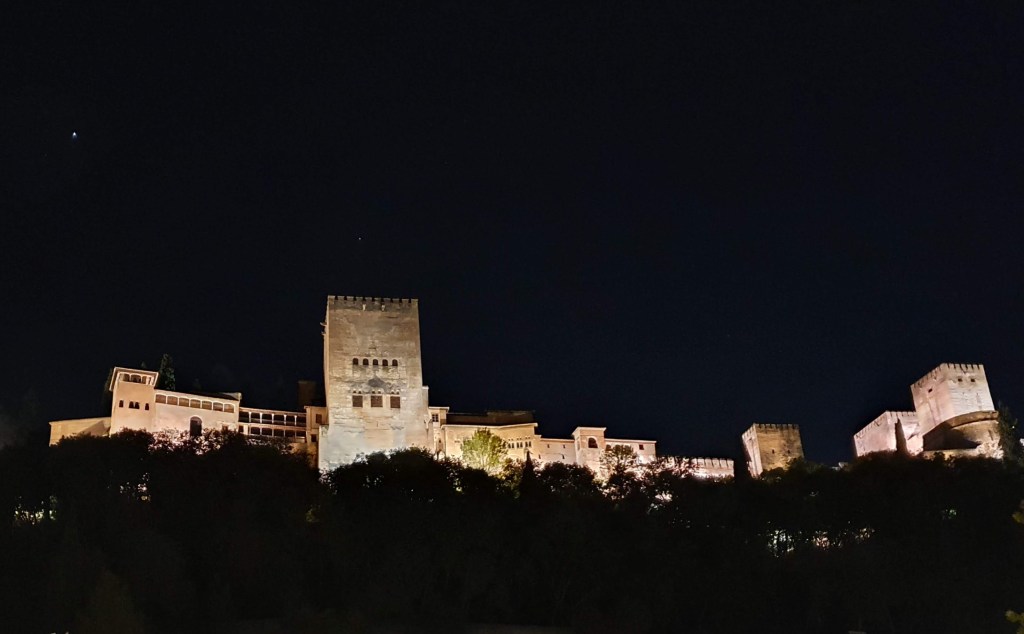
Having found another promising looking restaurant, we took the precaution of going for a walk before dinner to check it out and book one of the last remaining tables. When we returned for dinner we had a lovely meal. The menu was accessed by scanning a QR code on your table. While our order was being prepared we were brought hummus as an appetizer to go with the bottle of red Rioja we were having. For starter I had Harira soup, while my wife had Maruna pie (chicken with almonds and honey). For main course my wife had lamb with couscous, while I could not decide between a duck or pork dish – in the end I chose duck, but due to a misunderstanding I was served pork, which wasn’t a great problem as I had nearly ordered it in the first place. We somehow found room for desserts – I had thin slices of pineapple in a ginger sauce served with pistachio ice cream, while my wife had chocolate brownie with a raspberry sorbet. The whole meal was delicious and very reasonably priced, with views of the illuminated Alhambra’s Alcazaba from the restaurant window.
Friday 5th November 2021
This morning we again forsook breakfast in the hotel and retraced the route we took to Granada. We caught a local bus to Granada’s bus station on the edge of the city. Our bus to Malaga at 10:15am was not shown on the departure boards when we arrived, which was full of departures at 10am to destinations all over Spain. When we wandered out to the departures bays, we saw that the bus was already there and people were getting on it. Although, as with the bus to Granada, tickets had to be pre-booked, unlike the earlier bus this one did not have numbered reserved seats. By the time it left it was completely full, so much so that when the last family arrived to get on, the remaining spare seats were dotted around the bus and did not enable them to sit together – they tried, with only partial success, to get other passengers to move to accommodate their seating wishes.
We arrived at Malaga’s bus station at around noon. Our first stop on leaving the bus station was at Malaga Maria Zambrano railway station next door. We did not go there to catch a train, but to purchase Tarjeta Dorada Senior discount cards. These discount cards (which only cost €6) can only be purchased in person with proof of age at a ticket office. Unlike British Senior Railcards you also need the card number when booking a ticket – hence the need to purchase one in advance of any future trips.
We then walked into the centre of Malaga, pausing to eat a snack for lunch in a park near the seafront. Malaga was not how I imagined it, the centre had an old-fashioned charm and was not dominated by English speaking tourists from the nearby Costa del Sol. We wandered around the old centre, admiring the cathedral and Roman amphitheatre. The old city was overlooked by the Alcazaba, a Moorish fort built on Roman foundations on a nearby hill.

We visited Malaga Museum, which like the art gallery in Granada was free for EU citizens, but €1.50 for others. It is located in the former Custom House and has a comprehensive history of the city from ancient to modern times. As a thriving port, throughout its history Malaga had adapted to the different ruling forces. (For example, the museum explained that in the late 1930s under Franco there was fake archaeology undertaken to show to a visiting Nazi delegation that the Spanish were descended from the Visigoths and so were of Aryan stock.) The museum also housed an extensive art collection – I found the depictions of Malaga from different times to be the most interesting art exhibits.
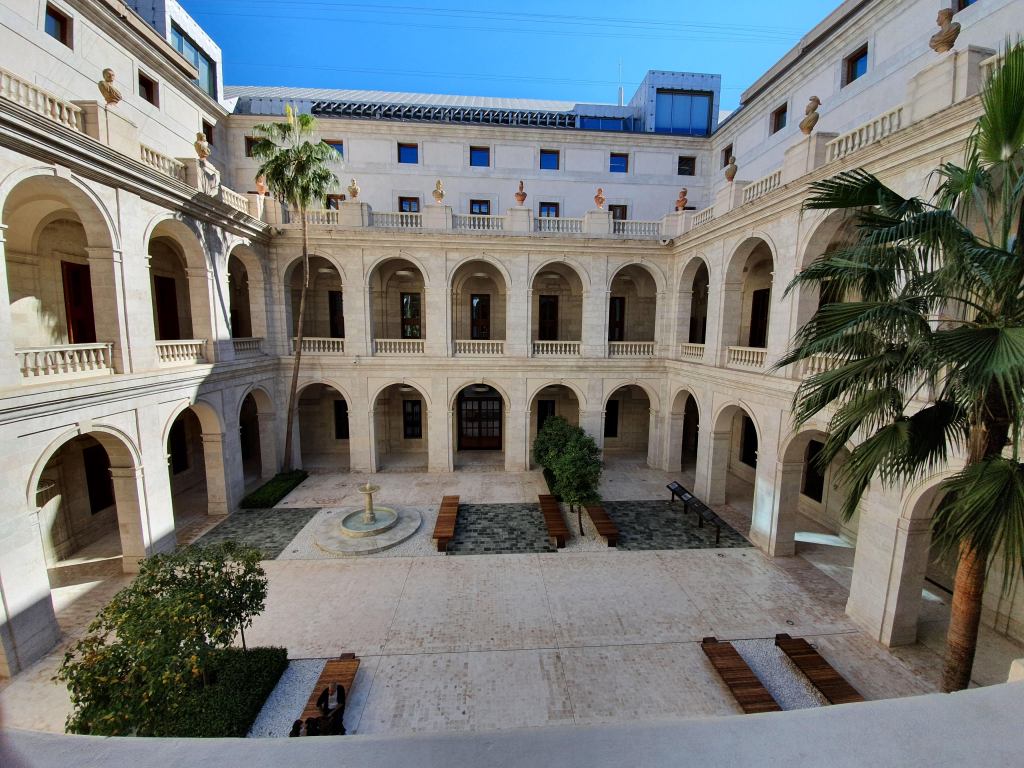
Pablo Picasso was born in Malaga, so the second museum we visited was the Pablo Picasso Museum, which provides a description of his long creative life with examples of his works from all periods. The exhibits were enhanced by an audio guide which we were given on the way in.

On leaving the Picasso Museum we contemplated climbing to the Alcazaba (or even to the further Gibralfaro castle of Phoenician origin) for the views over the Mediterranean, but decided that it would be too much of a rush to enjoy the walk. Instead we went for stroll along the harbour front and had an ice cream, before catching a local train to the airport.
Given the queues we encountered at Malaga airport on arrival, we thought we should for once take seriously the strictures about arriving two hours before our flight was due to depart. The queues to get through security turned out to be fairly short – on the other side the departure area was unpleasantly crowded and all the vendors of food and drink were charging ridiculously exorbitant prices. So after a while we decided to go through the leaving-Schengen passport control before our gate was announced to find somewhere quieter. This proved to be a wise move as there was a minimal queue at passport control when we went through, but once the details of our flight (and those of many other UK-bound flights leaving at about the same time) were posted on the departure boards, we could see that a massive queue developed which looked like it would take over half an hour to get through.
The flight back to the UK passed over Madrid, Bilbao, Nantes and Cherbourg – as the night was clear there were good views and I could recognise where I had walked on my brief explore of Cherbourg a few weeks previously. There was headwind affecting us throughout the flight, so it did not gain any time on its schedule and touched down as advertised at 11:05pm.
Given the on-schedule landing and with no hold luggage to collect, we had hopes of being able to get home before midnight. It was not to be:
- The plane had touched down at the stand which is furthest from the main terminal. So after walking for about ten minutes and going down some escalators we had to wait for the shuttle transport to take us two stops to the main terminal building.
- On arrival in the terminal, it was completely full with people queuing for passport control. We followed the instructions given and queued for the e-gates, but were worried that as my wife had been unable to upload her vaccine certificate to her Passenger Locator Form, the e-gate would reject her and we would have to join another long queue of rejects who needed manual processing. We waited in a constantly shuffling queue for nearly half an hour to reach the front – amazingly, the e-gates let us both through. So my wife had entered both Spain and the UK on a self-declared vaccine status with no actual check of her documentation.
- We naively thought that all our delays were over, but passing through Customs, a gate ahead of us closed suddenly, and we were made to wait for about five minutes before it reopened and we were allowed to proceed.
- We returned to the car park where we had left our car. The car parking fee had been paid in advance, so we didn’t need to find a machine to pay for our stay. However, when I inserted the ticket to raise the barrier to leave, the machine demanded another £186 as an excess fee. This was clearly wrong, so we had to contact someone to be let out – apparently their software had confused the letter ‘O’ on my car’s number plate with the numeral ‘0’ in their system. The problem was eventually resolved and we were allowed to proceed.
- We then thought it would be a quick half hour drive down the M11 to get home. But no – the airport approach road from the M11 was now shut for overnight repairs, as was the westbound carriageway of the nearby A120. So we were sent on a long detour of about 10 miles on small country roads to the north of Hatfield Forest to be able to access the M11.
We eventually got home at 1:20am – rather tired, but glad we had made the effort as the Alhambra was an amazing place.
Testing Epilogue
Unlike when I had been to France a few weeks earlier, the Day 2 tests we were required to take could now be Lateral Flow Tests, so long as they were purchased from a private provider, rather than using free NHS ones. On the Sunday morning we did our LFTs and uploaded photos of the negative results to the company’s website to obtain our certificates. We thought that was the end of the testing process, but on the following Saturday (a week after we returned) my wife and I were both contacted by Test & Trace to say we had been in contact with someone who had tested positive for Covid. They won’t tell you when or where the contact was, but the only possibility given the timings of potential required self-isolation, must have been someone on our flight home, with our details provided by the Passenger Locator Form. We had to go and get a PCR test, which fortunately returned a negative result the next day, so we were spared any further inconvenience.
 Europe Explored
Another great write up. In my head, the Alhambra will forever be in Bradford rather than Spain – obviously a differently cultured upbringing!
LikeLike