
“Nous avons besoin de la sagesse normande”
(‘What we need is common sense’, once translated literally in the European Parliament as ‘what we need is Norman Wisdom’.)
Nearly eighteen months late I finally managed to get Europe Explored under way this month. Not wishing to tempt the Covid fates too much, I planned a short six day rail journey the first half of which was in England. (In retrospect, it appears that case numbers in South West England were being seriously under-reported during the time that I was there, due to a rogue testing lab, and I would probably have been safer heading straight to the Continent.) The trip I went on was essentially the same as the one I had previously booked for May 2020, which had to be cancelled, but now using the overnight ferry to cross from Portsmouth to Cherbourg, and the days of the week shifted to accommodate the Sunday night sailing.
The trip was a great success – I felt safer in France, where there is mandatory mask wearing, Covid passports for admission to restaurants and museums, and Covid cases at only about one tenth of the level in the UK. This short trip has given me the confidence to consider planning others – the anti-Covid bureaucracy is easily manageable if you have planned properly.
Day One – Friday 8th October 2021 – London to Penzance
I arrived at Paddington Station at about 7:30am, in plenty of time for the 8:04am departure. I had splashed out on a first class ticket for the long journey to Penzance (which, although still reasonably priced, did not match the £21 first class ticket I had secured back in May 2020). As I had not had breakfast before leaving home, I bought a bacon roll and took it to the first class lounge at Paddington to eat. The first class lounge at Paddington is not as impressive as those that are on offer at some other stations and I was disappointed that the coffee machine was not working – there were just sachets of instant coffee to make your own with hot water. Not being a fan of instant coffee, it was not what I wanted, but there was not really time to go and find a decent coffee elsewhere on the station.
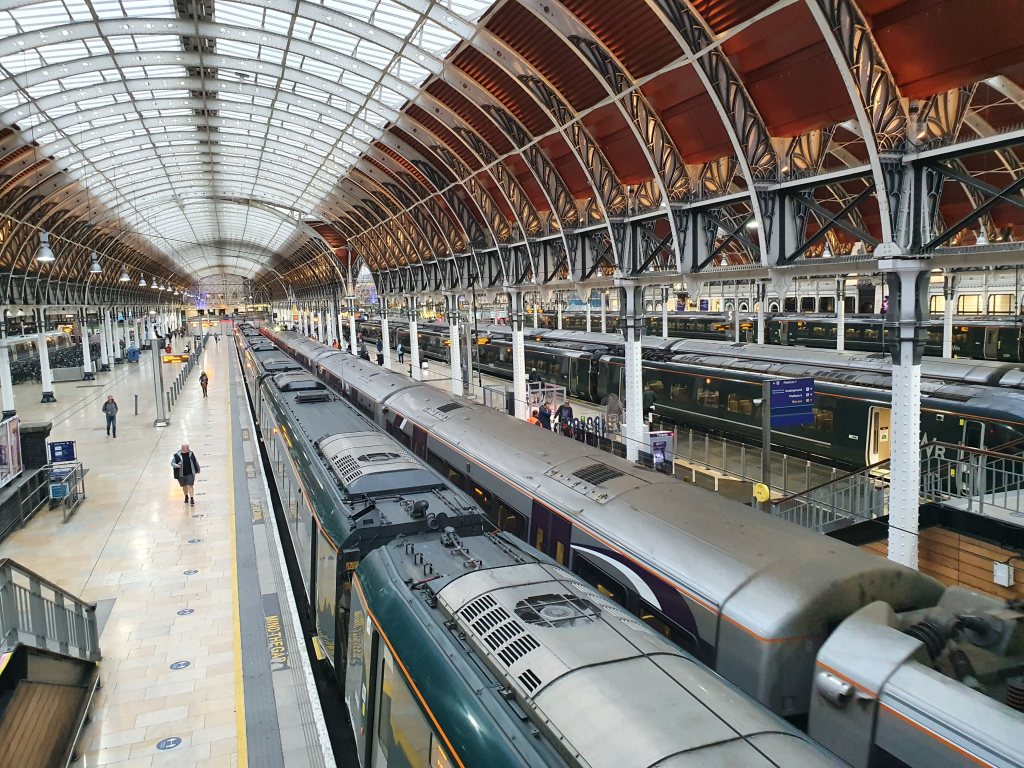
My next disappointment was that when I boarded the train I discovered my allocated seat did not have window views on either side. Since one of the main purposes of this rail journey was to admire the scenery, I had to to take pot luck and choose another seat hoping that it would not be claimed, as the seat reservation system was not working. As we pulled out of Paddington the reserved seat notifications sprung into life and I was relieved to see that my chosen seat was shown as being vacant all the way to Penzance. I had very attentive service on my journey and a serving of tea and cake made up for the missing coffee.
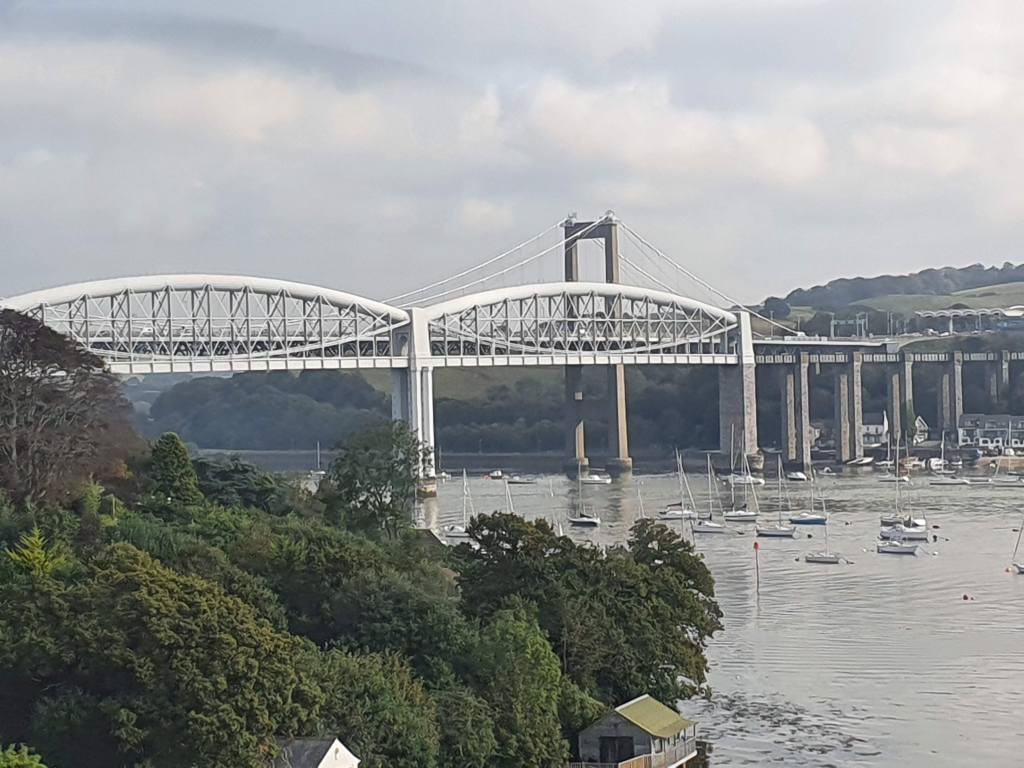
After leaving the main line to Bristol shortly after departing from Reading, the train followed the Kennet and Avon canal for a number of miles before arriving in Exeter. On leaving Exeter, the scenery became more impressive – first following the Exe estuary to the coast before returning inland via the Teign estuary. Shortly after Plymouth the train crossed into Cornwall on Isambard Kingdom Brunel’s 1859 Royal Albert Bridge.
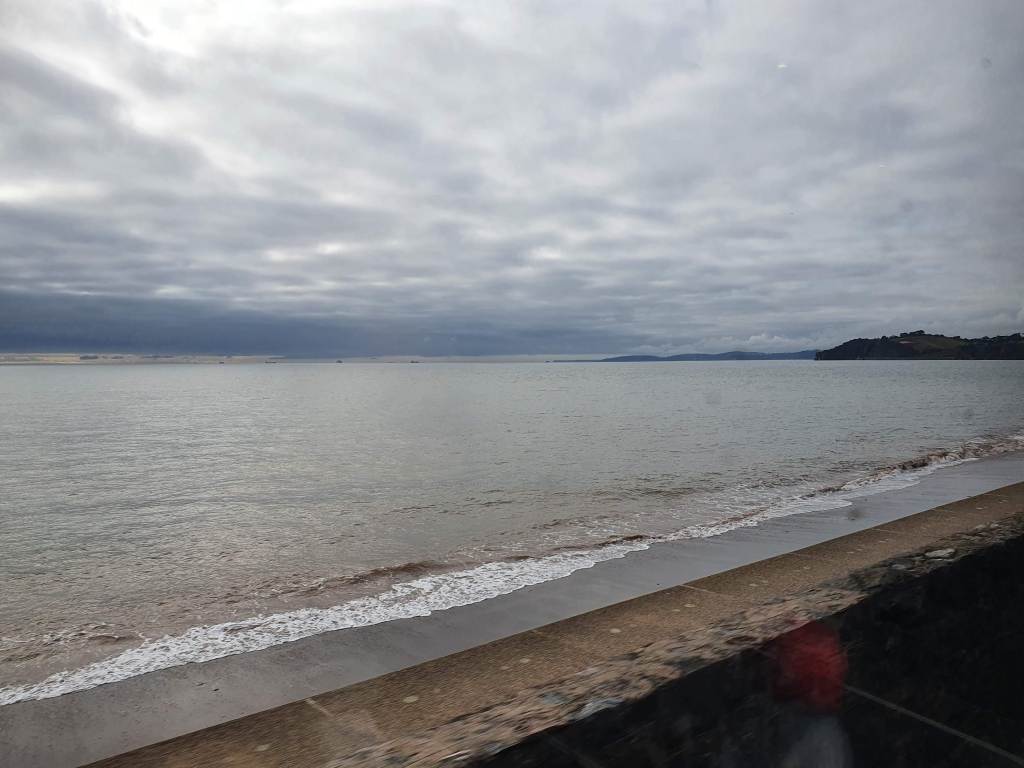
Once into Cornwall you might think that you were nearly there, but the train takes another two hours to reach Penzance, where it arrived at 1:10pm.
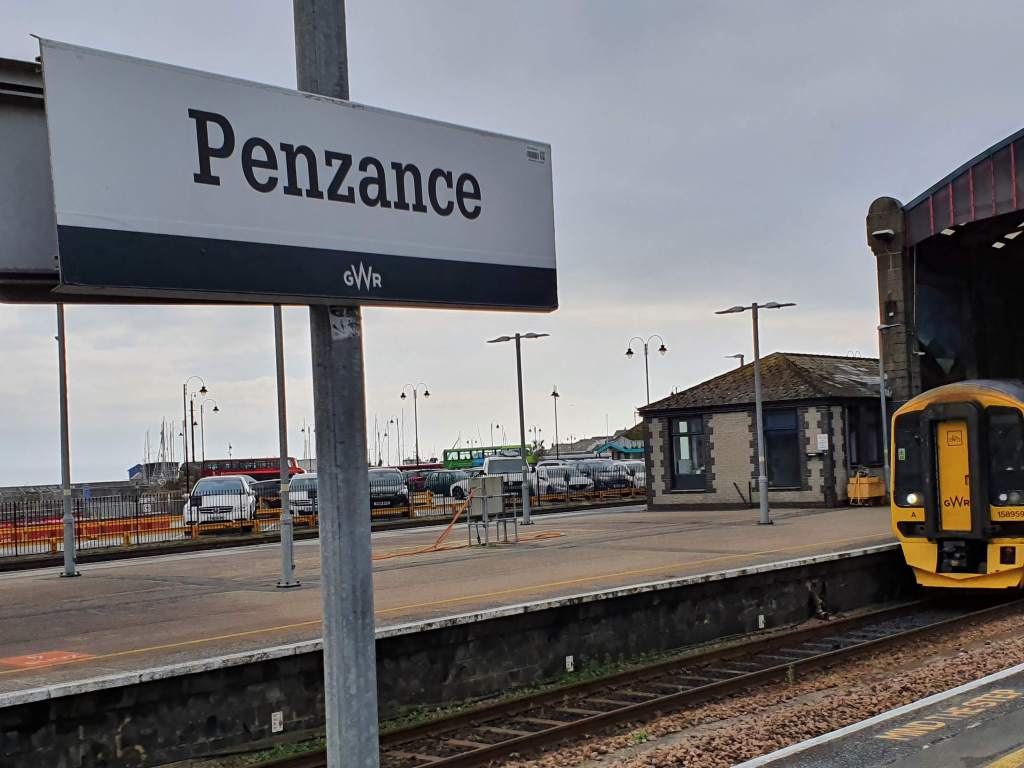
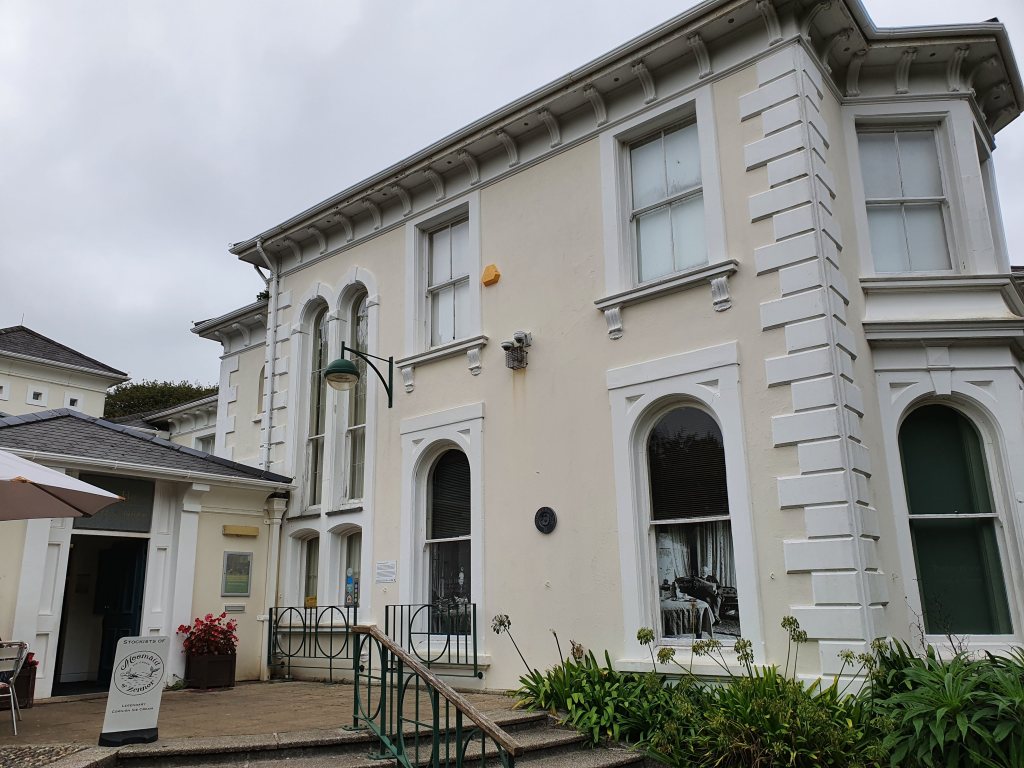
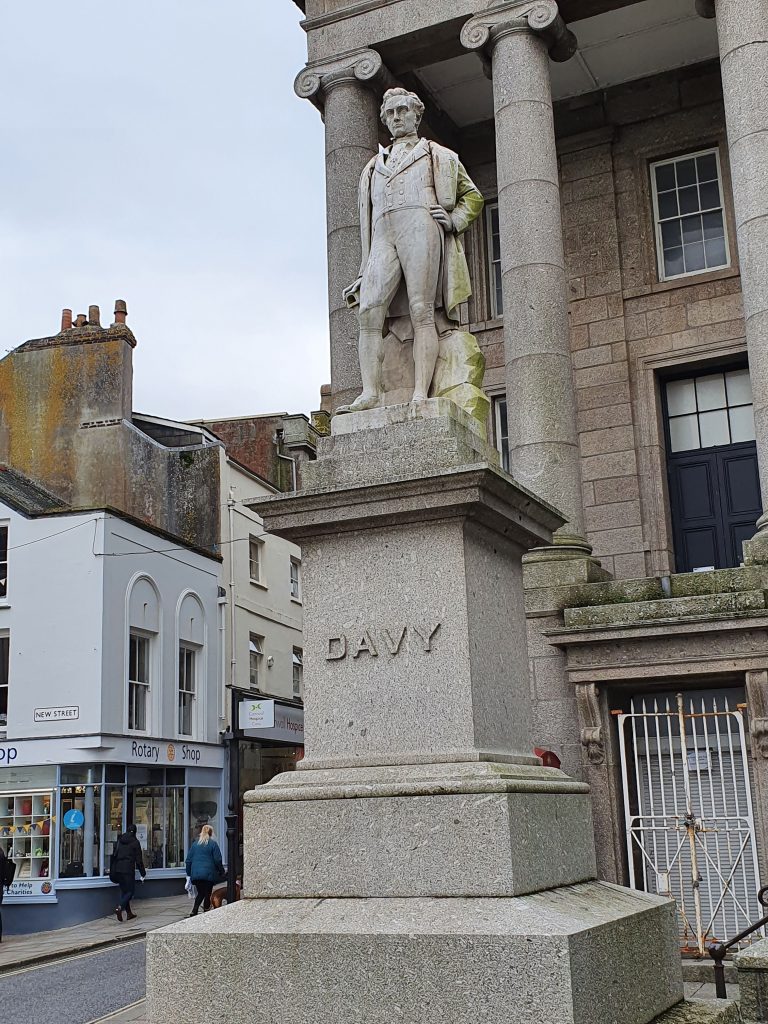
There is a tourist information office opposite the station, but it was unexpectedly closed when I arrived. I made my way to the Penlee House Gallery and Museum, which is a small art gallery and local history museum. Penzance and nearby Newlyn have attracted artists for over a century and the gallery displayed a selection of their output, including a special exhibition about the Anchor Studio in Newlyn. The museum featured a number of Penzance notables – I was particularly interested to read about the scientist Sir Humphry Davy who had been born in Penzance in 1778, before going on to discover seven new elements at the Royal Institution in London, where I am a member.
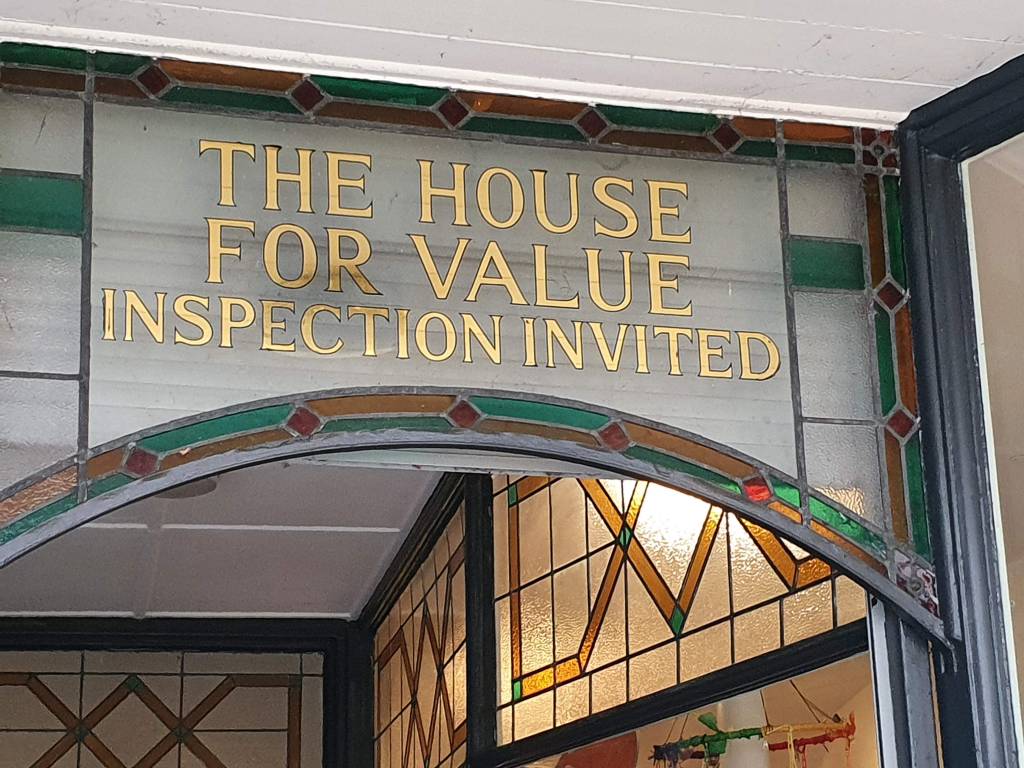
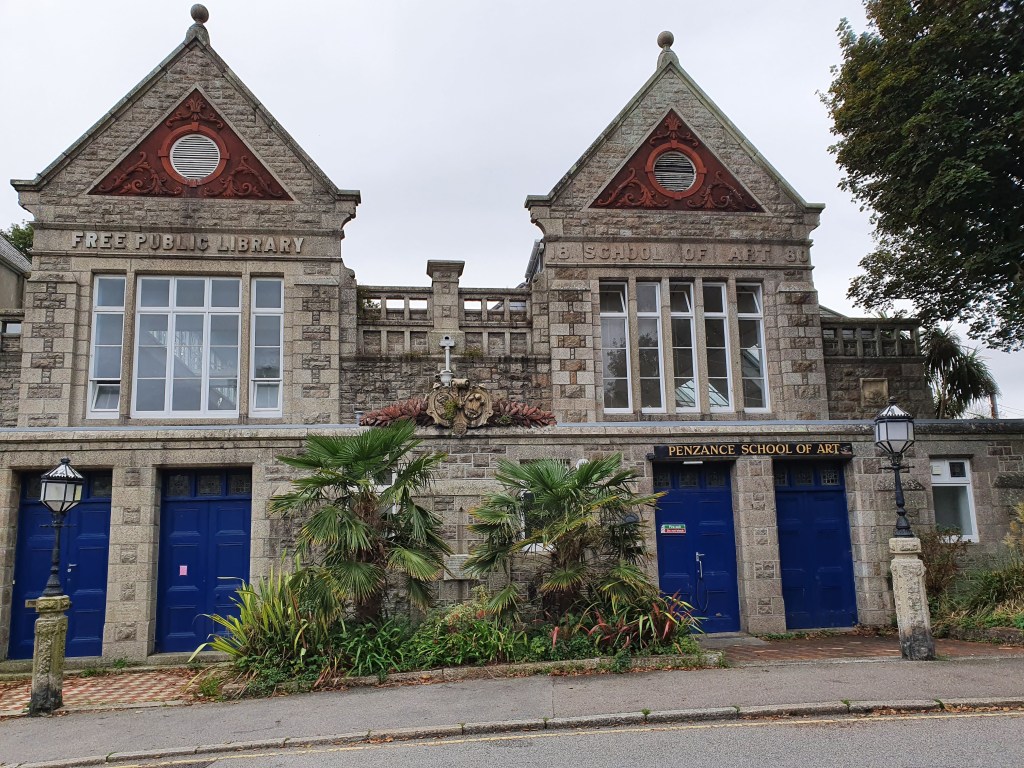
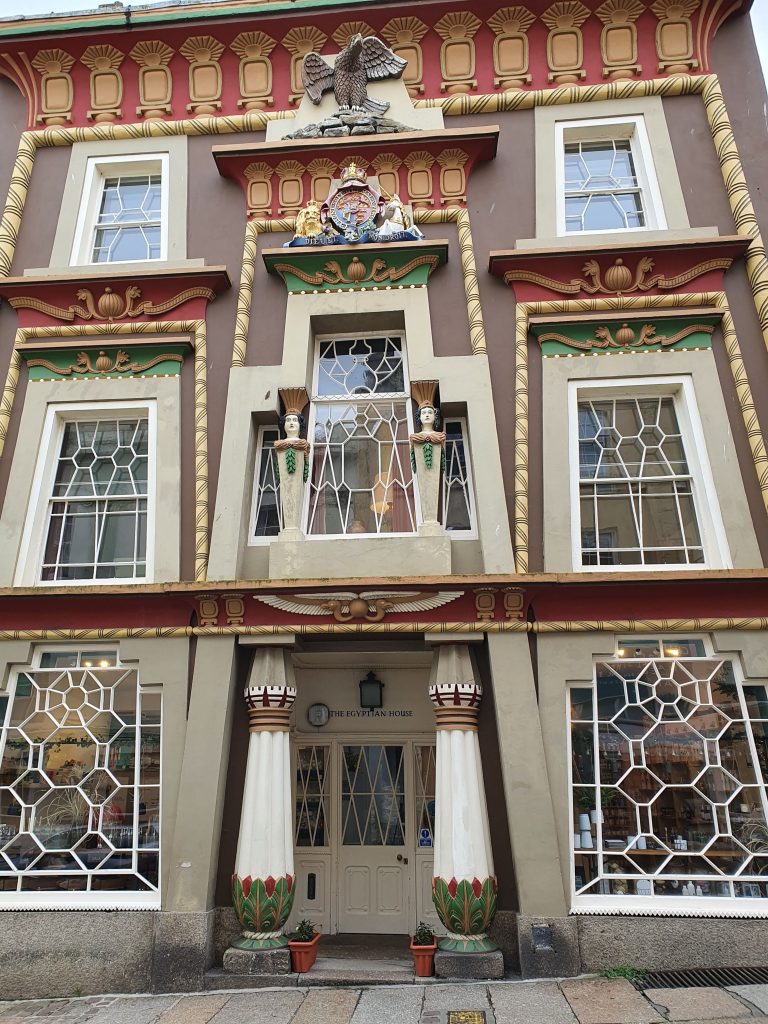
On leaving Penlee House, I remembered having seen a town trail of Penzance on the Internet, so I downloaded that and followed it round a variety of interesting buildings, including the Penzance School of Art.
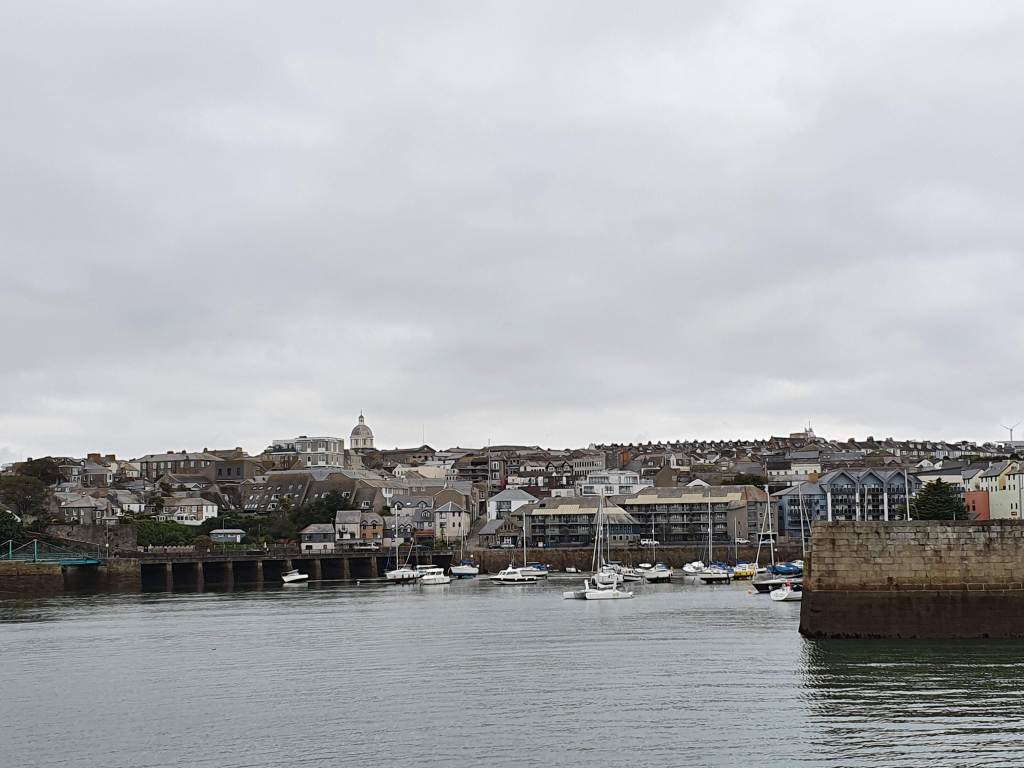
On finishing the town trail I explored the harbour, including walking along the pier to the lighthouse at the end. The Scillonian, the passenger ferry which makes a daily return crossing to the Scilly Isles, docks against the pier. Although it was not in the harbour when I walked out there, I did see it once it had returned later in the evening.
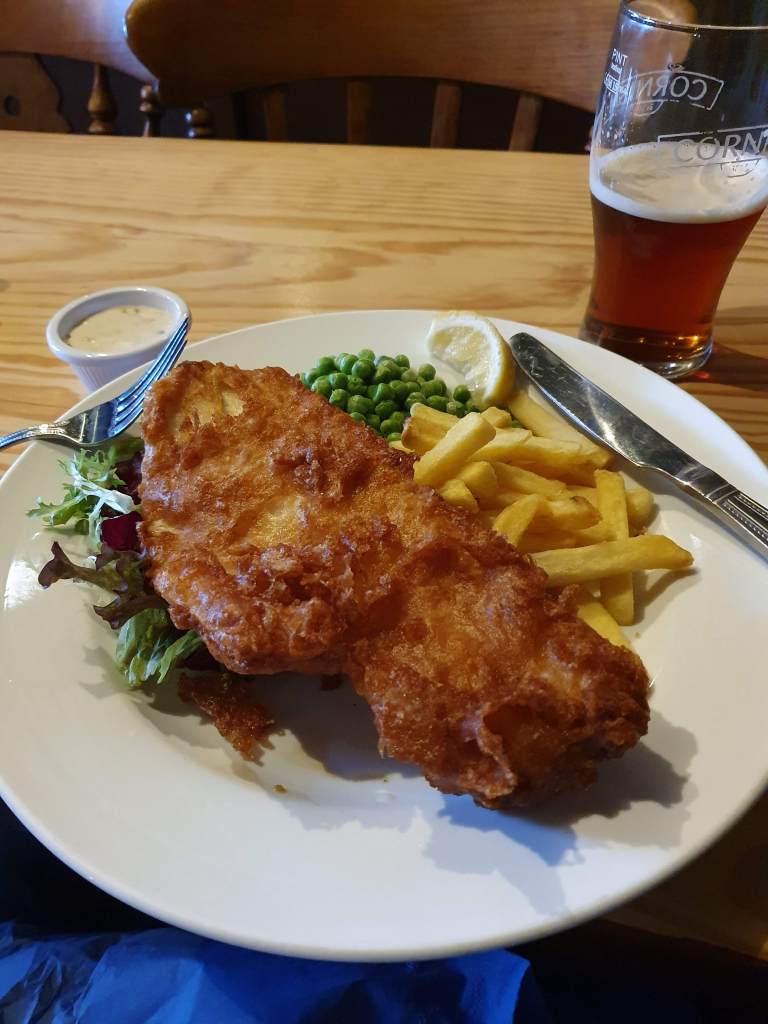
From the harbour I went to check in to my hotel for the night near the station. Once I had freshened up I set out to find dinner. I noticed that the tide had now come in and that there were a number of people swimming in the harbour, where earlier there had just been mud. I chose a pub for dinner, which was probably the most Covid secure venue that I dined in during the whole trip. I was shown to a table in an alcove several metres away from any other diners. Since I was by the sea, it seemed appropriate to have fish and chips for dinner, washed down with a couple of pints of the local bitter.
Day Two – Saturday 9th October 2021 – Penzance to Exeter
As I am not a big eater of breakfast, I decided not to pay for one in the hotel, but instead purchased a bacon sandwich to takeaway from a cafe opposite the station. I caught the 9:12am departure from Penzance to Exeter, giving me another chance to admire the the glorious scenery of Cornwall and Devon from the train.
The train was fairly empty as far as Plymouth, but there large numbers of non-mask wearing passengers got on filling up the carriage. It took just over an hour to travel from Plymouth to Exeter St Davids, where the train arrived at 12:20pm, seven minutes late – the only late arrival of my whole trip.
Exeter St Davids Station is a little way from the city centre. I climbed the hill opposite the station and walked into the city. My first stop was the Royal Albert Memorial Museum, which has a diverse series of collections covering world cultures, antiquities and natural history, as well as the history of Exeter and the surrounding area. Because of Covid restrictions there was an elaborate one way system through the museum – you gain access via the rear entrance and leave by the front door. The museum displays part of the Seaton Down hoard of 23,000 Roman coins, which were probably buried in 350AD, but not discovered until 2013. Why they were buried is still a mystery.
When I planned to come to Exeter originally, I had intended to go on a tour of the medieval underground passages, but unfortunately the tours had been suspended due to Covid. After leaving the museum I was pitched into the Saturday afternoon city centre, which was heaving with shoppers. Having been a Covid recluse for the past eighteen months the sight of so many people was somewhat of a culture shock. Fighting my way through the shoppers, I went to the Cathedral to seek tranquillity.
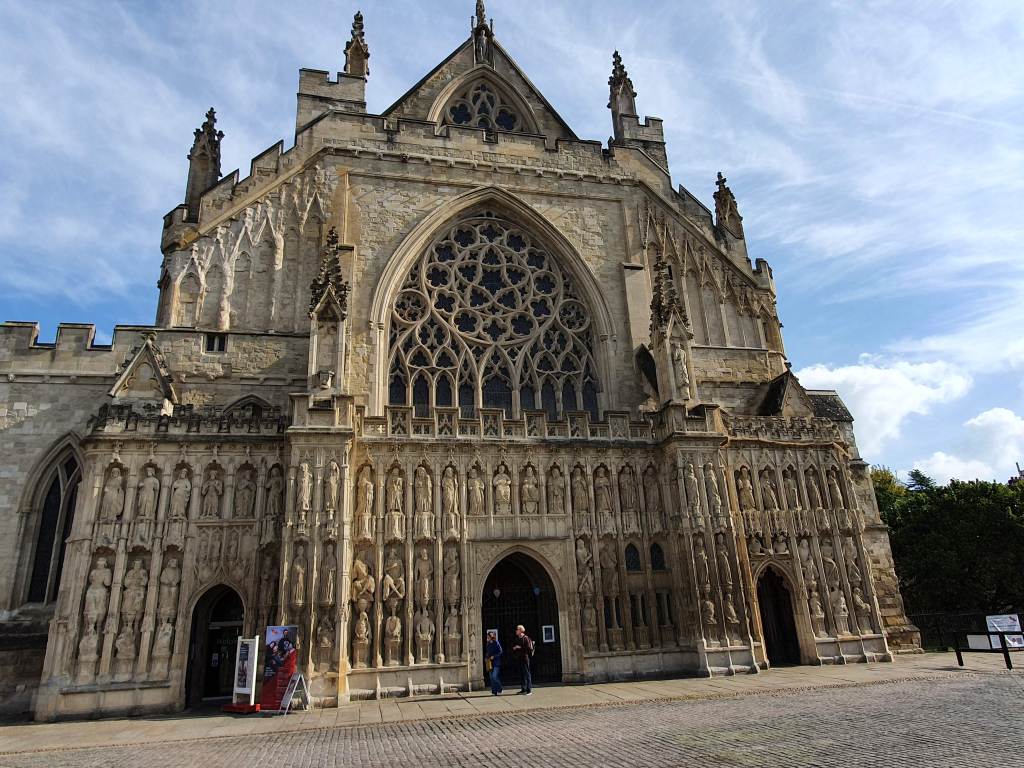
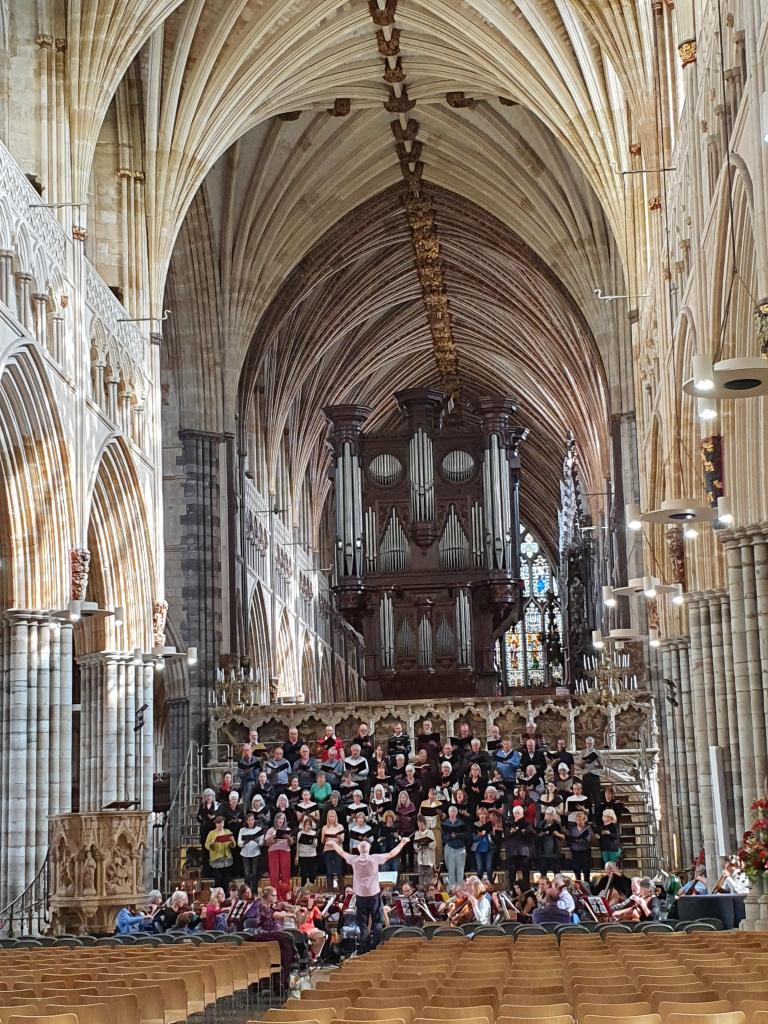
The cathedral was founded in 1050 and was added to over the next five hundred years, so displays a variety architectural styles from Norman to Perpendicular. Outside the cathedral there were posters advertising a concert that it was hosting that evening. When I went inside, the orchestra and choir were rehearsing. The conductor seemed to be unhappy with particular parts in two of the pieces they were practising – one from Verdi’s Nabucco (towards the start of the Chorus of the Hebrew Slaves) and one in the National Anthem. Throughout my entire time in the cathedral he kept getting them to repeat the same few bars over and over again.
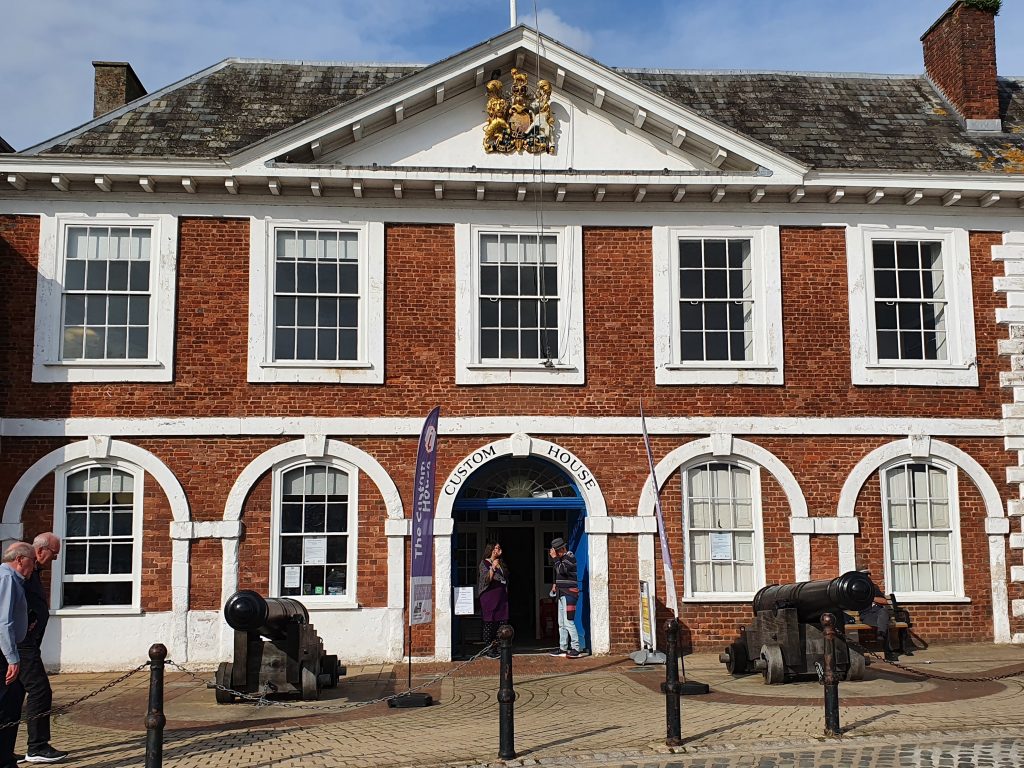
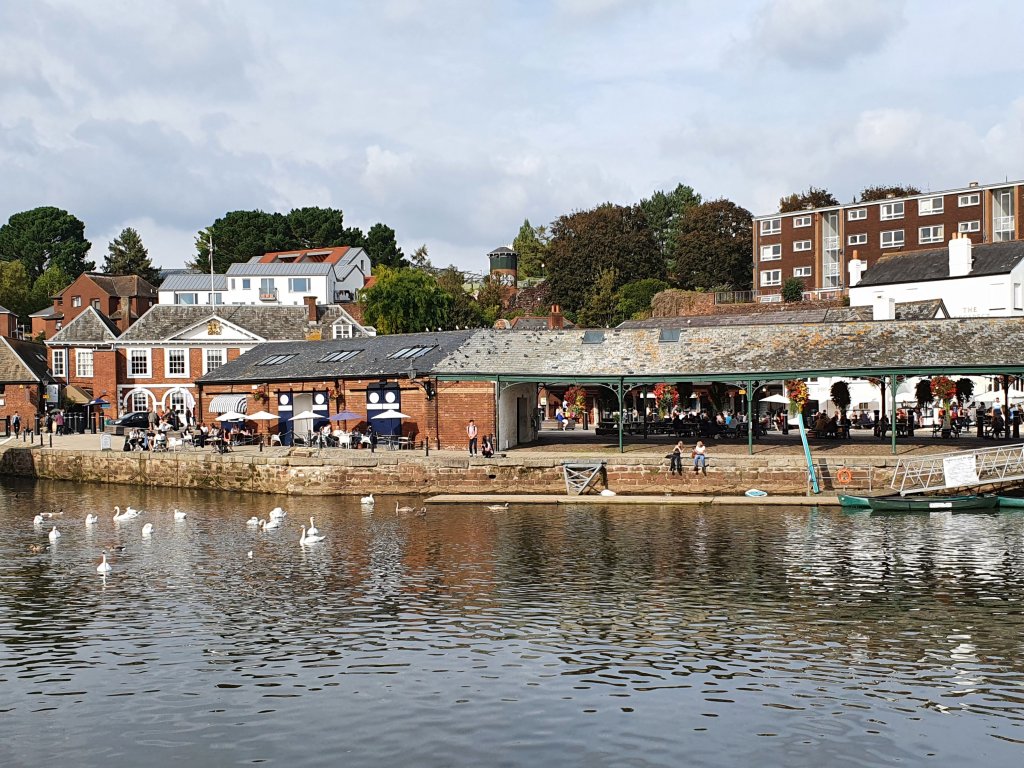
From the Cathedral I walked down to the Exeter Quay, where the old Custom House is now a small museum and tourist information office. After looking round the displays explaining the history of the quay and Exeter’s history as a port, I picked up some leaflets for three city walking trails, for which there are display boards dotted around the city. Exeter Quay was busy with many of the old warehouses now converted into bars and restaurants, with customers sitting outside in the warm afternoon sun.
I decided to follow (in reverse order) one of the city trails which finished at the quay. I found the final information panel which explained about the Exeter canal which had been built in the 16th century to enable vessels to reach Exeter to unload their goods. However, I could not find the next information panel nor the one after that, so I gave up on following that trail and returned to the city centre.
I walked through Rougemont Gardens, a park in the centre, with the aim of starting another trail at the top end of the High Street. Unfortunately either I was being extremely unobservant or this trail’s information panels were as incomplete as on the first walk that I had attempted. So I gave up on following a fixed route and just sought out some of the more interesting buildings in the city. I was left with the feeling that the rather unattractive shopping developments were unnecessarily dominating the more historic parts of the city. With the exception of the cathedral, I felt that the interesting older buildings seemed almost to be considered as an intrusion on the monotonous retail sprawl, rather than being highlighted as they are in other cities.
After I had returned to my hotel near Exeter Central station, I ventured out to find dinner. I chose to eat in an Indian restaurant slightly away from the city centre, where I dined on Duck Jalfrezi. On my return to my hotel, I discovered that its central location meant that it was quite noisy on a Saturday night, so it took me a while to get to sleep.
Day Three – Sunday 10th October – Exeter to Portsmouth
Again I did not bother with having breakfast in my hotel, but hoped to get something to eat from one of the many cafes and takeaways that filled the parade outside Exeter Central station. However, they were all shut first thing on a Sunday morning, so I had to revert to my emergency supplies that I had brought for such contingencies. I caught the 9:30am train from Exeter Central to Salisbury, which was very quiet throughout most of its journey. At Salisbury I had a fifteen minute wait for my next train to Portsmouth Harbour, which went via Southampton with good views of the Itchen estuary.
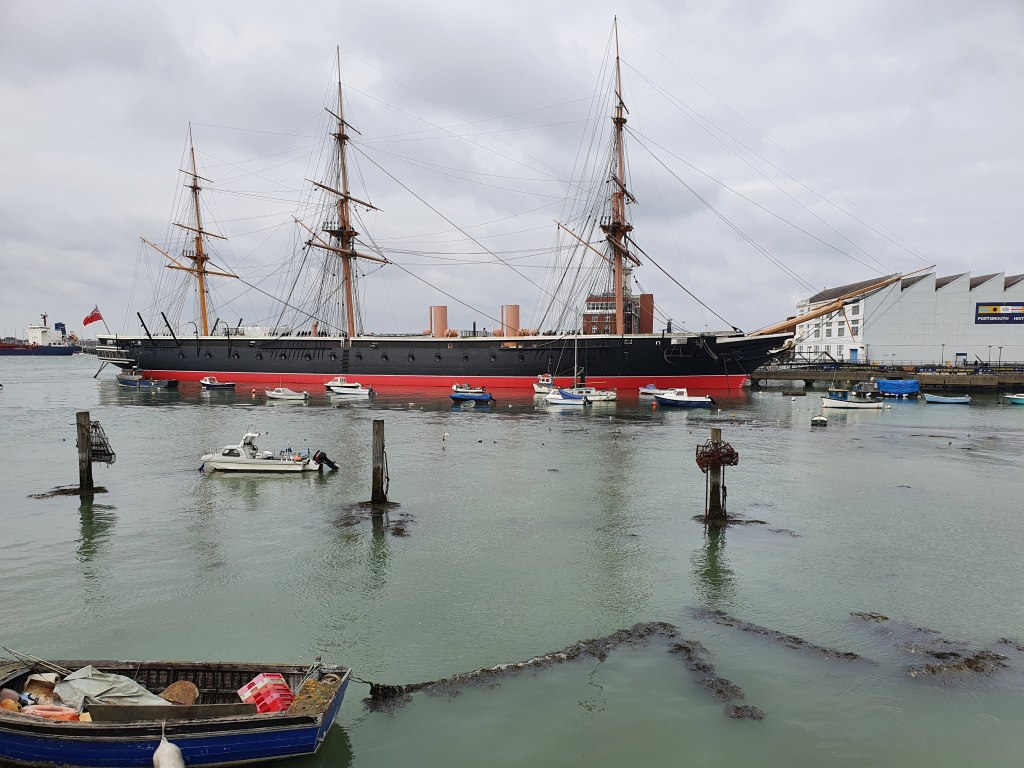
I arrived at Portsmouth Harbour station at 12:50pm, with the harbour immediately visible upon leaving the station. I had previously been to Portsmouth in 2015, so I wanted to do things that I had not done on that visit.
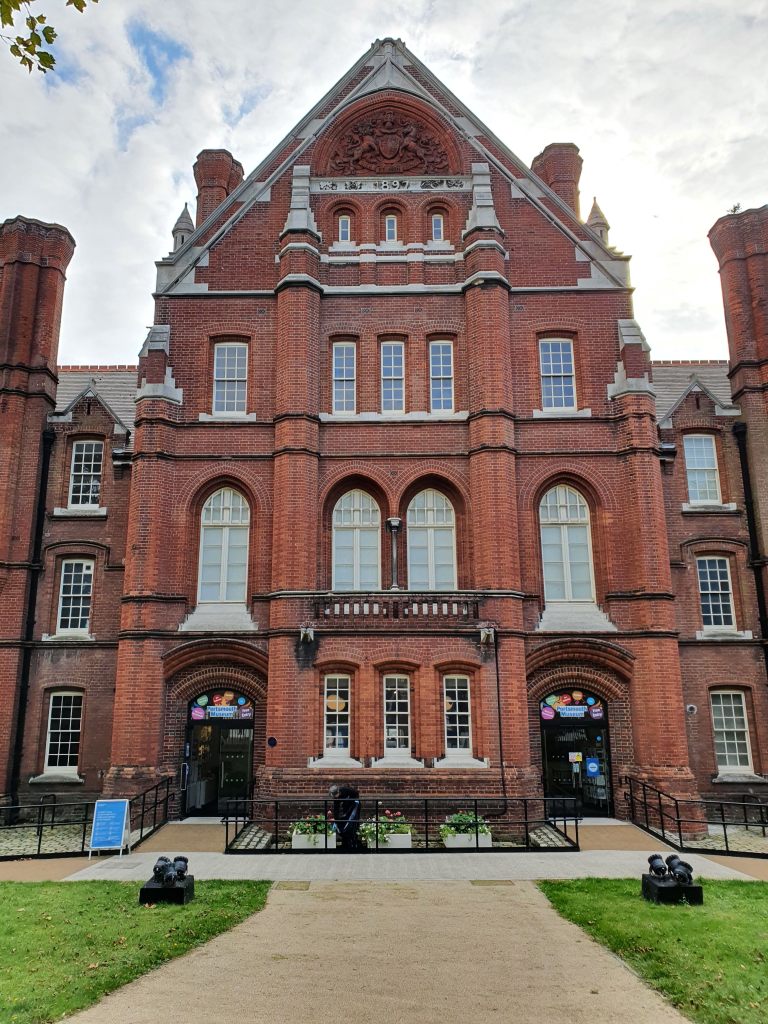
My first stop was Portsmouth Museum & Art Gallery housed in a former barracks about 15 minutes walk from the station. The first room is devoted to Sherlock Holmes and Arthur Conan Doyle, as the latter had been working as a doctor in Portsmouth when he started writing the stories. Most of the remaining galleries describe aspects of life in Portsmouth, mainly over the past 150 years. Finally, there is a small picture gallery displaying artworks relating to Portsmouth.
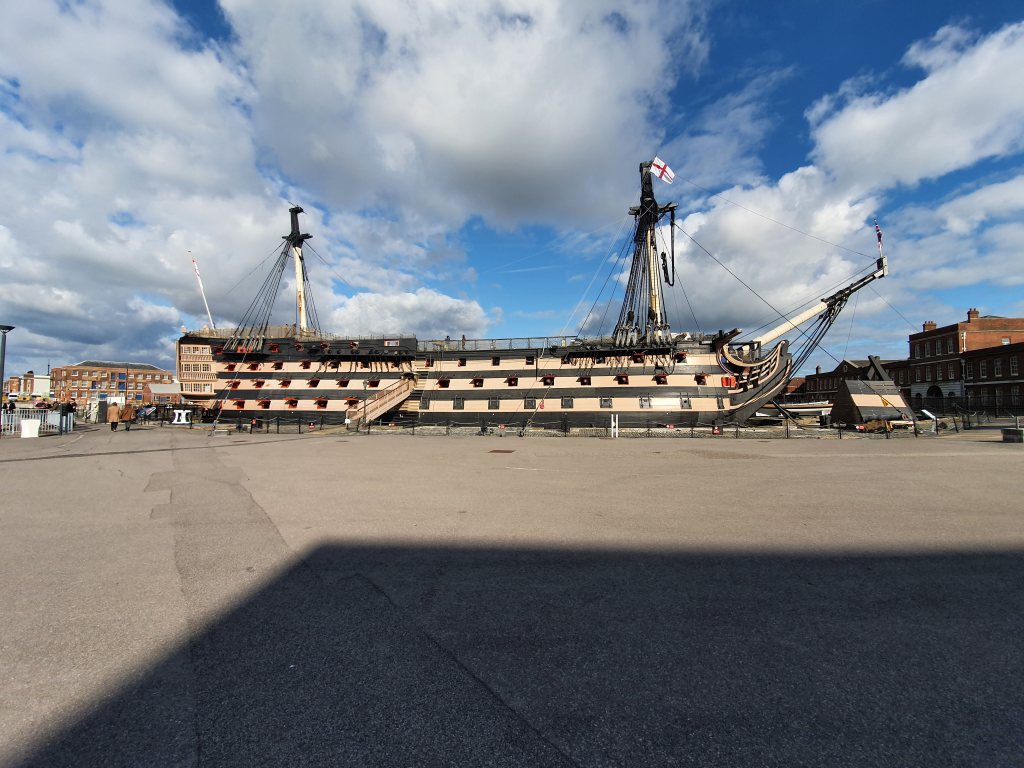
From the museum I took a circuitous route via Southsea Common, where one could see the vessels of all sizes coming in and out of the harbour, to Portsmouth Dockyard. On my previous visit to Portsmouth I had spent a whole day in Portsmouth Historic Dockyard, including going on board Nelson’s flagship HMS Victory, but I had come back specially to view the one vessel that was not open to the public when I came previously.
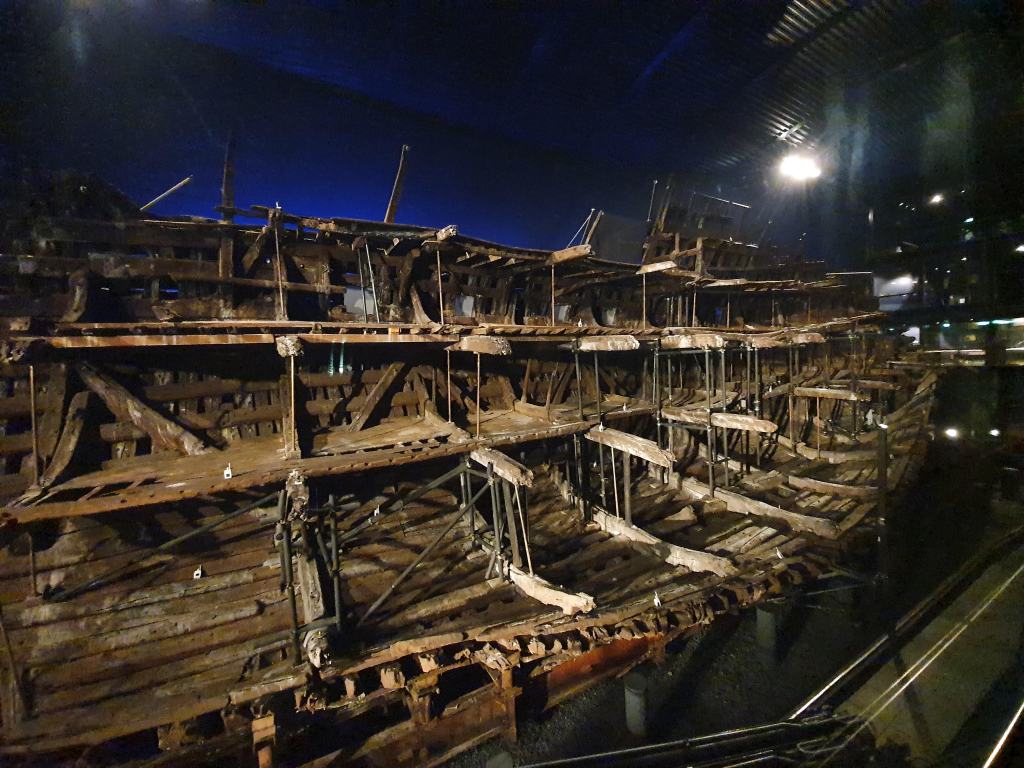
The purpose of my visit today was to see the Mary Rose, the pride of Henry VIII’s fleet, which sank in the Solent in 1545 and was raised from the seabed in 1982. The Mary Rose did not disappoint – one is immediately struck by the sheer size of the vessel, but there were also half a dozen galleries at each end showing artefacts and telling the story of the boat, how it sank and how it was recovered over four hundred years later. I took my time going round and by the time I had finished the dockyard was about to close for the evening.
On leaving the dockyard I strolled back to Southsea Common, keeping an eye open for places to eat that evening. As the sun began to set I made my way to a pizza restaurant overlooking the harbour entrance for dinner. I wanted to spot from my table the Galicia (the boat I was planning to catch later) coming into Portsmouth. I was tracking her progress on a marine traffic website – by the time I had finished eating she had rounded the Isle of Wight and was approaching Portsmouth. I briefly visited the restaurant’s toilets before departing, but as I came back I realised the Galicia had already gone past my viewpoint and was about to disappear out of sight as it headed north to the ferry terminal. I ran outside to take a not very good photograph of its stern as it passed – I had completely misjudged the speed at which it would be travelling as it entered the harbour – unlike the Isle of Wight ferries which had slowed right down at the harbour entrance, it was still travelling at speed as it had another couple of miles to go before it docked.
Brittany Ferries had informed me that I needed to check in at least 90 minutes before my 11pm departure, so I left the restaurant to walk to the ferry terminal to be there in good time. Most of the walk was along the main road out of Portsmouth skirting the Royal Navy base. I arrived at the ferry terminal at about 9pm, two hours before departure. Check-in was quick and easy, and I was informed that boarding was expected at 10:15pm. There were not very many foot passengers waiting in the cavernous terminal building and I subsequently discovered that the majority of these were waiting for the Caen ferry, whose boarding commenced at 9:45pm.
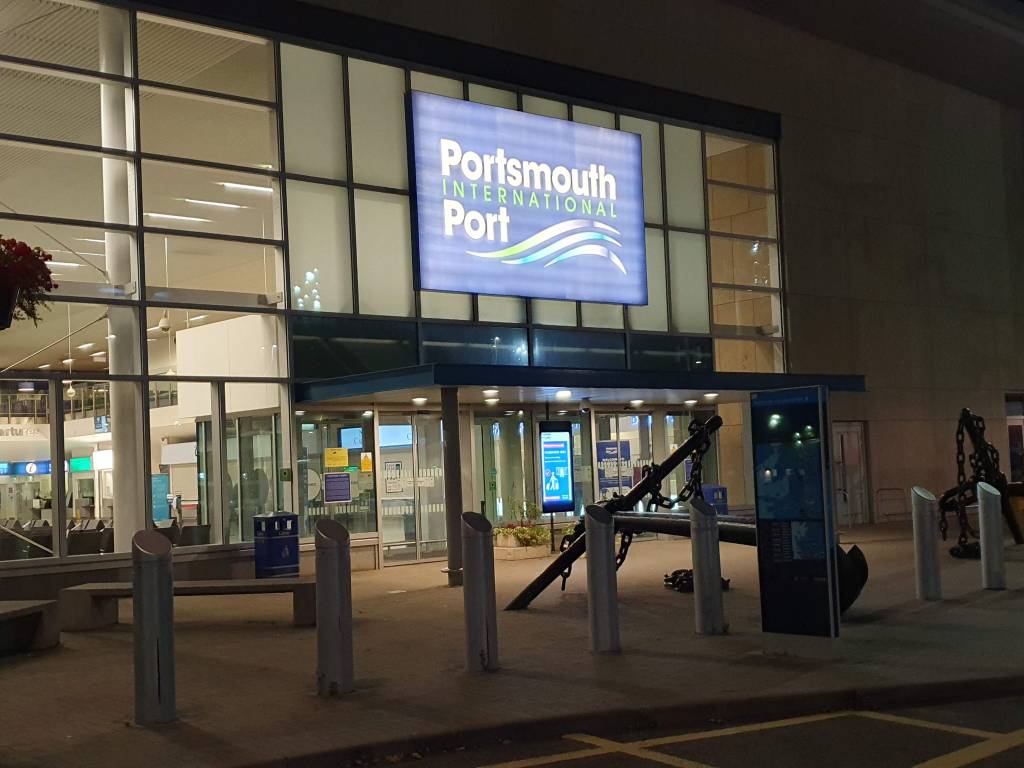
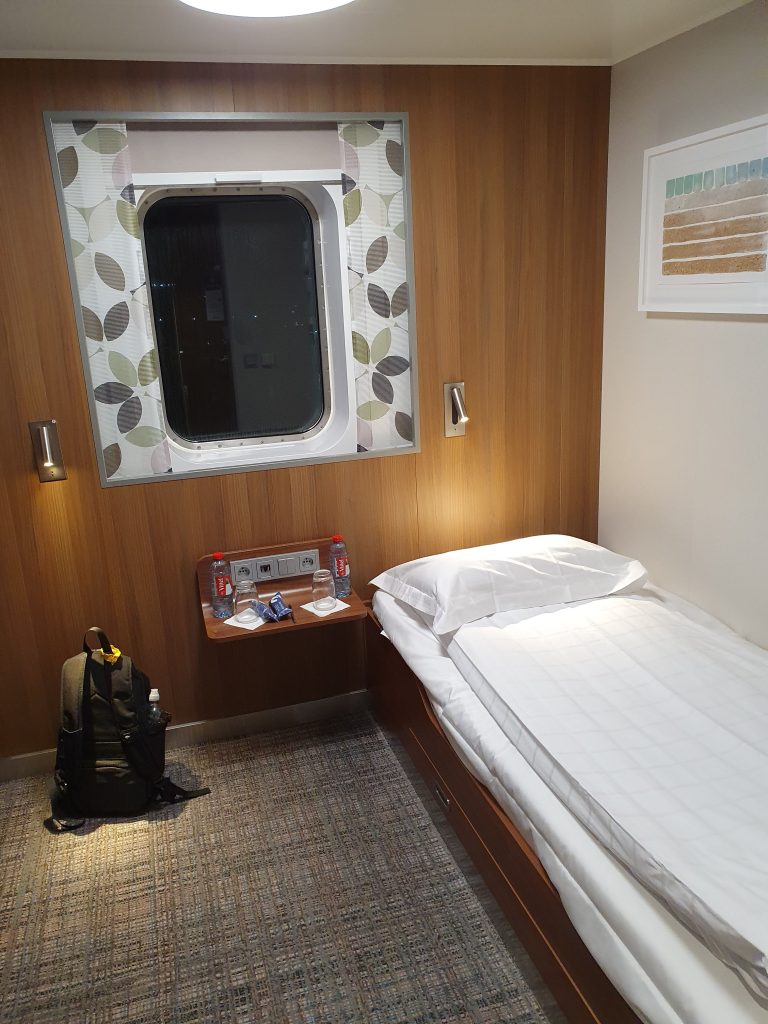
At exactly 10:15pm, as promised, boarding commenced. Apart from me, there were just seven other foot passengers. After passing the the security scanners we all boarded a bus which drove us onto the car deck of the Galica where we were met and taken by lift to the main body of the ship. I quickly found my cabin for the night – I had splashed out and paid for an en-suite cabin, though given it would be dark for the entire duration of the crossing, paying extra for an outside window was probably a bit extravagant. My cabin on the Galicia was the nicest room I stayed in on the whole trip. The Galicia was an enormous and very modern ship, which had only just entered service. There appeared to be very few passengers on board – it felt rather strange to have such a large boat almost to oneself. In October 2021 there was just the one sailing per week, by any vessel, from Portsmouth to Cherbourg – the Galicia returns to Portsmouth overnight on Monday night and for the remainder of the week she (as her name suggests) travels to and from northern Spain.
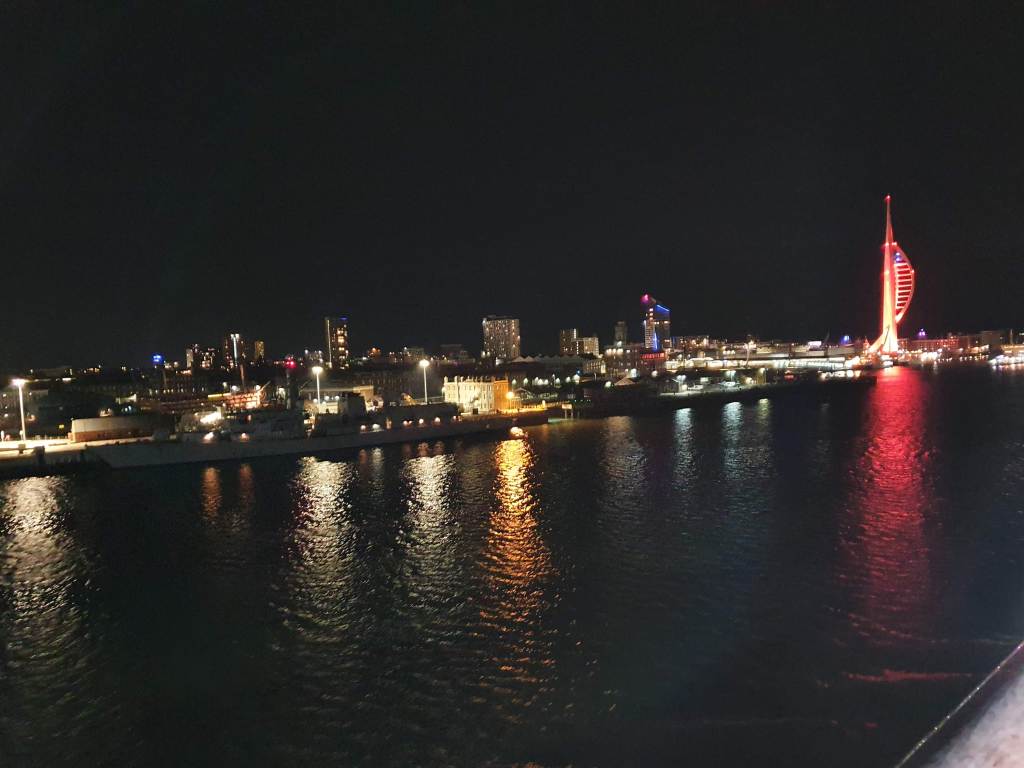
Leaving my bag in my cabin, I immediately went on deck to see what I could see. Moored alongside us was the Mont St Michel, the Caen ferry due to leave 15 minutes before we did. I soon noticed that we were moving relative to the Mont St Michel, which I initially assumed was the Mont St Michel departing, until I observed that her ropes were still firmly attached to the quayside. It was the Galicia that was leaving – 15 minutes early. I stayed on deck until we left Portsmouth, spotting the restaurant in which I had dined earlier. I then went below to my cabin to go to sleep.
Day Four – Monday 11th October – Cherbourg to Bayeux
I awoke in my cabin after a good night’s sleep. Shortly after I woke the ship started playing gentle music as an alarm call at 7am (French time), an hour before we were due to dock. The crossing had been smooth with virtually no sense of movement, just the gentle hum of the ship’s engines through the night. After a quick shower, I went on deck. Although it was still dark, the French coastline was clearly visible and the Galicia edged ever closer to Cherbourg. As we crossed the outer harbour wall of the port I returned inside. At about 8am, the foot passengers were summoned to meet outside the ship’s information desk and at 8:25am we were taken down to the vehicle deck to board a bus to take us off the ship.
The bus drove us to where the cars leaving the ship were having their documents checked. A French border policeman got on at the front of the bus, counted the eight passengers and asked for our passports to be passed down to him. He took them off to a little hut and returned a few minutes later with them – again just standing at the front of the bus and asking that the passports be passed passed back to their owners. So I entered France with no check of my photo identity and no check of the Covid documentation I was required to have to enter the country. The bus then drove on to the deserted terminal building where it deposited us. I realised that since leaving the ship the bus had been driving us further away from the centre of Cherbourg. Consequently, I ignored the signs in the building pointing to buses and taxis, yet further in the wrong direction and worked out how to escape and head back towards the centre of Cherbourg on foot. I reached the centre at about 9am – it didn’t seem to have properly woken up, as many of the shops were still closed. With the exception of the large aquarium and marine exhibition by the docks, the smaller museums in Cherbourg are closed on Mondays, so I contented myself with wandering around the centre for an hour or so, noticing that the Galicia dominated the skyline from her mooring in the harbour.
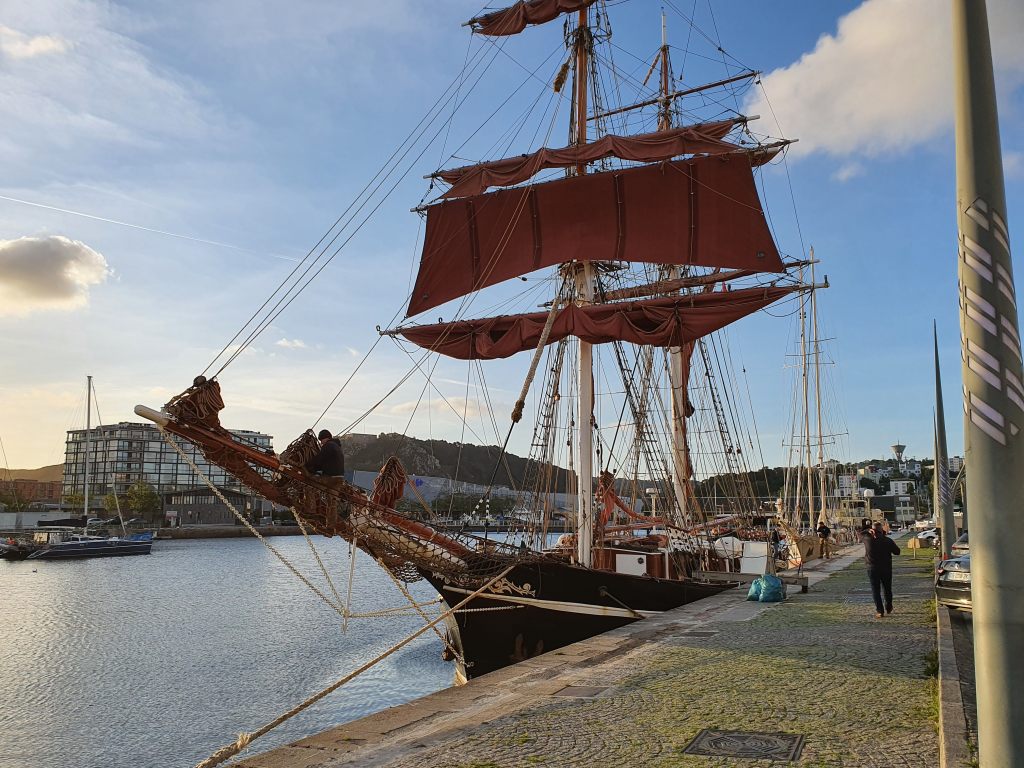
At about 10:15am, when I had thoroughly explored the old centre, I started to make my way to the station to catch my train which was due to depart at 10:40am.
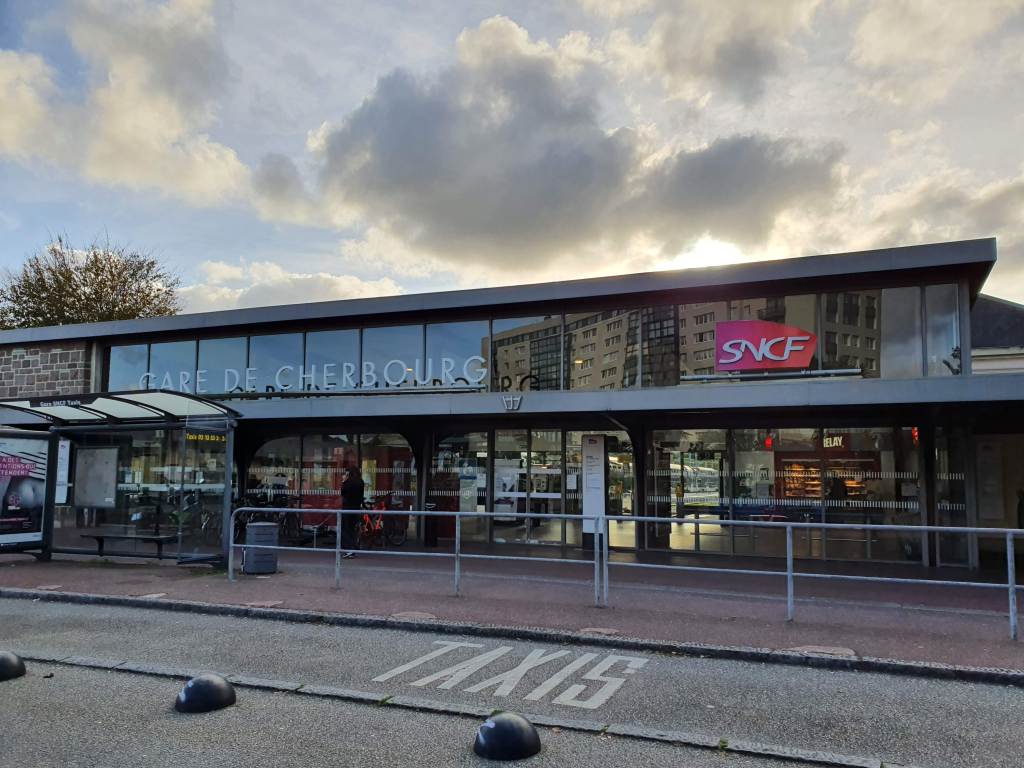
Shortly after I arrived at the station they opened the gate to the platform to let the passengers board the train which was already waiting. The train was going to Paris, but I would be riding on it for just under an hour to Bayeux – my seat was on the upper deck of the double-decker train.
Bayeux station is a little way from the centre, but it was not difficult to navigate to the centre as Bayeux cathedral could be seen all the way giving you something to aim for. I didn’t want to hang around, as I knew that the tourist information office and the museums in Bayeux closed for lunch from 12:30pm to 2:00pm. I reached the information office in good time to acquire a map of the city trail which is marked by bronze studs in the pavement and has 21 information boards around the old historic centre. I set off to follow the trail while the museums were closed for lunch. After finding the first information board, I couldn’t find the second, nor did the studs necessarily follow the route marked on the map I was given. Given my experiences in Exeter, I thought I was doomed if I tried to follow a town trail on this trip. Although to be fair to Bayeux, I did discover that nearly all the information boards were in fact there, just not necessarily exactly where they were shown on the map I had. I also took the opportunity to look round Bayeux Cathedral, which has some glorious stained glass windows.
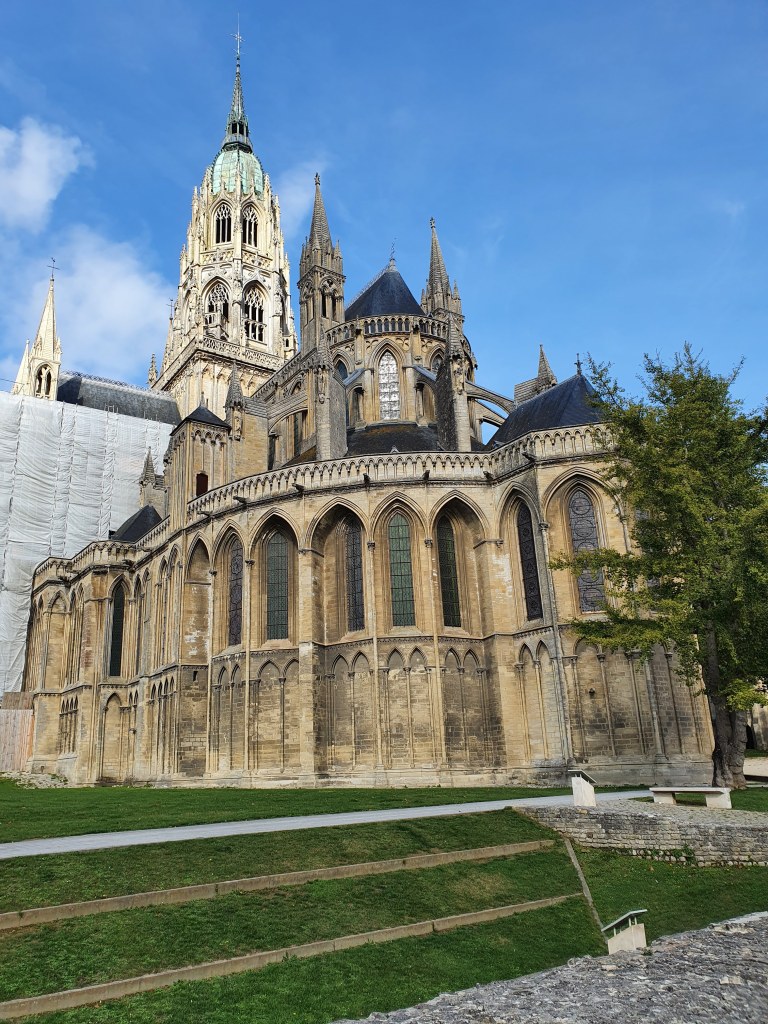
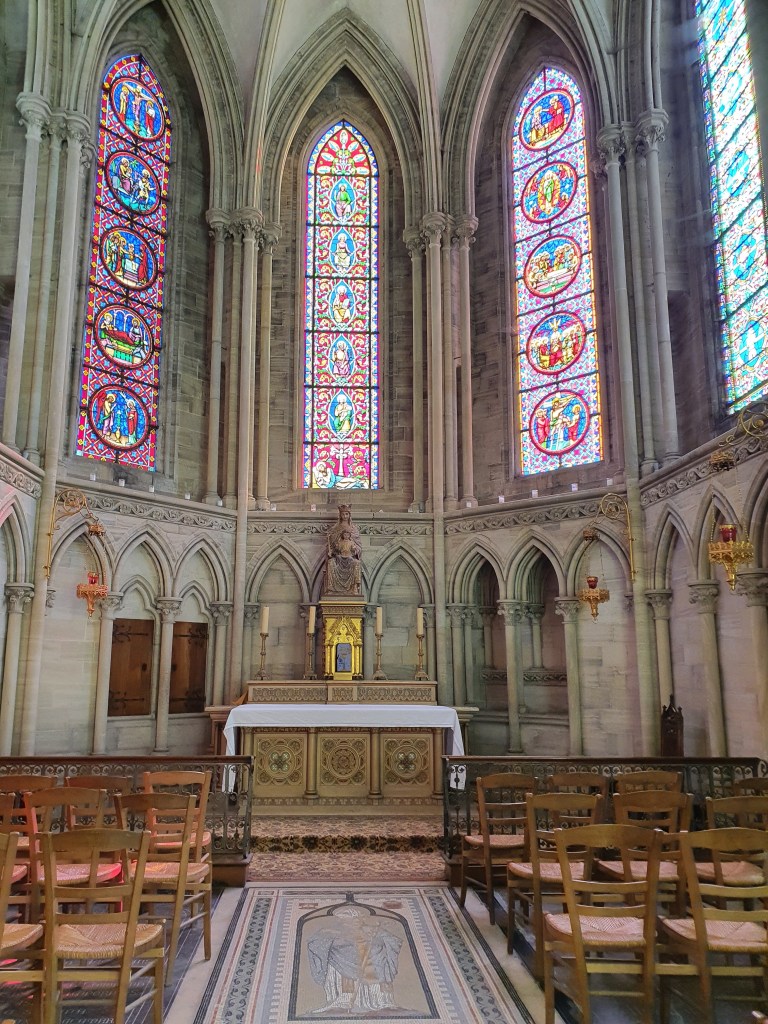
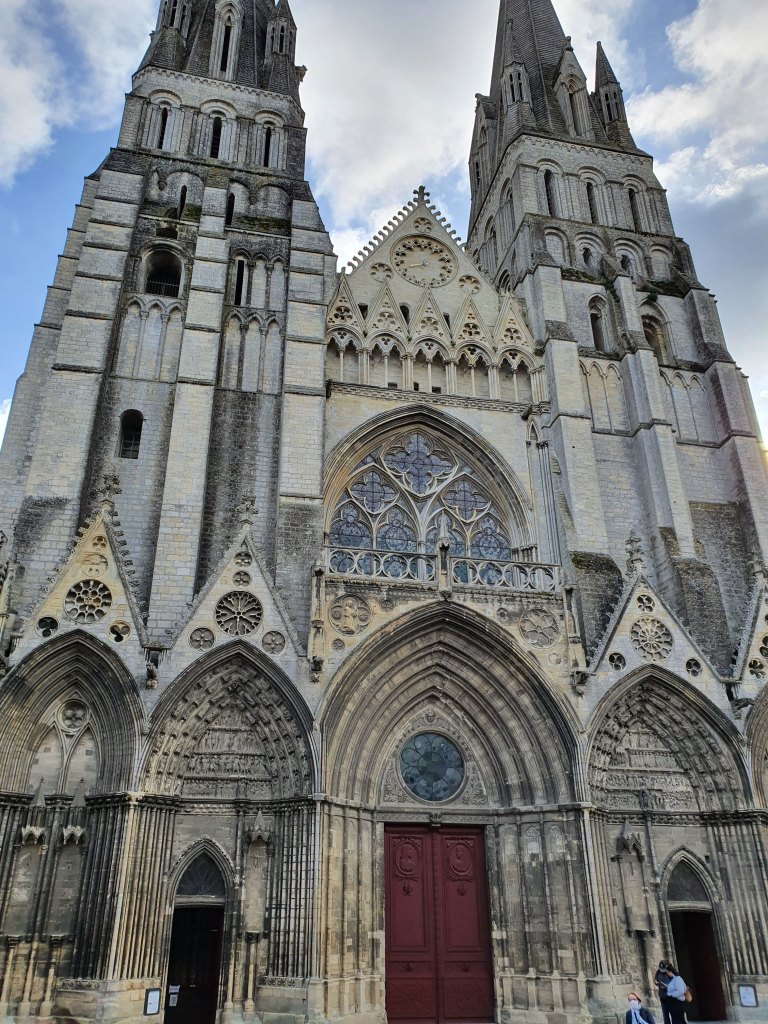
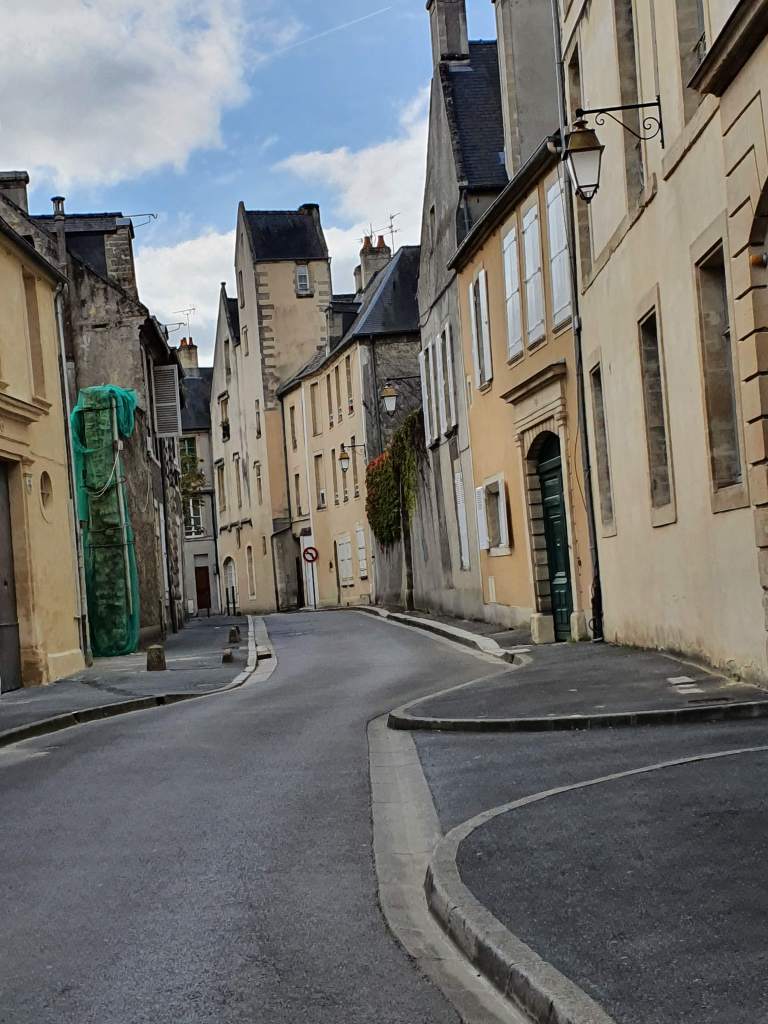
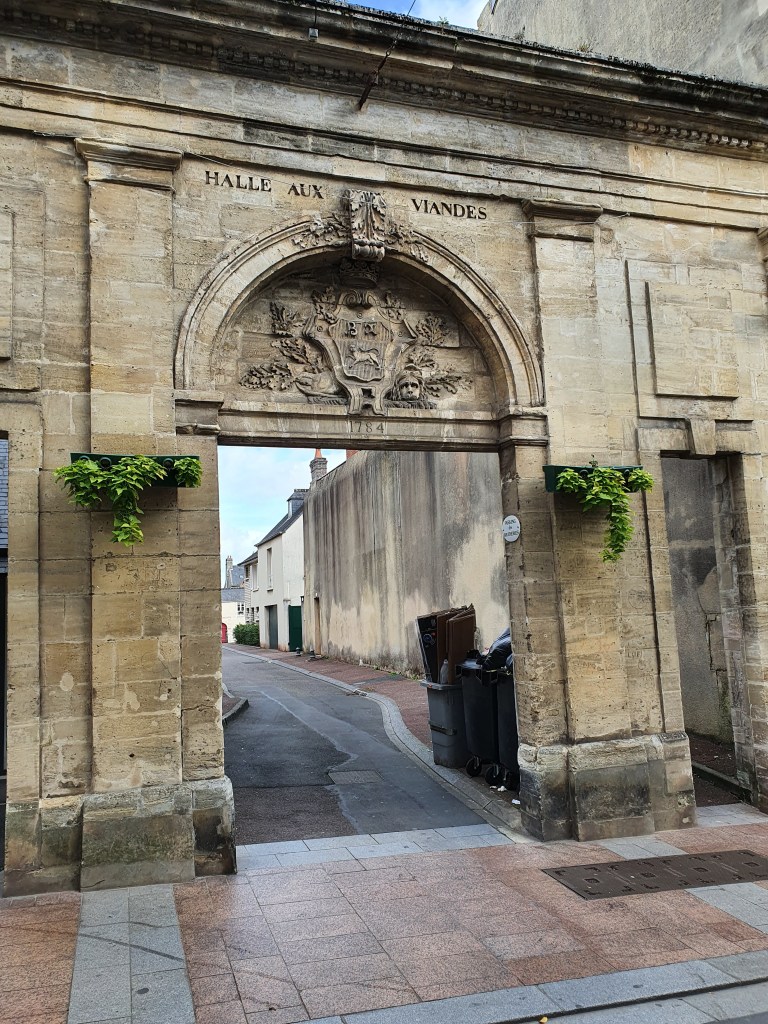
By the time I had finished my wandering round the historic centre, it was time to make my way to Battle of Normandy museum which is situated on the edge of town opposite the British war cemetery. I arrived there just as it was reopening after its lunchtime break – it was the first place that I had to use the ‘Pass Sanitaire’ app on my phone to gain admittance and it was a relief that it worked without problems. The museum tells the story of the period from 7th June to 29th August 1944 – from immediately after the D-Day landings to the capture of Paris. It was a hard-fought campaign with a number of setbacks and several missed opportunities by the Germans to rebuff the invasion.
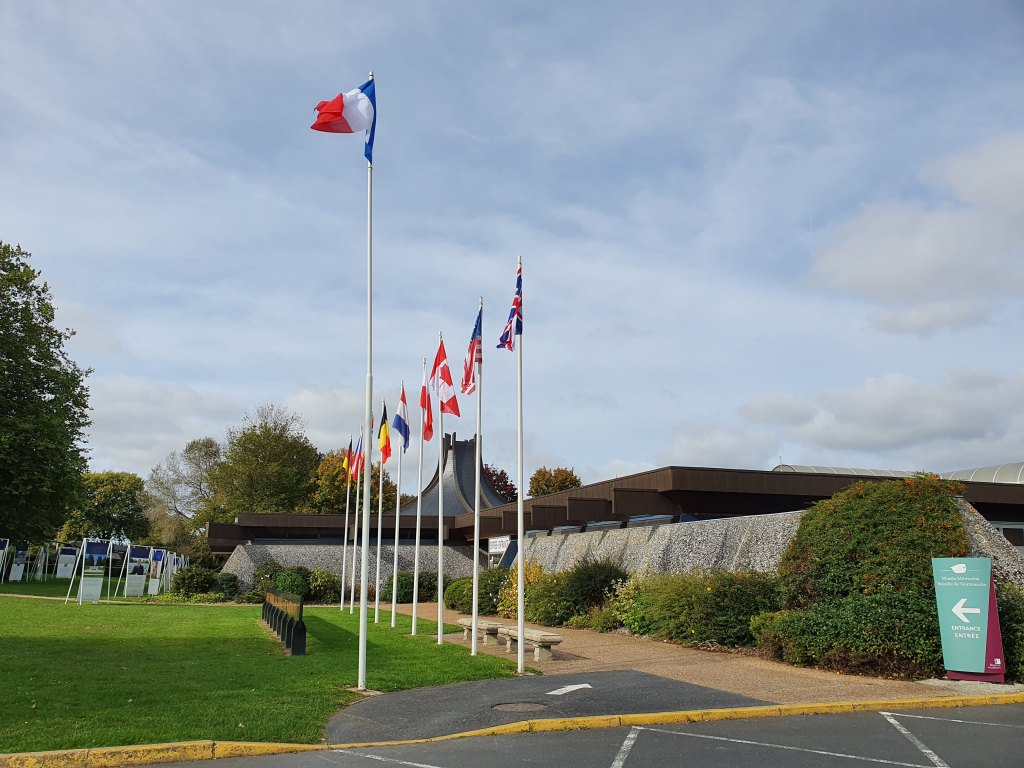
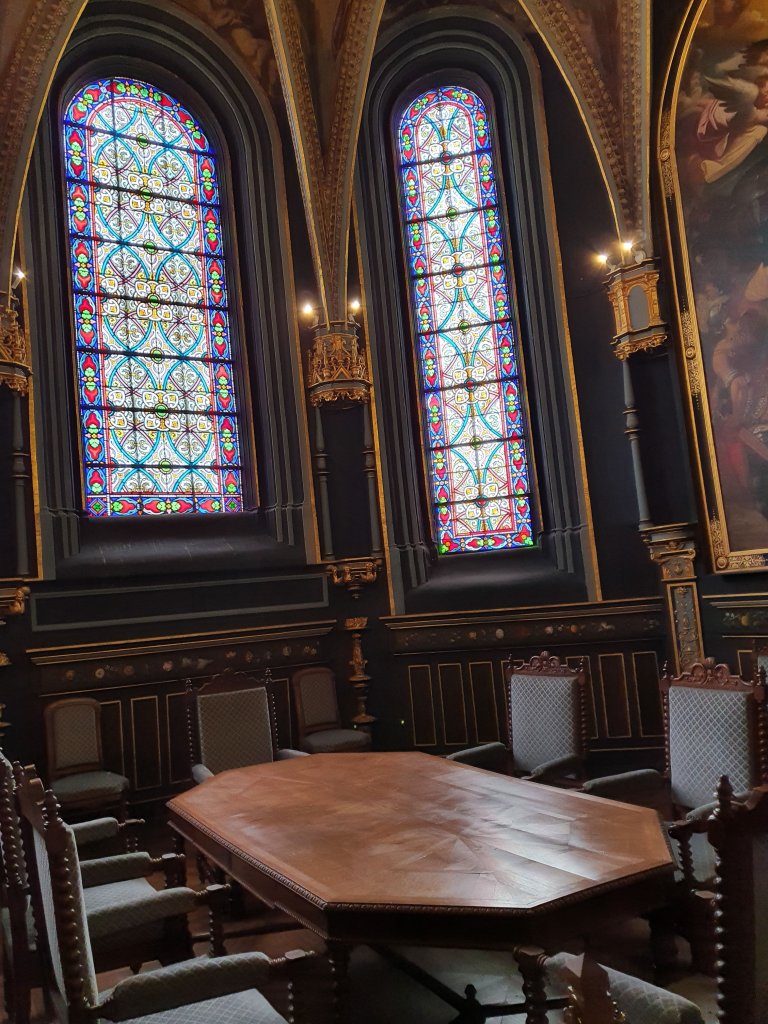
After about 90 minutes in the Battle of Normandy museum I returned to the centre of Bayeux. Having dropped off my bag at the hotel I was staying in that night, I then went on to my next location. This was the Baron Gerard Museum of Art and History, which has a diverse collection of artworks, as well as displays of porcelain and lace. It is located within the former episcopal palace.
When I had finally finished my explorations for the day I was a little tired when I returned to my hotel. Rather than exploring further afield for dinner that evening, I just booked a table for later in the restaurant adjoining the hotel. The dinner much revived me – I had terrine for starter, followed by bavette with onion sauce and frites, and crepes with bananas for dessert, washed down with a carafe of Côtes du Rhône.
Day Five – Tuesday 12th October – Bayeux to Rouen
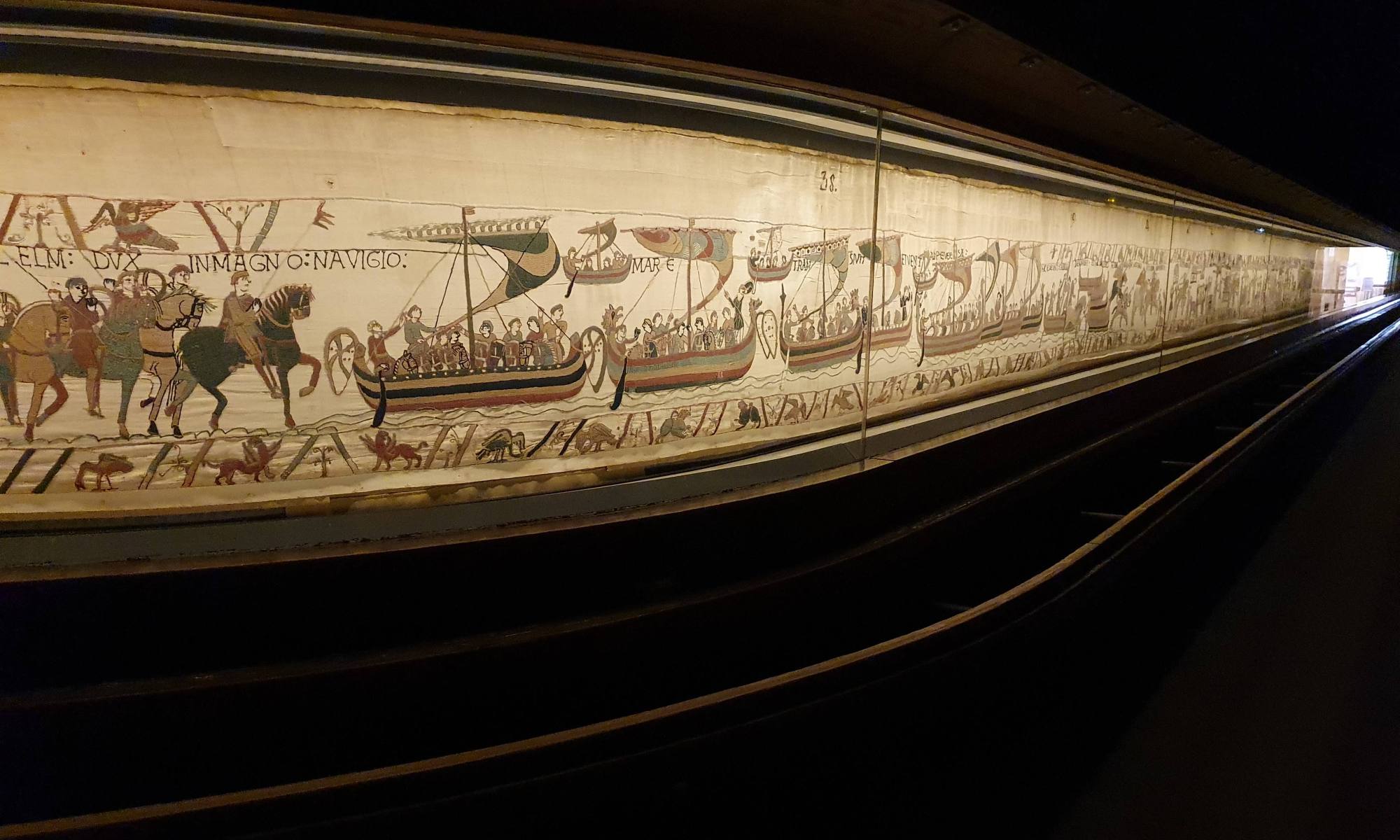
I awoke fairly early so that I could get to the Bayeux Tapestry for when it opened at 9am. When I arrived outside the building in which the Bayeux Tapestry is housed a few minutes before it opened, there was one couple already waiting. When the doors opened at 9am, the couple were not wearing face coverings, so were prevented from entering until they did so. Before you could enter the main building your Covid pass was checked, next I could then skip the desk selling tickets, as I had already bought a multi-museum ticket the day before. At the entrance to the Tapestry (which is not actually a tapestry, but an embroidery), I was given an audio-guide which provides a description of the scenes depicted.
The Tapestry is laid out in a horseshoe shape, around the outside of which you walk. I had seen it once before on a school trip in 1970 – the layout was not as I remembered, but I subsequently discovered that it had been housed in a different building then. Today I had the Tapestry entirely to myself, which felt very special. Only as I was getting towards the end of the first leg of the horseshoe did the couple who I had seen waiting earlier enter the room, only to leave again immediately apparently having a problem with their audio-guide – I did not see them again. The audio-guide plays a continuous narrative, which I assume is designed to keep the crowds moving along when the display is busy. As I had the place to myself, I had the luxury of going back and examining some scenes in more detail – it is surprising how much you can miss on a first look.
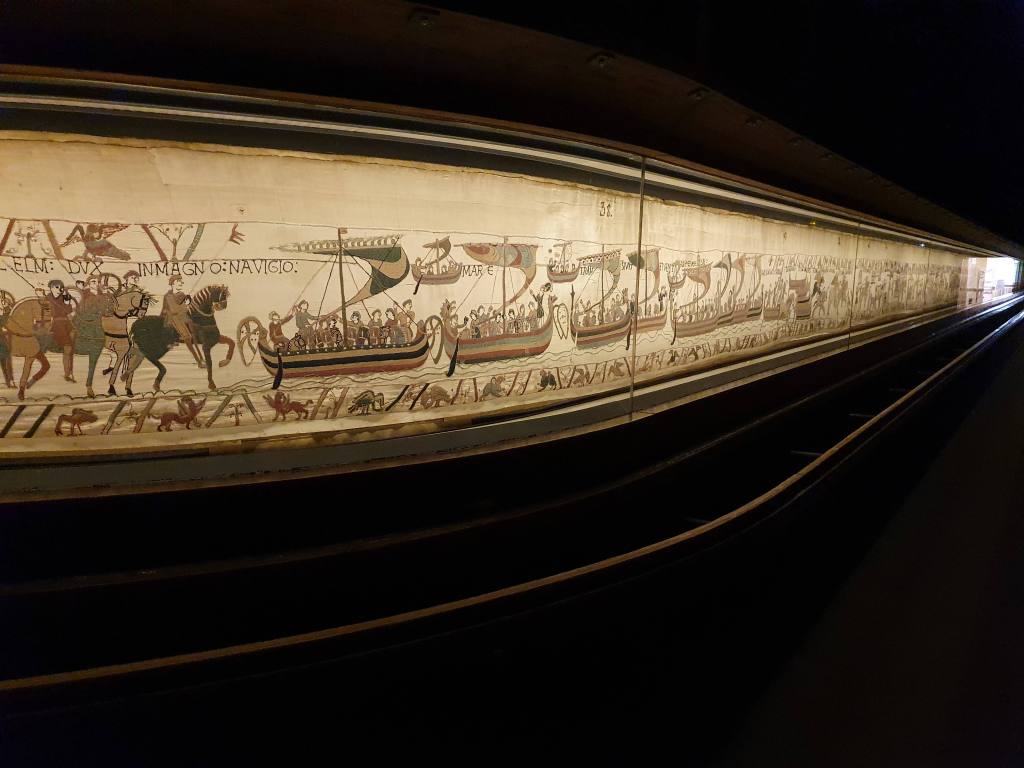
When I had finished looking at the Tapestry, I went upstairs to visit the museum which explains the history of the Tapestry and the events it depicts. There was also a twenty minute film to watch in a large cinema room above the museum. Again, I was the only person in the museum and the cinema.
When I had finished with the Bayeux Tapestry, I went outside and found a bench in a quiet park so that I could complete on my phone the Passenger Locator Form required for my return to the UK, which can only be done within 48 hours of one’s return. I then walked back to Bayeux station, where I was going to catch the same timed Cherbourg to Paris train as I had arrived on the previous day.
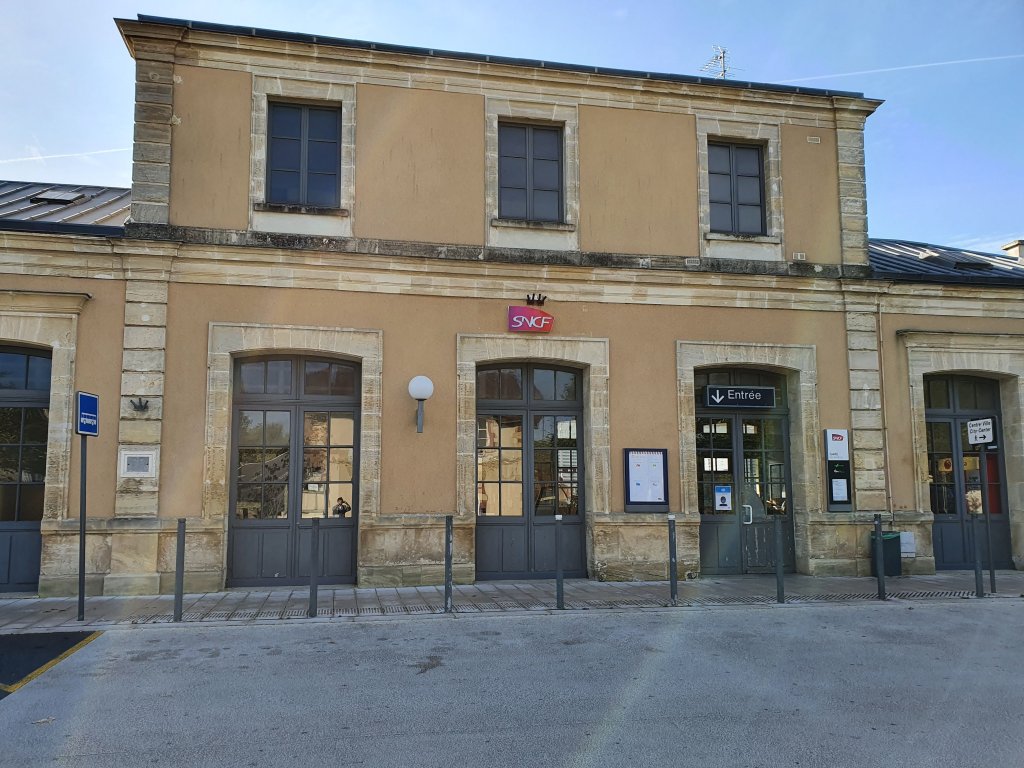
I only rode for one stop on this train and changed at Caen. At Caen I caught a train to Rouen – this journey took nearly two hours, the longest train ride (in terms of time) that I had in France, as it stopped at all the little stations on route.
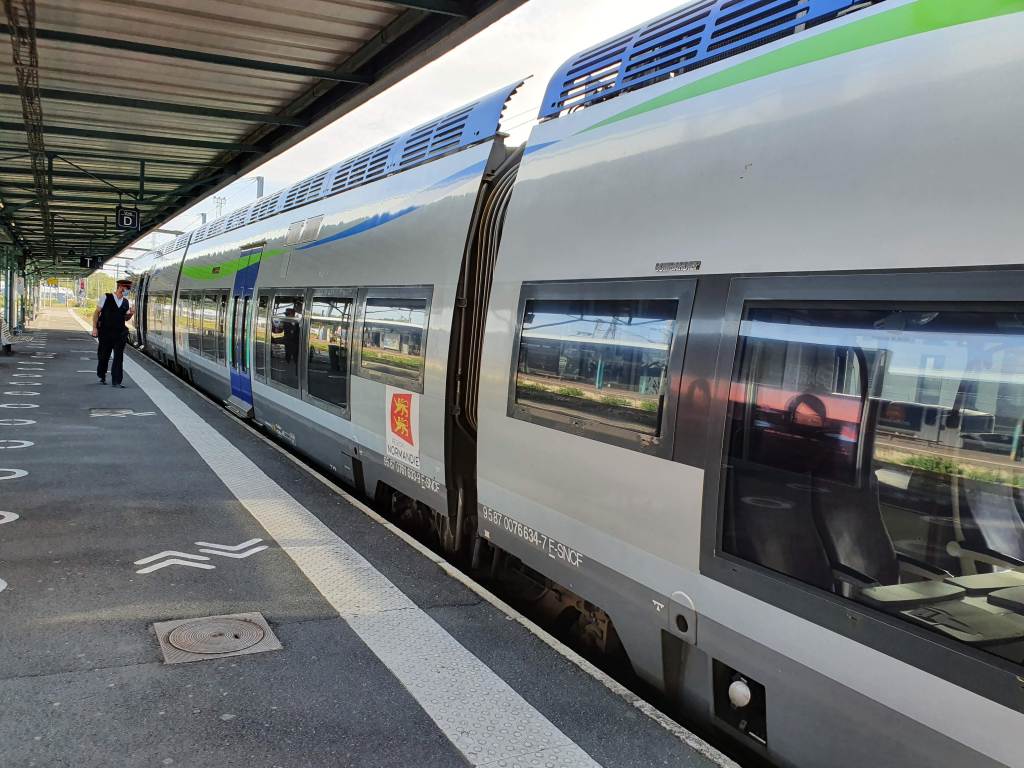
The train arrived at Rouen Rive Droit just before 2pm. To my surprise Rouen Rive Droit was not where I had assumed it was from looking at the map when planning the trip. My excuse is that the railway lines approaching the station from both directions are underground and a quick glance at a map may lead you assume assume that the main Rouen station would be where there was a confluence of above ground lines.
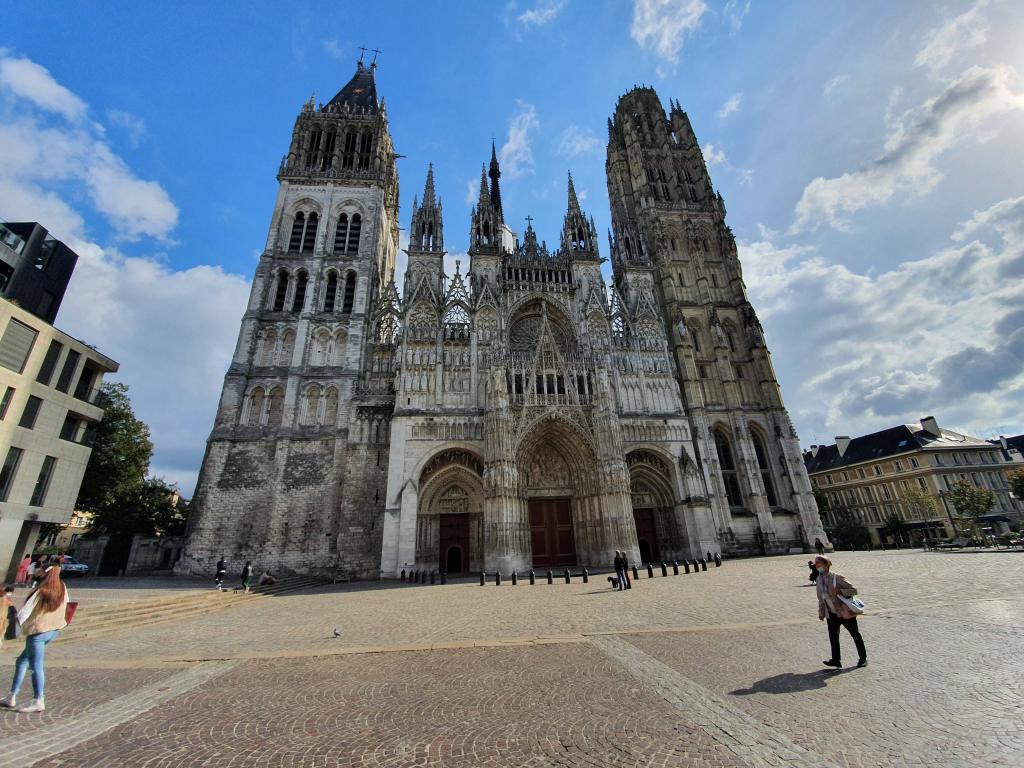
From the station I walked to the centre of Rouen, past the Donjon tower where Joan of Arc had been imprisoned. I called in at the tourist information office opposite the cathedral to pick up a map and guide to Rouen. After a look round the cathedral, where Richard the Lionheart’s heart (but not the rest of his body) is buried, I set off to explore Rouen.
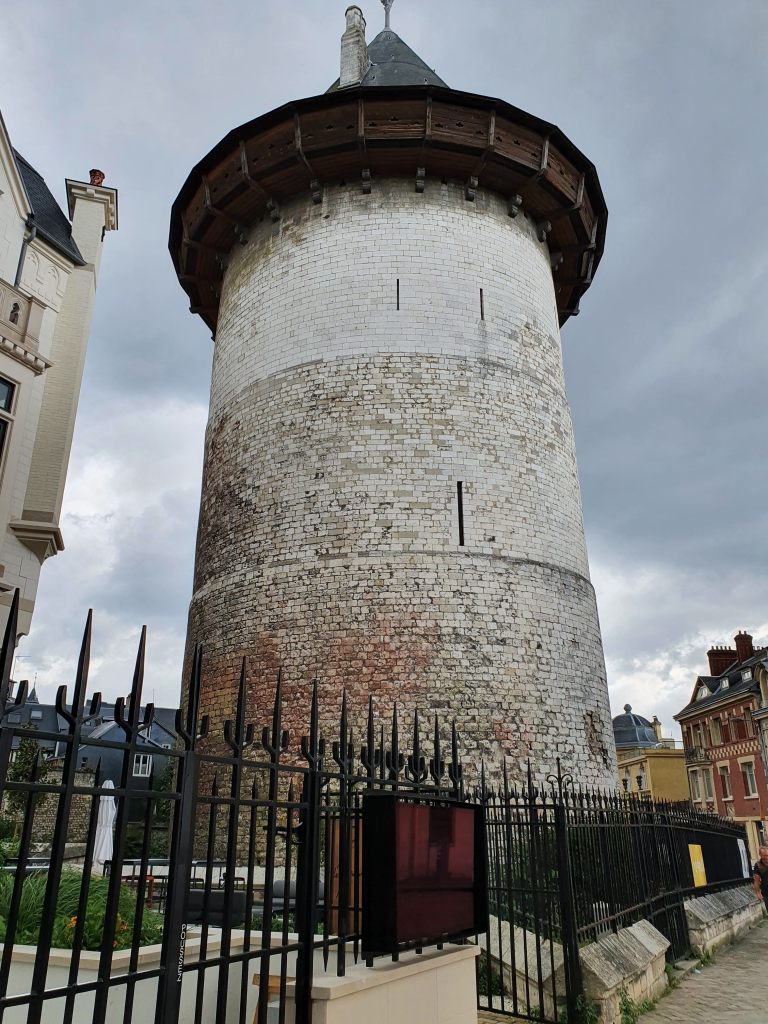
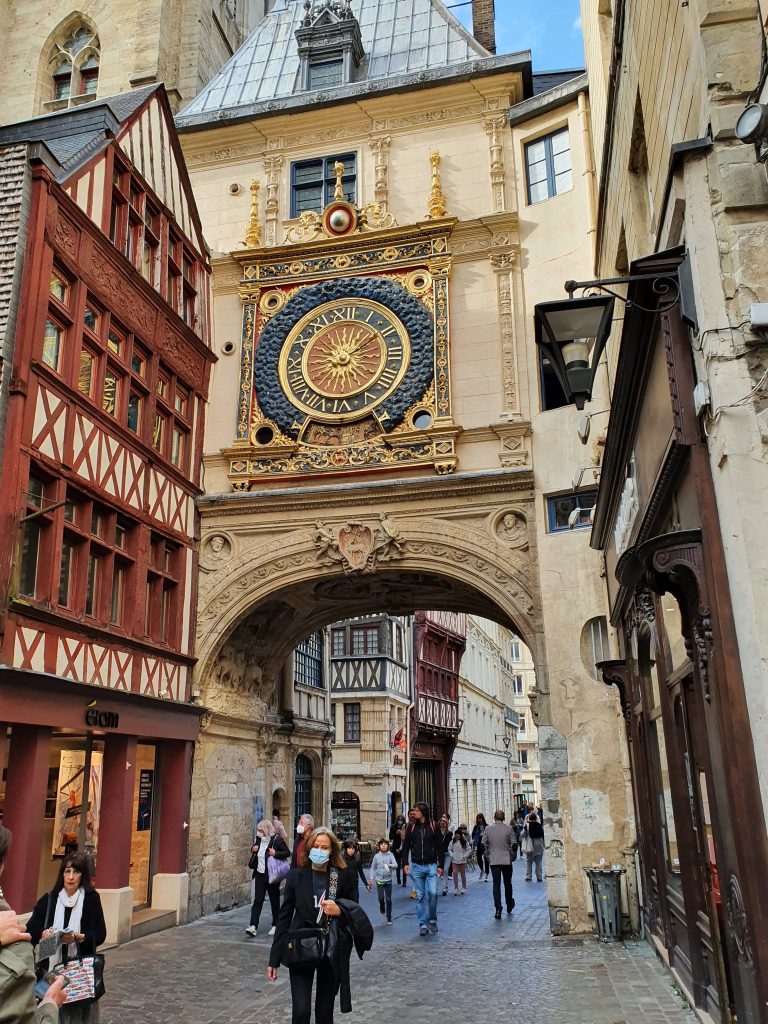
My perambulations took me past the Gros Horloge, the Palais de Justice (which still functions as a court building) and the old market place where Joan of Arc was burned at the stake.
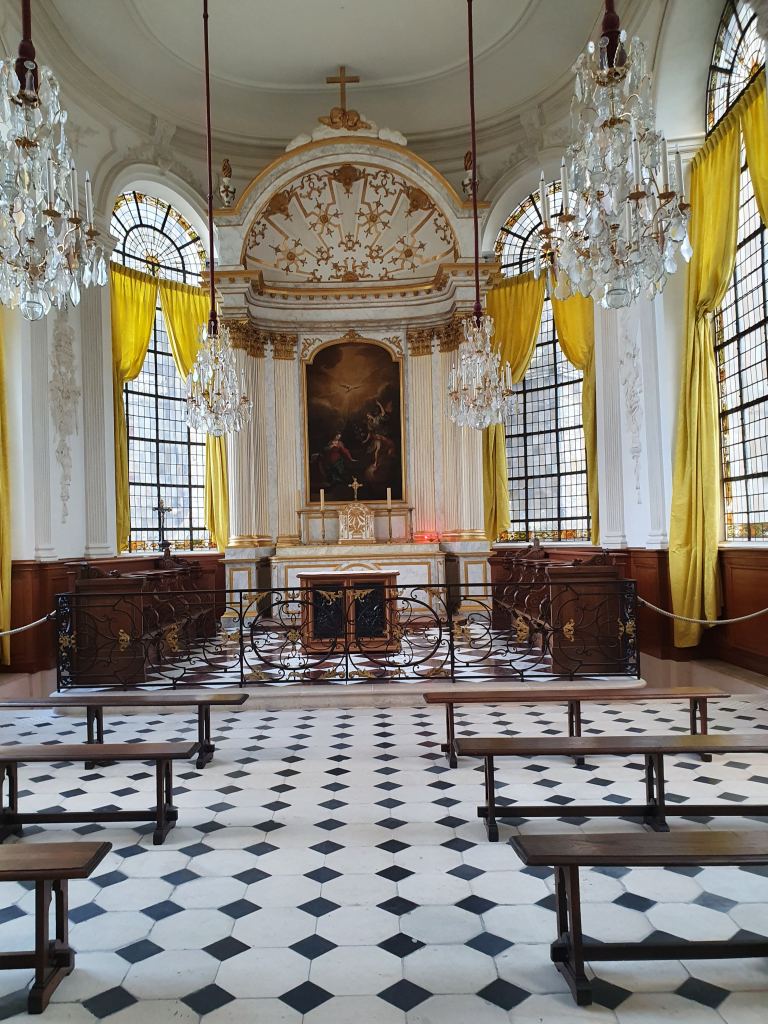
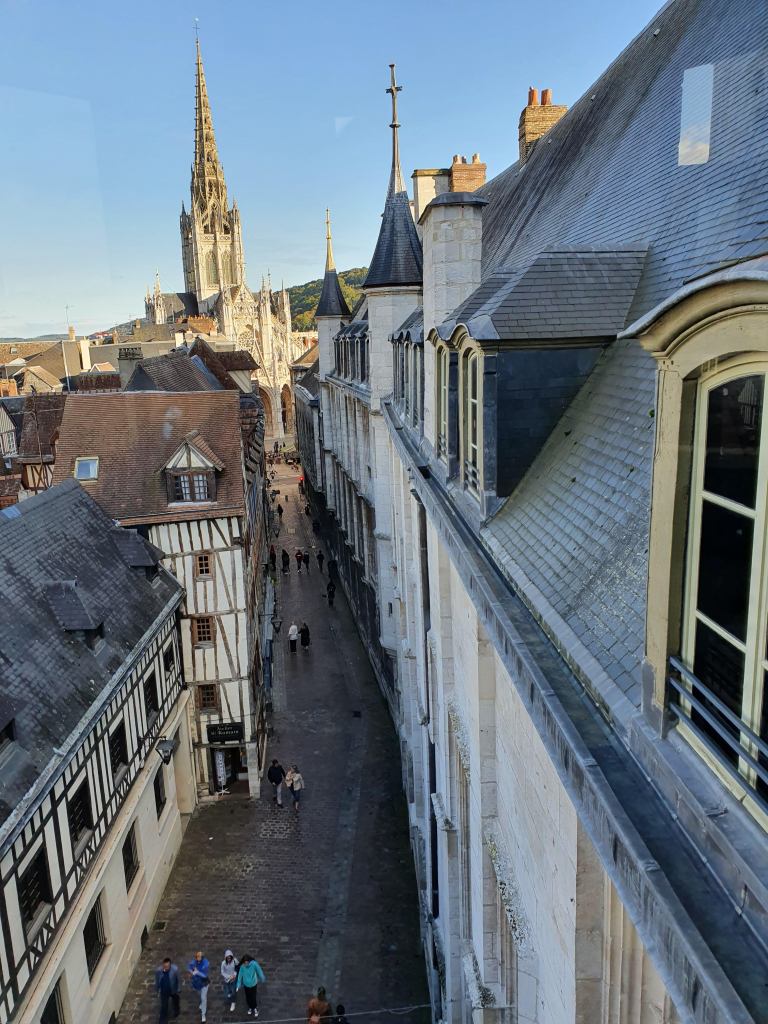
When I had thoroughly explored the old parts of the city centre, I visited the Historial Jeanne D’Arc a multimedia presentation of the trial of Joan of Arc situated in the former Archbishop’s Palace where the trial had taken place. You walk from room to room in the palace while the testimony of witnesses at the trial are projected on to the walls. The dialogue is in French, but at the start you are given a headset for translation into other languages. Because each scene is played out in a separate room, you have to start at a specific time slot. For my 4:15pm starting time, other than myself, there was just one Spanish family waiting. In each new room of the palace we had to wait a few minutes for the next scenes to begin to be played out, as I assume the timings are based on a rather larger number of people having to transfer from room to room.
For dinner that evening I chose a restaurant which offered traditional Normandy cuisine. It did not open for dinner until 7:30pm, but when I arrived at about 7:40pm it was already nearly full and I was lucky to get the last remaining free table. The menu was written on to individual blackboards which were brought to your table.
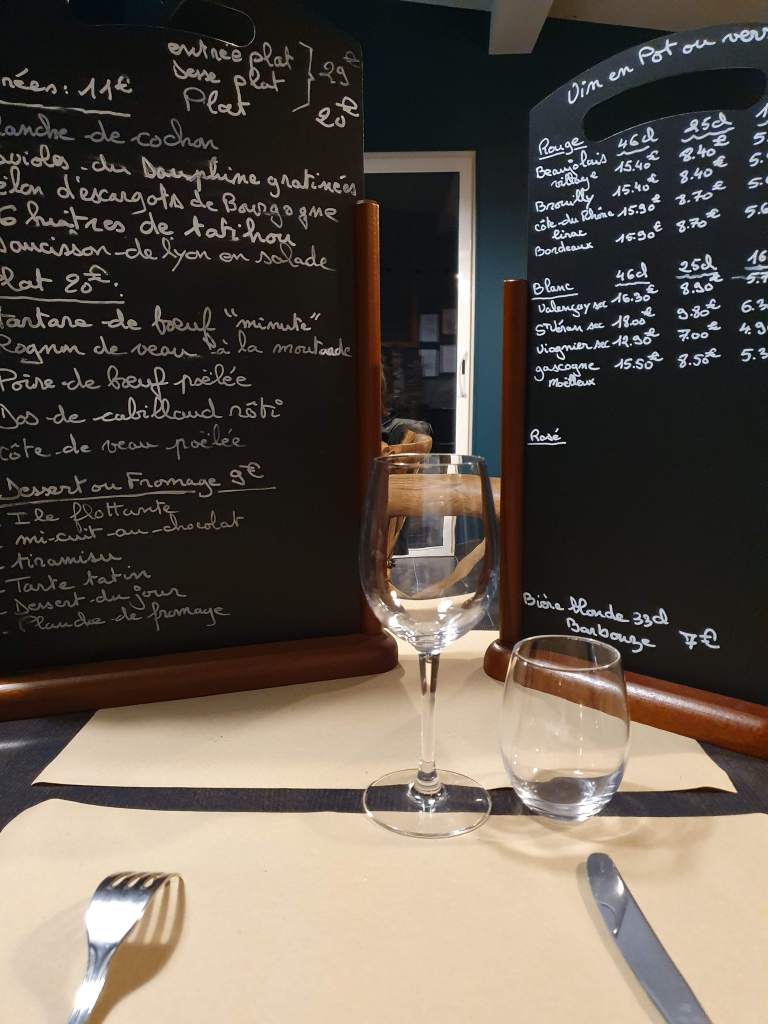
For main course I had kidneys in a mustard sauce served with mashed potato – I admit choosing this was as a result of translation error on my part, but it was very tasty. I followed up with a platter of mixed Normandy cheeses which were so ripe they were almost starting to crawl off the plate. I chose a carafe of Bordeaux to drink, which was smooth and delicious.
Day Six – Wednesday 13th October – Rouen to London (via Paris)
The hotel I had booked in Rouen was the only one on this trip to include breakfast in the price for the night, so before I set off this morning I helped myself from the buffet breakfast provided.
After breakfast I made my way to the Musée des Beaux-Arts in Rouen. This is housed in an impressive two storey building built round two internal courtyards. I arrived when it opened at 10am – access to the permanent collections is free, and, unlike many other museums during Covid, it still has working (and also free) lockers so you don’t need to carry your bag around.
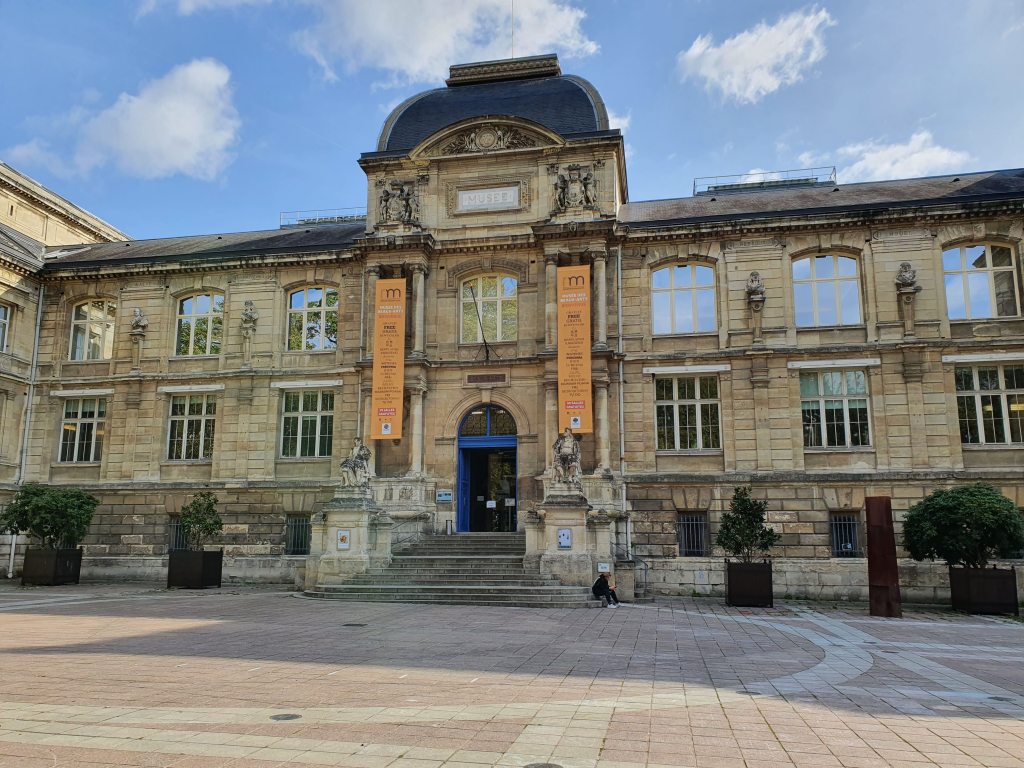
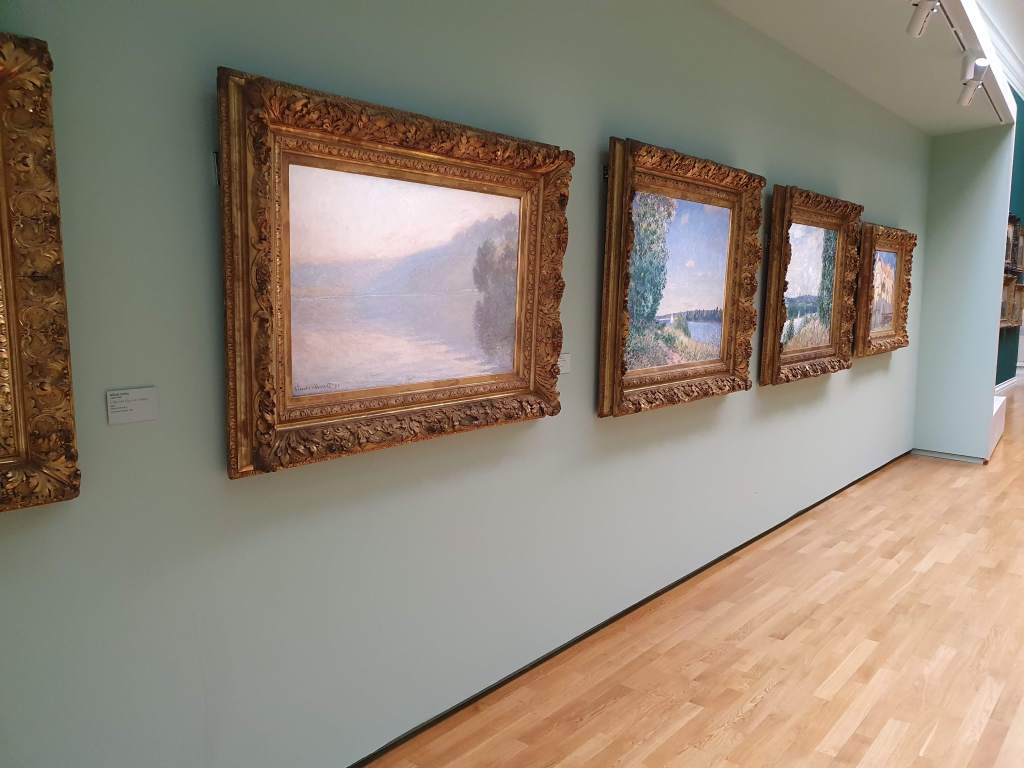
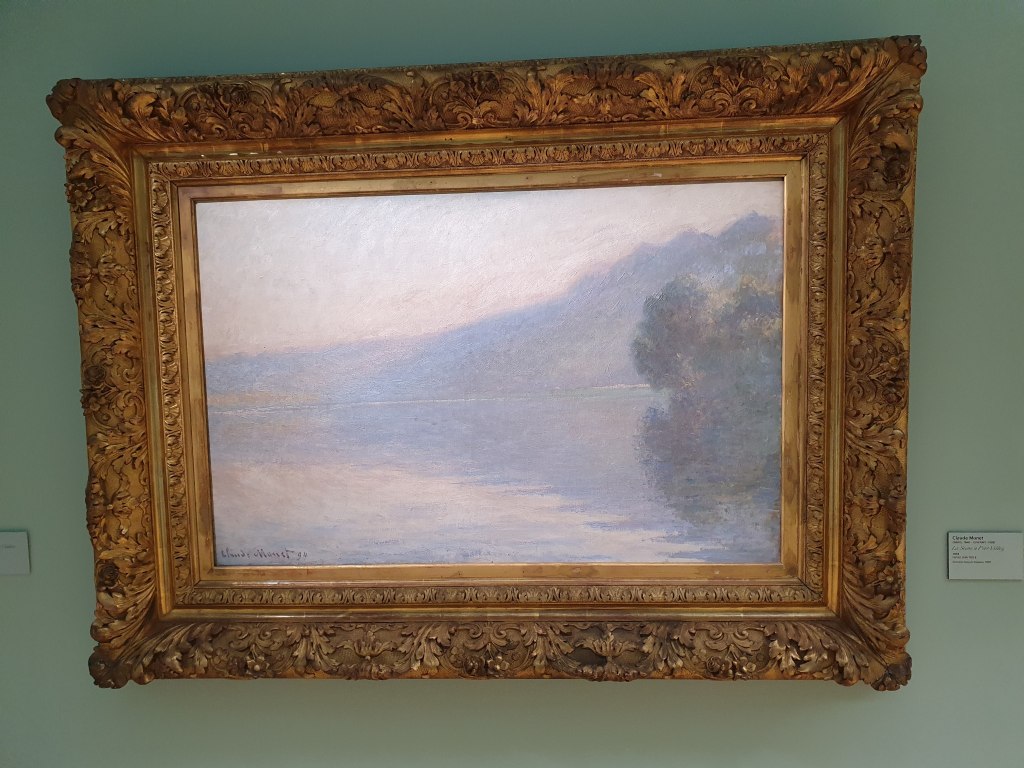
The Musée des Beaux-Arts contains a diverse collection of paintings, from a variety of periods, as well as some sculptures displayed in one of the covered courtyards. For me the highlight of the exhibitions was the collection of Impressionist paintings, mainly of the Seine valley. Claude Monet and Alfred Sisley were well represented. The Monets in particular had a translucent quality which does not really come out in photographs of the paintings.
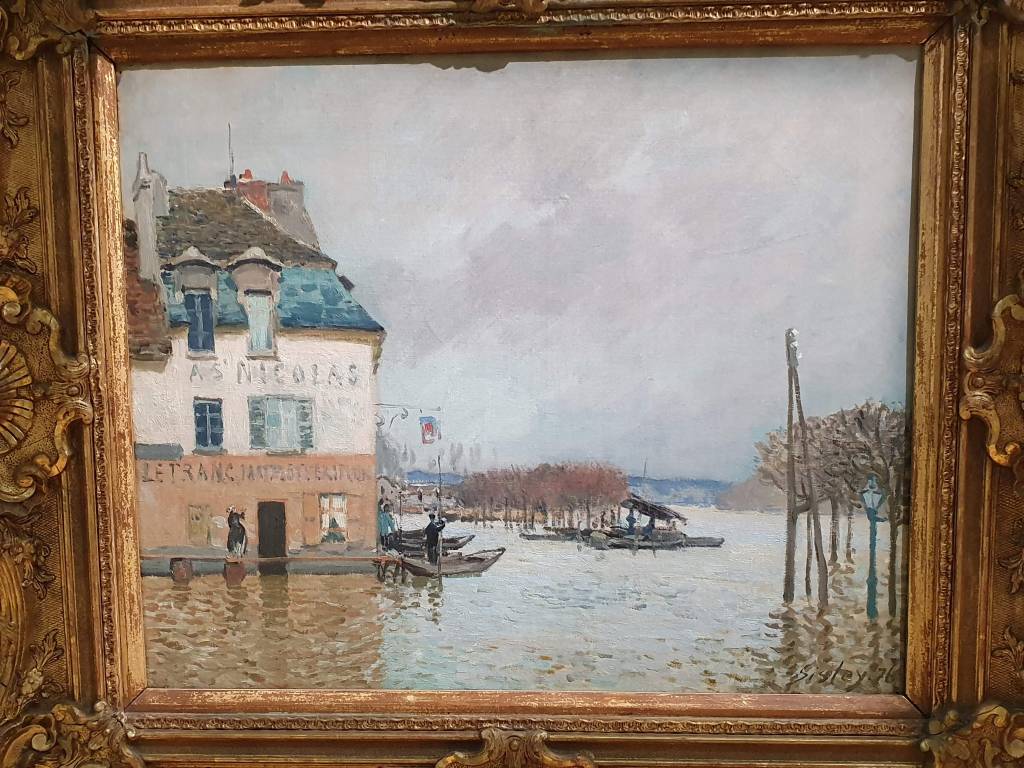
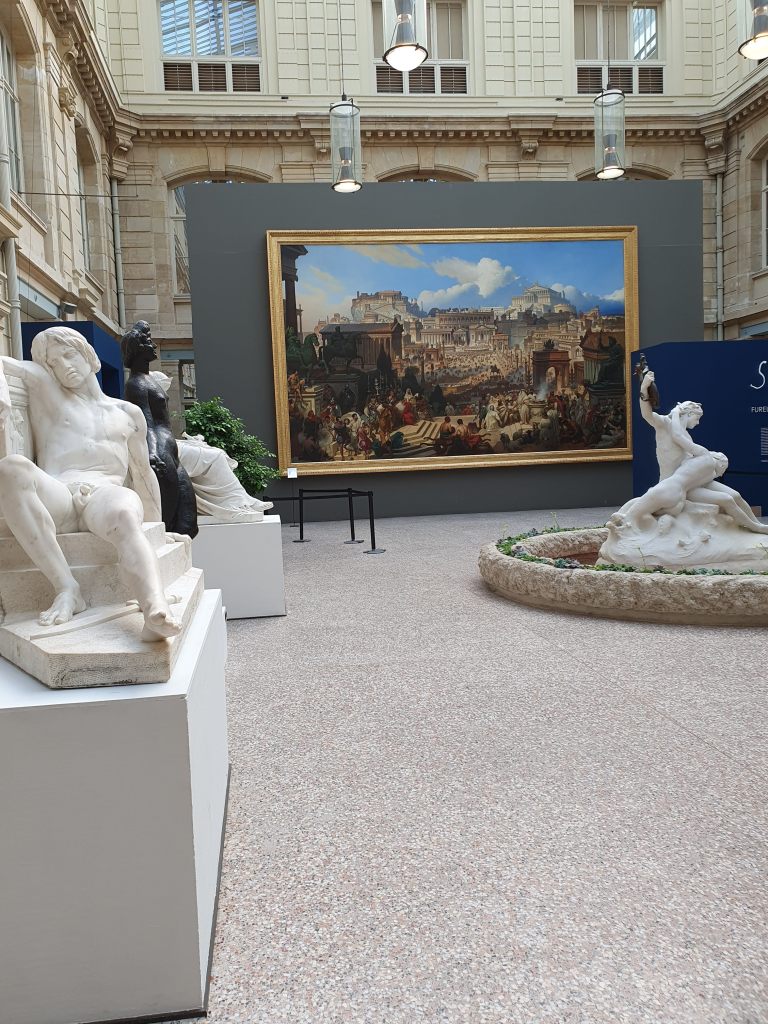
When I had finished in the Musée des Beaux-Arts I had a final look round the centre of Rouen before returning to Rouen Rive Droit Station from where I was to catch a train to Paris. When I was walking away from the station the previous day, I had not appreciated its Art Nouveau splendour.
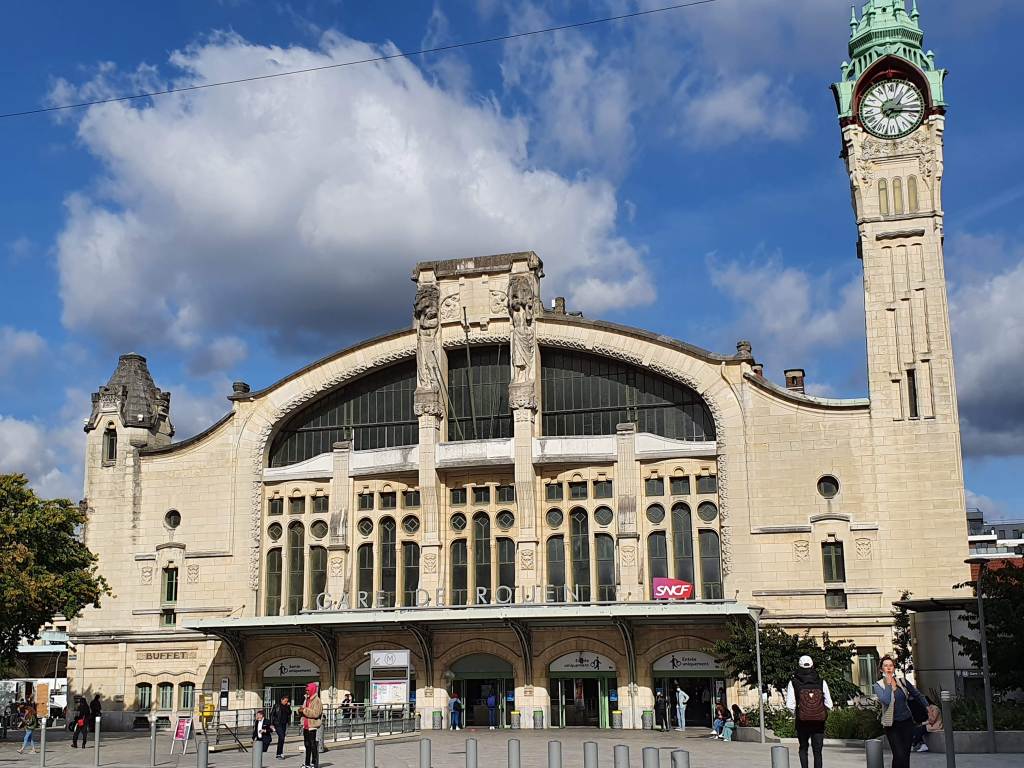
Despite the magnificence of the building above ground, all the platforms at the station are below ground, which are reached by stairs or escalators.
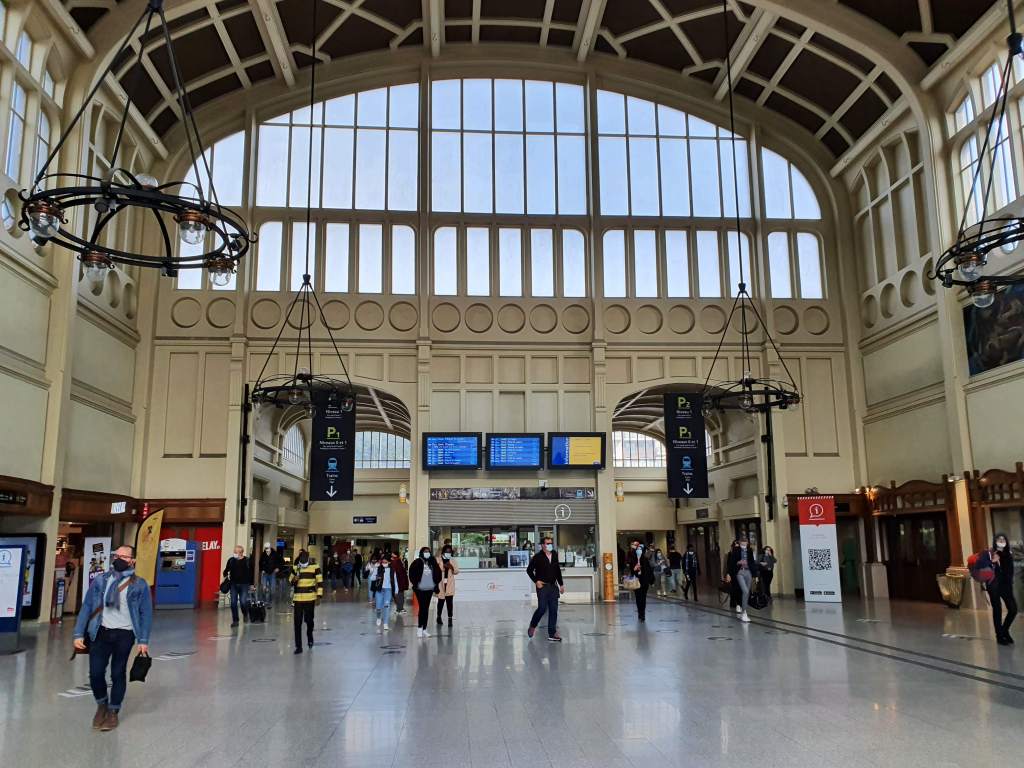
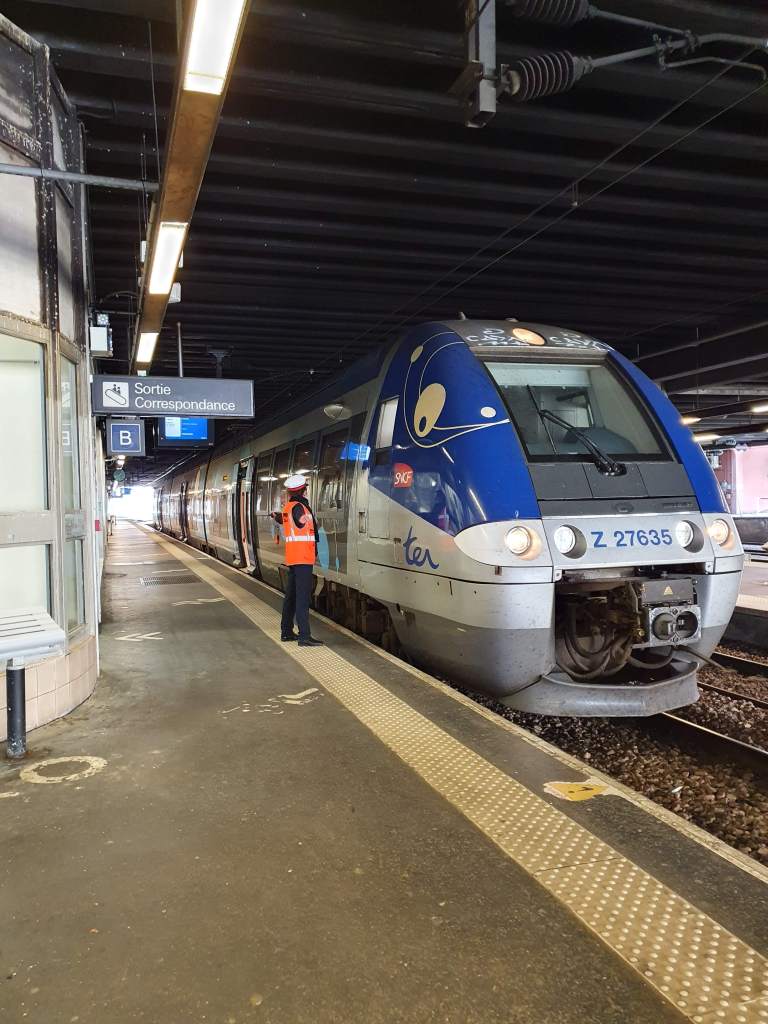
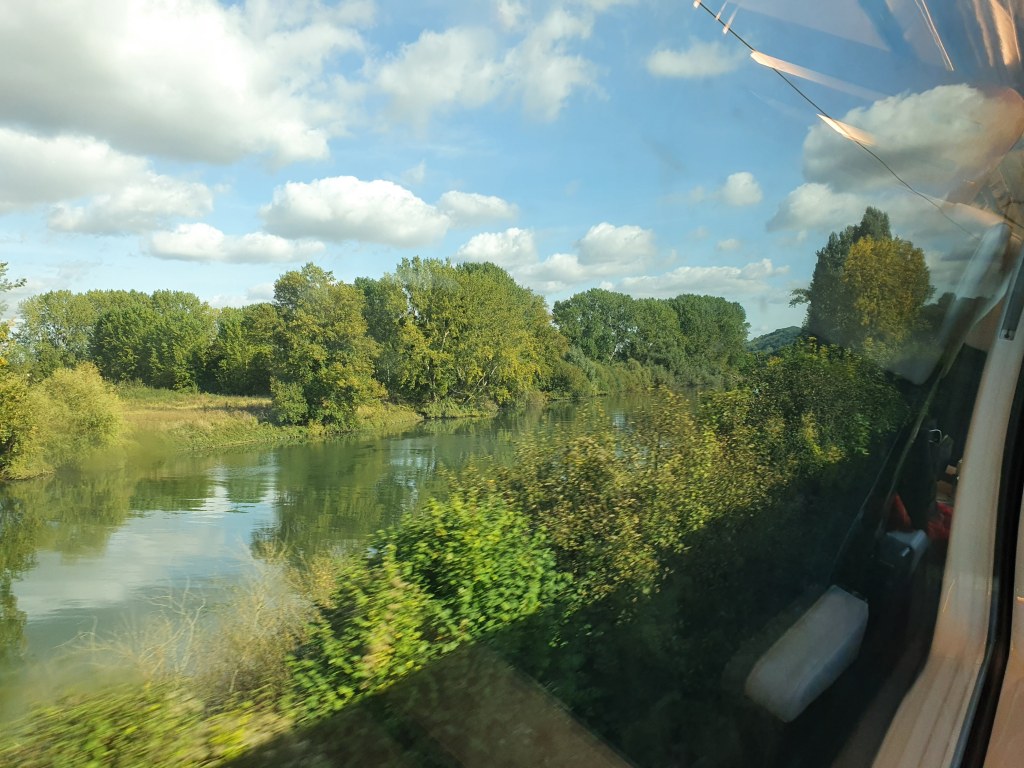
The train to Paris was another double-decker and again I was on the top deck. The reserved seat I was allocated did not have the best views, so once we had departed I knew that I could safely find a better seat with clear views to both sides, as the train was non-stop to Paris. Throughout the journey the railway line follows the Seine valley, usually with tantalising glimpses of the river through the trees that lined the track for much of the route.
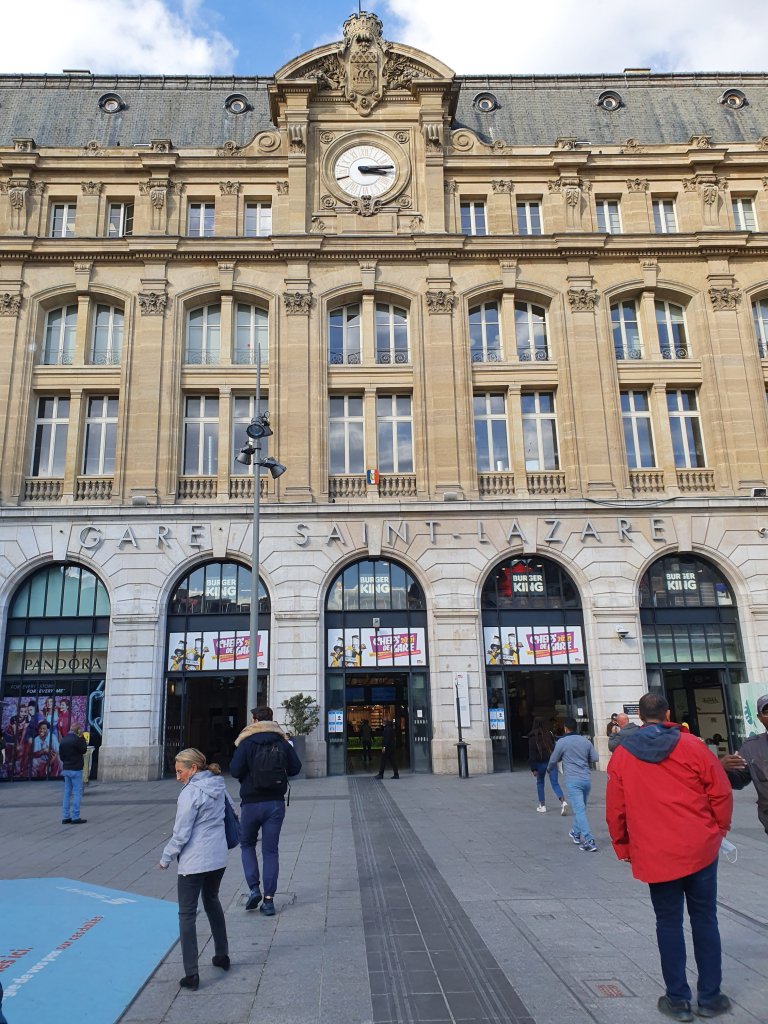
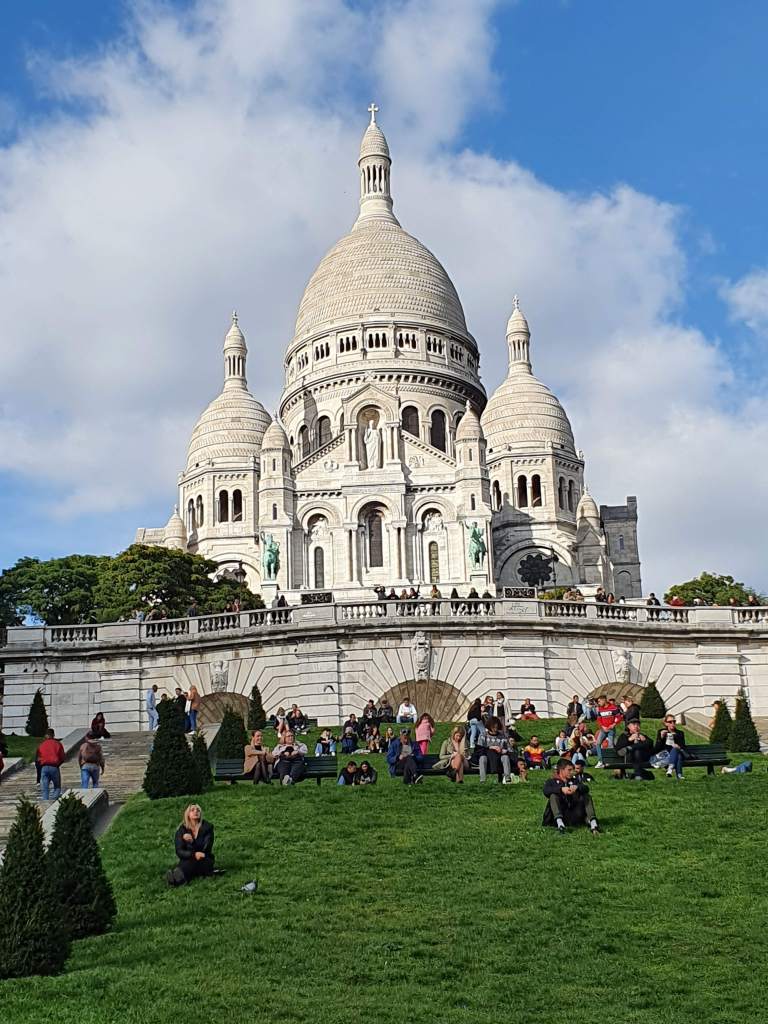
The train arrived at Paris Gare St Lazare a few minutes early. Upon leaving the station I was shocked to see how busy Paris was. The pavements were heaving with pedestrians and the roads clogged with hooting vehicles. I had contemplated visiting another museum or gallery while in Paris, but concluded that I would not have time to do it justice, so instead I walked from Gare St Lazare to Sacré-Cœur and went inside the basilica.
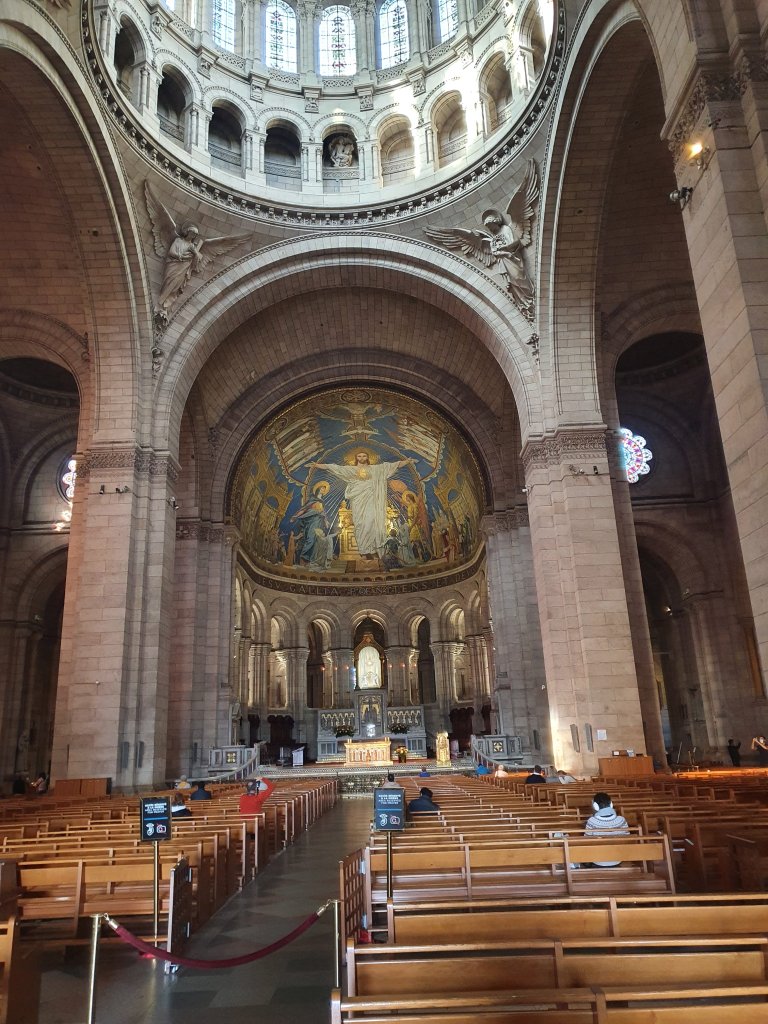
From Sacré-Cœur I walked the short distance to Gare du Nord. A few blocks from the station I found a supermarket which sold the Trois Monts beer I had discovered on my trip to Lille in 2018, so I bought a couple of bottles to bring home with me. I then found a café with tables outside where I had a croque monsieur and a glass of beer to sustain me on my journey home.
Eurostar had been sending me regular messages over the previous few days about the need to check in early at Gare du Nord for their service to London. As I find hanging around in Eurostar departure lounges not particularly attractive, I ignored their recommendations, but felt that I should not cut it too close to the last possible check-in.
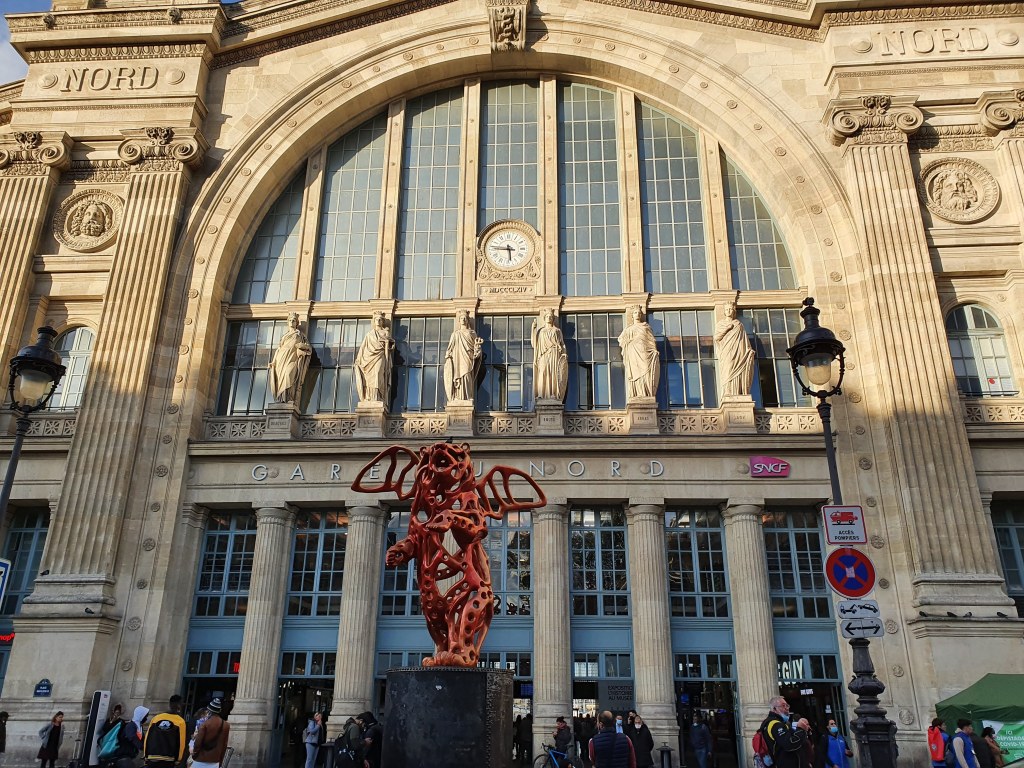
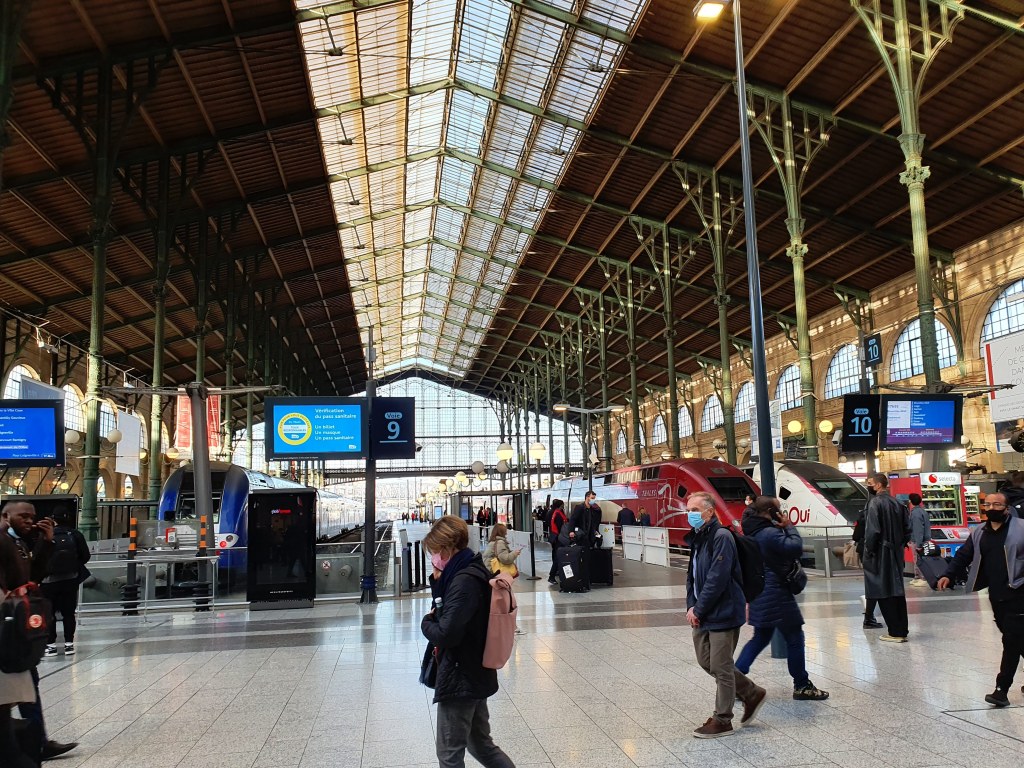
When I reached the Eurostar terminal, a Eurostar employee asked to see the UK Passenger Locator Form on my phone, but she did not look at it at all closely. She was also asking passengers whether they had a British or a EU passport, and dependent on the answer was directing them to different queues. When I said ‘both’, she just shrugged her shoulders and I chose the shorter queue (I’m not sure which one it was). As I had entered France on my EU passport, I needed to show that to the French border officials to leave, but I had put my British passport details on my UK Passenger Locator form so I need to show that one at the UK border post. The French official asked to see my Pass Sanitaire, as it is required to travel on French high speed trains. The British official did not ask about my Passenger Locator Form – I don’t know if this is because it is automatically linked to my passport. Instead they just asked me when I had arrived in France and then let me pass.
About twenty minutes before departure we were allowed to access the platform and board the train. When I found my seat there was someone sitting in it, but when I checked I discovered they were in the wrong carriage.
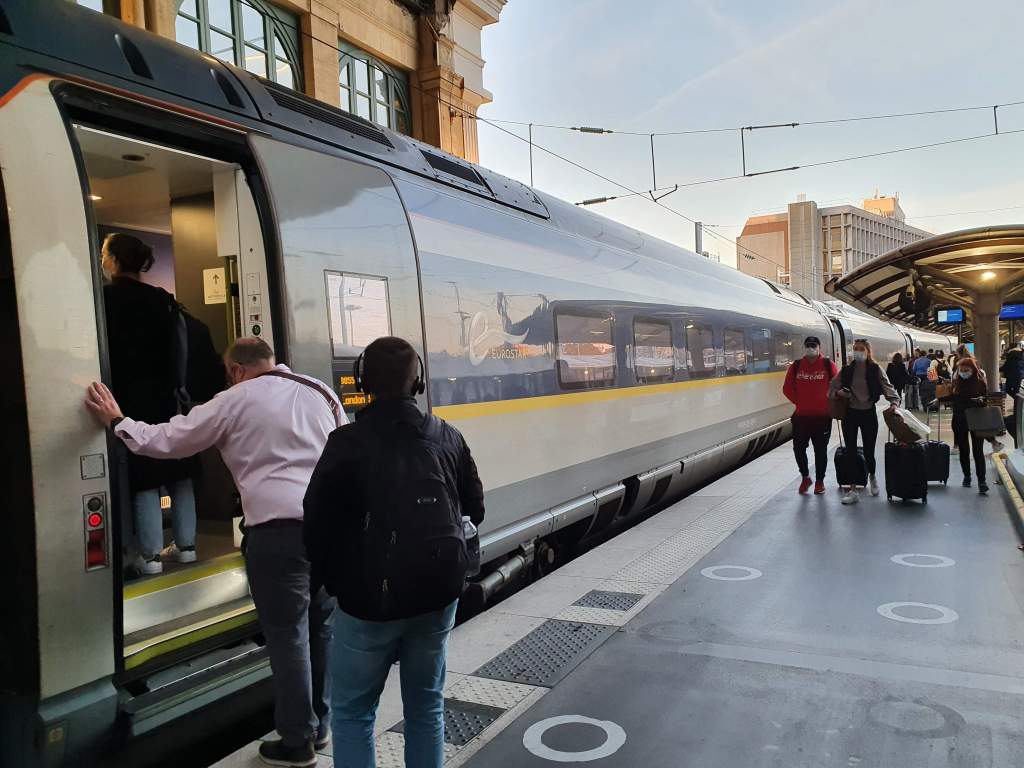
The train was fairly full, but in the seats around me as far as I could tell single travellers did not have strangers sitting next to them – I’m not sure if this is Eurostar’s general policy during Covid. When we left Paris the sun had set and it was dark throughout the journey. The train was non-stop to London and arrived a few minutes earlier than the arrival time shown on my ticket (but a few minutes later than the announced arrival time while on the train).
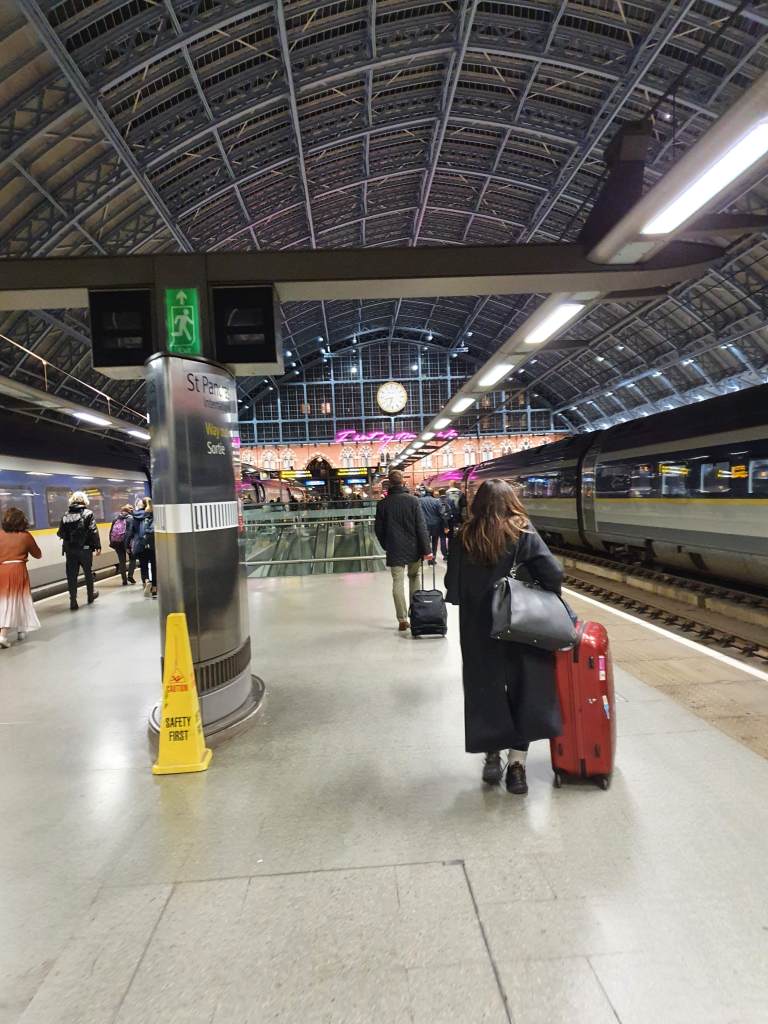
I was very pleased with how my trip had gone – even more so when my Day 2 Covid test returned a negative result. The restrictions of Covid had not proved to be a great imposition, with most things I would normally have done being possible.
This short trip enabled me to complete Routes 1 and 9 from Europe by Rail, the book I had been using as inspiration for planning Europe Explored. More importantly, it had given me the confidence to plan further trips.
 Europe Explored
I loved this read, been following your blog since you posted a link on RailUK Forums many months back (it’s Techniquest on said forum, by the way). Couple of really quick questions:
Day 2 test, was this taken on the morning you woke up in France after docking, or on arrival at the port?
Did you have to take one with you, or were they available easily in France?
Eurostar experience sounded positive, I hope to get on board with them in January 2022 if my passport renewal arrives in time to book sensibly priced tickets. Otherwise it’ll be by air. Are Eurostar e-tickets now or are they still needing to be printed?
Pass Sanitaire sounds like a really good system, I hear the UK is making it more and more recommended to businesses now. Was it easy to get this pass for France?
Thanks in advance for your answers 🙂
LikeLike
The only Day 2 test now required is on Day 2 after you arrive back in the UK – there is no longer a requirement (at least when visiting France if you are fully vaccinated) to take one while there. At the time of my visit, this had to be a PCR test on return, but can now be a Lateral Flow test (but either have to be privately bought and paid for, not NHS).
You can use either e-tickets on the Eurostar app or print at home interchangeably – the same is the case for SNCF tickets. I always take a printed copy, just in case of phone problems. You don’t actually need your Passport details to book Eurostar tickets (unlike some airlines & ferries), but obviously you need to have a Passport by the time you travel.
Pass Sanitaire was simple – download the French Tous Anti Covid app to your phone before you go & activate it by scanning the QR code from your second NHS Covid vaccination. (If you want to avoid battery drain turn off the Bluetooth contact tracing part of the app – it will tell you that the app has been deactivated, but the Pass Sanitaire bit required for admission to places still works fine.) However, I understand that the UK has now (without any fanfare) joined the common EU Covid Pass scheme, so in theory I believe the NHS QR code should now work, but given the French one is simple to set up, it may be best to continue to use the French one, as that is what the French restaurants and museums will be familiar with.
LikeLike