
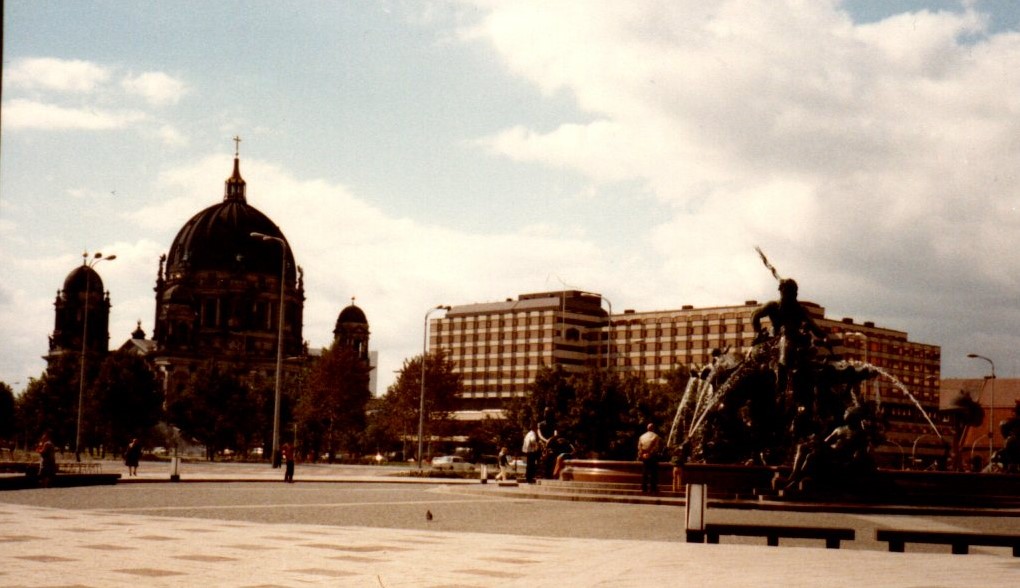
“Je stärker der Sozialismus, desto sicherer der Frieden.” (“The stronger the socialism the more secure the peace” – East German propaganda slogan of the 1980s.)
Shortly after I started this blog a year ago, I wrote a series of five posts describing the Interrail trip I made in 1983. As part of that trip, I visited the then two communist countries where you could use an Interrail pass – Hungary and Romania. In 1984, for my main holiday I visited the USA with friends and in May 1985 I had a week long solo trip exploring Portugal. For my main holiday in 1985 I decided to visit two more communist countries – East Germany (DDR) and Czechoslovakia. These two countries were rather more restricting of travel by foreigners than Hungary and Romania had been in 1983, so careful planning was required. For a start, you could only get a visa for East Germany and for Czechoslovakia if you had pre-booked accommodation for each night that you were going to be there, and in the case of East Germany this had to part of formally organised tour. Having a personal aversion to the constraints of organised group travel, I chose the least restrictive option then available from Berolina, the DDR’s travel agency, which had a branch in London’s West End. Once all the necessary advance bookings had been made, visas were then obtained. For this trip, I would be travelling with a friend – sadly, he died twenty years ago and I have recently rediscovered the notebook he used as a log of this trip – so, unlike my write up of my travels in 1983, my account is not totally based on my unreliable memory. (Finding this notebook has shown that there were some things of which I had no memory and others where my memories would appear to be wrong – so I wonder how much of my account of my 1983 trip is incorrect?)
Friday 6th September 1985
After work that day, I met up with my travelling companion in a pub near Liverpool Street station. After a swift drink, we got ourselves something to eat on the station, before boarding the 7:40pm Boat Train to Harwich Parkeston Quay, which arrived there just before 9pm. We boarded the ‘Prinses Beatrix‘ for the crossing to Hoek van Holland. After being allocated our cabin, we headed to the ship’s lounge for a drink before retiring for the night. The boat departed at 10:45pm. (As an aside, a month after our crossing the Princes Beatrix was sold to Brittany Ferries and the following year started operating their routes as the Duc de Normandie. In 2005, she was sold again and started sailing between Ramsgate and Ostend as the Wisteria. She was last heard of plying her trade between Spain and North Africa as the Voronskiy.)
Saturday 7th September 1985
After a smooth crossing our boat arrived promptly in Hoek van Holland at 6:30am. We disembarked and after passing through immigration and customs boarded the 7:11am departure to Berlin. (This was just one of several trains going to destinations across Europe – now no trains serve Hoek van Holland, there is just a tram service to Rotterdam.)
After an uneventful journey through the Netherlands and northern Germany, our train made its last advertised stop prior to Berlin at 2:21pm in Helmstedt. Shortly after leaving Helmstedt, it stopped again at the East German border crossing. There, East German border guards got on the train and performed an inspection of documents. (As westerners we needed no special documentation, other than a valid passport, to transit from West Germany to West Berlin.) For the journey through East Germany, there were armed East German guards positioned at each end of every carriage of the train, presumably to stop any attempts to board (or leave) the train on its route through East Germany. These guards remained on the train until it reached a drab looking station in the outer suburbs of Berlin, where the train stopped and the armed guards disembarked and stayed on the platform as the train departed and crossed into West Berlin. A short while later, at 5pm, we arrived at Berlin Zoo station where we alighted.
We made our way to a hotel not far from the Kurfürstendamm, near the ruins of Kaiser-Wilhelm Gedächtniskirche. When we had checked into our room we discovered that the television was showing live coverage of the final of the Nat West Trophy (the main English county one-day knock-out cricket competition at the time) between Essex and Nottinghamshire. After watching this for a while, we headed out to find a bar for pre-dinner drinks, followed by a restaurant for dinner, and then another bar for post-dinner drinks.
Sunday 8th September 1985
We spent this day exploring West Berlin. After breakfast, we strolled through the Tiergarten to get to the Berlin Wall in front of the Brandenburg Gate. There were viewing platforms erected there to look over the Wall.
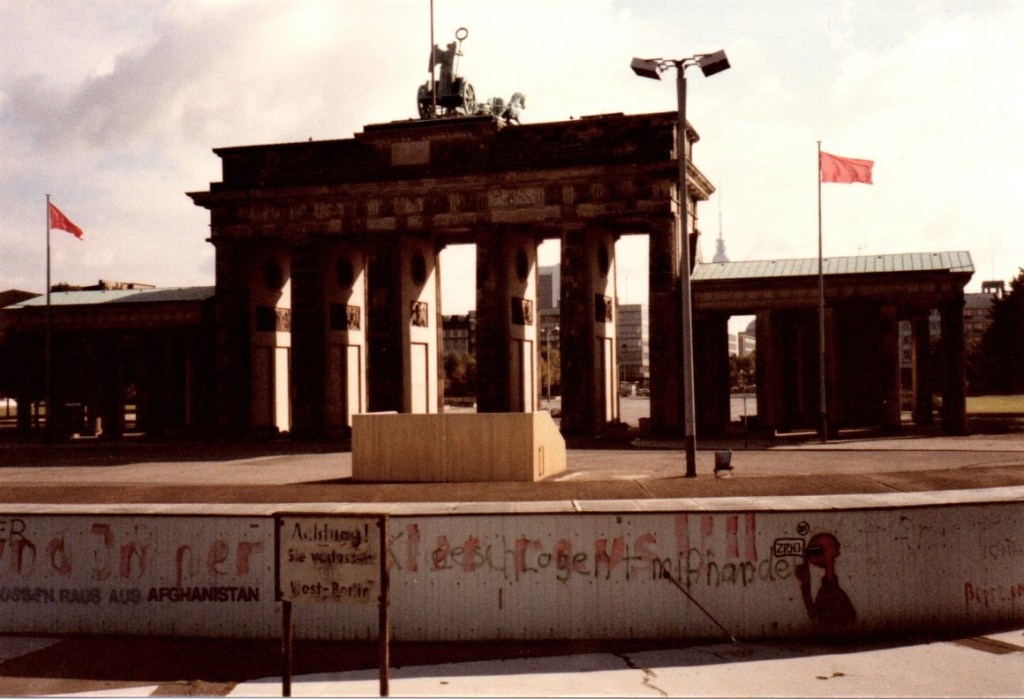
We also looked at the Russian War memorial, still guarded by goose-stepping Soviet soldiers. The nearby Reichstag (not then used as a Parliament and still showing extensive signs of war damage), had an exhibition of German history in the 19th and 20th centuries. We also visited the Museum of the Wall near Checkpoint Charlie, but found this a rather commercial venture presenting history from a very simplistic American viewpoint.
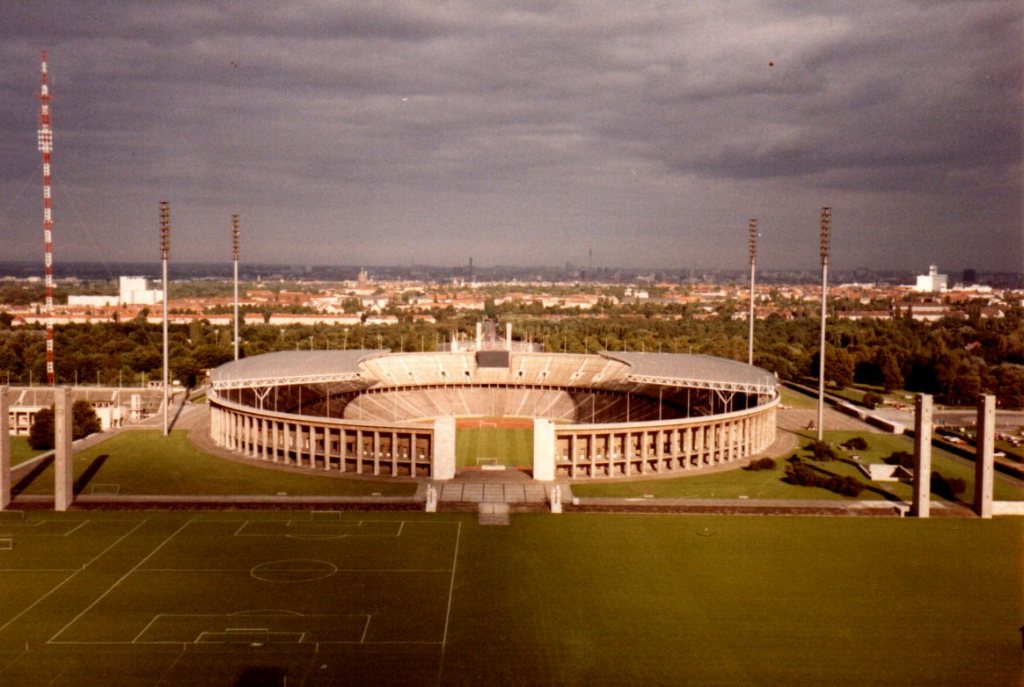
In the afternoon we travelled to the west of the city. First stop was the Schloss Charlottenburg, the seventeenth-century Prussian palace. After looking round inside and visiting the gardens, we moved on to the Olympic Stadium, site of the notorious 1936 Olympic Games. When we got there, the gates to the stadium were open to allow spectators to exit from a football match which was nearing its end, so we were able to enter for free. This was before the Stadium’s refurbishment in 2004 so that it could be used as a venue for the 2006 World Cup, so the majority of the seating was just spartan wooden benches. At the time, as it still is, the stadium was home to Hertha Berlin, who were then in the second division of the Bundesliga. I had always assumed that I had seen the final 10 minutes of a Hertha Berlin Bundesliga game that day, but on researching this post discovered they were not playing at home that weekend, so it was probably a reserve team game that we witnessed. After the game had finished, we went to the top of the adjacent Bell Tower, which gave good views of the stadium and of the city beyond.
Monday 9th September 1985
Today was the day when we crossed into East Germany. It seemed strange, but the easiest way to do so was by U-Bahn from West Berlin. The West Berlin U6 and S2 lines intersected underground at Friedrichstraße station, which is located in East Berlin. For the other stations located on these two lines within East Berlin, the trains would pass through without stopping – you could peer out from the train windows onto the dimly lit platforms of these ghost stations to see that they were patrolled by armed guards. On arriving at Friedrichstraße it looked like any any other modern metro station, a bit like Oxford Circus in London, brightly lit with signs giving directions on how to change lines. However, part way down one of the the platforms was an almost anonymous door bearing a sign which read “Ausgang zum DDR”. This led into a narrow corridor, which we followed on a labyrinthine circuit until it reached the hall at ground level which housed the border control. (You could not leave East Berlin by the underground lines – instead at Friedrichstraße you had use the elevated S-Bahn S3 line which terminated there after crossing from West Berlin.)
I had heard stories of it being rather a hassle entering the DDR, with long delays and with personal items, in particular books, being confiscated. However, our entry was fairly painless – our visas were in order and as well as an entry stamp in our passports, we were also given a residency permit valid for the duration of of our stay. We then changed currency at the official exchange rate of 1 (Ost) Mark to 1 Deutsche Mark. The going black market rate at the time seemed to be four times this – we were approached on several occasions during our stay with offers to change money, but having been warned that the authorities often set up sting operations to extract even more hard currency in fines for illegal money changing, we stuck to using the official money changing outlets. I then used some of this newly acquired currency to buy our train tickets for our departure from East Germany the following weekend.
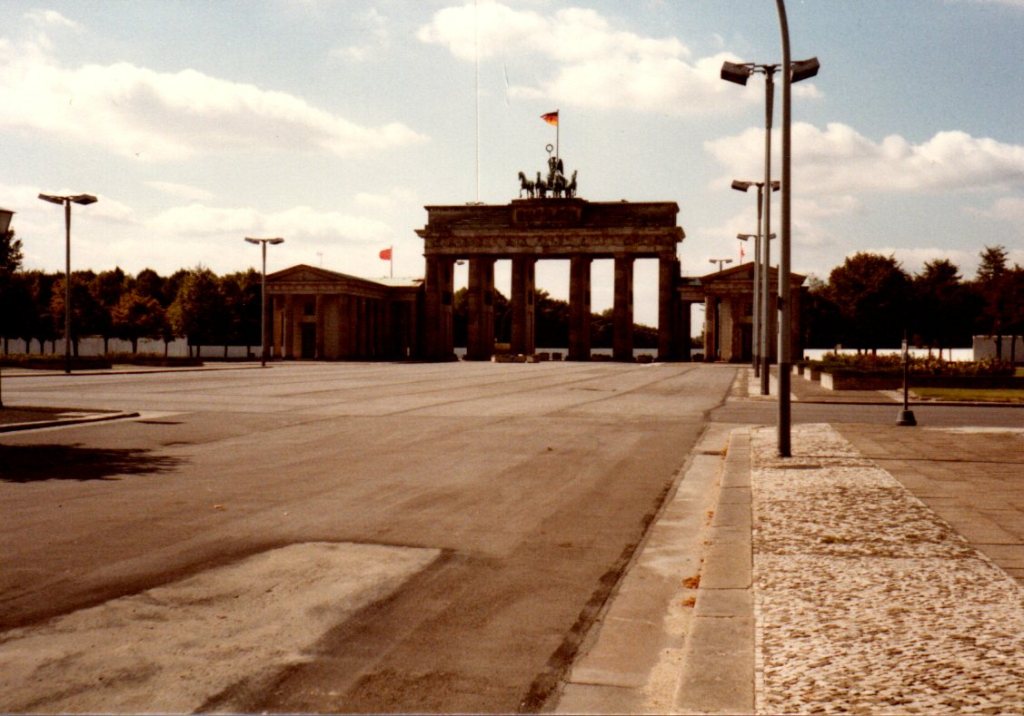
We then spent much of the day exploring East Berlin. We walked down Unter den Linden to view the Brandenburg Gate from the other side of the Wall from where we had seen it 24 hours earlier, though because it was close to the Wall, you were not allowed to actually go to the Gate itself.
We also went to Alexanderplatz to visit the Marienkirche and to ascend the TV Tower. Each of the communist countries I visited in 1983 and 1985 were uniquely different – and rather than the eastern bloc being a uniform entity as portrayed in the West, each had its own characteristics, and were probably more diverse than most Western European countries at the time. East Germany’s speciality seemed to be showcase projects which equalled and surpassed the best the West could offer, but, judging by the lack of contents in the shops, daily life for the average citizen was significantly below western standards, at least in material terms. The Berlin TV tower, was one such example of a showcase project. It was completed in 1969, with a modern design, being more than 200m taller than the equivalent tower in West Berlin. From the top there were good views over the whole city, although the information boards describing what could be seen conspicuously failed to make any mention of the Wall which could clearly be observed below.
At 4pm we met up with our official tour group at the Palast Hotel opposite the Volkskammer, the gleaming parliament building of the DDR. We were taken on a brief tour of the city, including calling in at the Pergamon Museum to view the stunning Pergamon Altar, a reconstruction of part of the Pergamon Acropolis originally in Asia Minor.
After the tour we returned to the Palast Hotel, where we would be staying the night. The Palast Hotel was another East German showcase project, being a modern well equipped luxury hotel, matching the best hotels of the West. As I was to later discover, it also had state of the art bugging equipment, with all rooms being monitored, including some with video surveillance. There was a full-time Stasi presence in a suite of rooms on the fifth floor to control the monitoring activities. Among the leaflets in our room was one advertising the hotel, complete with testimonials from guests who had visited. I found particularly amusing the quote attributed to the Vietnamese delegate to the fifth International Conference on Theoretical Marxism-Leninism who praised the hotel’s haute cuisine.
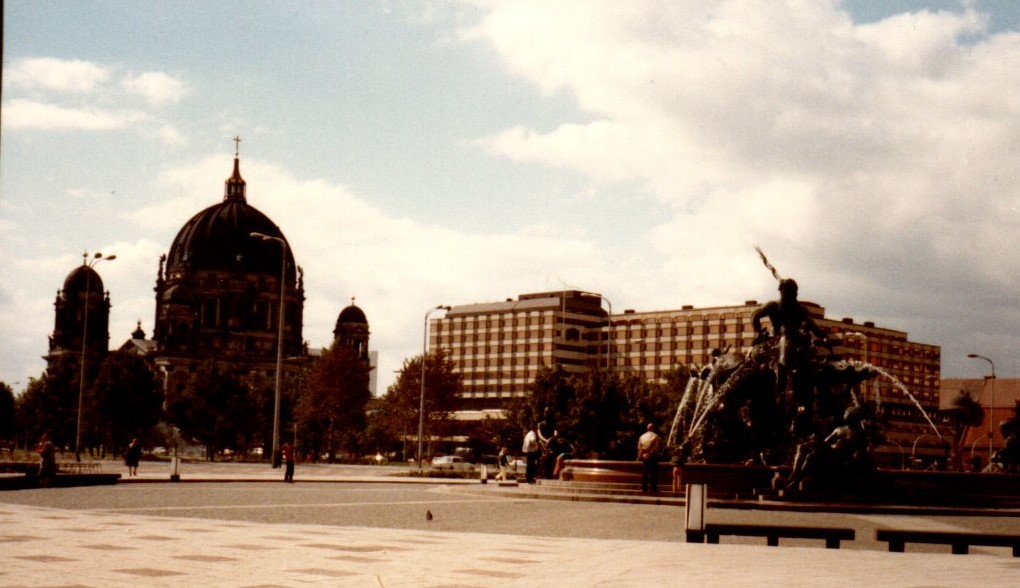
That evening our group was provided with dinner in the hotel – the only evening when dinner would be provided, as I had tried to book a tour which gave us as much freedom as possible to explore independently. We discovered that the majority of other travellers in our small group were American, and the majority of these seemed to be in complete ignorance of the geo-politics of the time.
After dinner, when it was now dark, we went for a walk again down Unter den Linden in search of of a bar for postprandial drinks. Unter den Linden was now deserted, but there were telephone box sized kiosks every hundred yards or so, each containing a policeman who was watching our activities. We found this rather spooky, so we returned and eventually found a bar near our hotel. We discovered that East Germany had not kept the German beer purity laws, and that the beer on offer was equivalent to the worst of British keg lager of the time.
Tuesday 10th September 1985
We left Berlin to travel to the Spreewald about 100km to the south – an extensive natural woodland area criss-crossed with waterways. The guide who would accompany us on our travels through East Germany was an easy going young woman in her twenties, who exhibited neither of the stereotypes of Teutonic efficiency nor of communist rigidity. Her main source for describing the places that we were visiting was a tattered copy of an American guidebook ‘Eastern Europe on $10 a day’.
On arrival in Lubbenau we transferred to a boat to take us to the Freiland (open air) Museum in Lehde. This was a collection of village and farm buildings as they would have been in the 19th and early 20th centuries.
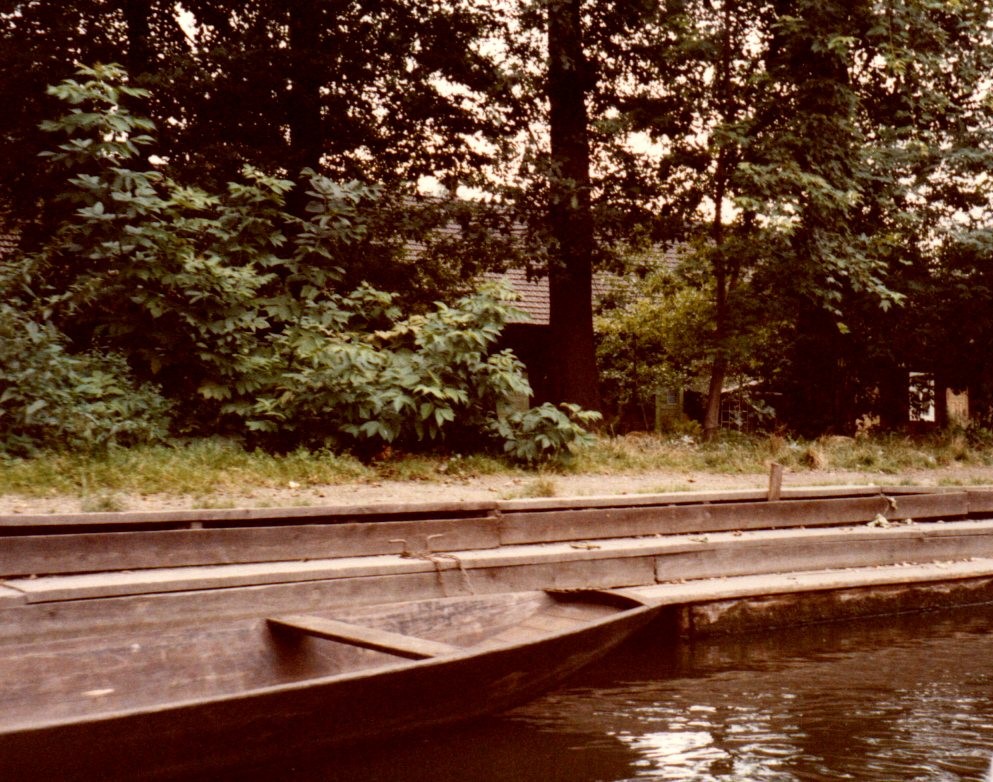
We had lunch at the Freiland Museum before returning by boat to Lubbenau and then proceeding to Dresden, where we were to spend the night. Once again we had been assigned one of the best hotels in the city, the then recently opened Bellvue Hotel on the north bank of the Elbe – which would have been completely beyond our budget had we stayed in similar hotels in the West.
That evening we explored by ourselves the Neustadt area of the city, choosing a fish restaurant in which to have dinner.
Wednesday 11th September 1985
After breakfast we were taken on a tour of the historic centre of Dresden. A few of the buildings had been restored after being destroyed in allied bombing raids in the second world war – the Opera House’s rebuilding had only just been completed at the time of our visit. However, many buildings including the Frauenkirche and the royal palace were still just bombed out ruins. Our guide, who normally seemed to want to avoid politically contentious topics, gave a heartfelt description of the bombing raids of February 1945 and the resulting fire-storm which cost tens of thousands of civilian lives. She described these events as a war crime committed by the British and Americans.
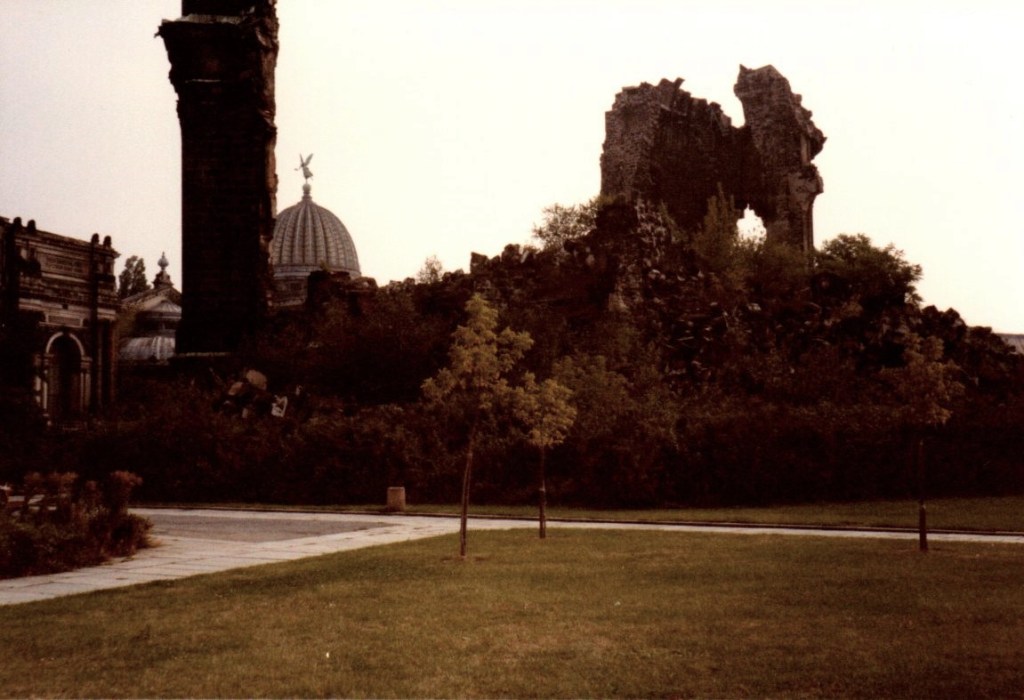

We then had a too short a visit to some of Dresden’s museums – the very interesting Mathematics and Physics Museum, the world class art in the Zwinger Gallery and the rather less interesting stuffed animals of the Natural History Museum. It would be another 32 years before I would get the chance to return and give the first two the attention they deserved.
We then travelled to the area know as Saxon Switzerland to the south of Dresden, containing amazing rock formations rising above the Elbe valley. We had lunch overlooking the jagged rocks of the Bastei, which were still slightly covered in mist.

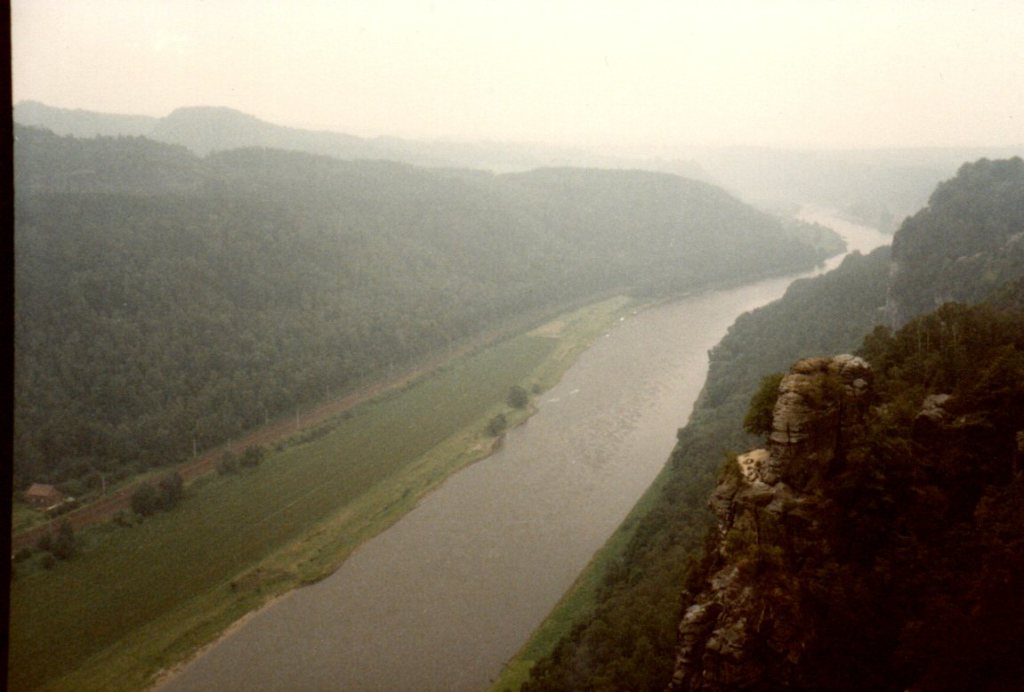
On our return to Dresden we went to see the jewel collection of Augustus the Strong, Elector of Saxony. This was originally housed in the Green Vault inside the royal palace, as it is again today, but since at the time of our visit the royal palace remained in ruins, the jewel collection was housed in its own gallery in the Albertinium museum. The jewels had been confiscated by the Red Army at the end of the Second World War, before being returned to Dresden in 1958.
In September 1985 I was in training to run my first Marathon the following month on my return to Britain, so I took the opportunity of some free time in Dresden to go for a run from my hotel along the banks of the Elbe. This included going through the Japanese Garden between the hotel and the river. The hotel also had a modern well equipped gym (or ‘fitness room’ as the hotel described it), where I also spent some time. The fitness room was staffed by a number of extremely attractive women who looked ‘fit’ in every sense of the word.
That evening we went in search of a different restaurant to the one we used for dinner the day before. I am sure that the idea of the East German Reisebüro who put together our tour was that we would stay in our allocated hotels to eat evening meals, thereby spending much more hard currency on the overpriced dinners they offered. After eating in an acceptable restaurant, we then found a bar nearby where we had further drinks.
When staying in the East German hotels, we worked on the assumption that our rooms would be bugged, so we tried to provide entertainment for those who might have been listening in. (In 1985, Vladimir Putin had just been posted to Dresden as a KGB agent working in close cooperation with the Stasi.) That evening as I was getting ready for bed, I loudly proclaimed, probably as a result of having had a beer or two too many, that I might be willing to trade some secrets in exchange for a liaison with one of the women from the fitness room. I think that my monologue had consequences, which became apparent the following evening, as will be revealed below.
Thursday 12th September 1985
Our first visit today was to the Meissen Porcelain Museum, where we were given a demonstration of porcelain making. (If you wish to know more about the history of Meissen Porcelain, I would recommend the episode on the subject from Neil MacGregor’s excellent series Germany: Memories of a Nation.)
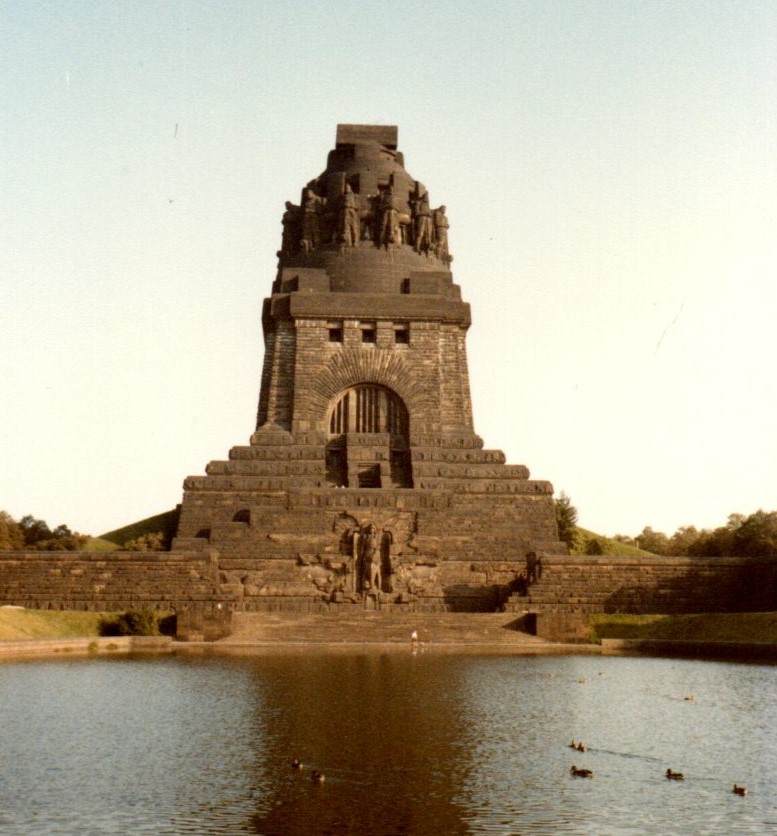
After lunch in nearby Coswig, we travelled to Leipzig. First stop was a visit to the monument to the Battle of the Nations located on the edge of the city, commemorating the defeat of Napoleon’s army in 1813 by the combined forces of Prussia, Austria, Russia and Sweden.
We then went to Leipzig city centre, where we were supposed to visit the Bach museum. However, due to unexplained reasons the museum was shut when we arrived and we had to content ourselves with peering through the windows. We moved on to visit St Thomas Church, where Johann Sebastian Bach had been Kapellmeister and where he was reburied in 1950. While looking round St Thomas Church we discovered that there was going to be a concert of Bach music in the church the following evening. As we would still be in Leipzig then, we made enquiries about how to acquire tickets for the concert.
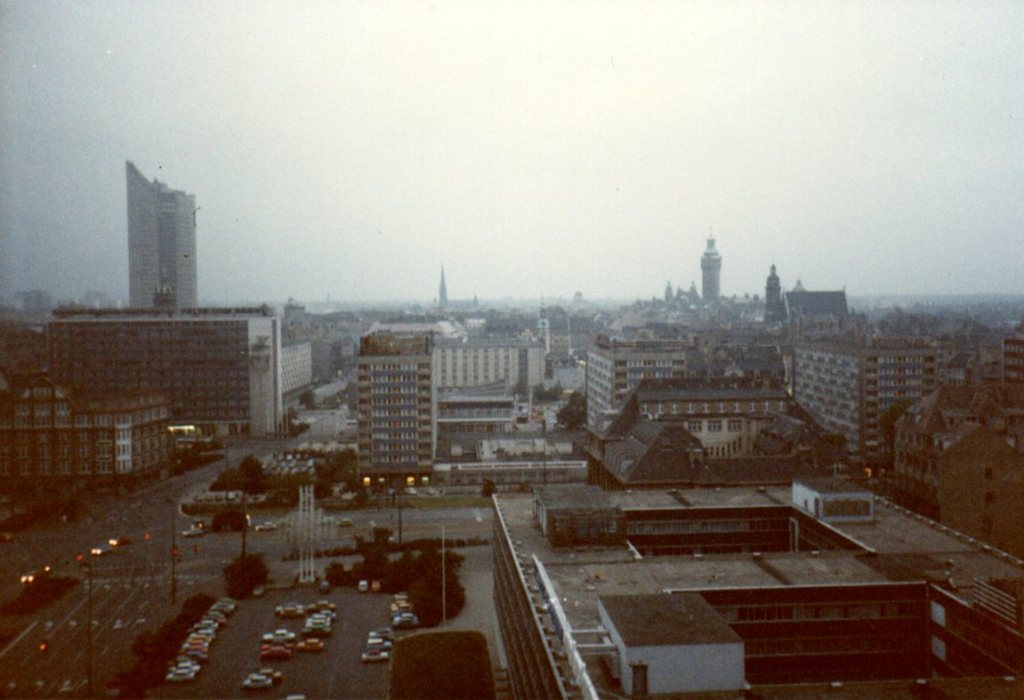
The hotel for our stay in Leipzig was a modern tower block close to the main railway station and overlooking what was then called Karl-Marx-Platz, scene of the Monday demonstrations in 1989, which played a major part in the downfall of the DDR government.
After eating dinner in a city centre restaurant, we found a bar nearby. Unfortunately, the bar charged well over the normal going rate for beer, so after one drink there, and failing to find anywhere else, we thought it couldn’t be any worse in the hotel bar, which normally we tried to avoid. It was worse – the hotel bar didn’t have any beer! I think we bought some overpriced wine and found ourselves a table. Shortly after we sat down we were joined at our table by two women, who unlike virtually all other East German women we had met, were wearing heavy layers of make up. After a short while the penny dropped and I realised these were a pair of prostitutes who were suggesting we might like to invite them to our room. When we made it clear that we were not interested they left and we last saw them talking to an American single man who was also part our our group. Given my comments made to the likely bugging equipment the previous evening, this seemed too much of a coincidence! So when we returned to our bedroom later, I felt obliged to make another statement to whoever might have been listening. I told them that when I had said that I would be prepared to trade some secrets for a session with one of the young women from the fitness room, I meant from the fitness room, not any slapper!
Friday 13th September 1985
According to my travelling companion’s notebook we went to Naumburg this morning and visited the cathedral. To be honest, I have no recollection of Naumburg and I did not appear to take any photographs while I was there, so there is little I can say other than from researching this post that it looks like it has a well preserved old city centre and the main part of the cathedral is of Romanesque design.
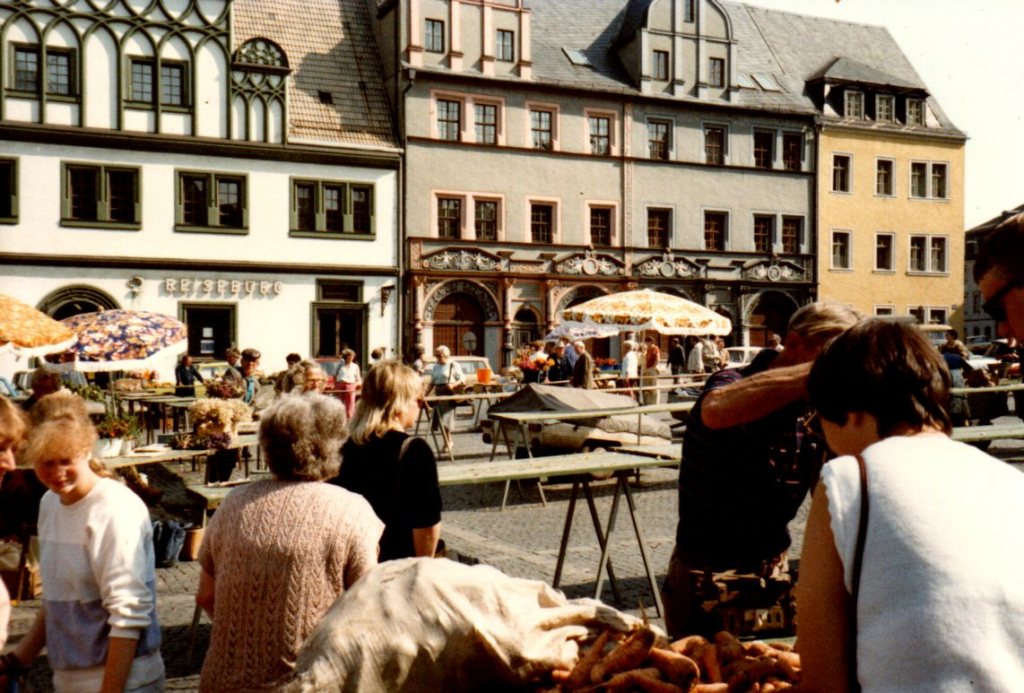
We then moved on to Weimar, which I do remember. After exploring the old city centre and having lunch, we visited the Goethe Museum located in the house in which he once lived. I remember being slightly disappointed that while in Weimar I could not find any references to the Weimar Republic and the role that the city had played during the rise of Nazism.
We returned to Leipzig later in the afternoon. I had managed to secure tickets for the Bach Concert in St Thomas Church, which I had seen advertised the day before. In the evening we went to the concert, which made full use of the church’s impressive organ.
When the concert had finished, we set off in search of somewhere for dinner. We chose a restaurant called the Stadt Kiev and it seemed appropriate to order Chicken Kiev to eat. Shortly after we placed our order, we saw the two waiters who had been serving walk out of the restaurant. After about half an hour with no sign of any food appearing, we tried to make enquiries about its whereabouts, but nobody seemed to show any concern. After about an hour the two waiters returned to the restaurant and about ten minutes later the Chicken Kiev was served without any apologies for the delay. After we had finished eating it was quite late and, given the problems of the night before, we returned to our hotel without trying to find a bar for a drink.
Saturday 14th September 1985
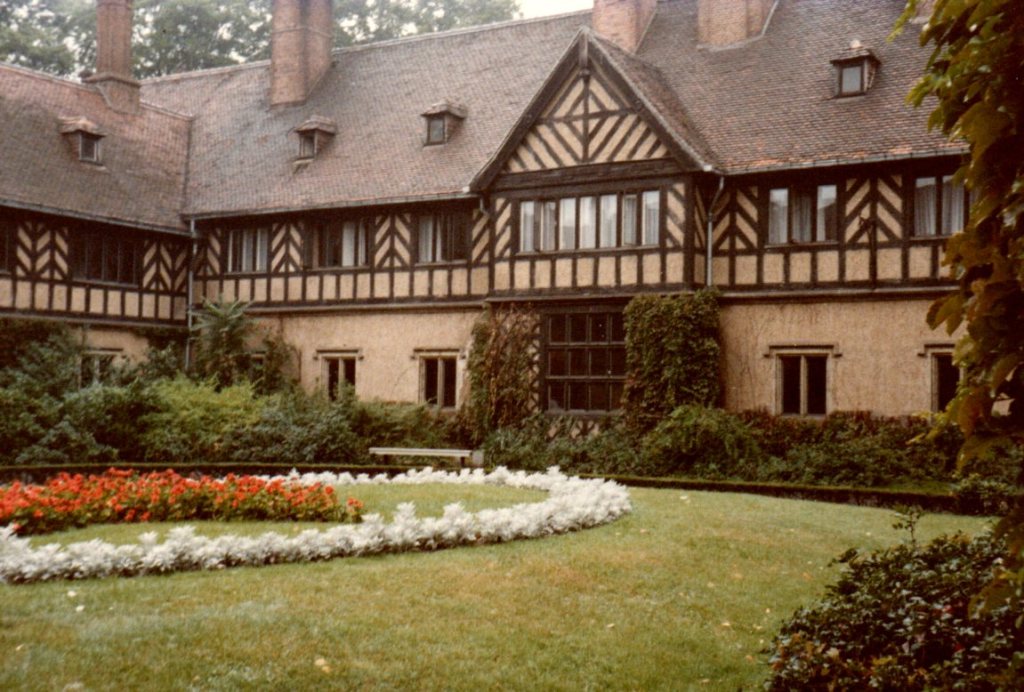
We left Leipzig in the morning and travelled to Potsdam to the west of Berlin. Our first stop in Potsdam was was the Cecilienhof Palace close to the shore of the Jungfernsee lake. To call it a palace is a bit of a misnomer in my opinion – it was completed in the early twentieth century in the style of an English Tudor manor house. It is most famous for being the location of the Potsdam conference in 1945 when the Russians, Americans and British negotiated the division of Germany and the rest of Europe. I found the Cecilienhof fascinating – the main hall still had the large round conference table on which were laid out maps showing possible divisions of Europe, with photographs on the walls of Stalin, Churchill and Truman and others sitting round the table. Our small group had the place to ourselves while we were there and were able to wander freely around the room examining in detail the documents and maps on the table. (On my subsequent two visits to the Cecilienfof most of the area had been roped off and on my most recent visit the maps had gone.)
After lunch we moved on to the nearby Sanssouci Palace. It was built as Frederick the Great’s summer palace in the mid 18th Century. We first explored the extensive gardens finding the graves of Frederick the Great’s dogs, with whom he himself had wished to be buried rather than with his wife. At the time of our visit this wish had not been fulfilled, and it was not until 1991 that he was eventually interred next his dogs. We then had a tour of the inside of the Sanssouci. I recall it having a rather faded splendour and obviously being in need of some restoration – many of the original artefacts and art works were not returned to the palace until the mid-1990s.
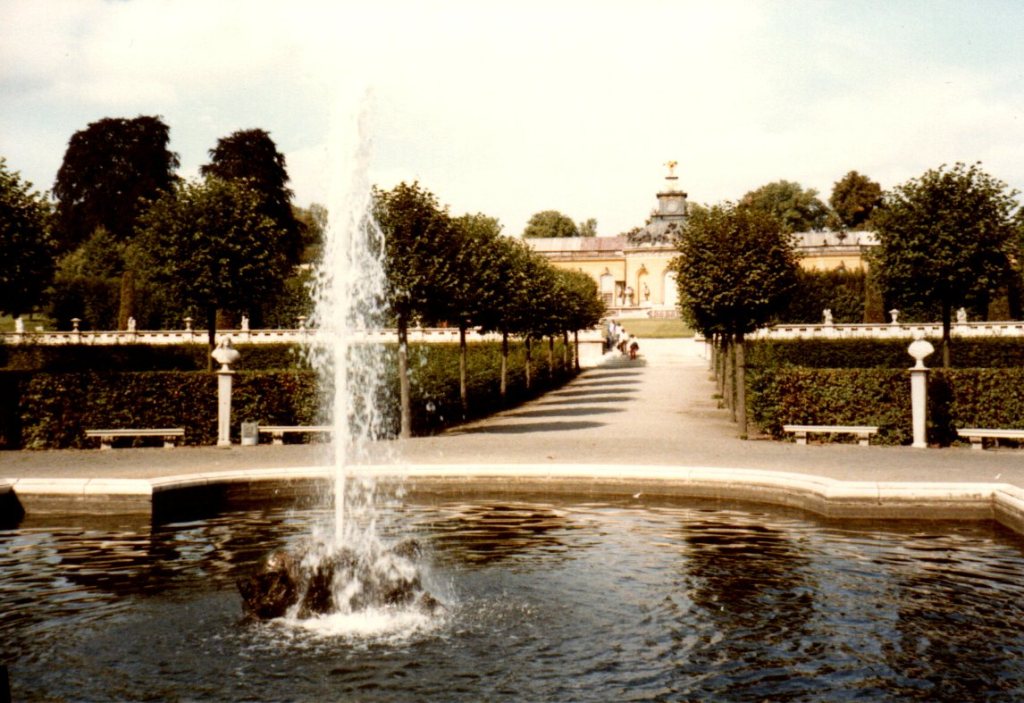
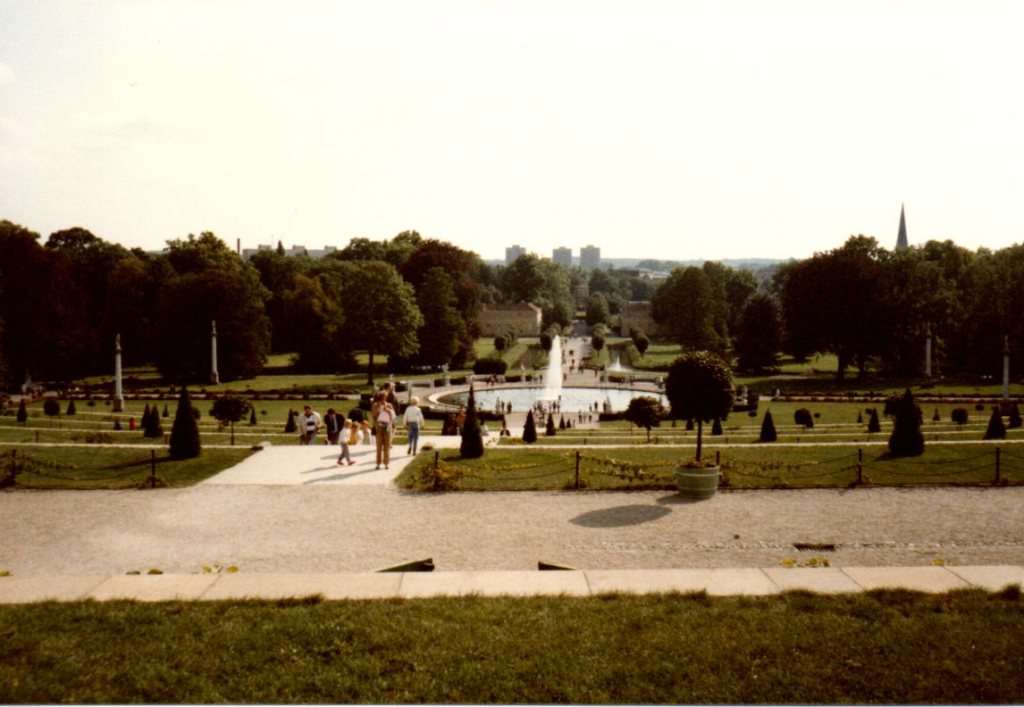
We then returned to East Berlin. These days this would be a simple through-trip on the S-Bahn (or by mainline train), but in 1985 West Berlin was in the way, so to get to Friedrichstraße we had go on a lengthy detour via the Berliner Ring, the autobahn which surrounded the city.
Our hotel for our final night in East Germany was the Hotel Metropol on Friedrichstraße. Like the Palast Hotel where we had stayed on our first night, this was another showcase location, but a notch below the standard of the Palast. I understand that the Palast was considered the top hotel in East Berlin used for the most important visitors, while the Metropol was the main hotel that was used to accommodate business people who were in East Berlin for trade reasons.
It was easier to find places to eat and drink around Friedrichstraße than it had been in Leipzig. So after dinner in a restaurant, we moved on to a bar to celebrate our final evening in East Germany. When we eventually arrived back in our hotel room and turned on the television we were somewhat nonplussed to discover it was broadcasting the Last Night of the Proms live from London’s Albert Hall. Firstly, it was a surprise that the hotel was allowing us to view a West Berlin TV station, as the authorities often tried to block such channels. Secondly, it was a surprise that any German TV station would want to broadcast live a festival of British jingoism. Watching the Last Night of the Proms live in East Berlin, with a screen full of waving Union Jacks and Land of Hope and Glory being sung, seemed really incongruous.
Many years after this trip, when I was visiting the former Statsi Headquarters which is now a museum, I learned that any organised tour group like the one we had been with for the past week would have had a Stasi operative embedded in the group posing as fellow tourist. Their job would have been to make reports on their travelling companions, with any information that might have been of use to the state. I wonder if this could have been the case for our small group and, if so, who was the Stasi plant? Most of our companions that week seemed unlikely suspects. However, there was a single youngish American, who being by himself tended to chat with others more. After we had rebuffed the advances of the prostitutes in Leipzig (who surely must have been operating under state sanction), they were last seen talking to the American. Were they reporting back to him on their failed mission or simply looking for another client? It is also almost certain that a Stasi file would have been opened on me, as this was routine for all foreigners entering the country. I have been meaning for some time to apply to the BStU to establish whether the file exists and what it contains. This will be a priority for me once lockdowns are over and it will be possible to travel again to view the records.
Looking back on my time in East Germany, it seems like a different world. While the oppressive surveillance by the state was all too obvious, I nevertheless did detect pride in the country and its achievements by some of those who lived there. I would not have believed that the regime was faltering and that within six years of my visit Germany would be a united country again. Nor would I have ever dreamed that 35 years later it would be illegal for UK citizens to leave their own country on holiday, as it had been for many East Germans in 1985.
[In next month’s blog post I will continue the story of this trip as we move on to visit Czechoslovakia.]
 Europe Explored
2 Replies to “1985 Communist Adventures – Part One – East Germany”