
“A bad plan is better than no plan at all” (attributed to many authors)
Being the start of a new year, I originally thought that my January blog post would be a good opportunity to look forward at what plans I have for exploring Europe. However, when I sit down to write this, I am gloomier about future prospects for travel than I have been at any time since the Europe Explored project was conceived. With the UK and much of the rest of Europe now in a far worse position for Covid infections than before, together with a supposedly more infectious strain having become prevalent in Britain, I see little prospect for international travel throughout 2021, particularly as national governments seem to be imposing ever more draconian curbs on movement. Even making the very big assumption that the vaccine roll-out proceeds without any major glitches (and glitches are already becoming apparent), I still think that most countries will be reluctant to remove restrictions until 2022 at the earliest. The lesson of the consequences of premature easing should have been learnt by now – and if it is not, then there remains the risk of another surge in cases.
My basis for planning my Europe Explored adventures has been the book Europe by Rail by Nicky Gardner and Susanne Kries. The book describes 52 rail routes which traverse the length and breadth of the continent. I made the schematic diagram below showing how the routes fit together (to enlarge right click on it and select view image). Each of the routes in the book is shown in a different colour and no two routes of the same colour intersect. Only the terminal and intersection points of routes are shown in this schematic diagram.
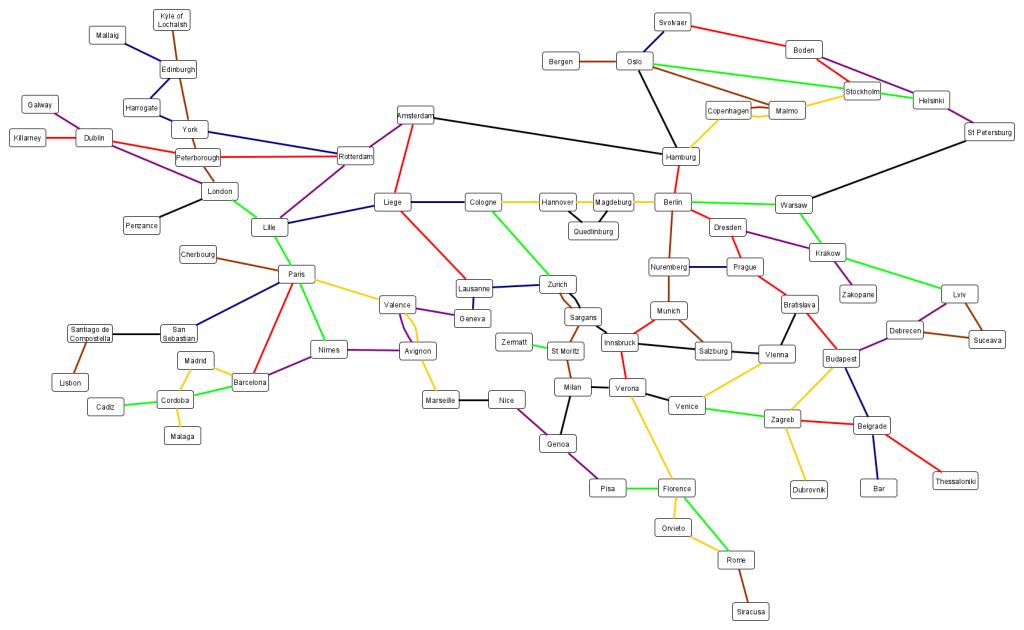
Using these routes as a guide, I pieced together 18 journeys of my own for Europe Explored, each one designed to last between one and two weeks in duration. These do not mirror the book’s routes exactly – for example, Europe Explored Trip 1, which I was intending to do in March 2020, was designed to visit places that I had not been to before. Given I will be starting and finishing each trip in London, and trying not to fly if possible, this also imposes constraints on route planning. Also, I am probably not allowing enough time to explore each location properly, but am working on the basis that some places I will be visiting more than once on my travels and others I will have explored reasonably thoroughly on trips in the recent past. Assuming that I can probably fit in about five such trips a year, the whole project will take about four years or so to complete. Assuming that it will not now be possible to start until 2022, this means I am unlikely to conclude until 2026.
Under normal circumstances, I would by now be undertaking detailed planning, by checking timetables and prices, selecting places I want to visit and places to stay. However, it seems pointless to do this at the moment, as until we know what a post-Covid Europe will look like, there are too many uncertainties to make any meaningful plans. For example, it has been announced recently that the Stockholm to Riga ferry, which has been suspended during the pandemic, will now permanently close and will not run again. As this link was going to be a crucial leg of my plans to explore the Baltic states, a rethink will now be required.
In the past, I’ve always liked to book well in advance, taking advantage of the substantial discounts available from advance fares. When travels do resume, I suspect that I will need to be more flexible and make arrangements at the last minute to take opportunities when they arise – for example, using the flexibility of an Interrail pass rather than making advance bookings many months ahead.
[In next month’s blog post I will attempt to dredge the recesses of my memory to talk about another trip from the past.]
 Europe Explored
One Reply to “”