
“Reassuringly expensive” (Advertising slogan used in the UK, 1982 – 2007, by Stella Artois (brewed in Leuven).)
[This months post looks back on another city visit made last year. Little did I know that this trip would be the last foreign excursion that I would be able to make for over a year.]
I had bought a return ticket to ‘any Belgian station’ in one of the periodic seat sales that Eurostar have from time to time. (An ‘any Belgian station’ ticket can be obtained for a small supplement to the price of a ticket to Brussels and allows you to travel to, or from, anywhere in Belgium within 24 hours of your arrival in, or departure from, Brussels.) I decided to visit Leuven, an ancient university city not far from Brussels, in the Flemish speaking part of the country. (Leuven is pronounced ‘Lurv-en’, not ‘Loo-ven’ or ‘Loy-ven’).
The trains I had booked meant that I would have a full day and a half to explore Leuven, and when I came to research how to spend my time there, I concluded that I could also afford to spend two or three hours elsewhere.
Wednesday 13th November 2019
My train to Brussels left St Pancras International at 0855 in the morning and after a smooth and punctual journey it arrived at Brussels Midi two and a quarter hours later, at 1210 local time. Although I had spent five days based in Brussels on a family holiday in 2015, there were a couple of places that I had not visited then, which I decided to go and have a look at before I went to Leuven. When I alighted from the train onto the platform at Brussels Midi I did not follow the crowds heading for the main exit at the front of the train, but instead walked a few yards back to use the short-cut to the connecting corridor. Once in the corridor I scanned the departure boards to find out from which platform the next train to Brussels Centrale was leaving. As virtually all trains passing through Brussels stop at Centrale, they depart every few minutes from Midi. (Another tip – if you have a Eurostar ticket to Brussels, it is valid to over 30 stations in the Brussels area, so you don’t need to buy another ticket, but remember that your Eurostar ticket can’t be used on the Metro.) I found a train that was just about to depart and jumped on board, making my way upstairs (as it was a double-decker train) for the five minute ride to Centrale.
Alighting at Centrale, I then had a short walk to my destination, the Musée BELvue, whose doors I walked through just 13 minutes after my Eurostar had arrived in Brussels. The Musée BELvue is located in a wing of the royal palace and tells the story of Belgium as a country from its creation in 1830 up to the present day. The history of the country and the present constitutional arrangements, carefully balancing the rights of the different language groups, are described in seven rooms over two floors. An audio-guide is provided to supplement the display panels in the rooms. As well as the rooms, the corridors linking them also have cases stuffed full of artefacts. The museum is very comprehensive – as well as the audio guide, you are given a booklet on entry which describes nearly 300 objects in the rooms alone. The audio-guide had 26 stops in the rooms and another 13 stops to describe what you can see in the corridors. In the interest of time, I had to forsake listening to all of the corridor audio-guide descriptions.
On leaving the BELvue, I then entered the adjacent Coudenberg Palace, the subterranean remains of the former royal palace, destroyed by fire in 1731. As well as part of the remains of the main building, you can also see the Chapel and the Aula Magna, together with part of a street which used to run outside. After the feast of information provided in the BELvue, I was expecting the description of the archaeological remains of the former palace to be less detailed, but I was wrong – the audio-guide accompanying the Coudenberg visit had 64 stops, including those in a small museum you go through after finishing the underground sections.
I eventually had to drag myself away from the Coudenberg as I wanted to spend some time in Leuven that afternoon. I walked the short distance back to Brussels Centrale station, where I caught the next train to Leuven.
The train took about half an hour to reach Leuven. Because there was building work going on in the square immediately outside the station, you were directed to a side exit to leave. This disadvantage of this exit was that there was not a pedestrian controlled crossing to assist crossing the busy road outside the station, and so you had to take your life into your hands trying to get to the other side. After waiting for a long time for a gap in the traffic, I started to cross, not noticing that a silent phalanx of bicycles had suddenly started coming from the other direction which nearly mowed me down.
Before leaving home, I had printed off a set of four self-guided walks from the Leuven tourist office website. However, better quality copies could be purchased for a small fee at the tourist office – so I made this my first stop. The tourist office is located near the town hall in the centre of the city, about a fifteen minute walk from the station.
After obtaining the walk leaflets, I set off to do the first one. This started in the Grote Markt, bounded on one side by the Town Hall (Stadhuis) and on the other by St Peter’s Church (Sint-Peterskerk). As I stood in the main square workmen arrived with barriers to close it to traffic, to enable a market and fair to be set up for the next day.

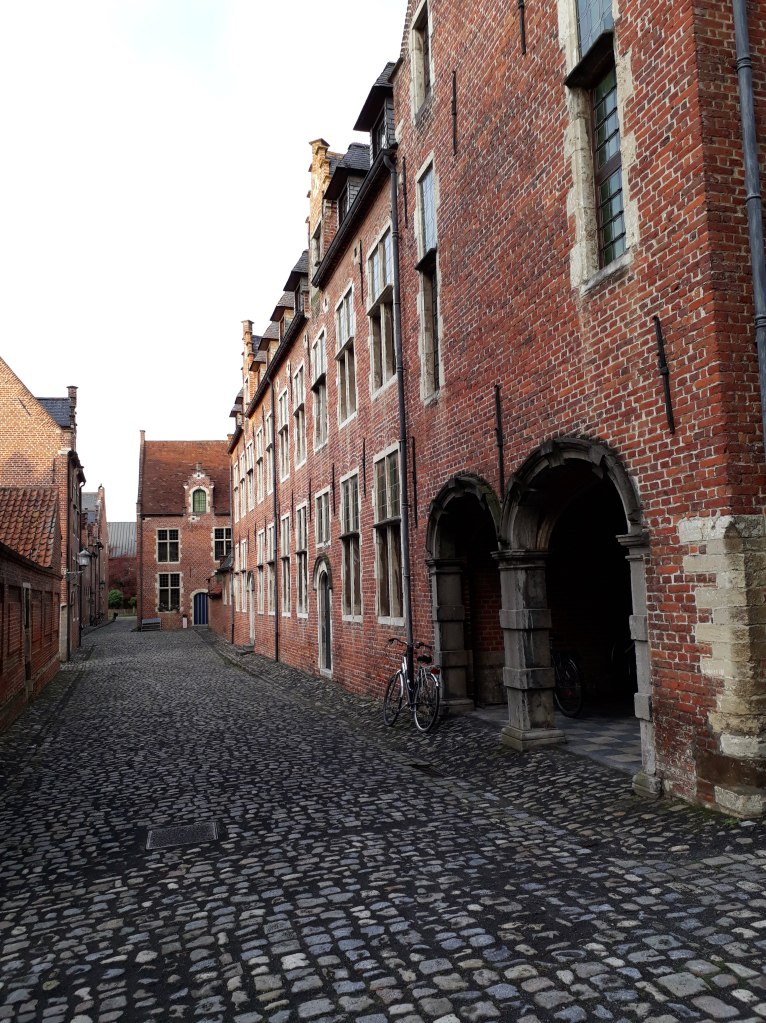
The walk went past the medieval hall of the university and into the Oude Markt. This long rectangular space is completely lined with with bars and restaurants – I imagine that in the evening or in the summer it is a very lively place, but on a grey November Wednesday afternoon it was fairly quiet. From there I made may way to the Great Beguinage (Groot Beginhof), which used to house a community of devout women (but who were not enrolled into any religious order). Leuven’s Great Beguinage is one of the largest remaining examples, which with twelve others in Flanders form a UNESCO World Heritage Site. Today the whole beguinage is owned by the university and is used as accommodation for academics. It still retains an aura of calm within the bustling city.
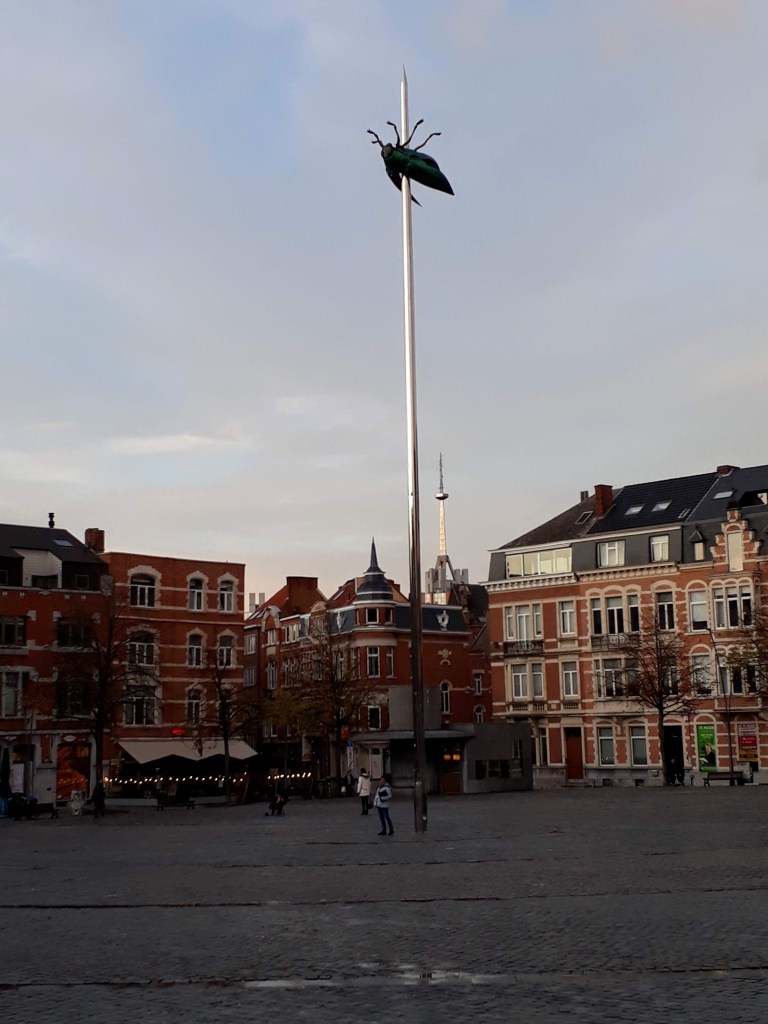
After passing through more parts of the University, I reached the square in which the University Library is situated, which I would be visiting the following day. The square in front of the library is noticeable for its artwork, entitled Totem, of an insect skewered on a large spike, commissioned to celebrate the 575th anniversary of the founding of the library.
There has been a university in Leuven since 1425, although not a single continuous institution over the years. Universities have opened, closed and split for political, religious and language reasons. The main institution currently in the city is KU Leuven, which is one of the top rated academic institutions in Europe. KU stands for Katholieke Universiteit, but as it is now independent of the church, only the abbreviated form of the name is used. The most recent change occurred in 1970 when the French language part of the university split off to form UCLouvain and was relocated to Louvain-la-Neuve in Wallonia.
On returning to the Grote Markt, I started out on a second walk which visited further university sites including the university hospital and the botanic garden. I continued on this walk until it was dark, after which it became difficult to spot some of the things that I was supposed to be looking out for. I then walked to the hotel I had booked for the night, which was opposite the railway station, about a fifteen minute walk from the city centre. I checked in and freshened myself up before heading out for dinner.
On this trip I had taken the precaution of booking a table for dinner before I had left home. I had chosen the restaurant attached to the Domus brewery. When I arrived just before 7pm, it became apparent that my decision to book a table had been wise, as the place was packed and there was a queue of people waiting for tables. The restaurant had an interesting take on what is meant by a table reservation – it didn’t actually save a space for you, but when you arrived with a reservation you were allowed to jump to the head of the queue of those waiting. I did not have to wait too long for a table. After perusing the printed menu, I ordered from the specials which were written (in Flemish) on a blackboard. I had celeriac soup to start with, followed by venison stew. To drink I started with the Con Domus, which is a hoppy unfiltered lager, followed by the Nostra Domus a stronger darker full bodied beer. For dessert, I ordered pear tart (also from the blackboard specials). I knew that they also served at least one seasonal beer on draught – I was expecting this to be a wheat beer, but when I enquired I was told they were now serving the Engel (angel) beer, which Is a strong 8% Christmas brew. It was probably a mistake to stick with having a half litre glass for the Engel, but I savoured it slowly and it was after 10pm by the time I left and wobbled back to my hotel.
Thursday 14th November 2019
Before I had left home I had booked on-line a combination ticket for the three places that I wished to visit today. One was for a timed tour at 3pm, whereas the other two opened at 10am and 11am respectively. That meant I had a little time to do some further exploring before the first place opened.
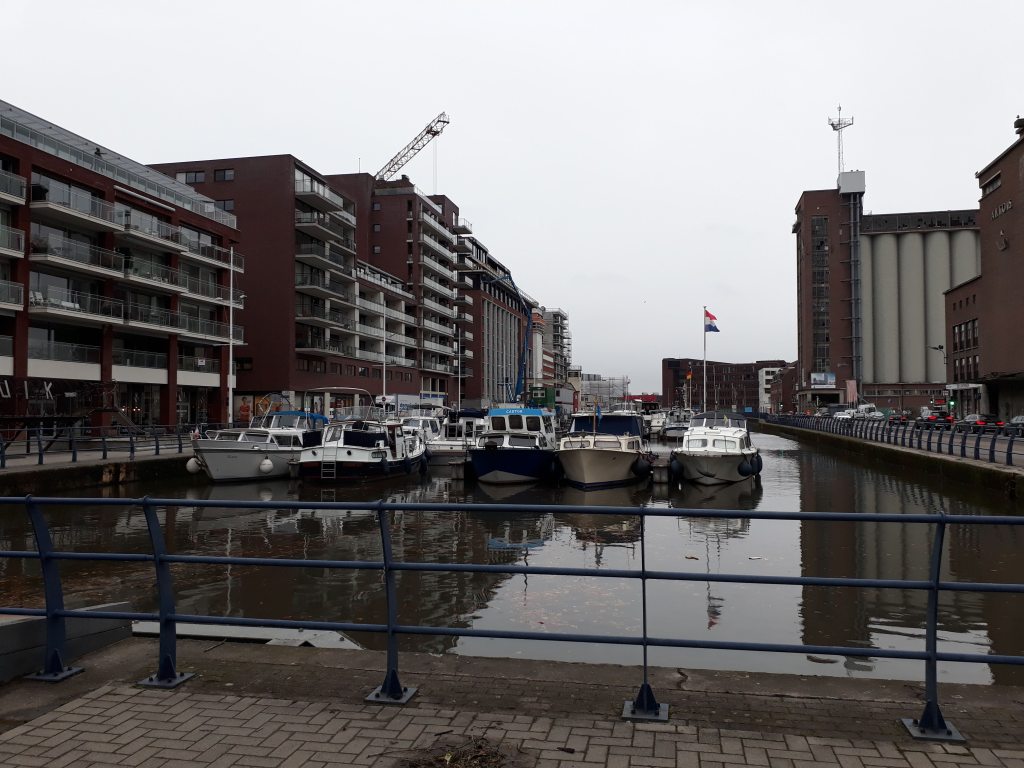
After breakfast in my hotel, I walked for about 15 minutes to the north of the city to the Vaartkom area. This used to be the heart of Leuven’s industry, with mills, breweries and other factories surrounding the wharves where small ships and barges would moor. With the decline of industry, although the Stella Artois brewery is still nearby, the Vaartkom has undergone major redevelopment in the 21st century, with new apartments and other buildings being constructed.
From the Vaartkom, I made my way back to the city centre by way of the Small Beguinage (Klein Beginhof). After many years of decline, the religious community that was here finally left in the year 2000 and the remaining houses were sold to private individuals.
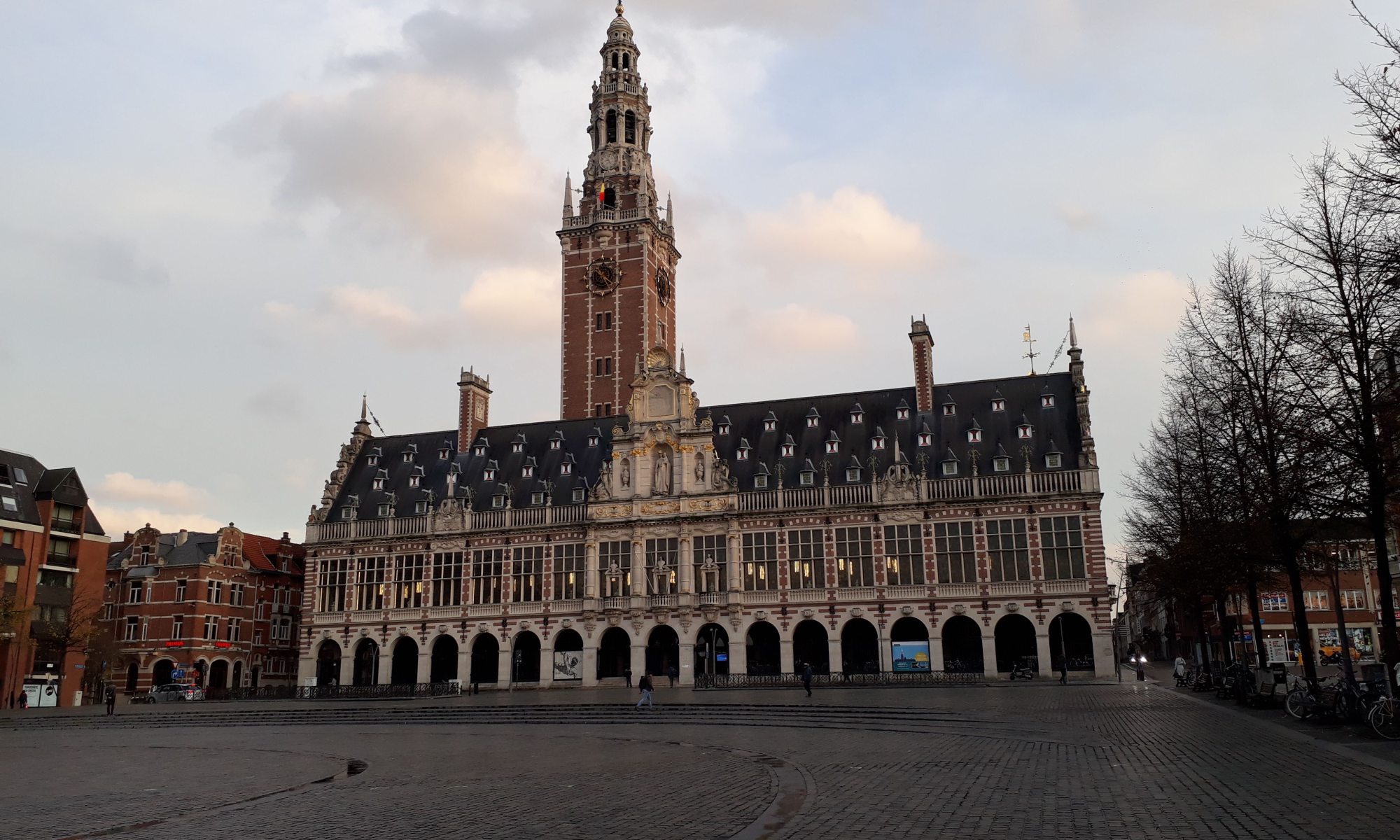
I arrived at the University Library at its opening time of 10am. The library had been built on its current site after the total destruction of the previous library in the first world war. After an international outcry over the wanton destruction of so much material, libraries from around the world help restock its collections and the new building was largely paid for by American fund-raising efforts. Unfortunately, a similar fate befell the library in the second world war and it was rebuilt on its existing site. When UCLouvain split off from KU Leuven in 1970 the library collection had to be split between the two – this was not done according to language, but in an arbitrary manner based on catalogue number.
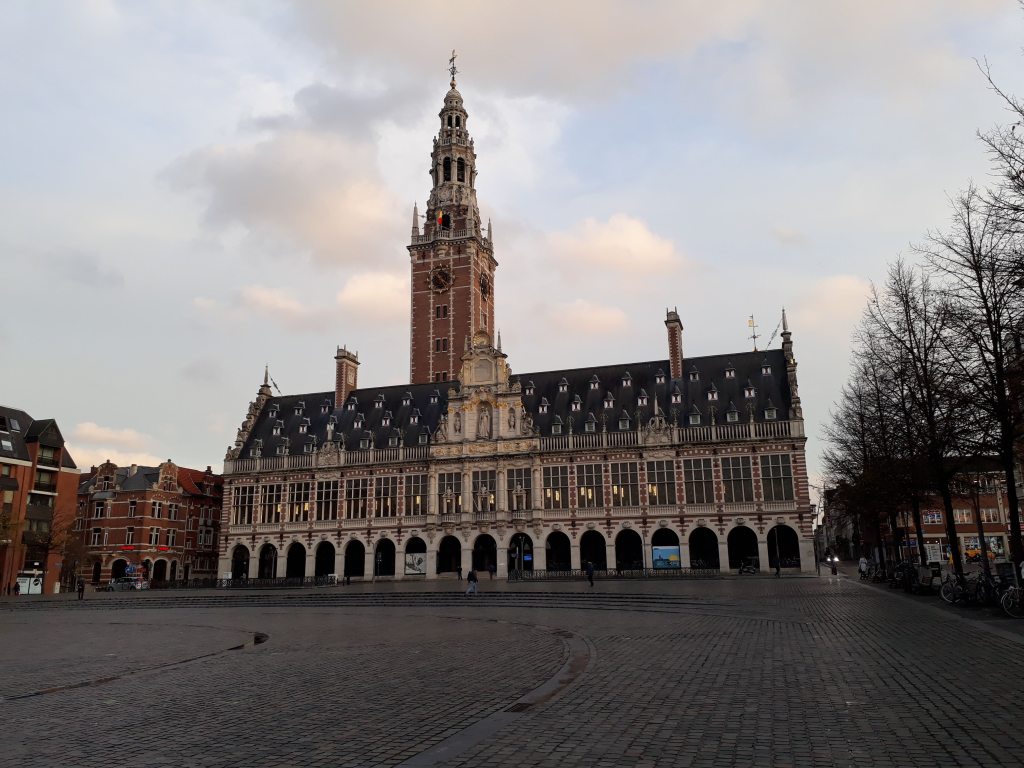
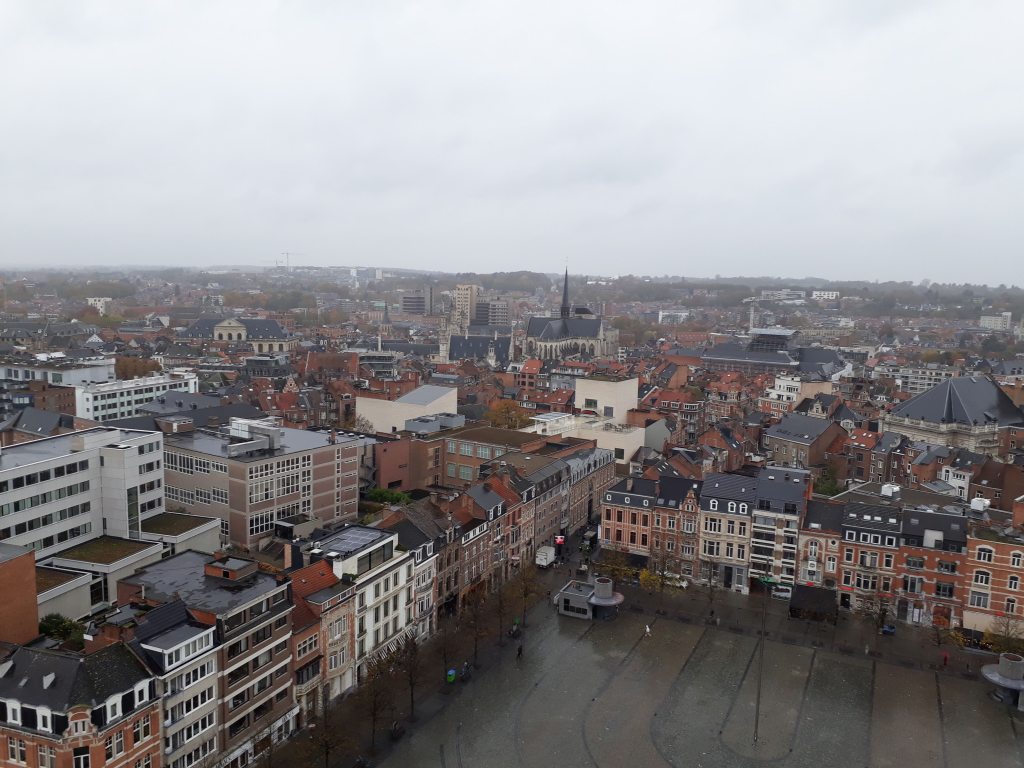
I went inside and obtained an audio-guide to accompany me on my visit. After visiting the main reading room, which was full of students working, I climbed the tall bell tower. On each landing on the way there were information panels telling more about the history of the library. At the top there were views across a drizzly Leuven.
After I had finished in the Library, I moved on to visit M Leuven, the city’s main art gallery. One of the highlights of the permanent exhibition was the Seven Sacraments by Rogier van der Weyden, which seems to be on long term loan from the Royal Museum in Antwerp. There were a couple of temporary exhibitions which I found interesting. One was curated by students on the theme of Madness, covering examples from all periods and types of art. The major temporary exhibition at the time of my visit was of the woodcarvings of Borman and sons – the work of four generations of Bormans was on display stretching over a hundred years from the late fifteenth century. There was a vast collection of their sculptures of the Virgin Mary – it was interesting to see how the techniques developed and how they became more intricate over time.
On leaving M Leuven I pieced together some of the bits of the leafleted walks that I had not yet done. This included going inside St Peter’s Church, but as it was having major restoration works, not very much of it was accessible. I had booked a guided tour of the Town Hall for 3pm. The interior of Town Hall could only be visited by a pre-booked guided tour, and at the time these were run once per day – they were bilingual, on alternate days being in either Flemish and French or Flemish and English. I had carefully chosen my day, so that I had an English tour. We met the tour guide in the courtyard of the tourist office. The first part of the tour involved looking at the external features of the building, including the 236 statues of historic and religious figures and local dignitaries. On going inside, the main council chamber was on the first floor. I had some familiarity with this space, as it had been used in recent years for a tournament in the Chess Grand Tour series, which I had watched coverage of on-line. As is often the case, an indoor space that you have only seen on screen seems much smaller when you actually visit it. After the main council chamber, we were also shown the small hall and the mayor’s office. When the tour finished at 4.15pm we were ushered out of the front door into the Grote Markt, where the market and fair that they had been setting up all day was now in full swing. I browsed at the stalls and considered buying some of the local food and drink they were selling, but in the end decided not too, as it all seemed a little pricey. I fought my way through the crowds to make my way to the station.
At Leuven station I caught a fairly full inter-city train, whose eventual destination was Ostend, back to Brussels, arriving at Midi at about 5:20pm. As in Leuven the previous evening, I had taken the precaution of booking a table for somewhere to eat in Brussels. Previous experience had told me that the restaurants in the immediate vicinity of Brussels Midi are not that inspiring, but I thought it a little far to go to the city centre. I had booked a table for 6pm at a Bistro near the Porte de Hal, about a ten minute walk from the station. When I arrived, the restaurant was already doing a reasonable trade, but was not too full. I ordered cheese croquettes for starter followed by beef carbonnade. To accompany my food I had a draught brune beer. I contemplated dessert, but instead decided to finish my meal with a glass of Morte Subite Kriek.

After dinner, I made my way back to Brussels Midi station, just having time to call into a supermarket to buy a selection of Belgian beers to bring home with me. I checked in at the Eurostar terminal for the 8:20pm departure to London. The day was the 25th anniversary of the first Eurostar passenger service and I had seen on the news that on some of the morning trains passengers had been given little cakes to celebrate. No cakes were forthcoming on my service, but the train was on time and it arrived back at St Pancras International at 9:30pm.
Little did I know that this would be my last foreign trip for a very long time. My plans for the first Europe Explored trip to Slovenia and back in March 2020 were at an advanced stage. I made some of the initial bookings shortly after I returned from Leuven, to make sure that I did not miss out on the cheapest train fares. At least I can be thankful for the very enjoyable two days I had on this trip.
 Europe Explored