
“Bologna is celebrated for producing popes, painters and sausage” (Lord Byron)
[Had things been normal this year, I would have expected by now to have planned and booked a number of Europe Explored trips for the autumn and I would probably have written a blog post providing a preview of my plans. Instead, this month I recall my first overseas city visit of last year.]
My first overnight City Visit in 2019 was to the Italian city of Bologna. I was very pleased to have secured flight tickets which cost £12.99 each way. Given the departure tax on flights from the UK to Europe is £13 per passenger, I struggle to understand the economic model operated by budget airlines – surely the marginal benefit to the airline of conveying me must have been negative, or am I missing something?
Wednesday 27th March 2019
I had had an unavoidable commitment the evening before, causing a late night, so the early morning alarm was even more of a shock than usual. The routine for these early starts was now familiar and I was standing at my local bus stop in the dark by 5am. Two buses and one train later I am at Stansted Airport by 6:20am, with plenty of time to spare for my flight. Intriguingly, although the plane to take us to Bologna was waiting at the gate, we could not board it until the incoming flight from Bologna had arrived and the crew transferred from one plane to the other. The cargo being unloaded from the incoming plane seemed largely to consist of airplane wheels. The flight to Bologna gave splendid views as it crossed the Alps and started to descend over the Italian lakes.
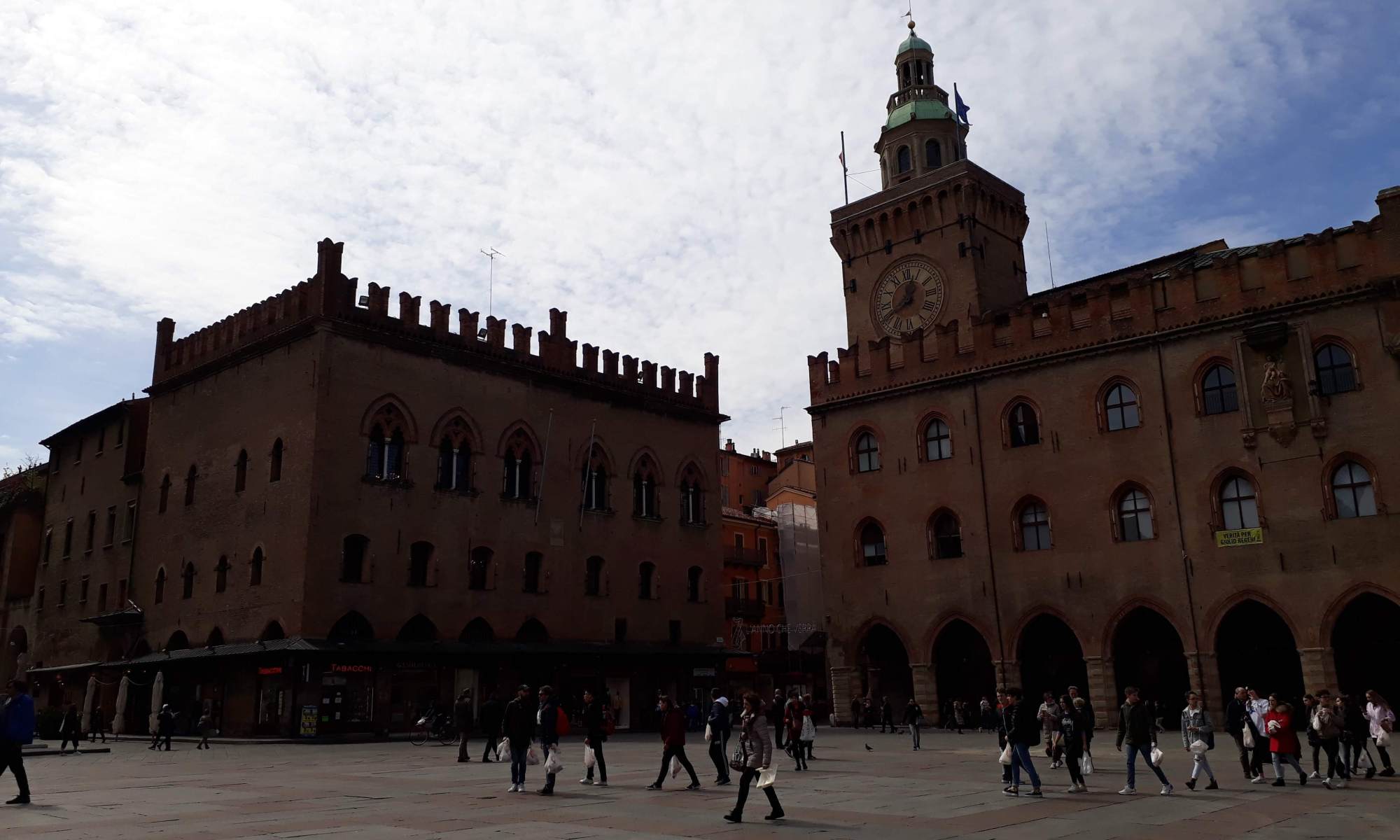
Flying time was a little longer than for the flights I had taken on my other recent European visits, so I did not arrive until about 1130 (local time). Bologna Airport is only about 3.5 miles from the city centre. The monorail from Bologna Airport to the main railway station was nearly complete, but was not yet operational. (It was due to open in March 2020, but the Covid pandemic seems to have scuppered that.) So I caught the airport bus and walked from the drop off point to the Piazza Maggiore, utilising the colonnades for which Bologna is famous.
I visited the Tourist Office in the main square to purchase a Bologna Welcome card, giving free admission to many of the museums, and also to book a timed ticket for later that afternoon to ascend the Asinelli Tower. I then had a quick look inside the Basilica di San Petronio, which occupies one side of the square. After that I bought some lunch from a small supermarket which I ate while sitting in the square.
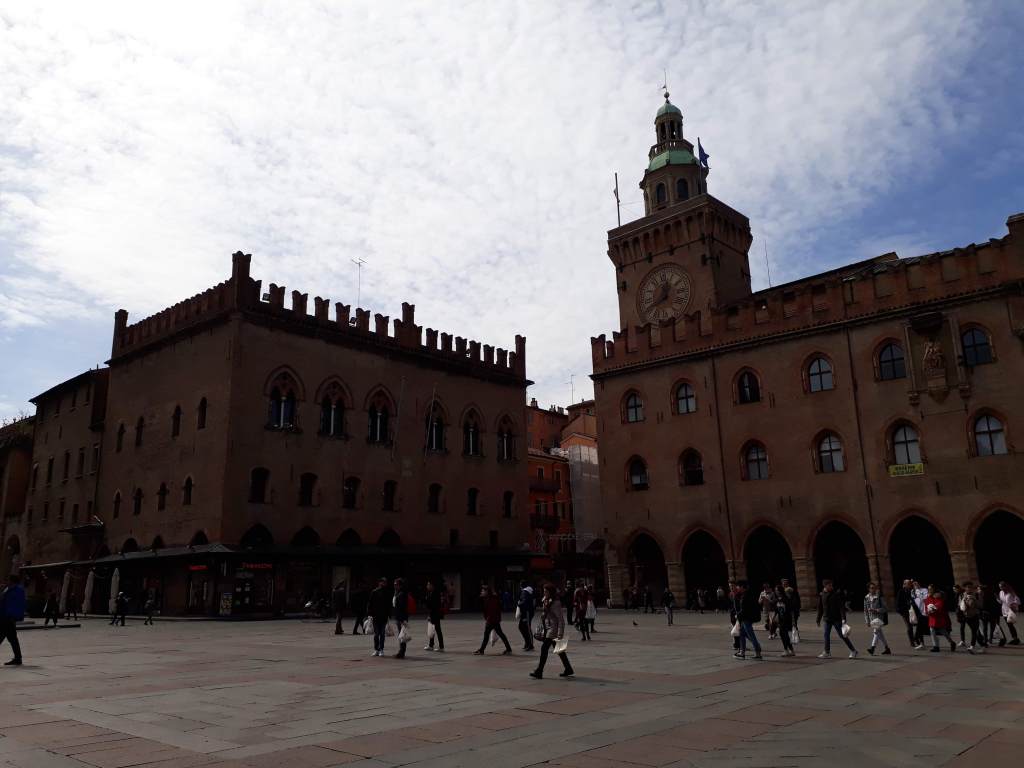
While eating my lunch, I noticed that some of the people in the square were wearing laurel wreaths on their heads. Most of these were smartly dressed, but a few were in fancy dress, such as a Spiderman costume. Many were accompanied by what appeared to be their families and the women were often also carrying a bouquet of flowers. I deduced that it must be graduation time at the university – the University of Bologna is the oldest university in the world. The graduation celebrations would become more apparent as I ventured closer to the university area later in the day, but the Piazza Maggiore seemed to be an attractive location for family photos of the new graduates.
Before my arrival in Bologna, I had downloaded a number of podcast walking tours of the city. After lunch, I set off to follow one of them, visiting many of the numerous churches of the city. On my perambulations I was pleased to see that Bologna still has an extensive trolleybus network – I had been brought up as a child in a town that had trolleybuses, but the UK no longer has any operational networks.
Upon returning to the Piazza Maggiore, I went inside the city hall which lies on one side of the main square, with the intention of visiting the city art collection. Unfortunately, at the time of my visit the art galleries were temporarily closed. Instead, I took a short walk, past the splendid Neptune Fountain, to the Civic Medieval Museum, where I spent about an hour looking at its collection of medieval monuments and other objects.
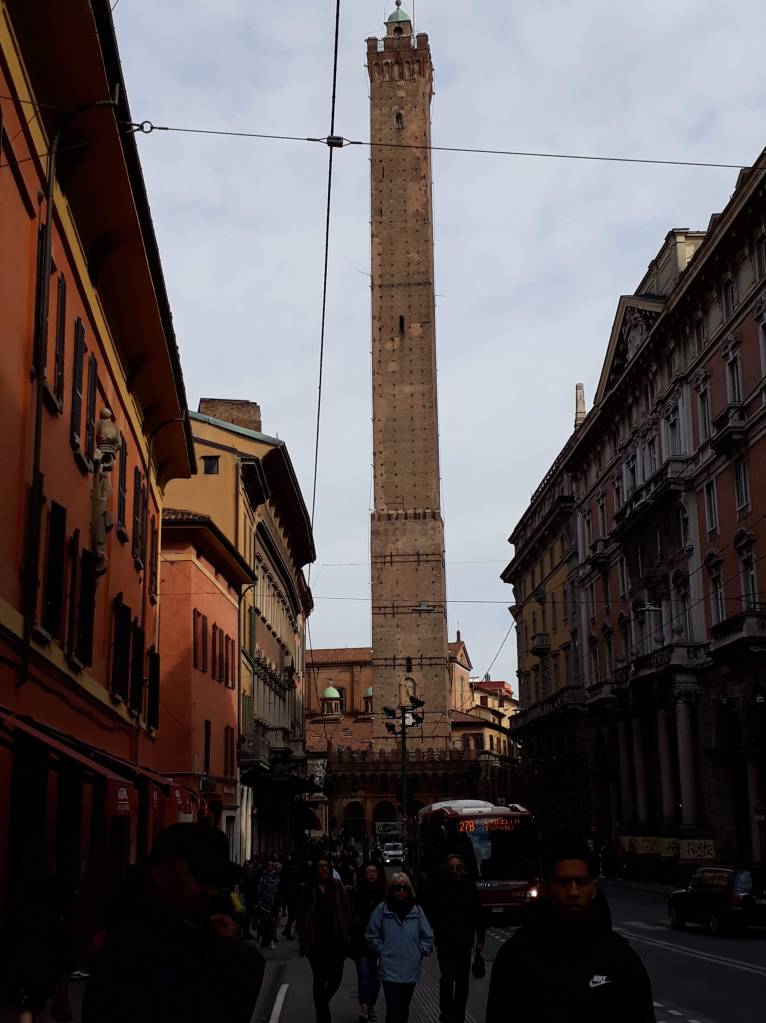
By the time I had finished, it was just about time for my ascent of the Asinelli Tower. The Asinelli Tower is the taller, being about 100m high, of two adjacent towers, both of which lean alarmingly. Timed tickets are required, as the only way to reach the top is by a narrow staircase, on which it would be impossible to have people ascending and descending at the same time. When I arrived at the entrance, a few minutes before the due time, a school party also showed up, but thankfully they let me wait ahead of them. When the doors opened, I was first to start climbing the staircase. Despite my advanced years, I am fitter than today’s typical teenager, so I had the top of the tower to myself for ten minutes, before the first of the school group breathlessly arrived. I just let everyone get to the top before I started my descent.
On my return to ground level, I treated myself to an ice cream from a gelateria close by, with an extensive choice of flavours. My next stop was to be the National Gallery of Bologna. To get to the National Gallery, I had to walk through the main University area. Here the graduation celebrations were in full swing – they were rather more raucous and drunken than the demure gatherings I had observed in the main square earlier and the participants generally more dishevelled.
The National Gallery of Bologna was a slight disappointment. The main collections were comprised mainly of fairly ancient religious art which I did not find exceptionally inspiring. After leaving the National Gallery, I made my way to the hotel I had booked for the night, using a route from another of the podcast walks. Once I had checked into the hotel, I started to plan where to eat that evening.
I chose to eat in a trattoria not far from the hotel. When I arrived, I found it was fully booked, but they would let me have a table if I promised to be finished before 8:30pm. Spaghetti Bolognese is not a dish usually served in Bologna – so for first course, I ordered the nearest equivalent, tagliatelle al ragù, which came with a far meatier sauce than the Bolognese sauce normally served in British Italian restaurants. My main course was cotoletta alla Bolognese, which despite the name does not involve a Bolognese sauce at all, but was comprised of a pork steak topped with cheese and ham. All this was washed down with a carafe of the house red wine, which was served in a pint milk bottle originally from Lancashire Hygienic Dairies! Despite the need to free up the table, the next party had not yet arrived, so I was able to order mascarpone for dessert.
Bologna is the centre of a nascent Italian craft beer movement, so after dinner, as it was still not very late, I sought out a bar which had a variety of local beers on offer. The bar was quite small, but had an extensive stock of bottled beers, which they seemed to sell a lot of as takeaways, but also had three different beers on draught of which I sampled a couple.
Thursday 28th March 2019
I got up fairly early, as my first visit this morning was to be to the Museum of the Risorgimento which opened at 9am and was a forty minute walk from my hotel. Although yesterday had been warm, there was a slight chill in the air as I set off to walk to the Museum of the Risorgimento, which is situated a little way from the city centre. I passed a primary school on route, where parents had been dropping off their children and were now involved in lengthy social chatting blocking the pavement outside.
The Museum of the Risorgimento is housed on the ground floor of a modest villa. It describes the history of Italian unification over the period from the Napoleonic invasions to the end of the First World War, with a particular emphasis on events in Bologna and its surrounding area. The building in which the museum is located was the final home of the poet Giosuè Carducci, who won the Nobel Prize for literature in 1906. When I had finished looking at the Risogimento exhibition, I requested permission to view the upper floor, which has been kept as it was at the time of Carducci’s death in 1907. To view Carduuci’s study and bedroom required an elderly attendant to be summoned, who had to accompany me while I looked at these rooms.
I then returned towards the city centre. En route, I was accosted by a young woman who thrust a petition on a clipboard at me and asked me to sign it. Not fully understanding what the petition was about, I declined, and even her offer to give me a kiss if I signed it was not enough to make me change my mind.
My next stop was the Davia Bargellini Museum. This consists of a diverse collection of art, sculpture, artefacts and other knick-knacks thrown together higgledy-piggledy in a slightly dilapidated old building.
Slightly further down the road was the International Music Museum of Bologna. This has a large collection showing the development of musical instruments and also information on the role of Bologna in providing formal musical training. I acquired a comprehensive audioguide to accompany my visit. I learned that accreditation from Bologna used to be a prerequisite for aspiring musicians to gain employment in the courts of Europe. There is some evidence that Mozart failed his Bologna exams, but given his already recognised talent, this failure was covered up and he was deemed to have passed. The audioguide provided samples of the instruments being played, but this proved unnecessary for some, as there were musicians playing in a number of the rooms. At first I had these performances largely to myself, but later on school parties arrived and sat on the floor listening to the musicians.
After leaving the music museum, I had a short walk to the Museum of the History of Bologna, housed in the Palazzo Pepoli. This is an enormous modern museum located in a old building. It tells the story of Bologna, from pre-history and Etruscan settlement through to the present day. There are many multimedia exhibits which interact with the audioguide that you are given on entry. It took me a couple of hours to look at everything and it was early afternoon by the time I left.
I made my way to the University area again, stopping off to buy another ice cream at the gelateria I had visited the day before. Graduation celebrations were still in full swing at the university – I noticed some of the more smartly dressed families were now dining at Bologna’s posher restaurants, but those without their families seemed happy to celebrate in the street by drinking wine straight from bottles. I went to the courtyard at the core of the old University and climbed a couple of flights of stairs to the Palazzo Poggi Museum, which is housed in the former 18th Century science laboratories of the University. This has a varied collection of scientific artefacts, including some gruesome human anatomical specimens.
It was now mid-afternoon, but my flight back was not until the early evening, so I had time to go to one more attraction. I chose to visit MAMbo (Museo d’Arte Moderna di Bologna), Bologna’s modern art gallery situated in a modern building away from the historic city centre and not far from Bologna railway station. There were some fairly weird items on display, by a variety of creators. The main collection of paintings was by Bologna local Giorgio Morandi. I was not overly impressed by most of the exhibits, so MAMbo did not detain me long. I then walked to the railway station, the scene of a notorious terrorist bombing in 1980, to catch the bus back to the airport. It was a bit of a challenge working out where to buy a ticket for the airport bus, as they could not be bought on board. Rather than having the ticket machine near the bus stop, it was hidden away among the various railway ticket machines in the main part of the station.
I arrived at Bologna Airport in plenty of time for my 1845 flight. As the only thing I had eaten since breakfast was an ice cream, I had planned to have something to eat while waiting. However, I discovered that the cost of just a sandwich and a drink would be more than the price of my flight back to London, so I didn’t bother. Perhaps the airlines can sell their tickets so cheaply by taking a cut from the airport sales to waiting passengers. It was just getting dark as we took off – the skies were clear throughout the flight, so built up areas were outlined by lights. The route we took involved a broad sweep round London, initially approaching from the south, then curving round north west and north east London before descending into Stansted. Upon arrival I grabbed a more reasonably priced sandwich to eat on the train home, where I finally arrived just before 10pm.
 Europe Explored
One Reply to “”