
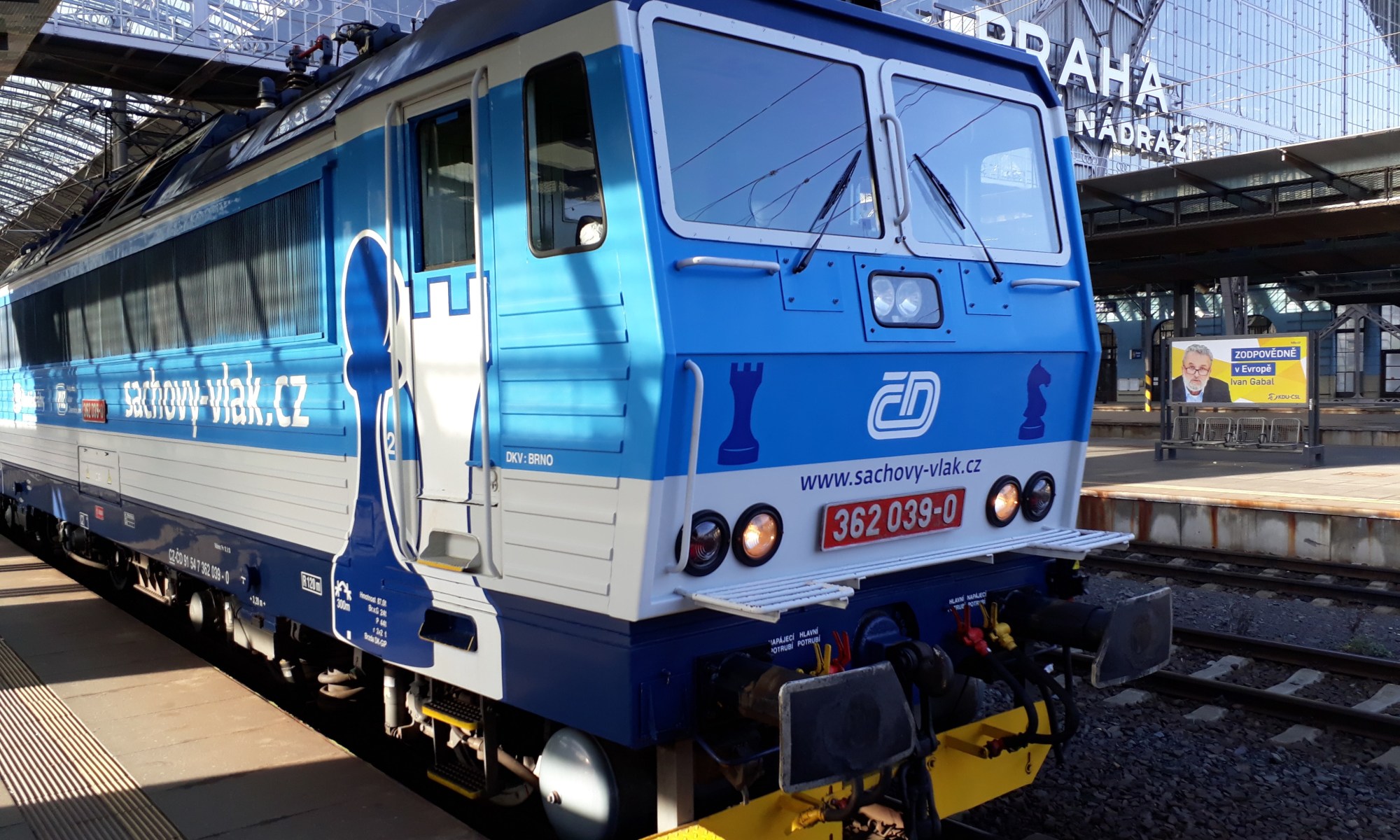
“On the chessboard, lies and hypocrisy do not survive long. The creative combination lays bare the presumption of a lie; the merciless fact, culminating in the checkmate, contradicts the hypocrite.” (Emanuel Lasker)
The Chess Train (Šachový Vlak in Czech) is an annual chess tournament organised by the Prague Chess Society since 2011. It has the unique feature that all the games are played on board the train as it travels for five days on a different route each year around central and eastern Europe. I had been planning to play in the special 10th running of this event from the 12th to 17th June 2020, but it was called off at the beginning of March as the Covid-19 epidemic took hold in Europe. The 10th edition was going to have been different in two respects to the previous events – it was taking place in June, rather than the traditional October, and it was taking place over six days, rather than five, to allow it to visit the capitals of the four Visegrád Group countries.
So in memory of the missing tournament this year, I’ve decided that this month’s post will be an account of my first trip on the Chess Train in 2017. I had been aware of the event for a few years, but had held off participating before as I was not sure how well playing chess and train travel would mix. I decided to take the plunge in 2017, a decision I did not regret, as despite the constraints of being played on a train it turned out to be one of the best organised chess tournaments that I have ever played. I also have an aversion to being constrained by group travel, but that was not a problem, as I had the freedom to explore each city by myself in the afternoon and evening.
Wednesday 11 October 2017 – London to Prague
I had travelled to Prague as part of a family holiday earlier in 2017, so the journey there was reasonably familiar. The flight from Stansted was in the late morning, so I could leave home at a civilised hour. After the usual hanging around at the airport, the flight departed on time and I arrived at Prague airport in the early afternoon. Prague airport was very efficient and there was no delay going through immigration or waiting for my bag, so within about 20 minutes of touching down I was on the 119 bus to Veleslavin station, where I caught the Metro to the city centre. I had chosen a different hotel from that which I had used on my visit earlier in 2017, as I wanted to be within a short walk of Praha hlavní nádraží (Prague main railway station) for my departure on Friday morning.
In the evening, I went out to a restaurant that I had used on my previous visit to Prague, where I had duck to eat washed down with a few beers.
Thursday 12 October 2017 – Prague
I had allowed myself an extra day to explore Prague before the Chess Train departed. As I had visited many of the main sights only a few months previously, I sought out places that I did not have a chance to look at on my recent trip. (I had also been to Prague in 1985 and 1992, but it was a very different city then.)
To make make maximum use of my time, my first stop was the Prague City Museum, as this opened at 9am, an hour earlier than most other attractions. This contained a comprehensive history of the city from prehistoric times to the 20th century. There was an impressive huge scale model of the city built in the early 19th century – it was fun to try to spot what in the city had changed and what remained unaltered. The special exhibition on at the time of my visit was on midwifery in Prague, which was more interesting than I at first imagined it would be.
On my way back from the City Musuem, I walked past Marasykovo station, which was the original main station for the city but now is only served by local trains. I think it is one of the most elegant station buildings that I have encountered.
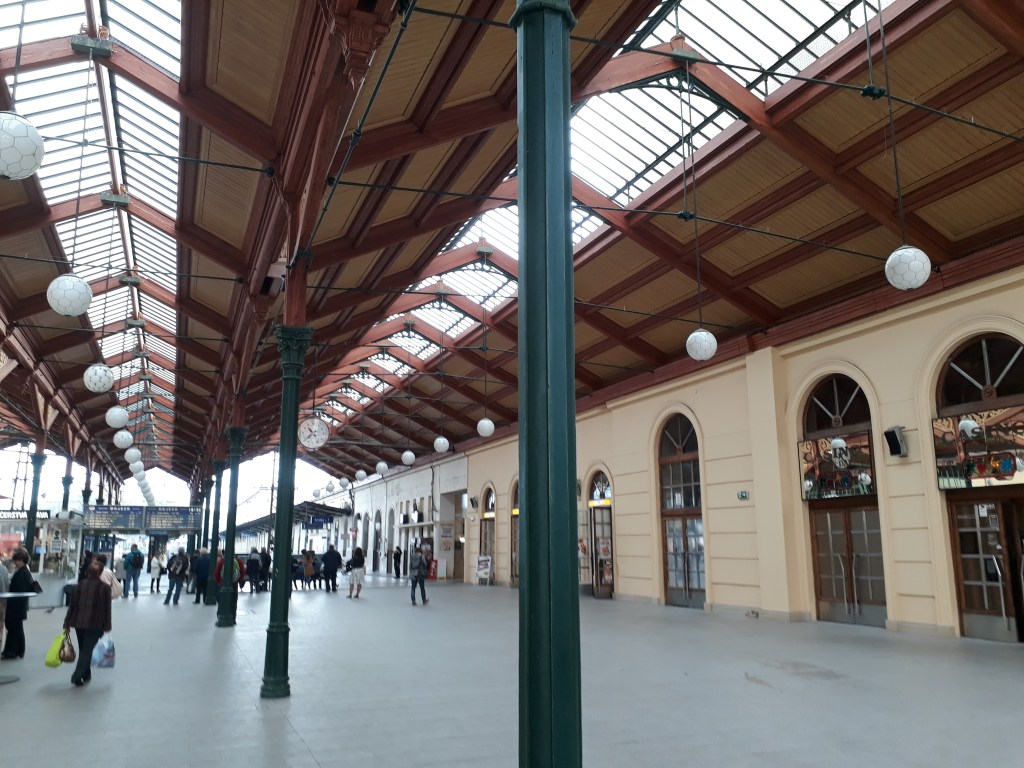
At the time of my visit in 2017 the National Museum, whose building dominates the top of Wenceslas Square, was closed for renovation. However, they had set up three exhibitions in an annexe a short distance away. In typical Czech fashion, you could buy separate tickets for each exhibition. On entry I bought all three, but in retrospect I wished I had just paid to see the one about Masaryk, as the other two (on the effect of light on biological processes and a large collection of stuffed animals) were not uniquely Czech. Tomáš Garrigue Masaryk, The Masaryk Phenomenon was a special exhibition to mark the 80th anniversary of the death of the first President of Czechoslovakia. He was a complex and unusual man. I leaned a lot from this exhibition – for example, TGM (as he was known) adopted the name of his American wife, Charlotte Garrigue, upon their marriage, a very uncommon choice for the time.
I had brought two jumpers with me on this trip – one thick and one thin. As it was unseasonally warm, I could not not see myself wearing the thick one much. Unfortunately, the thin one had developed a large hole during my journey out, which was steadily getting bigger as the wool continued to unravel. So my next stop was to buy a new thin jumper, so that I would look respectable for the remainder of my trip.
In the afternoon, I caught the Metro out to Želivského station to explore the Žižkov area of the city. After a short walk, I entered Olšany Cemetery. This cemetery contains a large number of ornate family memorials, many in the Art Nouveau style. I had specifically come to find two graves, ironically one was much easier to find than the other. The grave of Jan Palach, the student who died after self-immolating in protest against the Soviet invasion of 1968, was unmissable by the main path, being decorated with candles and fresh flowers. After being buried there following his funeral in 1969, Palach’s body had been exhumed from the site by the Czech secret police in 1973 and cremated. The grave was destroyed, as it had been been attracting too much attention. In 1990, his ashes were re-interred at the original site. Harder to find was the grave of Klement Gottwald, the first Communist president of Czechoslovakia. I eventually tracked him down to plot near the edge of the cemetery, where he is listed among about 20 other names of communist leaders who had initially been interred in the National Monument. Other than the listing of the names there was no other description or decoration of the grave.
On leaving Olšany Cemetery, I walked through Parukářka Park, underneath which is a Cold War nuclear bunker – you can still spot the steel entrance doors and ventilation shafts dotted around the park.
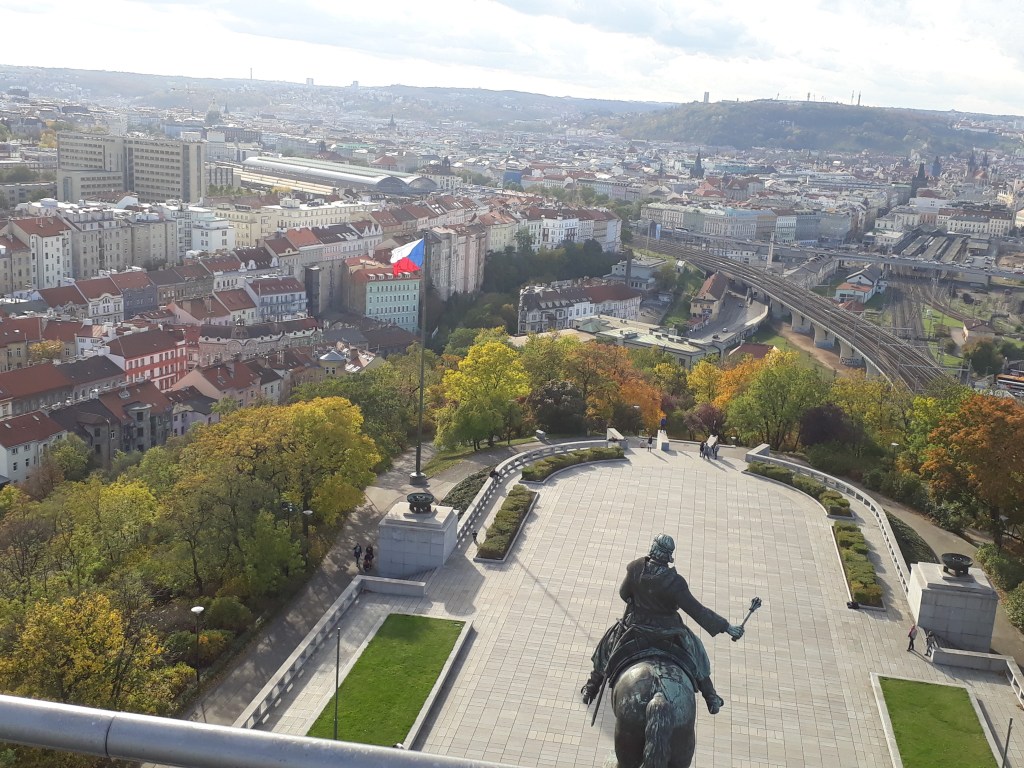
I then climbed Žižkov (or Vitkov) hill where at the summit is the massive National Monument. Built in the 1930s as a memorial to the fighters who helped establish an independent Czechoslovakia, it was subsequently appropriated by the Communist authorities and transformed into a pantheon of the socialist state. When Klement Gottwald died in 1953, it became his mausoleum and every Czechoslovak schoolchild was expected to come at least once on a school trip to view his embalmed body. I had some difficulty finding the entrance to the National Monument, as the obvious doors I tried initially were all locked, eventually gaining admission through a small side door. Some of the space of the Monument’s massive interior is devoted to portraying the history of Czechoslovakia in the 20th Century. There is also the somewhat gruesome mausoleum area where Gottwald’s body was previously on display. A lift was used to bring the body up from underground for display each day. Despite supposedly using the latest embalming techniques, the body started to decompose in the 1960s and Gottwald’s remains had to be cremated, the ashes continuing to be stored in the mausoleum until being transferred to Olšany Cemetery in 1990. After I had finished exploring inside the National Monument, I went onto the roof. This was accessed by a tiny lift complete with operator, who closely scrutinised my ticket. It was a one-way ride, as you had to walk down. From the top, beyond the enormous equestrian statue of Jan Žižka, there were superb views of the centre of Prague.
I walked back to the city centre, and after freshening up at my hotel went out for dinner at an Afghan restaurant nearby.
Friday 13 October 2017 – Prague to Olomouc
I awoke early and made my way to Praha hlavní nádraží (Prague’s main railway station) to arrive at 8am. I made my way to Platform 1 and found the entrance to the Government Lounge. Outside the entrance is a memorial to the Kindertransport, one of a series of three memorials (the others are at London Liverpool Street and Vienna Westbahnhof).
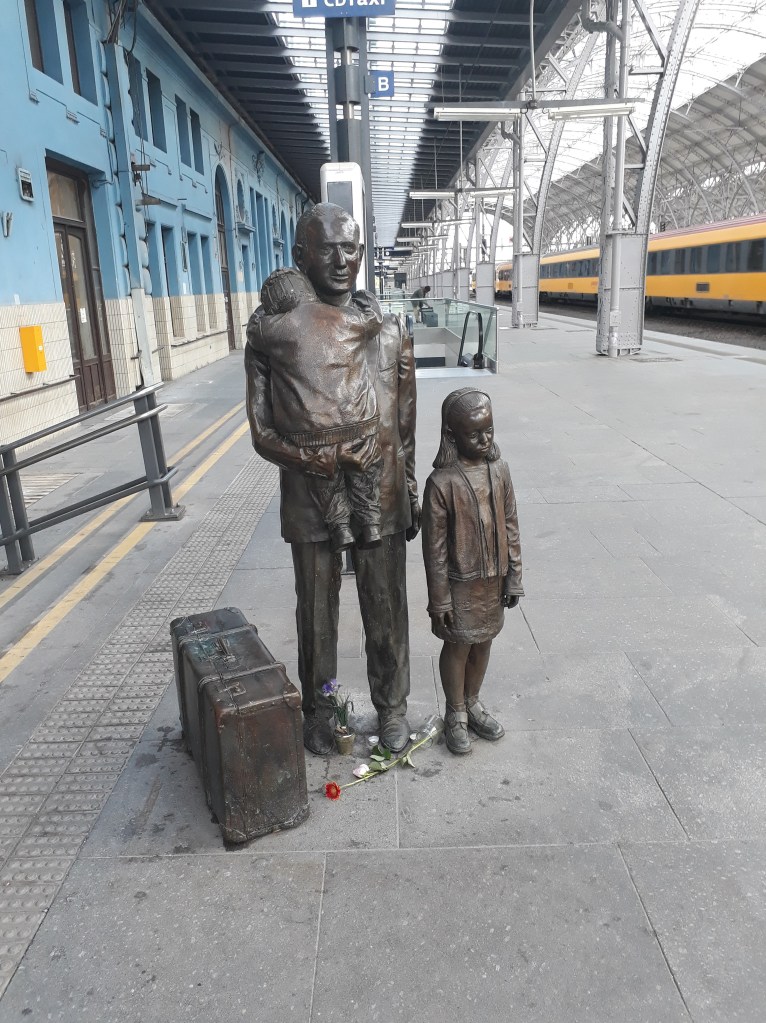
I registered my arrival and took my bag to the holding area to be loaded onto the Chess Train when it arrived. I then entered the sumptuously Art Nouveau decorated Government Lounge, where a generous buffet breakfast was being served. The Government Lounge has hosted heads of state waiting for their trains – ranging from Emperor Franz Joseph I through to Fidel Castro.
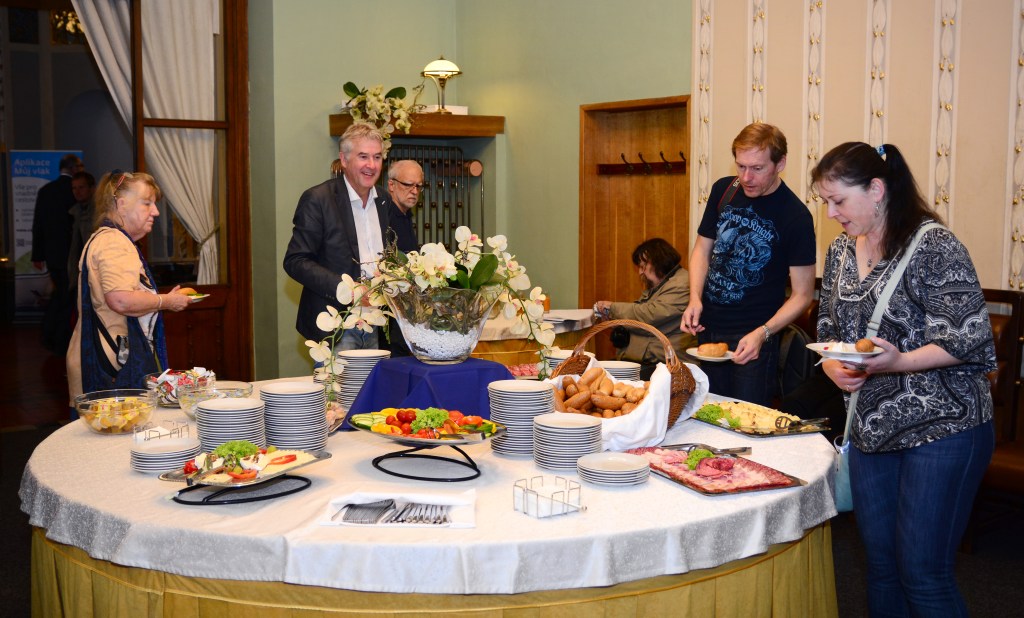
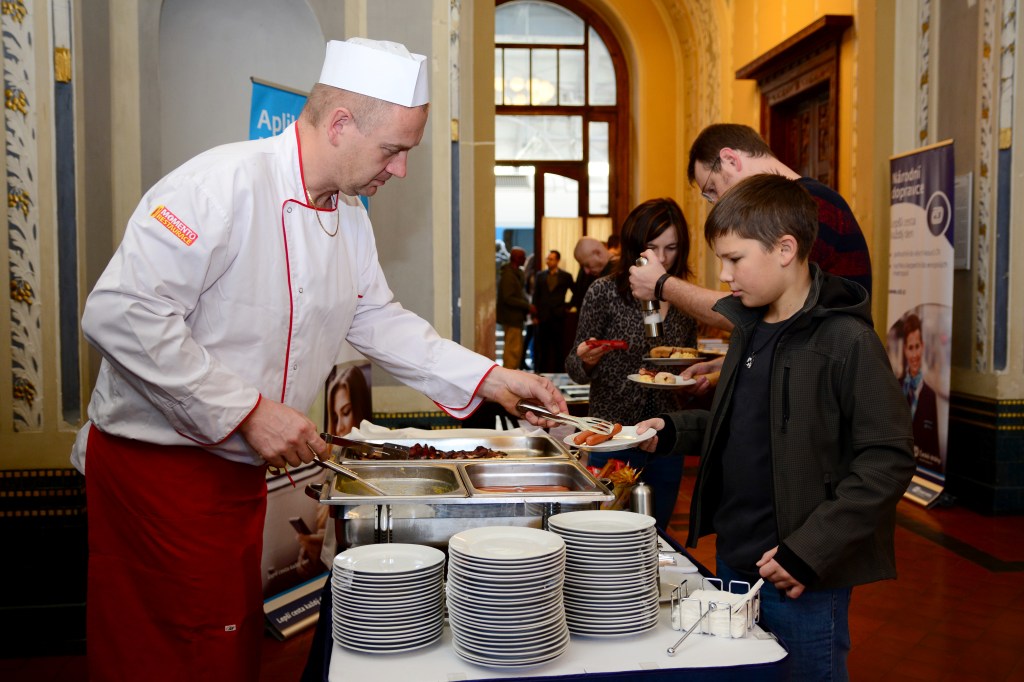
Over breakfast I chatted to fellow participants and at about 9am everyone was gathered together for the opening ceremony and players’ briefing. There would be two rapidplay games (i.e. with a time control so that they should each last about an hour) each day, apart from on Sunday when there would be just one. It would be a nine round Swiss tournament, so that in each round you would be paired against a different opponent who had a similar number of points to you. I asked a technical question about illegal moves and then we were ready to board the train.
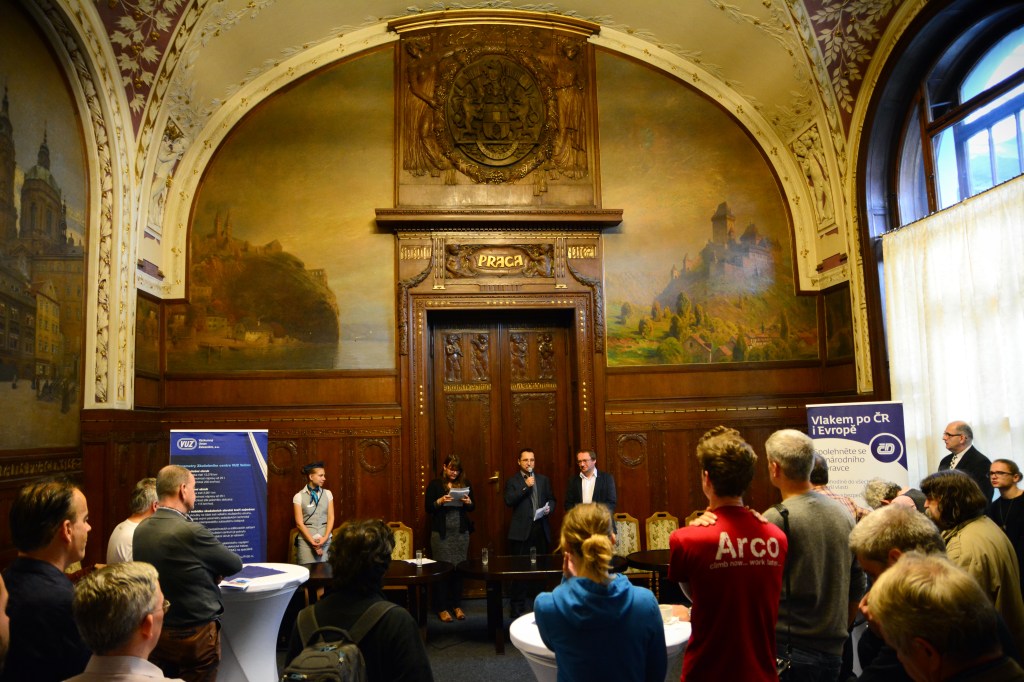
When we left the briefing the train was already at the platform.
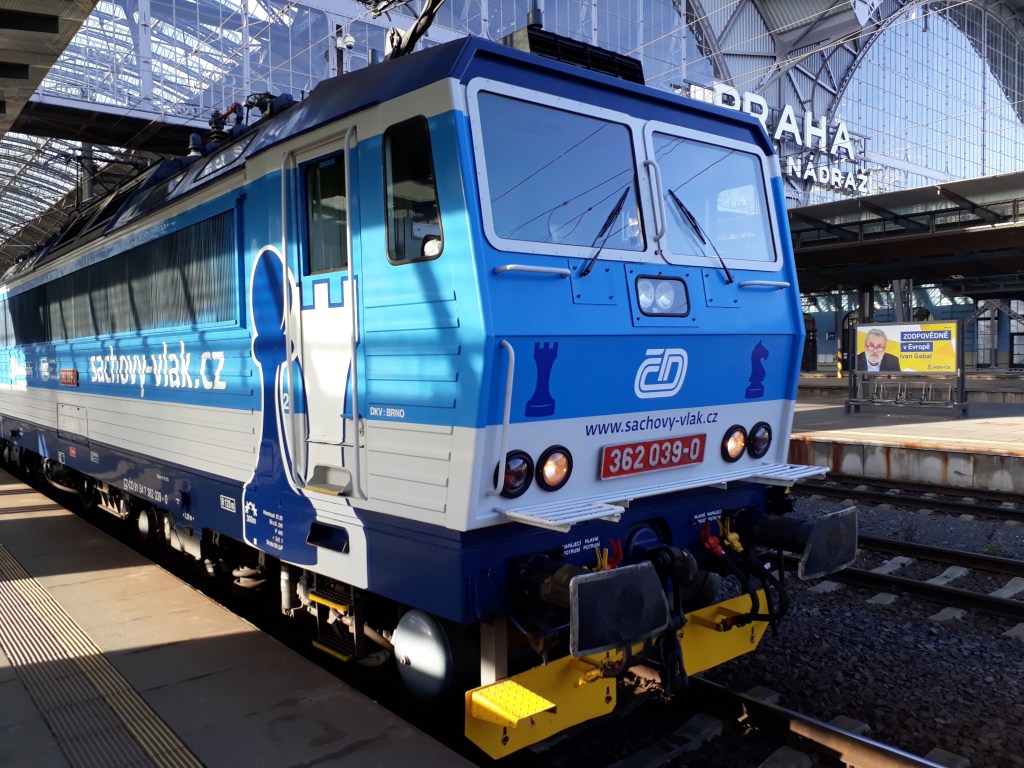
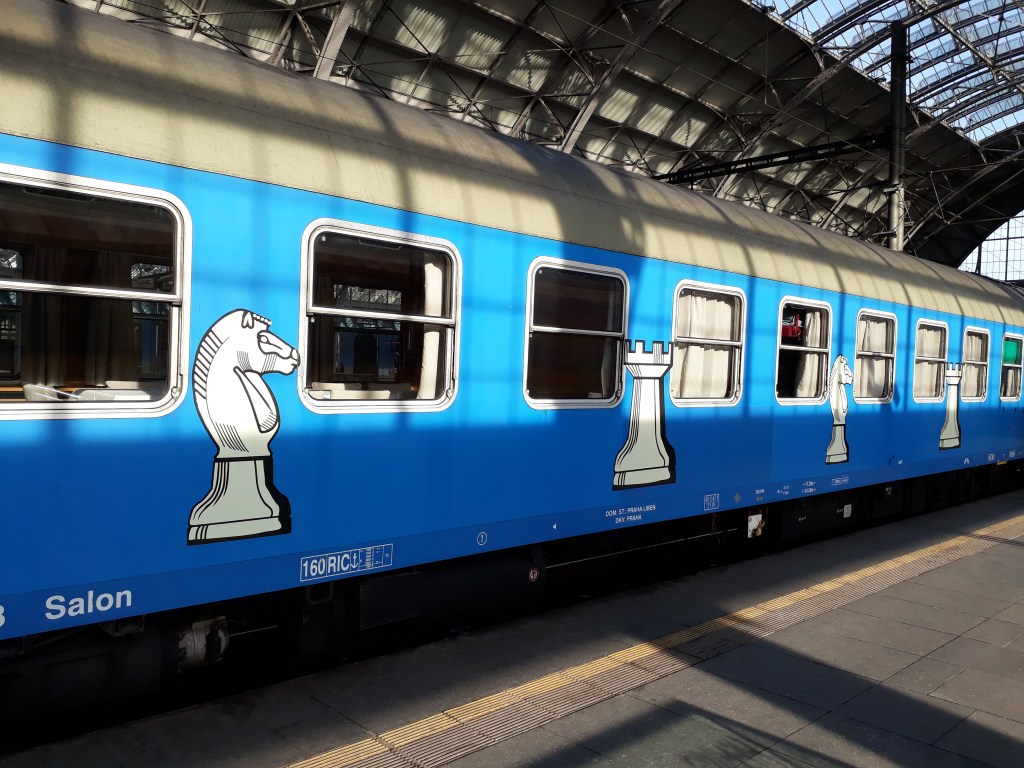
The top twenty boards in each round play in two old fashioned open-plan conference cars, but the lower board games each occupy a single compartment (with ten compartments per carriage). It is always my aim to play in the conference cars, but the standard of the tournament is very high and I have never quite made it. I found the compartment where my first round game was to take place. I was playing a very strong Frenchman, who had previously lived in London for a few years and was familiar with the London tournament scene. I had a bit of luck when shortly after our game started we entered a long tunnel and because the lights were not working in our compartment we were plunged into complete darkness. As it was my opponent’s move at the time, it used up a couple of minutes on his clock before he could continue. It mattered not and I succumbed to his superior play.
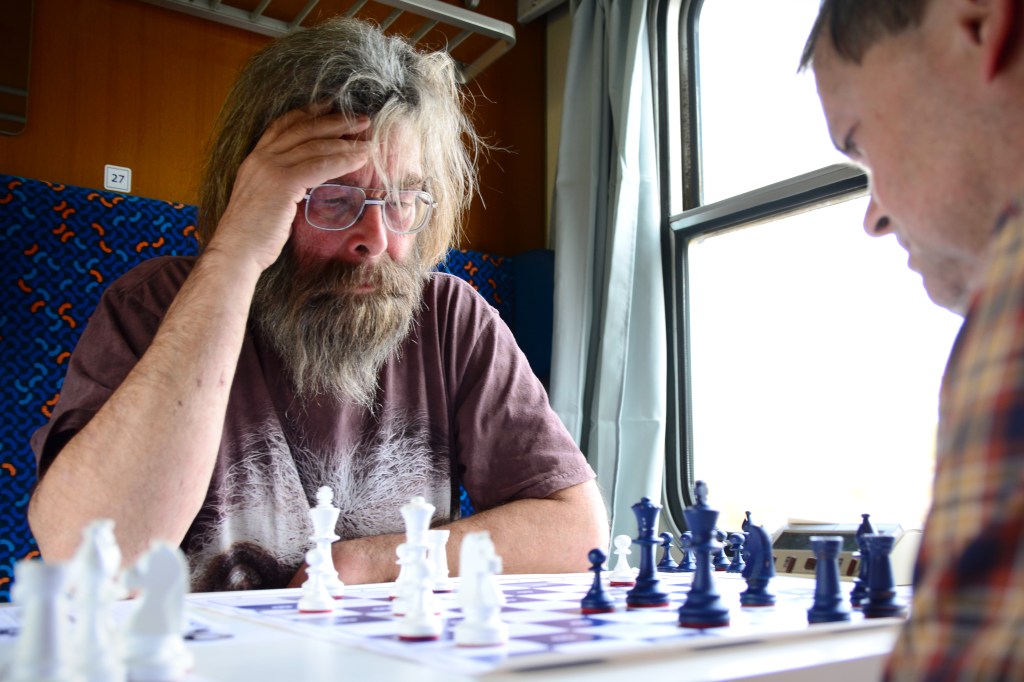
Once all the results had been reported in the arbiter’s coach, the pairings for the second round were printed out and a copy was posted in each carriage throughout the train. In the second round, I played a wild-looking Swede, who was again much higher rated than me. His play matched his looks. In the opening he sacrificed a piece for two of my pawns, and then a bit later did the same again, leaving my King very exposed. He then launched a fearsome attack with check after check on my unprotected King. I just had to find a way to stop his incessant checks to let my material advantage count. I eventually managed to do that, to pull off an unexpected win. There was a prize for the best game of the tournament, which my Swedish opponent won with another of his games – I assume from the style of his play that he was also trying to win the best game prize from his game against me.
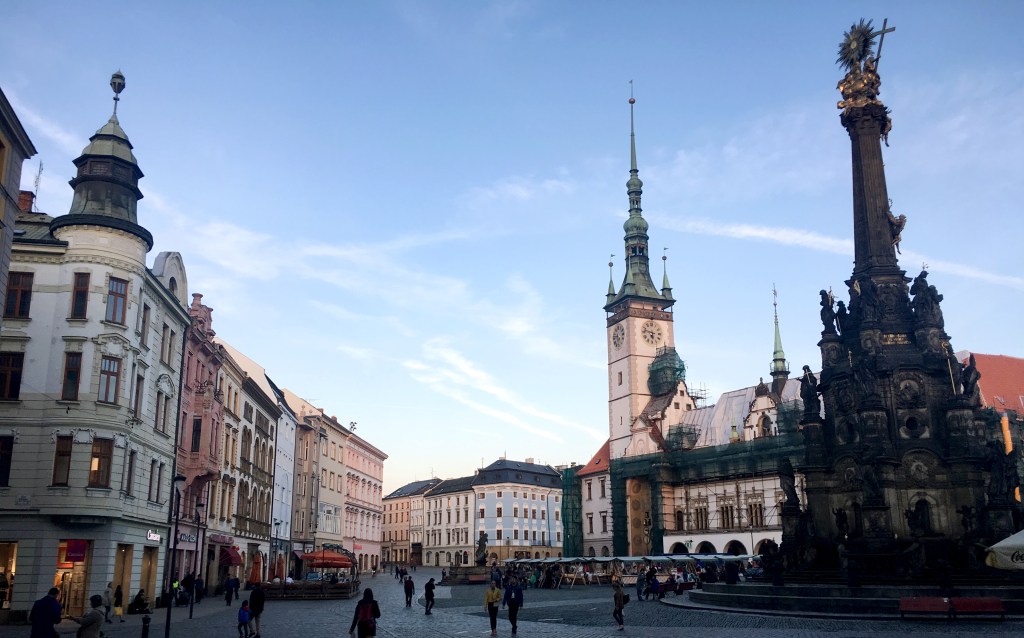
Not long after the second game finished, and after admiring the glorious autumnal colours in the Czech countryside, we arrived in Olomouc. The station is a little way from the city centre, but I decided to walk rather than hang around for a bus. After checking into my hotel, I set off to explore the city. Normally you can go to the top of the town hall tower, but it was closed for renovation when I was there. I bought an ice cream in the main square, which I ate while admiring the Trinity Column.
I wandered around the city centre, looking in on St Maurice’s church which had an impressive display of fruit, flowers and vegetables filling the central aisle, clearly as some form of harvest festival.
I realised that I would not have time to visit all the museums and galleries, so chose the Archdiocesan Museum next to the cathedral. On my way there I passed an interesting astronomical clock which had been rebuilt in the socialist realist style after its destruction in the second world war. Gaining entry to the Archdiocesan Museum was a bit of a palaver. Firstly, I did not have the correct money for the entrance fee. As it only cost about £1, I was happy for the woman on the desk to keep the change, but she would not do this. After some delay, suitable change was rustled up and I was eventually issued a ticket. I then tried to enter the museum, but was stopped by an official who had witnessed the whole saga of my attempted ticket buying. He wished to inspect my newly purchased ticket in great detail before letting me proceed. I had to deposit my bag in the cloakroom, which required another ticket to be issued. I appeared to be the only visitor in the whole museum, which had an interesting collection of art and sculpture, as well as information about the history of the building. Each room had its own attendant who closed the door after I entered and followed me around until I was ready to go to the next room where the process was repeated. When I went to retrieve my bag from the cloakroom, I could see that mine was the only item there. Nonetheless, the attendant scrutinised my cloakroom ticket and made a point of systematically going through the empty racks until she came to the place where she had put my bag.
During the day, Olomouc city centre had seemed rather sleepy with few people about. When I went out to find some dinner the place was transformed with predominantly young people thronging the streets and some queuing to enter various establishments. I was lucky to get a seat in a bustling bar/restaurant, where I dined on carrot and celery pancakes, followed by grilled pork.
Saturday 14 October 2017 – Olomouc to Trencin
As I walked to the railway station that morning, the Cathedral bells were ringing and there were large numbers of people making their way to Olomouc Cathedral from all directions. I learned the reason for this activity was that two new bishops were being installed.
Having won my previous game, I was bounced up the order to play strong opponents today. In the first game I lost to a French speaking Belgian, who was part a group from the same club. I then lost my next game to a Dutchman. Shortly after the second game finished we crossed from the Czech Republic into Slovakia, where we waited for about twenty minutes to let another train pass.
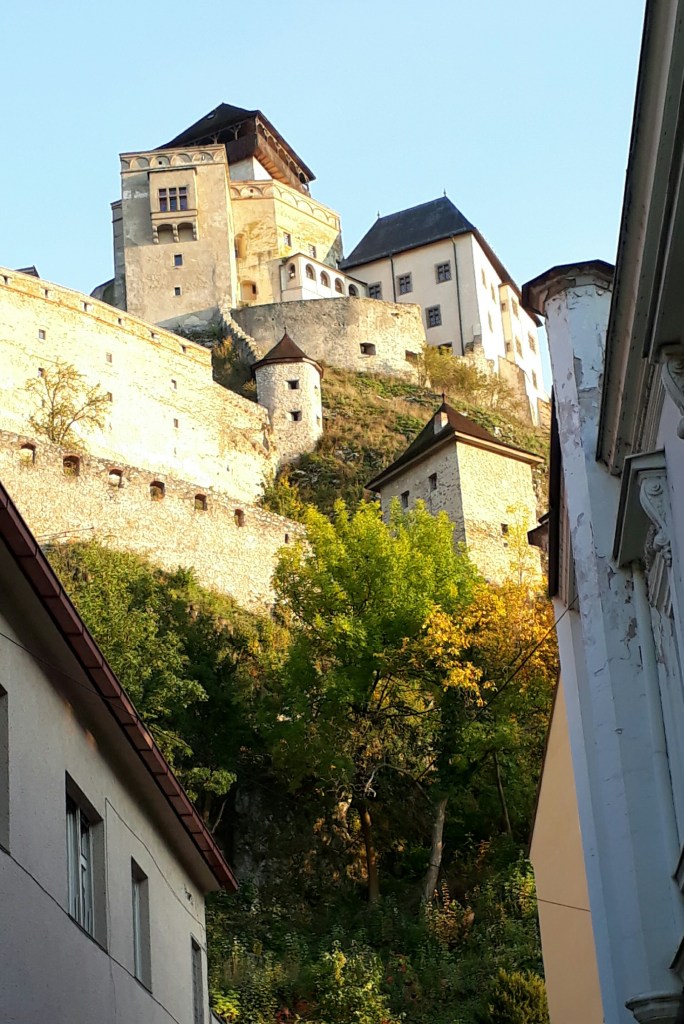
We arrived in Trencin shortly before 3pm. My hotel was near the station – I checked in and quickly left my bag, as I wanted to explore Trencin’s amazing castle perched on the hill overlooking the city, which I believed closed at 4pm. It turned out that I needn’t have rushed, as there was a pumpkin festival at the castle, which meant that it was going to be open until the evening. It was only possible to see much of the interior by taking a guided tour, which I booked for 4pm. The tour turned out to be rather chaotic, as at the appointed time there were about three times as many people waiting as were supposed to be on a tour – although tickets had been issued for the tour, the tickets did not say what time tour they were valid for. The tour guide was a teenage girl who only spoke Slovak and she struggled to control the extra numbers who had gatecrashed her group. Nonetheless, Trencin castle is so impressive that a chaotic tour conducted in Slovak did not detract from its splendour.
In the evening, I found a pleasant Italian restaurant on the edge of the town centre. After finishing a three course meal, I signalled that I would like the bill – however my gesture was interpreted as a request for another beer, which I happily consumed.
Sunday 15 October 2017 – Trencin to Bratislava
As the journey from Trencin to Bratislava would only take two hours, there was time for only one game on Sunday morning. I played an Englishman and I spent a lot of time in the middlegame constructing an elaborate plan to trap my opponent’s Queen. At the very last moment he saw through my plan and avoided the trap – thereafter, my game fell apart in time trouble and I stumbled to another defeat.
We arrived in Bratislava at noon. Rather than using the main station, the Chess Train went to Bratislava Novo Mesto (New Town), which is at the end of a tram line from the city centre. On the tram, I chatted to a Frenchman of Tunisian origin, who told me that he had lived in England for a couple of years as a child and that he had learned to play chess at my current chess club.
It was too early to check in to the hotel, so I just left my bag and went to explore the city. First stop was Bratislava castle perched on the bank of the Danube. I had previously visited the castle in 1985 during a trip in Communist times – I remember from then that there were just a couple of dingy rooms you could visit, housing a re-creation of an alchemist’s workshop. The castle had been extensively renovated since then, with vast areas now accessible, housing exhibitions on the history of Slovakia and various art collections.
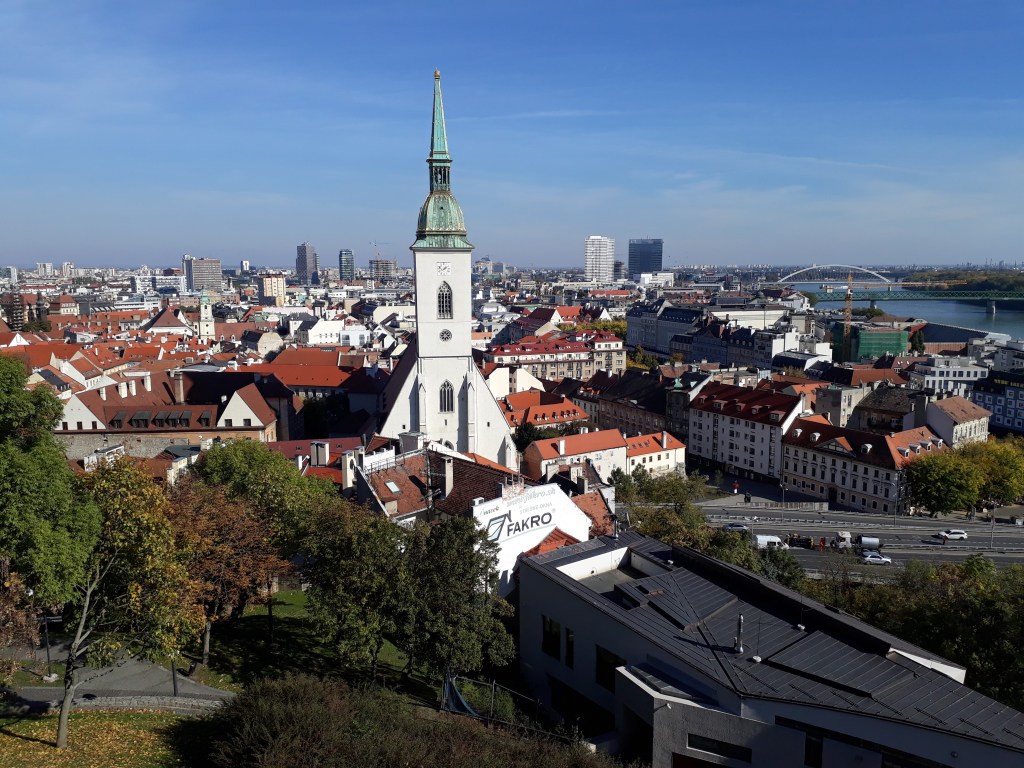
After leaving the castle I spent some time exploring the rest of the city, which was bustling with people on a Sunday afternoon. In the evening, I chose a restaurant down a little alley which had good reviews. It did not disappoint. The portions were enormous. For main course, I ordered Schnitzel with fried potatoes. When it came the Schnitzel filled the plate, but I could not see any potatoes. I found them in a layer underneath the Schnitzel, also filling the plate.
Monday 16 October 2017 – Bratislava to Lednice
I caught a tram out to Novo Mesto station for the 10am departure of the Chess Train. In the sixth round I played a young Australian student who was on a six month school exchange visit to Sweden. Although enthusiastic, he was not a very experienced player and I secured a relatively straightforward win.
As my game was finishing we pulled into Bratislava’s main station, where there was a delay of nearly an hour to enable the restaurant car, which had developed a fault, to be replaced with another. This required significant shunting to split the train and remove and replace the faulty carriage. The delay was fortunate for some participants. A number of people who had relied on taxis to transport them from Novo Mesto to Bratislava the previous day, had just asked for a taxi that morning to take them to ‘the station’ and had ended up in the wrong place, missing their sixth round game. However the delay enabled them all to be rounded up and rejoin the train.
Just before we set off again the seventh round games were started. I was playing a Ukrainian who, though on paper stronger than me, managed to muddle an opening I knew well, and I secured another victory. Having won two games in one day, I visited the newly replaced restaurant car to celebrate with a beer.
Our destination today was Lednice. However, Lednice station is on a small branch line and it was not big enough to accommodate the 13 carriages of the Chess Train, so we halted at Breclav on the main line where we transferred to buses to take us to Lednice.
Ledinice is little more than a large village, the main attraction being the enormous sprawling château built by the Princes of Liechtenstein. The area is a UNESCO World Heritage site. As the château is normally closed on Mondays, the organisers of the Chess Train had arranged three special guided tours for our benefit, conducted in Czech, English and German respectively. The interior of the château had recently finished being restored to its former glory, a project which had taken many years – during the Communist era it had been used as a tractor museum.
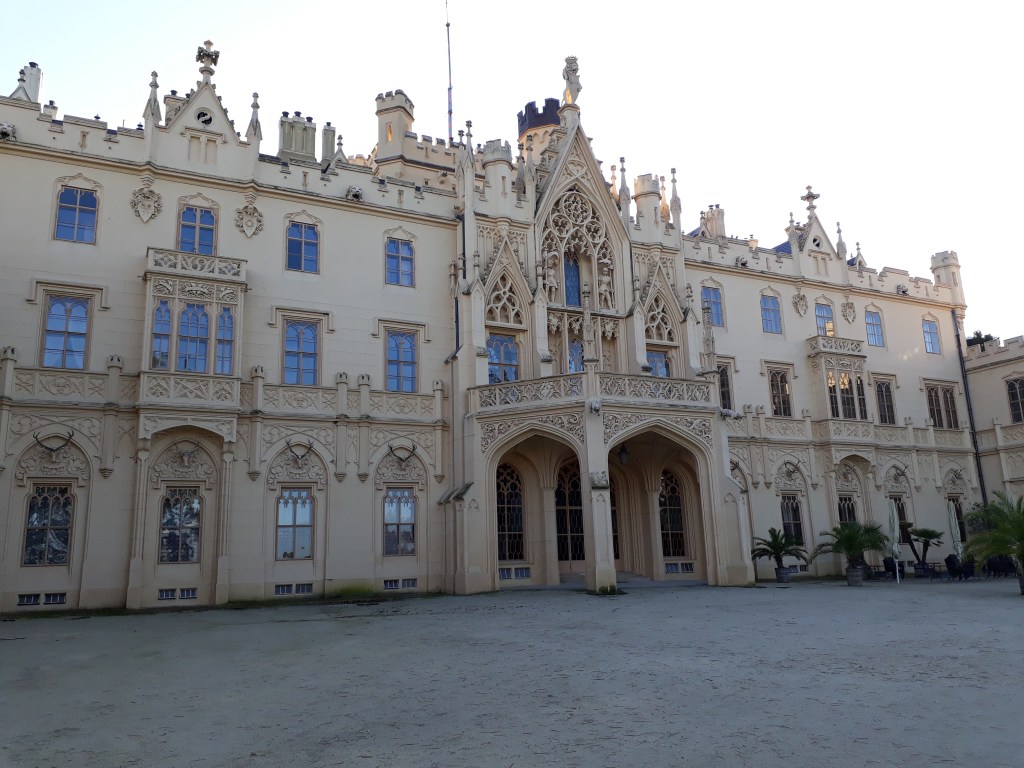
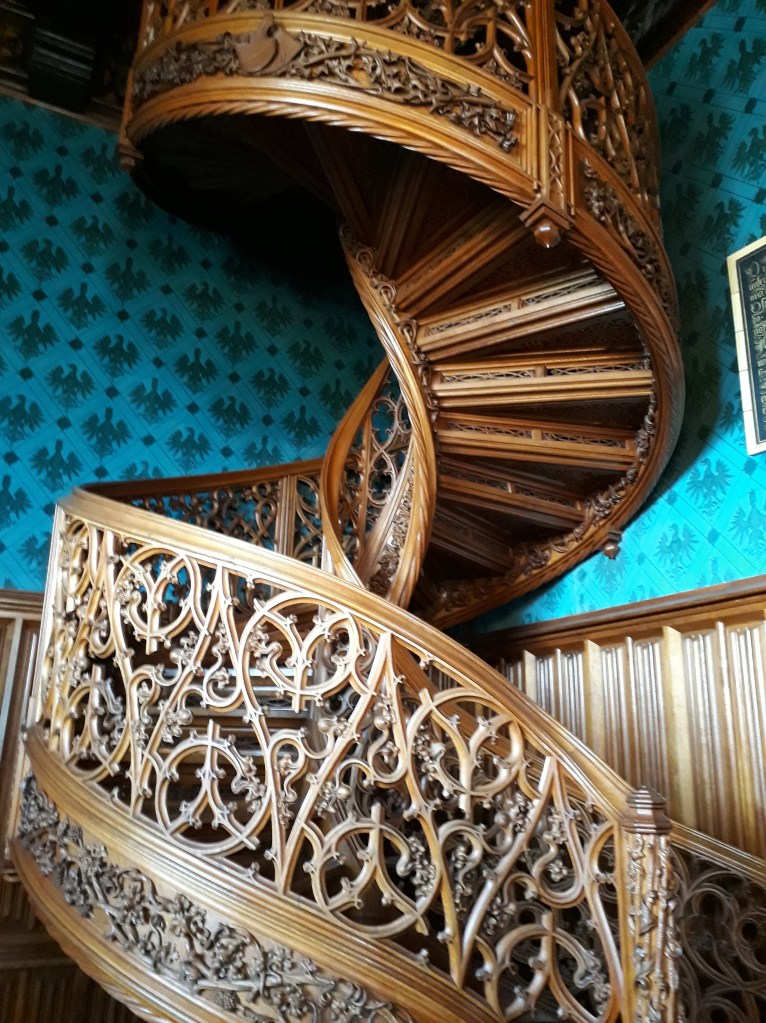
After the tour I walked round the extensive grounds of the château and then into the village. As I often did, I had a scout round possible places where I might eat that evening, to save time later. Despite being mid-October it was a very warm day, so when I returned to my hotel I enquired about using their open air swimming pool, but was told that it had now closed for the season.
I had researched on-line possible eating places. One had very good reviews, but when I had had checked it out earlier I found it to be little more than a shack right on the edge of the village, with no menus on display. Nonetheless, I trusted the reviews and decided to go there for my dinner. While I waited for a table, three other Chess Train participants arrived, a couple from Munich and another man also from Munich (who did not know the couple until he had met them on the Chess Train). They invited me to join their table and seemed quite happy to talk in English, despite my misgivings about imposing and shifting their conversation to a different language. We had a delicious meal – relying on my Czech phrasebook to translate the menu, as the waiter spoke no English or German. We talked for a long time, covering subjects such as European history and politics, healthcare in Germany (the couple worked in a hospital), and the English canal network (the other man’s most recent family holiday had been on an English narrowboat).
When we eventually left the restaurant it was late. Stepping out into the unlit lane we were immediately struck by the beauty of the night sky – there was so little light pollution that the Milky Way was very clearly visible. As we walked back to the centre of the village we spent the time spotting planets, stars and constellations, assisted by an app I had on my phone.
Tuesday 17 October 2017 – Lednice to Prague (via Kolin)
Every day on this trip had been warm and sunny. When I awoke this morning Lednice was shrouded in a thick mist, but it steadily lifted and by the time I was on the bus to Breclav it was once again a beautifully warm sunny day.
On departure from Breclav the eighth round commenced. I played a Swiss man who managed to get an advanced pawn fairly early on and I spent much of the game fighting a rearguard action to stop his pawn promoting. This used up a lot of my time and when I eventually managed to capture his threatening pawn, I was so relieved that I immediately offered a draw, which he readily accepted. I then looked at the position and realised that it was winning for me – we both just had our King and a couple of pawns each left, but my King was nearer his pawns than his was to mine, so even with my limited time remaining, I should have been able to win easily.
In the final round I played an elderly Czech. I was still kicking myself for my missed opportunity in the previous round, and didn’t play very well resulting in a loss. A little while after all the final round games had finished, the train arrived in Kolin, a picturesque town on the Elbe, where we would have a couple of hours to explore. After I had thoroughly looked round Kolin’s historic centre, I found a bar in the main square where I sat drinking a beer in the warm sunshine.
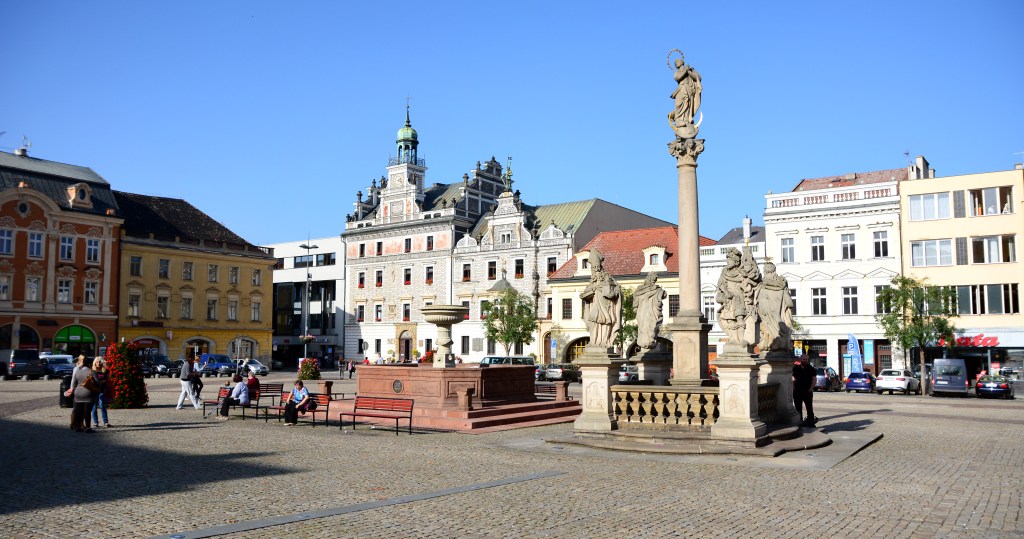
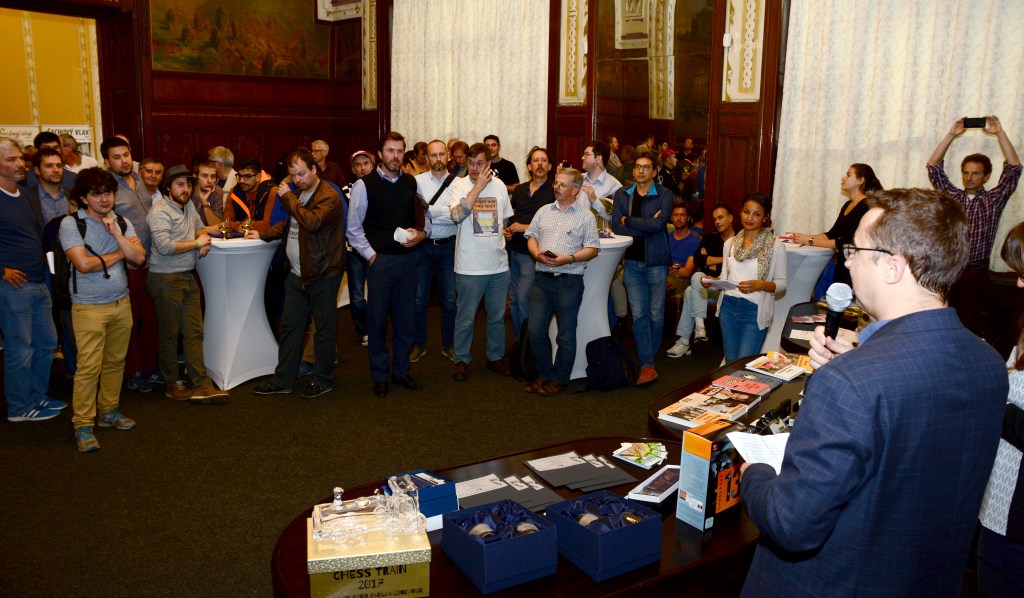
It is less than an hour from Kolin to Prague – the organisers used the time to work out who had won the many prizes to be presented on our return. I had played nine different nationalities in my nine rounds and finished on 3.5 points, not good enough for a prize. Upon arrival at Praha hlavní nádraží we all returned to the Government Lounge for the closing ceremony and prizegiving. Wine was provided and the ceremony began – the overall winner was Roman Khaetsky, a Ukrainian International Master, who finished on 7.5 points, half a point ahead of three rivals. After saying my farewells, I left and walked slowly back to my hotel.
For dinner, I revisited the restaurant that I had used on my first evening in Prague, this time ordering steak with green beans. After dinner, I tried the rooftop bar of my hotel with stunning views across night-time Prague to the castle illuminated by floodlights. By now the temperature had dropped and even wearing my thick jumper for the first time on the trip I felt rather chilly.
Wednesday 18 October 2017 – Prague to London
As my flight to London was not until the afternoon, I had a spare morning in Prague. I decided to visit the Vyšehrad fortress on a hill to the south of the city. As in Lednice the previous morning, it was misty when I first set out, but today the mist did not clear as the morning progressed.
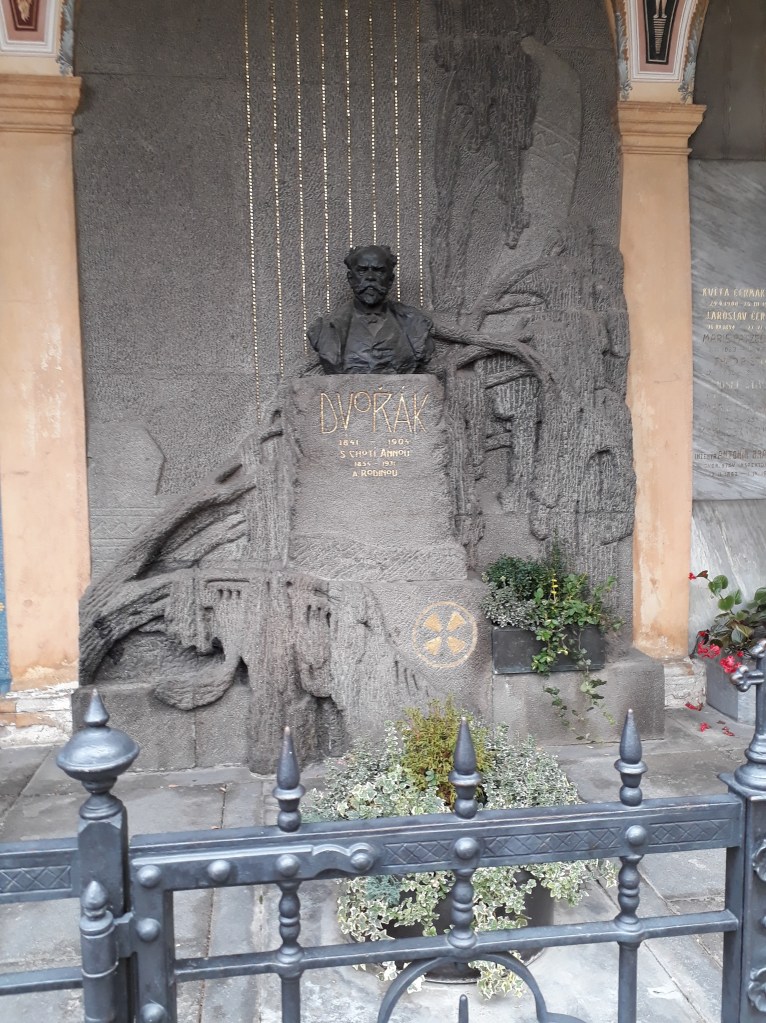
Entering Vyšehrad through the Tabor gate, the mist added to the atmosphere of the place, and because it was still quite early there were not many other people about. I spent some time wandering around the fortress complex, visiting a small exhibition on its history housed in a subterranean Gothic cellar. In the graveyard adjoining the church of Saints Peter & Paul, are buried many Czech luminaries. It was easy to find the resting places of the composers Antonín Dvořák and Bedřich Smetana.

After I left Vyšehrad, I went back to the centre of Prague and then on to the airport. The persistent fog was disrupting flights, but fortunately mine was only slightly delayed. It was a little disconcerting sitting on the runway to realise that you could no longer see the terminal building less than 100 metres away – however, the journey home was unproblematic. The week had been very enjoyable and I was already looking forward to the next year’s Chess Train, for which the organisers had announced the intention of visiting Poland.
 Europe Explored
2 Replies to “Chess Train 2017”