
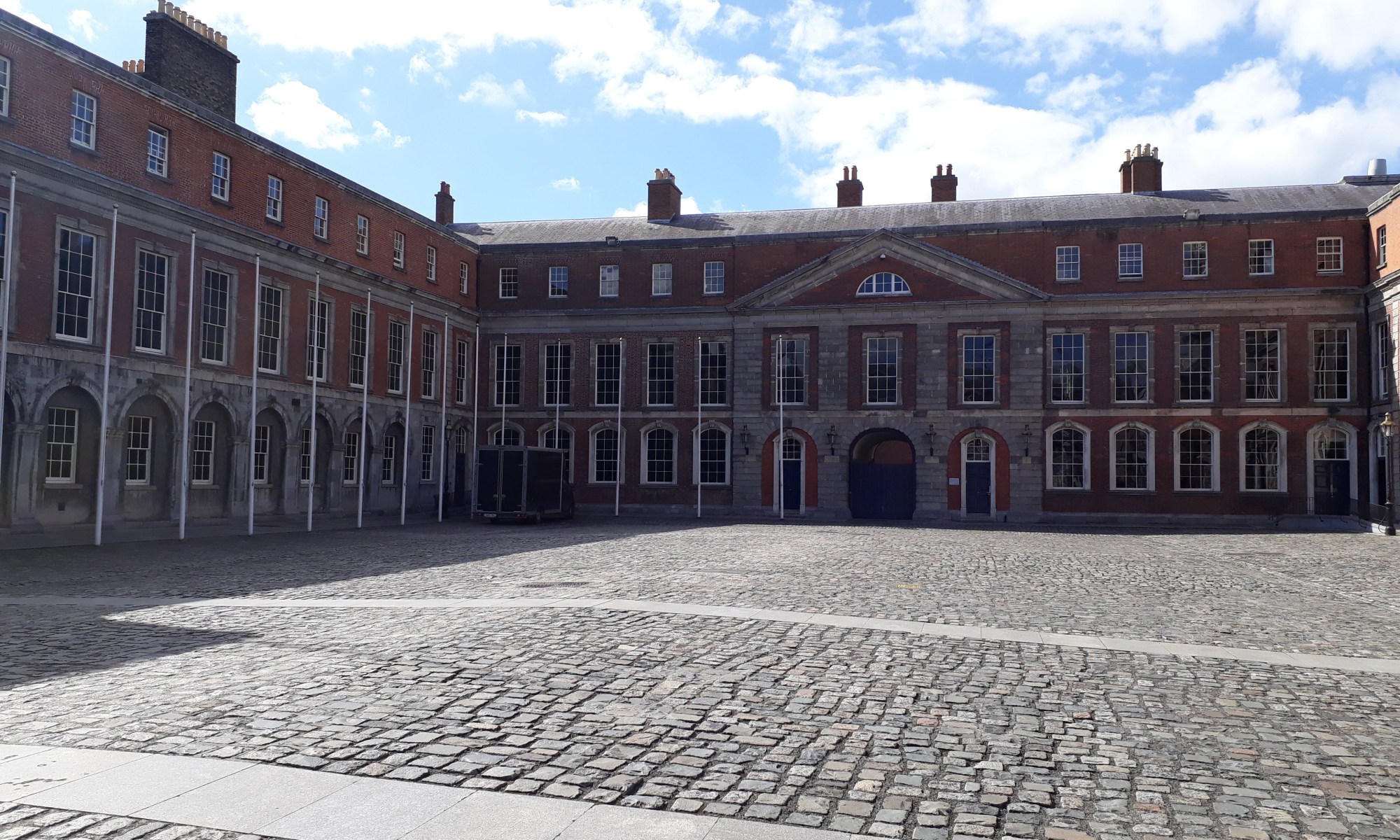
[In the absence of any travel being possible for the foreseeable future, I continue with another look back to a flying visit from a couple of years ago.]
In Dublin’s fair city,
Where the girls are so pretty,
I first set my eyes on sweet Molly Malone.
This month’s blog post recalls a two day trip to Dublin I made in September 2018. I subsequently revisited Dublin nine months later for a longer stay, as part of a family holiday to Ireland, which I may blog about on a future occasion.
Wednesday 12 September 2018
I followed my now usual pattern for these flying visits of getting up early and making my way to Stansted Airport for a breakfast time departure. Shortly after I arrived at Stansted, the airport descended into rather more chaos than usual, as the shuttle train, which which links the main terminal to many of the gates, broke down. This required a hasty arranging of replacement buses and long queues for them. My flight to Dublin was not from a gate which was served by the shuttle train, but did require a bus to access the plane. Presumably, because of the sudden demand for buses elsewhere in the airport, there was a long wait for a bus to appear to take the passengers to the Dublin plane and our departure was about half an hour late.
Just over an hour and a half after leaving Stansted, I arrived at a very busy Dublin airport. The first surprise was that arrivals from the UK were not segregated from those from other international destinations. The UK and Ireland form a Common Travel Area, and if you arrive by plane in the UK from Ireland, you are routed at the airport so that you miss immigration control, but not customs. However, in Ireland you just go through the same immigration controls as everyone else. In law, the Common Travel Area rules mean that a British or Irish citizen does not have to show a passport to enter Ireland, but the only way that you can easily prove that you are a British or Irish citizen is to show your passport – a classic Catch-22 situation.
I caught the bus to the city centre, alighting at O’Connell Street. The first thing I noticed was the 120 metres high needle-like structure, the Spire of Dublin, which had appeared since my previous visit to the city. This monument was erected in 2003 on the spot where Nelson’s Pillar had stood until it was blown up in 1966. I walked down O’Connell Street, pausing to have a little look inside the General Post Office, where the leaders of the 1916 Easter Rising had made their headquarters before finally surrendering to the British army.
I crossed the Liffey and made my way to the National Gallery of Ireland. I spent about an hour in the Gallery, which has a few interesting exhibits, but it is not really in the same class as galleries in other major European cities.
Next stop was lunch consisting of a sandwich and a pint of Guinness in an old fashioned pub, with added entertainment of listening to a couple of the other customers arguing about Irish politics.
I had pre-booked a guided tour of Dublin Castle for 2pm. This had cost me nothing, as the Irish Office of Public Works which manages the castle has a reciprocal deal with English Heritage, so that English Heritage members can book for free. Originally the seat of of British rule in Ireland, the castle is now used for ceremonial occasions, such as the inauguration of Irish presidents, and EU Council meetings. The tour started in the ruins of the medieval undercroft at the base of a now disappeared Norman tower. We then went to the Chapel Royal, which was the private chapel for the Lord Lieutenants of Ireland and had remained unused for many years following the end of British rule. The tour finished in the main state apartments, including the magnificent St Patrick’s Hall. When the tour was over, one could wander round the state apartments by yourself to look at things in more detail.
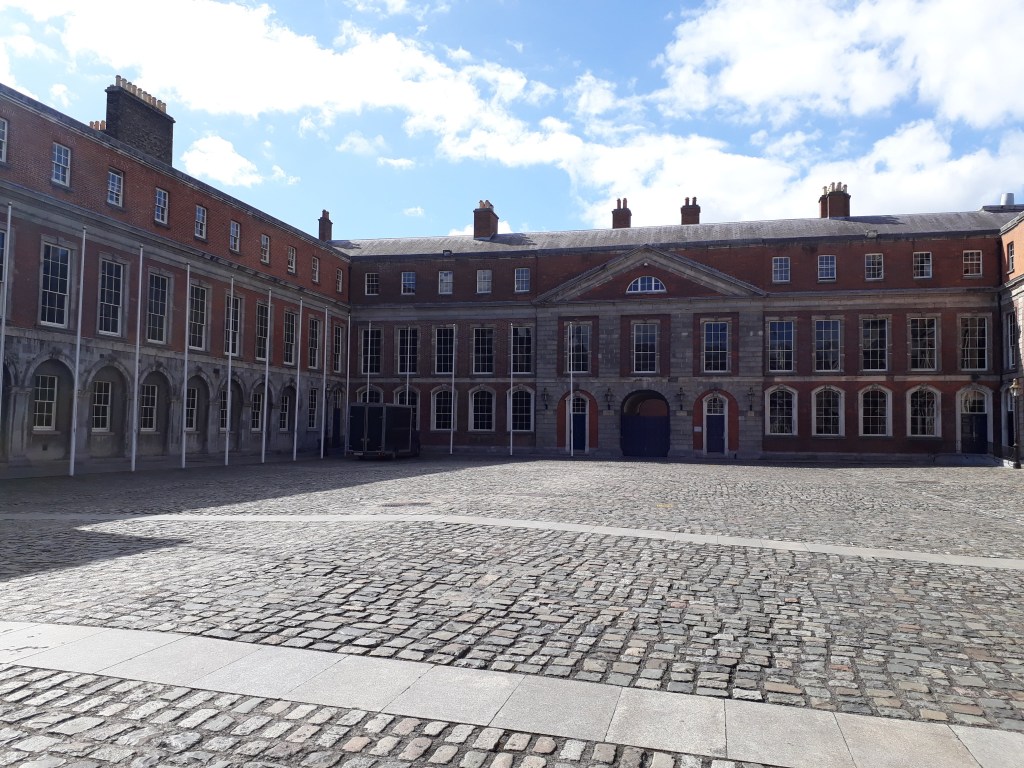
From the castle I walked across Dublin, crossing the Liffey at the Ha’penny Bridge.

My next visit was to EPIC, the then fairly newly opened Irish emigration museum. Calling it a museum is a slight misnomer, as it has virtually no original exhibits. Instead it is an extremely whizzy interactive multi-media exhibition spread over 20 rooms telling the story of the Irish diaspora. Epic is not a misnomer in terms of its size, as the amount of material presented would require many hours to fully experience. When you enter you are presented with a ‘passport’, which you self stamp in each of the rooms visited. Its claims about who should be considered Irish seemed a little tenuous for some people – for example, did you know Che Guevara was Irish? (His great-great-great-great grandfather came from Galway.) I just about managed to finish visiting all the rooms by closing time, when I was asked to leave. However, I had left my bag in a locker in a basement, which after I had retrieved it I discovered the signed exit route was now roped off. I suspect that I may have set off the alarms in my attempt to leave the building.
I then made my way to the hotel in the north of the city where I had booked a room for the night. While I was in my room contemplating where to eat that evening, I heard a lot of noise outside. There was an large demonstration passing by which brought traffic in the centre of Dublin to a halt. The demonstrators were protesting about the lack of affordable housing in Dublin, but specifically about the role of the Garda in assisting bailiffs evict squatters from a disused building the previous day.
Once the bulk of the demonstration had passed the hotel, I set off to find dinner. The streets were still closed to traffic and there was long jam of stationary trams at the top end of O’Connell Street. I found a busy restaurant where I ate lamb chops with onions. After my dinner, before retiring for the evening I visited a pub for a postprandial pint of Guinness.
Thursday 13 September 2018
I got up relatively early and after breakfast walked across Dublin to Trinity College. There I booked myself onto the the first student led tour of the day at 8:45am. An engaging final year law student took a small group of us round the campus, giving us anecdotes about student life past and present.
When the tour concluded, I was then free to visit Trinity College library. By this time it was already very busy with a queue to get in. Compared to my previous visit many years ago, the Book of Kells is now housed in its own exhibition space underneath the library – the library is housed from the first floor upwards to protect it from flooding. The impressive main gallery at the time of my visit was hosting a special exhibition on Erwin Schrӧdinger’s What is Life – most of the other tourists didn’t dwell on this, unlike the Book of Kells, giving me space to look at it properly.
After leaving Trinity College, I walked along the Liffey to the National Museum of Ireland (Decorative Arts and History) located in the old Collins Barracks. Unfortunately, because I had a timed ticket for my next stop, I did not have the opportunity to explore most of this museum. I only had time to look at the comprehensive special exhibition on the 1916 Easter Rising.
On leaving the museum, I had a short walk to Kilmainham Gaol. As with Dublin Castle, I had used my English Heritage membership to pre-book a tour for free. You can only visit by pre-booked tour, which sell out in advance – because I had only tried to book a few days before my visit, the only available slot was a bit later than ideally I would have liked. Our guide took us on tour to all parts of the prison, giving us information about its history from its opening in 1796 to its closure by the Free State government in 1924. Particularly poignant was the Stonebreakers’ Yard where 14 of the leaders of the 1916 Easter Rising had been executed by the British. (Our tour guide glossed over that the Free State had subsequently executed a larger number of Civil War anti-treaty prisoners in Kilmainham.) At the end of the tour, which lasted about an hour and a quarter, I was free to explore the Gaol’s museum – I did not have time to do this thoroughly, as I needed to leave to catch my flight back home.
I caught the airport bus outside Heuston station to the west of the city. The bus crawled through central Dublin rather more slowly than I had anticipated, meaning that I arrived at the airport less than an hour before my flight was due to leave. I was dismayed to find an enormous queue to get through security and I became worried that I might miss my flight. However the queue kept moving and within half an hour I was at the gate for my flight, which was just about to commence boarding. The flight actually managed to depart from its stand a few minutes early, but because of the number of planes waiting to leave it spent over half an hour in a queue taxiing to get to the runway, resulting in a late arrival at Stansted.
 Europe Explored