
“Wonderful, wonderful Copenhagen” (Danny Kaye song)
After my successful trip to Hamburg in April 2018, a month later I went to Copenhagen. Not only a new city for me, but also a new country, as I had never been to Denmark before.
Wednesday 23 May 2018
The flight to Copenhagen departed from Stansted over an hour later than the one I had caught the previous month when I went to Hamburg, so I had a slightly more relaxed journey to Stansted. I arrived with plenty of time to spare and acquired some breakfast at the airport. The flight departed shortly after 9am, touching down in Copenhagen 90 minutes later. Copenhagen airport is enormous – its catchment area includes southern Sweden (thanks to the Øresund Bridge, Malmö in Sweden is nearly as quick to reach as downtown Copenhagen) and it also acts as hub airport for flights from across Scandinavia. My plane spent an age taxiing to a far flung terminal, seemingly just for budget airlines, which was still in the process of construction.
Once I had made it from this remote outpost to the main airport terminal building, the first thing I did was to purchase a Copenhagen Card which provided free public transport in the city and admission to a large number of attractions.
To get to the city centre I had a choice of taking either the S-tog or the Metro from the airport. I chose the metro and travelled to Nørreport Station. In a recent ranking of Europe’s 50 busiest railway stations, Nørreport came next to bottom. I think this is rather unfair and I can think of many worse examples – Norreport is a busy subterranean station served by the Metro, S-tog and some mainline trains – equivalent to London’s Farringdon station, for example. It seemed quite functional and less dingy than some other underground railway stations.
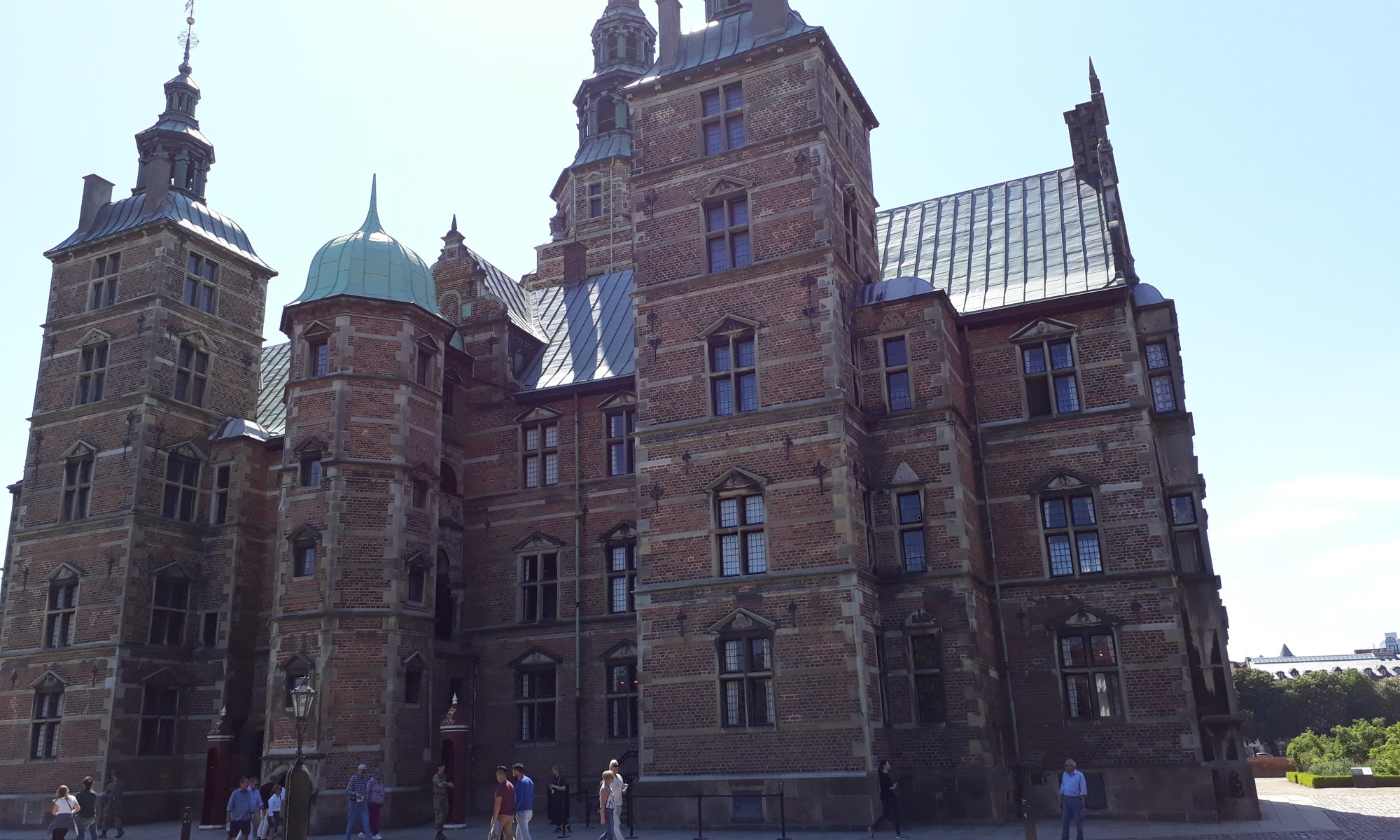
My first port of call was Rosenborg Slot, the renaissance royal castle built by Christian IV. Although no longer used as a royal residence, it is still protected by the Danish Royal Life Guards. My Copenhagen Card gave me free entry and I was lucky that I did not have to wait several hours for a timed slot, as can happen at busy periods. The main part of the castle consists of many small rooms over three floors, laid out with original furniture and other objects. Before entering the castle I was required to leave my backpack in a locker, but, having only just arrived in the country, I didn’t have any change to operate one – the understanding woman at the ticket desk lent me the required coin once I promised to her that I would pay her back. After visiting the rooms of the castle, I descended into the basement in which there is the Treasury, displaying the Danish Crown Jewels.
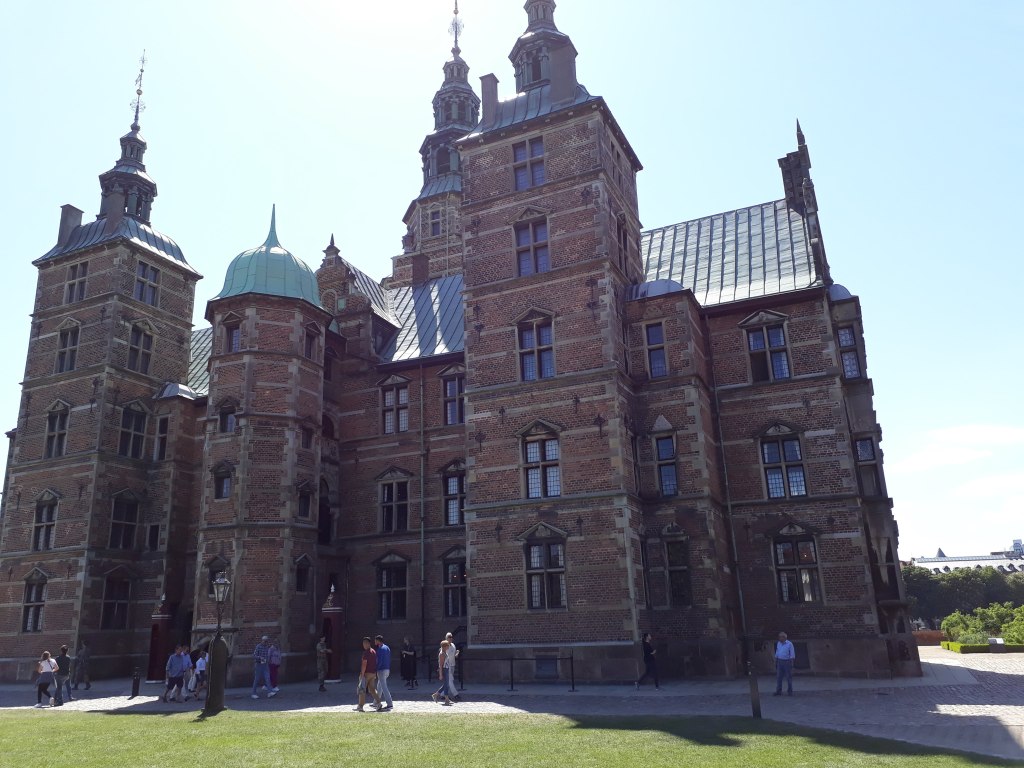
After finishing at Rosenborg Slot I walked through Kogens Have (Kings Garden), the park which surrounds the castle to the Amalienborg, the palace which is the current residence of the Danish Royal family. I had a look around the rooms which were open for viewing at the Amalienborg, which provided a potted history of the Royal Family. I was particularly taken by the wedding photograph of the current Crown Prince, Frederik, to his Australian bride Mary. She is the daughter of a Scottish maths professor, John Donaldson. In the picture the proud father was wearing full highland dress, seemingly upstaging most of the crowned heads of Europe in their regalia. The British Royal family only sent Prince Edward, so he was relegated to the back row of the photograph poking his head round a rather tall individual standing in front of him.
Next stop was SMK (Statens Museum for Kunst), Denmark’s National Gallery. It specialises in Danish and Nordic art, but also has a good collection of European art up to 1800. Unfortunately, at the time of my visit the galleries devoted to French art (1900-30) were temporarily closed.
After visiting the SMK, a short walk towards the city centre brought me to the Rundetårn, the astronomical observatory contained in a tower built by Christian IV in 1642. My guidebook said that it was built for Tycho Brahe, which cannot be the case as Brahe died in Prague in 1601, having left Denmark fours years earlier after falling out with the young Christian IV. The tower is impressive in having a spiral ramp all the way to the top, wide enough for a horse and carriage to be driven up. There were extensive views of the city from the top.
I then decided it was time to check in to my hotel near the Central station, but having so far only travelled by Metro, I thought I would try the S-tog for a change. This turned out to be a bit of a mistake, as a signal failure turned what should have been a five minute journey into one lasting half an hour. I carefully researched where to eat that evening, as Copenhagen’s restaurants are notoriously expensive, eventually choosing one near the Slotsholm Canal, where I had an interesting dish of pork and beetroot.
For my post dinner entertainment, I thought I would go the the Tivoli Gardens, the amusement park and pleasure gardens that have been in the centre of Copenhagen since the mid-nineteenth century. I made my way to the nearest entrance shown on my map, only to find that this just had automated turnstiles at which I could not use my Copenhagen card to gain free entry. The only entrance I could use for free was in the diagonally opposite corner of the park, nearly fifteen minutes walk away. When I got there, there was a queue to get in and the group ahead of me had some form of discount vouchers which required extensive negotiation and validation, delaying my entry further. I was not sure what to expect, but my overall impression from wandering around the park was of unredeemed naffness, such as you might find in the tackier bits of an English seaside town. However, there was a jazz concert scheduled to start in the open-air auditorium, which I thought might provide some entertainment. When I found the venue just after the performance had started, nearly all the seats had already been taken by a predominantly geriatric audience, so I just stood at the back. I don’t think I have ever witnessed a musical event where the performers looked more bored than the band playing that evening – to my eyes, they just seemed to be going through the motions to pick up their fee and would far rather have been somewhere else. After a short while, I decided I had had enough and left the park.
As it was still not very late, having checked the reviews (and applied for a second mortgage), I headed to a bar near the City Hall which had an extensive selection of beers. As most of the beers on offer had a similarly expensive price tag, I thought the best strategy was to buy one which was strongest in alcohol and drink it very slowly. Shortly after I sat at a table, a group of what appeared to be young professional types arrived and sat at the next table. They were having a lively conversation in Danish, of which I could understand none, when one of them in mid-stream inserted the English phrase “it takes one to know one”. It’s odd which foreign phrases make their way into languages.
Thursday 24 May 2018
I got up early and after a quick breakfast was on a bus shortly after 7:30am. Being in Copenhagen I could not leave without seeing the Little Mermaid. It was not as I expected in the centre of the city, but on the waterfront some way out to the north. By going early, I hoped to achieve two objectives – to not waste valuable time when other attractions would be open and also avoid the hordes who would be viewing it later. In this I succeeded, as the tour buses were starting to roll in as I was leaving.

As it was still early, I walked back along the waterside towards the centre of Copenhagen. It was now the busiest time of day for commuting and the broad cycle lanes (as wide as the carriageways for cars) were completely filled with phalanxes of cyclists.
I headed to the Christianborg Slot, the heart of the Danish Government and Parliament. I knew that I would not be able to visit the main state rooms, as they were closed for an official function that day, but I had hoped to see some other parts of the complex. Unfortunately, I had been misinformed about the opening times and when I arrived discovered they wouldn’t be opening until much later. Instead, I had to content myself with an exhibition of Danish political cartoons from the last hundred years or so, which was on display in the Parliament’s courtyard. It gave me a good overview of Danish political history, of which I had previously largely been unaware. Leaving the Christianborg Slot, I was able to see the horses of the royal stables being exercised.

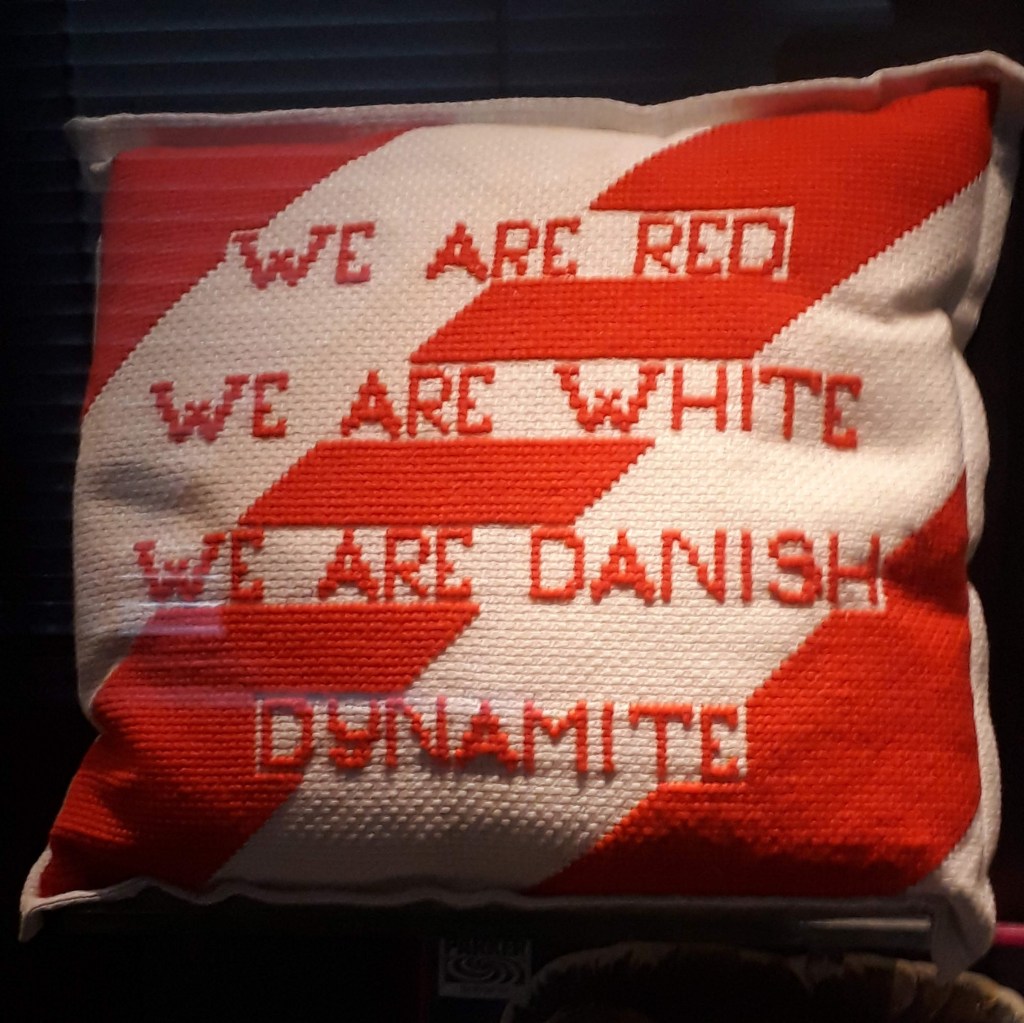
Next stop was the the Nationalmuseet, Denmark’s national museum. For me, one of the more surprising finds, tucked away on a stairway, was part of the Parthenon frieze – most of which controversially resides in the British Museum as the Elgin Marbles. There were extensive galleries devoted to the history of Denmark, from prehistoric times to the present day, which I found more interesting than the sections devoted to classical antiquities. The Danes seem particularly proud of their win in the 1992 European Football Championships, in which they only participated in the finals as a last minute replacement for war-torn Yugoslavia. These Championships came shortly after the agreement of the Maastricht Treaty which granted Denmark exemption from the more integrationist European projects (such as the Euro), the Danes at the time coined the phrase “if you can’t join them, beat them”.
After a brief pause to buy a licorice flavoured ice cream, I walked the short distance from the Nationalmuseet to Ny Carlsberg Glyptotek. This architecturally stunning gallery which is funded by the foundation established by the Carlsberg brewing family, houses a major collection of sculpture, as well as Danish and French art. It has more Rodin sculptures than anywhere outside France and a large exhibition of French 19th century painting with many pictures by Monet, Degas and Gaugin.
Before returning to the airport, I had time for a quick look inside the City Hall (Rådhus) which has a large enclosed courtyard where a number of wedding groups were congregating before and after their ceremonies.
I then wandered through the shopping streets to catch the Metro to the airport after a successful 26 hours or so in Copenhagen. One stop after I got on the Metro, a woman boarded and sat in the seat next to me until she also got off at the airport, where I did not see her again. When I boarded my plane, I thought that I might be lucky enough to have an empty seat next to me as it remained unoccupied until shortly before departure, when just before the plane doors closed the woman who had sat next to me on the Metro came aboard and sat in the spare seat next to me.
[Due to the Covid-19 epidemic, my current travels are on hold, depriving me of intended material for future blog posts. For the time being, future posts will only appear monthly at 8am on the last Friday of each month. I hope, but do not expect, that normality can return soon.]
 Europe Explored
One Reply to “”