
“I’m sitting in the railway station
Got a ticket to my destination
…
Homeward bound” (Paul Simon)
Monday 12th September 1983
Not having a bed for the night on the train from Bucharest meant that I did not manage much sleep. At about 7am the train reached Timișoara, the city where six years later the Romanian revolution first began. Many people left the train here, but the young Romanian woman and the three East African students that I had been sharing with since Bucharest did not – they were going all the way to Belgrade. This train was the only train of the day to make the border crossing between Romania and Yugoslavia (whereas now there are no trains at all).
The young woman told me that she was on her way to Rimini in Italy for a holiday. I thought that she must be very well connected, probably related to a senior government official, to be allowed such a privilege. Once we left Timișoara she produced a packet of cigarettes and proceeded one-by-one to empty the tobacco from each cigarette, then roll a large denomination US Dollar bill inside the paper case of each, before replacing the tobacco. When she had finished only close examination would reveal that this was anything other than a normal packet of cigarettes. Nonetheless, I was astonished that she should do this in full view of strangers and I had nervous anticipation of what might happen at the border.
We reached the Romanian border station of Stamora Moravita about an hour after leaving Timișoara. Here Romanian border guards entered our compartment. First they checked that everyone’s papers were in order to leave Romania – the visa I had obtained on entering the country was duly cancelled with another illegible stamp. Then the compartment, its occupants and our bags were thoroughly searched. I had placed my most disgustingly smelly dirty washing at the top of my bag, which made my searcher recoil when he first opened my bag and proceed rather more gingerly than before. Despite a lengthy search, my travelling companion’s stash of US Dollars was not discovered – she must have had nerves of steel, as she showed no emotion as her handbag containing the compromised cigarettes was rummaged through.
We eventually left Romania and a short time later crossed into Yugoslavia at Vrsac (now in Serbia), where further border formalities were to be conducted. Unlike for Hungary and Romania, I did not need a visa to enter Yugoslavia, so after a few questions an entry stamp was placed in my passport. The young Romanian woman’s papers were carefully scrutinised, but they were all in order. However, it became apparent that the three East African students did not have the visas that they required. A lengthy argument ensued and when it appeared that they might be escorted off the train, one of them delved into his belongings and produced a number of bags of coffee and offered them to the border guard. The border guard looked shocked and stormed out of the compartment. Some considerable time later he reappeared, accompanied by another official that I assumed to be the top man (judging by the amount of gold braid and ribbons on his uniform), with two armed guards either side of him. I thought that things might turn rather ugly at this stage. The original border guard seemed to be relating what had happened to his superior, who asked for the bags coffee to be produced again. The top man opened the bags and carefully smelled the contents – after some consideration he pocketed the coffee and gave the order that the necessary papers for the East Africans could now be issued!
After a lengthy delay we eventually left Vrsac and proceeded to Belgrade Danev station where we arrived at lunchtime about two hours late. Danev station was some way from the centre of Belgrade and my original plan was to catch a bus to the centre and have half a day exploring before catching another train that afternoon to Zagreb. However, the first problem I encountered was that despite Danev having a daily international arrival there was nowhere to change money at the station, so without Yugoslavian Dinars I was unable to catch a bus from there. Instead, I started walking towards the city centre, hoping to find a bank on the way where I could get some local currency.
After a while, I came across a bank which I was pleased to see did not seem too busy. It operated the old-fashioned system, whereby you had to go to one counter to initiate your transaction and having been given a chit then take it to a different counter for cash to be dispensed. Although there was only one person ahead of me in the queue, it transpired that he had about thirty different passbooks each one of which seemed to involve lengthy discussion at the first counter, followed by a very precise amount of notes and coins being counted out for each of the thirty chits at the second. By the time I had obtained my required Dinars I had spent about 90 minutes in the bank.
When I emerged I was somewhat concerned about catching my mid-afternoon train to Zagreb from Belgrade Central station. I made it just in time, but my sole sightseeing of Belgrade was just the visit to the bank.
My train to Zagreb left just after 3pm and I shared the compartment with a Yugoslav family. The contrast with the Romanian family I shared with a couple of days previously was striking. The Yugoslavs seemed much more jolly. Their clothes were more modern and brightly coloured, they had brought along a plentiful and varied picnic for the journey and the mother of the family was reading a glossy magazine with pictures of scantily clad women, which appeared to be a Yugoslav equivalent of Hello magazine.
Unfortunately, the train became delayed and got progressively later and later. So rather than arriving in Zagreb at about 7:30pm it was nearly 10pm before I eventually arrived. I had been planing to spend the night in Zagreb before catching an onward train the following lunchtime. Due to the late hour, the tourist office at the station had closed, so I ventured out into the still busy main square to see if I could find a hotel. The first hotel I tried said it was full and because of the trade fair taking place in Zagreb at the time they knew of no other hotels with vacancies.
I was left with no option but to return to the station, where fortunately there was a train to Italy due shortly. I had been looking forward to catching up on my sleep after not having much the previous night, but this now looked unlikely. I found my assigned compartment and discovered I was supposed to be sharing it with a couple who were clearly in the early stages of a relationship. Having thought that they were going to have the compartment to themselves for the night, they were understandably not enamoured that I had joined them. To make matters worse, the woman was Croatian and the man Brazilian, but their only common language was English, which neither of them spoke very well. As they tried to exchange lovers’ endearments in broken English, I wasn’t sure if I should try to help translate for them. After a while of suffering mutual embarrassment, one of them went looking for a spare compartment which they found, so they decamped there, leaving me with the compartment to myself for the rest of the night.
Tuesday 13th September 1983
Despite now having the compartment to myself, I found it difficult to get any sleep as the train made frequent stops as it travelled through Croatia and Slovenia, before halting at 3am for an hour at the Yugoslav/Italian border. I again used the trick of putting my smelliest dirty washing at the top of the bag to reduce the enthusiasm of the border officials rummaging through my belongings.
Once in Italy, the train continued via Trieste to Venice, picking up lots of passengers on the way, so by the time it arrived in Venice at about 0930 it was a packed commuter train. Part of the train was comprised of carriages which formed the Moscow to Rome express – though, as was common at the time, the train was continually being re-formed as through carriages to and from various destinations were added or detached. This necessitated lengthy stops to allow for these operations to take place – so in my view calling it an express was a misnomer. At Venice a stop of nearly an hour was scheduled, so I decided to stretch my legs by going for a short walk outside the station, leaving my bag on the train. When I returned, I had a slight panic as I could not not at first find my carriage where I had left my bag, as it had been shunted to a different platform – a section going to Milan remained where I had left the train, whereas the bit going to Florence and Rome had been moved.
Once reunited with my carriage, I travelled across northern Italy without further incident. There is only so much time one can spend looking out of the window, so by now I had moved on to read the second book of my trip – An Unfinished History of the World by Hugh Thomas.
The train arrived in Florence shortly before 3pm. I used the facilities at the station to secure a hotel room for two nights, which I went to straight away. The room was high ceilinged and airy in a rather old building, and I after I checked the bed by lying down on it, the next thing I remembered was waking up a couple of hours later. Falling straight asleep was not surprising, as I had had two consecutive nights travelling with little sleep. Once I did wake up it was early evening, so I ventured out to find something to eat.
Wednesday 14th September 1983
Given that I had been unable to spend Monday night (and Tuesday Morning) in Zagreb, I had gained a day compared with my original planned itinerary. I decided to use the extra time by going on a day trip from Florence to Pisa.
Pisa’s main claim to fame is its leaning tower, where Galileo allegedly confirmed that cannon balls of different masses reached the ground simultaneously when they were released at the same time. I headed straight to the Leaning Tower (or Campanile) after my hour long train ride from Florence. While the top of the tower was enclosed by railings, on the way up it was possible to walk along the outside of various levels which were completely unenclosed. As someone with no great head for heights, I found this scarier than being at the top. From the top there were good views across to the distant Apennines in one direction and the sea in the other.
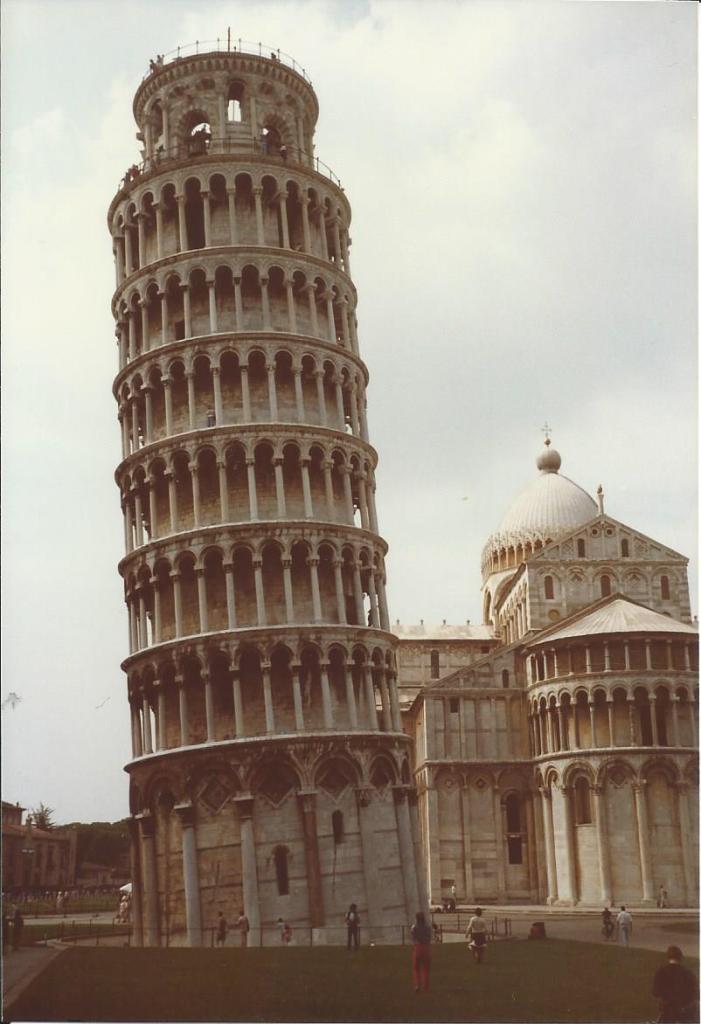
After visiting the tower, I also had a look at the adjoining Cathedral and its free standing Baptistry.
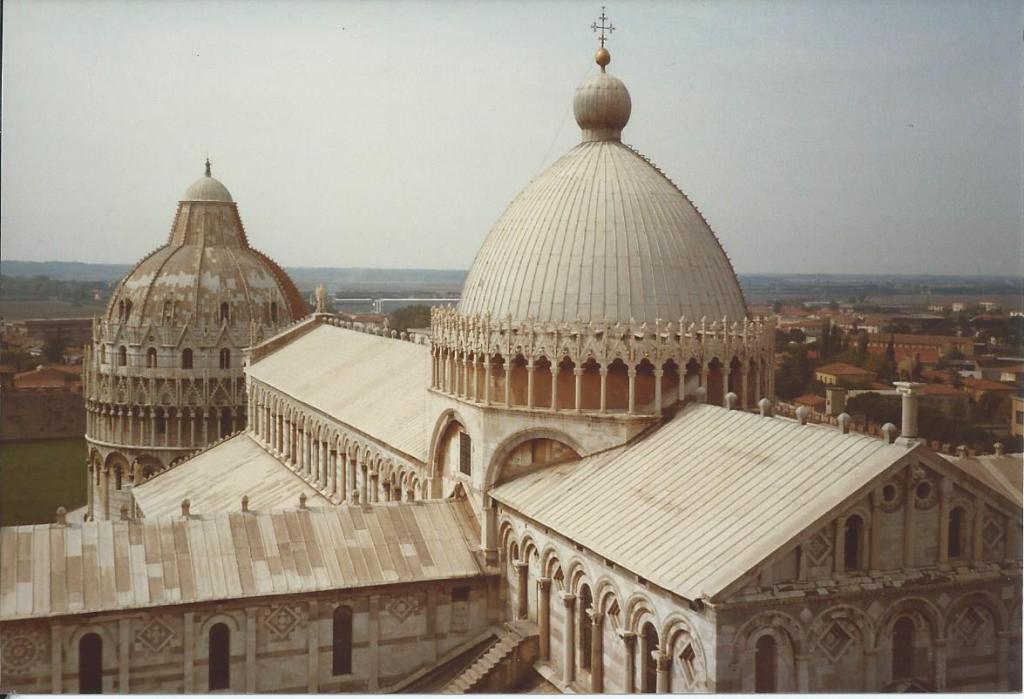
After lunch, I looked round round Pisa a little more before catching a train back to Florence to begin my exploration of that city.
Thursday 15th September
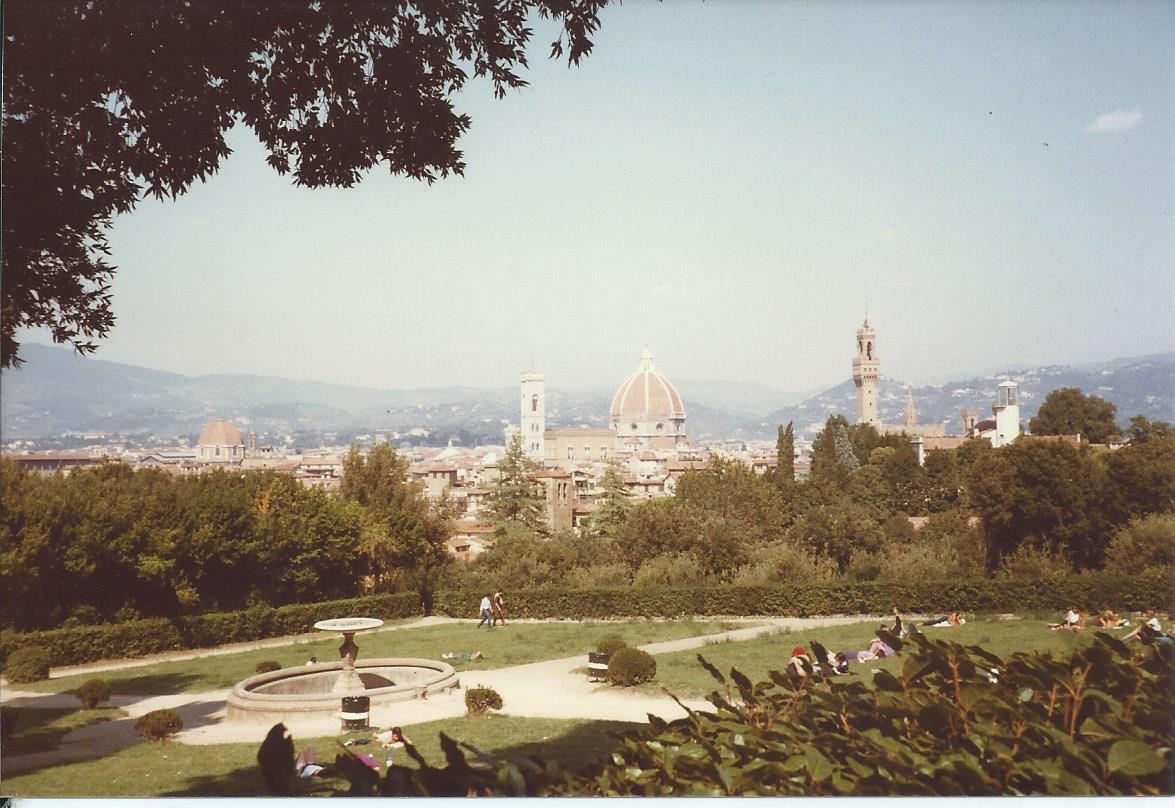
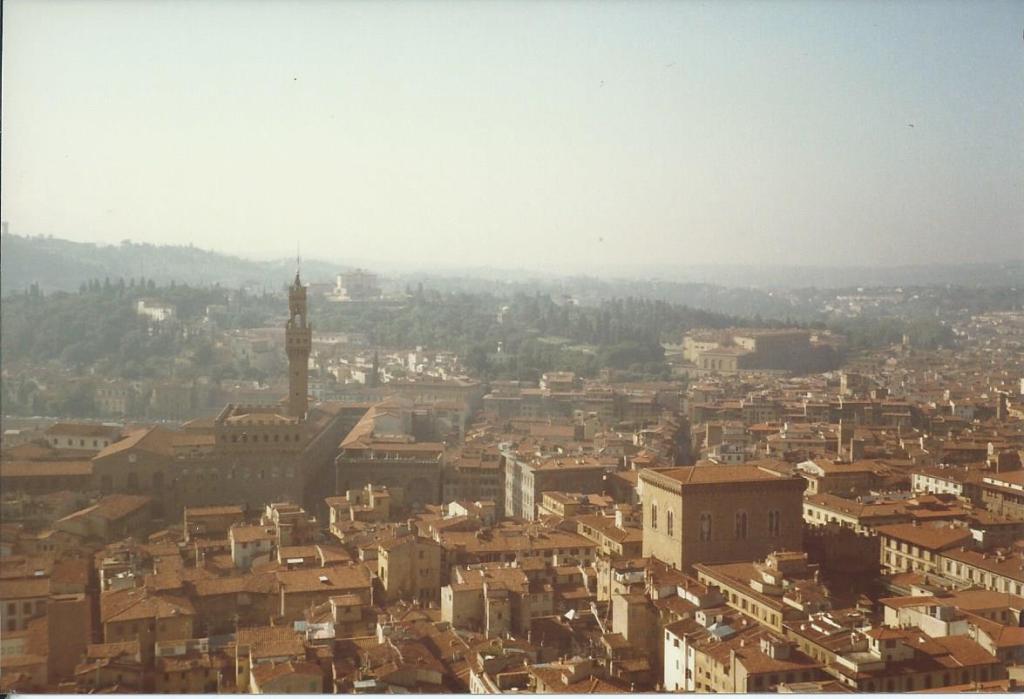
Florence was the focal point of the Renaissance under the Medicis and it still probably has a greater concentration of art than in any other city in the world. I first went to the Duomo and climbed the steps to the roof for great views over the city.
I then visited the Galleria Dell’Accademia, which houses Michelangelo’s David, followed by the extensive collections of the Uffizi, including Botticelli’s The Birth of Venus. Having a break, I recall eating my lunch while in the Boboli Gardens behind the Pitti Palace.

After lunch, I think I visited the Pitti Palace and walked across the Ponte Vecchio.

I had booked myself a couchette place on a train that was not leaving until just after midnight, so I had plenty of time that evening to ensure that I was well fed and watered before the next stage of my journey.
Friday 16th September
I was heading for Lucerne in Switzerland, but then (as now) Swiss hotels had a reputation for being extortionately expensive, so I had decided to finish my trip with two consecutive couchette nights. This would mean that I could have a full day in Lucerne without having the expense of a hotel.
Having left Florence just after midnight, I think I woke up briefly as we passed through Milan at about 4am. The train’s eventual destination was Stuttgart (via Zurich), so to get to Lucerne, I would need to change at the little junction station of Arth-Goldau at just after 9am. I remember while waiting in the train corridor as we approached Arth-Goldau overhearing a conversation between an American guy and an Italian woman. The woman said she was reading something by Goethe and asked him whether he had read any Goethe. Clearly nonplussed by this, yet trying not to look totally ignorant, he asked her to spell Goethe. After it was spelled out for him, he confidently announced “Oh, in English, he’s pronounced ‘Go’-‘Eth’.” At this point, I think I may have exchanged glances with the Italian woman to share our amusement of this display of self-confident ignorance which some Americans manage to perfect.
My connecting train was waiting at Arth-Goldau and it departed straight after the Zurich train had left. Just over half an hour later I arrived in Lucerne.
The first place I visited was the Swiss Transport and Postal Museum, which was a little way out of town along the lake shore. It had the advantage of offering free entry if you held an Interrail ticket. There were several locomotives and other rolling stock on display, as well as a model railway. In the postal section there was a working mock-up of a letter and packet sorting machine.
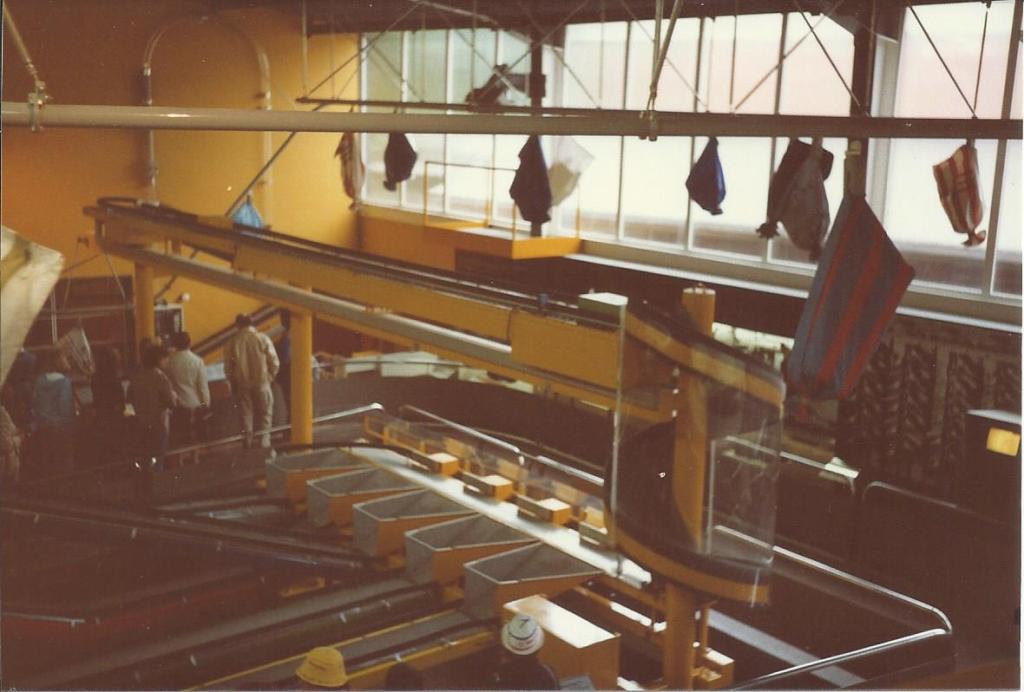
After I finished in the museum I returned to the centre of Lucerne by catching a boat along the lake. Unfortunately, the weather changed for the worse and the views of the surrounding mountains were obscured by low cloud and drizzle.
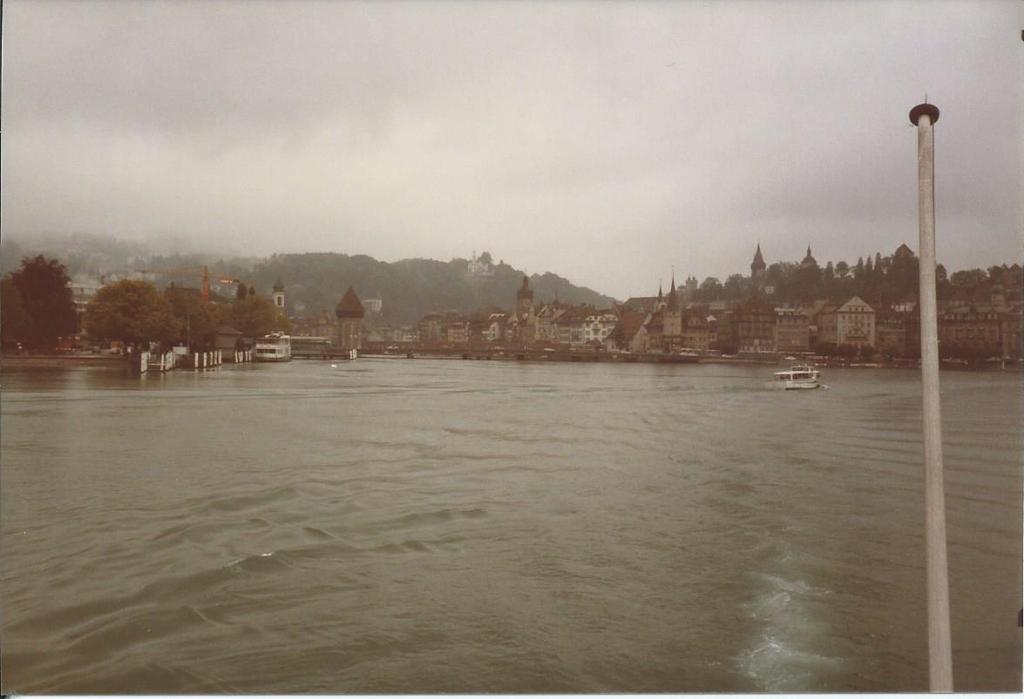
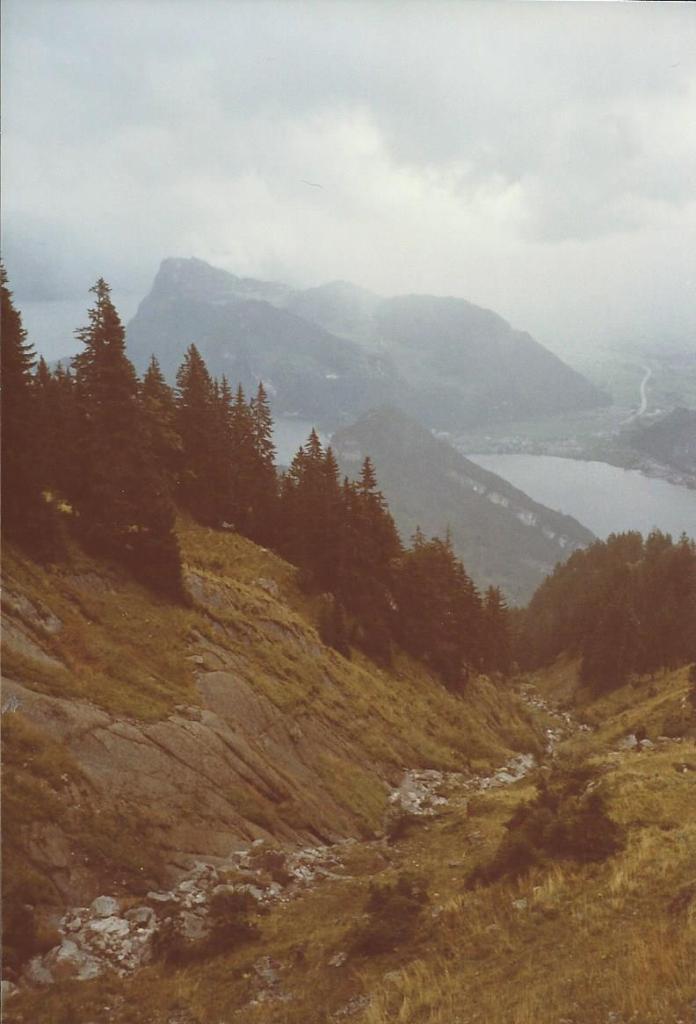
While the weather was bad I looked around the city, but by the late afternoon the cloud seemed to be lifting a little, so I risked going for a walk high above Lucerne to look down on the city and the lake.
I returned in plenty of time to find somewhere to eat, as my train, on which I had booked another couchette place, was not due to depart until 2215. The meal was good, but my wallet was thankful that this was the only dinner I would be having in Switzerland.
I got to Lucerne station in good time to find where my carriage would be, which would take me all the way to Calais (Maritime).
Saturday 17th September 1983
I think must have perfected the skill of sleeping on trains (or, alternatively, by this stage just been totally exhausted), as I slept fairly soundly until a very noisy French family disembarked at Lille at about 0745. The Lille station we stopped at was that which is now called Lille Flandres (to distinguish it from Lille Europe when that opened in 1993).
We reached Calais shortly after 9am and embarked on the Sealink ferry which departed at 0940 for the short crossing to Folkestone. Gaining an hour on the crossing, the boat docked at Folkestone Harbour at 1030. There then followed the usual queues to get through British immigration, before the connecting train could leave, slightly late at about 1115. (I revisited Folkestone five years ago in 2015 and I was saddened to see the harbour and its station in a state of dereliction – I wandered through the ruins reminiscing about how this had been my point of re-entry to Britain after many foreign trips. However, since my last visit I understand that it may have been redeveloped.)
After going up the hill after leaving the harbour, the electric train reversed direction before proceeding non-stop to London Victoria where it arrived at lunchtime. By 3pm I had arrived home at my flat in the suburbs.
I had only been home a little while when the phone rang. It was my best mate, with whom I had been out drinking the evening before I departed, checking that I had returned safely and suggesting that we meet up for a drink in central London that evening. I couldn’t resist the opportunity to be able to tell someone the stories from my trip so I readily agreed. Looking back I am amazed at the stamina I must have had as a 25 year old in 1983 – I’m sure that now I would just want an early night.
 Europe Explored