
“One’s destination is never a place, but a new way of seeing things.” (Henry Miller)
Wednesday 7th September 1983
The train from Budapest crossed into Romania at about midnight. The first noticeable difference was that the beer crate that had been freely dispensing all evening had to be locked away, but not before the Romanian borders guards who had now got on had each helped themselves to a bottle. A visa was also required to enter Romania, but unlike for Hungary, this could be obtained at the border. After a little bit of confusion about what needed to be done, various forms were filled in and a mandatory minimum amount of hard currency was exchanged for Romanian lei, resulting in my passport being returned with three 50 lei paper stamps being stuck on a visa page all overprinted with an illegible impression from a rubber stamp. After hanging around for over an hour at the border the train eventually moved off and I settled down to try to get some sleep.
We arrived in Sighișoara in Transylvania at about 7am, where I alighted. The first thing I did was to check the timetable at the station to confirm the time of the train that afternoon on which I intended to depart. However, there was a notice next to the timetable which I didn’t fully understand, but it seemed to imply that my intended departure may not be running, but that a departure a couple of hours earlier should be.
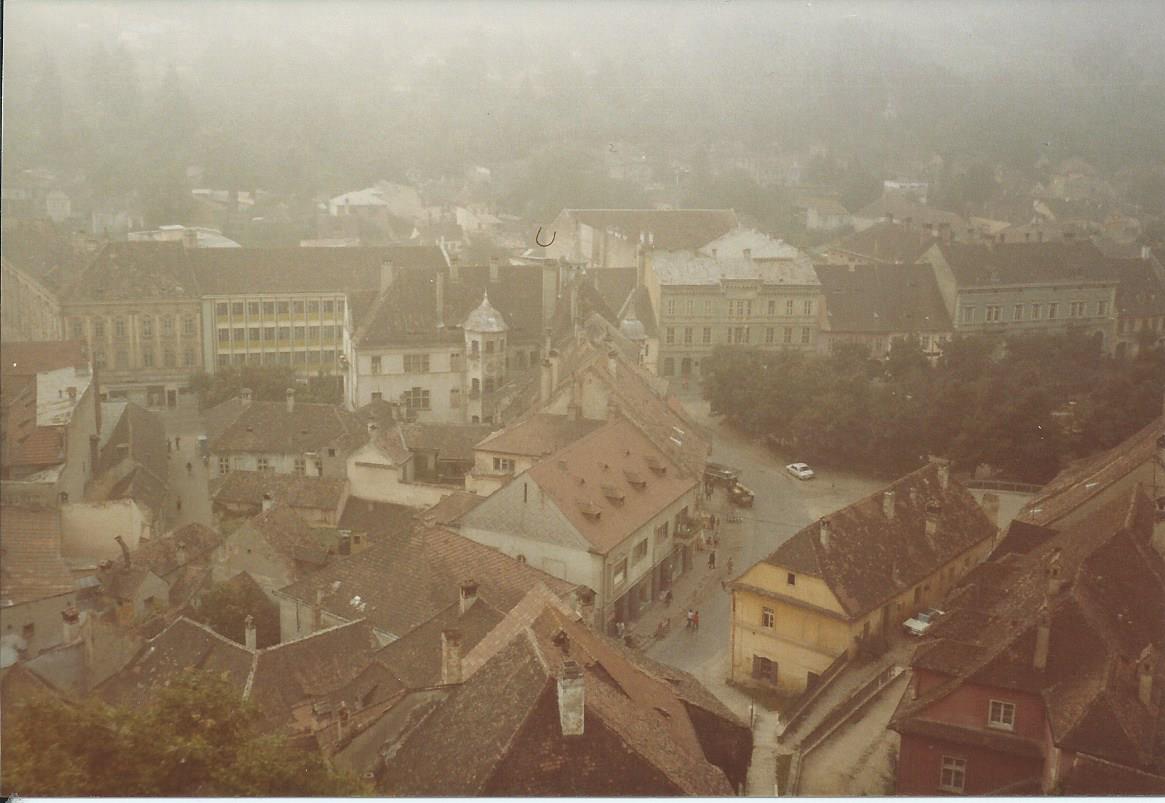
Walking into the centre of Sighișoara from the station was like stepping back in time. It was a misty morning and very few people seemed to be about, which added to the eerie atmosphere of the place.
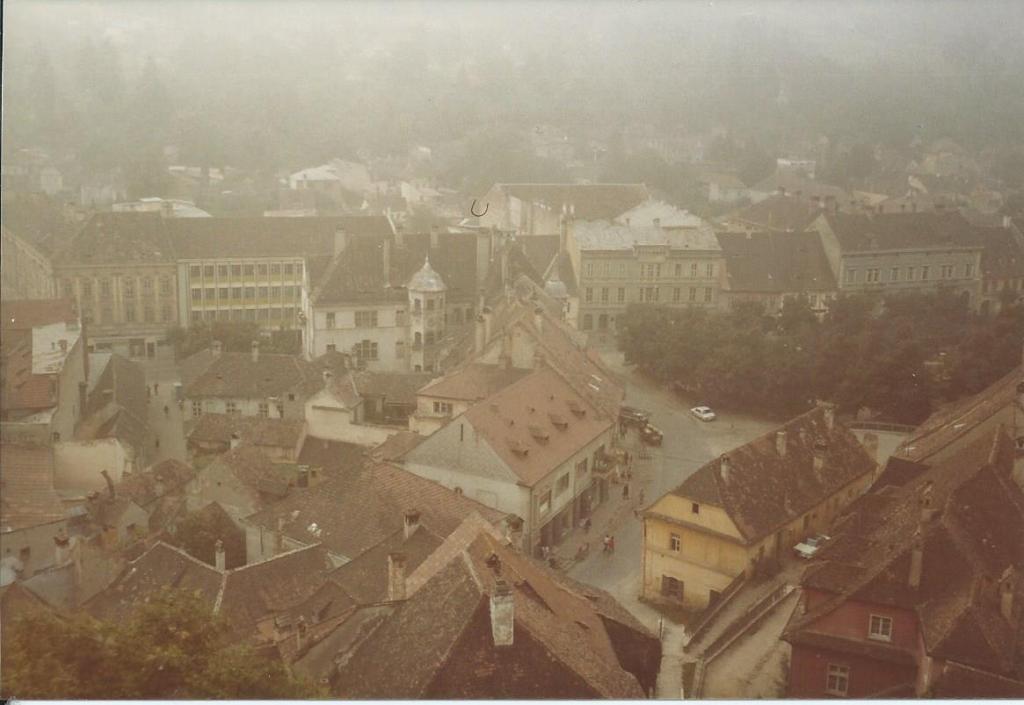
As nothing yet seemed to be open in the town, I decided to climb up above the town to visit the church on the hill. As I climbed, the mist thinned and as I approached the church, around which sheep were grazing, I could hear organ music from inside floating down the hill.
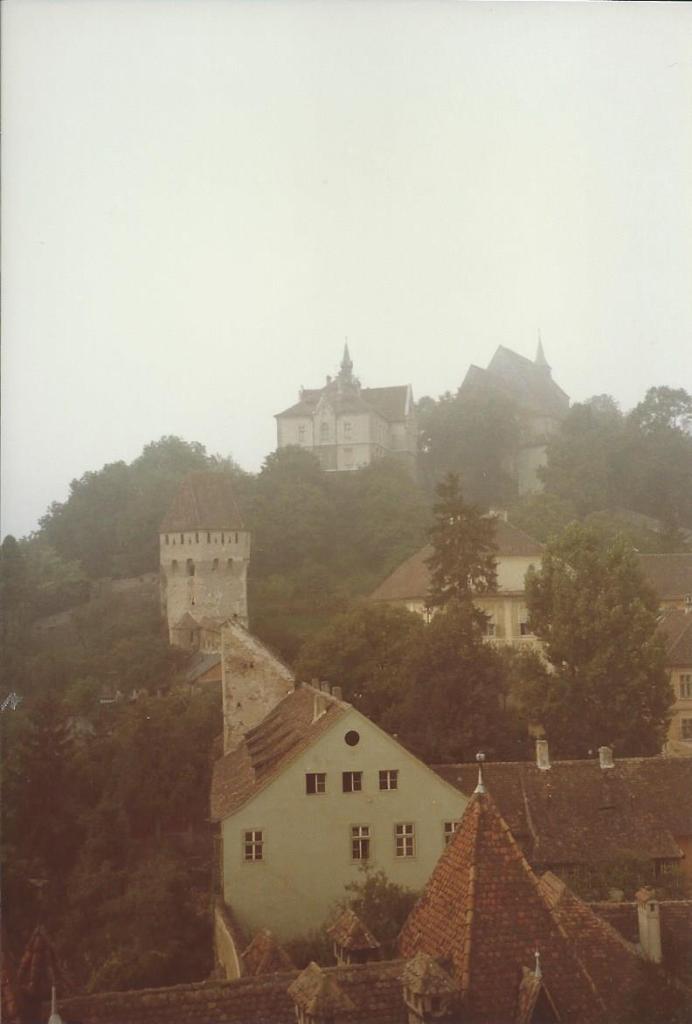
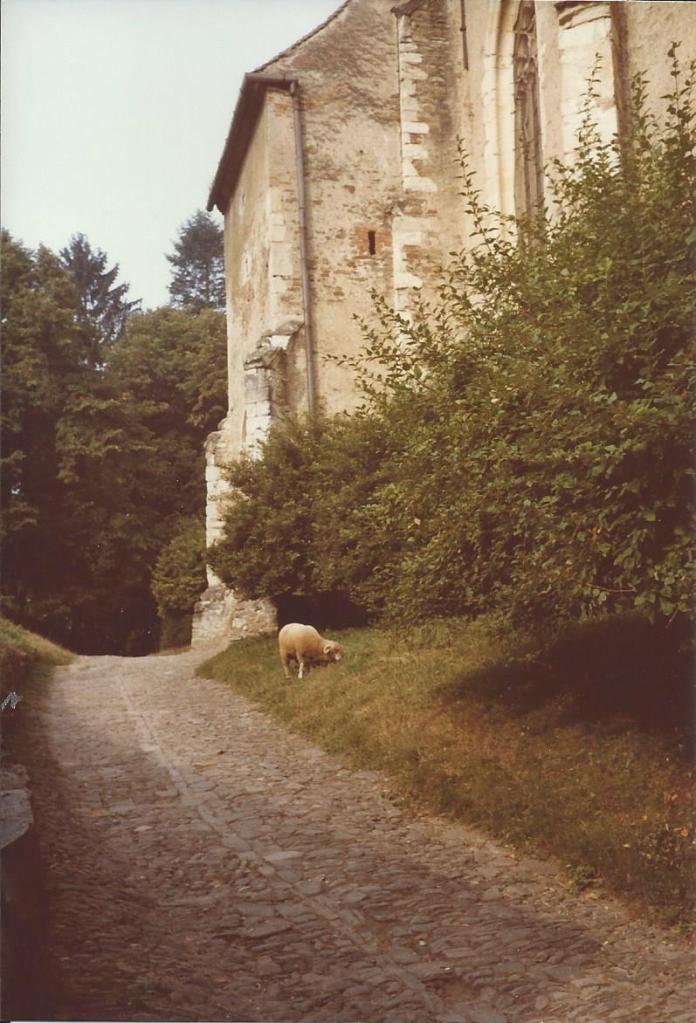
Despite there obviously being an organist playing inside the church, the door was locked and I had to content myself with listening from outside.
On my return to the town, it was noticeable that every shop and other public building had a picture of a youthful looking Nicolae Ceaușescu in the window. In the case of the shops, the picture of Ceaușescu was about all they had and I found it quite difficult to buy anything to eat. (It took me a little while to realise that the youthful picture seen displayed in every building in Romania was of the same person as the pictures of the rather more elderly individual which adorned the front page of every newspaper each day.)
I returned to the station about lunchtime and caught a train for the two hour journey to Brașov, where I arrived mid-afternoon. Unlike the bigger cities I had visited, there was no tourist office at the station to assist with finding accommodation, so I walked to the town centre and enquired at the only hotel I could find, using my best phrasebook translation, about having a single room for the night. The initial response from the person at the hotel desk was was that they had no rooms and that there were no other hotels nearby. However, after some persistence from me they eventually reluctantly disclosed that they did have double rooms and I could have one of those if I was prepared to pay the double room price!
That evening when I went looking for somewhere to eat, I discovered that restaurants in Romania at the time did not have written menus, which makes ordering slightly tricky if you and the waiter don’t share a common language. (A few days later, when talking to a waiter with whom I could communicate a little, I was told that since restaurants did not know from one day to the next what food, if any, they would have, there was little point in preparing written menus.) I eventually did get served a meal in Brașov, but I remember it being rather sparse and unappetising. The contrast with its communist neighbour Hungary, where the choice of food was plentiful and portions generous, was striking.
Thursday 8th September 1983
Brașov is dominated by Tampa mountain which overlooks the city. In the morning I decided to go to the top using the cable car which departs from the edge of the built-up area. I arrived when they were just opening up and I was the only passenger for the ride to the top. However, good use was made of the space in the cable car in which I rode, as I shared it with a crate of fish which was being sent up to a restaurant at the top of the mountain. Having admired the views from the top, I walked back down to Brașov by following a marked hiking trail.
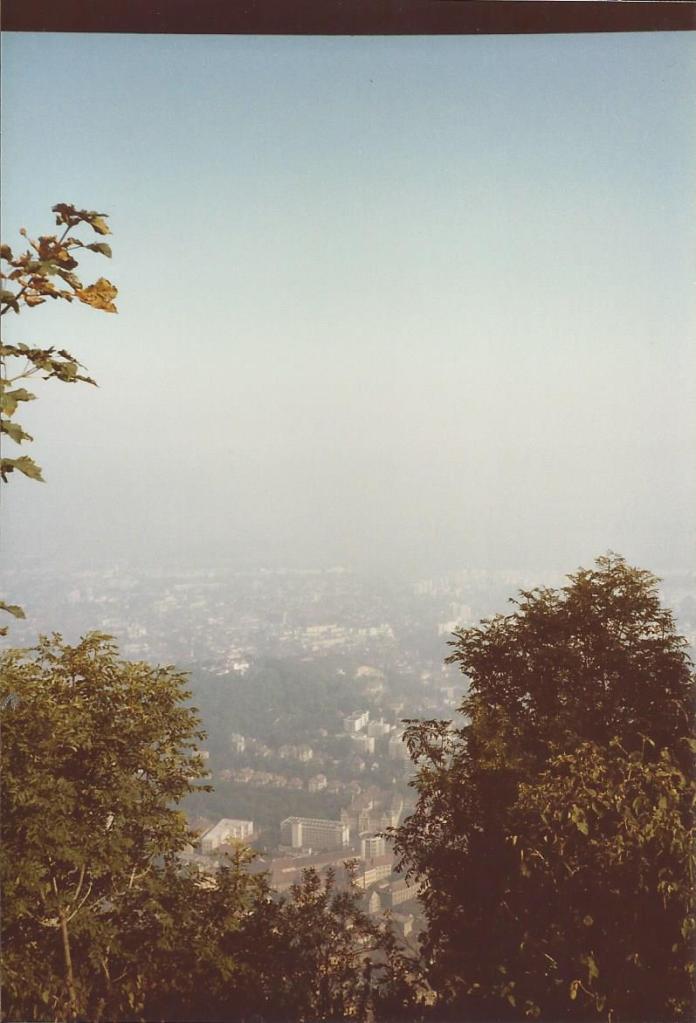
In the afternoon I caught a train for the three hour journey to Bucharest. At Bucharest Nord station there was an accommodation finding service which secured me a small room for two nights in a rather dingy hotel not far from the station.
Friday 9th September
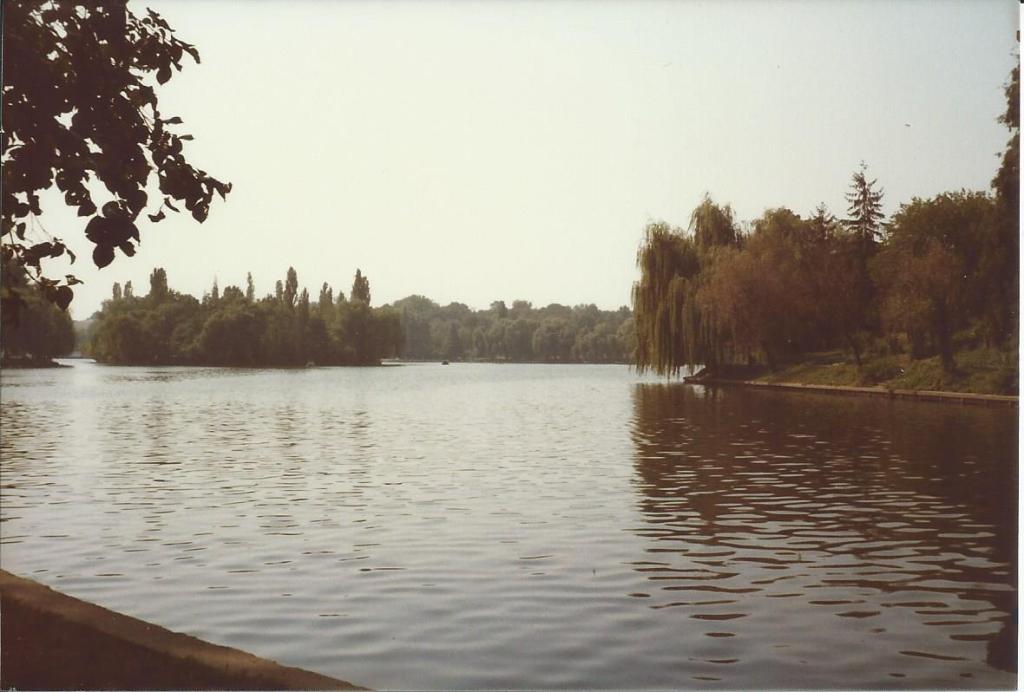
In the morning I travelled a little way from the city centre to visit Herăstrău Park (now renamed the King Michael I park) where there was a Village Museum which consisted of a collection of peasant houses in different styles from around the country.
In the afternoon I went to the National Museum of History, which had a couple of galleries devoted to the Ceaușescus. Amusingly, among the exhibits on display in these galleries were various knick-knacks picked up by the Ceaușescus on their foreign visits, including, for example, an ashtray from British Aerospace’s Filton works and a towel bearing the British royal insignia from Buckingham Palace. There was a whole section devoted to the achievements of Elena Ceaușescu as a chemist, including various honorary PhD certificates awarded by universities from around the world. The exhibition suggested that Elena Ceaușescu could expect to receive the Nobel Prize in Chemistry imminently, which, of course, for some reason, never happened.
That evening, for the first time since I arrived in Romania, I found a restaurant which had a menu and I ate a substantial meal. Unfortunately, my constitution had become unaccustomed to eating well, so after I left the restaurant and was walking through Bucharest I felt a sudden need to visit a toilet. There seemed to be no nearby public conveniences and I realised that I would not be able to make it back to my hotel, leaving me with no option but disappear into a small unlit park adjoining a large public building. Part way through doing my business there, all of a sudden floodlights came on illuminating the whole area. In my haste to make myself decent, and not wishing to have to explain my business in the park to the authorities, I managed to leave behind my underpants. I was thankful to make it back to my hotel without further incident.
Saturday 10th September 1983
In the late morning I made my way to Bucharest Nord to catch a train to the coast. The train was packed, mainly with families apparently setting off on late summer holidays, so I was glad that I had a reservation. I shared my compartment with a smartly dressed Romanian family – the father, who was wearing a suit, spent the journey intently reading a densely typed newspaper – it looked rather dull, the few pictures in it were of Nicolae Ceaușescu.
Just before 4pm we reached Constanța, a large port city on the Black Sea, where the family I had shared with from Bucharest got off. They were replaced by a Romanian couple. As the train travelled along the coast in the beautifully warm late afternoon, the couple tried to engage me in conversation, with only limited success due to language difficulties.
Just before 6pm the train reached its final destination of Mangalia. There was no tourist office at the station, so I walked a couple of blocks down to the seafront and enquired at a modern looking hotel whether they had a room for the night. Fortunately, they did – I was given a key, so I went to the room and left my bag, before immediately heading out for a quick explore of the town, as the hotel would be providing dinner shortly. Upon my return to the hotel I asked for the key to my room, but the receptionist refused to give it to me – he said that the room was broken and gave me the key to an alternative room instead. It took much persuasion to let me return to my original room to retrieve my bag. I was not allowed to do this unaccompanied – the original room looked exactly as I had left it and everything seemed to be working normally. My replacement room seemed identical, so I can only suppose that the difference was that my new room had functioning bugging equipment and that the Securitate wished to keep tabs on me.
I went down to dinner, which was generous and good quality. The main course consisted of steak and chips – the only downside was that the steak was served topped with a fried egg, and I have a life-long revulsion of eating eggs. At dinner, I discovered that all the fellow residents appeared to be elderly East Germans on a package holiday, and men formed a very small minority of the group. The East German grannies seemed delighted to have a young western man among their midst and were keen to associate with me during and after dinner. Once dinner was over, after a while I made my excuses and left.
I walked along the seafront and came to a bar where a number of people were drinking outside. I tried to order a beer, only to find that they had run out. All of a sudden, most of those in the bar got up and started running down the road. I realised that they had spotted a beer lorry and were running after it, to see where it was going to deliver to next. I followed and saw a number of crates of beer were being delivered to another bar a little further along the seafront road. I managed to buy a beer from the newly unloaded crates at this bar, which I drank before returning to my hotel to go to bed.
As I was convinced that I had been moved to a bugged room, I provided a running commentary as I got ready for bed saying that it was for the benefit of those listening.
Sunday 11th September 1983
The Sunday morning was not quite as warm as the previous day had been, but still pleasant enough for me to fulfil the objective for the whole trip – to sit on the beach and swim in the Black Sea.
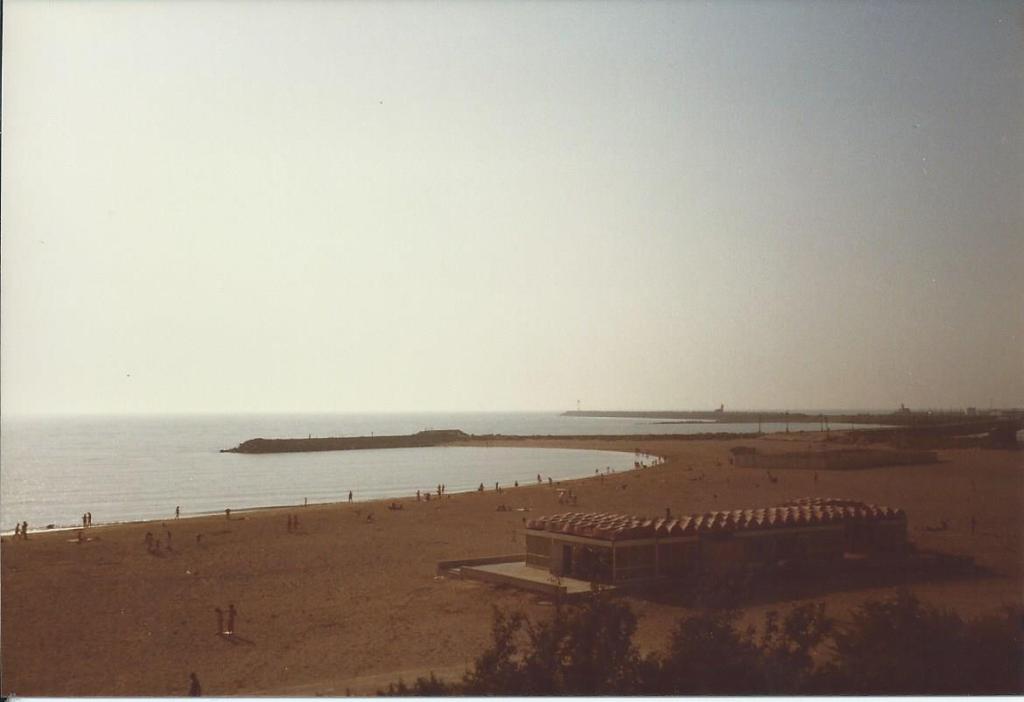
Mangalia is very close to the Bulgarian border and on the horizon to the south one could see various Bulgarian industrial works.
After a morning on the beach, I returned to the station at lunchtime to catch a train back to Bucharest. This train, although reasonably busy, was not as crowded as the previous day’s train to the coast.
I arrived in Bucharest in the early evening, in good time to catch my next overnight train at 2230. I ventured into the city to find somewhere to eat. After dinner, I found a bar (with beer!) on the main square opposite Romania’s flagship hotel, the Athenee Palace. Observing the world go by in this area, then called Republic Square, one could just about see why Bucharest was called the Paris of the East. The square is now called Revolution Square, as it was the scene of some of the fiercest fighting in the Romanian revolution which overthrew Ceaușescu in 1989.
I returned to Bucharest Nord with plenty of time to catch my 2230 departure to Belgrade. I was somewhat surprised to discover that you were not allowed to enter the station at that time of the evening unless you could show that you had a valid ticket. Even the socialist paradise that was Romania had a problem with rough sleepers using the station at night. The train I was catching to Belgrade only had seating or sleeper compartments, not convertible couchettes like those I had used on my overnight trip from Budapest. When I had first arrived in Bucharest a few days earlier, I had tried to book a bed in the sleeper for tonight’s trip, but none were available, so I just had to make do with a seat reservation. I discovered that I was sharing the compartment for the overnight journey with a young Romanian woman travelling by herself and three male East African students. Shortly after departure we all settled down to try to sleep as best we could.
 Europe Explored