
“Vienna is a handsome, lively city, and pleases me exceedingly.” (Frederic Chopin)
Thursday 1st September 1983
That morning a I caught one of the frequent trains from Munich for the 90 minute journey to Salzburg. Upon arrival, I found that Salzburg station was divided into separate German and Austrian sections and that to leave the German part of the station one had to go through immigration. As Austria was not part of the EEC (as it was then called), the immigration checks were more formal than there had been between Holland and Germany.
I have to admit that Salzburg is the one city visited on this trip that I remember least about. I do recall that it was very touristy and that the same image of Mozart was ubiquitous on the streets and in the shops. Looking back at the photographs I took of the views of the city, I must have been up to the Hohensalzburg Fortress, but it left no abiding memories.

However, I do remember that evening catching some of the television news in the lobby of the hotel where I was staying – which appeared to be leading with a plane crash in Asia. I didn’t think too much about it at the time – but its significance would become apparent a few days later.
Friday 2nd September 1983
I left Salzburg in the morning for the very scenic three hour journey to Vienna, initially following the narrow valley of the River Fishach, arriving at Westbahnhof (now supplanted in importance by the new Hauptbahnhof) around lunchtime.
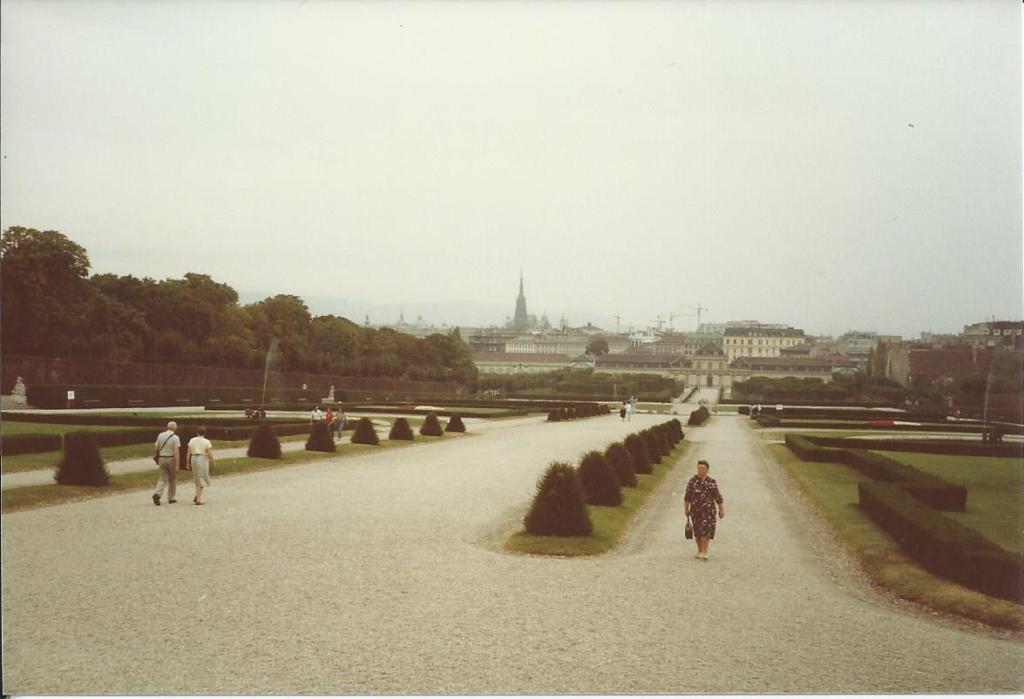
After finding somehere to stay for two nights, I spent the afternoon exploring the sights of the Altstadt and visited the Belvedere including its gallery of modern art.
Saturday 3rd September 1983
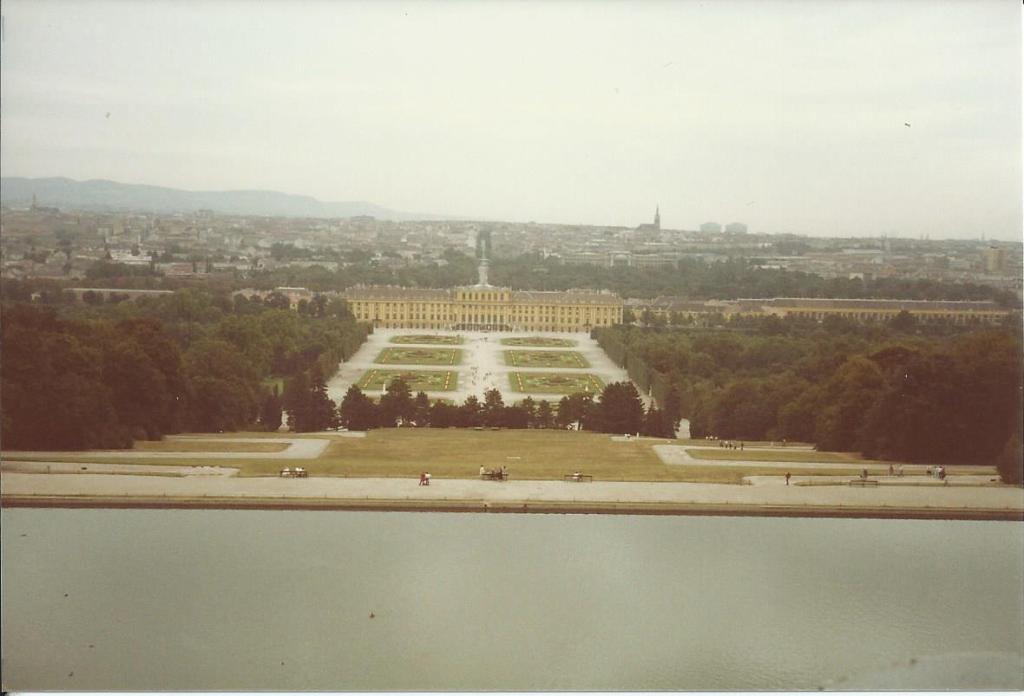
In the morning I visited the Schönbrunn Palace, the Habsburg’s summer residence, with its extensive gardens.
By the afternoon, I had tired of city bustle, so I caught a 38 bus out to the Vienna Woods, which rise high above the city to the north. Being a Saturday afternoon, many Viennese had the same idea and the cafe near the bus terminus was busy. However, the woods are large and it was easy enough to lose the crowds by following one of the many paths leading from the summit.
Sunday 4th September 1983
I returned to Westbahnhof to catch a Sunday morning train to Budapest. This would be the first time I had visited a communist country. After the train left Vienna, I found a discarded copy of an English language newspaper. The news was dominated by the shooting down of a Korean passenger jet (KAL 007) by a Soviet fighter, the first inklings of which I had picked up in Salzburg. Rather alarmingly for me, the newspaper also reported that, in a major ratcheting up of cold war tension, Ronald Reagan was threatening to isolate the Soviet bloc by “sealing the iron curtain” – I read this just half an before I was about to cross the border and made me wonder how I would get out.
The border was reached late morning, where the train stopped at Hegyeshalom station for about half an hour so that Hungarian officials could board and carry out their necessary checks. The visa I had obtained in London was inspected and stamped – fortunately everything was in order and the formalities were fairly painless. We then proceeded to Budapest, where I arrived at about 2:30pm.
Hotel beds in Budapest were in short supply, but the tourist office at Keleti station would happily arrange accommodation in private houses. I was given the address of a house where I could stay for the next two nights. I went straight there from the station, being at the end of a bus route deep in the suburbs of Budapest. Going there straight away was a mistake, as when I arrived at the house there was nobody in. So I returned to the centre and spent a bit of time exploring the city. The first noticeable difference with the west was that on busy streets there was a strange fuel smell, which I presumed was due to the predominant two-stroke engines not fully combusting properly. After no difficulty in finding a good evening meal, I returned to the house in the suburbs, where fortunately my hosts had returned. The house was a fairly small bungalow and my bed was in their front room, which I think that they sometimes also used as a dining room.
Monday 5th September 1983
I awoke early and while waiting for my breakfast to be prepared I took the opportunity to scan the well stocked bookcases in the room in which I had been sleeping. I can never resist looking at other people’s book collections, even if they are in a language I don’t understand. Among the books I was surprised to find a photographic record of the 1956 Hungarian uprising, clearly not written from the then communist party perspective. I imagine it would have been unthinkable to find such a book openly on display in a similar East German or Czechoslovak household.
As it was a nice sunny day, I decided to go on a day trip to spend the day at the beach. As I was in a landlocked country in the middle of central Europe, the beach would have to be on Lake Balaton, the largest lake in central Europe and a pleasure ground for Hungarians.
To get to the south shore of Lake Balaton I caught a train that morning from Budapest Deli and travelled for a couple of hours down to Siofok. On the the train, a rotund Hungarian carrying three carrier bags of food sat opposite me – during the course of the next two hours he proceeded to consume without pause the contents of his carrier bags. I think I heard it said that the Hungarians eat the largest breakfast of any nation in Europe, but that it is the smallest of the three meals that they consume each day.
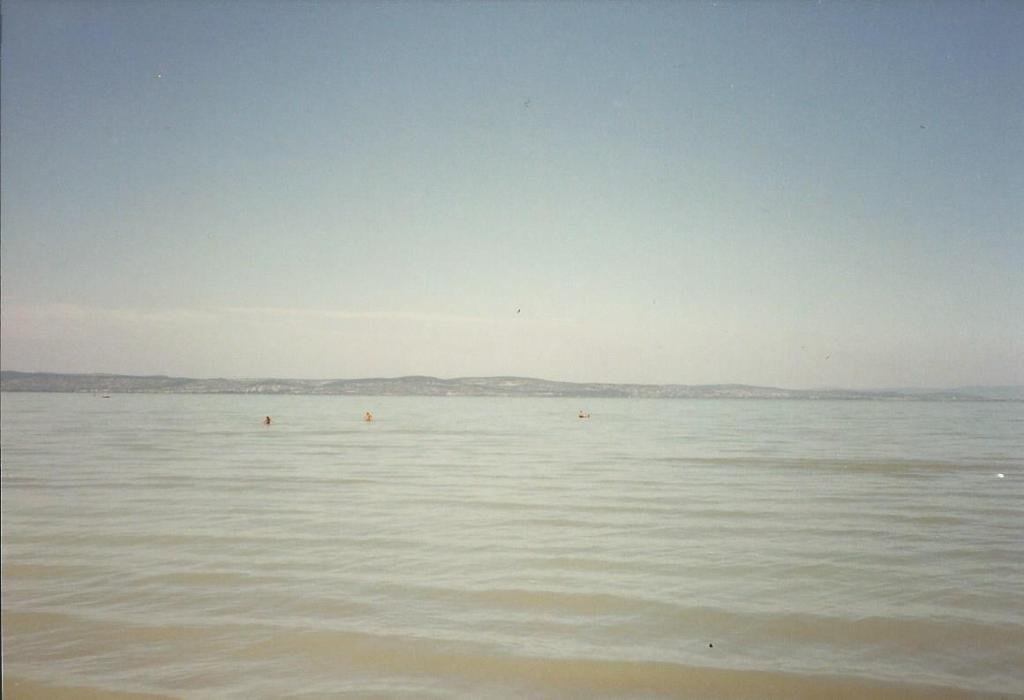
I arrived in Siofok (or possibly one of the other towns nearby, I can no longer remember exactly). It was just like any seaside resort with sandy beaches and the usual garish seaside facilities. I spent most of the day lounging on the beach and swimming in the lake.
Once I had had enough I caught the train back to Budapest, arriving in the early evening, where I had something to eat before heading to where I was staying in the suburbs.
Tuesday 6th September 1983
After my day at the beach, today would be the main day for exploring Budapest. Up until now I had largely seen Pest, the government and commercial heart of the city. On the other side of the Danube is Buda with ancient streets set among rolling hils. On Castle Hill there was Matthias Cathedral and the main historical museum.

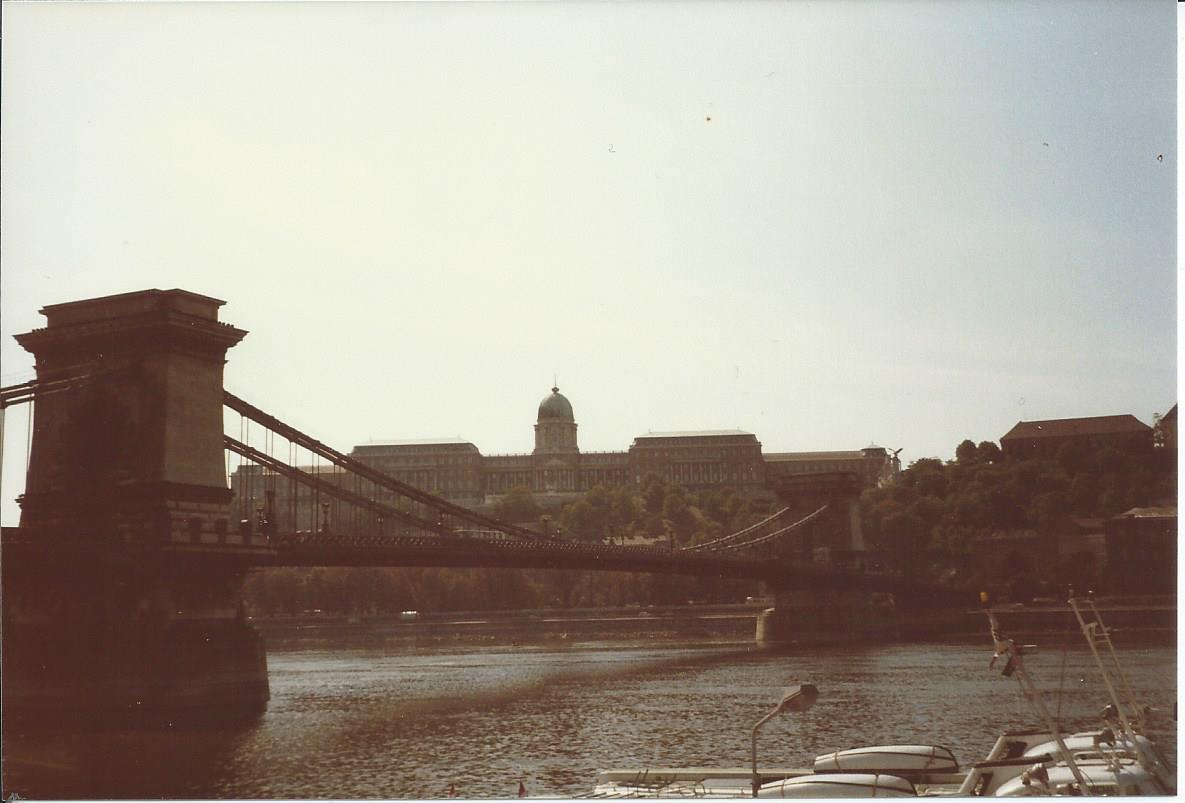
I was intrigued to note that the main bridge across the Danube (the Szechenyi bridge) had an inscription carved into the stonework commemorating its opening in 1849, but with a hammer and sickle integral to the design. As far as I was aware, the communists were not in power in 1849, but some research revealed that the bridge had been completely rebuilt as a faithful copy after being destroyed in the Second World War. It was a faithful copy apart from the addition of the hammer and sickle. Incidently, the bridge was designed by an Englishman William Tierney Clark, who also designed the similar chain bridge across the Thames at Marlow.
That night I was going to make my first overnight journey by train, having booked, when I first arrived in Budapest, a couchette place for the trip to Romania. So having eaten early, I made my way to Nyugati station (the third of the main Budapest stations) for the 1850 departure.
I found the coach in which my couchette place was located and when I arrived at my allocated compartment, I discovered that I would be sharing it for the night with a Romanian woman (of Hugarian descent) with the physique of a shot putter. She had already spread her belongings all over the compartment and to say that she was not totally pleased to be sharing with me was probably an understatement. All attempts to engage in any conversation with her were met with complete frostiness. The journey to the border was made more bearable by a woman attendant who came round regularly dispensing cheap bottles of beer from a hand held crate. My consumption of these bottles gathered more disparaging looks from my compartment companion.
The train arrived at Biharkeresztes shortly after 10pm, where Hungarian border police got on and my visa was duly stamped to show that I had left the country. After about half an hour the train proceeded for 10 minutes (but gaining another hour on the clock) to enter Romania.
(Next weeks post will all be about my experiences in Romania.)
 Europe Explored